Top core banking software in 2026: complete review & comparison

Jun 25, 2026 15 min read
Summarize article with AI

Key takeaways

  • Best doesn’t mean biggest. The right core banking system is the one that fits your products, markets, team, and rollout plan.
  • Don’t separate platform choice from implementation planning. A strong partner helps test the decision against real banking operations before the project gets expensive.
  • Some banks need depth, others need speed. Temenos and FLEXCUBE suit complex enterprise banking, while Mambu and Thought Machine fit faster digital product models.
  • By 2026, instant banking has raised the floor. Core systems need to support real-time payments, API connections, and faster product updates.

The top core banking software in 2026 has become a bigger decision than many banks expected. A core system can look “good enough” for years. Then the pressure hits all at once: real-time payments, open banking APIs, new compliance rules, and customers who expect every banking service to work instantly. Suddenly, the old core stops being “just old” and starts slowing down your business. 

And this is exactly where choosing between top core banking providers gets messy. 

Most platforms promise faster launches, easier integrations, and lower operating costs. But banks don’t buy promises. They inherit implementation work, data migration risks, reporting gaps, and long-term vendor contracts. Pick the wrong system, and your team may spend the next few years working around the core instead of building on top of it.

In this guide, I’ll compare the top core banking providers in 2026, explain where each system fits best, and show what you should check before making a long-term platform decision. If you’re evaluating core banking software this year, this comparison should help you separate vendor claims from real operational value.

Top core banking systems: platforms powering modern banks

Before we start comparing vendors, give me a minute to set the baseline.

A core banking system is the operational engine of the bank. It handles accounts, transactions, payments, lending, deposits, customer records, reporting, and ledger operations. Every time a customer transfers money, checks their balance, repays a loan, or receives a payment notification, the core platform is involved somewhere in that process. 

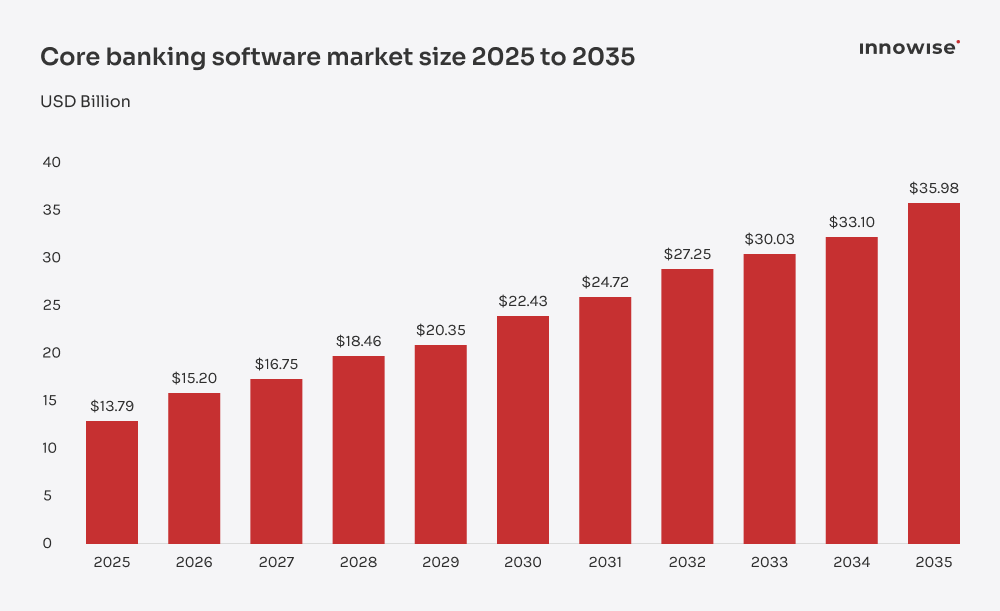
The global core banking software market was valued at $13.79B in 2025 and is projected to grow from $15.20B in 2026 to nearly $36B by 2035, with a CAGR of 10.07%. Growth is being driven by increased fintech investment, rising demand for digital banking services, and stronger pressure on banks to modernize customer experience without adding more cost and complexity. 

Now, the obvious question: why not build a core from scratch?

For some banks, that may be an option. But it’s rarely the fastest or safest one. Building a core means owning ledger design, transaction rules, audit trails, security controls, product configuration, reporting, integrations, testing, upgrades, and years of maintenance. It’s a permanent banking infrastructure program. 

A vendor platform gives you a ready base: account management, ledger operations, transaction processing, product setup, reporting tools, and standard integration options. That cuts a lot of technical risk from day one.

But here comes the part many teams underestimate: the platform still has to fit the bank. It won’t clean your legacy data, map your old loan products, connect every payment provider, or decide how approval flows should work across branches, regions, and business lines. That part requires involvement from subject matter experts (SMEs) and solution architects (SAs) who understand both the software and the business logic behind it.

Companies like Innowise help banks with that layer: adapting core banking systems, building missing modules, connecting third-party services, moving data, and making the new setup work inside the bank’s actual tech stack.

So, in plain terms, a good core banking platform gives you the foundation. A good implementation partner makes sure that the foundation actually supports the business you’re trying to build.

Bar chart showing steady core banking software market growth from 2025 to 2035

5 best core banking platforms in 2026 compared

My top core banking providers for 2026 are Temenos Transact (formerly known as T24), Mambu, Thought Machine Vault Core, Infosys Finacle, and Oracle FLEXCUBE. I chose these five because they don’t all solve the same problem. Some are better for large enterprise modernization, some fit digital-first banks, others make more sense for multi-country operations, complex corporate banking, or teams that need more control over product configuration.

The table below gives you a quick read. It won’t replace a full platform assessment, but it will help you see where each system fits before we look at architecture, service coverage, implementation complexity, integrations, and best-use scenarios.

Core banking platform
Best fit
Key strengths
Main limitations
Temenos Transact
Large banks, banking groups, complex retail & corporate operations
Deep functionality, strong global presence, wide product coverage
Can be heavy to implement and adapt
Mambu
Neobanks, fintech lenders, digital banks, fast-moving product teams
Fast product setup, strong API model, good fit for digital banking
May need extra systems for complex enterprise banking needs
Thought Machine Vault Core
Banks planning deep core modernization or new digital banking models
Strong product flexibility, real-time processing, modern engineering model
Needs strong technical teams & careful implementation planning
Infosys Finacle
Large banks, regional banks, multi-country financial institutions
Mature banking functionality, strong international banking fit, broad module coverage
Can require significant configuration for complex rollouts
Oracle FLEXCUBE
Enterprise banks, corporate banking, banks already using Oracle systems
Strong support for complex banking operations, multi-entity structures, corporate banking
Customization, migration & licensing can be demanding

Make your core banking upgrade easier to plan and run

1. Temenos Transact

If you ask enterprise banking teams which core banking platform appears on the most shortlists, Temenos Transact is usually somewhere near the top. And there’s a reason for that: few platforms cover as many banking operations, products, and regional requirements at the same scale.

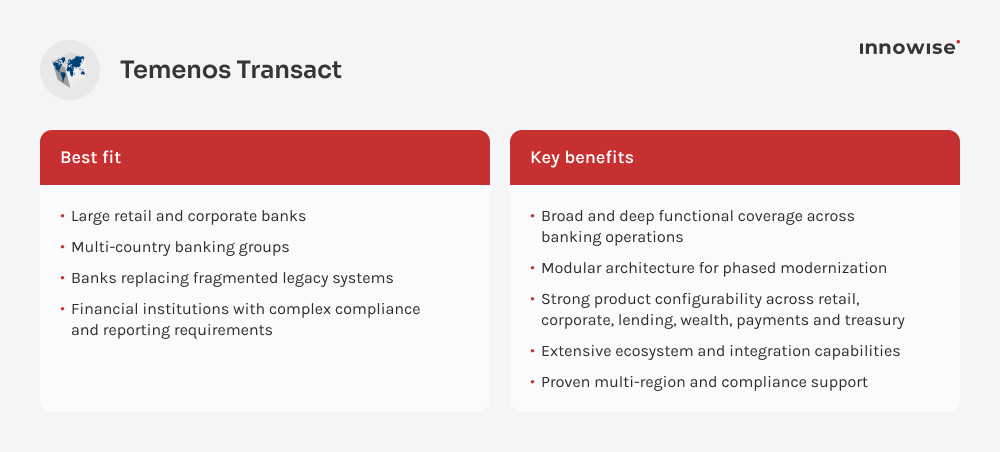
Temenos Transact summary highlighting banking modernization, configuration, and compliance strengths

Core architecture approach

Temenos has moved heavily toward modular banking architecture over the last few years. Banks can deploy specific components instead of replacing everything at once, which matters a lot during gradual modernization projects.

The platform supports:

  • API-based integrations
  • Real-time transaction processing
  • Cloud deployments
  • Modular service layers
  • Multi-entity banking structures

In practice, this gives banks more freedom to modernize in phases instead of running a full “big bang” migration. That alone reduces a huge amount of operational risk. One thing Temenos does well is product depth. Banks can support retail banking, corporate banking, lending, payments, wealth management, and treasury operations inside a broader ecosystem instead of stitching together disconnected tools.

Implementation complexity

This is not a lightweight rollout. Temenos projects can become large transformation programs that involve data migration, integration redesign, compliance mapping, workflow restructuring, and internal process changes across multiple departments.

And honestly, this is where some banks underestimate the workload. The platform is flexible, but flexibility increases implementation effort. Banks often need experienced architecture teams, integration specialists, and external implementation partners to avoid rollout delays.

The good news is that Temenos has a mature partner ecosystem, so banks aren’t forced to figure everything out internally. Innowise has also helped banks and fintech companies implement Temenos-based solutions, so we know where these projects usually get complicated and how to handle that complexity before it turns into delays, rework, or budget creep.

Product flexibility

Temenos gives banks strong control over product configuration compared to many older enterprise banking systems.

Banks can:

  • Configure lending products
  • Support multi-currency operations
  • Adapt fee structures
  • Create region-specific workflows
  • Launch new banking services without rebuilding the core itself

That matters for banks operating across different regulatory markets where product rules can vary significantly.

Ecosystem & integrations

This is one of Temenos’ strongest areas. The platform supports a wide integration ecosystem through APIs and partnerships with payment providers, fintech services, compliance tools, and digital banking applications. For banks moving toward open banking ecosystems, that flexibility becomes important fast. Modern banking stacks rarely depend on a single vendor anymore.

Compliance & multi-region support

Temenos performs particularly well here. The platform is widely used by banks operating across multiple countries, currencies, and regulatory environments. 

It supports:

  • Localization requirements
  • Audit trails
  • Regulatory reporting
  • Entity separation
  • Complex operational structures

2. Mambu

Mambu sits in a very different category from traditional enterprise core banking systems like Temenos. It was built for banks and fintechs that want to move faster, launch products without massive infrastructure projects, and avoid carrying years of technical baggage into a new banking setup. That’s exactly why Mambu became popular with neobanks and digital lenders over the last few years.

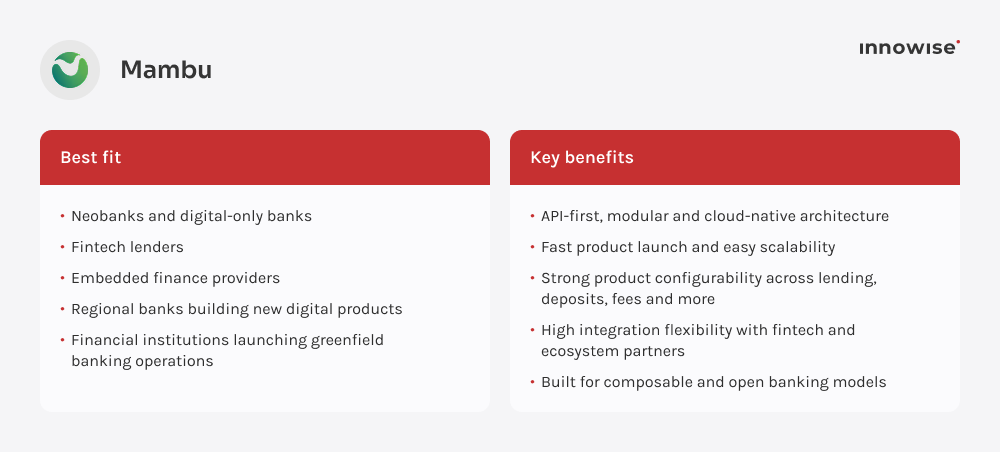
Mambu overview highlighting best-fit banking users and key benefits for digital finance

Mambu is especially strong for teams that prioritize faster product rollout cycles and modular banking services over highly customized enterprise banking environments. For large Tier-1 banks with deeply layered legacy systems, Mambu often works better as part of a gradual modernization strategy rather than a complete one-platform replacement.

Core architecture approach

Mambu was designed around a modular, API-first model from the beginning. Instead of trying to cover every banking function inside one tightly connected platform, Mambu allows banks to combine different services across their banking stack. That approach gives product teams more flexibility when launching new services or connecting external providers.

The platform supports:

  • Real-time transaction processing
  • API-heavy banking ecosystems
  • Cloud deployments
  • Microservices-based integrations
  • Composable banking models

Implementation complexity

Compared to traditional enterprise core banking systems, Mambu deployments are generally lighter and faster. That doesn’t mean implementation is simple.

Banks still need to:

  • Migrate customer and transaction data
  • Redesign operational workflows
  • Connect payment providers
  • Integrate compliance and KYC systems
  • Adapt reporting structures

As a Mambu partner, Innowise helps banks and fintech companies handle these implementation stages, from platform customization and integrations to migration planning and rollout support.

Product flexibility

This is one of Mambu’s strongest areas. Banks and fintechs can configure:

  • Lending products
  • Deposit accounts
  • Fee structures
  • Repayment logic
  • Customer segmentation rules
  • Multi-market product variations without rebuilding the platform itself

That flexibility matters for product teams testing new financial products quickly or operating across changing regulatory markets.

Ecosystem & integrations

Mambu performs well here because the platform was built around external connectivity. It integrates with:

  • Payment providers
  • Digital banking applications
  • KYC and AML tools
  • Analytics platforms
  • Card processing systems
  • Fintech service providers

For banks moving toward embedded finance or open banking ecosystems, this modular structure can reduce dependency on a single vendor stack.

Compliance & multi-region support

Mambu supports multi-country banking operations, but the level of customization and regulatory adaptation still depends heavily on the implementation setup around the platform. This is important to understand.

The platform itself provides flexibility, but banks operating across highly regulated or complex regional environments may still need additional layers for reporting, localization, and operational governance.

Let us turn your core banking shortlist into a rollout-ready plan

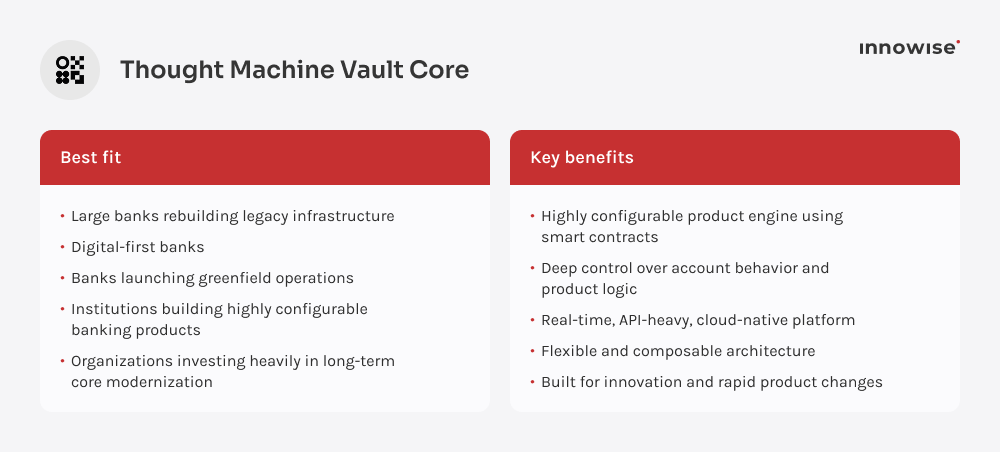
3. Thought Machine Vault Core

Thought Machine Vault Core was built for banks that want more control over how banking products are designed and managed internally. Unlike many other core banking systems, the platform wasn’t created around fixed banking products and rigid workflows. It was designed around configurable product logic from the start. That difference matters more than it sounds.

For banks trying to modernize complex legacy environments, one of the biggest frustrations is how difficult it becomes to change product rules, launch variations, or adapt workflows without touching multiple systems. Thought Machine approaches this problem differently by giving banks much deeper control over product behavior inside the core itself.

But that flexibility comes with a catch: the platform expects strong engineering maturity from the teams implementing it.

Thought Machine Vault Core summary highlighting digital banking transformation use cases

Core architecture approach

Vault Core was designed around a modern, cloud-based architecture with configurable banking products managed through smart contracts. In practice, this gives banks more control over:

  • Product configuration
  • Account behavior
  • Fee and interest logic
  • Lending structures
  • Workflow customization

One of the biggest advantages here is product flexibility. Teams can adjust banking products without rebuilding large parts of the platform, which makes experimentation and faster product rollout more realistic.

Implementation complexity

Thought Machine gives banks a high degree of control, but that also increases implementation responsibility. Institutions need strong architecture teams, experienced engineers, and clear migration planning before rollout begins.

The complexity usually appears in:

  • Legacy migration
  • Product mapping
  • Integration orchestration
  • Operational redesign
  • Coexistence with older banking systems during transition phases

Banks without strong internal technical ownership may struggle here. At the same time, organizations with experienced engineering teams often prefer this model because it gives them more long-term control over the platform instead of locking them into rigid vendor workflows. 

If you’re somewhere in the middle, that’s completely normal. Many banks have strong internal teams but still lack specific migration or integration expertise. Innowise can support your rollout through IT staff augmentation, adding fintech engineers and specialists when extra hands are needed.

Product flexibility

This is where Vault Core stands out. Banks can configure:

  • Highly customized lending products
  • Dynamic fee structures
  • Account behavior
  • Repayment models
  • Market-specific banking rules directly inside the platform logic

For product teams, this reduces dependency on lengthy backend change cycles every time the bank wants to launch or adjust a service.

Ecosystem & integrations

Thought Machine was built with external connectivity in mind. This makes it attractive for banks moving toward composable banking models instead of relying on one large vendor stack.

The platform supports API-heavy banking ecosystems and works well alongside:

  • Payment platforms
  • Digital banking applications
  • Compliance services
  • Fintech tools
  • Analytics systems
  • External orchestration layers

Compliance & multi-region support

Vault Core supports multi-region banking operations, but implementation planning becomes important quickly in highly regulated environments. The flexibility is there, but institutions need the right operational design around it.

Banks still need to carefully design:

  • Localization logic
  • Reporting structures
  • Governance models
  • Audit processes
  • Regional operational flows around the platform

The flexibility is there, but institutions need the right operational design around it.

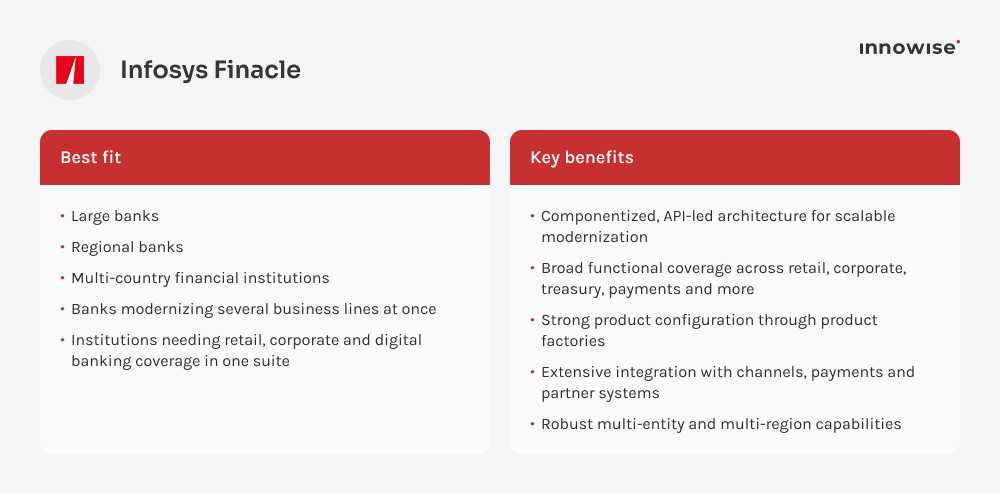
4. Infosys Finacle

Infosys Finacle is a mature core banking system with strong retail, corporate, payments, deposits, lending, and digital banking capabilities. That makes it a serious option for banks that operate across many products, channels, and regions. Finacle describes its core banking solution as componentized, cloud-ready, API-led, and built for real-time digital banking operations. 

It’s not the lightest choice for a small fintech with one lending product. Finacle is better suited to banks that already have operational depth and need a platform that can support many moving parts.

Infosys Finacle overview covering key users and modernization benefits

Core architecture approach

Finacle has moved toward a componentized, API-led architecture. In practical terms, banks can modernize parts of the core instead of replacing everything in one risky move. The platform supports open APIs, cloud deployment, real-time transactions, product factories, and reusable business components.

That matters because large banks rarely get a clean slate. They need to connect old systems, new channels, payment services, reporting tools, and regional operations without breaking daily banking.

Implementation complexity

Finacle is powerful, but it’s not a small implementation. Banks should expect serious work around:

  • Legacy data migration
  • Product configuration
  • Channel integration
  • Regulatory reporting
  • Process redesign
  • User training
  • Phased rollout planning

The upside is breadth. Finacle can support complex banking environments. The trade-off is that the project needs strong governance from day one. Without clear ownership, configuration choices can pile up fast.

Product flexibility

Finacle offers strong product configuration through product factories and parameterization. That helps banks create and adjust products without rebuilding the core every time.

This is useful for banks managing:

  • Multiple deposit products
  • Lending portfolios
  • Bundled services
  • Regional product variations
  • Corporate banking needs
  • Multi-currency operations.

For product teams, the value is simple: fewer hard-coded changes, more room to adapt products as the business changes.

Ecosystem & integrations

Finacle is built for banks that rely on many connected systems. Its API-led model helps institutions connect digital channels, payment systems, partner services, and internal applications. This is especially important for banks with more than one core system or several regional platforms.

Compliance & multi-region support

This is one of Finacle’s strongest areas. Finacle is a good fit for banks operating across countries, currencies, languages, entities, and regulatory environments. Its core banking solution is built with multi-entity parameters, global migration support, regional operations, and regulatory needs in mind.

For enterprise banks, this matters. A platform that works well in one country can become painful when the bank expands into five more.

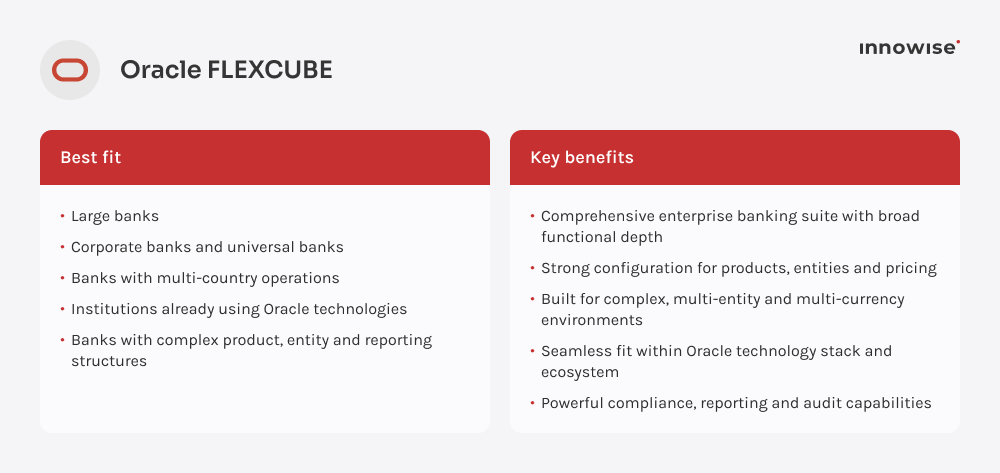
5. Oracle FLEXCUBE

Oracle FLEXCUBE is the kind of platform banks consider when they need to manage retail banking, corporate banking, lending, payments, deposits, trade finance, multi-entity operations, and strict reporting requirements under one large core banking setup. Its fit is even stronger in Oracle-heavy environments, where the core can align more naturally with existing databases, middleware, analytics, and enterprise systems.

Oracle FLEXCUBE overview showing enterprise banking users and benefits

Core architecture approach

FLEXCUBE is built as an enterprise core banking suite with broad functional coverage. It supports retail and corporate banking operations, product configuration, workflow management, reporting, and multi-entity structures.

In practical terms, it gives banks a central system for many critical operations rather than forcing every business line to run on separate tools. That depth is useful, but it also means the architecture needs careful planning. Banks should be clear about what they want FLEXCUBE to own, what should stay in surrounding systems, and where integrations need to sit.

Implementation complexity

FLEXCUBE implementations can be demanding. Banks should expect serious work around:

  • Legacy data migration
  • Product and fee configuration
  • Integration with payment systems
  • Reporting setup
  • User access models
  • Compliance workflows
  • Testing across regions and business lines

However, for banks already using Oracle, some implementation tasks may be easier to plan and execute. Existing infrastructure standards, internal Oracle expertise, vendor relationships, and support processes can reduce friction during integration, testing, and post-go-live maintenance.

Product flexibility

Oracle FLEXCUBE offers strong configuration options for banking products, especially across retail, corporate, lending, deposits, and trade finance.

Banks can use it to manage:

  • Multi-currency products
  • Corporate banking workflows
  • Lending products
  • Account structures
  • Pricing and fee models
  • Entity-level rules
  • Regional variations

This makes it useful for banks with complex product catalogs. But with that flexibility comes configuration work. Product teams need clear rules before implementation starts, or the setup can become heavier than expected.

Ecosystem & integrations

FLEXCUBE works well in Oracle-heavy environments and can connect with surrounding banking systems, payment services, reporting tools, and digital channels. For banks using mixed vendor environments, integration planning matters more. FLEXCUBE can support complex setups, but the integration design needs to be mapped carefully from the start.

Compliance & multi-region support

This is one of FLEXCUBE’s strongest areas. The platform is well suited to banks operating across multiple countries, entities, currencies, and regulatory environments. It can support audit trails, reporting workflows, user controls, and localized banking processes.

That’s one reason it remains relevant for enterprise banks. Large institutions rarely need only product speed. They need control, traceability, and consistency across markets.

Each platform in this list solves a different problem, and that’s a good thing. Temenos fits large-scale modernization, Mambu works well for digital-first launches, Thought Machine gives teams more product control, Finacle covers broad banking operations, and Oracle FLEXCUBE supports complex enterprise banking. 

But I’ll keep repeating this: the “best” core banking system is only best if it fits your operating model, technical maturity, compliance needs, and rollout plan. Choose wisely, because once the core is in place, every product, process, and integration will depend on it.

Make your next core banking move with experts beside you

How to choose the right core banking software for your bank

Now we’re getting to the practical part. A comparison table can help you build a shortlist, but it won’t choose the platform for you. The real decision depends on how your bank works today, what has to change, and how much complexity your team can realistically handle during implementation. 

So here are my recommendations, with less theory and more “check this before you sign.”

Start with your business model, not the feature list

A common mistake is choosing a platform based on functionality alone. Instead, ask a simple question: what kind of bank are you building over the next five years?

For example:

  • A neobank launching savings and lending products has very different requirements than a multinational bank operating across 15 countries.
  • A digital lender processing thousands of loans per day needs different capabilities than a private bank focused on wealth management.
  • A regional bank modernizing legacy systems faces different challenges than a fintech launching from scratch.

The platform should fit your operating model, not the other way around.

Look beyond implementation and think about change

Many banks evaluate how difficult it will be to launch the platform, but fewer evaluate how difficult it will be to change it later. That’s often where costs start growing.

Before making a decision, ask vendors:

  • How are new products configured?
  • Can business teams manage product changes themselves?
  • How much development work is required to launch a new lending product?
  • How are pricing, fees, and interest rules updated?
  • What happens when regulations change?

A platform that takes six months to introduce a new product can become a serious business limitation.

Assess your integration reality honestly

Every core banking platform supports integrations. The important question is how many integrations you’ll actually need.

Create a list of systems that must connect to the new core:

  • Payment processors
  • Card management systems
  • Fraud prevention tools
  • KYC and AML solutions
  • Reporting platforms
  • Customer-facing applications
  • Third-party fintech services

Then estimate the effort required to connect each one. In many modernization projects, integration work consumes more time than core platform deployment itself.

Don't underestimate data migration

Banks often focus on new functionality and overlook the complexity of moving years of customer records, transaction histories, loan portfolios, and accounting data.

Before selecting a platform, determine:

  • How much historical data must be migrated
  • Which systems contain the source data
  • What data quality issues already exist
  • Whether old systems must continue operating during the transition

The answers can influence platform selection more than any feature comparison.

Evaluate the operating model after go-live

Go-live isn’t the finish line. Someone still needs to manage upgrades, integrations, reporting changes, security controls, and platform governance.

Ask yourself:

  • Do we have enough internal expertise?
  • Will we need external implementation support?
  • Who owns future product configuration?
  • How much vendor dependency are we comfortable with?

These questions often have a larger impact on long-term costs than licensing fees.

Choose a platform and implementation partner together

This is probably the most important advice I can give. A strong platform won’t fix poor implementation decisions. Likewise, an experienced implementation partner can help a bank avoid months of unnecessary rework by identifying migration risks, integration challenges, and process gaps early.

Having delivered multiple banking modernization projects, Innowise knows there are two sides to this decision: choosing the right platform and making it work inside the bank’s day-to-day operations. So before clients commit, we help them pressure-test the choice against the messy parts: migration, integrations, workflows, internal ownership, and the cost of changing things later.

Core banking platform selection should include a delivery rehearsal before the contract is signed. Take a few real products, real integration points, and real reporting requirements, then test how they would be configured, migrated, connected, and governed in the new platform. That exercise tells you much more than a generic feature checklist.

Chief Technology Officer

Trends shaping core banking software in 2026

The trends shaping core banking in 2026 come from day-to-day banking realities: payments need to settle faster, partners need API access, regulators need clearer data, and legacy cores need a safer path to modernization. These are the shifts I’d pay closest attention to.

Core replacement is becoming phased

More banks are avoiding one massive core replacement. Instead, they’re replacing parts of the core step by step: lending first, deposits later, payments in parallel, or a new digital brand on a separate core. This gives teams room to test the setup, move data carefully, and reduce disruption for customers.

The practical takeaway: choose a platform that supports gradual migration, not only full replacement.

Real-time payments are forcing real-time cores

Real-time payments don’t wait for end-of-day processing. If money moves in seconds, the core has to update balances, apply checks, post transactions, and feed reporting systems just as fast. If your core still depends heavily on delayed posting, every real-time payment product becomes harder to run.

Embedded finance is pulling the core outside the bank

Banking products now appear inside e-commerce platforms, payroll tools, accounting software, marketplaces, and fintech apps. That changes what a core system needs to support.

For core banking teams, this means stronger APIs, clearer product rules, better partner onboarding, and tighter control over risk. If partners depend on your banking infrastructure, your core can’t behave like a closed internal system.

Tokenized deposits and stablecoins are moving from theory to banking strategy

Large banks are exploring tokenized deposits for 24/7 settlement, treasury, and cross-border payments. The Wall Street Journal reported that JPMorgan Chase, Bank of America, Citi, and Wells Fargo are planning to build a tokenized deposit network for the first half of 2027. BMO also announced a tokenized cash platform with CME Group and Google Cloud, planned for release in the second half of 2026, subject to approval.

Core banking systems won’t all process tokenized deposits directly yet. But banks choosing a platform in 2026 should ask: can this architecture support new settlement models without another core rebuild?

Compliance is becoming part of the product workflow

When banks launch new products, connect partners, or enter new markets, compliance checks need to be built into onboarding, transaction monitoring, reporting, access control, and audit trails from the start.

In 2026, a strong core banking platform has to do more than move money from one account to another. It needs to show who changed what, when rules were applied, how exceptions were handled, and where reporting data came from.

Final word

The best core banking system depends on what you’re trying to achieve. A digital bank launching new products every few months faces very different challenges than a multinational bank replacing decades-old infrastructure across multiple regions.

If I were advising a bank, here’s how I’d think about it:

  • Choose Temenos Transact if you need deep banking functionality and a platform that can support large-scale modernization over the long term.
  • Choose Mambu if speed, flexibility, and digital-first banking are your top priorities.
  • Choose Thought Machine Vault Core if you want maximum control over product design and are ready to invest in a modern engineering-driven operating model.
  • Choose Infosys Finacle if you need broad banking coverage across multiple products, channels, and markets.
  • Choose Oracle FLEXCUBE if you're running complex enterprise or corporate banking operations and need strong multi-entity support.

And regardless of which platform you choose, implementation will ultimately determine the outcome. The strongest core banking system on the market won’t deliver results if the migration is poorly planned, integrations are rushed, or business processes aren’t adapted properly. That’s where experienced implementation teams can make the difference between a successful modernization project and a very expensive lesson.

FAQ

There’s no single best core banking platform for every neobank, but Mambu is often one of the strongest choices for digital-first institutions. Its API-first architecture, flexible product configuration, and relatively fast implementation make it well suited for neobanks launching new products and services quickly.

As a rough benchmark, banks and fintechs can expect:

  • Cloud-based platforms: from tens of thousands to several hundred thousand dollars per year.
  • Enterprise core banking systems: from several hundred thousand dollars to several million dollars for implementation and licensing.
  • Large-scale modernization projects: often exceed several million dollars once migration, integrations, customization, testing, and training are included.

It's also important to look beyond licensing costs. In many projects, data migration, third-party integrations, process redesign, and ongoing support account for a significant share of the total investment. That's why evaluating the full implementation scope is often more important than comparing vendor pricing alone.

Most major core banking systems now support cloud deployments, including Mambu, Temenos Transact, Thought Machine Vault Core, Infosys Finacle, and Oracle FLEXCUBE. The difference is in how they support it. Mambu and Thought Machine are stronger fits for cloud-first banking models, while Temenos, Finacle, and FLEXCUBE are often used in larger enterprise environments where banks may choose private cloud, public cloud, or hybrid deployment depending on compliance and internal IT requirements.

Chief Delivery Officer & Head of Competence Center

Siarhei specializes in navigating high-stakes regulatory environments and complex delivery hurdles. He transforms abstract business requirements into secure, scalable architectures, ensuring that every project is technically sound and future-proofed against market shifts.

Table of contents

    Contact us

    Book a call or fill out the form below and we’ll get back to you once we’ve processed your request.

    Send us a voice message
    Attach documents
    Upload file

    You can attach 1 file up to 2MB. Valid file formats: pdf, jpg, jpeg, png.

    By clicking Send, you consent to Innowise processing your personal data per our Privacy Policy to provide you with relevant information. By submitting your phone number, you agree that we may contact you via voice calls, SMS, and messaging apps. Calling, message, and data rates may apply.

    You can also send us your request
    to contact@innowise.com
    What happens next?
    1

    Once we’ve received and processed your request, we’ll get back to you to detail your project needs and sign an NDA to ensure confidentiality.

    2

    After examining your wants, needs, and expectations, our team will devise a project proposal with the scope of work, team size, time, and cost estimates.

    3

    We’ll arrange a meeting with you to discuss the offer and nail down the details.

    4

    Finally, we’ll sign a contract and start working on your project right away.

    More services we cover

    arrow