Embedded finance trends 2026: what’s next for payments, lending and banking

Jul 5, 2026 10 min read
Summarize article with AI

Key takeaways

  • AI is shifting embedded finance from reactive to predictive
  • Blockchain and stablecoins are moving from experimental to practical
  • Super apps are raising the bar for what users expect
  • Embedded lending is maturing fast in B2B SaaS
  • Real-time payouts have become a baseline expectation for marketplaces, gig platforms, and creator tools.

I’ve spent years working at the intersection of financial technology and product engineering, and I can say with confidence that the pace of change in this space rarely slows down. But what’s happening right now feels a bit different, and this is especially vivid in the embedded finance trends 2026.  They reflect a fundamental shift in how businesses view their product offering: from a standalone product experience to a connected part of the financial services ecosystem. 

What used to require a banking license, a dedicated compliance team, and years of infrastructure work can now be assembled in months using modular APIs, BaaS providers, and well-architected integrations. My team has seen this firsthand across projects in e-commerce, logistics, B2B SaaS, and marketplace platforms. The question most clients are asking is no longer, “Should we embed financial features?” but “Which ones, in what order, and how do we build them right?”

What is embedded finance?

Embedded finance is the integration of financial products, be it payments, lending, insurance, accounts, or cards, directly into non-financial platforms and applications. Instead of redirecting a user to a bank or a third-party service, the platform handles the financial interaction natively, inside its own product experience.

Think of a logistics SaaS platform that lets drivers receive instant payouts, or a B2B marketplace that offers working capital to sellers based on their transaction history. Neither is a fintech company in the traditional sense, but both deliver financial services as a core part of their product. That’s exactly what embedded finance is.

The mechanism is typically a combination of:

  • BaaS providers offering licensed financial infrastructure via API
  • Open banking frameworks that standardize data access across institutions
  • Regulatory frameworks that allow non-banks to offer financial products under licensed partnerships

Why embedded finance matters in 2026

The business case has never been clearer, and the numbers back it up. According to Mordor Intelligence, the embedded finance market is projected to rise from around $156 billion in 2026 to $454 billion by 2031, growing at a CAGR of nearly 24%. It reflects demand that’s already well underway.

From my perspective, the more important shift is on the user expectations side. People who book rides, manage inventory, or run freelance businesses through digital platforms increasingly expect financial services to meet them where they already are. Switching to a separate banking app to get paid, apply for credit, or manage insurance feels like friction that shouldn’t exist anymore. Moreover, AI is a game-changer for all of us.

For businesses, embedding financial products means:

  • New revenue streams with margins that often exceed those of the core product
  • Stronger retention, because users who hold funds or have credit relationships inside a platform are far less likely to leave
  • Richer data, since every financial transaction feeds back into better product and risk decisions
  • Competitive differentiation, since every financial transaction feeds back into better product and risk decisions

The enabling infrastructure (BaaS APIs, real-time payment rails, AI-driven underwriting) has matured to the point where building embedded financial features is faster and more reliable than it was even two years ago. That’s what makes 2026 a meaningful inflection point, at least from where I sit.

Planning embedded finance features?

Top 5 embedded finance trends for 2026

Trend 1. AI and machine learning make embedded finance more predictive

The most consequential shift I’m tracking is the move from embedded finance as a transactional layer to embedded finance as a predictive one. AI and machine learning are driving this, and the practical applications are already in production.

Predictive analytics lets platforms anticipate financial needs before users articulate them. A SaaS accounting platform, for example, can analyze a company’s cash flow patterns and offer a working capital product before a liquidity gap appears, not after the user notices a problem and starts searching for solutions.

AI-powered credit scoring trained on platform-specific behavioral data consistently outperforms traditional bureau-based scoring in both accuracy and coverage. This matters especially for businesses and individuals underserved by legacy credit infrastructure, segments that have real creditworthiness but lack the paper trail traditional lenders require.

Fraud detection is where ML has become table stakes. Real-time transaction monitoring with adaptive models catches anomalous patterns that rule-based systems miss, and false positive rates keep improving. For platforms processing high transaction volumes, this directly affects conversion and user trust.

Agentic AI is worth calling out specifically as something to watch in 2026. Autonomous AI agents handling routine treasury operations, payment scheduling, and financial reconciliation without human intervention are moving from pilot to production at a meaningful pace. My team is already fielding questions about this from clients in the B2B SaaS space. It changes the operational model significantly by reducing manual overhead on financial workflows.

Trend 2. DeFi and blockchain payments enter embedded finance

For a long time, blockchain’s role in embedded finance was more theoretical than practical. That’s changing, and I think the shift is more durable than previous cycles of blockchain enthusiasm.

Stablecoin-based payments and settlements are the clearest near-term application. A global marketplace that needs to pay sellers across dozens of countries faces real friction with traditional rails: settlement delays, FX costs, and banking infrastructure gaps in certain regions. Embedding stablecoin payouts changes that calculation substantially.

Smart contracts bring another dimension: programmable money that executes financial workflows automatically based on defined conditions. Key use cases include:

  • Escrow arrangements tied to delivery confirmation
  • Milestone-based payments in freelance and project platforms
  • Revenue-share agreements executed without manual intervention or intermediary risk

Tokenized assets are still earlier in the adoption curve, but I expect them to become more relevant to embedded finance as platforms in real estate, supply chain finance, and private markets look for ways to bring traditionally illiquid assets into digital workflows.

The practical consideration for most platforms is how to incorporate blockchain-based rails selectively, in cases where they solve a specific problem better than existing infrastructure. Cross-border payments are the most obvious current use case, but the scope will expand as regulatory clarity improves across markets.

Trend 3. Super apps turn embedded finance into full financial ecosystems

The super app model — one platform, multiple financial and non-financial services, tightly integrated — is no longer a phenomenon limited to Southeast Asian markets. My team is seeing the same logic applied across Western retail, mobility, and B2B platforms, just through different product categories.

A mobility app is a good illustration of how this compounds:

  • Starts with ride booking and embedded payments
  • Adds driver wallets and instant payouts
  • Layers in insurance at the point of need
  • Introduces loyalty mechanics tied to spend
  • Eventually offers microloans based on driver income history

Each addition deepens the user relationship and increases switching costs in a way that a standalone ride-booking feature simply can’t.

From an engineering standpoint, what makes this possible is composable financial infrastructure. Rather than building each product independently, platforms assemble capabilities from BaaS and API providers and orchestrate them inside a unified product experience. The fintech development work is increasingly about integration architecture and UX design, not just individual feature implementation.

For 2026, the interesting question isn’t whether platforms should add financial features. Most will. The question is which financial products make sense for a given user base, and how to sequence them in a way that builds trust without overwhelming users with options they didn’t ask for.

Trend 4. Embedded lending becomes a native platform feature

Lending has always been one of the most valuable financial products to embed, and in 2026 the technical and regulatory conditions for doing it well are better than they’ve ever been.

In the B2B context, the most compelling use case is working capital delivered inside a platform that already has visibility into a business’s financials. An e-commerce platform that can see a merchant’s sales history, order volume, and revenue trajectory has a fundamentally better picture of credit risk than a traditional lender working from tax returns and bank statements alone. That information advantage translates into faster approvals, better pricing, and products merchants actually want to use.

Key embedded lending formats gaining traction right now: 

  • BNPL (buy now, pay later) at checkout — Klarna alone reports 30–35% improvement in checkout conversions when BNPL is available, and merchants see average order values rise by 30–50%
  • Merchant cash advances tied to platform transaction history
  • Invoice financing embedded inside procurement and B2B supply chain platforms
  • Working capital offers surfaced natively inside SaaS tools that already manage a business’s operations

The common thread is alternative credit scoring based on platform data: behavioral signals, transaction patterns, operational metrics. According to a Visa and PYMNTS survey, 43% of consumers already express strong interest in embedded lending solutions, and 56% of Gen Z consumers say they would switch platforms to access embedded lending. The demand is there, and the platforms that build the capability first will capture it.

Build secure payments, lending, and payouts faster

Trend 5. Real-time payments and payouts become a baseline expectation

If I had to pick one trend that cuts across every vertical and platform type, it’s this one. Users, whether they’re gig workers, marketplace sellers, or content creators, no longer accept multi-day settlement as a reasonable default.

The data makes this clear. Research by Worldpay shows that 67% of gig workers are willing to pay a fee for immediate access to their earnings. A separate study found that 81% of freelance and contract workers prefer instant payments, and 83% would pay for real-time payouts in emergency situations. These are mainstream expectations.

The infrastructure to support this exists. Real-time payment rails are live in over 80 countries, and the technical components such as disbursement APIs, payment orchestration, and automated reconciliation are well established. The gap is usually on the implementation side: platforms that haven’t updated their payout architecture to take advantage of what’s now available.

Areas my team focuses on when building real-time payout infrastructure:

  • Payment orchestration across multiple providers, currencies, and rails to minimize failed payments and optimize routing costs
  • Multi-currency support so international users aren't forced through painful FX processes
  • Automated reconciliation that keeps finance teams from drowning in manual matching as transaction volume scales
  • Cross-border payout rails for platforms with globally distributed sellers or contractors

Trend 6. Gen Z rewrites the B2C embedded finance playbook

For Gen Z, embedded finance isn’t about convenience, it’s about alignment. This cohort expects financial products to reflect how they think about value, trust, and commerce, which is a fundamentally different design brief.

Traditional BNPL conversion logic still works for older cohorts, but for digitally native consumers that model loses its appeal. The financial decision isn’t happening at checkout. It’s happening earlier, inside social environments, peer networks, and creator ecosystems. Embedded finance has to move upstream, which means products need to be discoverable inside the contexts where Gen Z actually decides: short-form video, community platforms, group commerce.

The social dimension of spending also changes what personalization needs to mean. For this cohort, financial decisions are often social acts, influenced by peers and creators. Platforms that haven’t built for that dynamic will find embedded finance conversion lagging regardless of how well the underlying product works.

Agentic AI fits naturally here. Gen Z would rather delegate financial admin entirely than manage it manually. But willingness to share behavioral data in exchange for automation is built on transparency, not just utility. Treating agentic AI as a pure efficiency play without addressing trust will create friction the technology alone can’t resolve.

Platforms that rearchitect around social context, cross-channel presence, and user-agent trust in 2026 will be positioned to capture a consumer cohort that is large, engaged, and underserved by the current generation of embedded financial products.

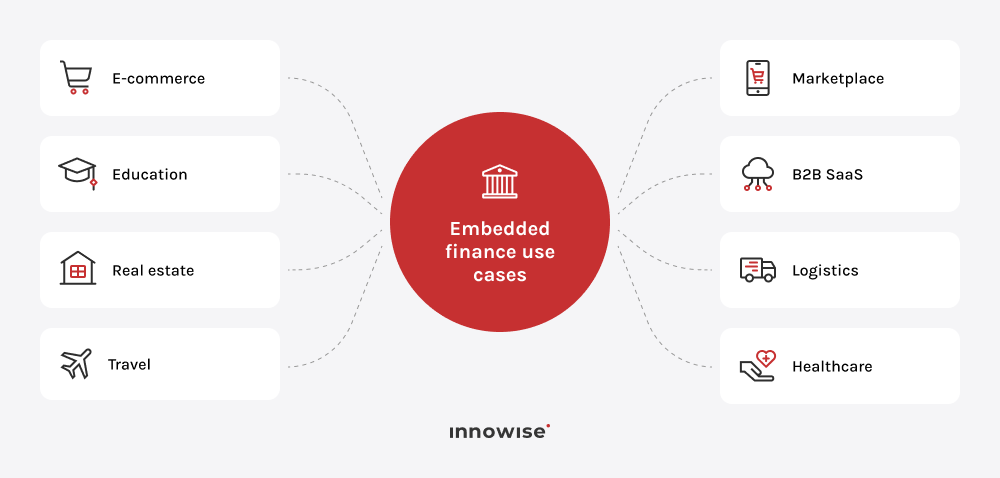
Embedded finance use cases by industry

The applications of embedded finance vary significantly by vertical, but the underlying logic is consistent: financial products delivered inside a workflow users already trust convert better, retain users longer, and generate more durable revenue than standalone fintech alternatives. Here’s where I see the strongest traction right now.

E-commerce

  • Embedded payments at checkout (cards, wallets, A2A)
  • BNPL and installment financing to reduce cart abandonment and lift average order value
  • Product insurance offered at the point of sale

Marketplaces

  • Split payments between platform and sellers with automated fee deduction
  • Seller wallets that hold and manage funds inside the platform
  • Instant payouts that make the platform more attractive to high-volume vendors

B2B SaaS

  • Embedded lending and working capital tied to platform activity data
  • Invoicing tools and net terms built into the product workflow
  • Corporate cards and expense management as native features

Logistics

  • Fuel cards linked to route and vehicle data
  • Shipment insurance priced dynamically based on cargo type and route risk
  • Same-day driver payouts that settle immediately after delivery completion

Healthcare

  • Patient financing options surfaced at scheduling or checkout
  • Real-time insurance eligibility checks before appointments
  • Structured payment plans that reduce bad debt for providers without manual collections

Travel

  • Multi-currency payment support for international bookings
  • Travel insurance embedded in the booking flow at the point of decision
  • Instant refunds that don’t require users to chase a bank for days

Real estate

  • Rent payment infrastructure with automated landlord disbursements
  • Deposit management with transparent hold and release workflows
  • Landlord wallets that consolidate property income across multiple units

Education

  • Student financing and tuition installment plans surfaced at enrollment
  • Subscription-style payment structures for ongoing courses or bootcamps

Benefits of embedded finance for businesses

When my team evaluates embedded finance opportunities with clients, the business case typically comes down to a few compounding benefits:

  • Revenue diversification. Financial services, particularly lending and payments, often carry margins that exceed the core product. Platforms that monetize through embedded finance reduce dependence on subscription or transaction fee revenue.
  • User retention. Switching platforms means losing financial history, credit relationships, and wallet balances. That stickiness is structural, not behavioral.
  • Data depth. Every financial transaction generates data about user behavior, cash flow, and risk profile that feeds back into better product decisions and more accurate underwriting.
  • Operational efficiency. Replacing manual financial workflows like invoice processing, payout runs, and reconciliation with embedded automated systems saves significant time as transaction volume scales.
  • Competitive positioning. In markets where core product experiences have converged, financial features are increasingly where differentiation is built. The platform that offers working capital, instant payouts, and embedded insurance has a meaningfully different value proposition than one that doesn’t.

Create a roadmap for embedded finance adoption

How Innowise can help with embedded finance development

At Innowise, my team works with companies at different stages of embedded finance adoption, from platforms adding their first payment feature to organizations building multi-product financial ecosystems.

Our work covers the full spectrum:

  • Payment integration and orchestration across multiple rails and geographies
  • Lending infrastructure, including underwriting models built on platform data
  • BaaS API integration and vendor selection
  • Compliance architecture for regulated financial products
  • Data engineering that underpins credit scoring and fraud detection

A few things distinguish how I approach this work with clients. I don’t treat embedded finance as a single implementation problem. I see it as a product and technical strategy, and the right architecture depends on the platform’s user base, regulatory context, and existing data infrastructure. We bring that thinking in from the start, not after a scope has already been locked.

We also have depth in fintech-specific engineering that generalist development teams typically have to build from scratch. I mean real-time payment systems, financial data pipelines, risk modeling, and compliance tooling.

If you’re evaluating where embedded finance fits in your product roadmap, or you’re already building and hitting specific technical or regulatory challenges, I’m happy to discuss what we’re seeing across the market.

FAQ

A few factors are converging simultaneously. API-based financial infrastructure has made it technically far simpler for non-financial platforms to offer financial products. Regulatory frameworks in many markets now support this without requiring platforms to become licensed banks. And user expectations have also shifted. People expect financial services where they already spend their time, not as a separate errand. The business case reinforces this: embedded financial products improve retention, generate new revenue, and increase the overall value a platform delivers to its users.


BaaS is the infrastructure layer: licensed banking capabilities exposed through APIs that other businesses can build on. Embedded finance is what you build using that infrastructure. BaaS is a means; embedded finance is the outcome. A platform uses BaaS providers to embed financial features into its product, but the two terms describe different layers of the stack. Think of BaaS as the wholesale layer and embedded finance as the retail experience built on top of it.

Some of the most recognizable examples include:

  • NPL at checkout (Klarna, Affirm, Afterpay)
  • Uber’s instant driver payouts
  • Shopify Capital offering working capital to merchants based on store sales
  • Apple Pay embedded in iOS apps
  • Amazon’s seller financing program
  • Accounting software that offers invoice financing
  • Expense management platforms that issue corporate cards

From my experience working across these projects, the challenges that come up most consistently are:

  • Regulatory compliance. Financial products are heavily regulated, and requirements vary by product type, geography, and licensing structure. This requires careful legal and compliance work from the start.
  • Data quality and privacy. The data advantages that make embedded lending or fraud detection powerful are subject to data protection regulation, and the infrastructure to handle financial data securely is non-trivial to build correctly.
  • Integration complexity. Platforms working with multiple BaaS providers, payment rails, and legacy systems face real orchestration challenges that require solid engineering to manage reliably at scale.
  • User trust. Adding financial features to a non-financial platform requires users to trust that platform with sensitive financial data and transactions. Earning that trust takes time and demands a product experience that handles financial interactions with the same care users expect from dedicated financial services.

Chief Delivery Officer & Head of Competence Center

Siarhei specializes in navigating high-stakes regulatory environments and complex delivery hurdles. He transforms abstract business requirements into secure, scalable architectures, ensuring that every project is technically sound and future-proofed against market shifts.

Table of contents

    Contact us

    Book a call or fill out the form below and we’ll get back to you once we’ve processed your request.

    Send us a voice message
    Attach documents
    Upload file

    You can attach 1 file up to 2MB. Valid file formats: pdf, jpg, jpeg, png.

    By clicking Send, you consent to Innowise processing your personal data per our Privacy Policy to provide you with relevant information. By submitting your phone number, you agree that we may contact you via voice calls, SMS, and messaging apps. Calling, message, and data rates may apply.

    You can also send us your request
    to contact@innowise.com
    What happens next?
    1

    Once we’ve received and processed your request, we’ll get back to you to detail your project needs and sign an NDA to ensure confidentiality.

    2

    After examining your wants, needs, and expectations, our team will devise a project proposal with the scope of work, team size, time, and cost estimates.

    3

    We’ll arrange a meeting with you to discuss the offer and nail down the details.

    4

    Finally, we’ll sign a contract and start working on your project right away.

    More services we cover

    arrow