Wealth management software development: a complete guide for financial institutions

May 14, 2026 8 min read
Summarize article with AI

Key takeaways

  • In 2026, wealth management software is a competitive edge, not a nice-to-have.
  • It brings everything together in one place, from client data and portfolios to reporting and compliance, making daily work much easier.
  • The biggest benefits are less manual work, faster decisions, greater personalization, and an overall better experience for clients.
  • The final result depends on the development partner, especially their experience with finance, security, and integrations.

Have you noticed how much wealth management has changed over the past few years? Much of this shift is driven by firms moving away from spreadsheets and outdated tools toward digital, integrated platforms. Customers are also becoming more demanding and selective: they expect personalized financial services, real-time portfolio access, and investment advice based on data rather than standard templates.

I’ve seen firms with strong teams fall behind simply because their tools weren’t built for the level of speed and complexity required today. That’s why wealth management software has become such an important part of modern financial services. In this guide, I’ll walk you through what it is, which features matter most, how it’s built, and what it typically costs.

What is wealth management software? Essential features and functions

Simply put, wealth management software is a digital platform that helps financial advisors, banks, and investment firms manage client assets, portfolios, and overall financial planning within a single system instead of dealing with a bunch of spreadsheets and tools 

But I’d say the real value lies in how these platforms connect core financial workflows in one place:

  • Portfolio management helps you build, monitor, and rebalance investment portfolios based on your goals, risk tolerance, and market changes. In practice, I’ve seen it replace much of the manual portfolio tracking traditionally done in Excel.
  • Financial planning supports long-term goals such as retirement planning, savings strategies, and overall wealth growth. It often has simulation tools that let you compare different potential outcomes.
  • Investment performance tracking provides a real-time view of how assets are performing so you can quickly understand gains, losses, and the portfolio’s overall health.
  • Risk management helps you assess your level of risk exposure and keep it in line with your risk tolerance and financial goals.
  • Compliance monitoring automatically handles regulatory requirements, including KYC and AML processes, and generates audit-ready reports, which makes day-to-day operations much easier.
  • Client relationship management (or CRM) centralizes all client interactions, goals, and communication, making it easier to provide more personalized service.
  • Reporting and analytics provide detailed insights into portfolio performance, risks, and general investment activity.
  • Integration capabilities connect the platform with banks, custodians, trading systems, and external financial data sources.
  • AI-powered tools support predictive analytics, automated recommendations, and data-driven portfolio optimization.

If you’re in private banking, wealth advisory, or investment management and dealing with large volumes of client capital where accuracy and efficiency really matter, this is the software you typically end up using.

Planning a wealth management platform?

Talk to our experts and get a clear roadmap for your project.

Why financial institutions invest in wealth management software development

The reasons financial institutions invest in custom wealth management software development are always practical. Nobody builds these platforms just to go digital or chase trends. It usually happens because client expectations keep rising, regulations are getting stricter, and manual processes take too long and cost too much. And when you’re managing serious capital, outdated tools aren’t just inefficient; they’re risky.

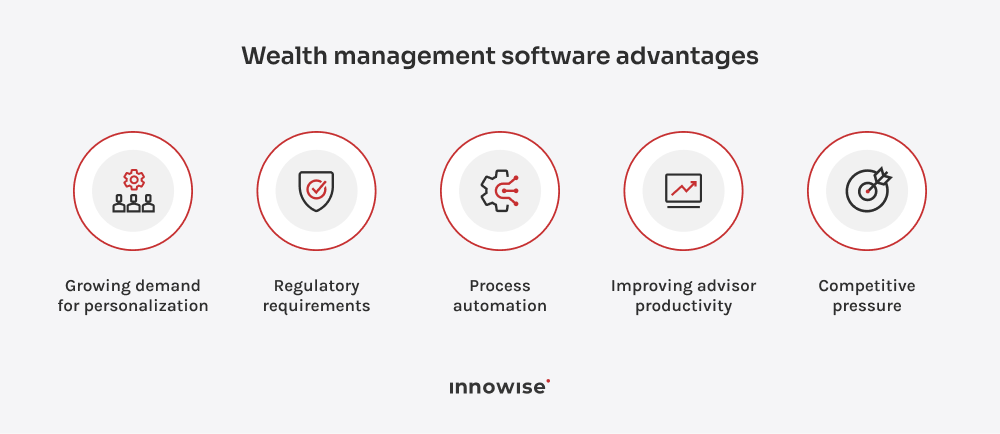
In my experience, there are five main reasons institutions invest in these platforms:

Growing demand for personalization

In 2026, generalization is out. Investors expect personalized strategies and real-time data that match their goals. AI-powered platforms help meet this need, whereas traditional tools make it impossible.

Regulatory requirements

Compliance is a constant operational requirement. Firms need systems that support KYC/AML checks, audit trails, and reporting standards without relying on manual workflows. And so built-in compliance automation is a lifesaver.

Process automation

Manual processes like reporting, portfolio rebalancing, and onboarding are costly and time-consuming. Making automation high-value priorities for financial institutions.

Improving advisor productivity

Multiple studies show that advisors spend only around 20% of their time with clients, with the remainder spent on admin such as reporting and planning. Automation and integrated data help them focus on more clients without getting overloaded.

Competitive pressure

In 2026, competition in finance is stronger than ever, so it’s important to stay one step ahead of competitors or at least not fall behind them. Firms investing in modern wealth solutions can offer faster and more innovative services that help them win and retain clients.

A scheme with arrows showing why financial institutions invest in wealth management software development.

Key benefits of wealth management software

The value of a good wealth management software is hard to overstate; comparing the two scenarios side by side helps clarify the difference. Instead of simply listing features, let’s look at how your day-to-day operations, client experience, and decision-making change with a modern platform versus without one.

Area
Without wealth management software
With modern wealth management software
Operational efficiency
Significant time is spent on manual reporting, spreadsheets, and repetitive admin work. Investment processes are slow.
Automation reduces manual tasks and streamlines daily operations, making workflows faster and more consistent.
Client experience
Clients often receive delayed updates and don’t have a clear view of how their investments are performing. Communication is also less personalized.
Clients get real-time portfolio insights, personalized recommendations, and transparent reporting in one place.
Investment decisions
Decisions rely on data from multiple systems and manual analysis, which slows the response to market changes.
Analytics tools help advisors quickly analyze performance and identify investment opportunities based on real-time data.
Compliance and risk management
Compliance checks and reporting are handled manually, increasing the risk of errors and missed regulatory updates.
Built-in compliance tools support KYC/AML processes and help reduce regulatory risk through automated reporting and audit trails.
Data management
Client and portfolio data are stored across different systems, which leads to inconsistencies and disconnected information.
All financial and client data is centralized, giving advisors a single, unified view of each client.
Show more

The data reinforces these sentiments, too. A 2024 Charles Schwab study found that top-performing wealth management firms spend around 25% less time per client on operations and allocate about 10% more time per client on client service than average firms.

In other words, in the right hands, wealth management software basically becomes a key driver of success — especially in 2026, when efficiency and client experience matter more than ever.

Custom wealth management software development process

In my experience, building a wealth management platform is less about code and more about understanding how financial institutions work. It usually unfolds in several stages:

01
Market research and product strategy

Identifying target users, business goals, and the core market problems the platform needs to solve.

02
Requirements analysis and architecture planning

Translating business needs into technical requirements, including regulatory constraints such as KYC and AML, and defining the overall system architecture.

03
UX and UI design

Designing intuitive dashboards and workflows for advisors and investors, as this directly affects whether they actually use the platform.

04
Software development

Building the backend infrastructure, frontend interfaces, and data processing systems.

05
Integration with external systems

Connecting the platform to custodians, trading systems, banking APIs, and financial data providers.

06
Testing and quality assurance

Checking the main workflows, calculations, integrations, and security through functional, load, and penetration testing to ensure the platform is reliable.

07
Deployment and maintenance

Launching the system in cloud or hybrid environments and ensuring ongoing updates, monitoring, and compliance adjustments.

arrow-iconarrow-icon
01 Market research and product strategy

Identifying target users, business goals, and the core market problems the platform needs to solve.

arrow-iconarrow-icon
02 Requirements analysis and architecture planning

Translating business needs into technical requirements, including regulatory constraints such as KYC and AML, and defining the overall system architecture.

arrow-iconarrow-icon
03 UX and UI design

Designing intuitive dashboards and workflows for advisors and investors, as this directly affects whether they actually use the platform.

arrow-iconarrow-icon
04 Software development

Building the backend infrastructure, frontend interfaces, and data processing systems.

arrow-iconarrow-icon
05 Integration with external systems

Connecting the platform to custodians, trading systems, banking APIs, and financial data providers.

arrow-iconarrow-icon
06 Testing and quality assurance

Checking the main workflows, calculations, integrations, and security through functional, load, and penetration testing to ensure the platform is reliable.

arrow-iconarrow-icon
07 Deployment and maintenance

Launching the system in cloud or hybrid environments and ensuring ongoing updates, monitoring, and compliance adjustments.

Ready to build a platform that actually works for your business?

Technology stack for wealth management software development

Choosing the right tech plays a major role in how scalable and secure a wealth management platform will be. Let’s look at the core technologies behind modern wealth management platforms to better understand how they work:

Layer
Technologies/components
Purpose
Frontend
React, Angular, Vue
Build responsive, user-friendly dashboards for advisors and clients
Backend
Node.js, Java, .NET, Python
Power core system logic, including portfolio calculations, data processing, and integrations
Databases
PostgreSQL, MongoDB, Oracle
Store client data, transactions, and investment portfolios based on structure and scale
Cloud infrastructure
AWS, Microsoft Azure, Google Cloud
Provide scalable hosting, data storage, and system reliability
Security
TLS/SSL, AES encryption, OAuth 2.0, OpenID Connect, MFA, RBAC
Protect sensitive financial data and support regulatory compliance

In reality, the exact tech stack depends on the complexity and scale of the platform. The final setup directly affects how fast, secure, and scalable the system will be. That’s why Innowise experts help choose the best setup based on your goals, security requirements, and integration needs.

Cost of wealth management software development

One of the questions I’m asked most often is how much it costs to build a wealth management platform. The honest answer is that the cost range can vary widely depending on what you’re trying to build. 

Here are some of the factors that affect price:

Project complexity and functionality

The more features you need, such as portfolio management, analytics, integrations, or AI tools, the higher the cost. Simple platforms are much cheaper than full-scale enterprise systems.

Security and compliance requirements

In financial software, security is not optional. Meeting regulatory standards like KYC, AML, and audit requirements adds significant development effort and cost.

Technology and infrastructure

Costs also depend on the technologies used and the cloud infrastructure supporting the platform. More advanced setups with high scalability and real-time processing increase overall expenses.

Development team and expertise

A small team will cost less, but building complex financial systems usually requires experienced engineers, architects, and fintech specialists, which increases the budget.

In general, basic platforms can cost anywhere from around $60,000 to $200,000. Mid-level solutions usually range from $200,000 to $500,000. Enterprise-grade systems with advanced features, integrations, and high security can go well above $500,000.

Remember that you’re not just paying for development: you are investing in the system’s security, scalability, and long-term reliability.

Need a cost estimate?

Get tailored guidance from Innowise consultants.

Emerging trends in wealth management technology

Most of the technologies and trends shaping wealth management already exist today. What’s changing is how they’re advancing and becoming highly integrated into daily operations. In my view, the main future focus will be on the following trends:

  • AI and machine learning are moving beyond simple automation into real decision support. They are increasingly used for portfolio recommendations, risk analysis, and robo-advisory services. The global robo-advisory market is projected to grow at over 29.6% CAGR in 2026–2035, which shows how fast this space is scaling.
  • Real-time data and analytics are becoming a must-have capability. As I said, advisors and clients no longer want delayed reports; they expect instant portfolio updates and live market insights.
  • Personalization will keep getting more advanced. Instead of using standard risk profiles, platforms will rely on real client behavior and financial data to build investment strategies that fit each client more precisely.
  • Open banking and fintech ecosystems will keep expanding through APIs, allowing wealth platforms to connect directly with banks, trading systems, and third-party services.

Over the next 5 to 10 years, we’ll likely see platforms that are much smarter, more connected, and far more tailored to each client, helping finance professionals make faster and more informed decisions with less manual effort.

How to choose the right wealth management software development partner

Choosing the right development partner is often more important than the technology itself. Sometimes, even a strong idea can fail if the team building it doesn’t understand financial workflows and the company’s needs. 

Here are the key things financial institutions should look for:

Experience in fintech and financial systems

The partner should understand how wealth management workflows function in practice, including portfolio operations, client data handling, and financial reporting.

Security and compliance expertise

Strong knowledge of regulations like KYC and AML is essential. Security cannot be added later; it must be built into the system from the start.

Scalability and integration capabilities

A good partner should know how to build platforms that won’t break when the client base grows. Besides, they should have real experience in integrating with banks, custodians, trading systems, and market data providers.

Post-launch support and maintenance

Launching the platform is only the beginning. Your partner should stay involved after release, helping with monitoring, updates, bug fixes, and security improvements. In wealth management, things change constantly, so long-term support really matters.

Ultimately, the right partner is not just a development team but one that understands the long-term financial, technical, and regulatory realities behind wealth management platforms.

If there’s one thing I’d recommend to firms, it’s to start by fixing data flow between systems before adding any advanced features. In practice, once data is clean and connected, everything else, including reporting, automation, and analytics becomes much easier to build and scale.

Global Development Director

Conclusion

Wealth management software isn’t just a trend anymore. It directly impacts how quickly you respond to clients, how you manage portfolios, and how well you adapt to market changes. So, if you’re still switching between spreadsheets, emails, and different systems just to get a full picture of one client, you’ll only lose time and make everyday work harder than it needs to be.

From where I stand, the best time to think about a proper platform is before small issues start getting in the way of daily work. If you’re ready for changes, start by defining what “better performance” actually means for your business, and build from there.

FAQ

Wealth management software helps manage client portfolios, investments, reporting, and compliance on a single platform. Instead of using separate tools, everything is centralized, making daily work faster, more accurate, and easier to manage.

It usually depends on the platform's complexity. A basic solution can take a few months, while more advanced systems with integrations, security layers, and custom features can take six months to a year or more.

Yes, if it’s built correctly. Security is a core part of these systems and includes encryption, authentication, and strict access control. In financial software, security is built into the architecture from the very beginning to protect sensitive client and transaction data.

Standard tools often don’t fully match a firm’s workflows, compliance needs, or integration requirements. Custom solutions let institutions build exactly what they need, scale it over time, and connect it with their existing financial systems without limitations.

Chief Delivery Officer & Head of Competence Center

Siarhei specializes in navigating high-stakes regulatory environments and complex delivery hurdles. He transforms abstract business requirements into secure, scalable architectures, ensuring that every project is technically sound and future-proofed against market shifts.

Table of contents

    Contact us

    Book a call or fill out the form below and we’ll get back to you once we’ve processed your request.

    Send us a voice message
    Attach documents
    Upload file

    You can attach 1 file up to 2MB. Valid file formats: pdf, jpg, jpeg, png.

    By clicking Send, you consent to Innowise processing your personal data per our Privacy Policy to provide you with relevant information. By submitting your phone number, you agree that we may contact you via voice calls, SMS, and messaging apps. Calling, message, and data rates may apply.

    You can also send us your request
    to contact@innowise.com
    What happens next?
    1

    Once we’ve received and processed your request, we’ll get back to you to detail your project needs and sign an NDA to ensure confidentiality.

    2

    After examining your wants, needs, and expectations, our team will devise a project proposal with the scope of work, team size, time, and cost estimates.

    3

    We’ll arrange a meeting with you to discuss the offer and nail down the details.

    4

    Finally, we’ll sign a contract and start working on your project right away.

    More services we cover

    arrow