The power of data mapping in healthcare: benefits, use cases & future trends. As the healthcare industry and its supporting technologies rapidly expand, an immense amount of data and information is generated. Statistics show that about 30% of the world's data volume is attributed to the healthcare industry, with a projected growth rate of nearly 36% by 2025. This indicates that the growth rate is far beyond that of other industries such as manufacturing, financial services, and media and entertainment.

6 vibe coding security issues & how to fix them

Jun 19, 2026 19 min read
Summarize article with AI

Key takeaways

  • Vibe coding is fast, but it comes with concrete security risks. The biggest trap is trusting the AI too much. Just because the code looks right doesn’t mean it’s secure, especially after a few rounds of prompts.
  • Many of the issues are classic ones, like RCE, SQL injection, or XSS, just showing up in AI-generated projects instead of traditional code.
  • The risks don’t stop at the code itself: dependencies, system setups, or even your development tools are never safe.
  • Strategies like self-review, security-focused prompts, and guardrails in your IDE or CI/CD can help catch most problems without slowing down your workflow.

You’ve probably noticed by now — vibe coding is our present and our future, for sure. It’s lightning-fast and lets you skip hours of tedious coding. What else can we dream about?

But there is always ‘but’. The very speed that makes it so attractive is what makes it risky. When teams move fast, skip proper validation, or rely on AI-generated architecture without enough review, vulnerabilities can slip into production unnoticed. Broken access controls, exposed credentials, insecure dependencies, and data leaks — these risks are real and serious.

Now, don’t panic, there’s a way to address these flaws. At Innowise, we often review AI-generated and vibe-coded applications, and these are the security issues we look for first. In this article, I’ll walk you through the most common problems vibe coding brings to the table and show you how to fix them.

What is vibe coding?

Vibe coding is the practice of using AI-powered tools to generate code quickly, often based on simple prompts or preset instructions. It’s essentially AI producing functional code in a fraction of the time it would take you to write it manually. 

It lets developers focus more on the bigger picture (building and innovating) and leaves the repetitive tasks to the AI. But that convenience comes at a price. 

The code generated by these tools may look perfect on the surface, but without proper security checks, it could be hiding major vibe coding security vulnerabilities that can leave your app exposed to an attack.

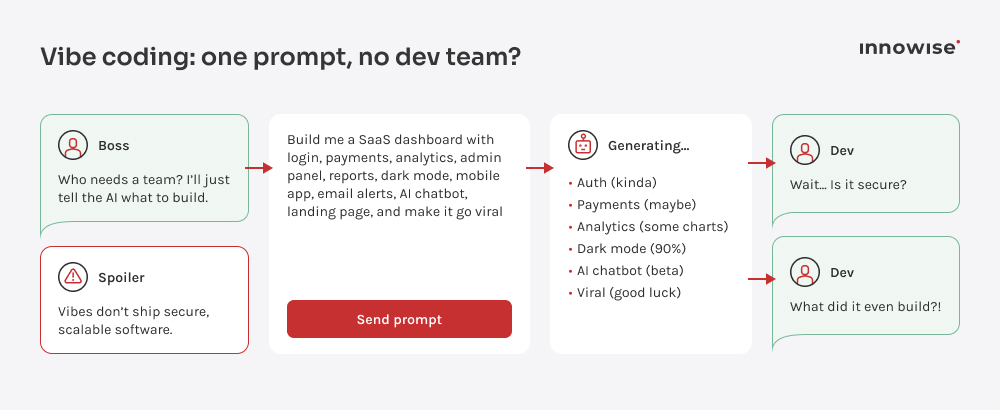
vibe coding going wrong

Why is vibe coding adoption accelerating at all?

Before we dive into the most critical security challenges, let’s take a closer look at two major reasons behind its rise.

Faster development and prototyping

Vibe coding is gaining momentum for a simple reason: speed. AI is handling the grunt work of coding, and what used to take weeks can now be done in days. Thanks to that,  businesses can push out MVPs and experiment at a rapid pace.

Lower barrier to entry

On top of that, vibe coding lowers the entry barrier for building software. You don’t need to be a seasoned developer to get a project idea off the ground. Non-technical teams can use AI tools to create applications without deep coding knowledge, raise funds, get competitive, and enter the market fast.

Already built with AI and worried about security?

6 common vibe coding security issues

Here are some of the most common security issues that come with AI-generated code.

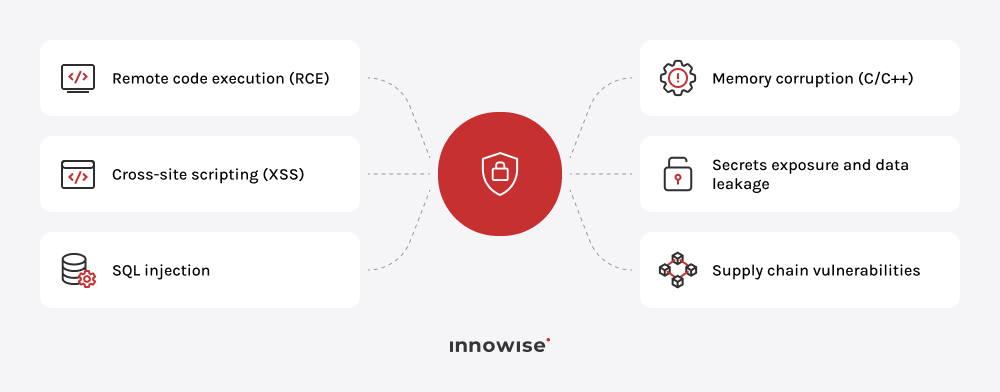
6 common vibe coding security issues

1. Remote code execution (RCE)

Remote code execution vulnerabilities allow attackers to run malicious code on your server, often without any user interaction. This can happen when an AI-generated app doesn’t properly validate input and lets an attacker inject code that can be executed on the server. Insecure deserialization (like using the pickle module in Python) and unsafe functions such as eval() can easily open the door to RCE. What’s the issue with that, you may ask. AI tends to prioritize quick solutions, not security, resulting in code that works but exposes you where you least expect it.

2. Cross-site scripting (XSS)

Cross-site scripting vulnerabilities occur when an application allows an attacker to inject malicious scripts into web pages viewed by others. This often happens when output is not properly encoded, allowing harmful scripts to run on a victim’s browser. AI-generated code may skip encoding certain outputs, thinking it’s fine, but it’s an easy vector for XSS attacks. 

3. SQL injection

SQL injection is one of the oldest tricks in the book, but still widely exploited. It occurs when unsanitized user input is inserted directly into SQL queries, allowing attackers to manipulate the database. AI often generates code that uses string concatenation instead of parameterized queries, which opens the door to this vulnerability. 

4. Memory corruption (C/C++)

In languages like C and C++, memory corruption vulnerabilities, such as buffer overflows and pointer misuse, can lead to disastrous consequences, including unauthorized access to system memory. AI-generated code may rely on unsafe memory handling patterns, especially when the prompt focuses on getting the feature working quickly rather than enforcing secure implementation. Without careful review, these flaws can make their way into production code.

5. Secrets exposure and data leakage

Hardcoded API keys, logging information, or environment variables can end up in the wrong hands if not properly secured. The danger is that AI-generated code might not flag these sensitive pieces of information during its creation. Exposed keys or credentials can quickly lead to data breaches and compromise the entire application.

6. Supply chain vulnerabilities

Vibe coding isn’t immune to supply chain vulnerabilities. AI-generated code often pulls in dependencies or external libraries that may be outdated or even malicious. Hallucinated packages, those that AI mistakenly adds without verification, are also a risk. And in some cases, developers may be exposed to slopsquatting, where malicious actors create fake package names that are very similar to legitimate ones, tricking AI tools into pulling them in. Regularly auditing dependencies and verifying their sources is essential to minimizing these risks.

Skip the risks — let us handle development safely from day one

Real-world examples of vibe coding vulnerabilities

Here are a few examples of vibe coding security flaws that shook the industry.

Lovable platform incident

In one of the most glaring examples of vibe coding vulnerabilities, the Lovable platform exposed thousands of projects for a staggering 48 days due to a BOLA (Broken Object Level Authorization) vulnerability. This issue originated in AI-generated apps and led to the unintentional leak of source code and database credentials. Despite a bug bounty report alerting the company, the issue remained unpatched for existing projects, resulting in massive exposure.

Moltbook data breach

In another troubling incident, the Moltbook platform, an entirely AI-generated app, suffered a major data breach that exposed 1.5 million API tokens and 35,000 emails. The breach was traced back to a misconfigured database, a flaw that AI overlooked in its code-generation process. The founder openly admitted that the app was fully AI-generated, raising vibe coding security concerns.

BBC experiment

The BBC conducted an experiment in which a vibe coding platform was successfully hacked by a researcher who gained full access to the app and user environment. What made this attack even more concerning? No user interaction was required for the compromise to occur. This experiment showed just how easily AI-generated code can be exploited if developers aren’t vigilant about security.

Hidden risks of vibe coding beyond code

The risks aren’t limited to what’s written in your files. Many problems hide in plain sight, embedded in assumptions, workflows, and system configurations. Here’s a closer look at the less obvious dangers that can sneak into vibe coding projects.

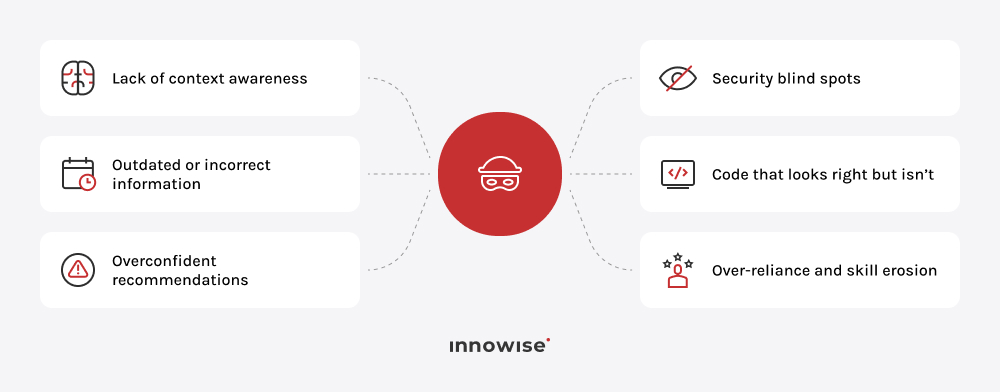
hidden risks of vibe coding: Over-trust in AI-generated code, Security degradation over iterations, Lack of context awareness, Reduced visibility and auditability, Misconfigurations in AI-built applications, and Development environment and tooling risks.

Over-trust in AI-generated code

Developers often fall into the trap of assuming AI output is automatically correct. A module can look clean, compile successfully, and still miss basic security controls, such as proper authentication checks or complete input validation. 

This problem is real: AI prioritizes plausible solutions over secure ones. Without manual review, critical vulnerabilities can slip through, leaving your app exposed to attacks that no automated test would catch.

Security degradation over iterations

It’s tempting to keep prompting AI to improve code or add new features, but each iteration can introduce new risks. In one project I worked on fixing, iterative prompts added three additional API endpoints, and with each one, a new vulnerability appeared. And two of them allowed unauthorized data access. The lesson is clear: each subsequent iteration can erode security if you don’t keep a watchful eye on it.

Lack of context awareness

AI doesn’t understand regulatory or business contexts. For example, I’ve seen AI-generated financial scripts that handle transactions without enforcing mandatory compliance checks. In healthcare projects, AI sometimes ignores HIPAA-related safeguards entirely. The code may run perfectly in a sandbox, but in production, it violates compliance and exposes legal liabilities.

Reduced visibility and auditability

AI-generated code often comes with hidden dependencies and opaque logic. In one internal audit, tracing why a critical function accessed a third-party API took days because the AI had introduced a chain of auto-generated helper functions. Reduced visibility makes governance virtually impossible, complicating audits. And there’s always a chance that if a breach occurs, teams will struggle to pinpoint exactly what went wrong.

Misconfigurations in AI-built applications

AI can mishandle configurations in ways human developers might catch immediately. Open databases, excessive permissions, and public exposure of internal tools happen surprisingly often. I’ve seen AI-generated scripts accidentally leave internal admin panels accessible via public URLs, essentially handing attackers the keys to the castle.

Development environment and tooling risks

The tools themselves can become a threat vector. Prompt injection, where malicious input alters AI behavior, is an underappreciated risk. AI assistants with system-level access can execute dangerous commands if prompts are crafted cleverly. Even local files or exposed APIs in development environments can be exploited. In short, every convenience of AI-assisted coding can carry hidden hazards if safeguards aren’t in place.

Want speed without compromise? Get expert AI code review and protection

Why traditional application security does not work

Sad to say, but traditional security approaches struggle to keep up with vibe coding. The pace and nature of AI-generated code break the old playbook, making conventional methods less effective. Here’s why relying on what used to be a standard is no longer enough.

Security cannot scale with AI speed

AI can generate entire modules in minutes, often faster than a team of developers could review them. In some projects, a single AI session produced hundreds of lines of code in under an hour — code that would take days for manual review. This way AI-generated code creates a false sense of completeness. A feature may look finished because the UI works, the endpoint responds, and the test case passes, while authorization logic, logging rules, or dependency checks remain incomplete.

That’s why security has to move closer to the point of generation. Reviews, scans, and policy checks need to run inside the same IDEs, pull requests, and CI/CD pipelines where AI-assisted development happens.

Detection-only approaches break down

Many security programs focus on detection: scanning code for known vulnerabilities and reporting issues. With AI-generated code, these tools quickly become overwhelmed. Backlogs of vulnerabilities pile up, and teams can’t realistically address every alert. In one project, static analysis flagged dozens of potential issues across 10 AI-generated modules, but the majority were ignored simply because the volume made triage impossible.

Lack of integration into developer workflows

Traditional security tools often sit outside the development workflow. Security scans run separately, reports are emailed, and feedback loops take hours or days. AI coding, on the other hand, happens in real time within IDEs or automated pipelines. If security tools aren’t integrated directly into these environments, developers (and AI models) continue generating potentially vulnerable code unchecked. 

How to secure AI-generated code

So the secret to securing a vibe-coded app is basically building safeguards into the workflow to catch risks before they turn your life into a nightmare. Here’s a practical approach that I’ve used on real projects.

Treat AI-generated code as untrusted input

Always assume that AI-generated code could be unsafe. Just like you validate user input, review every function, module, and dependency before deploying it. 

For example, this approach can help catch issues such as API keys being written to logs, missing authorization checks, or unsafe data handling before they become real vulnerabilities. 

Use security-focused system prompts

A simple but powerful step is to instruct the AI to follow secure coding practices from the start. System prompts can tell it to avoid unsafe functions, enforce input validation, and sanitize outputs. Even generic prompts like “always write secure, validated code” can reduce low-hanging risks before the code ever reaches your repository.

Apply language-specific secure prompts

Different languages have different pitfalls. Python code might accidentally use eval() or unsafe deserialization; C++ code could have buffer overflows. Tailoring prompts for the language and framework ensures the AI produces safer code. In web apps, prompts can enforce proper output encoding and parameterized database queries, automatically preventing XSS or SQL injection.

Implement self-reflection reviews

A practical strategy is self-reflection prompting. Let the AI review its own code for vulnerabilities before finalizing it. This process can catch things the initial generation missed, like improper authentication checks or unsafe library usage. It’s like giving the AI a second pair of eyes, but this time focused purely on security.

Add security guardrails in IDE and CI/CD

Inline scanning tools and pull request checks help enforce standards automatically. I’ve set up CI/CD pipelines that scan AI-generated commits for known vulnerabilities, flagging them before merging. This prevents unsafe code from entering production and reduces the burden on human reviewers.

Validate runtime behavior

Static analysis isn’t enough. Run tests that check how the code behaves in real scenarios: API calls, authentication flows, and permissions. In one case, an AI-generated module passed static scans but exposed sensitive endpoints when executed. Runtime validation catches issues that tools alone can’t detect.

Secure dependencies and supply chain

AI often pulls in external libraries, some outdated or even malicious. Validate every dependency, block risky packages, and monitor for supply chain attacks. This simple step can stop potential breaches in advance.

Maintain human oversight

Finally, never let AI replace human judgment. Even with all the prompts and guardrails, a final human review is critical. Humans understand context, compliance requirements, and subtle logic issues that AI can’t fully grasp.

Bring in security experts early

If your app was built with AI or vibe-coded under tight deadlines, it’s worth bringing in security specialists before scaling or going live. Experienced reviewers can spot issues that automated tools and AI self-checks often miss: broken access logic, unsafe dependencies, exposed secrets, misconfigurations, weak architecture decisions, and compliance gaps.

At Innowise, we audit AI-generated and vibe-coded applications to find what went wrong, prioritize the most critical risks, and help teams secure even messy, inconsistent, or poorly documented codebases. Our experts review the code, architecture, dependencies, runtime behavior, and deployment setup to turn fast-built software into something safer, cleaner, and production-ready.

AI can build fast, but it can’t reason about trust. Every function it outputs is a potential lie until proven otherwise.

Chief Technology Officer

Extra nerdy tips for AI security

If you want to take your AI security game even further, here are my golden, super-secret rules — things other teams would pay just to learn.

Embed security in every prompt (success criteria)

Every AI prompt is a mini-spec. Don’t just tell the AI what you want it to do, tell it what “done” means, including security requirements. Explicitly define input validation, authorization rules, exception handling, and what data must never be exposed. This turns AI assumptions into enforceable constraints and reduces the chance of accidental vulnerabilities.

Use safety contracts for reusable prompts

If you reuse prompt templates across features, attach a fixed block of security rules — a Safety Contract. This ensures every AI-generated feature follows consistent security standards, such as least privilege, dependency restrictions, and reporting changes in authentication or data handling. If you don’t want to micromanage every prompt, it’s the best way to enforce company-wide security policies in code generation.

Do-not-guess rule

When your prompt touches authentication, authorization, payments, or sensitive data, the AI must not assume anything. Instead, instruct it to pause and ask clarifying questions. This prevents confident but wrong guesses that could lead to vulnerabilities like IDORs or improper access controls.

Multi-stage prompt workflows

Break complex tasks into explicit stages: planning, security & risk analysis, implementation, and self-verification. Asking the AI to analyze risks before writing code catches logic flaws or access issues early, and you won’t need to patch them later. Basically,  it’s a threat modeling step embedded in your prompt.

End-of-prompt security checklist

Add a short checklist at the end of prompts for the AI to review: confirm input validation, secrets handling, permission changes, and dependencies. Even if the AI skips an earlier instruction, this final self-check re-anchors security before the code is ready.

Leverage up-to-date documentation and CVEs

AI training data can be months old. Before generating code or performing a security review, fetch the latest documentation, dependency info, and CVEs. This ensures your AI isn’t using outdated practices and can account for newly discovered vulnerabilities.

Isolate AI environment layers

Control what your AI can access: sandbox shells, read-only database users, ephemeral debug browsers, and containerized dev environments. Mask logs and secrets. Treat every interface the AI touches as a potential attack surface, and apply least-privilege principles consistently.

The future of vibe coding cybersecurity

Vibe coding is only going to get faster and more integrated into development workflows, and with that comes a new set of cybersecurity challenges.

Continuous security during code generation

Security won’t be a separate step. It will happen in real time. Imagine an IDE that flags potential vulnerabilities as the AI writes code, highlighting insecure patterns or risky dependencies before they’re committed. On recent projects, I’ve seen early implementations of this approach catch unsafe functions or exposed credentials instantly, saving hours of manual review.

AI-assisted security tooling

Just as AI generates code, it can also detect weaknesses. We are already moving to the tools that can scan AI-generated modules for common pitfalls, suggest fixes, and even rewrite insecure segments. This kind of AI-assisted security doesn’t replace developers, it empowers them to act quickly. In practice, combining AI detection with human review drastically reduces the window of exposure for vulnerabilities.

Increasing regulatory and compliance pressure

Governments and industry bodies are starting to focus on AI-generated software. Regulations around AI governance, data privacy, and cybersecurity are shaping expectations for secure code. Teams will need to demonstrate that AI outputs meet compliance standards, whether that’s logging audit trails, enforcing security policies, or verifying that generated code aligns with data protection regulations. Planning for these requirements now will make scaling safer and reduce future compliance headaches.

Secure your AI-generated code with Innowise

At Innowise, we help teams make AI-generated code safe, reliable, and production-ready. With our AI security consulting services, you can get a deliberate assessment of risks and implement mitigation strategies, so vulnerabilities never touch you.

We support compliance and governance, guide teams through secure AI adoption, and make certain that generated code meets industry standards. Our specialists review AI-generated modules, fix vulnerabilities, and implement security guardrails directly in IDEs and CI/CD pipelines. We also perform vibe-coded MVP audits, helping startups and enterprises launch AI-built apps without exposing themselves to unnecessary risk.

Whether your team uses Codex, Lovable, Claude, Replit, GitHub Copilot, or other AI coding tools, we can set up a secure software development lifecycle that becomes a core part of your workflow.

FAQ

Vibe coding is the use of AI-powered tools to generate code quickly, often based on prompts or instructions. It helps speed up development and lowers the barrier to creating software, but the code still requires review for security, performance, and correctness.
Not by default. AI can produce code that works, but it often introduces vulnerabilities like RCE, SQL injection, or data leaks. Security depends on how the AI is guided, reviewed, and integrated into development processes.

The key risks include remote code execution, cross-site scripting, SQL injection, memory corruption in C/C++, secrets exposure, supply chain vulnerabilities, misconfigurations, and reduced auditability. Over-trusting AI or relying on iterative prompts without review can compound these issues.

Innowise can help you identify and prevent these risks before they affect your product. Contact us to assess your AI-generated code, strengthen your development workflow, and build security into your vibe coding process.

Treat AI output as untrusted input. Use security-focused prompts, apply language-specific guidance, perform self-reflection reviews, add guardrails in IDEs and CI/CD, validate runtime behavior, secure dependencies, and maintain human oversight throughout the process.

AI can help detect and fix issues, but it doesn’t replace human oversight. Tools can flag common vulnerabilities and enforce secure patterns, yet final reviews, context checks, and compliance validation require experienced developers.

Philip Tihonovich
Head of Big Data
Philip leads Innowise’s Python, Big Data, ML/DS/AI departments with over 10 years of experience under his belt. While he’s responsible for setting the direction across teams, he stays hands-on with core architecture decisions, reviews critical data workflows, and actively contributes to designing solutions to complex challenges.

Table of contents

    Contact us

    Book a call or fill out the form below and we’ll get back to you once we’ve processed your request.

    Send us a voice message
    Attach documents
    Upload file

    You can attach 1 file up to 2MB. Valid file formats: pdf, jpg, jpeg, png.

    By clicking Send, you consent to Innowise processing your personal data per our Privacy Policy to provide you with relevant information. By submitting your phone number, you agree that we may contact you via voice calls, SMS, and messaging apps. Calling, message, and data rates may apply.

    You can also send us your request
    to contact@innowise.com
    What happens next?
    1

    Once we’ve received and processed your request, we’ll get back to you to detail your project needs and sign an NDA to ensure confidentiality.

    2

    After examining your wants, needs, and expectations, our team will devise a project proposal with the scope of work, team size, time, and cost estimates.

    3

    We’ll arrange a meeting with you to discuss the offer and nail down the details.

    4

    Finally, we’ll sign a contract and start working on your project right away.

    More services we cover

    arrow