IT outsourcing trends 2026: 11 shifts shaping software delivery and vendor partnerships

Jul 27, 2026 13 min read
Summarize article with AI

Key takeaways

  • IT outsourcing in 2026 is moving from cost-saving to capability-building, with companies using external partners for AI, cloud, cybersecurity, data, and specialized engineering expertise.
  • Vendor selection is becoming more rigorous: buyers now assess AI governance, security controls, delivery transparency, technical leadership, and measurable outcomes before signing.
  • The best outsourcing partners are no longer just talent providers. They act as engineering partners who help reduce risk, improve delivery quality, and scale product development responsibly.

You are busy, I’m busy so let’s skip the long warm-up. Here are the 11 IT services outsourcing trends that will matter most in 2026 for companies choosing software development partners, scaling delivery, and trying to get more than “extra hands” from outsourcing.

Market snapshot: why IT outsourcing is changing in 2026

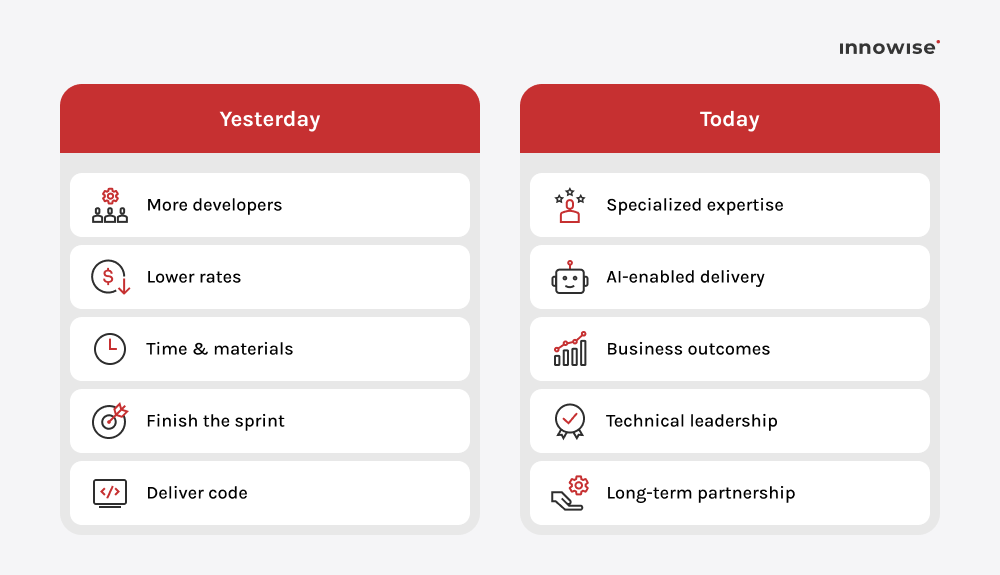
Not long ago, companies outsourced software development primarily to reduce costs or expand delivery capacity. That’s no longer the main driver. 

Today, most engineering leaders are looking for something much harder to build in-house: AI expertise, cloud architects, cybersecurity specialists, platform engineers, or teams that can step into a complex project and start delivering immediately. 

Technology budgets are growing, but finding the right people isn’t getting any easier. Gartner forecasts global IT spending to reach $6.3 trillion in 2026, even as organizations continue to compete for specialists in AI, cloud, data, and cybersecurity

Companies now evaluate partners based on technical depth, engineering maturity, security practices, and their ability to own outcomes (not just complete Jira tasks). The trends below show how these expectations are reshaping software delivery and what they mean for businesses choosing an outsourcing partner in 2026.

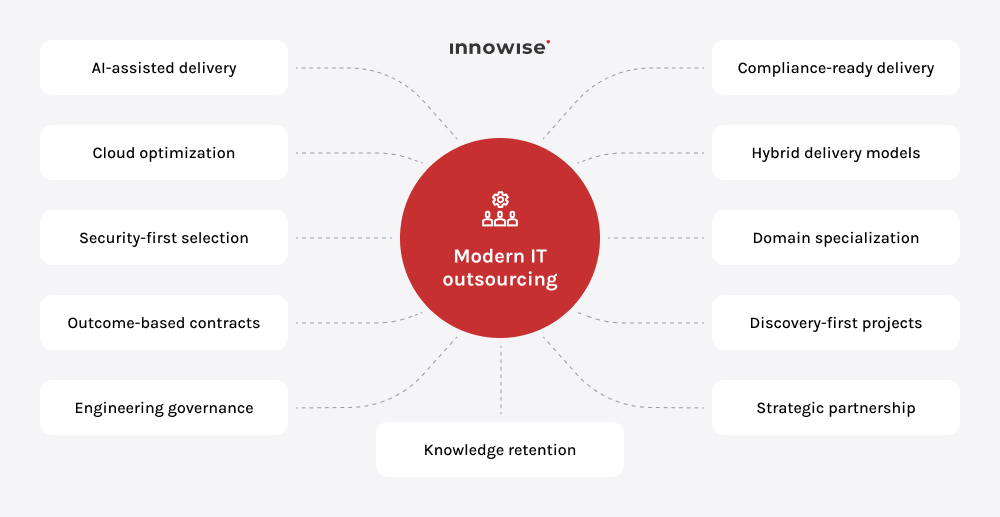
Key pillars of modern IT outsourcing in 2026

Need expert support for your next project?

11 software development outsourcing trends 2026

Not every trend will affect every business equally, but together they reveal what separates modern outsourcing partners from traditional service providers.

1. AI-assisted software delivery becomes the new outsourcing standard

AI has become a standard part of modern software delivery. Development teams now use coding assistants, AI-powered testing, documentation generation, code review, and backlog refinement tools to accelerate routine work and shorten delivery cycles. The competitive advantage no longer comes from using AI itself, but from integrating it into a disciplined engineering process.

This shift is also changing what clients expect from outsourcing partners. Instead of scaling projects with large junior-heavy teams, companies increasingly look for experienced engineers who can validate AI-generated code, make architectural decisions, and ensure long-term maintainability.

Speed, however, comes with new risks. AI can introduce inconsistent coding patterns, security vulnerabilities, or unnecessary technical debt if its output isn’t properly reviewed. That’s why mature outsourcing providers combine AI-assisted development with peer reviews, automated testing, security scanning, and human oversight.

What to look for in a vendor: look beyond productivity claims. Ask how they protect client data when using AI, which tools are approved for project work, how AI-generated code is reviewed, and whether they have clear governance policies for responsible AI use. Those practices say far more about delivery maturity than simply stating that the team uses AI.

AI has fundamentally changed how we build software but not what clients ultimately pay for. They don’t pay for generated code, obviously. They pay for software that’s secure, maintainable, and solves real business problems. Our job is to use AI where it speeds delivery, while making sure every architectural decision, security review, and quality check still comes from experienced engineers.

Chief Technology Officer

2. AI governance becomes part of outsourcing contracts

As AI becomes a standard part of software delivery, companies are no longer treating its use as an internal engineering decision. Increasingly, AI usage policies are discussed during vendor selection and formalized in contracts to address security, intellectual property, compliance, and accountability.

Procurement and legal teams now want to know which AI tools developers can use, whether client code or data is ever shared with external models, how AI-generated code is reviewed, and who is responsible if AI introduces security vulnerabilities or licensing issues.

For outsourcing providers, this means AI governance is becoming a delivery capability rather than just an internal policy. Clear rules around approved tools, human oversight, data protection, auditability, and IP ownership help reduce risk while giving clients confidence that AI is being used responsibly.

What to look for in a vendor: documented AI usage policies, restrictions on public AI tools, mandatory review of AI-generated code, transparent data handling practices, and clearly defined ownership of AI-assisted deliverables.

3. Cybersecurity becomes an early vendor selection filter

The next IT outsourcing industry trend is cybersecurity. It is no longer just a delivery concern. It’s a key factor in vendor selection. As cyber threats grow and regulations tighten, companies increasingly assess a provider’s security practices before discussing pricing, timelines, or team composition.

Beyond certifications like ISO 27001 or SOC 2, buyers want evidence of secure software development practices. They evaluate how vendors manage source code access, protect credentials and secrets, secure cloud environments, monitor vulnerabilities, respond to incidents, and comply with regulations such as GDPR, NIS2, or DORA where applicable.

A mature security posture also extends to the software supply chain. Many organizations now expect partners to perform dependency scanning, automate security testing throughout the SDLC, and maintain clear processes for vulnerability remediation.

What to look for in a vendor: secure SDLC practices, role-based access controls, regular penetration testing, documented incident response procedures, security audits, and transparent vulnerability management. Strong security should be embedded in the delivery process and not treated as a final checkpoint before release.

4. Cloud outsourcing shifts from migration to continuous optimization

For many organizations, cloud migration is no longer the finish line but a starting point. As cloud environments become more complex, companies increasingly rely on outsourcing partners to optimize performance, control costs, strengthen security, and ensure long-term reliability.

Rather than focusing on one-off migration projects, cloud providers are expected to deliver ongoing value through FinOps, cloud-native development, DevOps, platform engineering, infrastructure automation, and continuous monitoring. The goal is to keep cloud environments scalable, resilient, and cost-efficient as business needs evolve.

In practice, the biggest challenges often emerge after migration. Without clear ownership, performance monitoring, governance, and cost management, cloud spending can quickly spiral while applications become harder to maintain.

What to look for in a vendor: experience with cloud optimization (not just migration) along with expertise in FinOps, observability, infrastructure as code (IaC), automated CI/CD pipelines, security best practices, and proactive performance tuning. A strong partner should continuously improve your cloud environment rather than simply keep it running.

Ready to scale your software delivery?

5. Clients buy outcomes, not developer hours

Companies are increasingly looking beyond traditional staff augmentation. Instead of simply hiring developers to fill skill gaps, they expect outsourcing partners to take ownership of measurable business and delivery outcomes.

This shift is driving demand for managed services, dedicated product teams, and outcome-based engagement models, where success is measured by metrics such as system availability, deployment frequency, incident resolution time, application performance, or backlog health. Not just the number of hours worked.

For vendors, this means becoming an extension of the client’s engineering organization. That includes proactively identifying risks, recommending improvements, and continuously optimizing delivery rather than waiting for new tasks.

What to look for in a vendor: clearly defined SLAs and KPIs, transparent reporting, proactive communication, and a proven ability to improve operational metrics over time. The strongest outsourcing partners take responsibility for keeping software reliable, scalable, and aligned with business goals.

6. Specialized vendors outperform generalist providers

Companies are becoming more selective about outsourcing partners. Instead of choosing vendors that offer broad development capacity, they increasingly look for teams with deep expertise in specific domains, technologies, and compliance environments.

This is especially important in industries such as fintech, healthcare, telecom, e-commerce, logistics, and industrial software, where delivery depends on understanding business workflows, integration patterns, security expectations, and regulatory limits.

Specialized teams usually onboard faster because they know which questions to ask during discovery. They can identify architecture risks earlier, challenge unrealistic assumptions, and avoid common mistakes that generalist vendors may only discover later in development.

What to look for in a vendor: relevant case studies, domain-specific experience, senior technical specialists, understanding of industry regulations, and proven ability to work with similar systems, platforms, or business models.

7. Hybrid delivery models replace the nearshore vs offshore debate

IT outsourcing market trends show that the conversation is shifting from location to collaboration quality. Companies still compare nearshore and offshore options, but the more important question is how well distributed teams can work together across time zones, responsibilities, and delivery workflows.

Hybrid models are becoming more common because they allow businesses to combine onshore control, nearshore collaboration, and offshore scalability. For example, a client may keep product ownership in-house, place technical leads in a nearshore team, and use offshore specialists for development, QA, or support.

The success of this model depends less on geography and more on communication maturity, overlap hours, decision-making speed, documentation, and clear ownership.

What to look for in a vendor: flexible delivery models, strong English communication, sufficient time zone overlap, clear escalation paths, mature project management, and experience working with distributed or multi-vendor teams.

Not sure which delivery model fits your business?

8. Engineering governance becomes a competitive advantage

As outsourced software delivery becomes more complex, companies are paying more attention to engineering governance. They want to know not only who writes the code, but how technical decisions are made, documented, reviewed, and maintained over time.

Strong governance helps prevent architecture drift, duplicated logic, knowledge silos, and uncontrolled technical debt. It also gives clients better visibility into delivery quality, especially when multiple teams, vendors, or AI-assisted tools are involved.

This includes architecture ownership, coding standards, peer review processes, documentation practices, release governance, and architecture decision records. These practices may seem operational, but they directly affect speed, maintainability, and long-term product stability.

What to look for in a vendor: clear technical leadership, documented engineering standards, architecture review processes, ADRs, quality gates, and transparent reporting on technical risks.

9. Knowledge retention becomes a contractual concern

One of the biggest outsourcing risks is losing critical project knowledge when key engineers leave or teams change. As projects become more complex, clients increasingly expect vendors to treat knowledge retention as a formal delivery responsibility, not an informal handover task.

This is especially important for long-term product development, legacy modernization, cloud operations, and managed services. Without structured documentation and onboarding processes, even a strong team can become a single point of failure.

Mature vendors reduce this risk through internal knowledge bases, runbooks, architecture documentation, onboarding playbooks, shadowing, backup roles, and regular knowledge-sharing sessions.

What to look for in a vendor: documented handover processes, low dependency on individual engineers, clear onboarding materials, backup specialists, technical documentation standards, and continuity planning for critical roles.

10. Compliance becomes an engineering capability

Compliance is no longer only a legal or audit topic. In 2026, regulations increasingly affect how software is designed, developed, tested, deployed, and maintained.

For companies in regulated sectors, outsourcing partners need to understand how requirements such as GDPR, DORA, NIS2, the EU AI Act, HIPAA, PCI DSS, or industry-specific standards influence engineering work. This can affect data handling, access control, audit logs, vulnerability management, documentation, incident response, and software supply chain security.

The key shift is that compliance must be built into delivery from the start. Treating it as a final checklist can lead to rework, delays, and unnecessary risk.

What to look for in a vendor: experience with regulated projects, secure development practices, audit-ready documentation, access control policies, vulnerability management, and the ability to work with legal, security, and compliance teams.

11. Discovery-first partnerships replace “start coding immediately”

The last of the global IT outsourcing trends is discovery-first partnerships. More companies are realizing that starting development too quickly can create expensive problems later. As a result, mature outsourcing engagements increasingly begin with discovery, technical assessment, or solution validation before full-scale delivery starts.

This stage helps clarify business goals, assess technical risks, validate architecture, review existing code, estimate effort, and define a realistic roadmap. It is especially valuable for legacy modernization, AI projects, cloud optimization, integrations, and products with unclear requirements.

For clients, discovery reduces uncertainty. For vendors, it creates a stronger foundation for delivery and prevents teams from building the wrong solution faster.

What to look for in a vendor: structured discovery workshops, architecture assessment, technical due diligence, backlog validation, risk mapping, proof-of-concept capabilities, and transparent recommendations before development begins.

Final thoughts (my view on IT outsourcing future trends)

Five years from now, we may look back at today’s outsourcing model the way we now look at on-premise servers: useful for its time, but no longer the default. AI agents, autonomous engineering workflows, and globally distributed product teams will continue to blur the line between internal and external development. The companies that succeed won’t necessarily have the largest engineering organizations, they’ll have the strongest engineering ecosystems.

That’s why these trends matter. They’re signals of where software delivery is already heading. I’ll keep tracking them, and I’ll keep this guide up to date as the next wave of change arrives.

FAQ

The biggest current trend in IT outsourcing is that companies are outsourcing for expertise, not just extra capacity. AI-assisted development, cloud optimization, cybersecurity, engineering governance, and specialized domain knowledge are becoming far more important than simply finding developers at a lower cost. Buyers also expect vendors to take ownership of outcomes, with clear KPIs, transparent reporting, and mature delivery processes.


AI is making development faster, but it's also raising the bar for outsourcing providers. Clients now expect vendors to use AI responsibly: to automate repetitive work without sacrificing code quality, security, or maintainability. In practice, that means experienced engineers, strong review processes, and clear AI governance are becoming just as important as the tools themselves.

Because security can no longer be treated as an afterthought. Organizations face increasingly sophisticated cyber threats, stricter regulations, and more complex cloud environments. Many choose to work with external security specialists who can provide expertise in secure software development, penetration testing, cloud security, compliance, and continuous monitoring without having to build those capabilities entirely in-house.

It depends on your priorities. If close collaboration, overlapping working hours, and frequent communication are critical, nearshoring is often the better fit. If you're looking to scale quickly or optimize costs, offshoring may make more sense. Many companies no longer see it as an either-or decision. They combine onshore, nearshore, and offshore teams to balance expertise, cost, and delivery speed.

Start by looking beyond technical skills. A good outsourcing partner should have experience in your industry, a mature delivery process, strong security practices, transparent communication, and a proven track record of delivering similar projects. It's also worth asking how they use AI, how they manage knowledge transfer, and how they measure success throughout the engagement.

Software development remains the most common choice, but companies increasingly outsource cloud engineering, DevOps, cybersecurity, QA and test automation, data engineering, AI development, application support, and managed IT services. The best candidates are projects that require specialized expertise, flexible scaling, or continuous delivery over time.

Show all

Global Development Director

Ivan orchestrates complex, multi-regional development operations. He focuses on resource optimization and engineering discipline, ensuring that large-scale technical projects remain aligned with business objectives while maintaining a relentless pace of delivery.

Table of contents

    Contact us

    Book a call or fill out the form below and we’ll get back to you once we’ve processed your request.

    Send us a voice message
    Attach documents
    Upload file

    You can attach 1 file up to 2MB. Valid file formats: pdf, jpg, jpeg, png.

    By clicking Send, you consent to Innowise processing your personal data per our Privacy Policy to provide you with relevant information. By submitting your phone number, you agree that we may contact you via voice calls, SMS, and messaging apps. Calling, message, and data rates may apply.

    You can also send us your request
    to contact@innowise.com
    What happens next?
    1

    Once we’ve received and processed your request, we’ll get back to you to detail your project needs and sign an NDA to ensure confidentiality.

    2

    After examining your wants, needs, and expectations, our team will devise a project proposal with the scope of work, team size, time, and cost estimates.

    3

    We’ll arrange a meeting with you to discuss the offer and nail down the details.

    4

    Finally, we’ll sign a contract and start working on your project right away.

    More services we cover

    arrow