Islamic banking software solutions: problems, features, and core system architecture

June 17, 2026 15 min read
Summarize article with AI

Key highlights

  • Islamic banking software isn’t traditional banking with add-ons.
  • One of the main challenges is to make software Sharia-compliant.
  • The implementation strategy should be built around Sharia and include regional considerations.

Sharia compliance, interest-free finance, and profit-sharing models describe Islamic banking solutions. They are more than mere “features” that can be implemented in a traditional banking system. We have to take religious and legal rules and turn them into code, because the standard system can’t accommodate such contractual agreements.

This is a unique financial agreement where the money is tied to tangible assets and performance. Every transaction needs a documented contract basis that a Sharia scholar can review and a regulator can audit.

Two figures put this in context:

  • Global Islamic finance assets are projected to reach $6T by the end of 2026. The industry currently operates across 140 countries, providing services to 1.9B Muslims.
  • The Islamic banking software market itself grew from $1.5B in 2024 to $3.6-4.5B in 2026-2032. 

This growth became possible because technology caught up with the principles: AI automates Sharia compliance audits, blockchain creates immutable transaction trails, and composable architectures replace old monolithic systems.

That massive gap right there is both a challenge and an opportunity.

In this article, I’ll discuss what Islamic banking software is, how the technology behind it is changing, and what matters when you’re building such a system.

First things first, or what are Islamic banking software solutions?

Islamic banking software solutions are banking systems with functionality to create, manage, calculate, document, and audit Shariah-compliant financial products. Whereas traditional banking software deals with balance and payment tracking, Islamic banking systems also need to account for contracts, asset backing, profit-sharing logic, compliance rules, and governance workflows.

What happens to money beyond the ledger matters, and that’s a fundamental distinction here.

While interest accumulation is standard practice in conventional banking, Islamic banking follows a contractual approach and involves trade, leasing, partnerships, and investments, hence moving it from being “lend and accrue” to “validate, structure, compute, distribute, and prove”.

Another thing that distinguishes Islamic banking is the Sharia board, the bank’s religious authority. It is an independent body of scholars that reviews products, approves contracts, and issues fatwas on permissibility.

Start your Islamic banking platform with a consultation

Islamic banking software vs. conventional banking software

The system can’t just put a ‘Sharia-compliant’ label on a product; it has to verify and maintain the correct contract structure from setup through reporting. These rules must be built into the product’s logic, because the t structure itself is required for compliance.

Aspect
Conventional banking
Islamic banking
How returns are generated
Uses a fixed interest rate.
Focuses on genuine profit-and-loss sharing. The system manages investment pools, calculates actual returns, and distributes the profits fairly among participants.
What backs the transaction
Primarily tracks ledger entries, balances, and payments.
Money is tied to a real-world asset, like a car, house, or equipment. The software acts as a digital logbook for that asset, tracking its legal status and ownership changes in real time to ensure the transaction is clean and legitimate.
Trust and auditability
Standard auditing and transaction logs.
The system leaves a digital breadcrumb for every rule, override, and approval. If an auditor or the Sharia board has a question, the system can instantly provide a clear, unbreakable record of why each transaction was approved.
Revenue model
Lends money and earns income through fixed interest.
Acts as a partner in a transaction and earns a share of actual profit or rent.
Ethical and social focus
The main focus is on increasing profit within legal boundaries.
Funds must be ethically screened and cannot be tied to prohibited sectors, such as gambling, alcohol, or weapons.

One big difference between traditional and Islamic banking is the Sharia board. Often, they get fewer tools than the back-office team. But I believe their administrative processes can be automated, too. You can give them structured review queues so submissions do not get lost between meetings; versioned document storage with annotation so the decision trail is always intact; a fatwa registry that surfaces relevant precedents automatically; and a dedicated board portal that gives scholars secure access to their queue and decision history.

Chief Technology Officer

Key Islamic banking problems and solutions

Instead of calculating interest, Islamic banking is built to validate contracts, track assets throughout their lifecycle, and ensure everything is compliant and traceable. Because of this unique approach, it naturally creates a whole new set of engineering and operational hurdles we have to deal with.

Challenge
Technology and market responses
Complex Sharia compliance
  • Rule-based product configuration, approval workflows, and audit trails
  • Vendors such as Intellect and Newgen frame compliance as a built-in system capability
  • AI-supported routine compliance checks
  • AAOIFI FAS 53 on Istisna-Based Development Contracts, approved for issuance in 2026
Legacy core banking limitations
  • Modular Islamic banking layer or phased core modernization
  • Mambu and Intellect push composability and modern core design
  • Shift toward composable/microservices architecture in GCC markets
  • API-first and cloud-native designs replacing monolithic systems
Manual profit-sharing calculations
  • Automated calculation engines with transparent approval and distribution logic
  • Real-time profit distribution via smart contracts and blockchain verification
Limited product flexibility
  • Configurable product factory for Murabaha, Mudarabah, Ijarah, Tawarruq, and related products
  • Product factories for Takaful (Islamic insurance) modules and ESG-screened investment products
Poor integration with digital channels
  • API-first architecture with open connectors and middleware
  • Hexaware's MVP is core-agnostic, and Innowise's open banking work shows the same integration pattern in practice
  • Faster Murabaha approval flows to meet customer expectations
  • Embedded decision engines for near-instant eligibility checks and approvals
Regulatory reporting complexity
  • Automated reporting and data validation with full audit trails
  • Real-time reporting against AAOIFI standards via event-driven architecture
  • Real-time compliance monitoring to meet growing regulatory expectations in GCC markets
Scaling Islamic banking windows
  • Multi-entity, multi-product, multi-currency architecture with logical segregation and configuration-based controls
  • Scalable operating models for different institution types, as positioned by vendors such as Newgen and Temenos
  • Clean segregation between Islamic and conventional books, with growing demand for pure-play Islamic digital banks
Cybersecurity threats
  • Multi-factor authentication
  • Encryption
  • Blockchain-based security
  • AI-powered threat detection
ESG reporting and impact tracking complexity
  • Integration with ESG reporting frameworks
  • Support for green sukuk, waqf-linked investments, and social impact metrics alongside traditional financial reporting

Most issues in Islamic banking aren’t actually Islamic-specific; they’re just standard enterprise problems like slow product launches and fragmented data. The difference is that Islamic banking adds contract constraints and Sharia governance on top. That is why the software architecture has to support both layers at once.

Must-have features of Islamic banking software

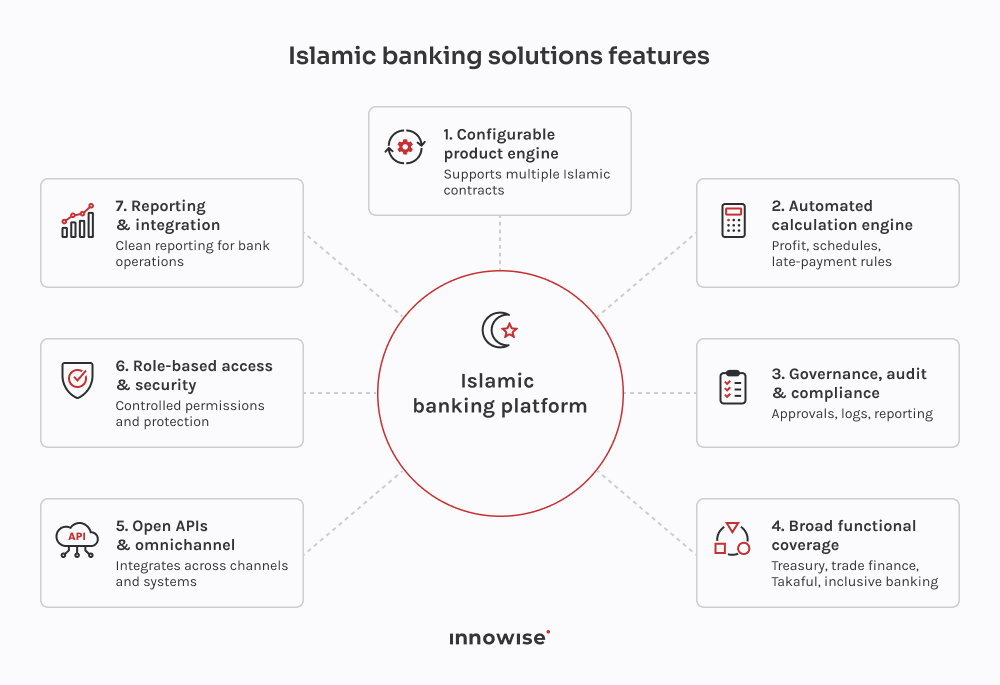
If I were defining requirements for this platform at a bank or fintech, I would treat several features as non-negotiable. 

First, the product engine needs to be configurable enough to support multiple Islamic contracts without hardcoding each one. Second, the calculation engine should automate profit distribution, payment schedules, late payment rules, and asset-backed financing logic. Third, the platform has to keep strong governance: approvals, audit logs, and compliance reporting should be part of the operating model.

I would also expect a modern Islamic banking solution to support treasury, trade finance, investment controls, Takaful, and inclusive banking use cases. Temenos covers many of these areas directly, while Intellect addresses them through its core banking, pool management, financing, trade finance, treasury, and digital engagement stack. This suggests that the market now expects broader coverage than simple deposit and financing workflows.

The feature set should also include open APIs, omnichannel delivery, role-based access, and strong reporting. Hexaware’s front-end prototype shows the value of a core-agnostic digital layer, while Newgen’s materials stress integration with existing infrastructure and clean reporting. In other words, the platform needs to work as a full banking system.

How to implement an Islamic banking software solution

When we work on Islamic banking software at Innowise, we balance speed and Sharia integrity. Usually, the roadmap would include the 6 essential steps:

01 arrow pointer
Foundation & governance

We define the product scope and get agreement on the Sharia governance model.

02 arrow pointer
Current state analysis

Here we map the existing banking stack and identify where legacy systems create risk, delay, or manual work.

03 arrow pointer
Target architecture design

Our team designs the target architecture and decides which components belong in the core, which belong in adjacent services, and which belong in the digital layer. This phased approach is aligned with the modular and progressive-modernization direction.

04 arrow pointer
Core components

Then we build the product factory and calculation engine before scaling into every product line. That sequence matters because it lets the bank validate the contract logic early.

05 arrow pointer
Integration & channel

After that, integrate channels, reporting, and third-party services.

06
Testing

Finally, our QA engineers test the full lifecycle end-to-end, including approval flows, profit distribution, exceptions, rescheduling, and audit extraction. If the bank is operating a dual model or an Islamic window, clear segregation rules should be in place from day one.

arrow-icon arrow-icon
01 Foundation & governance

We define the product scope and get agreement on the Sharia governance model.

arrow-icon arrow-icon
02 Current state analysis

Here we map the existing banking stack and identify where legacy systems create risk, delay, or manual work.

arrow-icon arrow-icon
03 Target architecture design

Our team designs the target architecture and decides which components belong in the core, which belong in adjacent services, and which belong in the digital layer. This phased approach is aligned with the modular and progressive-modernization direction.

arrow-icon arrow-icon
04 Core components

Then we build the product factory and calculation engine before scaling into every product line. That sequence matters because it lets the bank validate the contract logic early.

arrow-icon arrow-icon
05 Integration & channel

After that, integrate channels, reporting, and third-party services.

arrow-icon arrow-icon
06 Testing

Finally, our QA engineers test the full lifecycle end-to-end, including approval flows, profit distribution, exceptions, rescheduling, and audit extraction. If the bank is operating a dual model or an Islamic window, clear segregation rules should be in place from day one.

Now, banks can no longer afford a three-year implementation. Digital-native Islamic banks in the GCC are launching in 6-9 months with composable platforms and cloud infrastructure. If you’re a traditional institution, the competitive pressure comes not only from other banks, but also from fintech startups built to move faster. 

The modern approach:

  1. Start with a specific use case instead of a full transformation. That could be instant Murabaha for retail customers or Takaful for SMEs.
  2. Use microservices to modernize high-impact areas first: digital onboarding, Sharia-compliant lending, or profit distribution. At the same time, gradually migrate data from the legacy core.
  3. Leverage AI and blockchain from day one. Don’t bolt them on later. If you’re building new, build them in.
  4. Think API-first for embedded finance. Your Islamic banking services might need to power e-commerce checkouts, real estate platforms, or ride-sharing apps. That requires clean, secure, well-documented APIs.
  5. For deployment, keep the system cloud-ready and container-friendly, but avoid forcing a cloud-only model if the institution still needs hybrid or on-prem support.

Regional considerations

GCC markets (UAE, Saudi Arabia, Qatar): Regulators are sophisticated and expect real-time reporting. Customer expectations are especially high here.

Southeast Asia (Malaysia, Indonesia): Regulatory frameworks are mature with strong government support for Islamic finance. Value-based intermediation (VBI) and ESG alignment are explicit policy goals. Digital literacy is high, and mobile-first design is a practical necessity.

South Asia and Africa: Financial inclusion is the main driver. Mobile banking and agent networks often matter more than web portals. Lower-cost implementations need strong fraud prevention, while growing market demand has to be balanced against infrastructure challenges.

Europe and North America: Niche but growing, driven by Muslim populations seeking to access  Sharia-compliant banking. Solutions need to meet local financial regulations as well as Shariah governance requirements. Often starts as Islamic windows within conventional banks.

A phased modernization or a full replacement? Let Innowise walk you through what we've seen work in practice

Islamic banking core solution architecture

This is the part of the article I would want you to read slowly, because lots of the risk sits in the architecture.

Composable architecture is no longer aspirational. In 2026, GCC banks are moving from monolithic systems to microservices-based platforms, where you can change a profit-sharing rule without risking the entire stack. That’s built on:

  • Microservices. Breaking the banking platform into independent functional units (a Zakat calculation service, a profit distribution engine, and an asset registry).
  • API-first design. Every service is designed to integrate with external fintechs and national payment systems.
  • Cloud-native infrastructure. Supports peak Islamic finance cycles like Ramadan spending without manual scaling.
  • Headless architecture. One Islamic banking platform can power web, mobile, agent portals, and embedded finance experiences.

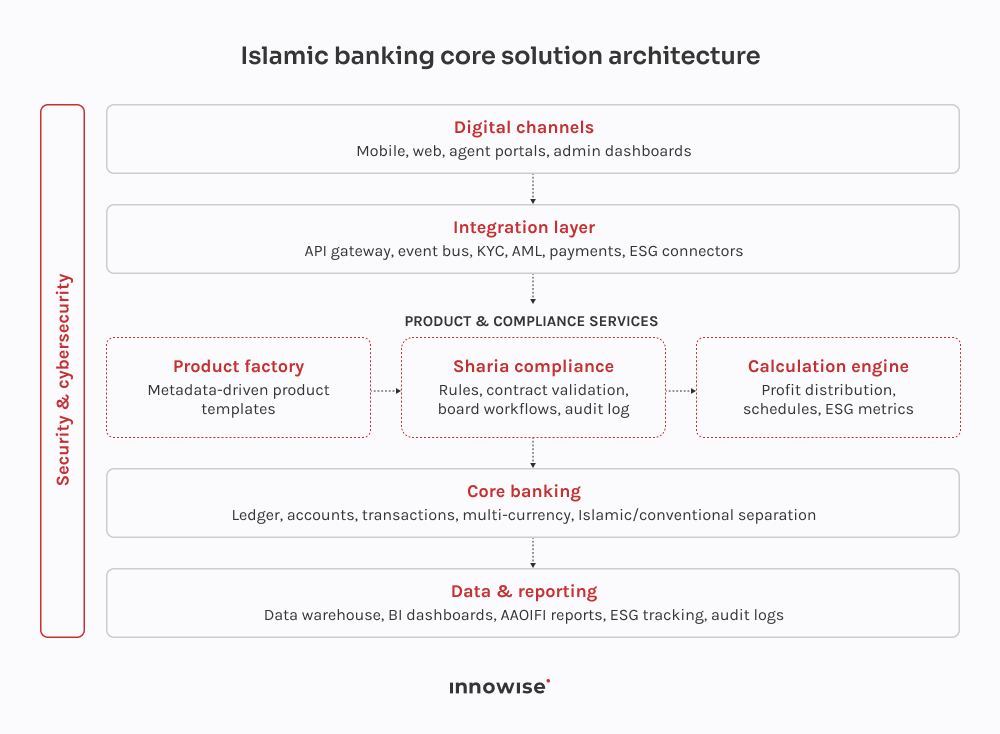
Islamic banking core solution architecture keeps the customer experience separate from the rules engine, ledger processing, and reporting stack. It also gives the bank room to modernize in stages instead of replacing the entire environment in one go. The strongest vendors I reviewed all point in the same direction: cloud-native, API-first, modular, and auditable.

The Islamic banking core solution architecture looks like this:

What follows is what each layer does and why it matters.

Digital channels layer

The channel layer should cover mobile banking, web banking, agent portals, and admin dashboards. This layer acts as a product distribution surface. Hexaware’s Sharia-compliant front-end prototype is relevant here because it is core-agnostic and designed to integrate with existing systems, which is often the reality for live banks.

GCC consumers now expect instant gratification. The time between application and approval should be measured in minutes. That means your digital channels need:

  • Instant decision engines embedded in the customer journey
  • Real-time compliance validation (not batch processing)
  • Biometric authentication and seamless onboarding
  • Multilingual support for global Muslim populations

Integration layer

An Islamic banking solution needs an API gateway, middleware, event-driven integrations, and third-party connectors for KYC, payments, AML, CRM, document management, regulatory systems, and increasingly, ESG data providers. 

Use an event bus for cross-system communication rather than tight point-to-point coupling. When a financing contract is approved, issued, rescheduled, or closed, that event should be available to reporting, notifications, analytics, and document systems without hard dependencies.

Product factory

A configurable product factory lets the bank launch and manage Islamic products without rebuilding the whole platform every time the board approves a new structure. It can be framed around productized modules such as Islamic Core Banking, Pool Management, and Financing, while product configurators are designed to reduce hand-coding and support rapid deployment.

Make the factory metadata-driven. Product templates, fee logic, eligibility criteria, profit formulas, approval chains, and document requirements should be configurable. It also means a Sharia board ruling that changes fee treatment can be implemented without a code deployment.

Sharia compliance

This layer should contain product rules, contract validation, approval workflows, Sharia board review steps, and compliance logs. Design it as a policy and workflow service, so compliance changes can be versioned, reviewed, and traced over time. 

In 2026, this layer will increasingly use AI. When a product team proposes a new financing structure, the compliance engine should flag potential conflicts with AAOIFI standards before human review. By the time a contract reaches the Sharia board, reviewers should see the full decision tree: which rules applied, which exceptions were considered, and which precedents exist.

Calculation engine

The calculation engine has to handle profit distribution, payment schedules, late payment rules, asset-backed financing calculations, fee treatment, and, increasingly, ESG impact metrics. 

In 2026, calculation engines are increasingly expected to handle:

  • Multi-layered profit pools with varying weights
  • Real-time distribution visibility for depositors
  • Smart contract integration for automated execution
  • Audit-ready logs for every calculation step
  • Takaful surplus distribution across thousands of participants

Engineering note: Separate calculation jobs into event-driven and periodic workloads. Some things should run when a contract event occurs, and others, such as profit distribution periods or month-end processing, should run on a schedule. That makes the engine easier to scale and test. It also keeps the logic explainable, which is essential when finance and compliance teams need to review the outcome.

Core banking layer

Some don’t start from scratch when building Islamic financial capabilities. They’ve got an existing system and are trying to integrate new components. It happens in what’s called the adoption layer, which is between the current banking setup and the new Islamic services. This layer handles discrepancies between standard practices and Sharia-compliant finance requirements, such as managing accounts separately, posting transactions appropriately, and aligning currency dealings with Sharia rules.

I would recommend using a modular design. It makes a difference. Instead of creating large, interconnected systems that are tough to manage, it’s better to develop smaller integration points. These points deal with specific areas such as account management, transaction posting, customer info, and balance checks. Doing it this way allows the core banking system to stay untouched and possibly even switch out down the line.

Let experts flag the risks before they get expensive to undo

Data and reporting layer

This layer should include the data warehouse, BI dashboards, regulatory reports, audit logs, and ESG impact tracking. It turns the system into something a bank can manage at scale. Innowise’s data management in the banking case study is a good parallel here: the team built a centralized repository to store, process, and secure large volumes of banking data when legacy systems and fragmented data made timely insight difficult.

In 2026, banks in the UAE, Saudi Arabia, and Qatar face growing expectations around real-time reporting, compliance monitoring, and alignment with Islamic finance standards. The  reporting layer needs to support:

  • Real-time compliance monitoring dashboards
  • Automated AAOIFI-standard reports
  • ESG impact metrics alongside financial performance
  • Sharia board review portals with full transaction visibility

Security and cybersecurity layer

Security needs to sit across the whole architecture. At minimum, I would include IAM, encryption, MFA, fraud detection, monitoring, and fine-grained access control. The same platform that stores customer data also stores contract governance records, approval history, and compliance evidence. In that environment, security becomes part of trust.

In 2026, cybersecurity is a front-and-center issue. Digital Islamic banks face:

  • Phishing and social engineering targeting customers and staff
  • Ransomware attacks that can lock critical compliance systems
  • Data breaches that expose sensitive financial and religious information
  • API vulnerabilities created by rapid digital expansion
  • Insider threats linked to privileged access abuse

The security layer should include:

  • Multi-factor authentication and behavioral biometrics
  • Encryption for data at rest and in transit
  • AI-powered threat detection and response
  • Blockchain-based, tamper-resistant  audit trails
  • Regular security training aligned with Islamic ethics
  • Zero-trust architecture, where every access request is validated

Islamic banks have an additional responsibility: they handle not just money but also people’s religious obligations. A security breach can become a breach of trust in a system people rely on to stay aligned with their faith. 

How Innowise can help with Islamic banking software development

Innowise has over 3,500 in-house specialists and has completed over 1,600 projects, including work for the Commercial Bank of Qatar and banking clients across Europe and the Middle East. Our team can help with banking software, fintech consulting, payment setups, embedded finance, or financial analytics. At the company level, Innowise is a full-cycle software development partner with custom development, cloud, DevOps, QA, security testing, and dedicated team/staff augmentation services. That matters for Islamic banking programs because they usually need a mix of architecture, backend engineering, compliance-aware implementation, and integration support rather than one narrow skill set.

For partners who handle contract governance records, compliance evidence, and sensitive customer data, Innowise holds a range of certifications, including ISO 9001:2015 for quality management and ISO 27001:2022 for information security. On the recognition side, Innowise was named Overall Peer-to-Peer Lending Platform of the Year at the 2026 FinTech Breakthrough Awards, which reflects proven capability in building secure, scalable financial platforms. 

We can help design the architecture, modernize the core, implement the product factory and calculation engine, integrate AI and blockchain capabilities where they make sense, build the cybersecurity layer properly from the start, integrate channels and enterprise systems, and support the delivery team with the right specialists. I would keep the message practical. The deliverable is a system that can pass a Sharia board audit..

We understand that in 2026, you’re not just competing with other banks, but you’re competing with the customer’s expectation of instant, transparent, and ethical banking. The software needs to deliver that while maintaining Sharia integrity.

Conclusion

An Islamic banking platform bottoms out with its contract model, calculation logic, compliance workflow, and ledger design. It can be well-designed but still fail an audit with the Sharia board if the profit-sharing isn’t set up right.

Banks and fintechs that get this right can build platforms that are easier to audit, scale, extend into new products and channels, and genuinely competitive with digital-native players. Those that treat Islamic banking as a conventional stack with a compliance sticker on top will keep paying for manual workarounds, slow product launches, and customer loss to speedier competitors.

The market is there. The technology is there. The customer demand is there. The market is ready, but what matters now is implementation quality: building systems that respect 1,400 years of principles while delivering 2026-level speed and transparency.

FAQ

Islamic banking software is a specialized system that manages Sharia-compliant financial products. It's built around contract-based structures like trade, leasing, partnership, and investment, with embedded compliance validation at every step.


Essential features include a configurable product factory for multiple Islamic contracts (Murabaha, Ijarah, Tawarruq); automated profit distribution engines; asset lifecycle management; Sharia compliance workflows with approval chains; real-time reporting to AAOIFI standards; and API-first architecture for digital channels. Increasingly, modern platforms also include AI-assisted compliance automation and blockchain transparency.

The core difference is that Islamic banking software validates contract structures before execution, manages profit-sharing instead of interest accrual, tracks real asset backing throughout the lifecycle, and maintains complete audit trails for Sharia board review. Conventional software assumes interest; Islamic software assumes contracts.

Yes, through what's called an Islamic banking window. The software architecture must maintain strict separation between Islamic and conventional books, with separate ledgers, profit pools, and compliance workflows. Many banks in the GCC, Southeast Asia, and the UK operate dual models this way. The challenge is to prevent commingling of funds and maintain separate Sharia board oversight for Islamic operations.

The biggest challenge is translating complex Sharia contracts into executable code without losing legal validity. Banks also need to integrate with legacy core systems that weren't designed for asset-backed financing. Profit-sharing calculations add another layer of complexity because they vary by contract type and timing. On top of that, the system has to validate compliance in real time, meet customer expectations for fast approvals, and preserve full audit trails. On top of that, banks also have to handle cybersecurity, regulatory reporting, and competition from digital-native fintechs.

Chief Delivery Officer & Head of Competence Center

Siarhei specializes in navigating high-stakes regulatory environments and complex delivery hurdles. He transforms abstract business requirements into secure, scalable architectures, ensuring that every project is technically sound and future-proofed against market shifts.

Table of contents

    Contact us

    Book a call or fill out the form below and we’ll get back to you once we’ve processed your request.

    Send us a voice message
    Attach documents
    Upload file

    You can attach 1 file up to 2MB. Valid file formats: pdf, jpg, jpeg, png.

    By clicking Send, you consent to Innowise processing your personal data per our Privacy Policy to provide you with relevant information. By submitting your phone number, you agree that we may contact you via voice calls, SMS, and messaging apps. Calling, message, and data rates may apply.

    You can also send us your request
    to contact@innowise.com
    What happens next?
    1

    Once we’ve received and processed your request, we’ll get back to you to detail your project needs and sign an NDA to ensure confidentiality.

    2

    After examining your wants, needs, and expectations, our team will devise a project proposal with the scope of work, team size, time, and cost estimates.

    3

    We’ll arrange a meeting with you to discuss the offer and nail down the details.

    4

    Finally, we’ll sign a contract and start working on your project right away.

    More services we cover

    arrow