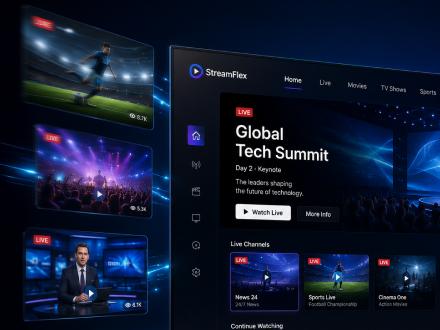
OTT DRM services protect streaming content from unauthorized access, copying, and distribution.
Your message has been sent.
We’ll process your request and contact you back as soon as possible.
The form has been successfully submitted.
Please find further information in your mailbox.
Select language

Digital piracy remains one of the biggest unresolved challenges in the streaming industry. According to consulting firm Kearney, online video piracy results in approximately $75 billion in annual revenue leakage for the global media industry, with losses projected to reach $125 billion by 2028 if current trends continue.
Piracy website traffic has already surpassed pre-pandemic levels, reflecting sustained demand for unauthorized access to movies, TV shows, live sports, and premium streaming content.
For OTT providers, these numbers translate into tangible business risks. Every unauthorized stream can impact subscription revenue, advertising income, pay-per-view purchases, and content licensing value.
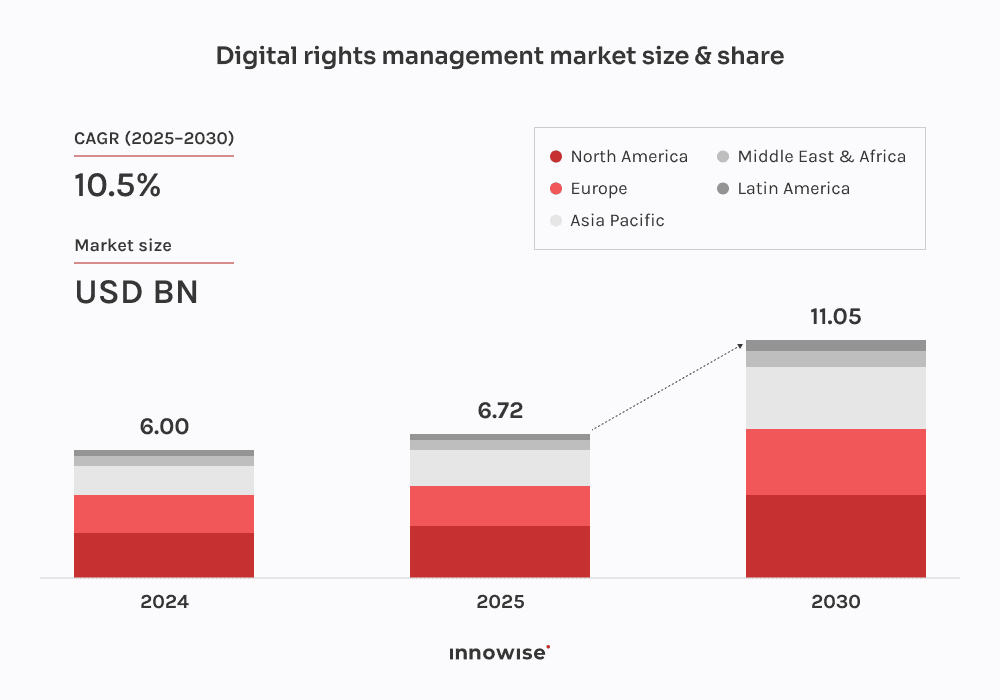
This is one of the reasons the DRM market itself is expanding so rapidly. Grand View Research estimates that the global digital rights management market reached USD 6.16 billion in 2024 and is expected to grow to USD 14.48 billion by 2033, reflecting growing demand for content protection across streaming, media, gaming, and digital publishing.
In the OTT DRM world, content may be king, but control is what protects the kingdom. The real question is which OTT DRM solution can provide the right balance of security, device coverage, scalability, and user experience.
To answer that question, I’ll examine how OTT DRM works, compare the leading solution types, and explore the factors that should shape your decision.
Simply put, OTT DRM (digital rights management) services are technologies that help streaming platforms protect video content from unauthorized access and distribution. Such technologies work by encrypting video streams and ensuring that only approved users and devices can decrypt and play them.
For streaming providers (like Netflix, Amazon Prime Video, Hulu, ect), DRM goes far beyond preventing simple downloads. Modern OTT DRM solutions help:
Most OTT platforms rely on one or more of the three major DRM ecosystems developed by leading technology vendors, such as Google Widevine, Microsoft PlayReady, and Apple FairPlay Streaming (FPS).
Because no single DRM system supports every device, OTT providers typically implement a multi-DRM strategy, allowing content to be securely delivered across diverse operating systems, browsers, smartphones, tablets, smart TVs, and streaming devices.
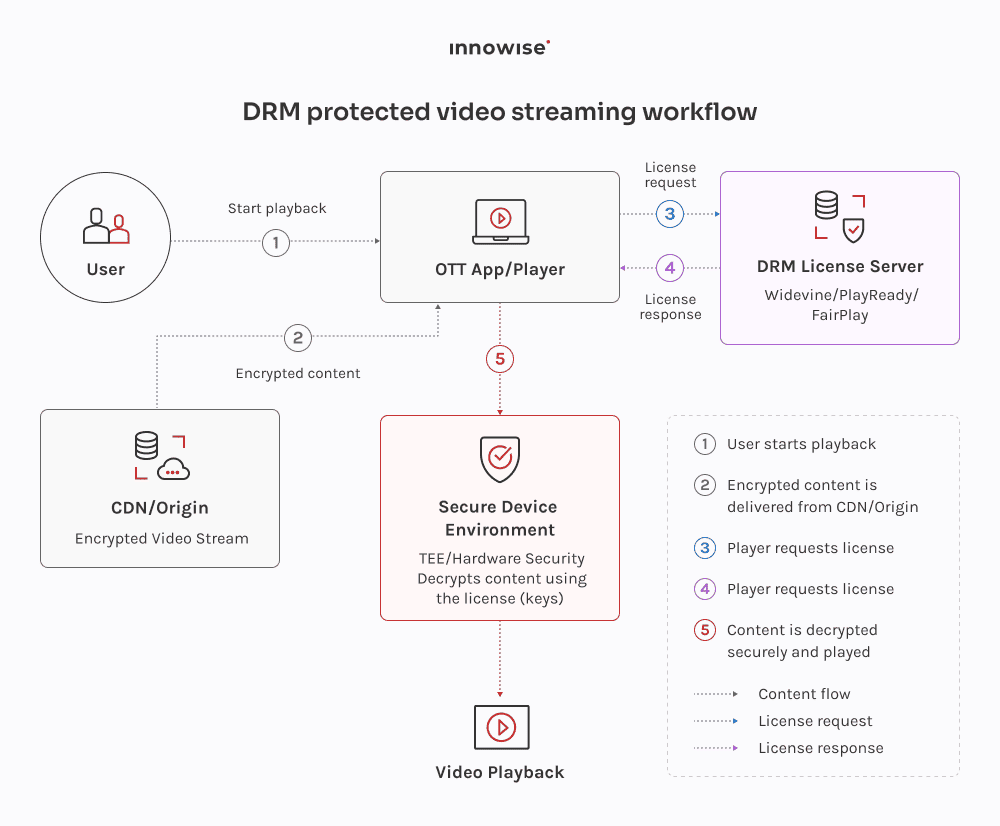
Under the hood, DRM protects video content by encrypting it and ensuring that only authorized users and devices can decrypt and play it. While the process happens behind the scenes in milliseconds, it involves several coordinated steps between the OTT platform, the video player, and the DRM provider.
Here’s how the process typically works:
Before a movie, TV show, or live event is published, the video is encrypted using DRM-compatible packaging tools. The encryption process generates one or more content keys that will later be used to decrypt the stream during playback.
When a subscriber starts watching content through a web browser, mobile app, smart TV, or streaming device, the video player detects that the stream is DRM-protected and initiates a license request.
The player’s request is sent to the DRM license server, which checks whether the user is authorized to access the content. This verification may include:
If the user meets all access requirements, the license server returns a DRM license containing the decryption keys and usage rules. These rules can define whether content can be downloaded, how long offline viewing is allowed, or whether screen recording protections should be enforced.
Once the license is issued, the video player decrypts the content inside a secure playback environment, such as a Trusted Execution Environment (TEE) or hardware-backed security module available on the device. The decryption keys remain protected and are never exposed to the user or third-party applications.
The decrypted video exists only temporarily in memory during playback rather than as a downloadable file on the device.
To address increasingly sophisticated piracy techniques, providers often combine DRM with additional security measures such as forensic watermarking to identify the source of leaked content, key rotation for live streaming protection, anti-screen-capture technologies on supported devices.
Combined, DRM, forensic watermarking, key rotation, and device-level protections create a multilayered content security framework that helps OTT platforms reduce piracy risks, protect revenue streams, and meet the security requirements of content owners and rights holders.
As subscription growth slows and consumers become more selective about where they spend their money, streaming providers are competing fiercely for audience attention. According to Deloitte’s 2025 Digital Media Trends report, 47% of consumers believe they already pay too much for streaming services, while 39% have canceled at least one streaming subscription within the previous six months.
To stay relevant in this environment, streaming platforms are doubling down on exclusive content. Netflix alone spent roughly $18 billion on content in 2025.
The challenge is that digital content can be copied and redistributed almost instantly. Without adequate protection, the very assets designed to attract and retain viewers can lose their exclusivity and commercial value.
That’s why DRM has become a cornerstone of modern OTT platforms. More than a security measure, it is a mechanism for preserving the value of content investments. DRM helps OTT providers protect those investments by controlling access to premium content and meeting the security requirements imposed by media studios and rights holders.
Best for: Android-first and large-scale OTT services
Typical platforms: Android, Chrome, Chromecast, Android TV, many smart TVs
Developed by Google, Widevine is the most widely used DRM technology in the OTT ecosystem. It supports multiple security levels, including hardware-backed protection, making it suitable for premium video-on-demand (VOD), live streaming, and 4K content distribution.
Best for: Apple ecosystem
Typical platforms: iOS, iPadOS, macOS, Safari, Apple TV
FairPlay Streaming is Apple’s proprietary DRM solution for protecting content delivered through HLS. It is required for secure playback on Apple devices and is commonly used by subscription-based and transactional streaming services targeting Apple users.
Best for: Connected TV ecosystems and enterprise-grade streaming
Typical platforms: Windows, Xbox, Edge, smart TVs, set-top boxes
PlayReady is Microsoft’s DRM platform designed for a broad range of connected devices. It supports advanced rights management features, including content expiration, offline playback, output protection, and subscription-based access controls.
Best for: Huawei device ecosystem
Typical platforms: Huawei smartphones, tablets, smart screens, HMS-powered devices
WisePlay is Huawei’s DRM technology for protecting premium content across its device portfolio. While less common globally, it can be important for OTT providers targeting markets where Huawei Mobile Services have significant adoption.
Choosing the wrong DRM solution can lead to playback issues, unsupported devices, scalability bottlenecks, and higher operating costs. Before making a decision, at Innowise, we recommend assessing providers against the following technical and business requirements.
“No DRM solution can eliminate piracy entirely, but a well-designed multi-DRM strategy significantly raises the barrier to unauthorized access. The most effective OTT platforms combine DRM with watermarking, access controls, and continuous monitoring to create multiple layers of protection.”

Head of Software Development Department at Innowise
Based on Innowise’s experience building OTT platforms and video streaming solutions, here are the mistakes that most frequently undermine OTT DRM deployments:
Innowise helps media companies, broadcasters, and content owners implement Widevine, FairPlay, PlayReady, and multi-DRM architectures for secure video delivery across web, mobile, Smart TV, and connected-device ecosystems.
Beyond DRM implementation, we develop end-to-end video-on-demand (VoD) platforms with secure content delivery, rights management, offline viewing, subscription and pay-per-view monetization, and advanced protection mechanisms such as watermarking and tokenized access.
OTT DRM services protect streaming content from unauthorized access, copying, and distribution.
When a viewer plays the video, the OTT player requests a license from the DRM license server. The server authenticates the user, validates entitlement policies, and, if access is authorized, issues the decryption keys required to unlock the encrypted content. The player then securely decrypts and renders the stream within a trusted playback environment.
That depends on your audience. Widevine is commonly used for Android and Chrome, FairPlay is required for Apple devices, and PlayReady supports many Windows and Smart TV environments. Since no single DRM covers every platform, most OTT providers choose a multi-DRM solution.
In most cases, yes. If you want your content to play across iOS, Android, web browsers, Smart TVs, streaming devices, and gaming consoles, multi-DRM is the simplest and most reliable way to ensure broad compatibility.
Not entirely. DRM is an essential first line of defense, but determined pirates can still use techniques such as screen recording or account sharing. That's why many OTT providers combine DRM with watermarking, geo-blocking, tokenized access, and anti-piracy monitoring.
DRM is a foundational component of your OTT platform architecture. It must be integrated during the development phase to ensure workflows like content ingestion, packaging, and playback are secure.

Chief Technology Officer
A visionary architect, Dmitry bridges the gap between raw innovation and commercial viability. He oversees the company’s tech roadmap, ensuring every solution is built on a stack that solves immediate business pain.


Your message has been sent.
We’ll process your request and contact you back as soon as possible.