
Machine learning trends 2026: technology shifts and business impact

Nov 12, 2026 17 min read
Head of Big Data, AI/ML/DS Departments
Verified expert
Every article at Innowise is created by authors with real-world experience. They understand the topic beyond theory and bring insight from real projects.
11+ years of experience
Verified expert
11+ years of experience
Philip builds data infrastructures that provide clarity. He focuses on the "why" behind the data, architecting systems that process massive volumes into actionable insights while ensuring the technical vision remains sharp and purposeful.
Expertise
Big data AI & ML Python
Let's talk

Key takeaways

  • ML in 2026 is getting more practical. A lot of the progress is in reuse, efficiency, monitoring, calibration, and making models less painful to run in production.
  • Pretrained and self-supervised models are changing how much needs to be built from scratch. Tabular foundation models, reusable visual representations, and synthetic training data can reduce some of the usual training and labeling work.
  • Deployment constraints matter more than benchmark wins. Latency, memory, energy use, drift, subgroup performance, and inference cost can matter more than squeezing out another fraction of a percent in accuracy.
  • The same trends are changing very different workflows. In retail it shows up in forecasting and recommendations; in banking, fraud and credit risk; in healthcare, patient prioritization; in manufacturing, predictive maintenance and defect detection; in logistics, ETAs and delay prediction.
  • A few promising areas are still very much works in progress. Continual learning, causal ML, hybrid models, cross-domain adaptation, and uncertainty-aware prediction all look useful, but I’d separate what has been demonstrated from what is ready to deploy.
Summarize article with AI

ML is boring now. That’s the trend.

Or, at least, a lot of the interesting progress is happening in places that don’t make very good headlines: shaving 40 milliseconds off inference, training with fewer labels, reusing a model instead of building another one, finding out why a 96%-accurate system keeps screwing up the same group of users.

And this is probably good news. I believe most companies don’t really need a grand ML breakthrough. They wouldn’t mind a good model that keeps working when the data changes, doesn’t cost a fortune to run, and gives some warning when it starts behaving strangely.

So, let’s look at the latest trends in machine learning to see where that work is heading.

Put ML to work

Machine learning market overview and forecast

The ML market is growing fast. But nobody quite agrees on how big it is.

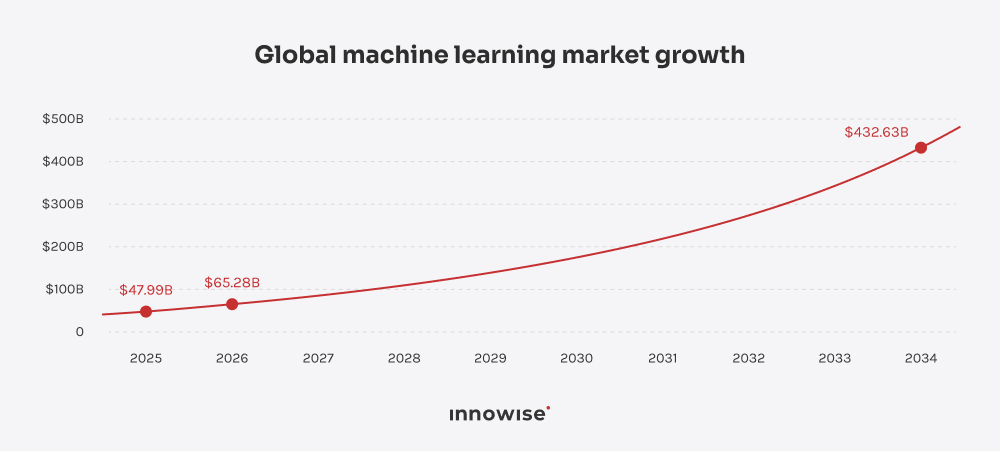
Fortune Business Insights puts the global machine learning market at $65.28 billion in 2026 and expects it to reach $432.63 billion by 2034. The Business Research Company gives a much larger estimate for the same year: $127.94 billion in 2026, rising to $445.25 billion by 2030.

Global machine learning market growth 2025-2034.

That’s almost a twofold difference for 2026. Mostly, it tells us that “machine learning market” is a surprisingly elastic category: different analysts include different mixes of software, infrastructure, services, and hardware.

The details inside the forecasts are useful too. Fortune expects cloud deployment to account for 53.14% of the ML market in 2026, with large enterprises at 55.61% and IT and telecom at 17.56% of end use.

Meanwhile, Gartner expects spending on AI platforms for data science and machine learning to reach $26.44 billion in 2026, up 36.3% from 2025.

So I wouldn’t get too attached to one giant market number. The useful part is the direction: spending is rising, cloud takes a large share of deployment, and the tooling around ML is becoming a sizeable market of its own.

Now, let’s see the recent trends in machine learning themselves.

Current trends in machine learning

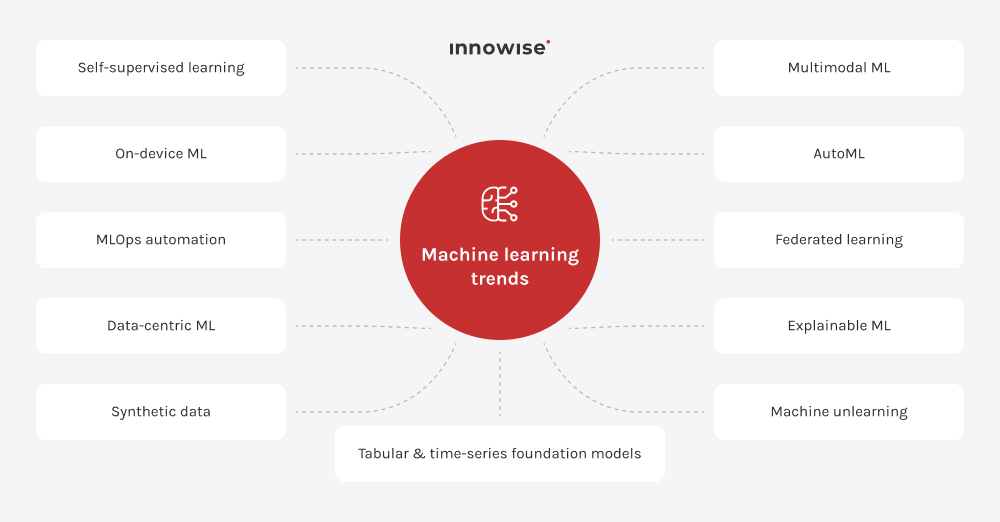
Some of the top machine learning trends are new. Others have been around for years and are only now becoming practical enough to go outside research teams. I’m more interested in the second group, to be honest, but anyway, let’s get into it.

Key machine learning trends this year.

Foundation models for tabular data and time series

Tables are having their foundation-model moment.

In June 2026, Google introduced TabFM, a model for tabular classification and regression that can make predictions on new datasets without the usual round of task-specific training and hyperparameter tuning. Google tested it across 38 classification and 13 regression datasets, including tables with up to 150,000 samples.

What’s curious about it? It’s how it was trained. There isn’t some gigantic public warehouse of clean enterprise tables, so Google generated hundreds of millions of synthetic datasets instead.

I wouldn’t delete XGBoost just yet. For many structured-data problems, conventional models are still cheaper, easier to debug, and very hard to beat. But the idea of opening a new dataset and getting a decent baseline without another tuning marathon is pretty attractive.

And time series are moving in the same direction. Google’s TimesFM is pretrained on large collections of time-series data and can produce zero-shot forecasts for datasets it hasn’t seen before. The attraction is similar to TabFM: less task-specific training every time somebody needs a new demand, traffic, or capacity forecast.

Would I replace every existing forecasting pipeline with it? No. But it’s worth testing when the alternative is another round of model training and tuning from scratch.

Self-supervised learning needs fewer labels

Labeling data is one of those jobs everyone agrees is essential and nobody is excited to pay for.

Self-supervised learning gets around part of that problem by learning useful representations from unlabeled data first, then adapting them to a smaller labeled dataset.

Meta’s DINOv3 is a good example. It was trained on 1.7 billion images without human labels, with the largest model reaching 7 billion parameters. The same frozen visual backbone can then support tasks such as classification, object detection, segmentation, and tracking.

For companies sitting on years of unlabeled inspection photos, satellite images, medical imagery, or video, that changes the economics a little. You may still need labels. Just perhaps not several million of them.

Smaller models are becoming more interesting again

A beautiful model that needs a data center to answer a simple question has limited charm on a phone, sensor, camera, or industrial controller.

So model compression keeps getting more attention: quantization reduces numerical precision, pruning removes less useful weights, and distillation transfers knowledge into a smaller model. TensorFlow’s own optimization toolkit lists latency, memory use, power consumption, and model size as central constraints for edge deployment.

There is no free lunch here. Compress too aggressively and accuracy drops.

The job is finding the point where nobody notices except the infrastructure bill.

MLOps is becoming less optional

Training the model was never the entire job. We just spent a surprising amount of time pretending it was.

Once an ML system is live, someone has to know which dataset produced it, which code version trained it, whether input data has changed, whether performance is drifting, when retraining is allowed, and how to roll back a bad release.

Tools are reflecting this. MLflow 3, for example, expanded its model-management architecture around stronger lineage and comparison between model versions and experiments.

This is probably one of the least glamorous machine learning trends on the list, and one of the ones I’d take most seriously.

Synthetic data gets a reality check

Synthetic data sounds wonderfully convenient. Missing examples? Make some.

That can work. It can also make a model very good at understanding an artificial world that doesn’t quite exist.

A 2026 Apple research paper looked at mixing real and synthetic training data and found something more useful than “synthetic data helps.” Their results suggest an optimal ratio can exist: add synthetic data and performance improves up to a point, then starts getting worse as the synthetic and real distributions move too far apart.

Multimodal ML moves into ordinary prediction

Multimodal doesn’t have to mean a model that can discuss your photo and write a poem about it.

For predictive ML, it can be much less exciting and much more useful: product image + description + price, medical scan + patient history, sensor readings + maintenance notes.

Current AutoGluon tooling, for example, can combine image, text, tabular, and document data for tasks including classification and regression.

The annoying part comes later. What happens when the image is missing? Or the sensor dies? Or one data source arrives two hours later than the others?

That needs to be part of evaluation, not a surprise discovered after launch.

AutoML keeps taking away the boring bits

Model selection, hyperparameter tuning, ensembling, parts of feature processing: a lot of this can already be automated reasonably well.

Good.

I’m not convinced a highly paid ML engineer needs to spend an afternoon manually testing 47 combinations of learning rate and tree depth just to prove dedication to the craft.

What AutoML doesn’t automate very well is deciding whether the target makes sense, whether the training data leaks information from the future, whether the evaluation metric reflects the business cost, or whether the model should exist at all.

Those remain inconveniently human problems.

Federated learning still doesn’t equal privacy

Federated learning has a very appealing setup: train across several devices or organizations without moving all the raw data into one central database.

Useful, yes. Automatically private, no.

NIST has documented attacks that can recover information from the model updates exchanged during federated training, and recommends additional protections rather than treating decentralization itself as a privacy guarantee.

And real deployments are messy. Different devices have different compute, participants disappear, data distributions differ, security assumptions break. NIST’s 2024 implementation review puts the gap between neat federated-learning theory and production systems rather plainly.

One expert quoted there, Dr. Mat Weldon from the UK Office for National Statistics, put it better than I can:

“It’s easier to design a new federated learning architecture than it is to red team it.”

Fair.

Explainability gets less ceremonial

For years, adding a SHAP chart to a dashboard could make a model feel satisfyingly “explainable.”

That’s a low bar.

NIST distinguishes between explainability, or understanding how a system produced an outcome, and interpretability, meaning what that result means in its context. Its guidance also recommends testing explanation methods before deployment rather than assuming the explanation is correct because the chart looks convincing.

NIST researchers published work in 2026 on explainable validation and feature reduction as well, which is interesting because it pulls explainability closer to model testing rather than leaving it as a layer added afterward.

I like that direction. An explanation should be something we test, not decoration for the model card.

Machine unlearning becomes a real engineering question

Suppose someone asks you to delete their data.

You delete the database record.

Fine.

What about the model that already trained on it?

That is where machine unlearning comes in: removing the influence of particular training data without retraining the entire model from zero. In June 2026, Google Research published a framework for auditing whether an unlearned model really behaves more like a freshly retrained model than the original one.

And that second part matters. Forgetting something is one problem. Proving the model forgot it is another.

Machine unlearning is still much closer to active research than routine enterprise tooling, but I’d keep an eye on it. The moment “delete my data” has to mean more than deleting a row, this stops being theoretical.

Build an ML solution for your business

How ML trends are changing workflows across industries

The same ML trend can behave very differently once it lands in a real workflow. In retail, faster inference can mean updating recommendations while someone is still browsing. In manufacturing, it can mean catching a defect before the product has already moved down the line.

  • Education
  • Retail and e-commerce
  • Banking and finance
  • Healthcare
  • Manufacturing
  • Logistics and transportation

Education

Education platforms already have a lot of data: answers, attempts, response times, skipped tasks, course progress. The harder part is turning that into something useful without pretending a model understands a student better than a teacher does.

Machine learning was already the largest technology segment in the AI-in-education market in 2025, with performance tracking, personalization, and intelligent tutoring among the main applications.

  • Adapt exercise difficulty and sequencing based on previous performance instead of forcing everyone through the same path.
  • Predict dropout risk from patterns such as declining participation, repeated failures, or long gaps between sessions.
  • Spot knowledge gaps earlier and schedule revision before the student reaches the next topic completely unprepared.

Retail and e-commerce

Retail has been using ML for years, but the interesting changes are happening in speed and data variety. Forecasting can update more often, recommendations can use more than purchase history, and visual search can combine images with product descriptions and catalog data.

  • Forecast demand and automate replenishment using sales history, seasonality, promotions, and fresher operational data.
  • Personalize recommendations from browsing and buying behavior rather than static customer segments.
  • Improve product search by combining text and image data, which is useful when the customer doesn’t know what the item is called but has a photo.

Banking and finance

Banking is where model monitoring, explainability, and drift become hard to ignore. Fraud patterns change, customer behavior changes, and a model that looked good six months ago can become very expensive very quickly.

The global machine learning in banking market was worth roughly $40 billion in 2025 and is projected to reach around $150 billion by 2034, according to Fortune Business Insights.

  • Detect suspicious transactions and rank cases so investigators start with the ones that look most risky.
  • Explain credit decisions by showing which factors had the strongest influence on a score.
  • Monitor model drift as fraud techniques, spending behavior, and customer profiles change.

Healthcare

Healthcare is one of those areas where a good benchmark number is nowhere near enough. Models can behave differently across hospitals, patient groups, devices, and clinical settings, so calibration and monitoring matter just as much as raw predictive performance.

The global healthcare predictive analytics market is estimated at $19.7 billion in 2026 by Grand View Research, which expects it to reach $49.3 billion by 2033.

  • Identify early signs of deterioration, including sepsis risk, before the situation becomes obvious clinically.
  • Predict readmission risk and prioritize follow-up for patients more likely to return.
  • Rank cases for review so clinicians can focus attention where the predicted risk is highest.

Manufacturing

Manufacturing is probably the clearest case for on-device ML. If a camera is checking parts moving down a line, there often isn’t much sense in shipping every image to the cloud and waiting for a response.

The broader AI-in-manufacturing market is estimated at $9.85 billion in 2026, with machine learning and computer vision used for predictive maintenance, inspection, quality control, and production planning.

  • Predict equipment failures from vibration, temperature, pressure, and maintenance history.
  • Detect defects with computer vision while the product is still on the production line.
  • Predict product quality from manufacturing parameters before final inspection.

Logistics and transportation

Logistics is full of prediction problems, which makes it a natural ML playground: arrival times, delays, warehouse demand, traffic, route changes, missed connections.

The machine learning in logistics market is estimated at $5.3 billion in 2026 and projected to reach $44.5 billion by 2035, according to Global Market Insights.

Here, uncertainty matters too. “ETA 14:10” and “ETA 14:10, but we’re really not sure” are two very different pieces of information for someone waiting at a loading dock.

  • Predict arrival times using historical delays, traffic conditions, and live vehicle positions.
  • Forecast shipment delays early enough to adjust warehouse or delivery plans.
  • Predict travel time and demand to support route planning and fleet allocation.

Education

Education platforms already have a lot of data: answers, attempts, response times, skipped tasks, course progress. The harder part is turning that into something useful without pretending a model understands a student better than a teacher does.

Machine learning was already the largest technology segment in the AI-in-education market in 2025, with performance tracking, personalization, and intelligent tutoring among the main applications.

  • Adapt exercise difficulty and sequencing based on previous performance instead of forcing everyone through the same path.
  • Predict dropout risk from patterns such as declining participation, repeated failures, or long gaps between sessions.
  • Spot knowledge gaps earlier and schedule revision before the student reaches the next topic completely unprepared.

Retail and e-commerce

Retail has been using ML for years, but the interesting changes are happening in speed and data variety. Forecasting can update more often, recommendations can use more than purchase history, and visual search can combine images with product descriptions and catalog data.

  • Forecast demand and automate replenishment using sales history, seasonality, promotions, and fresher operational data.
  • Personalize recommendations from browsing and buying behavior rather than static customer segments.
  • Improve product search by combining text and image data, which is useful when the customer doesn’t know what the item is called but has a photo.

Banking and finance

Banking is where model monitoring, explainability, and drift become hard to ignore. Fraud patterns change, customer behavior changes, and a model that looked good six months ago can become very expensive very quickly.

The global machine learning in banking market was worth roughly $40 billion in 2025 and is projected to reach around $150 billion by 2034, according to Fortune Business Insights.

  • Detect suspicious transactions and rank cases so investigators start with the ones that look most risky.
  • Explain credit decisions by showing which factors had the strongest influence on a score.
  • Monitor model drift as fraud techniques, spending behavior, and customer profiles change.

Healthcare

Healthcare is one of those areas where a good benchmark number is nowhere near enough. Models can behave differently across hospitals, patient groups, devices, and clinical settings, so calibration and monitoring matter just as much as raw predictive performance.

The global healthcare predictive analytics market is estimated at $19.7 billion in 2026 by Grand View Research, which expects it to reach $49.3 billion by 2033.

  • Identify early signs of deterioration, including sepsis risk, before the situation becomes obvious clinically.
  • Predict readmission risk and prioritize follow-up for patients more likely to return.
  • Rank cases for review so clinicians can focus attention where the predicted risk is highest.

Manufacturing

Manufacturing is probably the clearest case for on-device ML. If a camera is checking parts moving down a line, there often isn’t much sense in shipping every image to the cloud and waiting for a response.

The broader AI-in-manufacturing market is estimated at $9.85 billion in 2026, with machine learning and computer vision used for predictive maintenance, inspection, quality control, and production planning.

  • Predict equipment failures from vibration, temperature, pressure, and maintenance history.
  • Detect defects with computer vision while the product is still on the production line.
  • Predict product quality from manufacturing parameters before final inspection.

Logistics and transportation

Logistics is full of prediction problems, which makes it a natural ML playground: arrival times, delays, warehouse demand, traffic, route changes, missed connections.

The machine learning in logistics market is estimated at $5.3 billion in 2026 and projected to reach $44.5 billion by 2035, according to Global Market Insights.

Here, uncertainty matters too. “ETA 14:10” and “ETA 14:10, but we’re really not sure” are two very different pieces of information for someone waiting at a loading dock.

  • Predict arrival times using historical delays, traffic conditions, and live vehicle positions.
  • Forecast shipment delays early enough to adjust warehouse or delivery plans.
  • Predict travel time and demand to support route planning and fleet allocation.
The model that wins the benchmark is not always the one I’d put into production. Once you add latency, infrastructure cost, drift, and maintenance, a slightly less accurate model can easily become the better engineering decision.
Dmitry Nazarevich, CTO.
Dmitry Nazarevich
Chief Technology Officer

Machine learning future trends

Some ML ideas are already useful today. Others still need better benchmarks, cheaper compute, or a few unpleasant encounters with production before I’d call them ready.

These are the emerging trends in machine learning I’d keep watching.

  • Cross-domain generalization and adaptation icon.

    Cross-domain generalization and adaptation

    One of ML’s oldest problems is still very much alive: train a model in one environment, move it somewhere slightly different, watch performance drop.

    Domain generalization tries to make models hold up on data distributions they haven’t seen before. A 2026 study on pattern classification in unseen environments describes exactly this problem: changes in sensors, acquisition conditions, or other domain characteristics can be enough to hurt a model badly.

    The practical version is easy to imagine. A vision model trained in one factory has to work in another factory with different cameras. A medical model moves to another hospital. A fraud model sees a new customer population.

    I suspect this will become less of a research specialty and more of a basic deployment requirement.

  • Continual learning icon.

    Continual learning

    Most production models still learn in chunks: collect new data, retrain, validate, deploy again.

    Continual learning aims for something smoother. The model keeps learning as new data arrives without forgetting what it knew before.

    That last part is the catch.

    A 2026 systematic review of 189 peer-reviewed continual-learning papers still identifies catastrophic forgetting as one of the field’s central problems: learning something new can damage performance on older tasks.

    So I wouldn’t replace scheduled retraining with continual learning just because the name sounds better. But for fraud detection, industrial systems, recommendations, and other environments that change constantly, the appeal is obvious.

  • Hybrid ML models icon.

    Hybrid ML models

    There is something slightly funny about spending years trying to make neural networks learn everything from data, only to discover that known physics can still be useful.

    Google’s NeuralGCM is a good example. It combines machine learning with a physics-based atmospheric solver rather than asking either one to do the whole job. In research published in Nature, the model produced competitive weather and climate forecasts while using three to five orders of magnitude fewer computational resources than comparable conventional models.

    That idea goes far beyond weather.

    If we already know physical constraints, engineering rules, or other domain relationships, feeding them into the model can make more sense than asking a neural network to rediscover gravity from a spreadsheet.

  • Causal ML icon.

    Causal ML

    Prediction answers questions such as:

    Who is likely to churn?

    Businesses usually want the next question:

    Who will stay if we give them a discount?

    That is a causal question.

    Causal ML combines machine learning with causal inference to estimate what may happen under different interventions. The field is already being used to estimate individualized treatment effects in medicine, although researchers still warn that incorrect assumptions and confounding can produce convincing but wrong conclusions.

    I think this is one of the more interesting directions here because it changes what the model is for. Prediction describes a likely future. Causal ML tries to tell you whether doing something will change it.

    Much harder problem.

    Much more useful one.

  • Uncertainty-aware predictions icon.

    Uncertainty-aware predictions

    A model saying “92% confidence” feels reassuring.

    It may also be nonsense.

    Uncertainty calibration tries to make confidence line up with real predictive accuracy. Research published in Nature Machine Intelligence in 2026 describes calibration as essential for reliable ML deployment precisely because modern models can be highly confident while being wrong.

    Distribution shift makes this worse. A 2026 Scientific Reports study found that predictive models can lose both performance and calibration when moved across heterogeneous real-world datasets.

    For businesses, the useful outcome isn’t a model that always gives an answer. Sometimes the better model is the one that says, in effect, I’m not very sure about this one, give it to a human.

    I’d like to see much more of that.

Need help choosing the right ML approach?

Next steps: how businesses can implement ML technology trends

The worst way to use this list is to pick a trend because it sounds current and then go looking for a problem to attach it to.

Start with the annoying business problem instead.

01
Define what needs to improve

More accurate forecasts? Fewer false fraud alerts? Lower inference cost? Faster inspection? Pick the outcome first and keep the current process as a baseline.

02
Check whether the data can support it

Before comparing models, look at labels, missing values, access rights, class imbalance, coverage, and whether production data will resemble the data used for training. This is also where a lot of ML projects become less exciting very quickly.

03
Compare the new thing with the boring thing

If a pretrained model, AutoML system, or multimodal architecture is under consideration, test it against a simpler baseline under the same conditions. Same data, same metrics, same latency limits, same business objective.

If the complicated model wins by 0.3% and costs four times more to run, I’d want a very good reason for keeping it.

04
Pilot it where failure is survivable

Use representative data and test the cases most likely to cause trouble: missing inputs, rare classes, unusual devices, weaker customer segments, peak loads. Decide in advance what would make you stop the pilot.

05
Give the model an owner after launch

Someone needs to watch drift, latency, cost, calibration, subgroup performance, and the business metric the model was supposed to improve. Also decide when to retrain it, roll it back, replace it, or simply switch it off.

And yes, sometimes the right conclusion is that the new ML trend doesn’t improve enough to justify changing anything.

That counts as a successful evaluation too.

arrow-icon.arrow-icon.
01 Define what needs to improve

More accurate forecasts? Fewer false fraud alerts? Lower inference cost? Faster inspection? Pick the outcome first and keep the current process as a baseline.

arrow-icon.arrow-icon.
02 Check whether the data can support it

Before comparing models, look at labels, missing values, access rights, class imbalance, coverage, and whether production data will resemble the data used for training. This is also where a lot of ML projects become less exciting very quickly.

arrow-icon.arrow-icon.
03 Compare the new thing with the boring thing

If a pretrained model, AutoML system, or multimodal architecture is under consideration, test it against a simpler baseline under the same conditions. Same data, same metrics, same latency limits, same business objective.

If the complicated model wins by 0.3% and costs four times more to run, I’d want a very good reason for keeping it.

arrow-icon.arrow-icon.
04 Pilot it where failure is survivable

Use representative data and test the cases most likely to cause trouble: missing inputs, rare classes, unusual devices, weaker customer segments, peak loads. Decide in advance what would make you stop the pilot.

arrow-icon.arrow-icon.
05 Give the model an owner after launch

Someone needs to watch drift, latency, cost, calibration, subgroup performance, and the business metric the model was supposed to improve. Also decide when to retrain it, roll it back, replace it, or simply switch it off.

And yes, sometimes the right conclusion is that the new ML trend doesn’t improve enough to justify changing anything.

That counts as a successful evaluation too.

Machine learning applications and trends in practice: Innowise case studies

All case studies
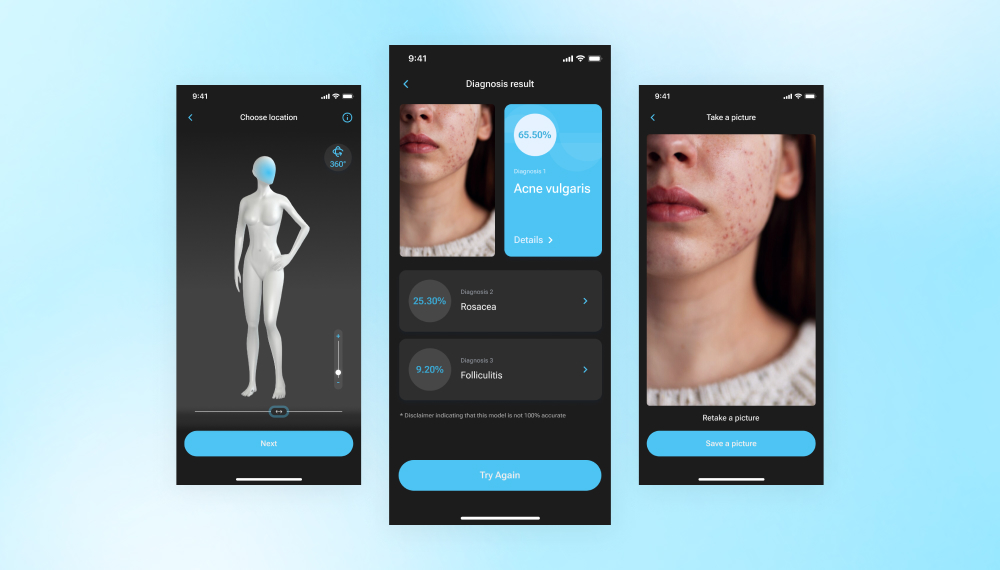
AI dermatologist skin scanner app development
An AI app we built uses deep learning and image recognition to quickly assess skin conditions, giving preliminary diagnoses based on photos.
30 dermatological conditions supported
Building an AI remote patient monitoring system
We built a wound care app as part of the remote patient monitoring software and implemented an AI-driven analysis for accurate assessment.
2-tier user role system
100% system compliance
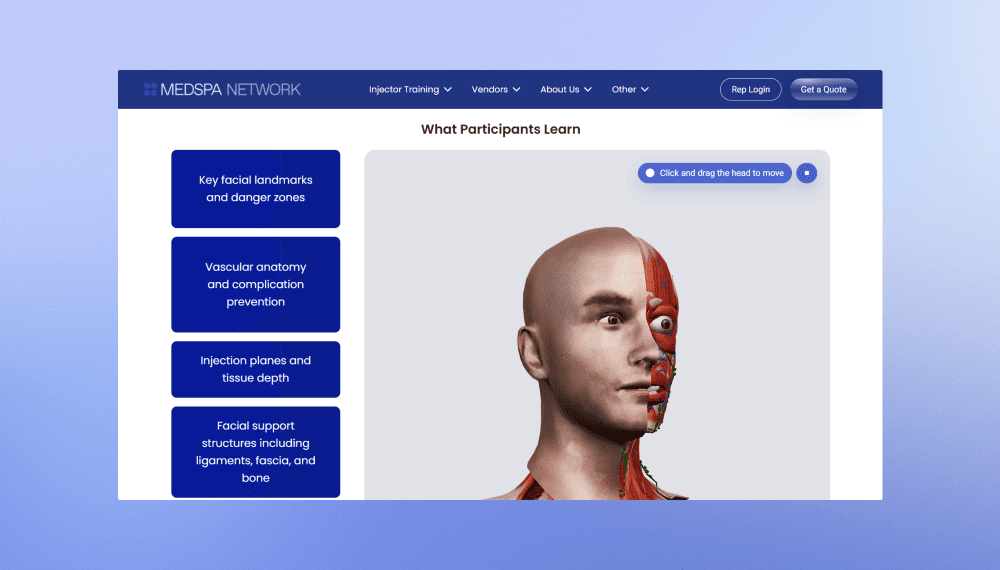
MedSpa Network website redesign and rebuild
Innowise rebuilt MedSpa Network’s website on WordPress, giving its team control over day-to-day content updates.
2 months from kickoff to launch
3-5 leads per week up from 1 per month
View case study
Client review
View case study
Client review logo. Client review

MedSpa Network website redesign and rebuild.
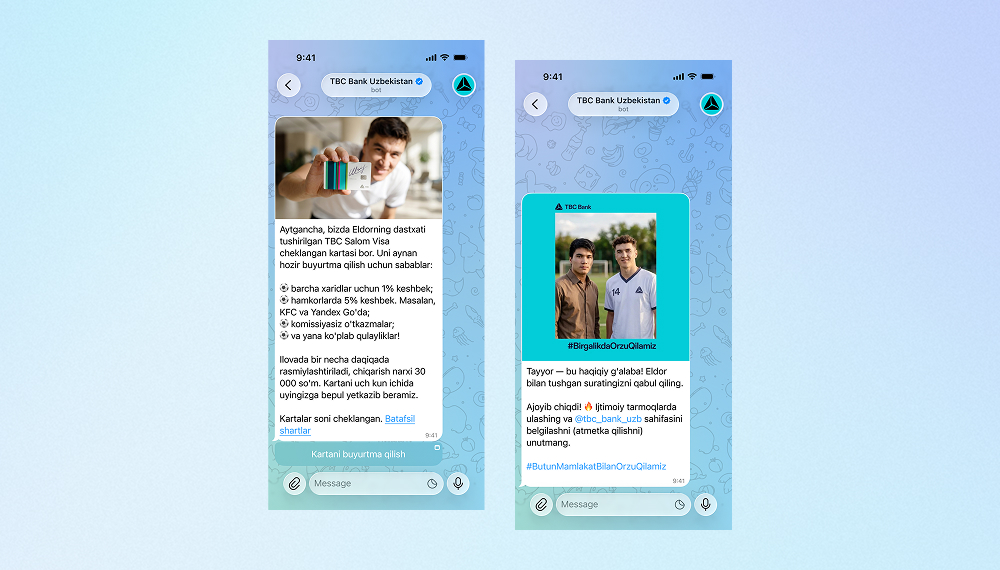
AI bot for TBC Bank marketing campaign
Innowise built a bilingual Telegram bot that generates AI selfies with TBC Bank's football-star brand ambassador.
3,000 users engaged
2 languages supported
View case study
Client review
View case study
Client review logo. Client review


AI Telegram bot..
Defining the product strategy for Bitlendex’s bitcoin lending platform
Innowise conducted a discovery phase for Bitlendex, helping the client transform an early-stage product concept into a validated business model and clearly defined MVP.
1 month for a full discovery phase
Financial advisory system for Bonnfinanz
Innowise helped Bonnfinanz to build a web-based advisory and administration system that supports mobile working and direct interaction with the client.
EV charging platform with flexible billing
Innowise helped modernize SMART/LAB’s e-mobility platform by enhancing its billing, payment, transaction management, and reporting capabilities.
>50% faster billing and payment processing
FinXP’s cloud-native DevOps transformation
Innowise helped FinXP modernize its financial services infrastructure by migrating legacy PHP-based APIs and applications to a cloud-native architecture.
11 apps moved to Azure App Service
100% Infrastructure as Code
01 / 01
Close popup icon

Conclusion

In 2026, more of the work is going into reusable models, better representations, smaller inference footprints, monitoring, calibration, and figuring out what happens once a model meets data that wasn’t in the training set.

That’s probably the useful shift to keep in mind. A newer approach is only better if it fits the problem, the data, the infrastructure, and the way the model will be used. If an older model performs just as well and is easier to run, keep the older model. If a foundation model saves weeks of training, use it. If neither survives a proper pilot, move on.

The trend itself is never the reason.

If you’re evaluating which ML approaches make sense for a real product or workflow, our machine learning consulting team can help with architecture, model selection, validation, and deployment.

FAQ

Machine learning (ML) is a branch of AI where models learn patterns from data and use them to make predictions or decisions without every rule being written manually.

In practice, that can mean predicting demand, detecting fraud, estimating risk, recommending products, spotting defects, or forecasting when equipment is likely to fail.

AI is the broad category. Machine learning is one way of building AI systems by learning from data. Deep learning is a subset of machine learning based on neural networks with many layers.

So the relationship is fairly simple: deep learning sits inside machine learning, and machine learning sits inside AI.

Very much so.

Gradient boosting, random forests, logistic regression, and other established methods are still strong choices for many structured-data problems. They can be faster, cheaper, and easier to explain than newer deep-learning approaches.

A model doesn’t become obsolete because a more fashionable one exists.

Usually the boring ones: poor data quality, missing labels, weak infrastructure, unclear ownership, privacy restrictions, integration problems, and not enough people who understand both the model and the business process around it.

There’s another one too: sometimes the proposed ML system doesn’t improve the existing process enough to justify the work.

That’s worth finding out early.

AutoML can handle parts of model selection, hyperparameter tuning, feature processing, ensembling, and experimentation.

Humans still need to decide what the model should predict, whether the data makes sense, which errors matter most, how success should be measured, and whether the final system is safe and useful enough to deploy.

AutoML can run experiments. It can’t decide whether the experiment was worth running.

On-device ML makes sense when latency matters, connectivity is unreliable, bandwidth is limited, or sensitive data should stay local.

The trade-off is hardware. Smaller devices have tighter limits on memory, compute, and energy, so models usually need compression or other optimization before they can run there comfortably.

For most companies, no.

Quantum machine learning is still largely a research topic. There are experiments around optimization, quantum kernels, and hybrid quantum-classical models, but conventional ML remains far more practical for normal production systems in 2026.

If someone is proposing quantum ML for a routine forecasting problem today, I’d ask what exactly the regular model failed to do first.

Show all

Table of contents

Put ML to work

    Contact us

    Book a call or fill out the form below and we’ll get back to you once we’ve processed your request.

    Send us a voice message
    Attach documents
    Upload file

    You can attach 1 file up to 2MB. Valid file formats: pdf, jpg, jpeg, png.

    By clicking Send, you consent to Innowise processing your personal data per our Privacy Policy to provide you with relevant information. By submitting your phone number, you agree that we may contact you via voice calls, SMS, and messaging apps. Calling, message, and data rates may apply.

    You can also send us your request
    to contact@innowise.com
    What happens next?
    1

    Once we’ve received and processed your request, we’ll get back to you to detail your project needs and sign an NDA to ensure confidentiality.

    2

    After examining your wants, needs, and expectations, our team will devise a project proposal with the scope of work, team size, time, and cost estimates.

    3

    We’ll arrange a meeting with you to discuss the offer and nail down the details.

    4

    Finally, we’ll sign a contract and start working on your project right away.

    More services we cover

    arrow