IT consulting industry trends in 2026: AI, risks, and smarter tech decisions

Sep 1, 2026 19 min read
Summarize article with AI

Key takeaways

  • AI should reduce delivery time for certain tasks. If it does not affect the estimate, you’d better ask why.
  • Time and materials will remain common, but more clients are asking for fixed deliverables, shared risk, and measurable outcomes.
  • Cybersecurity, compliance, cloud cost management, and AI governance are now part of mainstream technology consulting.
  • Generic advice is losing value. Industry knowledge and implementation experience are becoming more important.
  • Smaller expert teams can outperform larger ones when the scope is clear and the senior people remain involved.
  • Buyers have more leverage than they did a few years ago, but they still need to compare proposals carefully.

A couple of months ago, a client asked me a question I now hear almost every week: “If consultants and devs use AI to work faster, why does the proposal still contain the same number of people and the same number of months?

Fair question.

That is exactly the right one to ask in 2026. The main IT consulting industry trends are changing delivery speed, pricing, team structures, security expectations, and cloud priorities. Well, basically everything. 

From my side of the table, clients are also becoming much less tolerant of vague scopes and polished presentations with no clear ownership behind them.

That is where this article will focus — on the IT services consulting industry trends of 2026 that are now changing how consulting work is sold, delivered, and measured.

Talk through your challenges

Let’s discuss which technology shifts genuinely affect your business, and which ones can wait

What is the IT consulting industry in 2026?

IT consulting covers technology advice, implementation support, and ongoing specialist services. It includes IT strategy, architecture, cybersecurity, cloud, data, AI, software modernization, systems integration, governance, cost optimization, program recovery, and managed advisory work.

In real projects, consulting and delivery are already hard to separate.

A client may ask for an AI strategy and then expect the same team to review the data platform, build a pilot, define security controls, and support the first production release. 

And I think that is reasonable. A strategy that cannot survive contact with real systems is not especially useful.

The problem is that every provider defines “consulting” differently. One firm may provide senior advisers and a decision framework. Another may use consulting as the label for a development team. A third may deliver a 120-slide report and leave implementation to somebody else.

So before comparing prices, check what the offer contains.

IT consulting market overview

There is no single market-size number that describes the entire IT consulting industry. Sounds too good to be true. Research firms group the work differently, and this regularly creates misleading comparisons.

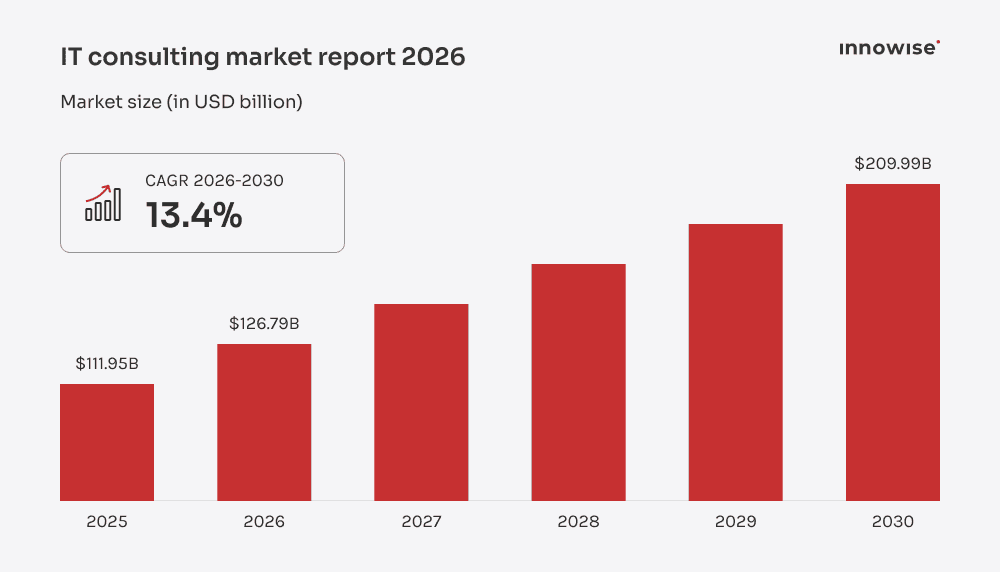
The Business Research Company defines the IT consulting market around operations, security, and strategy consulting. It estimates that the market will increase from $111.95 billion in 2025 to $126.79 billion in 2026, representing annual growth of 13.3%. It forecasts the market will reach $209.99 billion by 2030.

IT consulting market growth from $111.95 billion in 2025 to $209.99 billion in 2030, with a 13.4% CAGR.

Gartner measures the much broader IT services category. Its July 2026 forecast puts worldwide spending on IT services at $1.57 trillion in 2026, within total IT spending of $6.369 trillion.

These figures should not be blended. One describes consulting, the other includes a far wider range of technology services.

Market indicator2026 figureWhat it covers
Global IT consulting market$126.79 billionOperations, security, and strategy consulting
Annual IT consulting growth13.3%Increase from the 2025 estimate
IT consulting forecast$209.99 billion by 2030Same consulting-market definition
Worldwide IT services spending$1.57 trillionBroader IT services category
Total worldwide IT spending$6.369 trillionSoftware, services, infrastructure, devices, and communications

The overall direction is positive, but I would not read this as “consulting firms can sell anything.”

Budgets are growing in selected areas. AI infrastructure, cloud platforms, cybersecurity, data, and modernization are attracting money. At the same time, clients are delaying vague transformation programs and questioning projects that cannot show a credible return.

There is regional pressure too. The broader UK consulting market contracted by 3.4% in 2024, falling from £15.4 billion to £14.9 billion, before analysts forecast a recovery.

So yes, the market is growing. But the easy work is getting harder to sell.

Key IT consulting industry trends to watch in 2026

Here is the short version before we get into the details.

Now let’s go through the IT services consulting industry trends 2026 one by one and look at what each of them changes in a real consulting engagement.

1. AI is changing how consulting work is staffed and priced

I’ll be honest: I’m a little tired of every consulting conversation becoming an AI conversation. I suspect many clients are too. But being tired of the topic does not make it less relevant I guess. AI is already changing how consulting work is delivered. 

Consultants use AI to review documentation, compare requirements, summarize interviews, model options, analyze large amounts of information, and prepare routine project materials. 

A Harvard and BCG field study involving 758 consultants found that people using GPT-4 completed more tasks, worked about 25% faster, and produced higher-quality results on tasks that suited the model. The same research also found that performance declined when consultants relied on the model for a task outside its capabilities.

I know this study is from 2023, which is practically ancient history in AI terms. Still, the pattern it showed is very much alive in 2026, at least from what I see. 

AI is strong when the task is clear, the inputs are available, and the output can be reviewed. It is much weaker when the real issue is hidden in internal politics, contradictory priorities, missing ownership, or undocumented system behavior. An AI model cannot interview the head of operations and notice that everyone in the room avoids one specific topic. Yet.

The 2026 Professional Services Maturity Benchmark reports that generative AI is now used in 27.1% of professional-services projects covered by the survey.

That percentage will keep rising. Still, AI use alone says nothing about delivery quality.

What this means for buyers

Ask direct questions:

  • Which project activities will use AI?
  • Which tasks should take less time as a result?
  • Has the estimate already been reduced?
  • Can client data be entered into the tools?
  • Who reviews generated analysis and documentation? 
  • How are facts and citations checked?
  • Who owns generated assets and reusable prompts?
  • What happens when the model gives a plausible but incorrect answer?

I would pay close attention to the answer about estimates.

A supplier cannot claim that AI has transformed its productivity and then price the engagement as though every document is still being written manually. Though some of them still try — beware.

2. Clients are paying for deliverables and results, not just hours

The time and materials model is not disappearing. It is still the most practical one for uncertain discovery, legacy modernization, incident response, and projects where the scope will change.

But clients are asking a tougher question: “What am I buying for these hours?”

This is pushing more work toward fixed-price deliverables, milestone payments, managed capacity, and outcome-linked contracts.

The already mentioned Professional Services Maturity Benchmark recorded billable utilization at a historic low of 66.4%, while project margins reached a five-year high. The report connects this partly to value-based pricing and tighter delivery.

I’m fine with paying for effort when the uncertainty is genuine. What bothers me is when a supplier keeps the scope vague and then bills the client for figuring out what should have been clarified earlier. 

I have seen statements of work where almost every dependency is assigned to the client, every deliverable is described loosely, and every change triggers additional billing. That arrangement may be called agile. Commercially, it means the client carries nearly all the risk. By the way, this is something we make a point of avoiding at Innowise: uncertainty should be made visible, discussed, and priced honestly from the start.

What this means for buyers

For fixed-price or outcome-based work, define:

  • the starting baseline,
  • the result being measured,
  • who controls the variables behind that result,
  • which data source will be used,
  • responsibilities assigned to internal teams, 
  • exceptions and external dependencies,
  • the review period,
  • what happens if the target is missed,
  • whether strong overperformance changes the fee.

Outcome pricing works best when the result is measurable and both parties can influence it.

For example, a cloud consultant can commit to improving cost allocation, reducing identified waste, and introducing unit-cost reporting. It cannot promise that your cloud bill will fall by 30% while your usage doubles and three new products launch.

3. Large firms and focused specialists are pulling ahead

The consulting market is becoming more divided.

Large providers have global reach, established procurement relationships, broad partner networks, and the capacity to support complicated programs across several countries.

Specialist firms compete differently. They offer direct access to senior people, narrower expertise, shorter decision paths, and less organizational overhead.

The uncomfortable position is in the middle: firms that are too general to look like specialists and too small to compete on scale.

Technology-sector M&A also points toward continued consolidation. EY reported that US technology deal value almost doubled year over year from April through June 2026, while deal volume increased by 29%. Buyers were targeting AI capabilities, automation, software platforms, connectivity, and digital infrastructure.

This is broader than IT consulting, but the direction is relevant. Useful capabilities are being acquired and combined while generic capacity becomes easier to replace.

What this means for buyers

Do not assume the largest provider is the safest. Also, do not assume a small specialist will automatically be faster or more senior. A bit of a paradox, right? Still, firm size tells you far less about delivery quality than most buyers expect.

Ask a large firm:

  • Who will be on the project after the sales team leaves?
  • How many layers sit between the client and the decision-maker?
  • Can key people be replaced without approval?
  • How much time will senior experts actually spend?

Ask a smaller firm:

  • What happens if a key expert becomes unavailable?
  • How is continuity handled?
  • Which work is subcontracted?
  • Can the firm scale if the scope expands?
  • What security and insurance protections are in place?

4. Industry knowledge is beating generic technology expertise

Yes, this overlaps with the previous trend. I’m separating them for a reason: being positioned as a specialist and understanding how your industry works are not always the same thing. 

Like it or not, broad, generic advice is losing value.

Anyone can now produce a respectable summary of cloud migration options, AI use cases, or cybersecurity frameworks. That does not mean the advice will work inside a bank, hospital, factory, insurer, or logistics company.

Industry context changes technical decisions.

A manufacturing plant cannot accept the same downtime assumptions as an e-commerce platform. A healthcare company cannot treat data access like a marketing agency. A financial institution may need to document automated decisions in ways that completely change the AI architecture.

What this means for buyers

Check three types of experience:

  1. Technical experience: Has the firm delivered the relevant platform, architecture, or integration pattern?
  2. Process experience: Does it understand the workflow being changed?
  3. Industry experience: Has it dealt with similar operational, legal, or safety constraints?

Do not stop at the case-study headline.

A supplier may have “financial services experience” because it built a corporate website for a bank. That tells you very little about payments, fraud, risk models, data retention, or regulatory reporting.

Need people who understand the industry, not just the tech?

Let’s pressure-test your plan against the realities of your industry

5. Security now belongs inside every consulting project

Cybersecurity used to be something you brought in as a separate workstream. Now it comes up in almost every technology decision you make. 

Cloud architecture affects identity and data exposure. AI systems raise questions about model access, training data, logging, human review, and third-party providers. Software modernization can uncover years of unmanaged dependencies and access rights.

Regulation is adding more pressure.

The main EU AI Act application milestone arrived on August 2, 2026, although different provisions follow separate timelines.

NIS2 expanded cybersecurity obligations across essential and important entities, with an EU transposition deadline of October 17, 2024. DORA has applied to covered financial entities and relevant ICT providers since January 17, 2025.

For buyers, the practical point is straightforward: security cannot be added during the final week.

What this means for buyers

Put security requirements into the main engagement scope.

For AI work, cover:

  • approved data sources
  • identity and access controls
  • model and vendor risk
  • data retention
  • prompt injection and data leakage
  • secrets and credential handling
  • security monitoring
  • incident response
  • regulatory classification

For cloud and software projects, cover:

  • identity architecture
  • secrets management
  • dependency security
  • environment separation
  • recovery targets
  • monitoring
  • evidence collection
  • privileged access

Bring in IT security consulting before the architecture is fixed. A late security review usually discovers problems when they are expensive to change.

6. Cloud projects are now mostly cost and control projects

A few years ago, many cloud consulting conversations began with, “How do we migrate?” Now they often begin with, “Why does this cost so much, and who approved it?”

The easy migrations are largely done. Many companies are dealing with the results: duplicated platforms, inconsistent tagging, idle resources, unpredictable data costs, expensive AI workloads, and several teams buying overlapping SaaS products.

The State of FinOps 2026 found that 98% of surveyed FinOps practices now manage AI spending, up from 31% two years earlier. Ninety percent manage SaaS spending or expect to within a year.

This is a major change. FinOps is expanding beyond public-cloud bills into a broader technology-cost discipline.

The work is getting harder too. Mature organizations have already switched off many obvious idle resources. Further savings depend on architecture, product demand, commercial commitments, unit economics, and business priorities.

What this means for buyers

A good cloud consulting project should help you understand where the money is going.

Ask for:

  • costs assigned to products, teams, or customers
  • cost per transaction, user, workload, or inference
  • forecast assumptions
  • reserved-capacity and commitment logic
  • performance trade-offs
  • ownership of future optimization
  • a method for verifying savings

Be careful with dramatic savings promises.

7. AI projects are getting stuck on weak data and unclear ownership

AI pilots are easy to get excited about. The problems usually appear later when teams realize they have not agreed on acceptable error rates, data access, review steps, or responsibility when the output is wrong.

So, the hard questions to settle early:

Who owns the AI program? Which data can teams use? Is that data reliable enough? How will different systems be evaluated? What level of error is acceptable? Which decisions need human review? What evidence must be retained? And who approves changes to the models or policies?

IBM’s 2026 study of 2,000 technology executives found that two-thirds were accountable for AI systems they did not fully control. Seventy-seven percent said adoption was moving faster than governance, and only 11% considered their organizations fully prepared for the expected scale of AI-agent deployment.

McKinsey also reported that only about 30% of surveyed organizations had reached higher maturity levels in responsible-AI strategy, governance, and agentic controls.

These numbers do not surprise me.

The pilot phase is attractive because the team can focus on what the model does. Production forces the organization to decide who is accountable.

What this means for buyers

Before scaling, define:

  • the business owner
  • approved data sources
  • data lineage
  • access rules
  • evaluation criteria
  • acceptable error rates
  • human-review points
  • logs and audit evidence
  • model-change controls
  • incident handling

This is where AI consulting should add value. A consultant should challenge weak use cases, identify the controls required, and tell you when the data foundation is not ready.

Sometimes the correct recommendation is to delay the AI build and repair the underlying data process first. That may be less exciting. It is often cheaper.

8. Clients are hiring fractional experts instead of full consulting pyramids

Not every problem needs a twelve-person team.

More companies are bringing in a senior CIO, CTO, CISO, architect, data leader, or FinOps expert for one specific problem, rather than hiring a full consulting team or filling a permanent role.

This can work very well.

A senior specialist may need two weeks to review an architecture, challenge assumptions, and provide a decision path. Building a larger team around that person may add cost without adding much value.

Still, fractional work has obvious limits.

A fractional expert may not be there when something breaks, and they can advise without staying to carry the decision through. Bring in several of them, and you may end up with three sensible recommendations pointing in different directions. That’s the trade-off.

What this means for buyers

Use fractional expertise when:

  • the decision is bounded
  • the required experience is rare
  • the need is temporary
  • internal leaders can own implementation
  • outputs can be clearly documented

Define:

  • available hours
  • response times
  • decision authority
  • expected documents
  • meeting cadence
  • handoff requirements
  • implementation support

For a multi-year transformation, a stable team will usually work better.

Three years ago, clients often asked whether an AI idea was technically possible. Now they ask how quickly it can reach production, what it will cost at scale, who carries the risk, and which business metric should change. Those are better questions. They also expose weak consulting much faster.

Global Development Director

IT consulting challenges: what could slow the industry down

The latest trends create opportunities, but they also put pressure on the consulting model itself.

  • Routine work is becoming cheaper. Research, basic documentation, code analysis, and generic recommendations can be produced faster. Consulting firms must show where human judgment still changes the result.
  • AI is reducing billable effort. This benefits clients, but firms built around utilization targets have to rethink pricing and staffing.
  • Senior specialist talent remains limited. AI governance, cybersecurity, cloud economics, and industry regulation overlap. Finding people with real delivery experience across these areas is difficult.
  • Trust is becoming harder to prove. AI-generated errors, invented citations, and polished low-quality reports make buyers more skeptical.
  • Sales cycles are longer for unclear projects. Boards will fund AI, security, and modernization, but they want a stronger case and clearer ownership.
  • Clients expect speed without accepting extra risk. Faster delivery is possible, but review, testing, and governance still require time.

There is a buyer advantage inside each challenge.

Lower utilization can create room to negotiate. Automation should reduce estimates. Competition for trust should make firms more open about methodology. Longer approval cycles give you time to test the proposal.

Use that advantage, but do not squeeze the project until it becomes undeliverable.

An unrealistically low fixed price usually comes back later as change requests, reduced scope, or junior staffing.

How the 2026 trends change the way you choose an IT consulting partner

Engagement-model comparison

ModelBest forMain riskWhat to check
Time and materialsDiscovery, uncertain scope, legacy work, changing prioritiesSpending grows without visible progressRate card, burn limits, backlog ownership, weekly outputs
Fixed priceStable scope and clearly defined deliverablesExclusions and change requests expandAssumptions, acceptance criteria, change process
Outcome-basedMeasurable results with a reliable baselineArguments about who caused the resultMetrics, data source, shared responsibilities, fee limits
Managed capacityOngoing roadmap execution with a stable teamCapacity is paid for but poorly directedTeam structure, governance, replacement terms
Fractional expertTemporary leadership or a specialist decisionLimited availability and weak continuityHours, authority, response time, documentation
HybridPrograms with both uncertain and defined workCommercial boundaries become confusingWhich model applies to each phase
Show more

No engagement model is universally better.

Time and materials can be fair when nobody knows what will be found inside a legacy system. Fixed price is more useful when the output is specific. Outcome pricing works when results can be measured without endless arguments.

The model should match the uncertainty.

Signs you may need an IT consulting partner

External support may help when:

  • A modernization program has stalled and teams disagree about priorities.
  • AI pilots exist, but none has reached production.
  • Cloud costs are rising faster than usage or revenue.
  • A new regulation creates unfamiliar technical obligations.
  • A major architecture decision exceeds the experience available internally.
  • Several vendors are proposing incompatible approaches.
  • A critical program is late, but reporting does not explain why.
  • You need a senior specialist faster than you can hire one.
  • Internal teams are too close to the problem to provide an independent assessment.

A consulting partner should make the situation clearer within the first stage of work.

If the problem sounds less clear after four weeks, something has gone wrong.

When consulting should not be the first step

There are situations where an external engagement adds unnecessary cost.

You may not need consultants yet when:

  • Nobody internally owns the decision. Consultants cannot replace executive accountability.
  • One permanent hire covers the long-term requirement. Recruitment may create more value.
  • The problem has a standard product solution. A long strategy engagement may be excessive.
  • The scope is very narrow. Internal teams may answer the question faster.
  • There is no budget or capacity for implementation. Another roadmap will not change much.
  • Management already decided the answer. Hiring consultants to validate a political choice rarely ends well.
  • The basic facts are not available. Sometimes the first task is simply collecting system, cost, or process data.

I think consulting firms should say this more often.

Declining the wrong project is better than delivering a document nobody will use.

Partner-selection checklist

  • Ask for closely comparable cases. Similar scale and constraints matter more than a well-known client name.
  • Meet the actual delivery team. Do not evaluate only the salespeople and senior partners.
  • Check industry knowledge with specific questions. Generic answers become obvious quickly.
  • Review security practices. Cover access, subcontractors, development processes, certifications, data handling, and incidents.
  • Ask exactly how AI is used. Request information about tools, controls, reviews, and estimate reductions.
  • Read the assumptions section carefully. This is often where project risk is quietly transferred to the client.
  • Define weekly evidence of progress. Working software, decisions, validated models, and resolved risks are better than slide counts.
  • Make knowledge transfer part of the scope. Specify documentation, training, pairing, and internal ownership.
  • Agree on exit terms before starting. Cover code, credentials, environments, data, licenses, and transition support.
  • Ask references about the difficult moments. The supplier’s response to trouble tells you more than the launch announcement.

A market guide such as Innowise’s overview of top AI consulting firms can help create a longlist. The real evaluation begins when you meet the proposed team and discuss your actual scope.

Get your readiness assessment

Turn broad concerns about AI, architecture, security, or cloud costs into a short list of decisions and next steps.

How Innowise applies these trends in practice

The first job of a consultant is to check whether the client is solving the right problem.

That means looking at the business objective, current systems, operating constraints, internal ownership, available data, security exposure, and the organization’s ability to implement change.

Innowise’s IT consulting services cover strategy, architecture, IT service management, technology implementation, portfolio analysis, and process and cost optimization.

The exact capability depends on the issue:

  • For unclear modernization priorities, digital transformation consulting can help assess systems, processes, risks, and sequencing.
  • For AI initiatives without a production route, AI consulting can cover use-case selection, architecture, data readiness, governance, and rollout planning.
  • For security and regulatory exposure, IT security consulting can support risk assessment, compliance planning, testing, architecture, and resilience.
  • For cloud cost and platform sprawl, cloud consulting can connect architecture with cost allocation, scalability, security, and ongoing optimization.

Public evidence provides a starting point for due diligence. Innowise lists more than 19 years of experience, 3,500+ IT professionals, 1,600+ delivered projects, and 400+ certified professionals. Its published certifications include ISO 9001, ISO 27001, ISO 27017, and ISO 27018.

Those figures do not answer every project-level question. You should still review the proposed team, relevant experience, scope, assumptions, and delivery controls.

Conclusion

The most useful IT consulting industry trends in 2026 are quite practical.

AI is reducing the time needed for routine work. Clients are questioning hour-based pricing. Security and governance are entering projects earlier. Cloud work is moving toward cost control. Industry knowledge is becoming more valuable. Smaller senior teams are becoming a credible alternative to large consulting structures.

For buyers, this creates leverage.

Ask how AI changes the estimate. Ask who will actually perform the work. Ask which assumptions sit behind the price. Ask how knowledge will move into your organization. Ask what happens if the project stops halfway through.

And ask one question that tends to expose weak proposals quickly: “What will be measurably different after the first six weeks?

If the answer needs fifteen slides, you probably have your answer.

Define a practical consulting scope with clear decisions, deliverables, dependencies, and ownership.

FAQ

The latest IT consulting trends include AI-assisted delivery, outcome-linked pricing, a market split between large providers and focused specialists, stronger demand for industry knowledge, fractional senior expertise, cybersecurity, cloud cost control, AI governance, agent implementation, AI-written-software audits, and technology sovereignty.


The Business Research Company estimates the global IT consulting market at $126.79 billion in 2026. Gartner forecasts the wider IT services market at $1.57 trillion. These numbers measure different categories and should not be compared directly.

AI is reducing the time needed for routine consulting work and changing how projects are priced. Clients are looking for deeper industry knowledge, smaller senior teams, and clearer outcomes. At the same time, AI agents, AI-written software, security, cloud costs, governance, and technology sovereignty are creating new work that requires much more than a generic strategy deck.

AI will reduce the amount of time consultants spend on routine work. It is less likely to replace work involving unclear objectives, internal conflict, accountability, negotiation, implementation risk, and difficult trade-offs. Consultants will need stronger industry and delivery experience to remain valuable.

The main challenges include commoditization of standard services, pressure on billable-hour pricing, lower utilization, limited access to senior specialists, AI quality risks, and longer client approval cycles.

Time and materials remains common for uncertain work. Fixed-price, managed-capacity, value-based, and outcome-linked models are becoming more popular for scopes with defined deliverables or measurable results. Hybrid contracts are also common.

Review comparable cases, meet the proposed team, check industry expertise, examine security and AI practices, read the assumptions behind the estimate, define knowledge transfer, and agree on exit terms. Ask references how the firm handled problems, not only whether the project launched.

Hire internally when the requirement is permanent and central to the organization. Use consultants when you need several disciplines, temporary senior expertise, independent validation, or faster access to experience. A blended model works well when internal leaders retain ownership.

The cost depends on the scope, uncertainty, seniority, engagement model, location, security requirements, and urgency. Instead of comparing rates alone, compare:

  • Proposed team structure
  • Estimated effort
  • Assumptions and exclusions
  • Deliverables
  • Third-party costs
  • Contingency
  • Change-request rules
  • AI-assisted effort reductions
  • Termination and handover costs

A lower estimate is useful only when the scope and delivery risk are genuinely comparable.

Show all

Head of Delivery Office

Michael handles the heavy lifting of enterprise-grade ERP and custom software. He combines technical foresight with strategic execution to build durable systems that modernize core business operations without sacrificing stability or performance.

Table of contents

    Contact us

    Book a call or fill out the form below and we’ll get back to you once we’ve processed your request.

    Send us a voice message
    Attach documents
    Upload file

    You can attach 1 file up to 2MB. Valid file formats: pdf, jpg, jpeg, png.

    By clicking Send, you consent to Innowise processing your personal data per our Privacy Policy to provide you with relevant information. By submitting your phone number, you agree that we may contact you via voice calls, SMS, and messaging apps. Calling, message, and data rates may apply.

    You can also send us your request
    to contact@innowise.com
    What happens next?
    1

    Once we’ve received and processed your request, we’ll get back to you to detail your project needs and sign an NDA to ensure confidentiality.

    2

    After examining your wants, needs, and expectations, our team will devise a project proposal with the scope of work, team size, time, and cost estimates.

    3

    We’ll arrange a meeting with you to discuss the offer and nail down the details.

    4

    Finally, we’ll sign a contract and start working on your project right away.

    More services we cover

    arrow