AI chatbots in healthcare: use cases, benefits, and implementation

Sep, 2026 17 min read
Head of Data-Driven Life Sciences
Verified expert
Every article at Innowise is created by authors with real-world experience. They understand the topic beyond theory and bring insight from real projects.
11+ years of experience
Verified expert
11+ years of experience
Roman leads the charge in AI-driven drug discovery and clinical research. He specializes in turning fragmented medical data into high-performance analytical tools that accelerate innovation in labs and transform modern life sciences practices.
Expertise
Life sciences & pharma Healthcare IT ML
Let's talk

Key takeaways

  • Healthcare chatbots deliver the most immediate value in patient access, scheduling, intake, navigation, and repetitive administrative communication, rather than autonomous clinical decision-making. 
  • To be genuinely useful, a chatbot must connect directly into core tools like EHRs, scheduling systems, and patient portals so it can look up and update records in real time. 
  • The global healthcare chatbot market is surging from $1.98 billion in 2025 to $12.63 billion by 2034 (a 23% CAGR), driven by providers seeking immediate relief from operational bottlenecks. 
Summarize article with AI

Healthcare is running up against a familiar bottleneck: Care teams spend hours trapped behind screens and answering phones, while patients wait too long for basic answers.

AI chatbots offer real relief. They can handle routine tasks like 24/7 scheduling, check-ins, and triage routing without adding to your staff’s workload.

But healthcare isn’t the place for experimental tech or generic off-the-shelf bots. When clinical accuracy, EHR integrations, and patient data privacy are on the line, the implementation has to be rock-solid.

I put this guide together to break down what actually works in production:  main chatbot types, use cases, technologies, and implementation considerations.

What is an AI chatbot in healthcare?

An AI chatbot in healthcare is a conversational software application that automates administrative and clinical interactions — like triage routing, appointment scheduling, and patient check-ins — using natural language processing. 

The demand for these tools is taking off. The global healthcare chatbot market was valued at $1.98 billion in 2025 and is expected to reach $12.63 billion by 2034, growing at a 23% CAGR.

What’s behind this growth? A big part of it is simple: healthcare teams are overloaded with repetitive communication. Patients want faster answers, easier scheduling, clearer navigation, and support outside office hours. At the same time, clinicians do not want to spend more of their day answering routine messages. 

Professional AI adoption among physicians has risen rapidly, jumping from 38% in 2023 to 81% in 2026. While this figure reflects general clinical AI adoption rather than chatbots specifically, this widespread integration creates a far more receptive and favorable environment for conversational AI tools to take root.  

How healthcare AI chatbots work

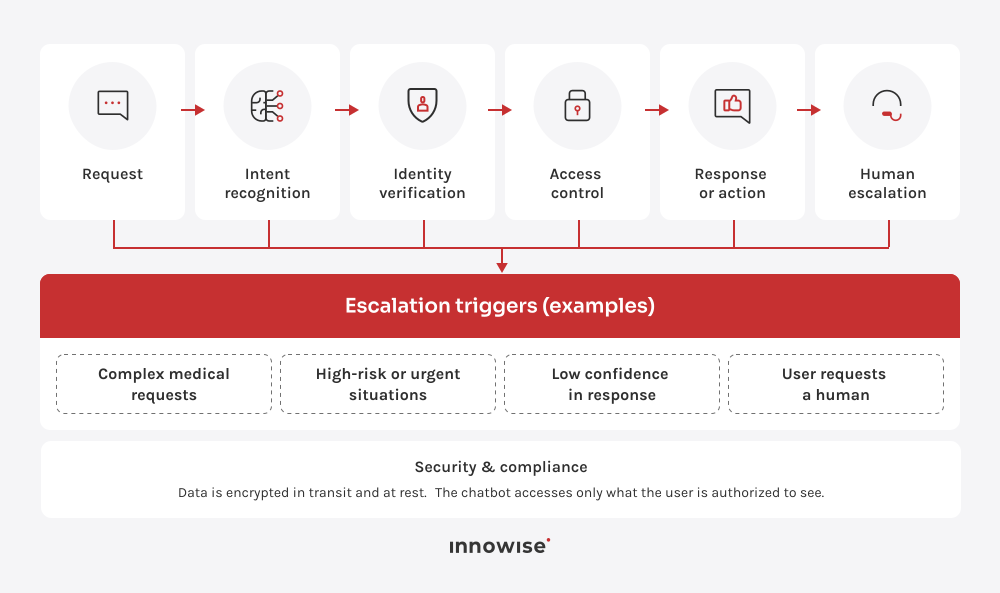
In this section, I explain how a healthcare AI chatbot handles a user request from start to finish. I see the process as a controlled sequence in which the chatbot first understands the request, then verifies access, retrieves only approved information, and either responds or passes the case to a human when needed.

  1. Request. The process starts when a patient or staff member sends a question or asks the chatbot to perform a task.
  2. Intent recognition. The chatbot analyzes the request to understand what the user wants and what type of support is needed.
  3. Identity verification. If the request involves personal or clinical information, the system verifies the user’s identity before continuing.
  4. Access control. The chatbot checks which data, services, or systems the verified user is authorized to access and retrieves only approved information.
  5. Response or action. Once the request and permissions are clear, the chatbot either provides an answer or completes the requested action.
  6. Human escalation. If the request is complex, urgent, low-confidence, outside the chatbot’s scope, or the user asks for human support, the case is escalated to a healthcare professional.

In my experience, the two most important safeguards in this flow are restricted access and clear escalation triggers. The chatbot should only reach data and systems the user is authorized to access, while complex, urgent, or low-confidence cases should move to a human rather than stay in the automated flow.

Types of healthcare chatbots​

In this section, I look at the main types of healthcare chatbots and how their capabilities differ. I move from simple rule-based systems to more advanced AI-powered solutions, voice assistants, and AI agents to show how each type can support different healthcare tasks.

Rule-based chatbots

A rule-based chatbot guides patients through predefined conversation flows built with decision trees, intents, keywords, and scripted responses. It can answer common questions, collect structured data, validate basic inputs, and route users to the right service or next step. These systems are usually easier to test and control because every supported path is defined in advance.

AI-powered chatbots

AI-powered chatbots mimic healthcare staff-patient conversations using NLP processing and LLMs. They can understand open-ended questions, provide relevant information, summarize complex content, and ask follow-up questions when more context is needed. When the request is unclear, sensitive, or outside its approved scope, the chatbot can escalate it to healthcare staff.

Voice assistants

A voice assistant lets patients speak naturally to a healthcare service, while speech-to-text converts the request into text for the AI to process. It can handle common patient inquiries, support appointment scheduling and rescheduling, collect intake information, assist with care navigation, and guide patients through routine administrative workflows over the phone or through voice-enabled patient channels.

AI agents

Despite the buzz around AI acting on its own, nobody is handing an algorithm the keys to a hospital. Instead, AI agents tackle multi-step administrative chores within very strict, predefined workflows. It can retrieve patient data, check eligibility, coordinate appointments, update records, trigger follow-up surveys, or support care teams within clearly defined permissions.

AI chatbot use cases in healthcare

Working on healthcare projects at Innowise, we’ve found that organizations don’t need AI to replace clinical decision-making. They need it to eliminate administrative lag. In practice, production-ready chatbots make the biggest difference across four primary areas:

Patient self-service and administration

AI chatbots can serve as a digital front door for routine patient needs. Serving as an intuitive 24/7 digital front door, an AI chatbot takes routine administrative traffic entirely off clinic phone lines.They can handle FAQs, support appointment booking, rescheduling, and cancellations, guide patients to the right service, and assist with pre-visit intake and registration.

Patient communication and support

Between office visits, an AI chatbot helps patients stay on track with chronic condition care plans and post-discharge protocols. They can provide status updates, send reminders, answer common coverage questions, and run post-visit surveys to capture patient-reported outcomes and satisfaction.

Care management

Doctors and nurses spend hours every day stuck behind computer screens typing notes. AI chatbots can support ongoing care by helping patients follow care plans, complete check-ins, report symptoms, and receive reminders for medications or follow-up activities.

More accurate demand forecasts

Forecasts built on pipeline stage, close rates by product line, and account-level signals can improve production planning and narrow the gap between what sales expects to close and what the plant needs to prepare for.

Clinical workflow support

Clinical AI chatbots can help doctors and nurses work faster by retrieving patient health data, answering routine “where do I find…?” questions, and pre-filling documentation from structured data or short dictation. They can also support workflow coordination without replacing clinical judgment.

Cut patient wait times and administrative workload with AI chatbots

Benefits of AI chatbots in healthcare

AI chatbots affect healthcare delivery at three levels: patient experience, clinical and administrative workflows, and organizational operations. The benefits look different for each group.

Benefits for patients

  • Improved access to care. Patients do not always need to wait for office hours to get basic support. Chatbots can provide health information, reminders, and care navigation at any time, helping people understand what to do next.
  • Higher patient engagement. Regular chatbot check-ins can make it easier for patients to stay involved in digital care programs. In a chronic pain self-management trial, participants using the smartphone-based healthcare bot responded to 71% of the conversations it initiated, showing relatively high engagement over the course of the intervention.

Benefits for healthcare staff

  • Reduced administrative burden. Healthcare chatbots can collect patient history and other information before a clinician enters the conversation. In a randomized trial involving 2,069 patients and 111 specialists, an LLM-based preassessment chatbot reduced physician consultation time by 28.7%, from 4.41 to 3.14 minutes on average. 
  • Fewer routine interruptions. By filtering and handling repetitive inquiries—such as clinic logistics, preparation instructions, and simple FAQs—chatbots shield nurses and front-desk personnel from constant phone triage, letting them focus on complex patient care. 

Benefits for healthcare organizations

  • Reduced operational costs. Automating routine interactions — from scheduling and intake to billing FAQs — cuts down contact center overhead and administrative staffing demands. At the same time, automated pre-visit reminders and seamless self-service rescheduling reduce missed appointments and last-minute cancellations, protecting billable clinical hours from unrecovered revenue loss. 
  • Increased clinical capacity. Streamlining the digital front door and routing patients to the correct level of care (e.g., virtual visit, urgent care, or primary care specialist) prevents misdirected appointments and spreads demand evenly across physical clinics and provider networks.

Risks and limitations

In this section, I focus on the main risks and limitations of using AI-powered chatbots in healthcare. While these systems can support patients and improve access to information, I also need to consider the risks of biased or inappropriate responses. Since healthcare decisions can directly affect patient safety, I treat these limitations as an important part of evaluating whether and how to use such systems.

Hallucinations

AI models can generate information that sounds confident but is incorrect or unsupported. This is especially risky in healthcare, where even a small factual error can affect patient decisions.

Incorrect medical guidance

A chatbot may misinterpret symptoms, overlook important warning signs, or provide advice that is not appropriate for a specific patient. Medical guidance should therefore be limited, validated, and supported by clear escalation rules.

Bias in medical decisions

Bias can arise at multiple stages of an AI system’s lifecycle, not only from its training data. It may also result from how data is collected and labeled, underrepresentation of particular demographic or clinical groups, model design choices, evaluation methods, and the context in which the system is deployed. As a result, chatbot responses may be less accurate or appropriate for certain populations, potentially reinforcing existing healthcare disparities.

Limited understanding of complex cases

Chatbots work best with structured, predictable requests. Complex cases involving multiple conditions, unusual symptoms, medication interactions, or incomplete information require professional clinical judgment.

Lack of empathy

AI can simulate a supportive tone, but it does not understand emotions in the same way a human clinician does. Sensitive conversations, distress, and difficult medical situations often need a real person.

Integration failures

Problems with EHR connections, APIs, identity systems, or external services can result in missing, outdated, or incorrect information. These failures need to be detected quickly and handled safely.

Patient trust

Patients need to understand when they are interacting with AI, what the system can and cannot do, and how their data is used. Clear communication is essential for maintaining trust.

Human escalation for high-risk cases

High-risk, urgent, ambiguous, or clinically complex requests should not stay with the chatbot. The system should recognize these situations and route them to qualified healthcare staff for review and follow-up.

Healthcare chatbot security and compliance

A healthcare chatbot is not just a conversational interface. It is a system that may process highly sensitive clinical and personal data, which means security, privacy, and compliance need to be built into the architecture from day one.

HIPAA and GDPR compliance

The first step is understanding which regulations apply. HIPAA governs the handling of protected health information in the US, while GDPR sets strict rules for personal and health data in the EU. A compliant chatbot needs clear data flows, defined responsibilities, proper vendor controls, and documented privacy practices.

PHI protection

Protected health information should be collected only when it is necessary for the use case. Teams should also make sure PHI does not leak into application logs, analytics tools, model prompts, or third-party services that are not approved to handle healthcare data.

Encryption

Sensitive data should be encrypted both in transit and at rest. In practice, that means protecting API traffic, databases, backups, chat histories, and file storage with modern encryption standards and secure key management.

Identity verification

A chatbot should never expose personal medical information before verifying who the user is. Depending on the use case, this can include secure login, multi-factor authentication, one-time verification codes, or integration with an existing patient portal.

Role-based access

Access should be based on the principle of least privilege. Patients, clinicians, support staff, and administrators should only be able to view the data and perform the actions required for their role.

Audit logs

Every sensitive action should be traceable. Audit logs should capture events such as logins, data access, permission changes, record updates, and administrative actions so teams can investigate incidents and demonstrate compliance.

Consent and data retention

The system should clearly explain how patient data is used and obtain consent where required. It should also define how long conversations and health data are stored, when they are deleted, and how user data requests are handled.

Model and conversation monitoring

The AI layer needs its own security controls. Teams should monitor for hallucinations, prompt injection, unsafe recommendations, data leakage, abnormal user behavior, and unexpected model outputs, with clear escalation paths when something goes wrong.

Healthcare systems AI chatbots can integrate with

Every time I wire a bot into a clinic’s core systems, the dynamic changes: it stops being just a Q&A script and starts acting like a real assistant that pulls patient data, updates records, and takes admin work off the staff’s plate.

SystemWhat the AI chatbot can use it for
EHR / EMRRetrieve patient data, appointments, medications, allergies, or encounter details
Practice management & schedulingBook, reschedule, cancel visits, and support registration
Telehealth platformsRoute patients to virtual visits and support pre-visit workflows
Patient portals & mobile appsProvide authenticated self-service and personalized support
Pharmacy systemsSupport refill status, medication reminders, and routine pharmacy inquiries
Billing & insurance platformsAnswer payment, coverage, and claims-related questions
CRM & contact center softwareKeep context across AI and human interactions
Wearables & remote monitoringCollect patient-generated data and support follow-up workflows

Connect AI healthcare chatbot to your real clinical workflows

Technologies behind healthcare AI chatbots

A healthcare chatbot is only as good as the tech stack supporting it. To safely handle patient interactions and automate clinic workflows, several core technologies have to work in tandem behind the scenes:

Natural language processing (NLP)

NLP helps the chatbot interpret patient requests, including messages that are informal, incomplete, or written in everyday language.

Large language models (LLMs)

LLMs power the conversation itself. They generate natural, empathetic responses, explain complex clinical details in plain English, and handle follow-ups without breaking conversational context.

Retrieval-augmented generation (RAG)

RAG anchors the model to verified medical knowledge before it generates a single word. Pulling directly from trusted sources dramatically curbs hallucinations and keeps answers clinically grounded.

Machine learning

Beyond pure text generation, traditional machine learning models handle operational logic behind the scenes: classifying incoming requests, scoring clinical urgency, routing tickets to the right specialists, and personalizing patient interactions over time.

Clinical knowledge bases

A strong healthcare chatbot relies on verified medical content. Structured clinical knowledge bases supply validated protocols, medication databases, and care pathways that guide safe responses.

EHR and FHIR integration

Connecting with EHRs through HL7 FHIR and vendor-specific APIs lets the chatbot securely access and update patient records, manage appointments, check lab results, and reconcile medication lists.

Speech technologies

Speech-to-text and text-to-speech make the chatbot accessible through voice, which is especially useful for virtual assistants, elderly patients, and hands-free interactions.

Security and compliance

Healthcare AI needs security built in from the start. Encryption, authentication, access controls, audit logs, and consent management help protect sensitive patient information.

Architecture for a healthcare chatbot

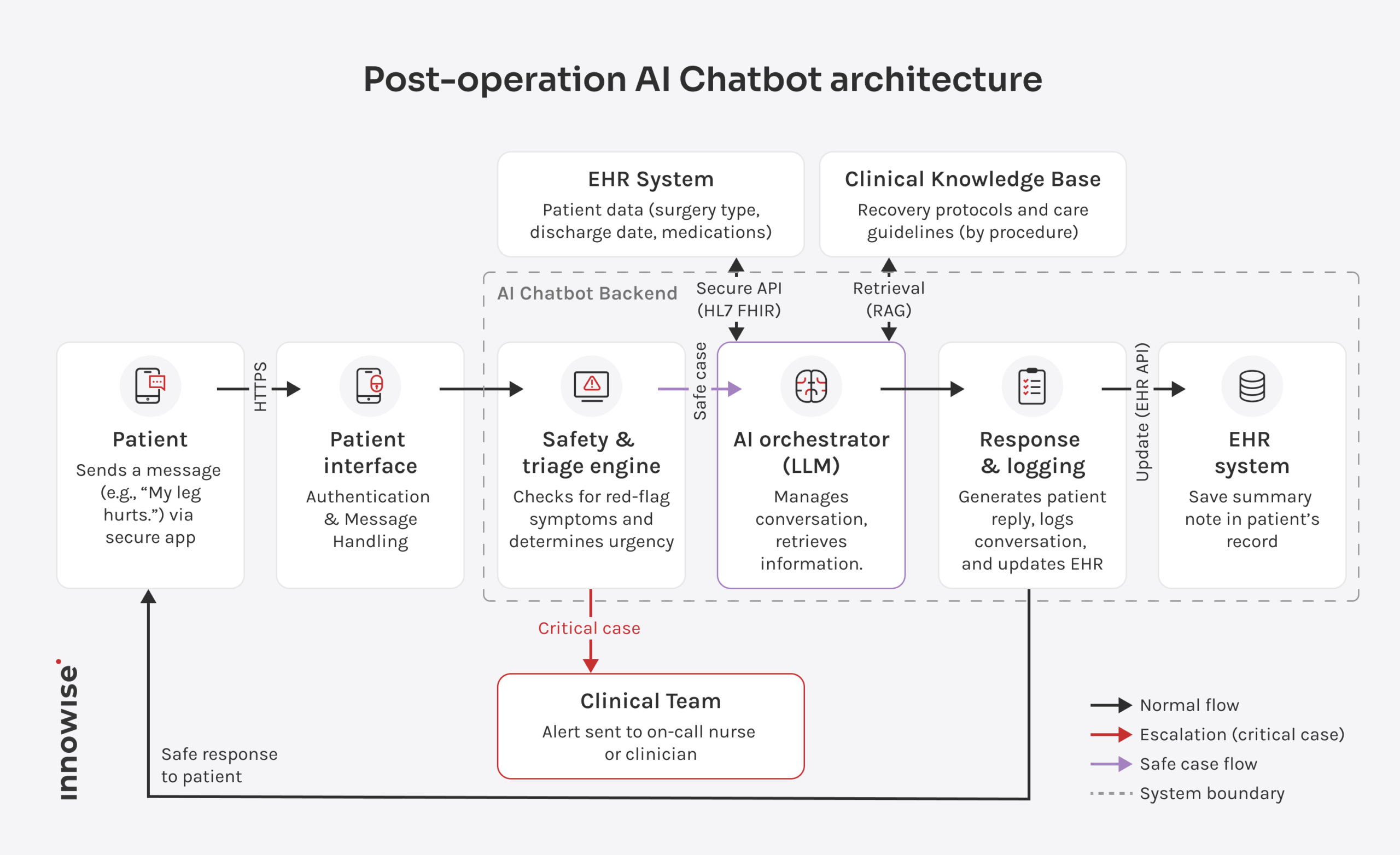
Below, I share the blueprint of a production-grade AI assistant our team engineered for post-discharge recovery monitoring and clinical triage. The platform operates within an isolated virtual private cloud, establishing secure, bidirectional connections directly into hospital systems via modern HL7 FHIR APIs.

The goal is to automate routine follow-up check-ins and reassurance, keep the surgical team’s charts up to date, and catch complications before they escalate

Here is the big-picture view of how the pipeline runs:

  • Safety & security check: The patient sends a message (e.g., “My leg hurts”). The gateway confirms the patient is securely logged in to protect private health data.
  • The danger alarm: The safety engine immediately scans the incoming message for red-flag symptoms (like sudden chest pain or high fever). If it spots critical danger, the bot stops automated chat right there and instantly alerts the on-call nurse to intervene.
  • Checking the patient’s file: If the message is safe, the bot checks the hospital record via API to pull the essential background: the exact surgery performed, discharge date, and prescribed medications.
  • Checking the clinical playbook: With the surgery type confirmed, the bot retrieves verified recovery protocols and care guidelines specific to that procedure so it never has to guess.
  • Safe reply & chart update: The bot generates a clear, reassuring response strictly grounded in the hospital’s clinical rules, then writes a quick summary note back to the EHR so the care team stays informed.

How to implement an AI chatbot in healthcare

In a regulated clinical environment, building an AI assistant requires de-risking the system long before it touches a real patient. Drawing from production deployments across hospital EHR systems, my team usually uses a five-step roadmap to move safely from design to launch.

Define the workflow and expected outcome

Start with the problem. Define who will use the chatbot, what task it should handle, what outcome you expect, and when the conversation should be escalated to a human.

Set clinical and regulatory boundaries

Decide what the chatbot is allowed to do and what must remain under human supervision. Set rules for sensitive data, clinical decisions, user consent, access permissions, and compliance requirements.

Prepare data and integrations

A chatbot is only as reliable as the information and systems behind it. Review source content for contradictions and outdated instructions. Decide which knowledge base is authoritative. Then map the systems the chatbot needs to access. For many healthcare projects, integration work becomes more difficult than the AI itself.

Build and test a proof of concept

I’d use the proof of concept to test the highest-risk assumptions. Can the model understand real requests? Does RAG retrieve the right information? Are tool calls reliable? Can the system recognize when it is uncertain? That’s what the PoC needs to expose.

Run a controlled pilot

Once the workflow works in testing, put it in front of a limited group of real users.

One department, one location, or a small percentage of incoming requests is usually enough to reveal problems.

Monitor and expand

A healthcare chatbot is not a one-time release. Review failed conversations, update the knowledge base, retest workflows, and expand only after the first use case performs consistently.

AI chatbot development costs

The cost of a healthcare chatbot depends less on the chatbot itself and more on what you expect it to do. A simple informational assistant is one thing. A voice agent connected to an EHR, scheduling platform, billing system, and patient portal is a very different project.

The biggest cost drivers usually come from functionality, integrations, AI complexity, compliance requirements, and data preparation. Data quality matters too. If the chatbot relies on scattered, outdated, or inconsistent information, preparing a trustworthy knowledge base can take a significant part of the project.

Then there are security and compliance requirements. HIPAA controls, encryption, identity verification, audit logs, role-based access, and additional validation for higher-risk workflows all increase development effort.

Because every healthcare organization has a unique legacy stack, differing levels of data maturity, and distinct security requirements, there is no universal price tag. You should treat these figures strictly as directional market benchmarks rather than binding project estimates. 

As a rough market benchmark, a basic healthcare chatbot may start at $15,000–$60,000, while an integrated administrative assistant typically moves into the $80,000–$150,000+ range. Voice-enabled solutions often start around $100,000, and advanced multi-step healthcare agents with several integrations, orchestration, and stronger safety controls can reach $150,000–$300,000+. Larger agentic platforms may go well beyond that. 

I’d also separate development costs from ongoing operating costs. After launch, the organization still needs to cover model usage, cloud infrastructure, monitoring, maintenance, knowledge-base updates, integration support, and periodic testing.

Real-world healthcare chatbot examples

Some of the strongest results I’ve seen come from patient access rather than clinical automation.

Tampa General Hospital is a good example.

The organization introduced voice AI for patient access and appointment-related interactions. According to the provider’s published case study, daily call abandonment dropped by 56%, average wait time fell by 58%, and appointments scheduled through its experience center increased by 21%.

Another case involved a European healthcare group using Druid AI voice agents for pre-operative scheduling, booking and rescheduling, and post-care follow-up. The organization reported 40% fewer booking and rescheduling calls and more than 1,000 optometrist hours saved.

UC San Diego Health took a broader approach, using AI agents across voice, chat, and WhatsApp for appointment management and patient self-service. According to AWS, the system helped save more than 300,000 staff hours, reached an 82% patient self-verification rate, and reduced call abandonment by 50%. 

How to choose a healthcare chatbot development partner

A strong healthcare chatbot partner should be able to cover much more than the conversational layer. The real complexity sits in healthcare integrations, access control, clinical risk, and production monitoring, so I’d assess vendors on their ability to deliver the full system, not just the AI component.

  1. Check the partner’s healthcare IT experience and make sure they understand how clinical and administrative workflows actually operate in regulated environments.
  2. Review their AI and voice expertise and look for practical experience with LLMs, RAG, speech AI, agent orchestration, and model guardrails.
  3. Assess their HIPAA and security knowledge and confirm they can design for PHI protection, encryption, identity management, role-based access, and auditability.
  4. Check their EHR integration experience and make sure they can work with FHIR, HL7, secure APIs, and the systems already used by your organization.
  5. Review how they manage clinical risk and whether they define clear system boundaries, escalation rules, confidence thresholds, and human review.
  6. Look closely at the testing process and make sure it covers not only happy-path scenarios, but also AI chatbot hallucinations, failed integrations, ambiguous requests, and unsafe outputs.
  7. Ask about post-launch monitoring and support and whether they provide model evaluation, knowledge-base updates, incident analysis, and integration maintenance.
  8. Evaluate the delivery approach and prefer a partner that starts with a narrow, measurable use case, validates it in a controlled pilot, and scales only after the system proves reliable.

If you’re planning a healthcare chatbot, Innowise can help you move from use-case selection to a production-ready solution with AI engineering, EHR integration, and security built in. We define the workflow, clinical boundaries, and technical architecture upfront, then validate the chatbot in real healthcare scenarios before scaling it safely.

Ready to launch your healthcare chatbot?

FAQ

They can be, but HIPAA compliance depends on the whole solution, not the chatbot alone. Healthcare organizations need safeguards for PHI, including access controls, encryption, authentication, audit logs, secure data handling, and compliant vendor agreements.

A chatbot can share approved health information, but patient-specific diagnosis or treatment advice needs careful clinical and regulatory review. In high-risk or uncertain cases, the safest approach is to collect relevant details and hand the conversation to qualified staff.

Yes. Healthcare chatbots can connect to EHR and EMR systems through FHIR, HL7, secure APIs, or vendor-specific integrations. Access should be limited to the data and actions required for the workflow, such as scheduling, intake, or chart lookup.

Not always. A chatbot used for scheduling, FAQs, or other administrative tasks usually has a different regulatory profile from software that influences diagnosis or treatment. FDA requirements depend on the software’s intended use and specific clinical functionality.

A focused proof of concept can take several weeks, while a production-ready chatbot with authentication, EHR integrations, voice, security controls, and extensive testing may take several months. Timeline depends mostly on scope, integrations, and clinical risk.

As rough baseline estimates, a basic informational chatbot may cost around $15,000–$60,000, while integrated or voice-enabled solutions can reach $80,000–$150,000+. Advanced multi-system healthcare agents may exceed $150,000–$300,000 depending on scope and compliance needs.

Modern healthcare chatbots can combine multilingual LLMs with speech-to-text, text-to-speech, or speech-to-speech models. Each language and voice scenario should still be tested carefully, especially for medical terms, accents, and urgent requests.

Show all

Table of contents

    Contact us

    Book a call or fill out the form below and we’ll get back to you once we’ve processed your request.

    Send us a voice message
    Attach documents
    Upload file

    You can attach 1 file up to 2MB. Valid file formats: pdf, jpg, jpeg, png.

    By clicking Send, you consent to Innowise processing your personal data per our Privacy Policy to provide you with relevant information. By submitting your phone number, you agree that we may contact you via voice calls, SMS, and messaging apps. Calling, message, and data rates may apply.

    You can also send us your request
    to contact@innowise.com
    What happens next?
    1

    Once we’ve received and processed your request, we’ll get back to you to detail your project needs and sign an NDA to ensure confidentiality.

    2

    After examining your wants, needs, and expectations, our team will devise a project proposal with the scope of work, team size, time, and cost estimates.

    3

    We’ll arrange a meeting with you to discuss the offer and nail down the details.

    4

    Finally, we’ll sign a contract and start working on your project right away.

    More services we cover

    arrow