

AI in supply chain and logistics: use cases, benefits, and implementation

Nov 4, 2026 23 min read
Head of Big Data, AI/ML/DS Departments
Verified expert
Every article at Innowise is created by authors with real-world experience. They understand the topic beyond theory and bring insight from real projects.
11+ years of experience
Verified expert
11+ years of experience
Philip builds data infrastructures that provide clarity. He focuses on the "why" behind the data, architecting systems that process massive volumes into actionable insights while ensuring the technical vision remains sharp and purposeful.
Expertise
Big data AI & ML Python
Let's talk

Key takeaways

  • AI helps supply chain and logistics businesses forecast demand, manage inventory, optimize transportation, automate workflows, and identify operational risks.
  • Machine learning, predictive analytics, computer vision, natural language processing, and generative AI address different logistics problems.
  • AI can reduce operational costs and improve delivery performance, but the outcome depends on data quality, system integration, and how companies use its recommendations.
  • Amazon, Walmart, DHL, and other major businesses already apply AI to demand planning, routing, warehouse operations, and shipment visibility.
  • Successful implementation starts with a measurable business problem, a reliable data foundation, and a pilot that demonstrates value before scaling.
Summarize article with AI

Supply chains generate enormous amounts of data. Every order, shipment, warehouse movement, and delivery adds to the pile. Processing all this information manually, spotting patterns, and making timely decisions? Good luck with that, especially when you’re managing thousands of shipments across multiple locations.

AI is your teeny-tiny little helper here. It predicts demand, keeps inventory in check, finds better delivery routes, and spots potential disruptions before they start costing money. And it doesn’t complain (just hallucinates sometimes, but hey, nobody’s perfect).

And businesses, including your competitors, aren’t fools. They’re already putting AI to work. According to McKinsey’s 2026 State of Digital Logistics Survey, nearly 90% of surveyed shippers had adopted at least one transportation-related AI use case.

So, if you’re a little late to the AI party, I’ve got you covered. We’ll figure out what AI can do for your supply chain, which applications are worth the investment, and how to make the whole thing work.

Got an idea for AI?

What is AI in supply chain and logistics?

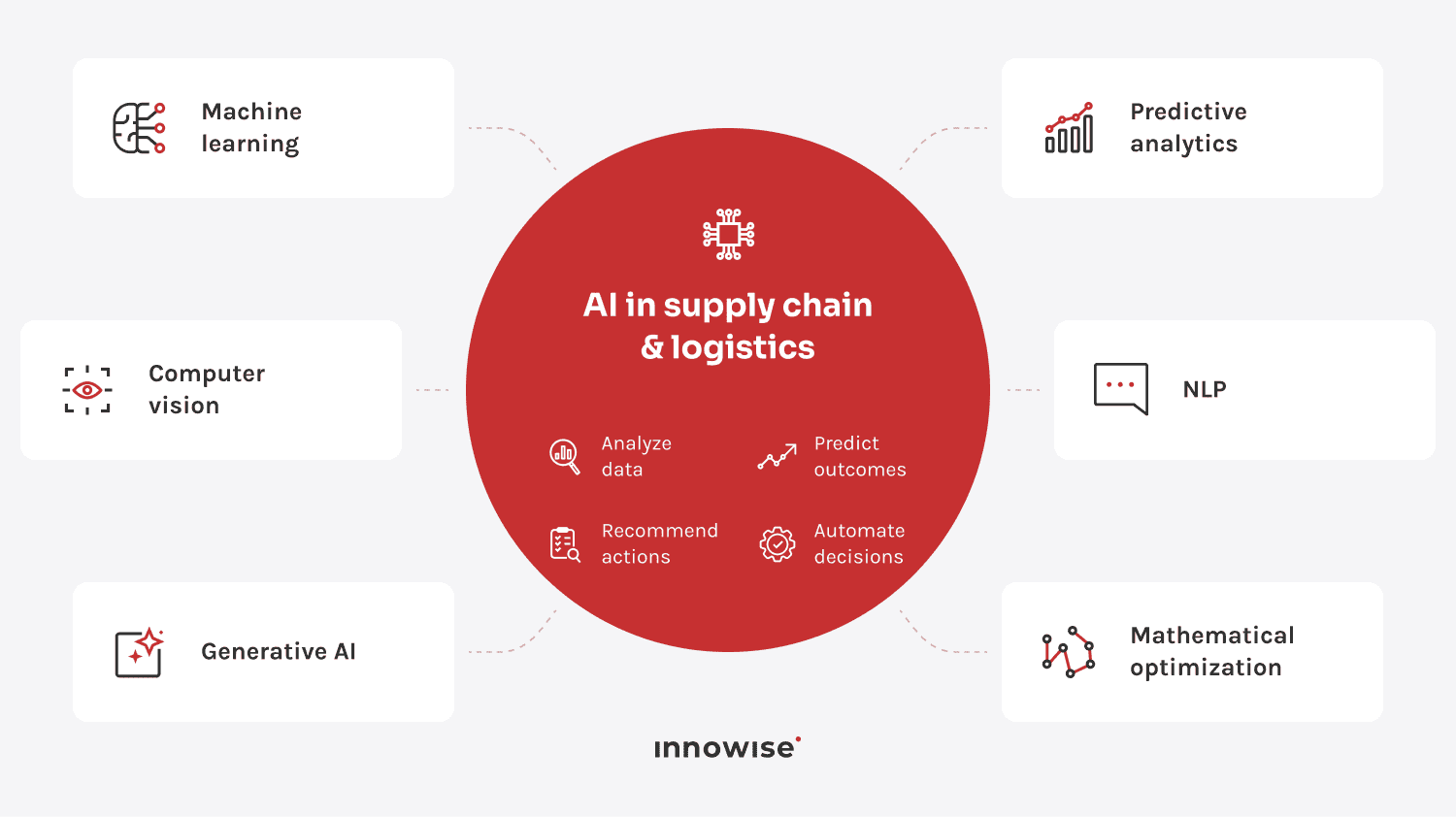
Artificial intelligence in logistics and supply chain management refers to the use of AI technologies to analyze operational data, predict outcomes, recommend actions, and automate decisions involved in sourcing, storing, transporting, and delivering goods.

Now let’s make this definition more practical.

Imagine a retailer operating five distribution centers. One location regularly runs out of popular products, while another has more inventory than it needs. The company has inventory records, sales histories, supplier information, and transportation data. Yet, manually analyzing these sources and deciding where to move stock takes time.

An AI-powered inventory management system can examine the available data, predict demand at each location, and recommend stock transfers or replenishment quantities. Depending on the system and business rules, it may also initiate approved actions automatically.

Several technologies make these applications possible.

  • Machine learning (ML) identifies patterns in historical and current data. In logistics, ML models can predict product demand, delivery delays, or equipment failures.
  • Predictive analytics uses statistical methods and, where appropriate, machine learning to estimate future outcomes. Companies apply it to inventory planning, shipment arrival predictions, and supply chain risk assessment.
  • Computer vision analyzes images and video. It can identify damaged packages, read labels, count goods, and support automated warehouse inspections.
  • Natural language processing (NLP) helps systems interpret written or spoken language. This makes it useful for processing shipping documents, analyzing supplier communications, and handling customer inquiries.
  • Generative AI produces text and other content based on instructions and available information. In logistics, it can summarize shipment exceptions, answer questions about operational records, and help employees retrieve information from complex documents.

There’s another technology worth mentioning: mathematical optimization. It helps businesses find suitable solutions under constraints such as vehicle capacity, delivery windows, and transportation costs. Optimization can work alongside AI predictions, but optimization algorithms aren’t necessarily AI themselves.

In practice, companies often combine these technologies. A transportation solution might use machine learning to predict travel times and an optimization engine to choose delivery routes based on those predictions.

AI implementation getting tricky?

AI use cases in supply chain and logistics

What can artificial intelligence do for a logistics business?

Quite a lot, actually. But the applications of AI in logistics depend on the processes you want to improve, the data you have, and the decisions you’re trying to make.

Let’s examine ten common use cases.

  • Demand forecasting
  • Inventory
  • Routing
  • Shipment tracking
  • Warehousing
  • Fleet management
  • Maintenance
  • Document processing
  • Customer support
  • Risk management

Demand forecasting

Overestimate demand, and you're stuck paying to store products nobody wants. Underestimate it, and you're losing sales because the products people do want are out of stock. Neither is particularly good for business.

AI helps get those forecasts closer to reality. Machine learning models analyze historical sales alongside seasonal trends, promotions, pricing changes, and external factors that influence purchasing behavior.

An online retailer, for instance, can forecast demand for individual products across different regions and adjust inventory allocation accordingly. If winter jackets are expected to sell faster in one location, the company can move stock there before the rush begins.

Of course, even the best model can't predict every sudden market shift. Forecasts still need monitoring and occasional recalibration.

Inventory optimization

Knowing how much inventory you have is one thing. Knowing how much you actually need, and where, is another.

AI-powered inventory systems analyze stock levels, demand forecasts, supplier lead times, and replenishment patterns to recommend reorder points, safety stock levels, and inventory transfers.

Say one warehouse has 500 units of a product gathering dust while another is about to run out. Instead of placing a new order, AI can suggest moving existing stock between locations.

Less money tied up in excess inventory, fewer stockouts, and better use of warehouse space. That's the idea.

Route optimization

Finding an efficient delivery route sounds straightforward until you have hundreds of destinations, different delivery windows, changing road conditions, vehicle capacity limits, and drivers with specific working schedules.

That's when route planning becomes a serious mathematical problem.

AI-supported routing systems can predict travel times using historical traffic patterns, weather information, and operational data. Optimization algorithms then use these predictions alongside delivery constraints to calculate suitable routes.

Some solutions can also recalculate routes when circumstances change.

Suppose a road closure affects several scheduled deliveries. Instead of manually rearranging every stop, the system can suggest an alternative route and estimate its impact on delivery times.

For logistics companies, AI in logistics and supply chain optimization can mean fewer kilometers traveled, lower fuel costs, and more reliable deliveries.

Shipment tracking and ETA prediction

A shipment being marked "in transit" doesn't tell a warehouse manager much about when to expect it.

AI-powered tracking systems go further by predicting estimated times of arrival (ETAs) and flagging potential delays. They draw on GPS data, carrier updates, historical transit times, weather conditions, and port activity.

Take an ocean shipment delayed by congestion at a transshipment port. A predictive model can revise its ETA as new information comes in, giving the receiving warehouse time to rearrange unloading appointments and labor schedules.

The catch is that AI can only work with the tracking information it receives. Missing carrier updates or unreliable sensor data can still leave gaps in visibility.

Warehouse automation

Warehouse automation has come a long way from conveyor belts and barcode scanners.

Computer vision systems now help identify products, inspect packages for damage, and verify shipments. AI-powered warehouse software can recommend storage locations based on picking frequency and product characteristics. Meanwhile, mobile robots move goods between workstations, with intelligent coordination systems helping them avoid congestion.

Picture a busy e-commerce fulfillment center during peak season. Instead of employees walking back and forth across the warehouse to retrieve products, robots can bring storage units directly to picking stations.

Of course, not every warehouse process needs AI. Sometimes a conventional automation system does the job perfectly well. The trick is knowing where the additional intelligence actually pays off.

Fleet management

Fuel consumption, vehicle utilization, driving patterns, maintenance schedules, delivery performance. Fleet managers have plenty to keep an eye on.

AI can take some of that analysis off their plates.

By processing telematics data, fleet management systems can spot unusual fuel consumption, identify underused vehicles, and recommend more efficient fleet allocation.

For example, if two trucks cover similar routes with comparable loads but one consistently consumes more fuel, AI can help investigate why. Excessive idling? Different driving patterns? A mechanical issue?

Armed with that information, fleet managers can make targeted improvements instead of relying on guesswork.

Predictive maintenance

A forklift breakdown during a busy warehouse shift can interrupt several operations. The same applies to delivery trucks, conveyor systems, sorting equipment, and automated storage systems.

Predictive maintenance aims to detect signs of equipment deterioration before an actual failure occurs.

Machine learning models analyze sensor readings, operating hours, maintenance records, fault codes, and other equipment data.

For example, unusual vibration patterns in a conveyor motor may indicate a developing mechanical issue. A predictive model can flag the anomaly so maintenance technicians can inspect the equipment before it fails.

This can reduce unplanned downtime and help teams schedule maintenance more effectively.

Still, predictive maintenance needs sufficient data and careful validation. A system that generates too many false alarms may create unnecessary maintenance work instead of reducing it.

Intelligent document processing

Bills of lading, invoices, purchase orders, customs declarations, delivery confirmations. The logistics industry certainly knows how to generate paperwork.

And somebody has to process it all.

Intelligent document processing (IDP) combines optical character recognition (OCR), natural language processing, and document classification to extract information from documents and organize it for further use.

For example, an AI-powered system can read a freight invoice, extract shipment details and charges, and compare them against records in a transportation management system. If something doesn't match, it flags the discrepancy for review.

That means less manual data entry, faster invoice processing, and fewer opportunities for human error. High-value transactions can still go through human verification.

Customer service automation

Where's my shipment? Can I change the delivery address? Why hasn't my order arrived?

Customer support teams in logistics receive many similar questions every day.

AI-powered assistants can handle routine inquiries by accessing order records, shipment tracking information, delivery policies, and knowledge bases.

For instance, a customer asks why a package is delayed. Instead of giving a generic answer, an assistant connected to the tracking system can retrieve the latest shipment status and provide an explanation based on the available information.

More complicated requests can be transferred to a human operator.

The important part is integration. Without access to trustworthy operational data, even a sophisticated AI assistant may provide inaccurate answers about delivery status.

Supply chain risk management

Supply chains are pretty good at producing unpleasant surprises. A supplier suddenly goes silent, a port gets congested, or a storm disrupts deliveries halfway across the world. And the consequences can reach your business long before you realize something's wrong.

AI helps spot trouble earlier. By analyzing supplier performance, shipment data, weather forecasts, news reports, and historical disruptions, it can identify potential risks and estimate their impact on operations.

For example, if a major port is experiencing congestion, an AI system can identify which shipments may be affected and help planners evaluate alternative routes or suppliers.

Sure, AI can't stop a hurricane or make an unreliable supplier suddenly reliable. But it can give your team something incredibly valuable: time to figure out what to do next.

Take a look at Innowise’s AI projects

AI bot for TBC Bank marketing campaign
Innowise built a bilingual Telegram bot that generates AI selfies with TBC Bank's football-star brand ambassador.
3,000 users engaged
2 languages supported
View case study
Client review
View case study
Client review logo. Client review

AI Telegram bot..
Breast cancer detection software development
Innowise implemented a federated learning framework that enabled 3 clinics to collaboratively train a breast cancer detection model.
<68.6% improvement in segmentation AP
10,500 mammography images in an imaging repository
AI-powered end-to-end compliance ecosystem development
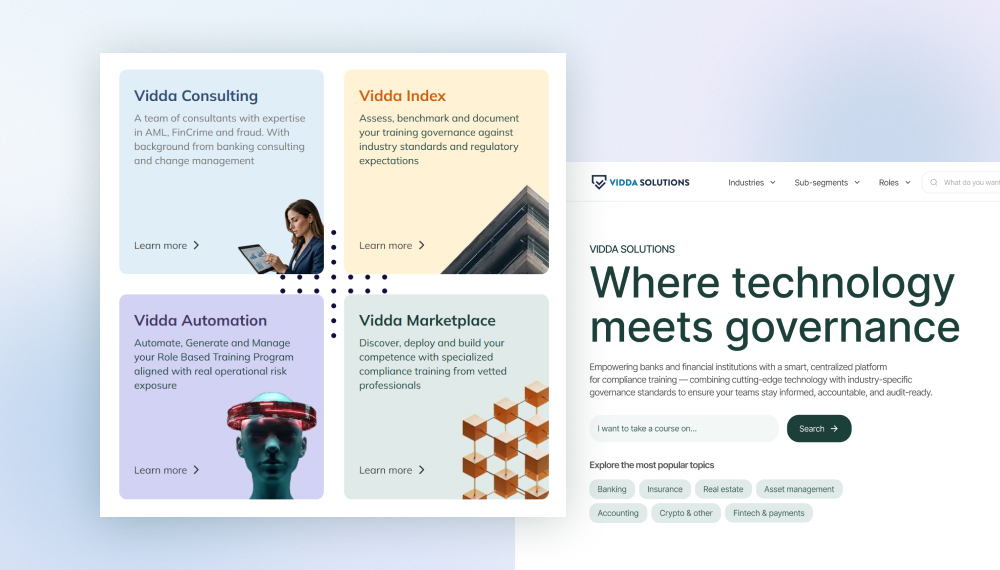
Innowise delivered an intelligent platform for compliance assessment and training in highly regulated sectors, like finance, insurance, etc.
8 months from concept to launch
100% GDPR and DORA rcompliance
View case study
Client review
View case study
Client review logo. Client review
Mobile medical advisor..
AI-assisted contract transformation platform development
We’ve built a contract management parsing module that uses AI for field classification and semantic content analysis.
10s to produce a parsed structure
100% DORA / NIS2 ready
View case study
Client review
View case study
Client review logo. Client review

AI-assisted contract transformation platform (DORA / NIS2 ready)..
Building a unified AI FinTech OS for fiat and crypto
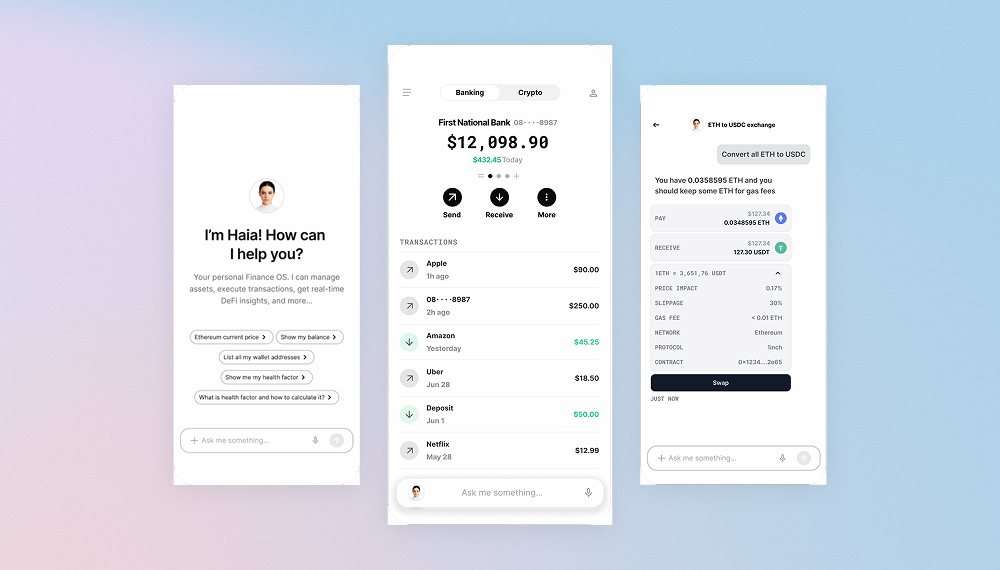
We helped build Haia, a modular AI finance OS that connects banks, crypto wallets, and investments, enabling secure, cross-chain operations.
25% more efficient LP via Superform integration
70 crypto app interfaces replaced with one
View case study
Client review

View case study
Client review logo. Client review

Haia: finance AI assistant.
AI dermatologist skin scanner app development
An AI app we built uses deep learning and image recognition to quickly assess skin conditions, giving preliminary diagnoses based on photos.
30 dermatological conditions supported
Building an analytical platform to improve decision-making
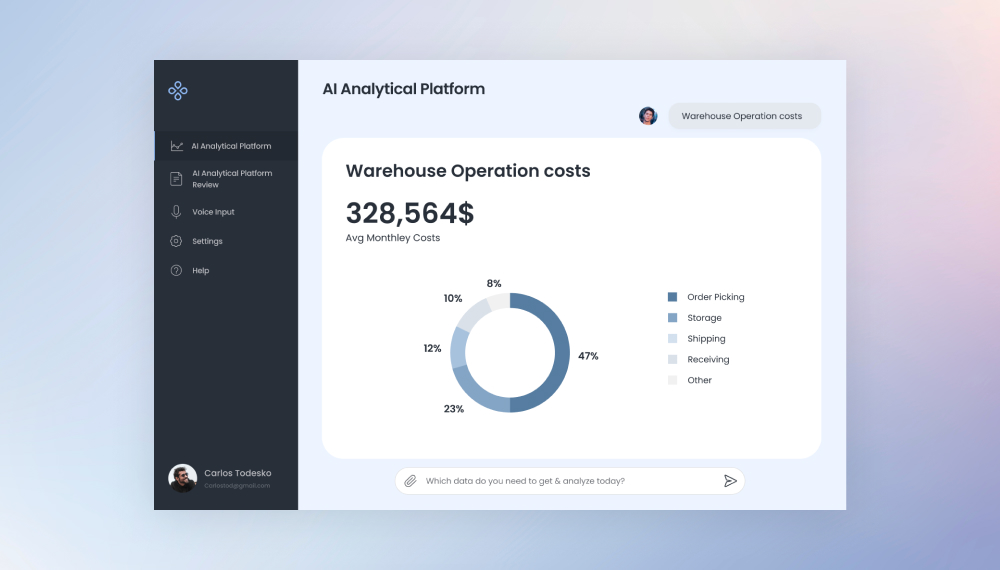
We developed an LLM-based analytical platform that can analyze the company’s internal data and generate responses to questions based on that info.
AI medical advice app development
Innowise has developed a cross-platform mobile app to provide travellers with medical advice and help find nearby medical facility locations.
100% GDPR compliance
01 / 01
Close popup icon

Benefits of AI in supply chain and logistics

We’ve looked at the applications. Now comes the question businesses care about most: what improvements can they expect?

The benefits of AI in logistics depend on which processes are automated or optimized, how accurately the models perform, and whether employees can act on the insights.

Here are the main areas where AI can make a difference.

BenefitHow AI contributes
More accurate demand planningAnalyzes historical and external demand signals to produce forecasts at a more granular level
Lower inventory levels and carrying costsSupports better replenishment decisions and reduces unnecessary safety stock
Faster order fulfillmentSupports warehouse picking, stock placement, and automation of repetitive processes
Better supply chain visibilityIdentifies shipment exceptions and predicts delays using connected operational data
Better resource utilizationHelps allocate vehicles, warehouse capacity, labor, and equipment more efficiently
Fewer operational errorsAutomates selected checks and reduces repetitive manual data processing
Faster response to disruptionsIdentifies risks earlier and supports evaluation of alternative plans
Lower fuel consumption and transportation costsOptimizes routes, loads, and vehicle utilization to reduce fuel consumption and transportation costs.
Better customer serviceImproves shipment updates, response times, and handling of routine inquiries
Show more

That sounds promising. But none of these improvements is guaranteed simply because a company introduces an AI system.

Take demand forecasting. More accurate predictions only reduce inventory costs if the business uses them to adjust purchasing, replenishment, or allocation decisions.

Similarly, route optimization saves money when the proposed routes are practical, drivers can follow them, and the transport operation adapts to the new plan.

That’s why companies should connect each AI initiative to measurable operational KPIs rather than judge success by model accuracy alone.

Want AI to cut your logistics costs?

Examples of AI in supply chain and logistics

Want to see how all this works outside the theory? These AI in logistics examples show what major companies have implemented and what they’ve achieved so far.

  • Demand forecasting
  • Routing & inventory
  • Warehouse robotics
  • Robots & AI agents

Amazon: predicting demand and improving inventory placement

Amazon manages an enormous product assortment, distributed across fulfillment centers in different regions.

One of its operational challenges is determining which products customers will order and where those products should be stored before purchases happen.

Amazon uses AI and machine learning in its Supply Chain Optimization Technologies (SCOT) systems to predict demand and support inventory placement decisions.

The company reported in its 2025 second-quarter earnings announcement that improvements in AI-powered demand forecasting increased regional forecast accuracy by 20%.

Better regional forecasts can help Amazon position inventory closer to customers, reduce unnecessary product movements, and speed up order fulfillment.

Walmart: improving routing and inventory distribution

Walmart operates an extensive logistics network connecting suppliers, distribution centers, and stores.

To improve transportation efficiency, Walmart developed an AI-powered Route Optimization solution. The technology supports decisions about transportation routes and freight movements.

In March 2024, Walmart announced that it was making the solution available to other businesses as a SaaS product.

Walmart has also described the use of AI in inventory orchestration. Its self-healing inventory capabilities identify stock imbalances and help redirect goods to locations where they're needed.

The broader business objective is to improve product availability while reducing unnecessary transportation and operational waste.

Amazon: coordinating warehouse robots with AI

Robots can improve warehouse operations, but coordinating large robotic fleets creates another operational challenge.

Hundreds of robots may need to move through shared warehouse spaces while avoiding congestion and completing tasks efficiently.

In June 2025, Amazon introduced DeepFleet, a generative AI foundation model designed to coordinate movement across its robotic fleet.

Amazon said the technology would improve robot travel efficiency by 10%, helping reduce congestion and support faster order processing.

This figure was presented as an expected improvement when the technology was announced, rather than a separately verified post-deployment result.

The example shows how AI can improve an existing automation system without requiring the company to replace all its warehouse equipment.

DHL: automating warehouses with robots and AI agents

DHL is giving AI quite a workload. By 2026, the logistics giant had deployed over 8,000 robots across its global network to handle tasks such as picking, packing, and moving inventory. The company reports lower costs, improved efficiency, and reduced dependence on manual labor.

And DHL isn't stopping at physical work. In 2025, it expanded its partnership with HappyRobot to deploy AI agents for appointment scheduling, driver follow-ups, and warehouse coordination. These agents handle phone calls and emails, with deployments covering hundreds of thousands of emails and millions of voice minutes annually.

So, robots deal with the warehouse hustle, AI agents handle the endless calls and emails, and DHL gets to move more goods with less manual work.

How to implement AI in supply chain and logistics

Now that we’ve covered the applications and real-world examples, let’s move to implementation.

Introducing AI into supply chain operations involves more than choosing an algorithm or subscribing to an AI platform. Companies need reliable data, integration with existing systems, clearly defined objectives, and employees who can use the resulting capabilities.

Here’s a practical approach.

01
Identify a high-value use case and set clear goals for AI

First, figure out where your supply chain is losing money or wasting time. Frequent stockouts? Inefficient delivery routes? Employees drowning in shipping paperwork?

Once you've identified the problem, assess whether AI is the right solution and what improvements you expect from it. Compare potential use cases based on business impact, data availability, implementation complexity, and operational risks.

And please, skip vague goals like "make logistics smarter." Set measurable targets instead: reduce forecast errors, lower transportation costs per delivery, or cut document processing time.

Start with a use case that promises tangible value without requiring you to rebuild your entire supply chain.

02
Assess available data and its quality

AI models depend on relevant data.

A demand forecasting system may require sales histories, stock records, promotions, and product information. A fleet management solution might need GPS data, vehicle telematics, maintenance records, and delivery histories.

Check whether these datasets are available, consistent, sufficiently detailed, and representative of real operating conditions.

Missing records, inconsistent product identifiers, and unreliable timestamps can cause serious problems later.

03
Prepare and integrate data sources

Supply chain data rarely lives in one system.

Businesses commonly use enterprise resource planning (ERP), warehouse management systems (WMS), transportation management systems (TMS), order management software, and additional partner platforms.

Preparing data may involve creating integrations, standardizing identifiers, cleaning historical records, and building processing pipelines.

For some AI applications, data also needs to be synchronized frequently enough to support operational decisions.

04
Choose your approach: custom or off-the-shelf AI

Should you purchase an existing product or invest in custom AI development?

That depends on your requirements.

Commercial AI-enabled platforms can be a suitable choice for standardized processes such as document extraction or common demand forecasting tasks.

Custom development makes more sense when businesses have unusual workflows, specialized constraints, proprietary data, or demanding integration requirements.

It's also worth assessing whether a hybrid approach could work, combining existing software with purpose-built AI components.

Once you've settled on an approach, it's time to test whether it works for your business.

05
Run a proof of concept or pilot

Before deploying AI across the entire logistics network, test it in a controlled environment.

For example, you could pilot a demand forecasting model in one product category or apply route optimization to a limited group of vehicles.

Compare the AI approach against a realistic baseline. Measure forecast errors, operational improvements, user acceptance, and implementation effort.

Use representative data and test how the solution behaves when conditions change.

A successful technical demonstration is useful, but operational value is what justifies a larger rollout.

06
Integrate the solution with existing systems

An AI model that produces recommendations in a separate dashboard may have limited practical value if employees must manually transfer those recommendations into another system.

Integration helps connect predictions to operational workflows.

A forecast might feed replenishment planning in an ERP system. An ETA prediction could update the TMS and notify a customer. An equipment warning might create a maintenance ticket.

Decide which actions can be automated and which need human approval. This is especially important when recommendations affect safety, costly inventory decisions, or customer commitments.

07
Measure performance against target KPIs

Once the system is running, measure what changed.

For inventory optimization, monitor carrying costs, stockout rates, inventory turnover, and service levels. For route optimization, track transportation costs, on-time deliveries, fuel consumption, and vehicle utilization.

Don't overlook operating costs related to the AI solution itself, including infrastructure, data processing, vendor fees, maintenance, and support.

Also monitor model performance over time. A forecast that worked well last year may become less reliable as demand patterns change.

08
Scale successful use cases across other operations

If the pilot delivers measurable value, you can expand it to additional warehouses, product categories, regions, or transportation routes.

However, scaling isn't always a matter of copying the same model.

Different locations may have different data structures, operating conditions, regulations, and business constraints.

Plan for retraining, monitoring, system reliability, user support, and data governance as adoption grows.

The goal is to make the solution dependable in everyday operations, rather than leave it as a promising experiment.

arrow-icon.arrow-icon.
01 Identify a high-value use case and set clear goals for AI

First, figure out where your supply chain is losing money or wasting time. Frequent stockouts? Inefficient delivery routes? Employees drowning in shipping paperwork?

Once you've identified the problem, assess whether AI is the right solution and what improvements you expect from it. Compare potential use cases based on business impact, data availability, implementation complexity, and operational risks.

And please, skip vague goals like "make logistics smarter." Set measurable targets instead: reduce forecast errors, lower transportation costs per delivery, or cut document processing time.

Start with a use case that promises tangible value without requiring you to rebuild your entire supply chain.

arrow-icon.arrow-icon.
02 Assess available data and its quality

AI models depend on relevant data.

A demand forecasting system may require sales histories, stock records, promotions, and product information. A fleet management solution might need GPS data, vehicle telematics, maintenance records, and delivery histories.

Check whether these datasets are available, consistent, sufficiently detailed, and representative of real operating conditions.

Missing records, inconsistent product identifiers, and unreliable timestamps can cause serious problems later.

arrow-icon.arrow-icon.
03 Prepare and integrate data sources

Supply chain data rarely lives in one system.

Businesses commonly use enterprise resource planning (ERP), warehouse management systems (WMS), transportation management systems (TMS), order management software, and additional partner platforms.

Preparing data may involve creating integrations, standardizing identifiers, cleaning historical records, and building processing pipelines.

For some AI applications, data also needs to be synchronized frequently enough to support operational decisions.

arrow-icon.arrow-icon.
04 Choose your approach: custom or off-the-shelf AI

Should you purchase an existing product or invest in custom AI development?

That depends on your requirements.

Commercial AI-enabled platforms can be a suitable choice for standardized processes such as document extraction or common demand forecasting tasks.

Custom development makes more sense when businesses have unusual workflows, specialized constraints, proprietary data, or demanding integration requirements.

It's also worth assessing whether a hybrid approach could work, combining existing software with purpose-built AI components.

Once you've settled on an approach, it's time to test whether it works for your business.

arrow-icon.arrow-icon.
05 Run a proof of concept or pilot

Before deploying AI across the entire logistics network, test it in a controlled environment.

For example, you could pilot a demand forecasting model in one product category or apply route optimization to a limited group of vehicles.

Compare the AI approach against a realistic baseline. Measure forecast errors, operational improvements, user acceptance, and implementation effort.

Use representative data and test how the solution behaves when conditions change.

A successful technical demonstration is useful, but operational value is what justifies a larger rollout.

arrow-icon.arrow-icon.
06 Integrate the solution with existing systems

An AI model that produces recommendations in a separate dashboard may have limited practical value if employees must manually transfer those recommendations into another system.

Integration helps connect predictions to operational workflows.

A forecast might feed replenishment planning in an ERP system. An ETA prediction could update the TMS and notify a customer. An equipment warning might create a maintenance ticket.

Decide which actions can be automated and which need human approval. This is especially important when recommendations affect safety, costly inventory decisions, or customer commitments.

arrow-icon.arrow-icon.
07 Measure performance against target KPIs

Once the system is running, measure what changed.

For inventory optimization, monitor carrying costs, stockout rates, inventory turnover, and service levels. For route optimization, track transportation costs, on-time deliveries, fuel consumption, and vehicle utilization.

Don't overlook operating costs related to the AI solution itself, including infrastructure, data processing, vendor fees, maintenance, and support.

Also monitor model performance over time. A forecast that worked well last year may become less reliable as demand patterns change.

arrow-icon.arrow-icon.
08 Scale successful use cases across other operations

If the pilot delivers measurable value, you can expand it to additional warehouses, product categories, regions, or transportation routes.

However, scaling isn't always a matter of copying the same model.

Different locations may have different data structures, operating conditions, regulations, and business constraints.

Plan for retraining, monitoring, system reliability, user support, and data governance as adoption grows.

The goal is to make the solution dependable in everyday operations, rather than leave it as a promising experiment.

One mistake I often see with AI projects is that companies spend months improving model accuracy without checking whether those improvements actually change anything in their operations. A demand forecast that's 10% more accurate sounds great, but if your procurement team still follows the same ordering rules, what have you really gained? I'd rather see a simpler model that changes decisions and saves money than a sophisticated one nobody uses.
Yuliya Pantsiuk, Head of Business Analysis.
Yuliya Pantsiuk
Head of Business Analysis

Challenges of implementing AI in supply chain

AI adoption has its difficulties. And some have little to do with the AI models themselves.

So, what makes implementation so challenging?

Data quality and accessibility

Inventory information may be stored in one system, transportation events in another, and supplier records in spreadsheets.

When data is incomplete, inconsistent, or outdated, AI models can produce unreliable predictions.

Before deployment, companies often need to standardize records, resolve duplicates, define data ownership, and establish consistent data pipelines.

Many supply chain businesses rely on software that has been customized and maintained over many years.

Such systems may have limited APIs, outdated data formats, or integration restrictions.

Connecting AI to these environments can require middleware, API development, data synchronization, or modernization of selected components.

Replacing existing software isn’t always necessary, but the integration effort needs to be considered early.

AI implementation costs include more than model development.

Businesses may need to invest in data engineering, infrastructure, software licenses, integration, security, employee training, and ongoing support.

The total cost depends heavily on the use case. A document processing solution generally has different requirements from an AI-driven warehouse robotics system.

Estimating total cost of ownership and expected financial value before scaling helps avoid expensive surprises.

Developing an AI model is one challenge. Making it work reliably within live supply chain operations is another.

Projects may require data engineers, ML specialists, software developers, cloud experts, security engineers, and people familiar with logistics processes.

Companies without these capabilities internally may need an experienced technology partner to design and deploy the solution.

Even an accurate AI system can fail to deliver business value if employees don’t trust it or understand how to use it.

Warehouse operators, dispatchers, procurement teams, and planners need to know what the system does, when to accept its recommendations, and when human judgment is required.

Involving employees during pilot testing can help identify problems that technical teams might otherwise overlook.

AI solutions often process commercially sensitive information, including supplier contracts, shipment details, customer records, and operational data.

Businesses need suitable access controls, encryption, audit logging, and clear rules for data retention and third-party access.

Generative AI introduces additional considerations, such as inaccurate outputs, inappropriate disclosure of sensitive information, and insecure connections to operational systems.

Security, compliance, and human oversight should be included in the implementation design from the beginning.

The future of AI in supply chain and logistics

What comes next for AI in logistics?

The most interesting developments concern how AI capabilities will become more closely integrated with existing operations.

  • Predictive and prescriptive supply chain analytics icon.

    Predictive and prescriptive supply chain analytics

    Businesses will increasingly combine predictions with recommendations for action. A system that anticipates inventory shortages may also evaluate possible stock transfers, alternative suppliers, and transportation costs.

  • AI agents and operational assistants icon.

    AI agents and operational assistants

    AI agents could take over entire workflows involving multiple systems. Imagine an agent investigating a delayed shipment, checking alternative routes, and requesting approval to make changes. And this might become pretty common soon. Gartner predicts that by 2030, 60% of enterprises using supply chain management software will have adopted agentic AI features, compared to just 5% in 2025. Of course, reliable integrations, safeguards, and human oversight will still be needed.

  • More advanced warehouse robotics icon.

    More advanced warehouse robotics

    Robotics systems are becoming better at identifying objects, navigating dynamic environments, and coordinating tasks. Computer vision and machine learning will continue to support developments in robotic picking, inspection, and internal transportation.

  • Digital twins and scenario planning icon.

    Digital twins and scenario planning

    Virtual representations of warehouses, transportation networks, and supply chain processes can help businesses evaluate operational changes before implementing them. Combined with predictive models, simulation can support decisions about warehouse capacity, inventory policies, and distribution networks.

  • Greater attention to supply chain resilience icon.

    Greater attention to supply chain resilience

    Companies will continue exploring AI-based monitoring of suppliers, transport corridors, and operational disruptions. Faster risk identification can support contingency planning, although it won't eliminate uncertainty.

    However, fully autonomous supply chains are unlikely to appear overnight. Data quality, fragmented software, regulatory constraints, and the financial consequences of incorrect decisions make human oversight necessary in many operations.

    The realistic direction is toward more connected, predictive, and selectively automated processes.

How Innowise can help with AI in supply chain and logistics

There’s no universal AI solution for logistics.

A retailer struggling with demand planning has different requirements from a freight forwarder processing shipping documents or a warehouse operator introducing computer vision.

At Innowise, we help companies evaluate AI opportunities, prepare data, develop AI solutions, and integrate them with existing business systems.

Our services cover the major stages of AI adoption.

  • AI consulting
  • AI development
  • Data management
  • Data analytics
  • Generative AI
  • AI agents
  • Computer vision

AI consulting

Our AI consulting services help you identify where AI can solve specific logistics problems, assess data readiness, and estimate implementation costs. We also help prioritize use cases and develop a roadmap based on your business goals and technical capabilities.

Logistics planner uses interactive world map to optimize multi-leg itineraries for clients.

Custom AI development

We build custom AI solutions for demand forecasting, inventory optimization, predictive maintenance, and other logistics processes. Our team develops and tests the models, deploys them, and integrates them with your existing ERP, WMS, or TMS.

Inventory supervisor audits stock levels on a tablet, using the warehouse management system.

Data management

Our data management services help consolidate inventory, shipment, supplier, and other operational data from disconnected systems. We clean and standardize records, build data pipelines, and establish data governance processes to keep information reliable and accessible.

Integrated cloud storage connects multiple enterprise locations, streamlining real-time file sharing and project updates.

Data analytics

We develop AI-driven supply chain and logistics analytics solutions to track delivery performance, inventory turnover, warehouse productivity, and transportation costs. These include dashboards, automated reports, and predictive models that help teams identify trends and operational inefficiencies.

Operations team monitors KPI metrics on a digital control panel for proactive order planning.

Generative AI development

Our generative AI solutions help process shipping documents, summarize supplier communications, and retrieve information from internal knowledge bases. We can also build AI assistants connected to your logistics systems to answer operational questions using company data.

IT professional working on laptop surrounded by holographic document schemas and a scheduling icon for task management.

AI agent development

We develop AI agents that automate multistep logistics workflows, such as checking shipment statuses, collecting carrier updates, and preparing responses to delivery disruptions. These agents can interact with existing business systems and request human approval before executing sensitive actions.

Architecture of interconnected AI agents and data pipelines, stacking modular blocks into unified, scalable AI systems.

Computer vision development

Our computer vision solutions can identify damaged packages, read shipping labels, count inventory, and verify goods during warehouse operations. We train and deploy models that process images or video from cameras and integrate the results with warehouse management systems.

Warehouse robotics system verifies parcel dimensions and status using computer vision at sorting station.

FAQ

Artificial intelligence is used to analyze operational data, predict future events, recommend actions, and automate selected workflows. Common applications include demand forecasting, inventory optimization, route planning, shipment ETA prediction, warehouse automation, predictive maintenance, intelligent document processing, and supply chain risk monitoring.

The main benefits of AI in logistics include more accurate forecasts, improved inventory availability, lower transportation costs, faster order fulfillment, better asset utilization, and greater visibility into potential disruptions. AI can also reduce repetitive manual work and improve customer service. Actual results depend on implementation quality, operational conditions, and the ability to act on AI-generated insights.


AI can reduce logistics costs by improving vehicle routing, helping consolidate shipments, identifying inefficient fleet usage, reducing excess inventory, and automating selected administrative processes. Predictive maintenance may also help prevent expensive equipment breakdowns. Businesses should measure these improvements against implementation and operating costs to determine their actual return on investment.

AI improves inventory management by analyzing demand patterns, stock availability, supplier lead times, and replenishment requirements. It can recommend reorder points, identify potential stockouts, detect excess inventory, and support stock transfers between locations. Better inventory decisions can help reduce carrying costs while maintaining the required product availability.

AI can predict travel times, detect delivery delays, and analyze transport conditions. These predictions can then be combined with route optimization algorithms that consider delivery windows, vehicle capacity, distance, and operational restrictions. The result is more efficient route planning and better responses to unexpected disruptions.

The most common challenges include poor data quality, fragmented information systems, complex integrations, implementation costs, a shortage of AI expertise, workforce adoption, and data security requirements. Companies can manage these risks by assessing data readiness, defining measurable goals, starting with a limited pilot, and scaling only after verifying the business results.

Show all

Table of contents

Got an idea for AI?

    Contact us

    Book a call or fill out the form below and we’ll get back to you once we’ve processed your request.

    Send us a voice message
    Attach documents
    Upload file

    You can attach 1 file up to 2MB. Valid file formats: pdf, jpg, jpeg, png.

    By clicking Send, you consent to Innowise processing your personal data per our Privacy Policy to provide you with relevant information. By submitting your phone number, you agree that we may contact you via voice calls, SMS, and messaging apps. Calling, message, and data rates may apply.

    You can also send us your request
    to contact@innowise.com
    What happens next?
    1

    Once we’ve received and processed your request, we’ll get back to you to detail your project needs and sign an NDA to ensure confidentiality.

    2

    After examining your wants, needs, and expectations, our team will devise a project proposal with the scope of work, team size, time, and cost estimates.

    3

    We’ll arrange a meeting with you to discuss the offer and nail down the details.

    4

    Finally, we’ll sign a contract and start working on your project right away.

    More services we cover

    arrow