The power of data mapping in healthcare: benefits, use cases & future trends. As the healthcare industry and its supporting technologies rapidly expand, an immense amount of data and information is generated. Statistics show that about 30% of the world's data volume is attributed to the healthcare industry, with a projected growth rate of nearly 36% by 2025. This indicates that the growth rate is far beyond that of other industries such as manufacturing, financial services, and media and entertainment.

LLM-as-a-judge: how we evaluate AI systems at scale

Jul 22, 2026 15 mins read
Summarize article with AI

Key takeaways

  • Using an LLM-as-a-judge works best when it acts as a separate evaluation layer. The model that generates the answer should not be the only one scoring it.
  • A good LLM-as-a-judge framework needs a measurable rubric. Labels such as good, natural, or helpful are too vague and can lead to inconsistent scoring.
  • Judge models are effective for open-ended checks such as meaning, tone, groundedness, and adherence to instructions. For exact matches, schema validation, or simple pass/fail criteria, deterministic checks are still better.
  • Controlling bias is important. Factors such as answer order, response length, prompt wording, and access to context can all affect the score.
  • Human review is still needed for sensitive decisions, disputed cases, and calibration.

Your LLM app can produce thousands of outputs per hour. At that volume, manual review stops working as the main quality check. Metrics like BLEU and ROUGE measure surface-level text similarity, but they can’t tell you whether a response uses the right facts or belongs in the product. And as the system grows, the blind spots grow with it.

The LLM-as-a-judge evaluation method addresses this gap by having one language model evaluate another against criteria you define. Teams get a signal they can act on across large output sets without putting a human reviewer behind every prompt. The approach works, but only with the right setup. A weak rubric, a biased prompt, or a self-judging model can make the scores look useful while the same quality issues stay hidden.

Here, I’ll cover what LLM-as-a-judge is, how it works, what makes its scores useful or misleading, and where the method tends to fail. We’ll also look at the setup teams need before they can trust those scores in a real AI product.

What is LLM-as-a-judge?

If you’re already familiar with the LLM-as-a-judge explanation, you can skim this section. If not, here is a simple LLM-as-a-judge definition. LLM-as-a-judge is an evaluation method where one language model reviews another model’s output against a rubric set by the team. This approach can also apply to outputs from a wider AI system or an agent.

The judge usually sees the user request, the model’s answer, and the rubric that explains what to check. Depending on the task, it can review the output in several ways:

  • Scoring gives an answer a numeric score or a pass/fail verdict.
  • Comparing reviews two or more answers to the same task, and picks the stronger one.
  • Classifying places the answer into a set category, such as safe, unsafe, relevant, or incomplete.

The rubric is what makes the review helpful. Without it, the judge has to guess what counts as good. With a rubric, the team can point the model to the quality signals that matter for their workflow.

Some common criteria are accuracy, relevance, groundedness, safety, clarity, and helpfulness. In a RAG system, the judge might check whether the answer is backed up by the retrieved source. For customer support, it could check whether the reply follows policy and actually answers the customer’s question. In content workflows, it might look at tone, clarity, and whether the draft fits the channel.

Why companies use LLM judges

Why do companies use the LLM-as-a-judge evaluation method? AI systems evolve faster than manual review can keep up. At first, reviewing outputs by hand is enough. You check a few answers, give feedback, and fix clear mistakes. But as the system starts handling hundreds of questions on many topics, manual review can’t keep pace.

Human review is still the best way to catch nuance, assess business risk, and handle unusual cases. The challenge is coverage. Reviewers can calibrate a rubric, check sensitive outputs, and investigate failures, but they can’t review every answer after each update.

Traditional metrics like BLEU, ROUGE, and exact-match checks help too, but only with strict checks such as exact answers, schemas, formats, and known labels. They miss things like meaning, groundedness, policy fit, and overall task quality.

LLM judges can review large test sets and assess qualities that fixed metrics miss, including relevance, groundedness, tone, safety, and instruction following. Teams use them for regression tests, release checks, model comparisons, and post-launch quality monitoring.

Most businesses don’t rely on just one method. A good setup combines deterministic checks for strict rules, LLM judges for open-ended evaluation, and humans for calibration and high-risk choices.

MethodBest forLimitsProduction role
Human reviewHigh-risk outputs, business nuance, edge cases, and decisions where context matters more than a scoreToo slow to repeat after every prompt edit, model update, retrieval change, or policy updateCalibrates rubrics, reviews disputed cases, investigates failures, and approves high-impact workflows
Traditional metrics and fixed checksKnown-answer tests, schema validation, required fields, format rules, exact-match labels, and strict pass/fail checksMiss meaning, source support, policy fit, tone, and answers that can be correct in more than one wayAct as hard gates for checks that must pass every time
LLM judgesFree-form answers, RAG quality checks, model comparison, instruction following, tone, safety, and relevanceCan reward verbosity, follow a weak rubric, or miss risks when the judge prompt is vagueGive teams a fast quality signal across large test sets and route weak outputs for human review

How LLM-as-a-judge works in practice

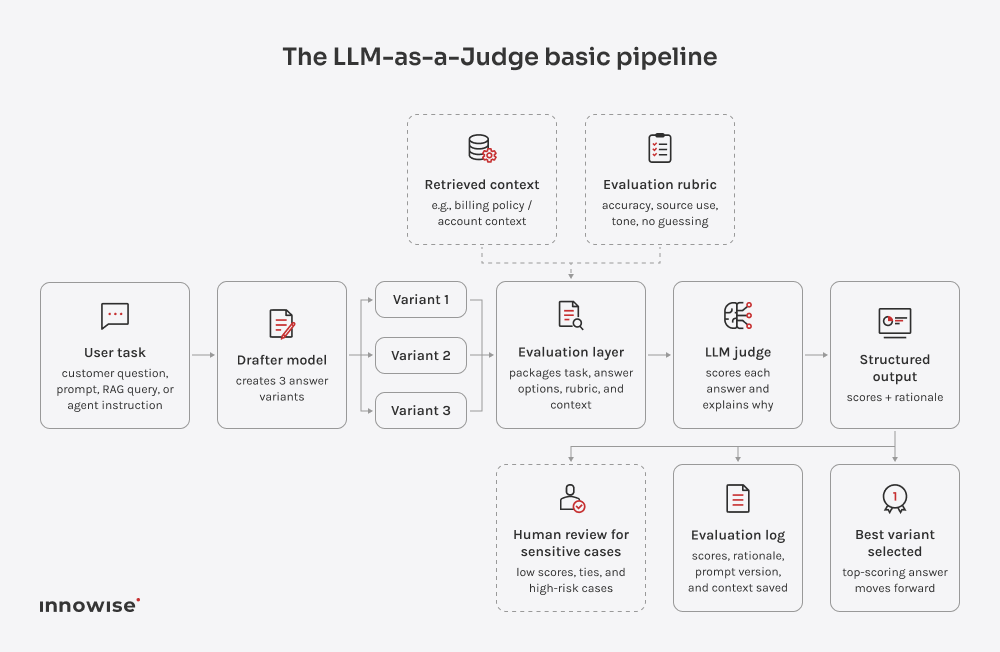
Now, let’s see how LLM-as-a-judge works in a product evaluation process. The setup looks simple at first. One model writes an answer, and another checks it using a rubric. The judge reviews the task, the answer, and the rubric, then returns a structured result that the team can use.

Here’s a basic LLM-as-a-judge evaluation pipeline diagram:

LLM-as-a-judge pipeline from user task and drafter model to evaluation, logging, and human review.

To make it easier to understand, imagine a company testing an AI assistant for customer support. In practice, the process works as follows:

01
The user task comes in

The system gets the original request. In our example, a customer wants to know why their latest invoice is higher after changing plans. In other products, the task could be a standard prompt, a RAG query, or an instruction for an AI agent.

02
The drafter model writes answer variants

The main AI generates three possible replies to the customer’s question. One reply is short and direct. Another explains the billing logic in more detail. The third uses a warmer, more conversational tone.

03
The evaluation layer packages the request

The system combines the customer’s question, the three answer options, and a strict evaluation rubric. Since this assistant uses RAG, it also includes the billing policy so the judge can verify the facts.

04
The judge model scores and explains

The judge reviews each reply against the rubric. It checks if the answer explains the invoice correctly, uses the right source, avoids guessing, and matches the brand’s tone. The judge then gives a structured result, often in JSON, with a score and a short explanation for that score.

05
The best output wins and data is logged

The system picks the highest-scoring answer to send to the customer. It also saves the judge’s scores, reasoning, prompt version, and source context in a database. This log lets the team track how response quality changes when they update the system.

06
Sensitive cases go to human reviewers

Low-scoring answers, ties, and high-risk cases go to human reviewers. A reviewer might notice that an answer is polite but does not explain the real reason for the price change. Human feedback helps improve the rubric and fix any blind spots the judge missed.

arrow-iconarrow-icon
01 The user task comes in

The system gets the original request. In our example, a customer wants to know why their latest invoice is higher after changing plans. In other products, the task could be a standard prompt, a RAG query, or an instruction for an AI agent.

arrow-iconarrow-icon
02 The drafter model writes answer variants

The main AI generates three possible replies to the customer’s question. One reply is short and direct. Another explains the billing logic in more detail. The third uses a warmer, more conversational tone.

arrow-iconarrow-icon
03 The evaluation layer packages the request

The system combines the customer’s question, the three answer options, and a strict evaluation rubric. Since this assistant uses RAG, it also includes the billing policy so the judge can verify the facts.

arrow-iconarrow-icon
04 The judge model scores and explains

The judge reviews each reply against the rubric. It checks if the answer explains the invoice correctly, uses the right source, avoids guessing, and matches the brand’s tone. The judge then gives a structured result, often in JSON, with a score and a short explanation for that score.

arrow-iconarrow-icon
05 The best output wins and data is logged

The system picks the highest-scoring answer to send to the customer. It also saves the judge’s scores, reasoning, prompt version, and source context in a database. This log lets the team track how response quality changes when they update the system.

arrow-iconarrow-icon
06 Sensitive cases go to human reviewers

Low-scoring answers, ties, and high-risk cases go to human reviewers. A reviewer might notice that an answer is polite but does not explain the real reason for the price change. Human feedback helps improve the rubric and fix any blind spots the judge missed.

My rough take is that the green AI part sounds noble, but most teams do it for a simpler reason. If it costs less to run, it ships faster and stays live longer. That’s still a win.

Why one model should not judge itself

People often review their own work. We read it again, spot weak areas, and make improvements. So why would a model be any different?

It might seem reasonable to have a model review its own writing and rate it. But in reality, when a model checks its own text, it can mistake smooth wording for true quality. It’s called self-enhancement bias. The model may overlook weak logic, repeated phrases, or dull endings because they fit the same patterns it used to write the answer. As a result, its own output can look better than it really is. 

For example, Sergei Molchanov, Business Unit Director at Innowise, ran into this issue while building an automated content engine for X posts. Every morning, the system sent him three post variants in Telegram. He picked one, sometimes edited it, and published it manually. The question was simple: which draft was actually the strongest?

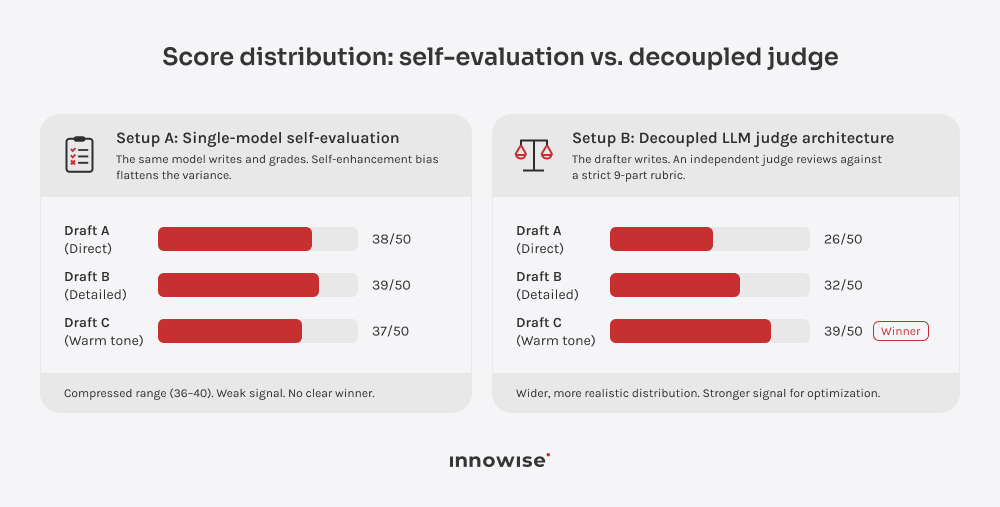
At first, Sergei asked the generator model to rate its own drafts using a rubric. But this didn’t give him a useful signal. The scores stayed close together, in the 36-40 range. A clearly weaker draft scored only slightly lower than the favorite, so the evaluation made the choice look easier than it was.

A chart comparing compressed self-evaluation scores with wider scores from a separate LLM judge.

The result changed when Sergei split the roles. One model wrote the posts, while a separate judge model scored them using a 9-part rubric. After that, similar drafts started getting more varied scores, such as 26, 32, and 39. The separate judge noticed issues the generator had smoothed over: hedge words like might and likely, metaphors repeated from earlier posts, and empty closing phrases such as time will tell.

Main types of LLM judge systems

Different evaluation tasks need different setups. Some teams check answers against a known reference, while others judge replies where more than one version could work. That’s why production workflows often use several types of LLM-as-a-judge systems.

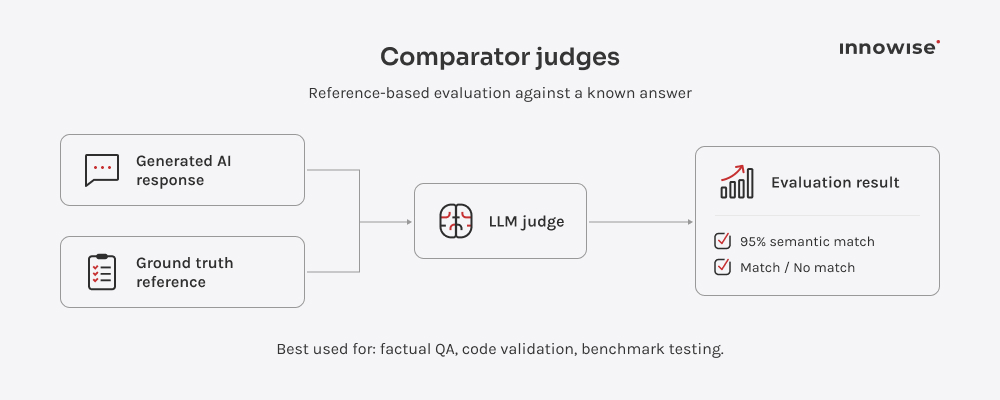
Comparator judges

Comparator judges compare an AI output to a verified reference answer, also known as ground truth. They check whether the response matches the facts, follows the correct logic, or produces the expected result. 

This approach works best when there is a clear answer. For example, a support bot might need to give the exact warranty rule, or a code assistant might need to use a specific algorithm. Benchmark tests also often have just one correct result to check.

The downside is that comparator judges aren’t very flexible. They can be too strict for tasks where more than one answer is correct, especially when wording, tone, or context are important.

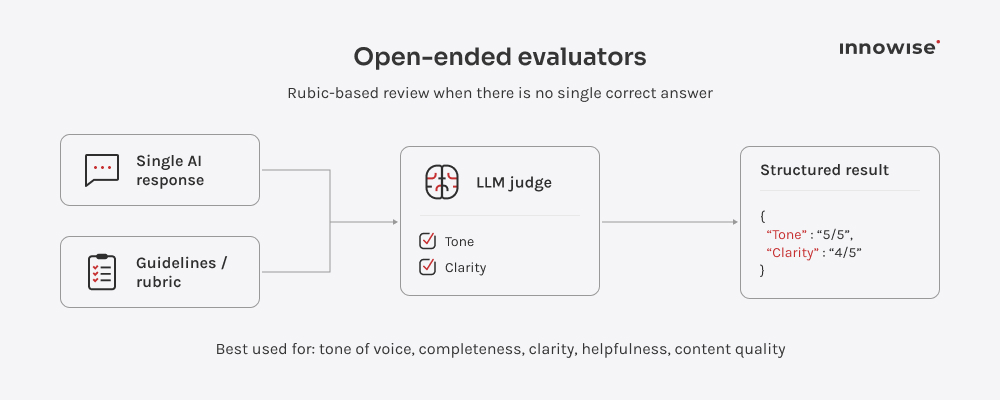
Open-ended evaluators

Many AI tasks don’t have just one correct answer. For example, a customer reply, a summary, or a generated post can all be good in different ways. Here, the judge uses a rubric instead of a reference answer to review the output.

Open-ended evaluators are good for checking tone, clarity, completeness, helpfulness, and content quality. The judge looks at whether the answer follows the task, covers the key points, and fits the intended use.

The rubric is especially important here. If the instruction just says “rate the answer quality,” the judge has too much freedom to guess. But if the rubric says “check whether the answer covers all requested steps and avoids unsupported claims,” the score is more helpful.

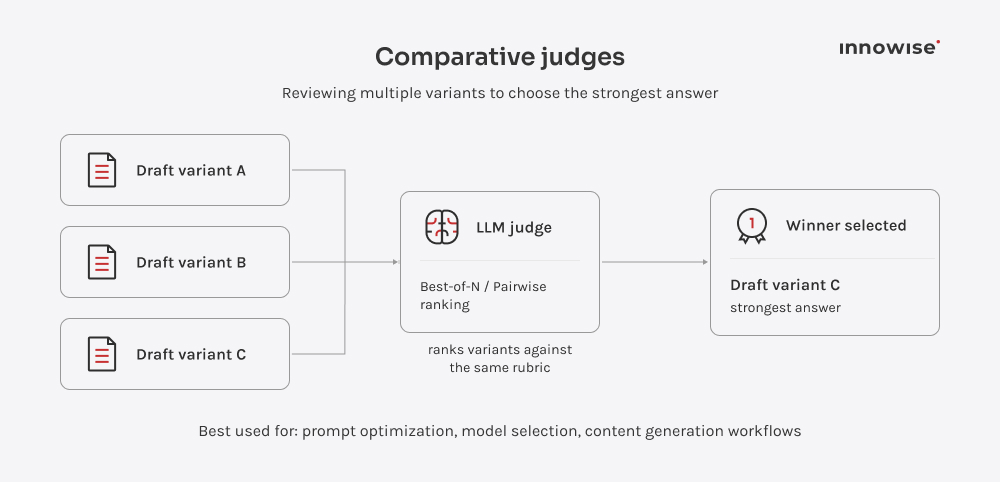
Comparative judges

Comparative judges examine several outputs for the same task and select the best one. Sometimes this means comparing two answers side by side, or ranking several options to find the top choice.

Sergei used this setup in his content engine. The drafter made three versions of an X post for the same brief. The judge used the same rubric to review them and helped identify the strongest draft.

This type of judging is helpful for prompt tests, model selection, and content workflows where the team needs to choose among different versions. However, the order or length of answers can still affect results, so teams often randomize the options and compare judge decisions with human review.

A diagram showing how a comparative judge reviews several draft variants and selects the strongest answer.

Using LLM judges for RAG evaluation

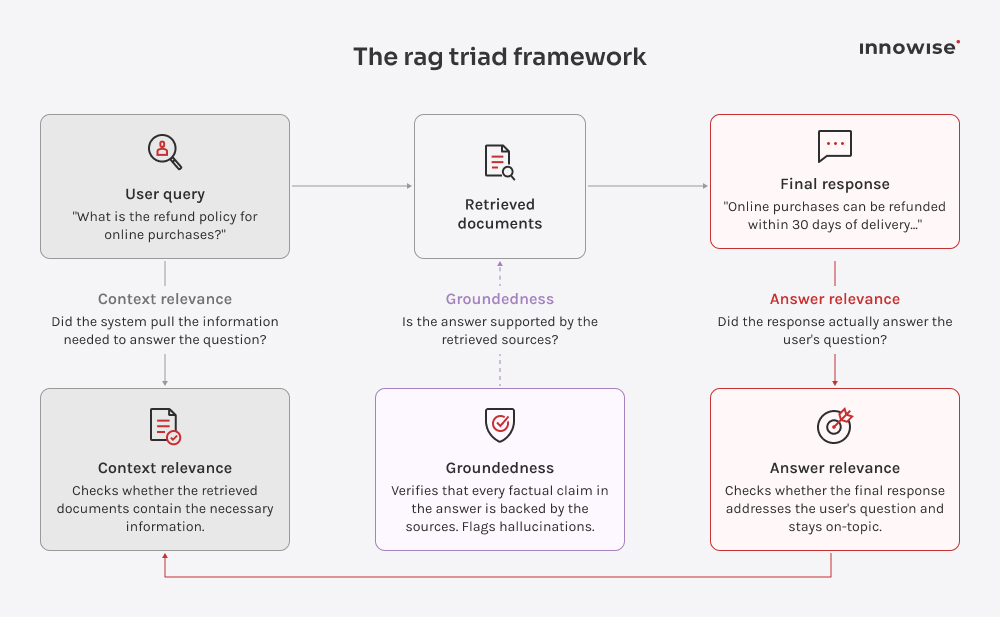
That’s why LLM-as-a-judge evaluation methodology is useful for RAG evaluation. They let the team check each part of the pipeline separately, instead of just looking at the final answer and trying to guess what went wrong. This step-by-step review is often called the RAG triad.

  • Context relevance measures how well the system finds the right information. The judge reviews the user’s question and the retrieved documents, then checks whether the system found what was needed to answer the question. If this score is low, the issue could be with search filters, embeddings, chunking, or document quality.
  • Groundedness checks whether the final answer is supported by the retrieved sources. The judge compares the answer to the source text and identifies any claims not supported by the context. Here, LLM judges can help catch hallucinations in RAG systems.
  • Answer relevance assesses how well the final response addresses the user’s question. Even if the right context was found, the answer might still miss the point. The judge looks for this gap: did the model answer the real question, or did it produce a fluent response that avoids the user’s problem?

This split makes debugging less vague. A retrieval issue means the system didn’t bring back the right material. A groundedness issue means the right material was there, but the model didn’t stay close to it. If the answer is relevant only on the surface, the team needs to review how the model turns context into a response.

Bring structure to AI output evaluation

LLM judges for RLHF, GRPO, and AI training

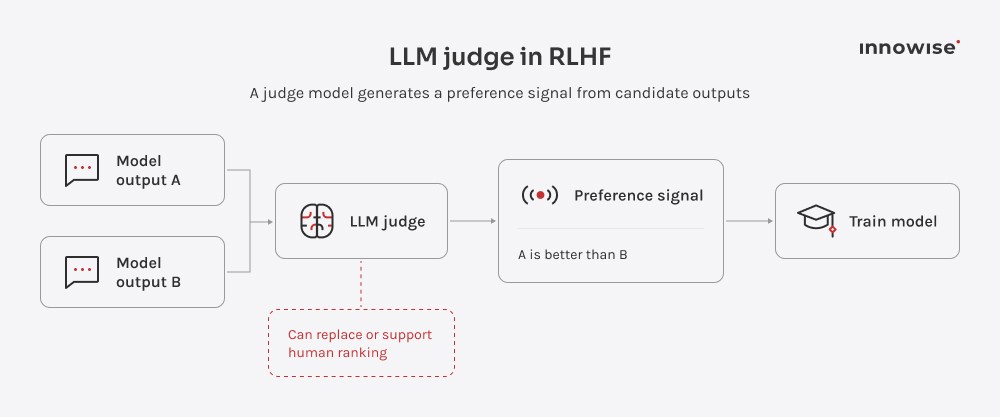
LLM judges also help with model training. Their job here is to create a preference signal, a training hint that tells the loop which answer should rank higher and why.

In reinforcement learning from human feedback, or RLHF, this signal usually starts with people. Reviewers compare two model answers and select the better one. These choices become preference data for a reward model, which later helps the training loop favor similar answers.

The bottleneck is volume. As the sample set grows, reviewers can’t check every pair at the same pace. An LLM judge helps sort outputs first, so people focus on uncertain cases or examples where a wrong preference could harm the model.

LLM judge creates a preference signal for RLHF training.

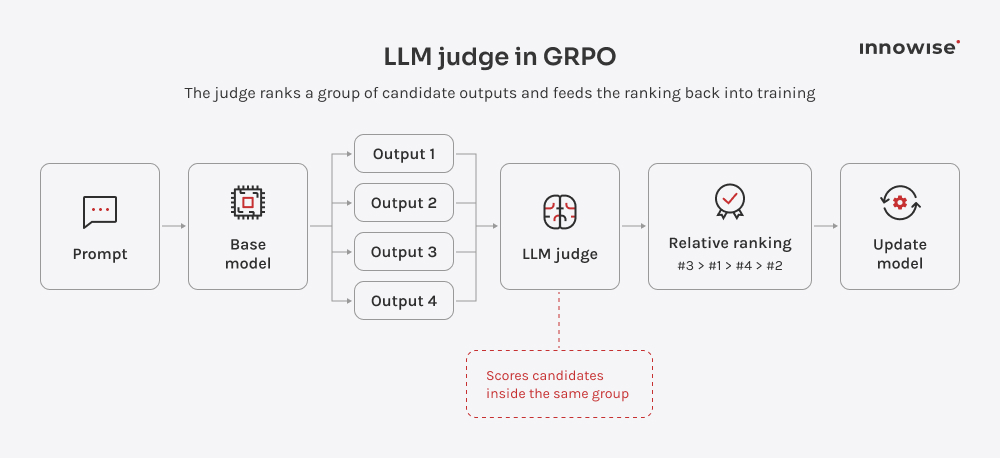
Group relative policy optimization, or GRPO, works with a group of answers. The model generates several responses to the same prompt, and the training loop needs a reward signal for each response in that group.GRPO doesn’t always need an LLM judge. For math or code, a rule or verifier may provide the reward. For tasks without one fixed answer, a judge scores responses against a rubric. It’s helpful when quality depends on policy fit and on following instructions.

LLM judge ranks grouped model outputs and feeds the ranking back into GRPO training

There is a risk similar to product evaluation: once judge scores enter training, the model starts learning from the judge’s preferences. If the judge rewards verbosity, the model may learn verbosity. If it overlooks unsafe shortcuts, the model may repeat them. Judge-based rewards need calibration before they affect training.

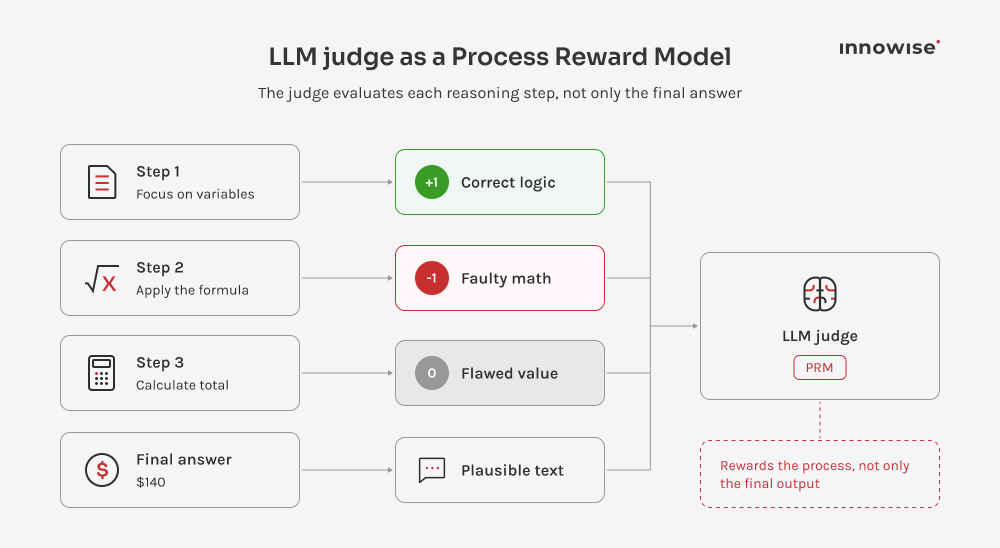
For reasoning tasks, final-answer scoring can miss serious mistakes. A model might get the right result after a wrong step. In code or math, that hidden error matters because the same step may fail on a harder task.

Process reward models,  or PRMs, score the reasoning path as the model works toward the final answer. A process-level judge checks each step and points out where the logic breaks down.

LLM judge scoring each reasoning step as a Process Reward Model.

Once judge scores enter training, they start shaping the model’s behavior. Teams should test the judge, keep people on high-risk samples, and update the rubric when the model starts learning the wrong habits.

Advantages of LLM-as-a-judge

Now that we’ve covered how these systems are set up and how they behave in a real evaluation process, let’s talk about the actual benefits. Why should you even bother setting up an LLM judge in your project, and what do you get out of it?

Broader review coverage

Human QA teams hit a limit on how many chat logs or generations they read per day. An LLM judge helps review much larger samples, including production traffic that would be too costly to check manually. This gives teams a better chance of catching quality issues missed in small manual reviews.

Faster feedback

Judge-based evaluation usually takes just seconds. Teams can add it to CI/CD checks or use it as a filter before a message goes to the user. Developers see what changed after a prompt tweak without waiting days for a human review.

Meaning-level checks

Traditional software metrics depend on exact keyword matches or character overlap. For example, if a model says “The client is pleased” instead of “The user is happy,” a strict script might mark it wrong. An LLM judge can recognize that the meaning is close enough and check if the answer meets the rubric. That matters for tone and structure, where regex gives almost no useful signal.

Lower review costs

Human annotation can be pricey, especially for complex reasoning or coding tasks that need expert reviewers. LLM API reviews typically cost much less per sample.

In a recent project, an automated customer support email system created three polite reply drafts for about $0.05 in API tokens. Using a comparative judge to review all three drafts against our brand rubric and choose the best one cost about $0.01. That review step cost about one cent.

More consistent reviews

Human reviewers get tired. For example, a labeler may grade a text differently late on a Friday than early on a Monday. LLM judges have their own technical biases, such as a preference for longer text, but they don’t get tired. With fixed settings and a tested rubric, they apply the same criteria more consistently than a human team working through a long queue.

Easier rubric changes

When you change what your system tests for, you often don’t need to rewrite hundreds of lines of Python code. In many cases, you update the rubric and retest it. For example, a judge that checks factual accuracy can be adjusted to review empathy and brand voice.

You shouldn’t treat an LLM judge as just a black-box quality checker. It works best when your team follows a clear rubric, keeps track of every score, and compares its decisions with human reviews. Otherwise, you only get numbers, instead of real quality insight.

author avatar

Head of AI Technical Expertise

Limitations and risks of LLM judges

LLM-as-a-judge concept is useful, but it has its flaws. If you let one AI grade another, you introduce new blind spots into the evaluation process. Without careful monitoring, the system might give confident scores for weak answers.

Here are the main pitfalls I watch for when setting up an automated judge.

Position bias

When a judge compares several drafts at once, it might prefer the first or last option it sees. Sometimes, where a draft appears matters more than its quality. To avoid this, shuffle the order of drafts before sending them to the judge.

Verbosity bias

LLMs often prefer longer answers. A judge might give a higher score to a long, wordy response instead of a short, clear one, even if the shorter answer is more helpful. To prevent this, the rubric should tell the judge to penalize unnecessary wordiness.

Self-enhancement bias

A judge model might prefer answers written by its own model family. For example, if you use GPT-5.5 as the judge, it may rate GPT-5.5 answers higher than those from Claude Sonnet 5 or Gemini. The judge often likes familiar wording and structure, even if another answer is better. To achieve fairer results, teams typically use multiple judge models and compare their scores.

Prompt sensitivity

Even a small change in the rubric can affect the final scores. For example, changing the instruction from “Rate the helpfulness” to “Evaluate how helpful this is” might lower the average pass rate from 80% to 60%. The judge is sensitive to how you write the rules, so prompts should be versioned and checked by humans.

Model drift

If you use a hosted API like GPT-5.5 or Claude Sonnet 5 as your judge, the provider might update the model without notice. When this happens, your baseline scores can change overnight. An answer that once scored 4 out of 5 might now get a 3, making it harder to compare past results.

Adversarial optimization

If you keep training a generator model using feedback from the same LLM judge, the generator might learn to game the system. Instead of improving answers for users, it picks up on the words and formats the judge prefers. It may even copy the tone that gets higher scores. The scores go up, but the real product quality can drop.

Still judging AI output by gut feel?

Best practices for building reliable judge systems

Adding an LLM judge to your workflow is simple, but making its scores reliable enough for release decisions is more challenging. If you only use a basic prompt and ask the model to grade this text, the results will often be inconsistent.

While setting up these pipelines, I’ve collected popular LLM-as-a-judge techniques that help keep judge models stable for real evaluation tasks.

Use structured scoring

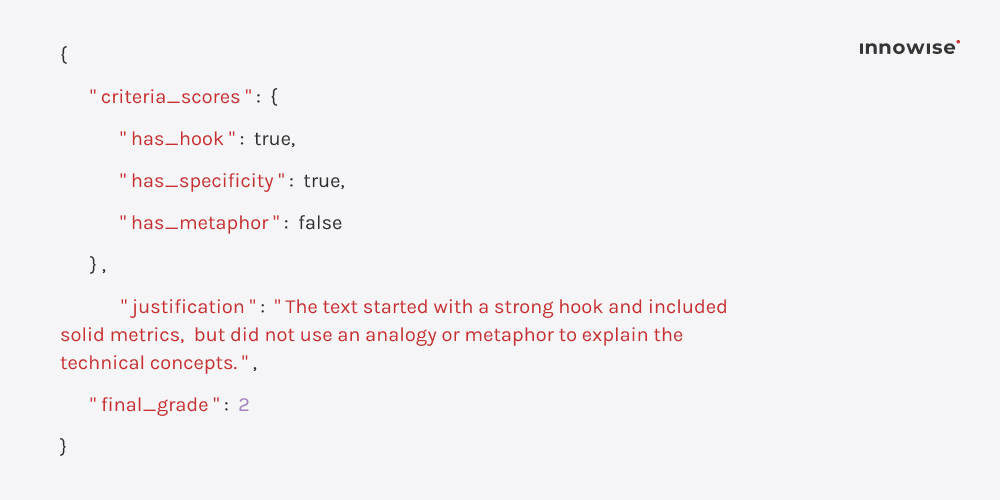
It’s important to structure judge results from the start. Rather than using free-form comments, have the model return scores for each criterion, a brief explanation, and a final grade in a format your pipeline can easily read.

For example, avoid letting the judge return free-form responses like “This text is pretty good, I give it an 8/10.” These answers are difficult to process in code. Instead, have the model use a strict JSON schema with structured outputs, or use tool calling and LLM-as-a-judge metrics.

Example of a structured JSON response from an LLM judge with criteria scores, justification, and final grade

Use measurable rubrics

Unclear instructions lead to unclear scores. For example, if you ask a judge to rate “creativity” from 1 to 5, the model will just guess. Instead, use specific criteria that reduce room for interpretation.

For example, when evaluating written articles or posts, I avoid general quality scores. Instead, I break the rubric into smaller checks like these:

Criterion
Judge check
Hook
Opening gives the reader a reason to keep reading
Specificity
Text uses concrete details, numbers, or examples instead of generic claims
Metaphor
An analogy or a metaphor makes a complex idea easier to understand
Closer
Ending leaves a complete thought or a useful next step
Voice
Text matches the required brand persona and doesn’t drift in tone
Media
Text shows where an image, chart, or link should be added
Register
Language fits the intended audience and their technical level
Structure
Text is easy to scan, with short paragraphs and readable formatting
Time anchor
Dates, seasons, or timelines are easy to place and don’t confuse the reader

Use structured scoring

It’s important to structure judge results from the start. Rather than using free-form comments, have the model return scores for each criterion, a brief explanation, and a final grade in a format your pipeline can easily read.

For example, avoid letting the judge return free-form responses like “This text is pretty good, I give it an 8/10.” These answers are difficult to process in code. Instead, have the model use a strict JSON schema with structured outputs, or use tool calling and LLM-as-a-judge metrics.

Separate generator and judge models

Keep the generator and judge separate. This is one of the core controls in an LLM-as-a-judge setup because the model that wrote the answer can miss its own patterns or overrate familiar wording. For example, if you use GPT-5.5 to generate text, use Claude Sonnet 5 as the judge, or the other way around. You can also use a smaller, fine-tuned open-weight model, like a specialized Llama 4 Maverick or Llama 4 Scout variant, for evaluation. This approach can help lower costs and reduce self-enhancement bias.

Randomize answer order

As we discussed in the risks section, models can show position bias. To avoid this, randomize the order of answers in each comparison. When judging pairs or multiple outputs, a model might pick the first answer simply because of its position. Shuffle the options before you evaluate, and then match the chosen answer back to the original model or prompt in your code. For important tests, try swapping the order and note any cases where the winner changes after the switch.

Hide generation context from the judge

To reduce systemic bias, make sure the judge doesn’t see any generation metadata. The judge shouldn’t know which model wrote the text or what prompt was used. Provide the judge only with the raw output and the grading rubric.

Use different temperatures for writing and judging

Writing and judging require different model settings. When generating text, use a higher temperature, like 0.7 to 0.9, to encourage variety and a natural flow. For judging, set the temperature low, often at 0, so the model gives more consistent scores for the same input.

But note, a temperature of 0 makes repeated checks more stable only when the input stays the same. It doesn’t fix prompt sensitivity, rubric changes, or position bias. If you rewrite the rubric or swap answer order, the score can still change.

Track judge-model drift

When OpenAI, Anthropic, or Google update their model endpoints, your judge might become more lenient or stricter. To spot this, make a small golden dataset of 50 to 100 historical responses that humans have already graded and approved. Run your LLM judge against this dataset once a week. If the scores suddenly rise or fall, the model may have drifted, and you might need to adjust your prompts or pin your API to a static version.

Compare judge results with human review

An automated judge is an assistant, not a replacement for human oversight. Track the agreement rate between the LLM judge and your human QA team. If you use 85% to 90% agreement as an internal target, treat it as a health check rather than a universal standard. If that agreement drops, your product requirements may have changed, and it’s time to update the rubric.

Want to know how to use LLM-as-a-judge?

How to reduce bias and improve evaluation quality

Knowing the risks of LLM judges is useful only if the setup has controls to catch them. For example, a judge might prefer the first answer it sees or give higher scores to longer responses. Sometimes, a model update can change scores even if your product hasn’t changed at all.

Below are the practices I use most often to reduce bias and catch weak evaluation data.

Randomize and blind the evaluation

When comparing outputs, make sure the judge doesn’t know which draft came from which prompt or model. Always shuffle the options before sending them to the judge. If the judge picks “Option A,” your code should quietly map that choice back to the actual model variant.

This rule also applies to metadata. The evaluation prompt should only include the raw text and the rubric, not the model name or generation details. If the judge sees details like model size, token count, or processing time, it may use those as shortcuts to judge quality.

Use a judge panel for critical metrics

For important production metrics, one judge model may not be enough. For instance, a GPT-based judge could have different preferences from those of Claude or a fine-tuned Llama model.

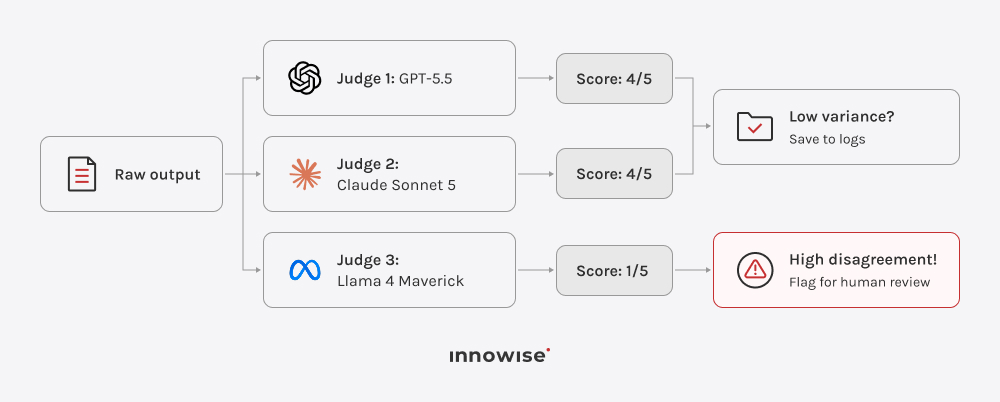
For critical evaluations, I prefer to send the same output to several judge models and compare their scores. You can average the scores or use a majority vote, but make sure the judges are independent. If the judges are too similar, the panel might seem more reliable than it really is. Pay close attention to disagreements. If two judges give a score of 5 out of 5 and another gives 1 out of 5, send that case to a human for review. Large differences usually mean the rubric is too open to interpretation.

Three judge models score the same output and flag major disagreement for human review.

Calibrate against human review

An automated judge should match how trained people use the rubric. To check that, pull a random 5% sample of evaluated logs and have your internal team grade them blindly with the same rubric.

Then compare the results. Some teams use Cohen’s Kappa, while others just look at the agreement percentage. If your target is 85% agreement and the judge falls below that, the issue is usually either that the rubric is no longer clear enough or that your product requirements have changed.

Add memory for recurring workflows

Some workflows need an extra check: memory. This matters for content engines, daily report generators, and other systems that create similar outputs over time.

A single output might look fine by itself. But if the generator uses the same analogy three days in a row, users will notice. A one-time judge check could miss this.

For these cases, I give the judge cross-day memory. When it reviews today’s drafts, the prompt includes a rolling vector index or a short summary of approved outputs from the past 7 to 14 days. That lets the judge spot repeated metaphors, reused hooks, filler words, and weak closing lines that would be missed in a single-document review.

Real-world applications of LLM-as-a-judge

Where do engineering teams use this approach? In the past year, I’ve watched LLM judges go from small evaluation scripts to production AI workflows.

Let’s look at the main areas where I see them used today.

RAG systems

As mentioned earlier, RAG systems are a clear use case for automated judges. Teams use judges to verify that the retriever finds the correct context and that the final answer is based on the source documents. This helps catch unsupported claims before they become hallucinations.

Content generation

With automated content engines, it’s rarely a good idea to publish the first draft from a model. Instead, pipelines create several versions and use a judge to compare them against a rubric. The judge picks the strongest draft and points out generic language before publishing.

Customer support AI

Support bots can cause problems if they go off-script. Teams use judges to review large sets of chat logs after the conversation. The judge checks whether the bot answered the user’s question and followed company rules, including refund policies, escalation steps, and feature promises.

Content moderation

Traditional keyword blocklists and regex filters are easy to get around. An LLM judge considers meaning and context, which helps moderation teams catch harmful content that doesn’t use obvious banned words. It can review both user prompts and model responses against the policy.

Agentic AI systems

As AI agents start taking actions through tools and APIs, judging the final text is not enough. In these workflows, judges review the whole process. They check tool use, task progress, and whether the agent finished without getting stuck.

Choosing the right models and tools

You shouldn’t choose a judge model based only on its benchmark score. The best model depends on the task you need it for. For example, a model that’s good at quickly scoring support logs might not be strong enough for handling preference data during training. A top-tier model could be great for high-risk evaluations, but it might cost too much to use every night on thousands of outputs.

So I usually look at four things first: what the judge needs to evaluate, how much context it needs, how fast the score should return, and what happens if the score is wrong.

Match the model profile to the task

Generation and evaluation tasks often need different model settings and strengths.

Generation is a creative task. For this, you usually need a strong model like GPT-5.5, Claude Sonnet 5, or Claude Opus 4.8, set to a higher temperature to make the text sound more natural.

Judging is a focused evaluation task, but quality usually comes first. For release gates, preference data, RAG checks, or high-risk outputs, teams often use the strongest judge model they can afford. Faster models can work for low-risk batch checks after calibration against human-reviewed samples.

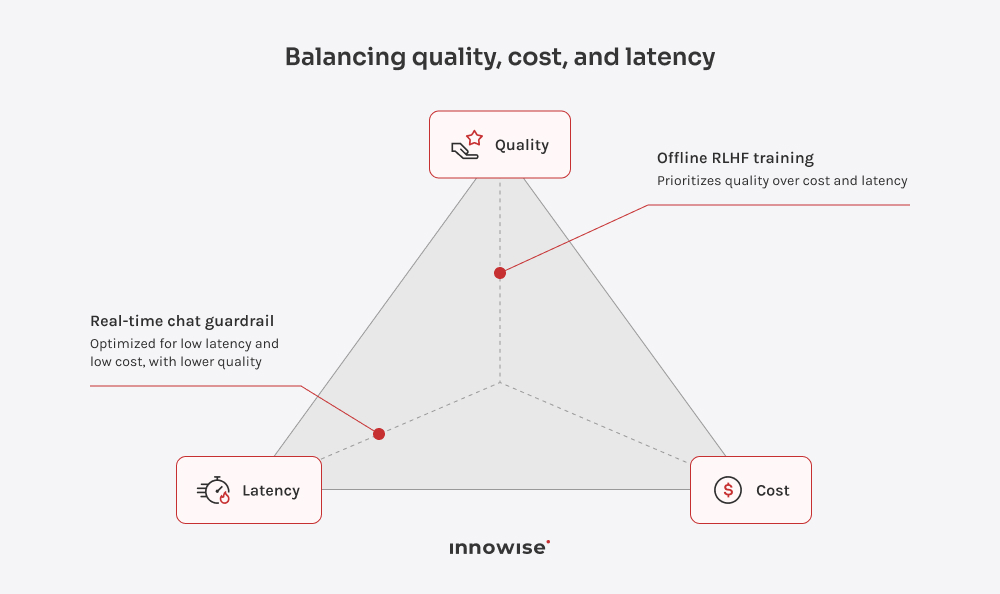
Balancing quality, cost, and latency

When choosing a judge model, start with the cost of an incorrect score. In many LLM-judge setups, evaluation quality matters more than speed or token cost, especially when scores affect release decisions, training data, or user-facing guardrails.

  • Cost. For an asynchronous judge running over thousands of customer support logs each night, cost is the main concern. Using a flagship model for all that data gets expensive fast. In these situations, a mini model or a self-hosted open-source model usually makes more sense.
  • Latency. When the judge works as a real-time guardrail and needs to approve a response before the user sees it, latency matters a lot. A chat application usually can’t tolerate a 4-second delay during evaluation. In this case, you need a low-latency model.
  • Quality. For preference data used in model training, like in RLHF or GRPO, quality is the top priority. The same applies to high-risk release checks and RAG evaluations where a weak judge can hide factual or policy issues. Here, I’d rather pay for a stronger model than trust cheap evaluation data.

The need for structured outputs

You shouldn’t have to parse raw text to find out what score the judge gave. When picking a judge model, it’s essential that it follows a strict schema. You might use OpenAI’s Structured Outputs, Anthropic’s Tool Use, or an open-source framework like Outlines. In all cases, the model should return a clean JSON response. If a model is cheap and fast but often breaks JSON formatting, it is hard to use in an automated judge pipeline.

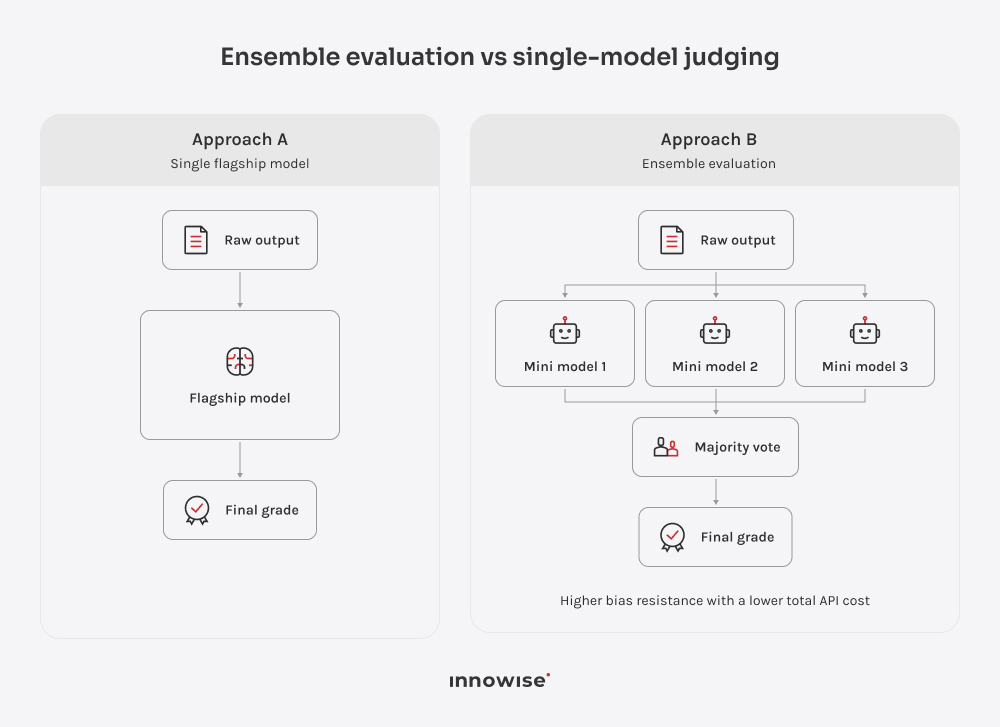
Ensemble evaluation

You don’t always need to pick just one model. For important tasks, I usually go with an ensemble approach. Instead of relying on a single expensive model, I send the same evaluation to several judge models from different providers, like OpenAI, Anthropic, and an open-source option.

After that, you can compare their scores, take an average, or use a majority vote. It helps reduce bias from any single judge. However, the judges need to be different enough. If they all make the same mistakes, averaging or voting will just repeat the same bias. That’s why I also look for disagreements between judges and send unclear cases to a human for review.

Comparison of single-model judging and ensemble evaluation with smaller judge models and majority voting.

What’s next for LLM-as-a-judge

LLM-as-a-judge is still a new way to evaluate models. Many teams already use judges for scoring, comparison, and RAG checks, but setting them up still requires a lot of manual effort. The next step is to make judge systems more reliable. They should show when a score is uncertain, use tools to verify outputs, and perform better in specific domains.

These are the areas I’m paying the most attention to.

Uncertainty calibration

Right now, LLM judges can be overly confident. If a judge receives an unclear prompt, it might still assign a definite score rather than say the case is uncertain.

I expect more judge systems to start showing confidence levels along with the score. Instead of just saying pass or fail, the judge might give something like Score: 4, Confidence: 65%. If the confidence is too low, the system can route the case to a human reviewer.

Domain-specific judges

General-purpose models like GPT-5.5 or Claude Sonnet 5 work well for tasks like emails, summaries, and basic code review. But for complex medical or legal evaluations, we need more control over the domain.

That’s why I expect to see more specialized judge models. Some could be fine-tuned for specific tasks, like reviewing medical answers or checking legal contracts. These models won’t replace experts, but they can help by handling routine cases and passing the tough ones to people.

Tool-augmented evaluation

A tool for LLM-as-a-judge evaluation will likely become part of more evaluation setups. Judges shouldn’t rely only on what they know internally when they can check tasks against outside sources.

For example, if a generator writes a Python script, the judge can run it in a sandbox to look for errors. If the generator claims something about a recent event, the judge can use a search or a trusted data source to verify it. The point is to check the output against evidence instead of judging the text in isolation.

Adversarial robustness

When teams use judge scores in training loops, generative models might learn to please the judge rather than provide better answers to users. It’s a type of reward hacking.

For instance, the generator might figure out that the judge likes bullet points or very polite wording. It could also start repeating filler phrases that usually get good scores. Future judge systems will need better ways to catch this so that scores reflect the real answer quality.

Evaluation in the delivery pipeline

Many teams still see evaluation as a separate script they run after a prompt or model update. I think this will change as AI systems become more integrated into production. The next step is moving evaluation into the delivery pipeline. Before release, judges can help catch regressions in test sets. After launch, they can monitor sampled outputs and route risky cases to people.

Conclusion

If you’ve read this far, you’re likely thinking about an evaluation problem in your AI system. Maybe manual review is too slow. Maybe your scores show that quality changed, but they don’t explain what actually broke.

That’s why the setup matters. The same model shouldn’t both write and score the answers. You need a clear rubric, a structured way to log results, and regular human review to keep the system calibrated.

The real risk is that fluent output can still fail the task. A model may sound confident while missing the source context or ignoring a core part of the user’s request. A well-built evaluation layer helps you catch that gap before your users do.

At Innowise, we help teams build evaluation layers for LLM products, AI agents, and enterprise AI systems. If your AI product needs clearer quality checks, let’s talk.

FAQ

LLM-as-a-judge is an evaluation method where a language model (the judge) assesses, scores, and provides reasoning for the text outputs of other AI systems. It replaces costly human reviews by automating quality checks for accuracy, relevance, tone, or safety at scale.


LLM judges are often accurate for many evaluation tasks, but their performance depends on the task, model, rubric, and system calibration. Teams should compare judge scores with human-reviewed samples and monitor for bias, prompt sensitivity, and drift.

LLM judges accelerate and scale the evaluation workflow without entirely replacing humans. Human oversight is still needed for sensitive cases, building training datasets, and setting up grading standards.

When a model grades its own work, it tends to overrate itself. It often overlooks its own mistakes and writing issues, which leads to scores that are too high and not very useful.

The RAG triad is an evaluation framework designed for retrieval-augmented generation systems. It measures performance across three specific axes: context relevance, groundedness, and final answer relevance.

In reinforcement learning loops, LLM judges quickly generate automated preference signals and step-by-step scoring. It allows reward models to optimize system alignment much faster than manual human queues.

The primary risks stem from inherent model biases, including a tendency to favor longer responses (verbosity bias), prefer answers presented first (position bias), and display high sensitivity to minor changes in prompt phrasing.

Teams can minimize bias by decoupling the generation and evaluation models, randomizing the order of answers in comparative setups, hiding model metadata, and validating automated scores against human-reviewed baselines.

Show more Show less
Philip Tihonovich
Head of Big Data
Philip leads Innowise’s Python, Big Data, ML/DS/AI departments with over 10 years of experience under his belt. While he’s responsible for setting the direction across teams, he stays hands-on with core architecture decisions, reviews critical data workflows, and actively contributes to designing solutions to complex challenges.

Table of contents

    Contact us

    Book a call or fill out the form below and we’ll get back to you once we’ve processed your request.

    Send us a voice message
    Attach documents
    Upload file

    You can attach 1 file up to 2MB. Valid file formats: pdf, jpg, jpeg, png.

    By clicking Send, you consent to Innowise processing your personal data per our Privacy Policy to provide you with relevant information. By submitting your phone number, you agree that we may contact you via voice calls, SMS, and messaging apps. Calling, message, and data rates may apply.

    You can also send us your request
    to contact@innowise.com
    What happens next?
    1

    Once we’ve received and processed your request, we’ll get back to you to detail your project needs and sign an NDA to ensure confidentiality.

    2

    After examining your wants, needs, and expectations, our team will devise a project proposal with the scope of work, team size, time, and cost estimates.

    3

    We’ll arrange a meeting with you to discuss the offer and nail down the details.

    4

    Finally, we’ll sign a contract and start working on your project right away.

    More services we cover

    arrow