





Collaborative mammography segmentation across three clinics

Innowise implemented a federated learning framework that enabled three clinics to collaboratively train a breast cancer detection model without sharing sensitive patient data.

Up to 68.6%

improvement in segmentation AP

AI-powered mammography segmentation across three clinics using a privacy-preserving federated learning framework
Industry Healthcare
Employees 3,500+
Region Europe

Project overview

Summarize article with AI

Innowise initiated a federated learning project and engaged three hospitals to collaboratively develop a breast cancer detection and segmentation model. Since each hospital managed sensitive mammography data within its own secure environment, the project required a privacy-preserving approach that allowed joint AI training without exchanging patient records.

Challenge

  • Healthcare data privacy. The participating clinics wanted to collaborate on AI development without exposing sensitive patient imaging data outside their local infrastructure.
  • Regulatory and governance constraints. The solution had to comply with strict healthcare privacy and regulatory requirements that limited centralized storage of medical images.
  • Scalable clinical collaboration. The framework needed to support future collaboration between additional healthcare institutions without changing the privacy model.
  • Privacy-preserving distributed training. The system required collaborative AI training across multiple clinics without transferring raw mammography data.
  • Secure model synchronization. Only model parameters and updates could be exchanged between participants, while patient data had to remain within each clinic’s local environment.
  • Heterogeneous datasets. Different imaging distributions and case mixes across clinics created challenges for stable model training and optimization.

Solution we delivered

Innowise implemented a privacy-preserving federated learning framework to train a shared breast cancer detection and segmentation model without transferring sensitive patient data outside local clinical systems.

FEDERATED LEARNING ARCHITECTURE

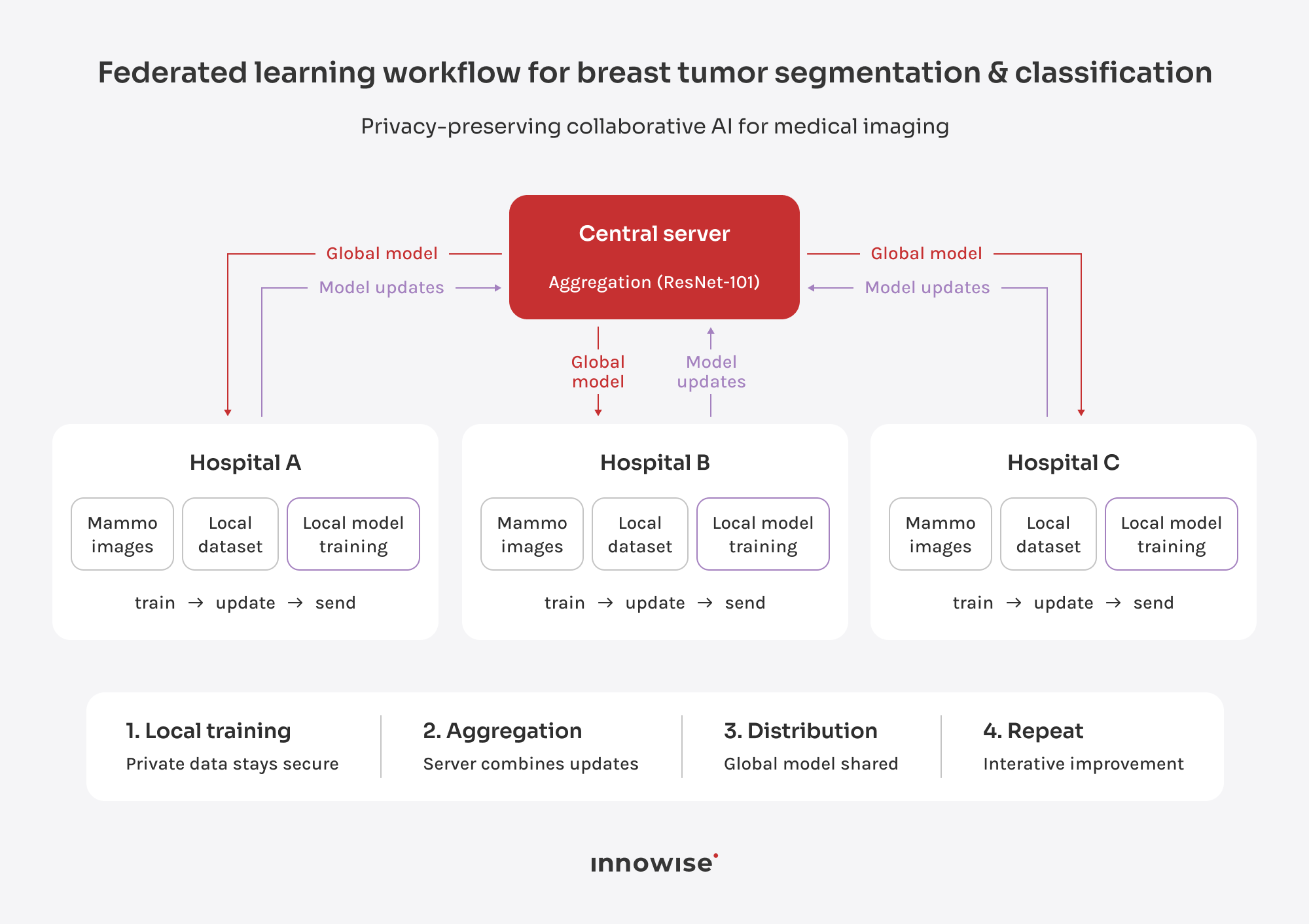
Instead of centralizing mammography images in a shared database, each clinic trained the model locally within its own secure infrastructure.

During training, the system exchanged only model parameters and training updates through a centralized aggregation workflow. The aggregated updates were combined into an improved global model and then redistributed to all participating clinics during subsequent training cycles.

This federated learning approach allowed the institutions to collaboratively improve model performance while preserving patient privacy and complying with healthcare governance requirements.

MAMMOGRAPHY SEGMENTATION MODEL

The project used Mask R-CNN for:

  • Breast lesion detection
  • Lesion localization
  • Pixel-level segmentation of mammography images

The model enabled the clinics to identify suspicious regions and generate detailed lesion segmentation masks that support downstream diagnostic workflows and improve interpretation consistency.

To ensure stable collaborative learning across all participating institutions, Innowise standardized:

  • Model architecture
  • Training configurations
  • Preprocessing pipelines
  • Evaluation procedures

To improve model reliability across different clinical datasets, Innowise implemented data augmentation pipelines and class imbalance handling strategies to stabilize collaborative model training and reduce dataset bias. This helped the AI model better handle variations in mammography images, uneven distribution of cancer cases, and differences in imaging quality between clinics.

All models were evaluated using a standardized shared evaluation protocol and a common benchmark test set, ensuring fair performance comparison.

DISTRIBUTED TRAINING WORKFLOW

Each clinic previously faced performance ceilings when training independently due to limited local data diversity and dataset bias. 

The federated learning process allowed each clinic to train the model independently on approximately 3,500 local mammography images while participating in a shared distributed learning cycle.

The workflow included:

  • Local model training at each clinic
  • Periodic synchronization of model updates
  • Centralized aggregation of learned parameters
  • Redistribution of the updated global model to participants

This approach facilitated collaborative AI training across approximately 10,500 mammography images without creating a centralized medical imaging repository.

PRIVACY-PRESERVING DATA RETENTION

The project used a local-only data retention model, meaning that all mammography images remained within each clinic’s secure environment throughout the entire training process.

The system never transferred raw medical images between institutions. Only model parameters and training updates were exchanged during synchronization cycles.

This architecture allowed the clinics to collaboratively train a shared AI model while maintaining full local control over sensitive patient data.

Quote icon

One of the key goals of this project was to create a practical framework for collaborative clinical AI without centralized data sharing. The federated learning approach allowed the participating clinics to improve model quality across diverse mammography datasets while maintaining full local control over patient information.

logo
Hanna Karpenka Scientific Consultant

Technologies

AI & Machine Learning

Federated Learning, Computer Vision, Medical Image Detection & Segmentation

Frameworks

PyTorch, TensorFlow

Models

Mask R-CNN

Distributed AI

Distributed Training, Model Aggregation

Team

Icon 2
ML engineers
Icon 1
domain expert in biomedical imaging
Innowise team

Result

Project duration

2 months

By implementing a federated learning workflow across three clinics, Innowise helped the participating institutions collaboratively improve breast cancer detection and segmentation without centralizing sensitive mammography data.

The federated model consistently outperformed models trained independently at individual clinics. Collaborative learning across approximately 10,500 mammography images gave the model access to a broader range of lesion types, imaging patterns, and patient distributions than any single institution could provide on its own.

As a result, the project achieved:

  • Higher segmentation quality than any standalone clinic model
  • Up to a 68.6% improvement in segmentation AP compared to the weakest single-site baseline
  • Improved model generalization across heterogeneous mammography datasets
  • More stable lesion localization across different imaging conditions

These improvements directly supported downstream clinical workflows where accurate segmentation is important for lesion localization, diagnostic support, and interpretation consistency.

The project also demonstrated that federated learning can serve as a scalable foundation for future multi-institutional clinical AI initiatives while remaining compatible with healthcare privacy and governance requirements.

Table of contents

Develop secure clinical AI solutions with Innowise

    Contact us

    Book a call or fill out the form below and we’ll get back to you once we’ve processed your request.

    Send us a voice message
    Attach documents
    Upload file

    You can attach 1 file up to 2MB. Valid file formats: pdf, jpg, jpeg, png.

    By clicking Send, you consent to Innowise processing your personal data per our Privacy Policy to provide you with relevant information. By submitting your phone number, you agree that we may contact you via voice calls, SMS, and messaging apps. Calling, message, and data rates may apply.

    You can also send us your request
    to contact@innowise.com
    What happens next?
    1

    Once we’ve received and processed your request, we’ll get back to you to detail your project needs and sign an NDA to ensure confidentiality.

    2

    After examining your wants, needs, and expectations, our team will devise a project proposal with the scope of work, team size, time, and cost estimates.

    3

    We’ll arrange a meeting with you to discuss the offer and nail down the details.

    4

    Finally, we’ll sign a contract and start working on your project right away.

    arrow