Enterprise AI adoption trends 2026

Jul 7, 2026 15 min read
Summarize article with AI

Key takeaways

  • As of 2026, more than one-third of enterprises have moved to scaling AI initiatives, signaling the approaching end of the pilot era.
  • AI becomes increasingly available to the teams that actually use its insights. It is now embedded across core business functions such as marketing, HR, and finance.
  • On the technology side, genAI continues to prove its value for automating routine tasks, while recently emerged but already proven SLMs (small language models) are being embraced to balance cost and performance.
  • The market is gravitating towards domain-specific solutions. However, the industry landscape is uneven, with the information, education, and finance sectors leading adoption.

AI is one of the few fields where the dominant trends can become almost unrecognizable from one year to the next. GenAI is accelerating, market leaders continue to expand their AI ecosystems, and nearly anyone can become an “AI builder” now.

Among the current trends, you’ll no longer find arguments about why AI is worth implementing at the enterprise level, but you’ll be able to recognize how to scale AI for greater ROI and what to scale first. Today, these trends reflect the lessons learned from the first wave of large-scale AI adoption.

I’ve been tracking enterprise AI trends for nearly a decade, helping enterprise clients maximize the value of AI. What’s worth it for you? Find out in the article.

What is enterprise AI adoption?

If you plug a chatbot into your intranet, it’s not yet enterprise AI adoption. AI becomes enterprise-grade through the deliberate, systemic weaving of AI technologies such as machine learning, natural language processing, computer vision, or generative models into business operations. Typically, AI changes how workflows are organized, how decision-making loops work, and how customers interact with your product.

To earn the label “enterprise-adopted,” AI has to be deeply integrated into workflows, so employees do not notice the technology itself but definitely notice its impact. Algorithms get baked into CRM, ERP, legacy, or custom systems your organization uses, and are designed so that scaling across business units comes without unravelling. Cases in point: when a supply chain forecast adjusts itself overnight, a claims process flags potential fraud before a human blinks, and a sales rep fields nuanced product questions from an AI copilot — this signals enterprise AI adoption done right.

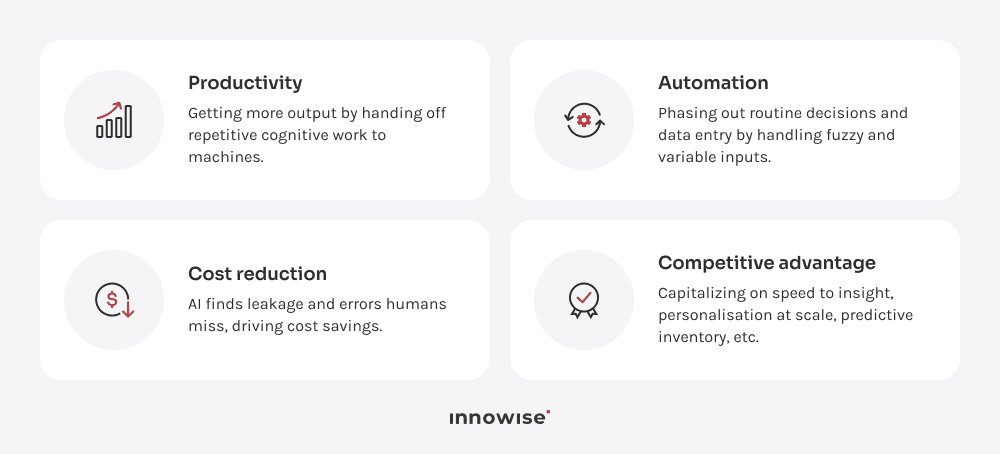
Traditionally, enterprise AI adoption has been built around four core advantages.

A diagram with 4 pros of AI adoption: productivity, automation, cost reduction, and competitive advantage

Why enterprise AI adoption is accelerating

Global enterprise AI market size was estimated at $23.95 billion in 2024, and is projected to reach $155.21 billion in 2030, growing at 37.6% annually. As of 2025, about 88% of organizations leverage AI for at least one business function.

What matters most is that cultural pivot has mostly happened. Enterprises have come to trust models — although they did not fully understand them at first — after seeing results and learning how to manage them.

Today, enterprises that are actively investing in AI are guided by these key factors:

  • Pressure to improve operational efficiency. Lean Six Sigma alone won’t support margins anymore. AI is now the lever they pull on to wring out waste: automating exception handling, smoothing over bottlenecked workflows, and trimming down cycle times without adding headcount.
  • Advances in generative AI and AI agents. With LLMs, multimodal AI, and text-to-image, video, and speech models available now, you can turn out draft contracts, talk through data visualizations, and set loose autonomous agents that see through multi-step tasks without handholding. Agents team up across systems, such as Salesforce, SAP, and Slack, and carry out actions a human would’ve needed twenty clicks to finish.
  • Increasing availability of enterprise data. Modern data lakes, real-time streaming, and unified governance have enabled clean, labeled, accessible data to pile up faster than teams can keep up with. AI models finally have enough fuel to run on, and that fuel keeps topping itself up.
  • Growing executive support for AI initiatives. A couple of years ago, AI was a science project fobbed off to a center of excellence, but today, it’s a line item in the operating plan. Businesses saw early wins and did the math: when one division shaved off 15% of its manual review costs, the rest fell in line.

Top enterprise AI adoption trends in 2026

AI agents transforming enterprise workflows

We’ve moved past chatbots that just talk back. Today’s AI agents act on your behalf: they log into systems, fill out forms, cross-check records, and work through multi-step tasks automatically. When they hit a wall, they flag down a human, walk them through what they’ve done, and pick up where they left off. Now, enterprises don’t need to implement a perfect model; they need one with enough autonomy and rules to call for backup.

Thanks to advancements in adaptive AI, enterprise agents learn on the fly. Take procurement. The agent monitors inventory, prepares a PO, checks it against the budget, and submits it for approval. In IT, agents can see an expiring certificate, order a new one, restart the service, and inform the user “it’s done” before it becomes a problem. The hardest thing to decide is what process can be given the “reins to its own fate” and what is going to be “on a very short leash.”

LLM to SLM transition

Bigger is not always better. Businesses that scrambled to hook up every enterprise process to a large language model (GPT-4, Claude, Gemini, etc.) ended up blowing their inference budgets. Small language models (up to 14B parameters) can sit on one GPU and handle tasks at a much lower cost.

So many exist already. Microsoft released Phi-3 models (3.8B and 7B parameters) that can go head-to-head with GPT-3.5 on many benchmarks while consuming very little compute. Google launched Gemma (2B and 7B parameters), tuned for enterprise use cases such as summaries and entity recognition. Open models such as Mistral 7B and Zephyr allowed engineers to fine-tune their own specialized SLMs over a weekend.

When it comes to an enterprise deployment, you’ll see these SLMs deployed for specific business processes, such as internal knowledge search, document classification, or customer service chatbots. Enterprises are increasingly stacking up SLMs in swarms: they hand off tasks to one another through lightweight orchestration layers like LangGraph or DSPy. When an SLM hits something it can’t handle, it fails over to a larger LLM, but that happens maybe 5% of the time. This way, inference drops to fractions of a cent, which is critical for 1000+ employee firms.

Generative AI beyond experimentation

I rarely hear the question “What can GenAI do?” anymore. Instead, the question is “Which GenAI capabilities do we bake into production right now?” The answers commonly boil down to practically useful things such as automated meeting summarization that respects company terminology, or code completion that shaves minutes off every developer context switch. 

Much of this shift has been enabled by advances in retrieval-augmented generation (RAG), which finds relevant context across millions of enterprise records in milliseconds (copilots). Prompt management platforms (LangSmith, HoneyHive, PromptLayer) have sprung up to track, version, and A/B test prompts. Meanwhile, hallucination detection layers, such as Guardrails AI, NeMo Guardrails, and custom verification models fine-tuned for specific domains, now sit between the LLM and the user. Structured output generation has also helped turn GenAI from a chatty liability into a reliable system component.

AI is becoming embedded across business functions

AI is subtly integrated into the daily work of business departments as infrastructure that goes unnoticed. This is what it looks like in business language:

  • Marketing — AI segments customer lists instantly, adjusts bids on advertising platforms hourly, and suggests personalized product offers that convert in real time. Executives do strategy.
  • HR — The system flags relevant resume content, identifies best-fit candidates by more than just keyword search, and handles meeting scheduling for interviews automatically. It also guides new hires through policy attestations, benefits questions, and IT setup.
  • Operations — AI uses internal sales, weather forecasts, port strike notifications, and other external signals to anticipate demand, optimize inventory, and reroute warehouse operations based on backlogs.
  • Finance — AI is actively used for transaction reconciliations, spotting outliers, and reviewing invoices that don't adhere to negotiated terms. Accounts payable teams eliminate manual work, while FP&A teams use automated rollups that provide weekly rolling forecasts.
  • Legal — AI automates document review tasks, checks NDAs against playbooks, creates deadline alerts, and finds risky terms within huge stacks of vendor contracts to reduce billings for external counsel.

In all of these cases, AI is embedded into applications like Salesforce, Workday, and SAP that employees are already using, so the change is imperceptible apart from the positive effects.

Multimodal AI expanding enterprise capabilities

Multimodal models can process and reason over text, images, audio, video, and now structured enterprise data in one workflow, interpreting signals from multiple inputs concurrently. What it looks like in action: an insurance adjuster may process claims forms, crash photos, and customer statements to speed up processing, instead of being pulled between multiple isolated systems.

In practice, enterprises are now using multimodal systems for things like visual inspection on a factory floor, underwriting and claims processing for companies swimming in documents, retail shelf stock counting, customer service interactions analysis, and AI copilots that understand both your report and your speech or an image. AI can now “understand” business context somewhat like employees do.

AI governance and compliance becoming mandatory

As AI moves into mission-critical use cases, transparency and accountability are non-negotiable. Regulatory frameworks such as the EU AI Act, data privacy regulations like GDPR, and sector-specific model risk management requirements are raising the bar. Simultaneously, standards like ISO/IEC 42001, ISO/IEC 23894, and NIST AI Risk Management Framework provide organizations with a framework for responsible AI implementation.

This is where we fit in. Innowise integrates governance directly into your enterprise platforms, making your company audit-ready, bias-aware, and compliance-focused by design.

Enterprise AI shifting toward real-time decision-making

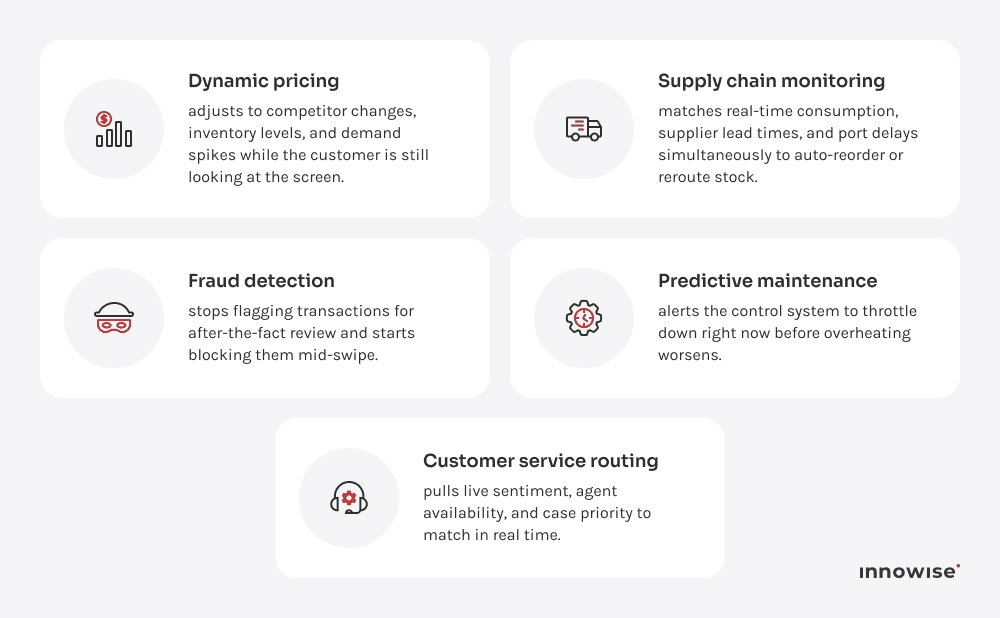
According to an Omdia study of over 600 enterprises across 10 countries, 82% of organizations are already using or planning to implement real-time data processing capabilities, and over 75% are augmenting IoT deployments with AI and machine learning to act on streaming data almost instantly. Three technologies have converged to make this possible: real-time streaming data, low-latency AI inference, and edge computing. 

The most successful real-time use cases today:

Top use cases of enterprise AI: fraud detection, dynamic pricing, predictive maintenance, customer service routing, and supply chain monitoring

Democratization of AI tools across organizations

Developments in large language models, user-friendly low-code/no-code tools, serverless AI APIs, and built-in governance allow AI to be put directly into the hands of marketers, financial officers, customer success managers — essentially anyone who can use it. In short, technical experience isn’t a requirement anymore. 

Beyond just using, more and more employees are expected to create and deploy their own AI- powered solutions. Custom AI builders and preconfigured agents enable business users to quickly create assistants that complete routine tasks. For organizations, this approach provides greater control and security over AI use through policies, governance rules, and cost management, without restricting new initiatives.

Increased focus on ROI and measurable outcomes

Experimentation ends, and full-scale ROI begins. At 38% of organizations, large-scale AI deployment has already occurred. With deployment comes the expectation of returns, where customer service AI assistants are judged on factors such as a reduction in the time-to-resolution, a decrease in average handle time, and so on. AI-driven tools for software developers, on the other hand, rely on faster time-to-release or lowered engineer effort to justify their use. 

The “ROI-at-work” in 2026 will be the biggest: not from massive transformation initiatives, but from AI that’s integrated into the workflow.

Capitalize on enterprise-grade AI with Innowise

Hybrid AI infrastructure strategies becoming standard

There is no ‘one-size-fits-all’ deployment model for AI in an enterprise. A hybrid strategy bridges the gap between aspiration and realization. Improved model orchestration, containerisation and multi-cloud management can help organizations deploy different AI workloads where they derive maximum value. For example, they can train vast models in the public cloud and process confidential customer and operational data privately.

A common approach involves using large public cloud-based foundation models where applicable, while deploying smaller custom models at the edge near business-critical systems and proprietary data.

Industry-specific AI solutions gaining traction

The edge now lies less in algorithms and more in data. Both custom solutions and platforms are no longer just about compute power; they now offer ready-made pipelines tailored to specific verticals. Here’s what sets the leaders apart:

  • Models pre-trained on industry-specific datasets
  • Architectures built for regulated environments (HIPAA, GDPR, SOX)
  • Seamless integration with vertical software (e.g., Epic for healthcare, SAP for manufacturing)

AI adoption by industry

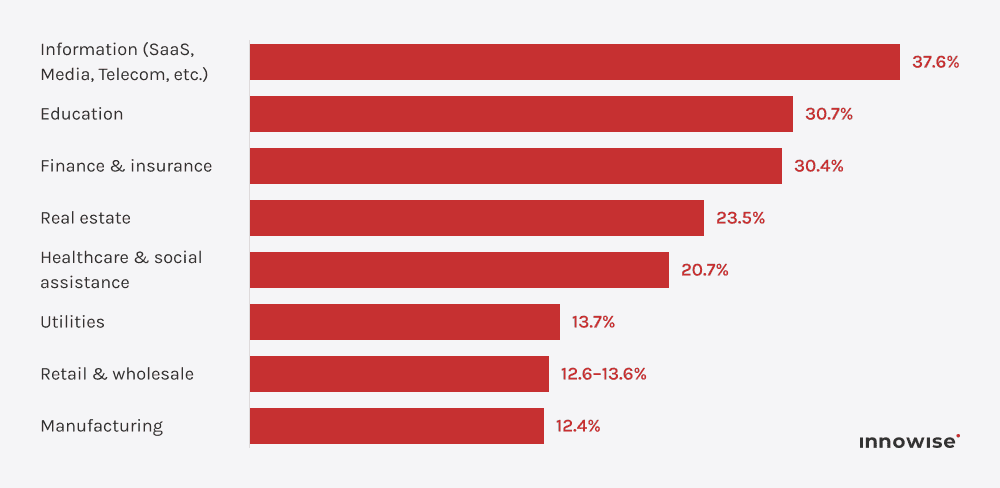
The AI adoption landscape remains uneven, with data-rich or digitized industries, those with highly manual workflows, and traditionally tech-forward sectors at the forefront of adoption. 

The chart below reflects the real use in operations, beyond experiments and pilots, in at least one business function.

Bar chart showing the share of enterprises that have adopted AI for at least one business function, broken down by industry

Telecommunications

Around 90% of telecom operators already use AI in some form, but most deployments remain in pilot or early scaling stages.

The majority of use cases are focused on cost optimization rather than revenue generation.

Nearly half of telecom AI deployments are concentrated in customer service automation and conversational AI systems.

Key use cases:
  • Customer support
  • Network optimization
  • Predictive maintenance

Education

A significant majority of university students, between 86–92%, admit using AI tools to summarize or brainstorm content for papers or as a tool to help with writing.

While teachers might explore AI applications in their classroom, their primary driver is to alleviate preparation tasks.

Only 19% of higher learning institutions have an existing AI policy, while another 42% are working to build them.

Key use cases:
  • Personalized learning
  • AI tutoring and student assistants
  • Automated grading and feedback

Finance & insurance

Only 41% of organizations use AI in finance to a moderate or large degree, while the rest are at initial or limited stages of adoption.

Risk, legal, and compliance are where most financial institutions apply AI, ahead of areas such as HR and strategy.

The adoption level of generative AI in financial services reached about 61% globally in 2025, showing relatively rapid deployment of LLM-enabled tools in the sector.

Key use cases:
  • Fraud detection
  • Risk assessment
  • Underwriting

Real estate

Around 82% of real estate agents have integrated AI tools into their work.

The most common AI use cases are listing descriptions (68%), social media content creation (59%), and email drafting (53%).

Advanced use cases such as underwriting, valuation, and investment decisioning remain less widely adopted and still emerging.

Key use cases:
  • Property valuation
  • Market forecasting and pricing analytics
  • Lead generation and customer targeting

Healthcare

~66% of physicians use AI tools in their work.

AI is most advanced in medical imaging, but only less than 10% of such solutions are scaled nationally; diagnosis-level AI remains highly constrained and tightly regulated.

While experimentation is rampant, healthcare AI uptake is still quite scattered and uneven; most AI implementations are currently only occurring at a local or pilot level, not across entire health systems.

Key use cases:
  • Clinical documentation
  • Diagnostic support
  • Patient scheduling

Manufacturing

In 2024, a minute proportion of companies in manufacturing built AI in-house: the bulk of AI in use was adopted off-the-shelf or developed by external providers.

Predictive maintenance, quality control, and supply chain optimization are the most applied use cases of AI in manufacturing.

The main barriers to AI adoption in manufacturing are skills shortages, data quality limitations, and legacy infrastructure incompatibility.

Key use cases:
  • Predictive maintenance
  • Quality inspection
  • Production optimization

Enterprise AI adoption challenges

Data quality and availability

AI is “garbage in, garbage out.” Decades of fragmented systems, departmental silos, inconsistent formats, missing values, and outdated labels mean that most organizations simply do not have “AI-ready” data. Without a robust data governance strategy, AI projects stall, with data scientists spending 80% of their time cleaning and integrating data, leaving only 20% for actual modeling.

Computing costs and energy consumption

When training the most advanced, cutting-edge models requires clusters that cost millions and burn enormous amounts of power, the whole exercise is simply out of range for all but the wealthiest organizations. Even using these in production generates huge cloud costs, amounting to tens of thousands of dollars a month. Their energy consumption and associated carbon emissions are also attracting growing attention from organizations seeking to balance innovation with sustainability goals.

Legacy infrastructure limitations

Modern AI demands modern infrastructure: real-time data streaming, containerized microservices, flexible data lakehouses, and robust MLOps pipelines. Yet most enterprises are anchored to legacy systems, such as mainframes, COBOL, DB2, and on-premise ERPs that were built before the cloud existed. This can make integration a multi-year rewrite project.

Security and compliance concerns

By design, AI models are black boxes that remember what they learn. If trained on sensitive data such as customer PII, health records, or financial transactions, they risk leaking that information through cleverly crafted prompts or adversarial attacks. At the same time, regulators demand explainability, as you cannot deny a loan, reject a claim, or make a hiring decision based on a model you cannot explain to an auditor or a court.

Talent shortages and AI skills gaps

AI talent is very hot and scarce, particularly among experts in specific industries. The key to adopting AI properly is having the right blend of people — data engineers, infrastructure experts, domain experts who get the business logic of the company, and people who know how to manage change and drive adoption. Many companies don’t have that. It comes to a halt with one data scientist, but then they run out of the other skills needed to complete it.

Difficulty measuring ROI

AI provides probabilities, predictions, and what appear to be “intelligent” tips, which are difficult to separate from other business factors in the picture. One of your models improved supply chain forecasting by 5%. But how much of that improvement translates into dollar sales? What percentage was seasonality? What was through the marketing efforts? Also, much of the f AI value is in prevention (fraud, equipment downtime), and this is not a number you can accurately calculate.

Resistance to organizational change

Traditionally, the most difficult barrier is not technological, but human: AI upends established power hierarchies, overrides experts, and threatens jobs. Executives may dread having their decisions questioned by a program; line employees may fear being automated out of their livelihoods. As a result, AI tools often lie unused, disabled, or bypassed. So much for technical success and the slow embrace of a new technology if no one is willing to adopt it.

How businesses can accelerate enterprise AI adoption

01
Start with high-value use cases

Identify 2–3 specific, high-impact business problems with clear ROI potential instead of trying to "AI everything" at once.

02
Build AI governance frameworks early

Establish policies for security, compliance, ethics, and model monitoring before deployment to avoid regulatory and reputational crises later.

03
Prioritize data readiness

Clean, unify, and structure only the data needed for your first use cases rather than undertaking a massive, years-long data transformation project.

04
Invest in workforce enablement

Train both technical teams and business users on AI literacy, change management, and prompt engineering to ensure tools are properly adopted.

05
Scale incrementally

Start with a single business unit or function, prove value, document learnings, and then expand gradually before moving to organization-wide deployment.

arrow-iconarrow-icon
01 Start with high-value use cases

Identify 2–3 specific, high-impact business problems with clear ROI potential instead of trying to "AI everything" at once.

arrow-iconarrow-icon
02 Build AI governance frameworks early

Establish policies for security, compliance, ethics, and model monitoring before deployment to avoid regulatory and reputational crises later.

arrow-iconarrow-icon
03 Prioritize data readiness

Clean, unify, and structure only the data needed for your first use cases rather than undertaking a massive, years-long data transformation project.

arrow-iconarrow-icon
04 Invest in workforce enablement

Train both technical teams and business users on AI literacy, change management, and prompt engineering to ensure tools are properly adopted.

arrow-iconarrow-icon
05 Scale incrementally

Start with a single business unit or function, prove value, document learnings, and then expand gradually before moving to organization-wide deployment.

How Innowise can help

At Innowise, we’ve been doing enterprise AI development for years, from strategy to full‑scale support. Our AI hub brings together deep technical expertise, industry knowledge, and proven frameworks to take your AI initiatives from idea to impact.

Enterprise AI consulting and strategy

We help clarify what “AI success” means for you by building roadmaps, prioritizing high-value use cases, and connecting AI initiatives to business goals. You gain a defensible plan that both CFOs and engineers can get behind.

AI readiness assessment

You want to build AI, but is your organization ready? First, we evaluate your data maturity, infrastructure, security, governance, and integration needs to architect scalable enterprise AI systems that can smoothly enter production.

Custom AI solution development

Innowise teams develop enterprise-grade AI systems that tackle your everyday workflows, including complex processes, cross-functional collaboration, and the need to support constant business evolution. Our models integrate seamlessly into your business.

Enterprise AI integration and scaling

We integrate AI into software, legacy systems, cloud environments, and data platforms, and upgrade underperforming or overpriced AI solutions. Your systems stay the same on the outside, but wake up on the inside.

AI governance and compliance support

We help you operationalize AI governance, from policy design to regulatory alignment. Our approach covers bias detection, explainability, audit trails, human oversight, and compliance with the EU AI Act, GDPR, HIPAA, and SOX.

Level up your enterprise with AI

Backed by deep expertise, we design, build, and scale AI solutions across enterprises

Final word

AI trends in 2026 point to one thing: AI is transitioning from experimental novelty to operational necessity. The era of flashy demos and isolated pilots is coming to an end. The first successes have been documented, and the “production, governance, and scale” phase is here.

If you’re building with AI this year, success won’t go to teams chasing every new model release. It will go to those who anchor AI in real business problems, high-volume and high-value use cases, connect it to clean, integrated data and existing enterprise systems, and build robust guardrails around security, compliance, and ethical risk.

And yes, continuous learning remains essential: the pace of AI advancement means today’s competitive edge becomes tomorrow’s baseline.

FAQs

It is the process of embedding AI into an organization's core workflows, decision-making, and customer operations. AI has moved from isolated pilots to being an invisible, reliable part of daily business.

Information, education, and financial services lead at 30–40%, followed by real estate and healthcare at 20–25%, with manufacturing and energy trailing behind due to legacy infrastructure and physical complexity.

Poor data quality and fragmentation, legacy systems that cannot support real-time AI, prohibitive compute costs, talent shortages, regulatory compliance pressures, difficulty measuring ROI, and cultural resistance from employees who distrust or fear the technology.

AI is shifting decisions from intuition to data-driven predictions, automating routine tasks (customer support, document processing, reporting), and enabling real-time responsiveness, from dynamic pricing to predictive maintenance, across every business function.

Democratization of tools (low-code/no-code, AutoML), a shift toward industry-specific vertical AI solutions, the rise of smaller, cheaper open-source models that reduce vendor lock-in, and the growing adoption of agentic AI that acts autonomously rather than just generating recommendations.

The global enterprise AI market is projected to reach $155.21 billion in 2030, growing at 37.6% CAGR, driven by increasing cloud adoption, falling compute costs relative to performance, and proven ROI from early adopters across industries.

Head of Big Data

Philip builds data infrastructures that provide clarity. He focuses on the “why” behind the data, architecting systems that process massive volumes into actionable insights while ensuring the technical vision remains sharp and purposeful.

Table of contents

    Contact us

    Book a call or fill out the form below and we’ll get back to you once we’ve processed your request.

    Send us a voice message
    Attach documents
    Upload file

    You can attach 1 file up to 2MB. Valid file formats: pdf, jpg, jpeg, png.

    By clicking Send, you consent to Innowise processing your personal data per our Privacy Policy to provide you with relevant information. By submitting your phone number, you agree that we may contact you via voice calls, SMS, and messaging apps. Calling, message, and data rates may apply.

    You can also send us your request
    to contact@innowise.com
    What happens next?
    1

    Once we’ve received and processed your request, we’ll get back to you to detail your project needs and sign an NDA to ensure confidentiality.

    2

    After examining your wants, needs, and expectations, our team will devise a project proposal with the scope of work, team size, time, and cost estimates.

    3

    We’ll arrange a meeting with you to discuss the offer and nail down the details.

    4

    Finally, we’ll sign a contract and start working on your project right away.

    More services we cover

    arrow