How to create a music streaming app: features, process and trends

Sep 18, 2026 25 min read
Head of Mobile Development
Verified expert
Every article at Innowise is created by authors with real-world experience. They understand the topic beyond theory and bring insight from real projects.
9+ years of experience
Verified expert
9+ years of experience
Pavel drives the delivery of high-performance mobile apps across iOS and Android. With a background in native engineering, he ensures that cross-platform and native products scale smoothly and provide a flawless user experience.
Expertise
Cross-platform apps iOS & Android Product delivery
Let's talk

Key takeaways

  • Don’t clone Spotify. Build a music streaming app only if it has a clear reason to exist: a neglected genre, a regional catalog, a creator-to-fan model, a social listening habit, a DJ or producer workflow, a wellness use case, or another job the big services do not solve well.
  • Rights and catalog strategy come before code. Your licensing model can change what you are allowed to stream, download, clip, share, recommend, display as lyrics, or offer in each territory.
  • The player is only one part of the product. Search, metadata, catalog ingestion, recommendations, payments, offline access, rights rules, analytics, moderation, security, and content delivery all affect the listening experience.
  • Build the smallest product that proves your thesis. A niche app with a strong catalog and one memorable listening behavior can be more defensible than a broad service with dozens of familiar features.
  • 2026 product direction is clear. Listeners are getting more control over discovery, more social ways to listen, better audio options, and more context about who made a track and how it was made.
Summarize article with AI

A slightly uncomfortable question: why would anyone open your app when Spotify, Apple Music, Amazon Music, and YouTube Music are already on their phone?

My advice is don’t begin with “an app like Spotify.” Begin with the listening experience Spotify is unlikely to build for your audience.

Maybe you want a service for a regional scene whose catalog is poorly tagged elsewhere. Maybe it is a direct-to-fan app for a label collective. Maybe it mixes music with live sessions, lessons, fan clubs, fitness, gaming, or creator tools. Maybe the product is built around better discovery for people who are tired of being fed more of what they already know.

That changes the whole planning process. You are no longer trying to recreate the largest catalog, the biggest recommendation system, and every platform integration at once. You are choosing a narrow product thesis and building the technology around it.

If you are at that stage, Innowise’s mobile app development services cover product discovery, UX/UI, native and cross-platform engineering, backend work, testing, and post-launch development. The rest of this music app development guide explains what you should decide before a team starts writing code.

Music streaming market overview 2026

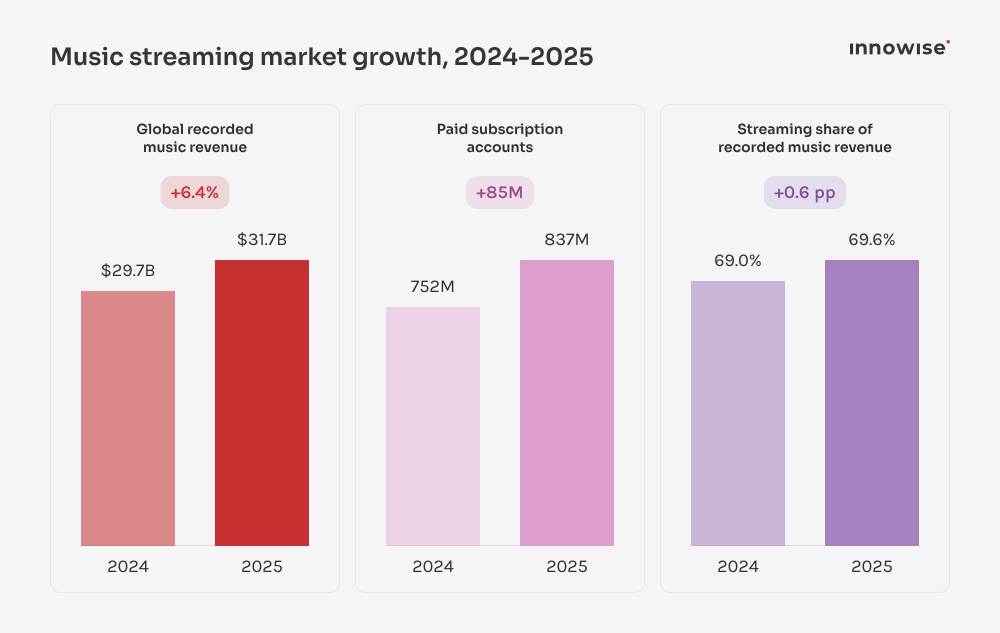
The music business is still growing, and streaming remains its biggest recorded-music revenue format.IFPI reported that global recorded music revenue reached $31.7 billion in 2025, up 6.4% year over year. Streaming generated more than $22 billion and accounted for 69.6% of recorded music revenue. Paid subscription streaming represented 52.4% of total revenue, and IFPI counted 837 million users of paid subscription accounts worldwide.Here is the useful part for a founder: the market is large, but user expectations are also mature. A new app is competing with years of habit, not just other codebases.
Market indicator20242025
Global recorded music revenue$29.7B$31.7B
Users of paid subscription accounts752M837M
Streaming share of recorded music revenue69.0%69.6%
The 2024 and 2025 figures come from IFPI’s latest reports.Spotify is still the clearest public benchmark because it reports user numbers every quarter. In Q2 2026, Spotify reported 777 million monthly active users and 300 million Premium subscribers. YouTube said in 2025 that YouTube Music and Premium had passed 125 million subscribers globally, including trials. Apple Music and Amazon Music remain important reference products. I am not using subscriber counts for them here because the sources used for this guide do not provide directly comparable 2026 figures, and forcing them into a current market-share table would create false precision.So I would put it this way: there is almost no room for one more general-purpose streaming service. I would focus on where the big services are structurally weak.

Types of music streaming apps

Music streaming apps differ mainly by catalog model, listening behavior, and business relationship with artists or listeners. These categories are not mutually exclusive, though. One platform can easily combine several models, for example, on-demand streaming with direct-to-fan subscriptions, social listening, and live sessions.

Main types of music streaming apps, including on-demand, niche, direct-to-fan, social, live, and context-based platforms.

On-demand catalog services

These apps let users search a large licensed catalog and play tracks when they want. Spotify, Apple Music, Amazon Music, and YouTube Music set the user expectations here: fast search, queues, libraries, playlists, downloads, recommendations, lyrics, and playback across devices.

For a startup, this is the hardest category to enter broadly because catalog licensing, metadata, recommendation quality, and user acquisition all become expensive at the same time.

Niche and editorial streaming services

A niche service wins by knowing a scene better than a mass-market app can.

Think classical music with work-level metadata, underground electronic music with label and set relationships, regional music with better language support, faith-based audio, independent jazz, archival recordings, or music for children. 

The value here is not in “fewer songs.” It is in better structure, context, curation, and community around those songs.

Creator and direct-to-fan platforms

These products treat streaming as one part of a deeper artist relationship.

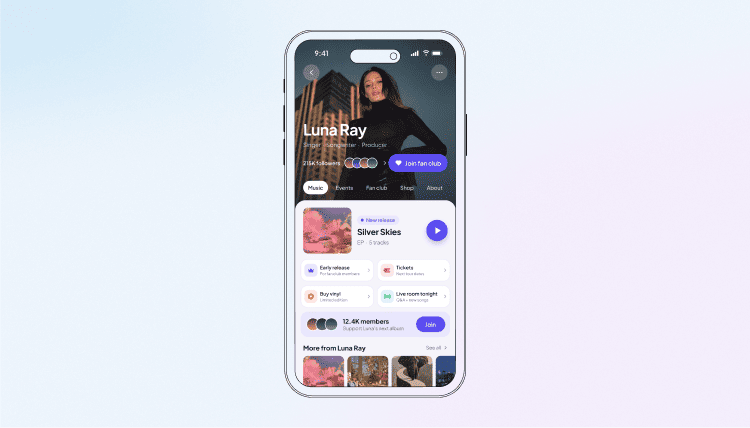
The app might combine tracks with demos, live recordings, early releases, memberships, tickets, merchandise, fan posts, or paid communities. The business model may depend less on minutes streamed and more on direct purchases or subscriptions tied to a creator.

For labels, collectives, and artist groups, this can be much more interesting than trying to win a catalog-size contest.

It’s basically a paid fan club rebuilt for streaming: demos, live sessions, early releases, backstage content, and a much shorter distance between artist and listener.

Social and collaborative music apps

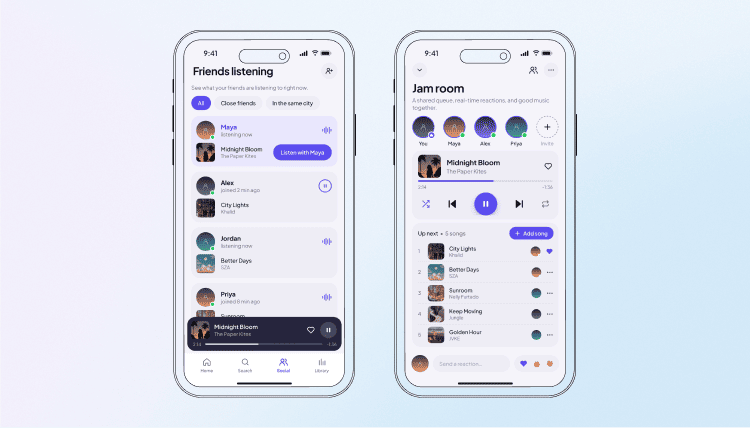
These apps make listening a shared behavior.The core action may be joining a room, building a queue together, seeing what friends are playing, swapping tracks, voting on the next song, or creating playlists around a group. Spotify’s recent work around in-app messaging, listening status, and Jam shows that social listening is moving closer to the player itself.A startup can go further if social behavior is the product rather than an extra tab.

Radio, live, and DJ-led apps

These services are based on programming instead of pure on-demand choice.

They can include internet radio, live DJ sets, artist broadcasts, festival streams, label channels, or scheduled listening sessions. Their technical needs can differ from an on-demand app because latency, live metadata, chat, moderation, and scheduling may matter more than a huge searchable catalog.

Context-specific music products

Some of the best ideas are not “music apps” in the usual sense.

A fitness product may change music based on the workout phase. A hospitality product may manage licensed music for venues. A learning product may use stems, loops, notation, or playback controls for musicians. A game community may turn playlists into a social layer. A meditation product may mix music with guided sessions.

This is often where a new music product has the strongest reason to exist.

Music streaming application features

A music app needs two layers of features: the ones that make listening work every day, and the ones that give people a reason to choose your app.

Core features users expect

FeatureWhat it needs to do well
Audio playerStart quickly, recover from network changes, handle queues, background playback, interruptions, Bluetooth, and device audio controls
SearchFind tracks, artists, albums, playlists, labels, genres, and other catalog entities despite typos or incomplete queries
Registration and profileSupport account creation, authentication, settings, plans, privacy choices, and device sessions
Music librarySave followed artists, albums, tracks, history, and user-owned collections
PlaylistsCreate, edit, reorder, share, and, where the product calls for it, collaborate
FavoritesGive users a fast way to train their library and return to music
Offline listeningDownload encrypted media, enforce rights rules, manage storage, and refresh access when needed
NotificationsHandle release alerts, social events, subscription notices, live sessions, and product messages without becoming noise
Subscriptions & paymentsHandle plan selection, trials, upgrades, renewals, cancellations, payment failures, refunds, and access changes across supported platforms

The list looks familiar because listeners already expect most of it. The interesting decision is how much of each feature your first release actually needs.

Say you are building the best home for a local music scene. Rich artist pages, proper credits, editorial collections, local event links, and excellent search may do far more for that idea than lyric translation or advanced mixing.

That is a better way to scope an MVP: start with the experience you are promising and work backward into the feature list.

Advanced features they remember you for

This is where feature planning gets more fun and more dangerous. You may see every feature below as useful. That would be a bad idea. Pick the ones that change how people discover, experience, or participate in music inside your product.

  • Recommendations and mixes. Listening history, skips, saves, follows, catalog data, editorial input, mood, activity, and context can all shape what comes next. Decide what good discovery means for your product first. The deeper question of how much control users should have over that system is worth its own discussion below.
  • Social features. Shared queues, group listening, comments, messaging, fan rooms, collaborative playlists, and friend-based discovery can give people reasons to return together. For some niche products, the community may be as important as the catalog.
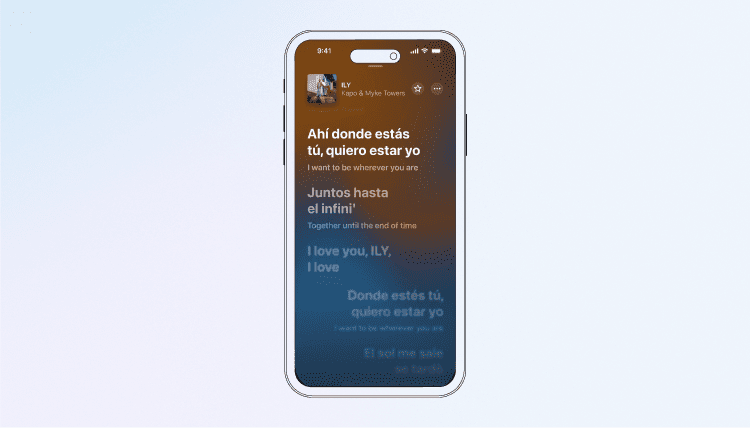
  • Lyrics and translation. Lyrics, translation, and pronunciation can help listeners follow, understand, and participate in music outside their native language.
  • Song recognition. Hear something in a club, café, video, festival, or taxi, identify it, save it, then fall into the artist catalog. That little journey can be a very strong acquisition and discovery loop.
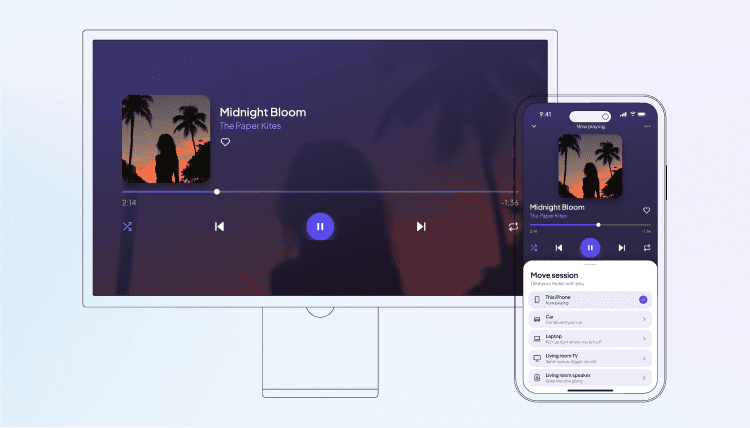
  • Cross-platform synchronization. The phone, laptop, car, TV, and speaker should feel like parts of the same listening session. Queue state, playback position, library changes, and history need to travel with the user. People become surprisingly emotional when their queue disappears. I understand them.
  • Creator tools. Artist dashboards, release management, fan messaging, presaves, ticket links, paid drops, audience analytics, and community features can turn the product into something creators actively use rather than another place where their tracks happen to exist. This matters a lot for direct-to-fan and label-led products.
  • Content identity and AI disclosure. By 2026, platforms need to think about whether tracks, voices, artist identities, artwork, or credits were generated or altered with AI. That information may affect moderation, discovery, trust, and rights workflows.

Need a music app idea consultation?

We can help define the audience, catalog, and feature wedge before you expand the scope.

What to learn from Spotify and Apple Music in 2026

Spotify and Apple Music are useful references because they have already spent years finding out what listeners expect, what they ignore, and what eventually becomes muscle memory. For a new music product, that makes them less of a blueprint and more of a very expensive public usability test.

Give users more control over discovery

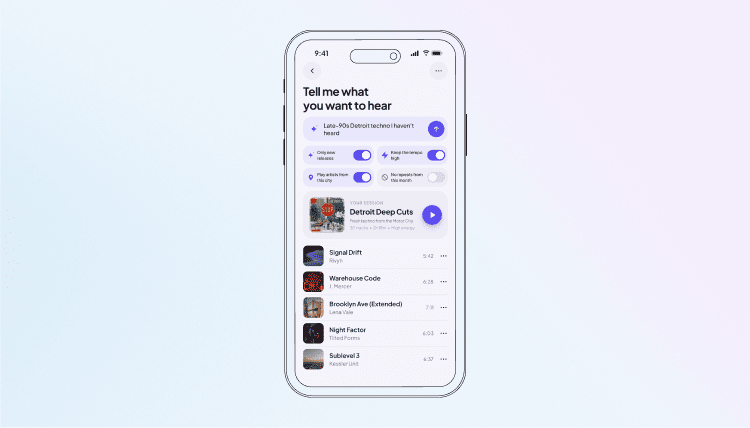
Spotify has been adding more direct ways for listeners to shape what they hear, including controls around discovery playlists and a 2026 beta that lets eligible Premium users type or speak requests about what to play and explore.

The interesting shift is from passive recommendation toward something closer to negotiation. The system suggests; the listener corrects, narrows, pushes, or changes direction.

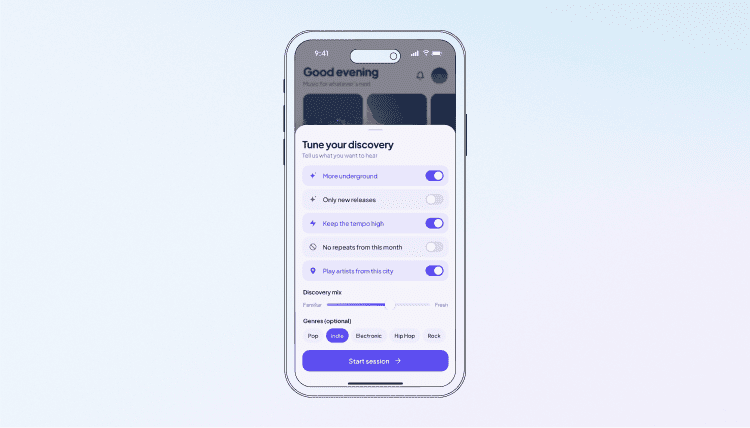
For a new product, that could mean controls such as “more underground,” “only new releases,” “keep the tempo high,” “no repeats from this month,” or “play artists from this city.”

You do not need a chat interface to get there. A few well-chosen controls may be much better for your audience than an empty text box asking what they feel like hearing.

Treat social listening as part of playback

Spotify’s listening activity and Request to Jam features bring sharing and group listening into the same place where people already talk about music.

The bigger lesson is about where the product loses the user.

If someone finds a track in your app, sends it to a friend in another app, discusses it there, then plans the next listening session somewhere else, a large part of the experience has left your product.

For a social-first service, ask what people should be able to do together without leaving. A label app might host release-night listening rooms. A genre community might build shared queues. A fan product might let an artist join the conversation around a new drop.

Make audio quality a user choice

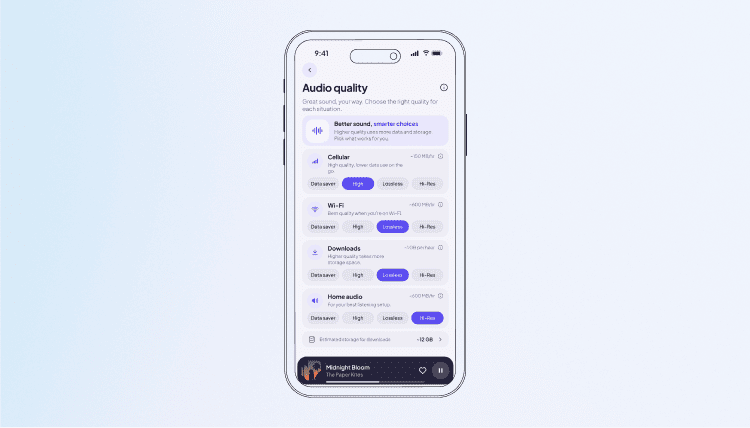
Spotify rolled out lossless listening for Premium users in 2025, with support up to 24-bit/44.1 kHz FLAC in eligible markets. Apple Music also offers lossless audio and Dolby Atmos on supported tracks and devices.

The interesting part is what happens after you add the quality option.

A listener on home Wi-Fi with good equipment has very different needs from someone on mobile data with Bluetooth earbuds. Downloads introduce storage limits. Weak coverage introduces buffering. Cars and speakers introduce another set of device constraints.

So audio quality becomes a product decision about context, not a race toward the largest file.

Give people sensible choices for Wi-Fi, cellular use, and downloads, and make the cost in data and storage clear. There is little glory in serving a beautiful lossless file that stops twice before the chorus.

Use language and participation as discovery tools

Apple added Lyrics Translation, Lyrics Pronunciation, AutoMix, Library Pins, and richer Sing features during the iOS 26 cycle, then expanded parts of that work again in 2026.

Taken together, those features point to something more interesting than “better lyrics.”

Music apps are giving people more ways to do something with a track: understand it, sing it, mix it, learn it, organize it, or explore the context around it.

That creates room for smaller products to go much deeper.

A K-pop app could make translation, pronunciation, fan discussion, and comeback activity part of the listening experience. A classical service could connect a recording to the work, conductor, score, and performance history. A product for musicians could add stems, tempo controls, loops, or practice tools.

Spotify and Apple Music have to build for enormous mixed audiences. A niche product gets to obsess over one group. That is the advantage worth borrowing.

Now, we finally reached the point where I explain how to start a music streaming platform.

How start a music streaming service step-by-step

A good music app usually takes shape long before anyone touches the player screen. The early work is about four things: the audience, the catalog, the rights around that catalog, and the listening habit you want to create.

Once those are clear, the technical decisions get much much easier.

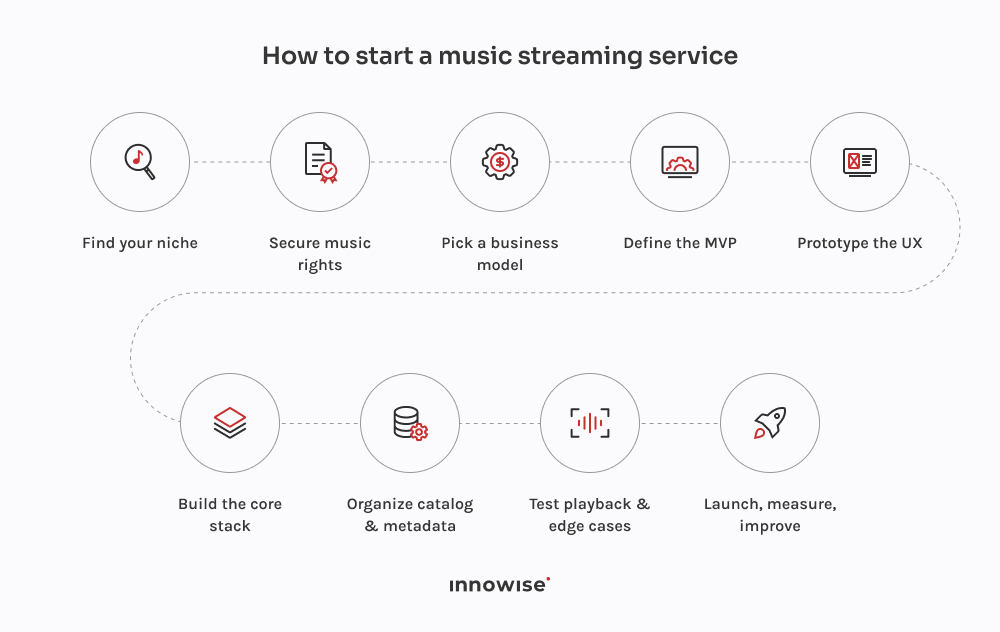
1. Define the reason the app should exist

Start with one sentence that explains why a specific listener would choose your product.

“Better music discovery” says very little.

“A streaming service for underground electronic labels where fans can follow releases, buy limited drops, and join label-run listening rooms” gives the team something useful to build around.

That sentence becomes a filter for the roadmap. Lyrics may fit. Collaborative playlists may fit. Podcasts may have nothing to do with the idea. The decision comes from the product, rather than from a tour of Spotify’s feature list.

This matters because music apps can grow sideways very quickly. A player turns into playlists, social profiles, messaging, lyrics, recommendations, creator pages, ticketing, and ten other things before the main listening habit has even been tested.

A tighter product usually gives you better answers faster.

2. Work out where the music comes from

Catalog strategy should be settled early because it affects almost every technical layer.

The music may come from labels, direct artist uploads, distributors, your own catalog, public-domain recordings, or several sources at once. Each model brings different rules around playback, downloads, territories, credits, reporting, and takedowns.

This also changes the backend.

A track may be available in one country but unavailable in another. A release may expire. One subscription tier may allow offline listening while another does not. A label may permit full playback but restrict clips or user-created edits.

So availability is rarely a simple yes-or-no field. The system often needs to understand who can play a track, where, under which plan, and under which rights conditions.

Those rules are much easier to build when they are part of the data model from the beginning.

3. Decide what people are paying for (aka your business model)

The business model should make sense from the listener’s point of view.

A subscription can sell access to a catalog, but a niche product may be charging for something more specific: early releases, artist communities, live sessions, archive material, stems, lessons, DJ tools, fan memberships, or events.

Some products can combine several revenue streams. A listener may use the app for free, pay a creator membership, buy a limited release, and purchase a ticket from the same account.

The useful question here is simple: what feels valuable enough that a user understands the price immediately?

For a broad streaming service, that value is often catalog access. For a smaller product, it may be closeness to a scene, better discovery inside a genre, rare content, or a direct relationship with artists.

That answer will affect product design, payments, permissions, analytics, and even the catalog structure.

4. Cut the MVP to one listening loop

An MVP should prove a behavior people want to repeat.

Write that behavior as a short sequence.

Discover artist → play track → save → follow → return for the next release

Or:

Join room → add track → react with friends → follow people → return for the next session

Or:

Start workout → choose intensity → play set → rate the fit → return tomorrow

This exercise tends to settle feature arguments faster than a long requirements document.

If the main loop is clear, you can judge each feature by whether it supports that loop. Search probably does. Account recovery does. A full creator marketplace may belong much later.

For a broader view of app planning and delivery, see Innowise’s guide to mobile app development types and processes.

5. Prototype the listening experience

A clickable prototype is enough to test the basic flow before the team builds the full media system.

Focus on onboarding, home, search, the player, queue behavior, library actions, subscriptions, and the feature that gives the product its identity.

The player deserves extra attention because people repeat the same actions constantly.

What happens after a user taps another track? Where does it go in the queue? How does “play next” behave? What happens when an album ends? Can the listener recover a queue after closing the app?

These decisions can look tiny on a Figma screen. In daily use, they become muscle memory.

That is why playback UX should be treated as product design, not as a decorative screen around an audio file.

6. Design the architecture around media, metadata, and rights

Most music products become easier to reason about when the backend is split into three broad areas.

Media covers audio files, encoded versions, artwork, downloads, and delivery.

Metadata covers artists, releases, genres, credits, labels, composers, moods, languages, versions, and relationships between catalog entities.

Rights covers who can listen, where, on which plan, for how long, and under which conditions.

Music data gets complicated surprisingly fast.

A song can exist as an album version, radio edit, remaster, remix, instrumental, clean version, live recording, deluxe reissue, or regional release. Two artists can share a name. One artist can change a name. A release can disappear in one territory and remain available everywhere else.

A data model that reflects those relationships will save a lot of painful cleanup later.

7. Build catalog ingestion and metadata early

Bad metadata makes good music hard to find.

Users notice problems immediately. Duplicate artist pages create confusion. Incorrect or poorly modeled release dates make catalog browsing feel sloppy. A remix attached to the wrong artist damages search and recommendations at the same time.

Niche products often need more detailed metadata than broad consumer services.

A classical app may care about composer, work, movement, conductor, orchestra, soloist, period, and recording date.

A DJ-focused product may care about BPM, key, label, mix version, release series, and remix relationships.

A regional service may need transliteration, local spellings, alternate artist names, and language-specific search.

In some products, the metadata model becomes one of the strongest reasons to use the app. It lets people browse music in the way they already think about it.

8. Build playback for real network conditions

A music player should be tested where listeners actually use it: mobile networks, trains, cars, weak Wi-Fi, Bluetooth headphones, background mode, and devices with almost no free storage.

Run through the messy cases.

Switch from Wi-Fi to cellular in the middle of a track. Lock the phone. Take a call. Disconnect Bluetooth. Kill the app. Reopen it. Interrupt a download. Fill the device storage.

Then check what the user sees.

Does the queue survive? Does playback continue from the right place? Does the app recover after a connection drop? Is the error message useful? Can the listener tell which tracks are available offline?

Buffering rules, local cache, preloading, retry logic, quality settings, and download behavior all shape this experience.

A beautiful home screen means very little if playback keeps breaking.

9. Add search and recommendations in layers

Strong search usually gives a new music product more value than an ambitious recommendation engine built too early.

Users should be able to find artists despite typos. Search should understand tracks, albums, labels, playlists, genres, and the catalog entities that matter to your audience.

Discovery can start with simple but useful signals: recent releases from followed artists, editorial collections, genre relationships, label connections, listening history, and “more like this” suggestions.

More complex recommendation models make more sense once the product has enough real behavior to learn from.

And session length alone is a weak measure of recommendation quality.

Look at skips, saves, repeat plays, follows, hides, searches, and whether listeners return to artists they discovered through the app. These signals tell you much more about whether discovery is actually working.

Give users some control too. A simple “less like this” action can fix a bad recommendation faster than another layer of ranking logic.

10. Test rights, security, payments, and edge cases

Music apps collect edge cases quickly, so QA should include more than normal playback.

Check what happens when:

  • a subscription expires;
  • a download license expires;
  • a track disappears from the catalog;
  • a payment fails;
  • a user changes country;
  • the same account is active on several devices;
  • a playlist contains unavailable music;
  • an artist deletes an upload;
  • a listener has a very large library;
  • a download stops just before completion.

Then cover abuse.

Fake streams can affect payouts. Scraping can expose catalog data. Upload spam can bury legitimate music. Artist impersonation creates rights and trust problems. Account sharing can distort subscription rules.

If the product pays creators or sells access to licensed content, these cases belong in the first serious QA plan.

11. Launch to a narrow audience first

The first release should go to people who match the original product idea as closely as possible.

A service for independent techno labels needs techno listeners, DJs, artists, and label teams in the beta.

A music-learning product needs musicians at the skill level the experience was designed around.

A fan platform becomes much easier to test when a small number of creators already have audiences willing to follow them somewhere new.

Then watch the core behavior.

How quickly does someone reach the first track? What do they search for? What gets saved? Which feature brings them back? Where do they leave? Does the main listening loop happen naturally, or does the product keep pushing users toward it?

That last question matters most.

Version one should tell you whether the idea creates a real habit. Once you know that, the rest of the roadmap becomes much easier to justify.

How to choose the right tech stack

The right stack depends on supported platforms, audio requirements, offline behavior, recommendation complexity, catalog size, team skills, and what systems you already have.

There is no single “music app stack.” A niche iOS app for an artist collective and a global multi-device service should not make the same choices.

ComponentTechnology optionsBest suited for / considerations
iOSSwift, SwiftUIDeep Apple media APIs, background audio, CarPlay, Apple TV, platform-specific UX
AndroidKotlin, Jetpack ComposeDeep Android media APIs, broad device support, Android Auto, background playback
Cross-platform mobileFlutter, React NativeShared product logic and UI across iOS and Android when low-level media needs are manageable
WebReact, Next.js, VueBrowser player, account management, creator dashboards, editorial tools
Backend APIsNode.js, Java, Kotlin, Go, Python, .NETChoose around team skills, traffic patterns, service boundaries, and existing systems
Relational dataPostgreSQL, MySQLUsers, subscriptions, catalog entities, rights records, transactional data
High-volume/event dataKafka, ClickHouse, Cassandra, cloud queuesPlayback events, analytics, recommendation signals, royalty event pipelines
SearchElasticsearch, OpenSearchTrack, artist, album, playlist, typo-tolerant and faceted search
CacheRedisSessions, hot catalog data, rate limits, short-lived playback state
Media storageAmazon S3, Google Cloud Storage, Azure Blob StorageMaster files, encoded versions, artwork, downloads
Content deliveryCloudFront, Cloudflare, Akamai, FastlyGlobal media delivery and edge caching
Media processingFFmpeg, GStreamer, managed encoding servicesTranscoding, loudness handling, waveform generation, format preparation
Streaming formatsHLS, MPEG-DASH; AAC, Opus, FLAC where appropriateNetwork delivery, compatibility, quality tiers, lossless plans
Content protectionFairPlay, Widevine, PlayReady, signed URLs/tokensLicensed media, offline access, device rules
RecommendationsPython, PyTorch, TensorFlow, feature pipelines, vector searchRanking, similarity, listener models, audio or text embeddings
MonitoringOpenTelemetry, Prometheus, Grafana, SentryPlayback errors, API health, crash tracking, latency, release monitoring

You can review Innowise’s broader technology expertise for the web, mobile, backend, cloud, data, and machine-learning options used across product work. Innowise’s media and entertainment practice also works with HLS/MPEG-DASH, FairPlay, Widevine, PlayReady, FFmpeg, GStreamer, and CDN platforms.

Native or cross-platform?

Choose native when the listening experience depends heavily on platform media APIs, low-level audio control, complex offline behavior, deep car/TV/watch support, or very platform-specific interaction.

Choose cross-platform when your product is mainly catalog browsing, accounts, payments, playlists, social features, and standard media playback, and you want to share more code across iOS and Android. Innowise covers both approaches, including cross-platform app development.

A common middle path is shared business logic with native media modules where needed. The right decision is architectural, not ideological.

Have a catalog model, feature list, or existing backend already?

Review the stack, playback architecture, rights rules, integrations, and platform plan before development expands.

Key challenges in music streaming app development

Well, a streaming app can look finished long before it is technically ready. Like any other app, if you ask me. 

A polished player screen proves roughly one thing: the designer did their job. Then come weak networks, expired rights, Bluetooth, offline mode, duplicate tracks, fake streams, and users doing g̶o̶d̶ ̶k̶n̶o̶w̶s̶ ̶w̶h̶a̶t things nobody put in the test script. You know, all the classics.

Streaming performance and audio quality

Playback has to start quickly, stay stable, and recover gracefully when the connection gets ugly.

That means working with several audio quality levels, CDN delivery, local caching, buffering rules, and retry logic. Measure startup delay, rebuffering, failed plays, and errors by device, OS version, network type, and app release. A global average can hide a terrible experience for one specific Android model or mobile carrier.

Lossless audio deserves the same practical treatment.

It sounds great in a feature list, but the technical cost is real: larger files, more bandwidth, heavier downloads, and more storage. Give listeners control over quality for Wi-Fi, cellular, and offline listening instead of assuming the biggest file is always the best choice.

And test playback outside perfect Wi-Fi. Elevators, trains, underground parking, weak 4G, Bluetooth reconnects, incoming calls, and switching networks will teach you more than another hour in the office.

Data storage and growth

Music products generate far more data than the audio catalog itself.

A single listening session can produce plays, pauses, skips, searches, saves, playlist changes, recommendation impressions, downloads, ad events, device events, and royalty records. Multiply that across an active user base and the event stream grows quickly.

Keep those workloads separate.

Audio files belong in object storage. Core product records belong in transactional databases. Search needs its own index. High-volume listening events usually belong in an event pipeline and analytics store rather than beside user accounts and subscription records.

Retention deserves an early decision too. Keeping every raw event forever is easy to approve when traffic is small and much harder to justify later.

As usage grows, watch CDN traffic, storage, event throughput, search indexing, recommendation workloads, and database hot spots. Capacity problems rarely arrive everywhere at once. One queue, query, or popular release tends to complain first.

Cross-platform compatibility

“Works on iOS and Android” tells you almost nothing about whether playback actually behaves well.

Music interacts with the operating system constantly. Lock screens, Bluetooth, headphones, calls, notifications, background limits, casting, car systems, TVs, watches, and battery-saving modes can all change playback behavior.

Build a device matrix around how your audience listens.

Test what happens when headphones disconnect, Bluetooth reconnects, the app moves into the background, a call interrupts playback, the user changes accounts, or the queue moves from one device to another.

If your product depends heavily on cars, TVs, watches, or connected speakers, that requirement should influence the platform strategy from the beginning. It is much easier than discovering halfway through development that one of your main listening scenarios needs deeper native work.

Recommendations that do not become repetitive

A recommendation system can shrink a huge catalog surprisingly fast.

If someone likes three artists and the app keeps rotating those artists forever, discovery turns into a loop. Push too much unfamiliar music, though, and the listener starts wondering whether the system knows them at all.

The balance depends heavily on the product.

A classical listener may care about composer, work, conductor, orchestra, period, or recording. A DJ may care about BPM, key, label, mix version, and scene. A fan following one regional genre may care about city, language, collaborators, and local labels.

That is why recommendation quality starts with the catalog model. Better metadata gives ranking systems more useful relationships to work with and more ways to pull users outside their usual bubble without throwing random tracks at them. 

I would also give listeners simple ways to steer the result: more like this, less like this, hide this artist, exclude this playlist from taste history, show newer releases, or move further outside the usual rotation.

Recommendation systems should learn from people, but people should still be able to correct them.

Data privacy and security

Listening history looks harmless until you think about what it can reveal.

Music can point to routines, locations, relationships, communities, cultural interests, religious interests, moods, and daily habits. Social features add another layer because users may expose what they are listening to, when they are online, and who they interact with.

Collect the data the product actually needs and define who inside the company can access it. Protect sessions, account recovery, payment flows, downloaded content, creator accounts, and admin tools.

Social visibility deserves particular care. Users should clearly understand when listening activity, playlists, follows, or group sessions are visible to other people.

Security also has a very practical streaming side: stolen accounts, credential stuffing, scraped catalogs, abused free trials, shared subscriptions, and creator impersonation can become expensive long before anyone describes them as a security incident.

Music licensing

Licensing can change the product more than almost any technical decision.

A commercial recording usually involves rights in the sound recording and rights in the underlying composition. Then come territory rules, reporting requirements, contract terms, lyrics, artwork, offline access, clips, user uploads, remixes, and other uses.

Each one can affect what the software is allowed to do.

That is why the rights model belongs in the system design. A track may be playable in Poland but unavailable in Canada. A contract may allow streaming but exclude downloads. Lyrics may come from another provider under another agreement. Rights can also expire while the release still exists in your database.

Your backend needs to answer more than “does this track exist?”

It may need to answer:

Can this user play this track, in this country, on this plan, on this device, right now?

Get licensing counsel involved before promising catalog size, territories, offline listening, lyrics, clips, remixes, or creator uploads. Engineering can implement the rules only after the business understands what those rules are.

Fraud, spam, and artist identity

Once money follows streams, someone will eventually try to manufacture streams.

IFPI treats this as a serious industry problem in its Global Music Report 2026. The report describes how fraudsters upload tracks and use bots to generate artificial plays, diverting royalty money from legitimate artists and right holders. It also points to generative AI as an accelerant, and Deezer’s own numbers show how quickly the volume is growing. In January 2026, the company said it was receiving more than 60,000 fully AI-generated tracks every day. By June, that figure had climbed to about 90,000 a day, representing more than 50% of all new uploads on peak days. Deezer also reported that up to 85% of streams on fully AI-generated tracks were fraudulent in 2025.

The tricky part is that unusual traffic is not automatically fraudulent. Music fandom can produce some very strange patterns all by itself.

Your anti-fraud system also needs some cultural awareness. A sudden wall of repeat plays might be bots. Or BTS dropped something.

That is why raw play counts tell you very little on their own. The system needs context: account behavior, device patterns, timing, geography, repetition, payment relationships, upload history, and other signals that help separate highly committed humans from automated manipulation.

Actual abuse can take many forms: bot traffic, replay farms, account abuse, duplicate uploads, fake artist profiles, stolen recordings, misleading metadata, or synthetic tracks produced and uploaded in bulk. Generative AI adds another identity question too: who made the track, whose voice is being used, and what should the listener be told about it?

A streaming platform needs controls on both the content and listening sides. That can include upload checks, duplicate detection, artist verification, suspicious-play rules, rate limits, credits, AI-use labels, takedown flows, and tools for the people reviewing questionable activity. IFPI also points to identity verification, content checks, platform-level fraud detection, and information sharing across the music ecosystem as key responses.

The level of protection depends on the product. A closed catalog supplied by a handful of labels has a very different risk profile from an open service where anyone can upload a thousand tracks before breakfast.

And waiting until the fraud becomes obvious gets expensive. Fake plays can distort payouts, charts, recommendation signals, and the visibility of legitimate artists before the team even realizes what is happening.

For a music service, fraud prevention and artist identity sit very close to the money. That alone earns them a place in the architecture.

What’s shaping the future of music streaming?

The interesting shifts in 2026 are happening around control, context, trust, and the relationship between listeners and creators. The player itself is pretty mature. 

Conversational music control

Typing an artist name into search is still fine. Describing what you want is starting to become more useful.

Spotify’s 2026 “Talk to Spotify” beta is one sign of that shift. A listener can ask for something closer to an intent than a title: “late-90s Detroit techno I haven’t heard,” “new releases from artists I follow, no remixes,” or “piano recordings under six minutes.”

For niche services, this gets especially interesting because their catalogs often contain richer specialist metadata. A classical app can understand conductor, work, period, or movement. A DJ product can work with BPM, key, label, and mix version. A regional service can work with language, city, scene, or local collaborators.

The value is not chatting with the app for the sake of it. It is getting from a vague musical thought to the right track with fewer taps.

Better audio with clearer trade-offs

Lossless is no longer an audiophile-only talking point among major services. Spotify’s 2025 rollout brought it into its Premium offer, while Apple continues to invest in richer playback and mixing features.

For developers, better audio means more decisions about storage, delivery cost, device capability, download size, and user settings. Build quality tiers around actual listening contexts.

Music feels weightless because you tap a song and sound appears. Behind that tap are storage systems, encoding jobs, networks, caches, devices, and millions of repeated requests. My sustainability side keeps reminding my producer side that ‘better quality everywhere, all the time’ has a technical and environmental cost. The better question is where that extra quality actually matters to the listener.
Stanislav Kazanov, Head of GRC and Cybersecurity.
Stanislav Kazanov
Head of GRC, Cybersecurity & Sustainability

Cross-device listening as one session

People move from phone to car, laptop, TV, speaker, headphones, and back again.

The product opportunity is to treat the session, queue, and context as a portable state. A listener should not have to rebuild what they were doing every time the device changes.

This is especially interesting for products built around workouts, events, gaming, home listening, or commuting because the device change is part of the use case.

Creator tools and fan economics

For smaller services, the stream itself may be the beginning of the transaction rather than the end of it.

Creator memberships, exclusive releases, live rooms, tickets, digital goods, fan clubs, paid drops, and direct purchases can all sit around listening.

This is especially relevant for niche catalogs. Competing with mass-market streaming economics track for track is a rough game. Building a place where a smaller number of fans spend more because they care deeply about the artist, label, or scene is a very different business.

That is why creator tools and fan economics deserve a place in product planning from the start. Sometimes the most important button around a song is not “play again.” It is “join,” “buy,” or “see them live.”

For a broader view of where mobile products are heading, see mobile app development trends in 2026.

How to choose your music app development company

A good music app development company should understand the listening product and the systems behind it.

Use this checklist when comparing partners:

  • Relevant mobile, media, audio, or streaming work
  • Strong iOS, Android, web, and backend engineering
  • Practical knowledge of media formats, player behavior, CDN delivery, offline access, and content protection
  • Experience designing systems that can handle growth in users, catalog size, and playback events
  • UI/UX work for repeat-use consumer products
  • Search, recommendation, data, and machine-learning skills where your roadmap needs them
  • QA across real devices, network changes, background playback, and subscriptions
  • Security work around accounts, payments, media access, uploads, and abuse
  • Case studies that show similar technical problems, not just a similar industry label
  • A clear development process, scope assumptions, estimation method, and change process
  • Post-launch support for OS changes, new devices, catalog growth, and feature releases

Ask one more question that is easy to forget: what would this team advise us not to build? A useful partner should be willing to cut scope when a feature does not support the product thesis.

How Innowise can help with music app development

Innowise can support a music product from early discovery through mobile and backend delivery, QA, release, and later development.

For a streaming product, that can include:

  • Product discovery and technical planning
  • UX/UI for discovery, playback, libraries, creator tools, and subscriptions
  • Native iOS and Android development
  • Flutter or React Native development where a shared codebase fits
  • Backend APIs, account systems, payments, catalog services, and admin tools
  • Search and recommendation systems
  • Media processing, storage, CDN delivery, and content protection
  • Data pipelines for product analytics and royalty events
  • Security and QA across devices and network conditions
  • Cloud infrastructure, monitoring, and release engineering

Innowise’s public media and entertainment stack includes mobile and web development, HLS/MPEG-DASH, FairPlay, Widevine, PlayReady, FFmpeg, GStreamer, major cloud platforms, and CDN technologies.

The important part is choosing the smallest technical plan that fits the business. A founder with a licensed niche catalog and a strong community idea does not need the architecture of a global mass-market platform on day one.

Got the idea. Need the plan?

We’ll work through features, architecture, team setup, and what should come first.

Conclusion

If you want to build a music streaming app in 2026, start with a narrower question: what listening problem can you solve better than Spotify because you are smaller, more focused, or closer to a specific community?

Then work outward from that answer.

Choose the audience. Secure the catalog. Decide how money flows. Cut the MVP to one repeatable listening loop. Build metadata and rights into the architecture. Make playback steady under real conditions. Give listeners control over discovery. Treat identity, AI disclosure, fraud, and creator rights as product concerns. Add social or creator features only when they strengthen the reason people come back.

FAQ

A music streaming app delivers audio over the internet so users can listen without owning each file locally. Depending on the product, it may offer on-demand playback, radio-style programming, live streams, downloads, playlists, recommendations, social listening, creator content, or a mix of these.

The technical system usually combines media storage and delivery, a player, catalog metadata, accounts, search, rights rules, analytics, and backend services.

Choose native when deep platform media behavior is central to the product. That includes complex background playback, advanced audio handling, heavy offline use, deep car or TV support, and many platform-specific integrations.

Choose cross-platform when the app is mostly shared product logic and UI across iOS and Android, with standard playback needs. Flutter and React Native can reduce duplicated work, while native modules can cover media features that need direct platform access.

The best choice depends on the product, team, and device roadmap, not on a blanket rule.

Common models include subscriptions, advertising, freemium plans, direct creator memberships, paid releases, ticketing, merchandise, tips, B2B subscriptions, and transaction fees.

A niche service should choose a model around the value it provides. If the product creates a closer artist-fan relationship, direct payments may matter more than maximizing listening hours.

There is no useful single price because the expensive parts vary widely: platform count, catalog ingestion, offline playback, content protection, recommendation systems, creator tools, payments, admin software, cloud traffic, and licensing operations.

Use a broader mobile development cost guide as a baseline, then estimate the music-specific parts separately. Innowise’s 2026 guide also recommends starting with an MVP and budgeting for ongoing maintenance rather than treating launch as the end of development.

A focused MVP can take several months, while a large streaming product can take much longer.

Innowise’s broader 2026 mobile cost guide puts medium-complexity apps at roughly three to six months and complex apps at six months to more than a year. A music product can move toward the longer end when it includes a large catalog, offline access, custom recommendations, multiple device types, creator tools, content protection, and heavy backend work.

If you stream copyrighted music, yes, you generally need permission or licenses for the rights involved.

The exact requirements depend on country, catalog source, whether playback is on-demand or non-interactive, and what else the product does with the music. A recording and its underlying composition are separate rights, and features such as lyrics, offline downloads, clips, video, or user remixing can add more rights questions.

Get music-rights advice before you make catalog or territory promises.

A typical team may include a product manager or business analyst, UX/UI designer, iOS and Android or cross-platform developers, backend developers, QA engineers, DevOps or cloud engineers, and a project manager.

Depending on the product, you may also need data engineers, machine-learning engineers, audio or media specialists, security engineers, web developers, and licensing or rights experts.

Build in-house when the product is central to your company and you already have the people to own mobile, backend, media delivery, QA, data, and operations over the long term.

Outsourcing can make sense when you need specialist skills quickly, want to fill gaps in an existing team, or do not want to hire every role before the product is validated.

A mixed model is common: keep product ownership, catalog relationships, and core business knowledge inside the company, while an external team handles selected engineering areas or delivery.

You do not begin by copying Spotify’s full feature set.

Define the part of Spotify’s job you actually need: on-demand playback, discovery, playlists, social listening, creator tools, or multi-device access. Then choose a narrower audience, secure the right catalog, design one repeatable listening loop, and build the minimum architecture needed to support it.

If the real goal is to start a music streaming service, the strongest strategy is usually not “Spotify with fewer users.” It is a product Spotify has little reason to become.

Show all

Table of contents

    Contact us

    Book a call or fill out the form below and we’ll get back to you once we’ve processed your request.

    Send us a voice message

    Attach documents
    Upload file

    You can attach 1 file up to 2MB. Valid file formats: pdf, jpg, jpeg, png.

    By clicking Send, you consent to Innowise processing your personal data per our Privacy Policy to provide you with relevant information. By submitting your phone number, you agree that we may contact you via voice calls, SMS, and messaging apps. Calling, message, and data rates may apply.

    You can also send us your request

    to contact@innowise.com
    What happens next?

    1

    Once we’ve received and processed your request, we’ll get back to you to detail your project needs and sign an NDA to ensure confidentiality.

    2

    After examining your wants, needs, and expectations, our team will devise a project proposal with the scope of work, team size, time, and cost estimates.

    3

    We’ll arrange a meeting with you to discuss the offer and nail down the details.

    4

    Finally, we’ll sign a contract and start working on your project right away.

    More services we cover

    arrow