Software development industry challenges in 2026 and how companies can overcome them

May 19, 2026 10 min read
Summarize article with AI

Key takeaways

  • Talent shortages are structural, especially for senior, AI, and security roles.
  • AI boosts productivity but introduces real security and governance risks.
  • Cyber threats are scaling faster than most teams can defend.
  • Technical debt is draining time, budget, and innovation capacity.
  • Winning teams balance speed with governance, security, and long-term architecture.

The software development world has never really stood still. But what about 2026? It feels like things have shifted in a way you can’t just brush off anymore.

AI isn’t some side experiment tucked away in an R&D lab. It’s literally everywhere. The talent shortage isn’t just a headline people debate on LinkedIn, but something teams run into when they’re trying to hire and simply can’t. Cybersecurity threats aren’t abstract risks either. They’re real, frequent, and often expensive. And that technical debt many companies kept pushing aside? It’s starting to show up on the balance sheet.

I work in software development, so I see this play out day to day. This article is a straightforward look at where things stand, what’s making life harder for teams right now, and what actually helps when you’re in the middle of it.

The Software Development Market: Current Overview

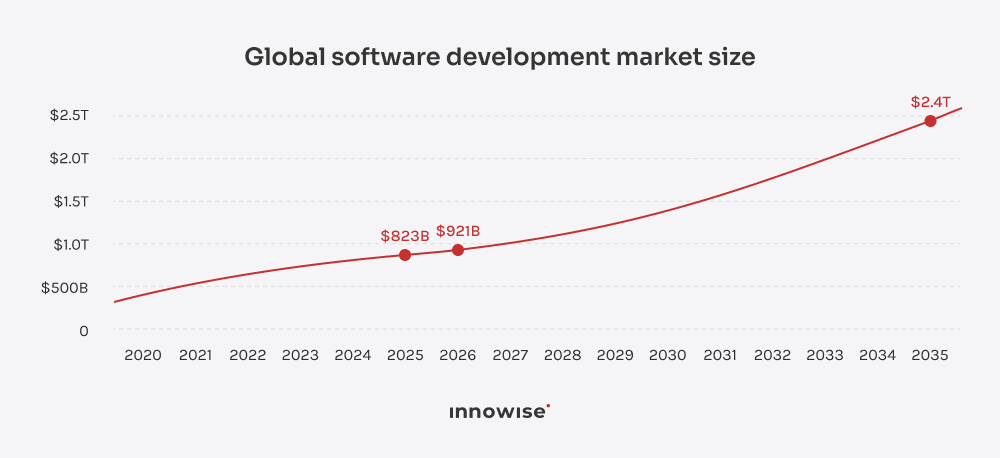
Let’s start with the big picture and look at software development statistics. The global software development market reached approximately $823 billion in 2025 and is on track to exceed $921 billion in 2026, with projections pointing toward $2.4 trillion by 2035. A compound annual growth rate of around 11.6%. That’s not slow-burn growth. That’s structural.

Cloud is the dominant delivery model, accounting for more than 71% of revenue in 2025, growing at a 12% CAGR as organizations move away from on-premise infrastructure. North America holds roughly 44% of global market share, but Asia Pacific is the fastest-growing region, led by India, China, and Southeast Asian nations.

The developer workforce has also expanded. There are now around 28.7 million developers worldwide, up from 25.5 million in 2020. Demand for developers is projected to grow 17.9% from 2023 to 2033, adding over 300,000 jobs. And yet, filling those roles is getting harder, not easier. More on that shortly.

One more thing worth noting: low-code and no-code tools are no longer niche. The global low-code market is growing from around $45 billion in 2026 at a 22.3% CAGR, and by 2026, 80% of low-code users are expected to sit outside of traditional IT departments. This is changing how organizations think about who “does” software development.

Top software development industry challenges in 2026

The talent shortage is structural

This one tops almost every industry survey right now, and the data backs it up. Talent shortages are now the #1 software development challenge, with 50% of organizations reporting difficulty recruiting and retaining skilled technical staff, and 80% saying these shortages are actively affecting their operations. 59% of enterprises say skill gaps are slowing down innovation.

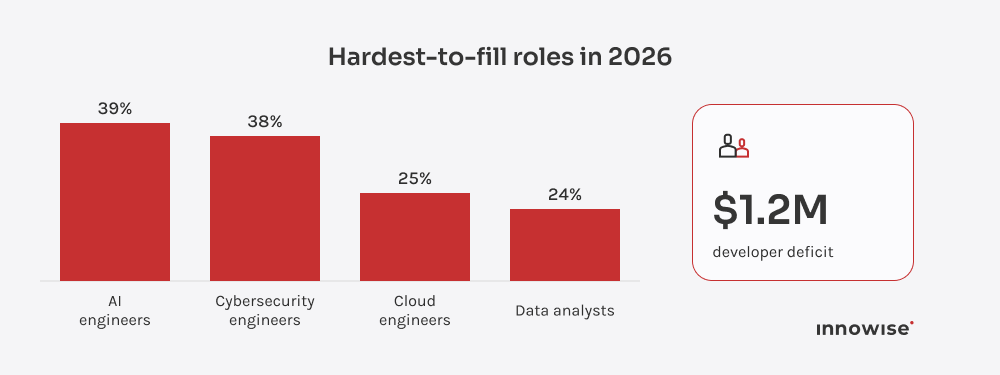
The hardest roles to fill are AI engineers (cited by 39% of organizations) and cybersecurity engineers (38%). Cloud engineers and data analysts aren’t far behind. By 2026, the US alone faces a projected deficit of around 1.2 million software engineers.

Here’s what makes this particularly tricky: the shortage is about seniority and depth. The market is polarized and there’s an oversupply of junior and generalist developers, and a genuine scarcity of senior engineers who can build and maintain complex systems in production. Bootcamps and hiring surges won’t fix this. The gap is structural.

AI is also reshaping what skills are actually in demand. In 2026, 91% of organizations are prioritizing AI-skilled hires, and 48% say AI adoption has created new roles, while only 18% report layoffs tied to it. AI is a job creator in tech, not a job killer — though it’s creating demand for skills that don’t yet exist at scale.

AI adoption is moving faster than governance

There’s no question that AI has changed how software gets built. By 2025, 80% of tech leaders were using AI in software development, and 77% named expanding AI as a top priority for 2026. GitHub Copilot users complete 126% more projects per week. The productivity gains are real.

But there’s a problem hiding underneath those numbers: the code AI produces is not inherently safe. Veracode’s 2025 GenAI Code Security Report tested more than 100 LLMs across four programming languages and found that AI-generated code contained 2.74x more vulnerabilities than human-written code, with a 45% security failure rate on standard benchmarks. A more recent study found that one in five breaches is now caused by AI-generated code.

What’s making this worse: fewer than half of developers actually review AI-generated code before committing it. Speed becomes the enemy of security when governance isn’t in place. IBM’s 2025 Cost of a Data Breach Report found that 63% of breached organizations lacked AI governance frameworks entirely.

Then there’s the challenge of actually integrating AI into mature production environments. Moving from AI experimentation (which most companies did in 2023–2024) to AI in production is a different problem entirely — it requires MLOps expertise, model monitoring, LLM integration into legacy systems, and a new kind of engineering discipline most teams are still building.

Half of respondents in Reveal’s 2026 IT Talent Survey cited ethics and responsible AI use as major challenges, while 48% flagged security and privacy risks from AI adoption. This isn’t just a technical problem. It’s a governance problem, and most organizations are behind on it.

Cybersecurity threats are growing faster than defenses

Security has consistently ranked as the top concern among tech leaders in 2026, and it’s not hard to see why. The cybersecurity field faces a global talent gap approaching 4 million professionals, with the US shortfall alone estimated at 700,000. At the same time, the attack surface is expanding rapidly — AI, cloud, IoT, and remote work environments all create new entry points.

90% of cybersecurity teams report skills gaps, particularly in AI defense and cloud security. And the threats are getting more sophisticated. In 2026, prompt injection attacks achieved 50–84% success rates across common LLM deployments, with 73% of AI systems showing exposure to prompt injection vulnerabilities in security audits.

Software supply chains are a particular concern. The rapid pace of AI adoption increases supply chain complexity significantly — a single compromised component can cascade across thousands of applications. Regulatory pressure is also intensifying: the EU AI Act, updated SEC disclosure requirements, and new NIST frameworks are all raising the compliance bar, particularly for companies operating across borders.

Technical debt and legacy systems are killing productivity

This one doesn’t get the same headlines as AI or cybersecurity, but it might be costing more. The average global enterprise wastes over $370 million per year due to its inability to efficiently modernize legacy systems, according to Pegasystems’ 2025 research across 500+ IT decision makers. The US figure is even more striking: accumulated technical debt has reached $1.52 trillion.

More than three in five IT leaders say their organization’s data stack is experiencing moderate to severe negative impact due to technical debt. According to Gartner, by 2026, 80% of technical debt will be architectural in nature — meaning it’s baked into the foundations of systems, not just sitting on top.

This isn’t just about old code. Legacy systems block AI adoption (you can’t easily bolt modern ML pipelines onto systems built in the 1990s), slow down release cycles, and drain engineering time. More than three-quarters of IT decision-makers say their teams spend 5 to 25 hours a week just updating and patching legacy systems. That’s time not spent building new things.

The average developer spends roughly 13.5 hours per week — about a third of their time — dealing with technical debt rather than developing new features. That number should feel alarming to any engineering leader.

Scalability and cost optimization under pressure

Cloud adoption solved many of the old infrastructure headaches, but it created new ones. As workloads scale, cloud costs can spiral quickly — and many organizations are discovering that their cloud architecture was designed for a different era of load. The challenge isn’t just “will this scale?” but “what will this cost us when it does?”

In 2026, organizations building AI-powered products face an additional layer of this: compute costs for training and inference are substantial, and managing GPU infrastructure efficiently requires expertise most teams are still developing.

At the same time, business pressure to deliver faster isn’t going away. Agile and DevOps adoption has become the norm (the majority of organizations prefer Agile frameworks) but the complexity of modern software stacks means that “move fast” still needs to be balanced against “don’t break things.” Especially when those things include customer data and regulated systems.

Regulatory compliance is getting more complex

Software development doesn’t happen in a vacuum. As software becomes more integrated into every part of the economy, regulatory frameworks are catching up. The EU AI Act, GDPR updates, HIPAA requirements, SOC 2 compliance, and sector-specific regulations are all creating compliance obligations that touch the development process directly.

AI governance is a particularly new front. Organizations using AI in development need audit trails, explainability documentation, and data governance policies that most weren’t thinking about two years ago. And failing to get this right is a serious risk, especially for companies working with enterprise clients or in regulated industries.

Dealing with any of these right now?

Let’s find the fastest way to close the gap — together.

How companies can address these challenges

Rethink how you source talent

Traditional hiring isn’t enough anymore. The companies navigating the talent shortage best are the ones that have built diverse talent ecosystems — combining in-house teams with strategic external partnerships.

IT staff augmentation is one approach that’s gained real traction: rather than waiting months to hire a senior AI engineer or cloud architect, you bring in specialized expertise for the duration of the project. It’s not a workaround — for specific competencies in high-demand areas, it’s often the smarter move. You get access to skills that are genuinely hard to find and don’t have to build entire practice areas from scratch.

Upskilling existing teams in AI tooling, cloud-native development, and security practices is also worth serious investment. The companies that win the next five years won’t necessarily be the ones that hired the most AI engineers — they’ll be the ones that built internal capabilities to use AI responsibly and effectively.

Establish AI governance before you scale

If your organization is using AI coding assistants (and it almost certainly is), you need governance around how that code is reviewed and validated. This doesn’t have to be bureaucratic. It means setting clear policies on code review, using security scanning tools that are specifically calibrated for AI-generated code, and making sure developers understand that AI output is a starting point, not a finished product.

AI governance at the development level also means tracking provenance, which matters a lot when you’re dealing with compliance frameworks or enterprise due diligence.

Address technical debt strategically

Not all technical debt is equal. Prioritize the debt that’s actively blocking your ability to ship, scale, or adopt new capabilities. A legacy system that runs quietly in the background and causes no integration headaches isn’t your first priority. A monolith that makes it impossible to add AI features or move to cloud infrastructure is.

Consider building modernization into your product roadmap as a first-class item rather than treating it as maintenance overhead. Custom software development with a deliberate modernization strategy pays dividends over time in both reduced maintenance cost and increased team velocity.

Build security into the process

Security needs to move left in the development process. That means integrating security scanning into CI/CD pipelines, training developers to recognize common vulnerability patterns, and establishing code review practices that include security as a standard checkpoint — not an afterthought before launch.

For AI-generated code specifically, static analysis tools and peer review are non-negotiable. The data on vulnerability rates is clear enough that treating AI code as inherently safe is a risk no organization should be taking.

Optimize cloud architecture for the long term

Cloud cost optimization isn’t glamorous, but it matters. Regular architecture reviews, right-sizing compute resources, using serverless where it makes sense, and building with cost observability from the start are all part of running efficient cloud operations at scale. FinOps practices — treating cloud spend as a shared responsibility between finance, product, and engineering — are becoming standard at mature organizations.

Your next project deserves the right people behind it.

Explore custom software development built around your actual constraints.

Future outlook: software development beyond 2026

Looking beyond 2026, a few trajectories feel fairly clear.

AI will move deeper into the development stack. Right now, most AI tooling is at the code generation level — autocomplete, code review, testing assistance. The next wave is agentic AI: systems that can plan, execute, and verify multi-step software tasks with minimal human intervention. This will change what developer workflows look like and raise the stakes on AI governance significantly.

The talent market will stay tight for specialized skills. Even as AI tools improve developer productivity, the demand for engineers who can design complex systems, secure AI deployments, and work with regulated data is structural and won’t ease quickly. Organizations that invest in training pipelines and retention strategies now will be better positioned.

Regulation will keep expanding. The EU AI Act is already in effect, and other jurisdictions are following. Companies building software for global markets need compliance infrastructure that can adapt as these frameworks evolve. This will make legal and compliance expertise increasingly important inside engineering organizations.

Low-code and citizen development will mature. The boundary between “technical” and “non-technical” users of software development tools will continue to blur. Engineering teams will increasingly be responsible for defining the guardrails and standards that citizen developers operate within, rather than building everything themselves.

The market will keep growing but the companies that grow with it will be the ones that have treated security, talent, and technical foundations as genuine strategic priorities, not backlog items.

Chief Technology Officer

Dmitry leads the tech strategy behind custom solutions that actually work for clients — now and as they grow. He bridges big-picture vision with hands-on execution, making sure every build is smart, scalable, and aligned with the business.

Table of contents

    Contact us

    Book a call or fill out the form below and we’ll get back to you once we’ve processed your request.

    Send us a voice message
    Attach documents
    Upload file

    You can attach 1 file up to 2MB. Valid file formats: pdf, jpg, jpeg, png.

    By clicking Send, you consent to Innowise processing your personal data per our Privacy Policy to provide you with relevant information. By submitting your phone number, you agree that we may contact you via voice calls, SMS, and messaging apps. Calling, message, and data rates may apply.

    You can also send us your request
    to contact@innowise.com
    What happens next?
    1

    Once we’ve received and processed your request, we’ll get back to you to detail your project needs and sign an NDA to ensure confidentiality.

    2

    After examining your wants, needs, and expectations, our team will devise a project proposal with the scope of work, team size, time, and cost estimates.

    3

    We’ll arrange a meeting with you to discuss the offer and nail down the details.

    4

    Finally, we’ll sign a contract and start working on your project right away.

    More services we cover

    arrow