How to build a food delivery app: features, process & costs

Sep 16, 2026 27 min read
Head of Mobile Development
Verified expert
Every article at Innowise is created by authors with real-world experience. They understand the topic beyond theory and bring insight from real projects.
9+ years of experience
Verified expert
9+ years of experience
Pavel drives the delivery of high-performance mobile apps across iOS and Android. With a background in native engineering, he ensures that cross-platform and native products scale smoothly and provide a flawless user experience.
Expertise
Cross-platform apps iOS & Android Product delivery
Let's talk

Key takeaways

  • A strong food delivery product starts with a clear local business model. Delivery density, restaurant supply, customer habits, and courier availability can look very different from one city to another.
  • Most platforms need four connected parts: a customer app, a restaurant panel, a courier app, and an admin console.
  • A first version can cost around $30,000–$60,000, while a larger multi-module platform may reach $150,000–$300,000 or more.
  • Start with the features that make ordering and delivery work reliably. AI, forecasting, advanced personalization, and alternative delivery methods can come later.
  • Choose the architecture around real order volume, location updates, payments, and future growth rather than around whatever technology happens to be fashionable.
Summarize article with AI

A customer sees a burger, taps twice, and dinner appears at the door. That’s nice, that’s beautiful. 

Behind that tiny miracle are payments, couriers, restaurant staff, maps, notifications, support, and about a hundred opportunities for something to go sideways.

If you are planning to build a food delivery app, here is what it takes to make the whole operation work.

How does a food delivery app work?

From the customer’s side, it feels pretty simple: pick a meal, place the order, pay, and wait for it to arrive.

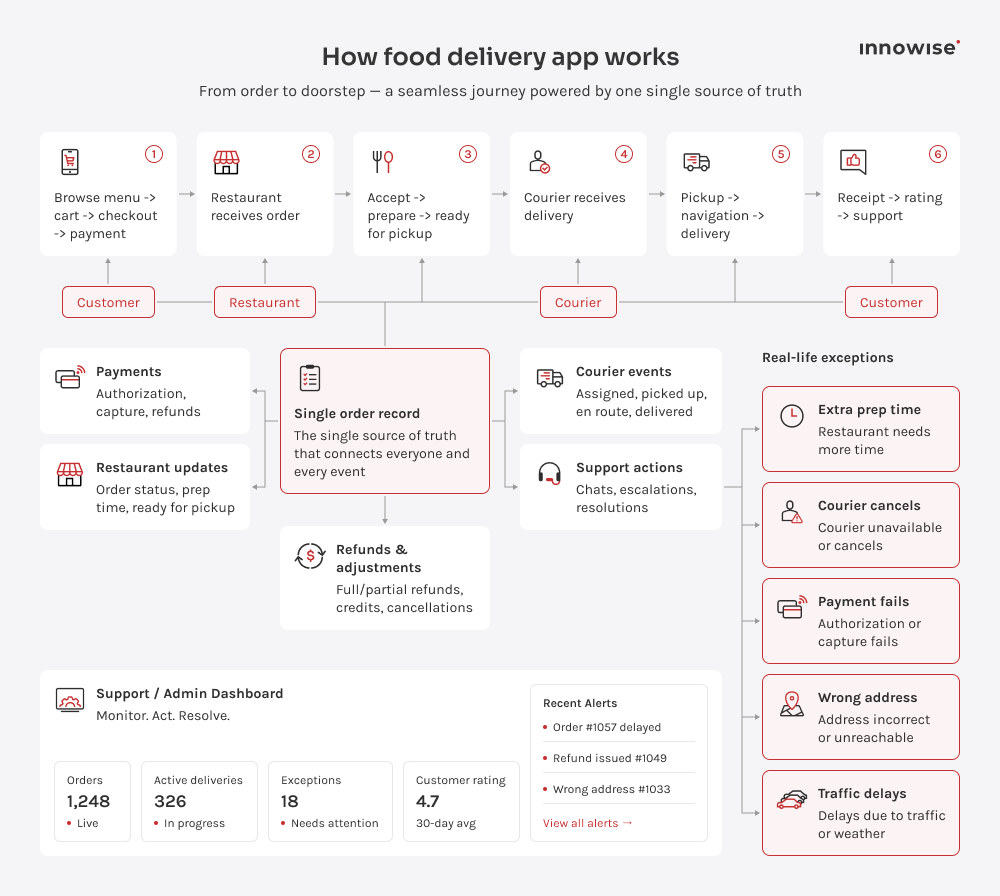
Of course, there is a lot more happening once they hit Order: the restaurant has to accept and prepare it, the platform needs to find a courier, the courier has to get to the restaurant, pick everything up, and make it to the right address. And throughout all of that, the customer expects to know exactly what is going on.

A typical flow looks like this:

Simple enough on paper. In real life, not so much. A restaurant may need another ten minutes, a courier may cancel (happens way too often), a payment may fail, a customer may enter the wrong address, and traffic may suddenly make the original ETA unrealistic.

A good platform has to handle those situations without confusing the customer or forcing the support team to untangle every problem manually.

That is why the order itself should sit at the center of the system. Payments, restaurant updates, courier events, refunds, and support actions should all connect back to one clear order record.

Food delivery app types and business models

There is no single food delivery model that works for every business.

The right one depends on who owns the customer relationship, who handles delivery, and whether the platform works with one restaurant or many.

Type of appDescriptionKey featuresExamples
Restaurant-owned appA restaurant or chain sells directly to its customersMenu, ordering, loyalty, payments, pickup or deliveryDomino's, Pizza Hut
Order aggregatorCustomers order from several restaurants listed in one placeSearch, menus, checkout, ratings, merchant toolsRegional restaurant marketplaces
Order-and-delivery platformThe platform handles both ordering and courier deliveryMulti-merchant catalog, dispatch, tracking, fees, supportUber Eats, DoorDash, Deliveroo
Dedicated delivery appA service focuses mainly on last-mile deliveryCourier assignment, route planning, proof of delivery, merchant integrationsLocal courier networks

The differences matter because they shape almost everything else.

A restaurant-owned app gives the brand more control over customer relationships, loyalty, and data. But the restaurant also has to attract users and manage more of the delivery operation itself.

A marketplace can bring many restaurants into one product, but then it has to solve merchant onboarding, quality control, customer acquisition, and supply-demand balance.

A full delivery platform has more ways to earn revenue, but it also has the hardest operational problem.

For a new business, starting narrow is often the smarter choice. You might focus on office lunches, independent restaurants, university campuses, a specific cuisine, or one geographic area instead of trying to compete with every major delivery platform at once.

Planning a delivery app?

Get practical input on features, integrations, and delivery setup.

Features of a food delivery app

Before you start thinking about AI recommendations, voice ordering, or any other shiny extra, make sure the basics work really well.

Must-have features

User groupFeatureWhy it matters
CustomerRegistration and profileSaves addresses, preferences, payments, and order history
CustomerRestaurant and menu browsingHelps users quickly understand what is available
CustomerSearch and filtersMakes it easier to find relevant restaurants and dishes
CustomerCart and checkoutHandles items, modifiers, fees, taxes, tips, and promo codes
CustomerPaymentsSupports cards, wallets, refunds, and local payment options
CustomerReal-time trackingShows preparation, courier location, and estimated delivery time
CustomerNotificationsKeeps people updated without making them constantly reopen the app
CustomerRatings and supportGives customers a clear way to report issues
RestaurantMenu managementControls products, prices, modifiers, stock, and opening hours
RestaurantOrder managementLets staff accept, reject, prepare, and complete orders
CourierDelivery tasksShows pickups, drop-offs, and active jobs
CourierNavigationHelps couriers reach restaurants and customers efficiently
AdminUser and merchant managementSupports verification, access control, and issue resolution
AdminReportingTracks orders, cancellations, delivery times, refunds, and revenue

By the way, menu design deserves more attention than it often gets.

Customers usually do not want to study a menu for fifteen minutes. They want to make a decision quickly. That means categories should be clear, photos useful, modifiers easy to understand, and unavailable items hidden or clearly marked.

Tracking should be equally straightforward. “Your order is on the way” sounds reassuring the first time. Less so when it has been “on the way” for an hour. So show the current stage, update the ETA when something changes, and make support easy to reach when needed.

Future-ready features

Once the core experience works well, you can start adding features that make the service smarter or more efficient.

The important part is to add them for a reason. Adding AI because everyone else is doing it? That’s not strategy.

FeatureWhat it can doWhen it makes sense
AI recommendationsSuggest relevant restaurants and dishesWhen customers struggle with large catalogs
AI chat supportHandle simple questions and route support requestsWhen support volume becomes difficult to manage
Voice orderingLet customers search or reorder by voiceWhen accessibility or hands-free use matters
Smarter routingCompare courier location, traffic, and pickup readinessWhen travel time is hurting delivery economics
Demand forecastingEstimate orders by area, time, weather, or eventWhen courier supply or restaurant capacity often misses demand
Fraud detectionFlag suspicious payment, account, or refund activityWhen transaction volume becomes too high for manual review

For example, AI can be especially useful for discovery and support. Maybe instead of making a user search through dozens of restaurants, the app could suggest meals based on previous orders, dietary preferences, time of day, or current location.

But high-impact decisions still need careful control. Let AI suggest dinner? Sure. Let it deny a refund or flag someone for fraud without a clear reason? That’s a different story.

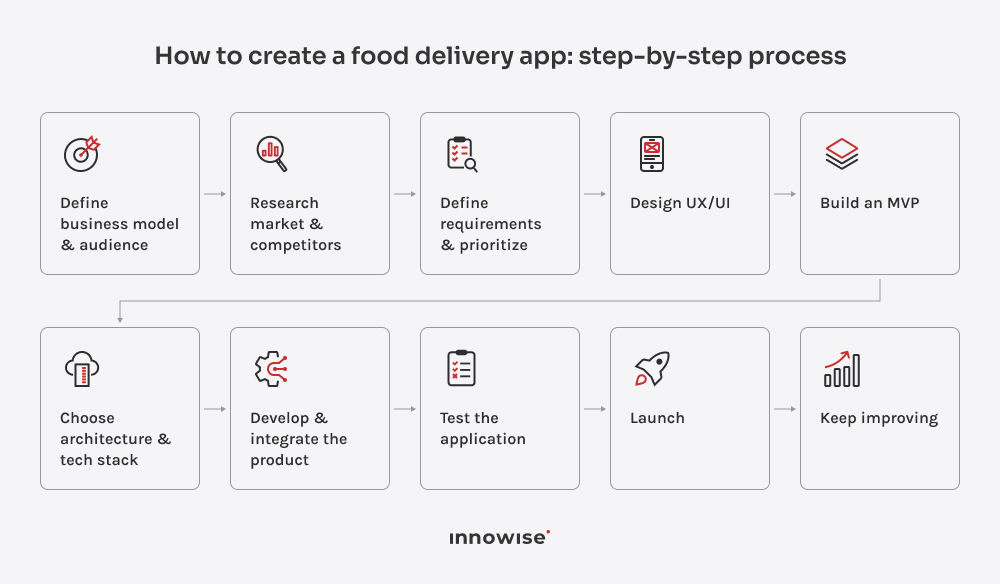
How to create a food delivery app: step-by-step process

A successful app usually starts long before the first screen is coded. That’s not a secret, I guess.

Define the business model and target audience

Start with the basics: who is the app for, who pays, who delivers the order, who supplies the food, and why would someone choose this service instead of an existing one?

A restaurant chain may want more repeat orders and stronger loyalty. A marketplace needs enough restaurants and couriers in the same area to make the model work. A corporate meal platform may care more about scheduled orders, budgets, shared carts, and invoices.

Same industry but very different apps.

Research the market and competitors

Uber Eats and DoorDash are useful references. They should not be your entire research plan.

Look at the market you want to enter: which restaurants are popular, what fees customers are willing to pay, which payment methods they expect and where the existing services are frustrating people. 

And look beyond features.

One neighborhood may be badly covered, or independent restaurants may hate the current commission model. Maybe group ordering is a pain, or existing apps simply do a poor job with the type of delivery you want to offer.

That gap is quite often more valuable than another clever feature.

Define requirements and prioritize features

Once you understand the market, make up a clear list of product requirements.

A useful way to prioritize is:

Must have now: features required to complete a real order.

Needed soon: features that support growth after launch.

Can wait: experiments and advanced ideas.

This helps prevent the first version from becoming an unnecessarily large feature buffet.

It also keeps the team focused on complete user journeys rather than isolated features.

Design the UX/UI

People usually open a food delivery app hungry, busy, or both. Do not make them think harder than necessary.

A customer should always know:

  • What can I order?
  • What will I pay?
  • What happens next?

The same rule applies to restaurant staff and couriers.

A restaurant manager during the dinner rush and a courier outside in the rain are not using your app the same way. Their screens should not feel the same either. Keep the most important actions obvious, cut unnecessary steps, and design around the situation people are in. 

See Innowise’s mobile app design services for more on this stage.

Build an MVP

An MVP should be small enough to launch quickly but complete enough to test the real business model.

That might mean launching in one city, working with a limited group of restaurants, or keeping the delivery model simple. What you should not cut are the basics that protect the experience: reliable payments, clear order statuses, security, and support.

If speed is the priority, you can even use vibe coding to prototype some of the product faster. Just remember that faster does not always mean safer: AI-generated code can hide security gaps, weak logic, or technical debt. We covered those risks in our guide to vibe coding security.

Or you can play it safer and build the first release with an experienced team. Innowise’s MVP development services can help get to market with fewer technical surprises.

Need a team?

Get the mobile, backend, QA, cloud, and AI skills you need.

Choose the architecture and technology stack

Do not build for ten million users before you have ten thousand. 

But do not box yourself in either. 

Your architecture should match the problem you are solving today while leaving room for tomorrow.

A small MVP does not automatically need dozens of microservices. It does need clear boundaries between important areas such as orders, payments, dispatch, notifications, restaurant data, and customer accounts.

Think about where pressure is most likely to appear. Will thousands of couriers be sending location updates? Will menus change constantly? Will the platform work across several countries with different payment providers and tax rules?

The answers should shape your technical design.

For architecture and planning support, see Innowise’s IT consulting services.

Develop and connect the product

Now you need to connect the customer app, restaurant side, courier app, payments, maps, notifications, POS systems, and probably a few other tools on top of that. They all need to exchange the right data at the right time. 

And yes, some of those integrations will misbehave: payments time out, maps get addresses wrong, restaurant systems send duplicate updates. Many, many things.

So build for that from the start. Use retries, logs, duplicate protection, and fallback rules. If you need help with the mobile side of the product, see Innowise’s mobile app development services.

Test the application

Testing should cover the full order flow, including the points where it can break.

That means checking cases such as courier cancellation after preparation has started, payment confirmation delays, address changes during delivery, missing GPS updates, duplicate requests, and failed third-party responses.

Security testing should cover authentication, permissions, APIs, payments, account recovery, admin access, and personal data.

That is where thorough software testing services can save you from finding expensive problems after launch.

Launch and keep improving

A launch is the beginning of the learning process, not the end of development. So be ready. 

Start with a controlled market and watch what happens.

Look at conversion, restaurant acceptance rates, preparation time, courier waiting time, delivery duration, cancellations, payment failures, refunds, support contacts, and repeat orders.

Then ask a simple question: where are customers, restaurants, or couriers struggling most?

Fix that first. The next big feature can wait.

Choosing the right technology stack

There is no single “best” food delivery technology stack. The right stack is the one your team can build, maintain, and scale confidently.

CategoryTechnologies
MobileSwift, Kotlin, Flutter, React Native
FrontendReact, Angular, Vue.js
BackendJava, .NET, Python, Node.js
DatabasesPostgreSQL, MySQL, MongoDB, Redis
CloudAWS, Microsoft Azure, Google Cloud
DevOpsDocker, Kubernetes, Terraform

For mobile, the first decision is usually native vs cross-platform

Native iOS and Android development makes sense when you need deep access to platform features or very specific device behavior.

Flutter or React Native can be a good choice when the iOS and Android experiences are similar and you want to reduce duplicated work.

For the backend, start simple.

A well-structured application with clear modules, a relational database, caching, queues, and external services can be enough for an early-stage platform.

Split services apart when there is a real reason, such as traffic, deployment independence, or several teams working on different areas.

Real-time courier tracking needs particular care because location updates can create a large amount of traffic.

The system should receive enough information to give customers useful updates without flooding the backend with unnecessary GPS events.

How much does it cost to develop a food delivery app?

A narrow first version may cost around $30,000–$60,000.

A more complete platform often falls somewhere between $60,000 and $150,000.

A large product with advanced dispatch, several apps, many external systems, AI features, and multi-region support can cost $150,000–$300,000 or more.

These are planning ranges, not fixed prices.

Development scopeEstimated costTypical scope
Lean MVP$30,000–$60,000Ordering, basic merchant tools, admin panel, payments, notifications
Growth-stage product$60,000–$150,000Customer, merchant, courier, admin apps, live tracking, integrations, reporting
Large platform$150,000–$300,000+Complex dispatch, several regions, AI, advanced analytics, deeper integrations

The final number depends heavily on what the system needs to do.

A seemingly simple app becomes more expensive when you add real-time courier tracking, several payment methods, split payments, custom restaurant onboarding, tax rules, refunds, promotions, fraud checks, or multi-country support.

Post-launch costs matter too.

You will still need cloud infrastructure, maps, notifications, monitoring, updates, security work, bug fixes, support tools, and new development.

For a broader breakdown, see our guide to mobile development cost.

Delivery app monetization strategies

Now for the part every business owner eventually gets to: where does the money come from?

Usually, from a mix of places. A platform might take a commission from restaurants, charge customers for delivery, offer subscriptions, sell sponsored spots, or package services for corporate clients.

Revenue modelHow it worksBest fit
Merchant commissionThe platform keeps part of each orderMulti-restaurant marketplaces
Delivery feeCustomers pay for deliveryCourier-based platforms
Service feeCustomers pay an additional platform feeLarge marketplaces
Customer subscriptionUsers pay monthly or annually for lower fees or perksFrequent users
Merchant subscriptionRestaurants pay for software or ordering toolsRestaurant technology platforms
Sponsored placementRestaurants pay for better visibilityLarge marketplaces
Transaction feeThe platform charges for payment or ordering infrastructureDirect-order platforms
Corporate plansCompanies pay for employee meal programs and reportingB2B services

The table shows you the options. You need to figure out which mix makes sense for your market.

Also remember that monetization should be tested, not guessed. Look at basket size, delivery distance, repeat order rate, merchant margins, and fulfillment cost together. That will tell you much more than copying the fee structure of a bigger app.

I also would like to add that choosing the revenue streams is only half the job. You also need to know what is left after delivery costs, payment fees, discounts, refunds, and support. Two orders with the same basket value can have very different economics depending on distance, courier time, and how much intervention they need.

In food delivery, the order with the highest fee is not necessarily the one making you the most money. A short delivery that arrives on time, needs no support, and brings the customer back can be far more valuable. That’s why I’d look at contribution margin by area, order type, and customer segment — not just revenue per order.
Yuliya Pantsiuk, Head of Business Analysis.
Yuliya Pantsiuk
Head of Business Analysis

Common delivery app development challenges and how to solve them

Food delivery has plenty of small failure points. They are everyday operational issues that become expensive when they happen thousands of times.

ChallengePractical solution
Inaccurate ETAEstimate restaurant preparation and courier travel separately, then update both as conditions change
Too few couriersManage delivery zones, incentives, scheduling, and order volume during peaks
Restaurant delaysLet restaurants update preparation time and compare estimates with historical data
Payment problemsUse clear payment states, duplicate protection, webhooks, and safe retries
GPS gapsAllow short offline periods and avoid pretending location data is perfectly precise
High support volumeGive support teams a complete order timeline and quick tools for common problems
Fraud and promo abuseCheck suspicious account, payment, device, and refund patterns
Regional expansionKeep payment, tax, language, and delivery rules configurable
Peak-hour instabilityLoad-test ordering, dispatch, tracking, and notifications before launch

Support is one area I would not leave until later. When a customer says, “My order never arrived,” your team should not have to jump between five systems to figure out what happened. They should be able to open the order and see the timeline: payment, restaurant status, courier assignment, location updates, refunds, everything. That saves time. It also makes it much easier to spot the same problem happening again and again.

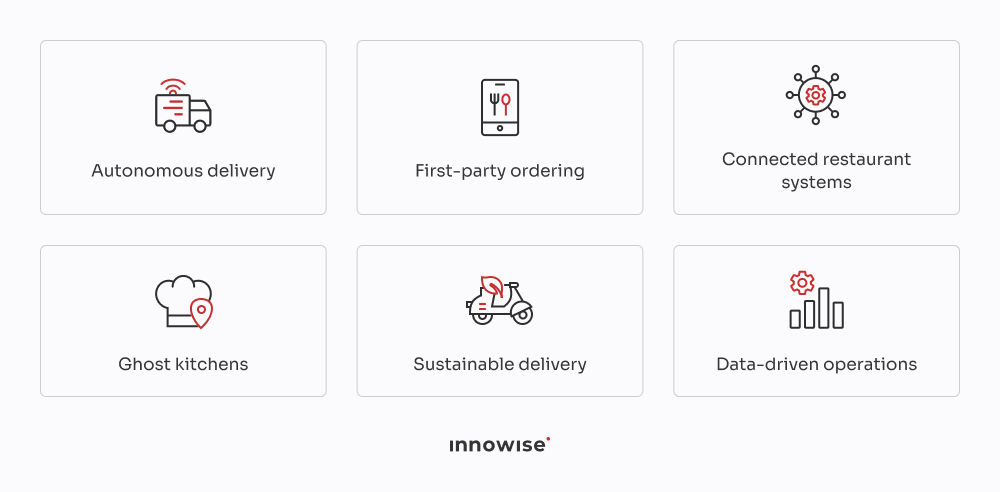
Emerging technologies and development trends

Some very interesting changes in food delivery are happening beyond the app itself. The bigger question now is how orders are fulfilled, where they come from, and how much of the customer relationship a restaurant wants to own.

Delivery is becoming multimodal

A courier on a bike or in a car is no longer the only option on the table.

DoorDash launched DoorDash Air in July 2026 after receiving FAA Part 135 certification, and Uber announced a partnership with Zipline in August 2026 to bring drone delivery to Uber Eats in the US.

That does not mean every pizza is about to arrive by drone. Apartment buildings, large orders, weather, regulation, and plenty of other practical issues still favor human couriers.

What is changing is the model. One platform may eventually decide whether an order is best handled by a courier, robot, or drone depending on distance, cost, and location. DoorDash is already building around that idea with its Autonomous Delivery Platform.

For businesses building today, that is worth keeping in mind. Delivery logic may need to support more than one fulfillment method later.

Restaurants want more control over direct orders

Third-party marketplaces are great at bringing demand. They also sit between the restaurant and the customer.

That is why direct ordering is still getting attention. Restaurants want their own web and mobile channels for loyalty, customer data, promotions, and repeat business.

There is a catch, though: customers will not switch channels simply because the restaurant would prefer them to. Research reported by Restaurant Business found almost no difference in satisfaction: 88% when ordering directly from the restaurant versus 90% through third-party apps.

So an owned app needs to give people a reason to use it: better loyalty perks, easier reordering, exclusive offers, or simply a smoother experience.

Restaurant systems are getting more connected

The POS is no longer just the thing that prints a receipt.

Restaurants increasingly want orders, payments, reservations, customer data, loyalty, and delivery information to talk to each other. In August 2026, for example, Square expanded its OpenTable integration while Toast did the same with Resy, bringing more customer and transaction information into the restaurant’s core systems.

For a delivery app, this matters a lot. The less staff have to re-enter menus, prices, orders, or customer information by hand, the better.

It also means integrations are becoming part of the product strategy, not something you bolt on later.

Delivery is getting greener

Customers are also paying more attention to packaging, waste, sourcing, and delivery methods.

An app can support that with reusable packaging options, grouped deliveries, restaurant sustainability information, or lower-emission delivery choices where available.

DoorDash, for example, says it is working on lower-emission transport, more efficient routing and order batching, and reusable, recyclable, or compostable packaging. Uber Eats has also run reusable-packaging programs in several countries. 

The important thing is to make these choices practical, not just promotional.

Build your own food delivery app with Innowise

Food delivery products usually bring a lot together at once: mobile apps, backend logic, payments, maps, restaurant systems, cloud, QA, and sometimes AI.

Innowise has worked across that full stack, including a food delivery solution for a European restaurant chain with iOS and Android apps, loyalty, live order tracking, multiple payment options, chat, and AI-based recommendations.

Our client reviews can prove that this approach works well in practice — especially when projects need strong communication, flexibility, and technical depth. And our awards and recognition say quite a lot about the quality of that work too.

Depending on where you are now, that can mean an MVP team, help with integrations, or extra cloud, QA, and AI expertise.

Not sure where to start?

Let’s review your idea, scope, and technical options first.

Conclusion

At the end of the day, nobody opens a food delivery app because they are excited about logistics.

They are hungry.

Your job is to make everything between “I want this” and “it’s at my door” feel easy. If the tech does its job, nobody notices it. And that is a pretty good sign you built it well.

FAQ

Start with the core system rather than trying to copy every Uber Eats feature.

You need customer ordering, restaurant order management, courier delivery flows, payments, tracking, and admin tools. Launch them in a limited market first, then add subscriptions, advanced dispatch, AI, multi-region support, and other features as the business grows.
A smaller MVP may take around three to six months.

A larger platform can take six to twelve months or longer depending on the number of apps, integrations, delivery rules, and markets involved.

A simple first version may start around $30,000–$60,000.

A more complete product may cost $60,000–$150,000, while a large multi-module platform can reach $150,000–$300,000 or more.

The only useful final estimate is one based on a defined scope.

Start by finding the part of the system actually under pressure.

It might be checkout, courier location traffic, dispatch, restaurant menus, notifications, or reporting.

Then optimize that area instead of redesigning the whole platform too early.

AI is being used for recommendations, search, customer support, fraud detection, demand forecasting, ETA improvement, and merchant tools.

The strongest use cases are usually the ones that save time or make decisions easier without taking too much control away from the user.

Most products need payment services, maps and geocoding, push notifications, analytics, identity tools, and often SMS or email.

Restaurant-focused products may also need POS or ERP integrations.

Courier apps usually need routing, background location, and proof-of-delivery functionality.

Use strong authentication, role-based access, encryption, secure payment providers, audit logs, rate limiting, dependency checks, fraud controls, and regular security testing.

Admin access should be especially tightly controlled because it can expose customer, merchant, payment, and order information.

Look for a team that understands the whole delivery process, not just mobile app screens.

Ask how they would handle restaurant delays, failed payments, courier cancellations, duplicate orders, GPS gaps, refunds, peak traffic, and support tools.

A strong development partner should be able to explain those situations clearly before engineering begins.

Show all

Table of contents

    Contact us

    Book a call or fill out the form below and we’ll get back to you once we’ve processed your request.

    Send us a voice message
    Attach documents
    Upload file

    You can attach 1 file up to 2MB. Valid file formats: pdf, jpg, jpeg, png.

    By clicking Send, you consent to Innowise processing your personal data per our Privacy Policy to provide you with relevant information. By submitting your phone number, you agree that we may contact you via voice calls, SMS, and messaging apps. Calling, message, and data rates may apply.

    You can also send us your request
    to contact@innowise.com
    What happens next?
    1

    Once we’ve received and processed your request, we’ll get back to you to detail your project needs and sign an NDA to ensure confidentiality.

    2

    After examining your wants, needs, and expectations, our team will devise a project proposal with the scope of work, team size, time, and cost estimates.

    3

    We’ll arrange a meeting with you to discuss the offer and nail down the details.

    4

    Finally, we’ll sign a contract and start working on your project right away.

    More services we cover

    arrow