Your message has been sent.
We’ll process your request and contact you back as soon as possible.
The form has been successfully submitted.
Please find further information in your mailbox.

Select language


Let’s start with an honest observation. The decision between custom software and a ready-made product often feels daunting, as both sides have strong advocates, and both can drain your budget if you get it wrong. There are plenty of reasons why.
Maybe you feel that you’ve outgrown “the box” but not yet grown into a full-fledged custom development under the lens of team and budget? Or do you have doubts about formalizing requirements, as your unique processes exist only in the minds of employees? Or maybe, you operate in a compliance-heavy sector and need to evaluate risks with particular vigilance?
In this article, I give an unbiased snapshot of both software strategies and help ask the right questions about your workflows, your constraints, and the future outlook, so you can choose a solution that fits.
Bespoke, or custom software, is what it sounds like: a software, custom-built from the ground up for a particular business’s specific problems. Unlike packaged software, which forces you to adapt your processes to someone else’s assumptions, bespoke development starts with your workflows, your data, your users, and your operational constraints. The resulting product fits perfectly, as it was made for your company.
Developers create custom source code, data schema, API contracts, and infrastructure configuration to meet your organization’s requirements, which enables significant flexibility and growth potential. In custom-built systems, the entire codebase is an extension point while off-the-shelf products expose a fixed set of configuration parameters.
In practical terms: you control the stack, the deployment pipeline, the authentication provider, and every error message a user might see, and assume responsibility for maintaining it.
Despite the “versus” sign above, off-the-shelf and custom options aren’t absolute competitors, as the right choice depends on context. You may plan for a decade-long expansion in which customization becomes critical, or this can be fully irrelevant for you. Let’s walk through:
We’ll help you map the build-versus-buy decision before writing a line of code
Going bespoke, you end up developing the most impactful elements for your business. Here’s what you get:
The first thing that makes companies hesitate about custom-built software is money: developer rates, if you’re doing outstaffing, or the total project cost if you’re outsourcing. The good news is that good software partners will calculate detailed costs upfront. That said, the payback period is longer, as you’re not up and running in a few days, as you would be with an off-the-shelf solution
Then there’s maintenance. Finding security vulnerabilities, smoothing out UX rough edges, chasing down features that could be better — that’s on you now, including the budget for it. But is that actually a burden? Well, it depends on how you look at it. On the flip side, you can spot and fix faults in less time, and make improvements you actually need.
One real risk that appears at the business analysis stage is over-engineering. The threat here lies in building sophisticated solutions for a problem that a spreadsheet could solve. That’s where discovery comes in. At Innowise, we spend time upfront separating must-haves from nice-to-haves and never offer features you don’t need.
With custom software, it’s often not possible to define every detail at the start with complete certainty. That’s why we use Agile methodology with a heavy focus on the discovery phase, so requirements can change along the way without everything falling apart. The result is solid from every angle, and you walk away happy with it.

Digging into your systems and workflows to understand how the software should fit into them.

Talking, usually a lot, with managers and with the people who'll use the system every day.

Sketching, prototyping, and making sure the logic holds up before writing serious code.

Building the solution iteratively so you see the progress regularly and adjust when needed.

Testing the system in different scenarios to catch issues early, then comes fixing.

Putting the system into your hands with support, documents, and a plan for what comes next.
Keeping the system healthy and up to date through timely fixes and targeted improvements.

Digging into your systems and workflows to understand how the software should fit into them.

Talking, usually a lot, with managers and with the people who'll use the system every day.

Sketching, prototyping, and making sure the logic holds up before writing serious code.

Building the solution iteratively so you see the progress regularly and adjust when needed.

Testing the system in different scenarios to catch issues early, then comes fixing.

Putting the system into your hands with support, documents, and a plan for what comes next.

Keeping the system healthy and up to date through timely fixes and targeted improvements.
Over 19+ years, Innowise has delivered more than 1,600+ projects, many of them custom builds from scratch. Sharing cases below.
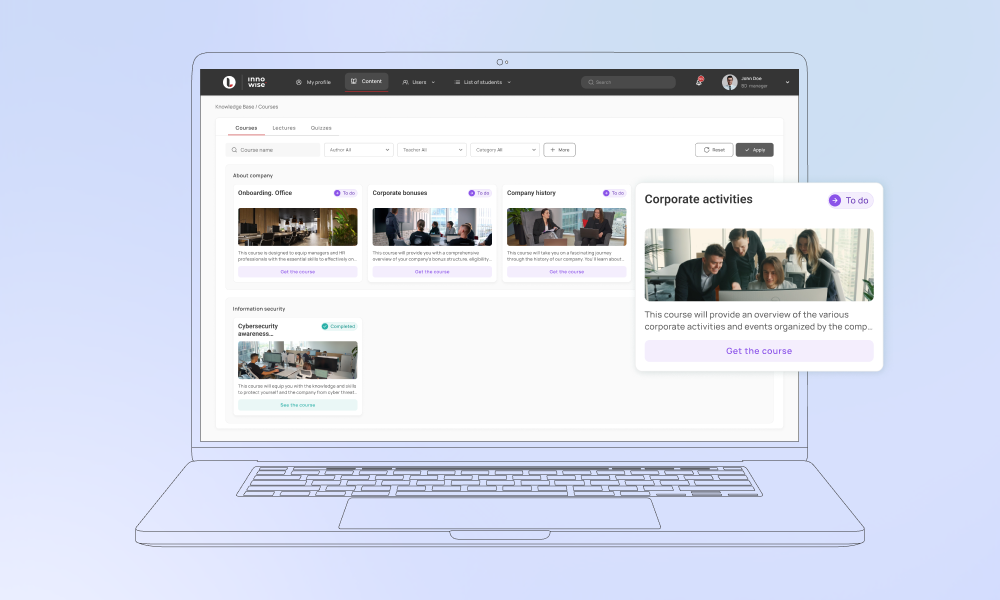
As a global company with 3,500+ employees (and growing), we needed a learning platform that fit their workflows and roles.
An off-the-shelf LMS meant forcing Innowise’s distinctive culture, years in the making, into a rough template. So we built one from scratch, delivering the following core capabilities:
As a result, new hires get up to speed 40 percent faster, while training costs have dropped 30 percent thanks to automation and centralized management. The platform now hosts hundreds of courses, certifications, and internal knowledge resources, and this is far from the limit.

In regulated industries, off-the-shelf systems often struggle to support specific compliance requirements. And if your data is scattered across different sources that have to be pulled together manually, that’s just painful.
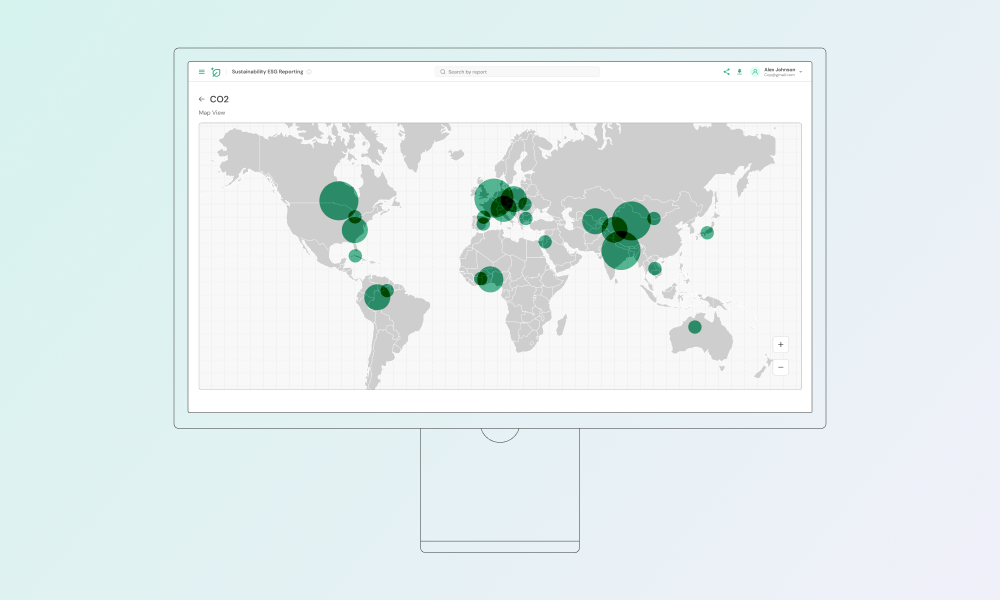
A cement manufacturer needed to automatically collect environmental data across their production process to cut CO₂, meet LCA and EPD standards, and cut out expensive external certification procedures.
A multi-module software was built to cover specific data collection and certification processes:
The fully custom process is simple: users select the factory, material, and production year, and the app manages the rest. As a result, certification costs were slashed, CO₂ emissions were reduced, and the entire cement line now meets international LCA and EPD standards.

Launching a new product, service, or business? Building visibility for it starts with a website, often using a hybrid approach: custom development + an off-the-shelf CMS.
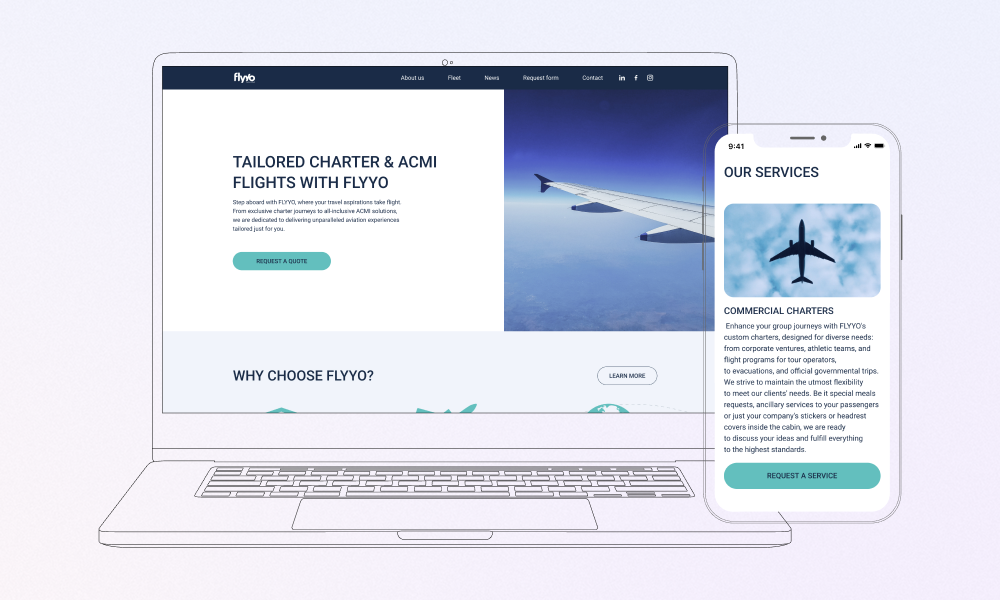
Take FLYYO. They started with almost no online footprint. We helped them go from a “coming soon” page to build early interest to a stable, multi-page site with passenger-facing tools and basic infrastructure monitoring. And here’s where custom really shines: you grow in stages, at whatever pace makes sense for your business strategy.
The following were built: the home page, company history, aircraft fleet info pages, request forms, contact forms, passenger claims, news listing, and detailed news page. FLYYO benefited from custom responsive layouts and visual elements to stand out. Most websites run on some off-the-shelf CMS — in this case, we used flexible and user-friendly Craft CMS. Your development team will always suggest the best option for your goals.
The final site turned out user-friendly, fast, and distinctive. And it’s ready for future expansion, which is not a problem when you go custom.

Every situation needs an individual assessment. But generally speaking, bespoke makes sense when at least two of these conditions are true:
Costs vary depending on where you decide to develop your custom software. For instance, nearshoring to Poland offers pretty flexible and comfortable rates: €45–60 per hour for a solid senior developer. That’s 30–40 percent below the EU average. With that in mind, here’s a rough estimate of what development costs look like for various solution types:
A lot depends on the partner you pick: quality, cost, and delivery timelines at least. Here’s a quick rundown of how we suggest you choose.
Look for partners with demonstrated experience in your industry or in solving problems like yours — study the portfolio. A partner who has never touched logistics software will learn on your dime, whereas one who has built three warehouse management systems will anticipate problems before you articulate them.
Has the partner worked with relevant technologies, for example, your backend stack, cloud platform, or AI components? Have they tackled technical challenges similar to yours and what results did they get? Don’t hesitate to dig in and ask detailed questions. Better to figure out what they’re capable of ahead of development than to waste time later while they learn the tools.
This is almost as important as technical expertise. In the early stages, pay close attention to: do they ask relevant questions? Do they push back when requirements are vague? Do they explain how they’ll show progress — weekly demos or just “we’ll let you know when it’s ready”? Do they treat your business problem like it’s theirs, or do they sound like order-takers?
A short list of must-ask questions to avoid ending up with a half-finished or poorly matched solution after spending your budget:
Bespoke software isn’t the answer to every problem. For generic needs, off-the-shelf works fine and costs less at the beginning. But when your processes are unique, your constraints are unusual, or your future growth is hindered by tools that don’t fit your workflows, custom development starts being a competitive necessity.
The companies that get this right don’t develop software because they “want their own” or because someone else has it. They build it because the math works, the alternatives are worse, and the gap between what they need and what’s available has become too expensive to ignore.
If you’re staring at that gap right now, you already know which side of the decision you’re on. Contact Innowise for a full-fledged assessment and custom software development that fits.

Chief Technology Officer
Dmitry leads the tech strategy behind custom solutions that actually work for clients — now and as they grow. He bridges big-picture vision with hands-on execution, making sure every build is smart, scalable, and aligned with the business.


Your message has been sent.
We’ll process your request and contact you back as soon as possible.