Die beste Kernbankensoftware im Jahr 2026: Umfassender Test und Vergleich

25. Juni 2026 15 Minuten Lesezeit
Artikel mit KI zusammenfassen

Wichtige Erkenntnisse

  • „Das Beste“ bedeutet nicht unbedingt „das Größte“. Das richtige Kernbankensystem ist dasjenige, das zu Ihren Produkten, Märkten, Ihrem Team und Ihrem Einführungsplan passt.
  • Trennen Sie die Wahl der Plattform nicht von der Umsetzungsplanung. Ein starker Partner hilft dabei, die Entscheidung anhand realer Bankabläufe zu prüfen, bevor das Projekt zu kostspielig wird.
  • Manche Banken legen Wert auf Tiefe, andere auf Geschwindigkeit. Temenos und FLEXCUBE eignen sich für komplexe Unternehmensbankgeschäfte, während Mambu und Thought Machine besser zu schnelleren digitalen Produktmodellen passen.
  • Unter 2026, … hat das Instant-Banking die Messlatte höher gelegt. Kernsysteme müssen Echtzeit-Zahlungen, API-Anbindungen und schnellere Produktaktualisierungen unterstützen.

Die führende Kernbankensoftware in 2026 hat sich als größere Herausforderung erwiesen, als viele Banken erwartet hatten. Ein Kernsystem kann jahrelang “gut genug” erscheinen. Doch dann kommt der Druck auf einmal: Echtzeit-Zahlungen, Open-Banking-APIs, neue Compliance-Vorschriften und Kunden, die erwarten, dass jede Bankdienstleistung sofort funktioniert. Plötzlich ist das alte Kernsystem nicht mehr “nur alt”, sondern bremst Ihr Geschäft aus. 

Und genau hier wird die Entscheidung zwischen den führenden Anbietern von Kernbankensystemen zu einer schwierigen Angelegenheit. 

Die meisten Plattformen versprechen eine schnellere Inbetriebnahme, einfachere Integrationen und niedrigere Betriebskosten. Doch Banken lassen sich nicht von Versprechungen überzeugen. Sie erben Implementierungsaufwand, Risiken bei der Datenmigration, Lücken in der Berichterstattung und langfristige Lieferantenverträge. Wählen Sie das falsche System, und Ihr Team wird möglicherweise die nächsten Jahre damit verbringen, das Kernsystem zu umgehen, anstatt darauf aufzubauen.

In diesem Leitfaden werde ich die führenden Anbieter von Kernbankensystemen in 2026, Erläutern Sie, wo sich die einzelnen Systeme am besten eignen, und zeigen Sie auf, was Sie prüfen sollten, bevor Sie eine langfristige Entscheidung für eine Plattform treffen. Wenn Sie in diesem Jahr Kernbankensoftware evaluieren, sollte Ihnen dieser Vergleich dabei helfen, die Werbeversprechen der Anbieter vom tatsächlichen betrieblichen Nutzen zu unterscheiden.

Die führenden Kernbankensysteme: Plattformen, die moderne Banken antreiben

Bevor wir mit dem Vergleich der Anbieter beginnen, gib mir bitte einen Moment Zeit, um die Ausgangsbasis festzulegen.

Ein Kernbankensystem ist der operative Motor einer Bank. Es verwaltet Konten, Transaktionen, Zahlungen, Kredite, Einlagen, Kundendaten, das Berichtswesen und die Hauptbuchführung. Jedes Mal, wenn ein Kunde Geld überweist, seinen Kontostand abfragt, einen Kredit zurückzahlt oder eine Zahlungsbenachrichtigung erhält, ist die Kernplattform an irgendeiner Stelle dieses Prozesses beteiligt. 

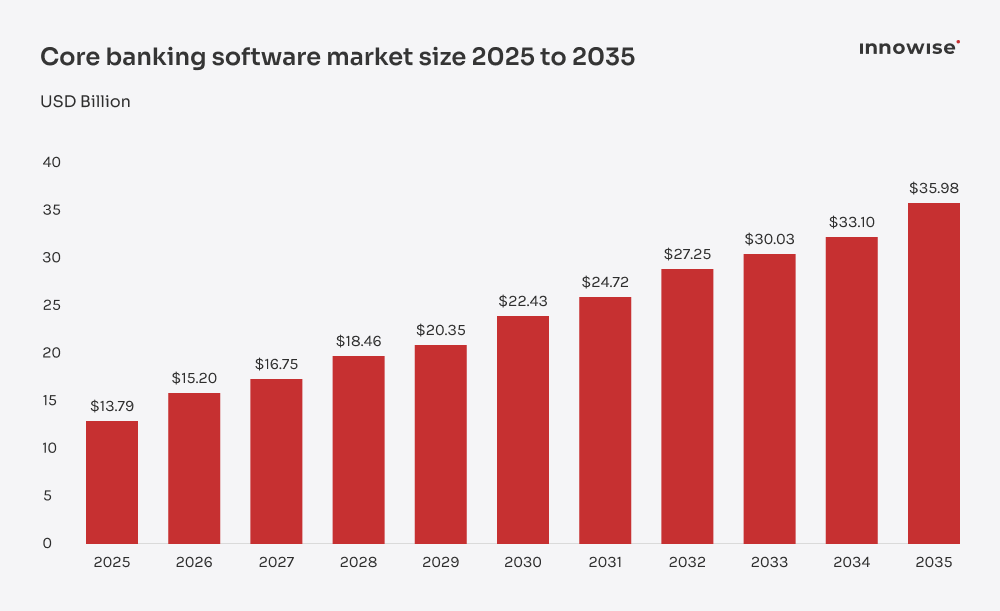
Der weltweite Markt für Kernbankensoftware wurde auf $13,79B im Jahr 2025 und wird voraussichtlich von $15.20B im Jahr 2026 bis fast $36B bis 2035, mit einer durchschnittlichen jährlichen Wachstumsrate (CAGR) von 10.07%. Das Wachstum wird durch steigende Investitionen im Fintech-Bereich, eine zunehmende Nachfrage nach digitalen Bankdienstleistungen und den wachsenden Druck auf die Banken vorangetrieben, das Kundenerlebnis zu modernisieren, ohne dabei zusätzliche Kosten und Komplexität zu verursachen. 

Nun die naheliegende Frage: Warum nicht einen Kern von Grund auf neu entwickeln?

Für manche Banken mag das eine Option sein. Aber es ist selten die schnellste oder sicherste. Der Aufbau eines Kernsystems bedeutet, dass man die Verantwortung für das Ledger-Design, die Transaktionsregeln, die Prüfpfade, die Sicherheitskontrollen, die Produktkonfiguration, das Berichtswesen, die Integrationen, die Tests, die Upgrades und die jahrelange Wartung trägt. Es handelt sich um ein dauerhaftes Programm zum Aufbau einer Bankinfrastruktur. 

Eine Anbieterplattform bietet Ihnen eine fertige Grundlage: Kundenverwaltung, Buchhaltung, Transaktionsabwicklung, Produkteinrichtung, Berichtstools und Standard-Integrationsmöglichkeiten. Das reduziert das technische Risiko vom ersten Tag an erheblich.

Doch nun kommt der Punkt, den viele Teams unterschätzen: Die Plattform muss noch an die Bank angepasst werden. Es wird weder Ihre Altdaten bereinigen, noch Ihre alten Kreditprodukte abbilden, noch jeden Zahlungsanbieter anbinden, noch entscheiden, wie Genehmigungsabläufe über Filialen, Regionen und Geschäftsbereiche hinweg funktionieren sollen. Dieser Teil erfordert die Einbindung von Fachexperten (SMEs) und Lösungsarchitekten (SAs), die sowohl die Software als auch die dahinterstehende Geschäftslogik verstehen.

Unternehmen wie Innowise Banken bei dieser Ebene zu unterstützen: Kernbankensysteme anzupassen, fehlende Module zu entwickeln, Dienste von Drittanbietern anzubinden, Daten zu migrieren und dafür zu sorgen, dass die neue Konfiguration innerhalb des bestehenden Technologie-Stacks der Bank funktioniert.

Einfach ausgedrückt: Eine gute Kernbankplattform bildet das Fundament. Ein guter Implementierungspartner sorgt dafür, dass dieses Fundament auch tatsächlich das Geschäft unterstützt, das Sie aufbauen möchten.

Bar chart showing steady core banking software market growth from 2025 to 2035

Die 5 besten Kernbankensysteme in 2026 im Vergleich

Meine bevorzugten Anbieter von Kernbankensystemen für 2026 sind Temenos Transact (früher bekannt als T24), Mambu, Thought Machine Vault Core, Infosys Finacle und Oracle FLEXCUBE. Ich habe diese fünf ausgewählt, weil sie nicht alle dasselbe Problem lösen. Einige eignen sich besser für die Modernisierung großer Unternehmen, andere passen zu „Digital-First“-Banken, wieder andere sind sinnvoller für länderübergreifende Geschäftstätigkeiten, komplexes Firmenkundengeschäft oder Teams, die mehr Kontrolle über die Produktkonfiguration benötigen.

Die folgende Tabelle bietet Ihnen einen schnellen Überblick. Sie ersetzt zwar keine umfassende Plattformbewertung, hilft Ihnen aber dabei, zu erkennen, wo die einzelnen Systeme eingesetzt werden können, bevor wir uns mit der Architektur, der Serviceabdeckung, der Komplexität der Implementierung, den Integrationen und den besten Anwendungsszenarien befassen.

Kernbankplattform
Beste Passform
Die wichtigsten Stärken
Wesentliche Einschränkungen
Temenos Transact
Großbanken, Bankengruppen, komplexe Privatkunden- und Firmenkundengeschäfte
Umfassende Funktionalität, starke globale Präsenz, breite Produktpalette
Die Umsetzung und Anpassung kann aufwendig sein
Mambu
Neobanken, Fintech-Kreditgeber, digitale Banken, agil arbeitende Produktteams
Schnelle Produkteinrichtung, leistungsstarkes API-Modell, gut geeignet für das digitale Banking
Für komplexe Anforderungen im Firmenkundengeschäft sind möglicherweise zusätzliche Systeme erforderlich
Thought Machine Vault Core
Banken, die eine umfassende Modernisierung ihrer Kernsysteme oder neue digitale Bankmodelle planen
Hohe Produktflexibilität, Echtzeitverarbeitung, modernes Konstruktionsmodell
Erfordert kompetente technische Teams und eine sorgfältige Umsetzungsplanung
Infosys Finacle
Großbanken, Regionalbanken, länderübergreifende Finanzinstitute
Ausgereifte Bankfunktionalität, hervorragende Eignung für das internationale Bankgeschäft, umfassende Modulabdeckung
Erfordert bei komplexen Implementierungen unter Umständen einen erheblichen Konfigurationsaufwand
Oracle FLEXCUBE
Großkundenbanken, Firmenkundengeschäft, Banken, die bereits Oracle-Systeme einsetzen
Umfassende Unterstützung für komplexe Bankgeschäfte, Strukturen mit mehreren Rechtsträgern und Firmenkundengeschäft
Anpassung, Migration und Lizenzierung können anspruchsvoll sein

Erleichtern Sie die Planung und Durchführung Ihres Core-Banking-Upgrades

1. Temenos Transact

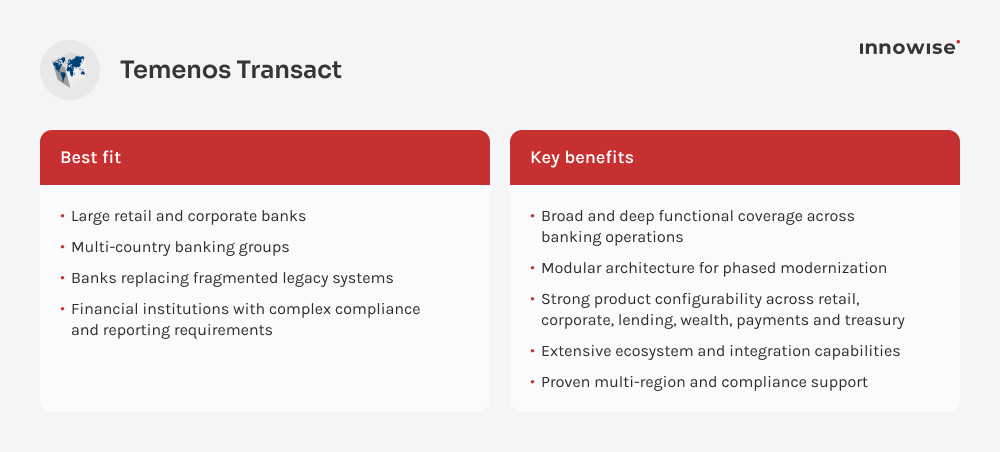
Fragt man Teams aus dem Firmenkundengeschäft, welche Kernbankplattform am häufigsten auf der Auswahlliste steht, rangiert Temenos Transact in der Regel ganz oben. Und dafür gibt es einen Grund: Nur wenige Plattformen decken in gleichem Umfang so viele Bankgeschäfte, Produkte und regionale Anforderungen ab.

Temenos Transact summary highlighting banking modernization, configuration, and compliance strengths

Kernarchitektur-Ansatz

Temenos hat in den letzten Jahren einen starken Kurswechsel hin zu einer modularen Bankarchitektur vollzogen. Banken können nun einzelne Komponenten einsetzen, anstatt alles auf einmal zu ersetzen, was bei schrittweisen Modernisierungsprojekten von großer Bedeutung ist.

Die Plattform unterstützt:

  • API-basierte Integrationen
  • Transaktionsverarbeitung in Echtzeit
  • Cloud-Installationen
  • Modulare Service-Schichten
  • Bankenstrukturen mit mehreren Rechtsträgern

In der Praxis gibt dies den Banken mehr Spielraum, die Modernisierung schrittweise durchzuführen, anstatt eine vollständige “Big-Bang”-Migration vorzunehmen. Allein dadurch lässt sich das operative Risiko erheblich reduzieren. Eine Stärke von Temenos ist die Produktvielfalt. Banken können Privatkunden- und Firmenkundengeschäft, Kreditvergabe, Zahlungsverkehr, Vermögensverwaltung und Treasury-Geschäfte innerhalb eines umfassenden Ökosystems abdecken, anstatt unzusammenhängende Tools miteinander zu verknüpfen.

Komplexität der Implementierung

Dies ist keine einfache Einführung. Temenos-Projekte können zu umfangreichen Transformationsprogrammen werden, die Datenmigration, die Neugestaltung der Integration, die Ermittlung der Compliance-Anforderungen, die Umstrukturierung von Arbeitsabläufen sowie interne Prozessänderungen in mehreren Abteilungen umfassen.

Und ehrlich gesagt: Genau hier unterschätzen manche Banken den Arbeitsaufwand. Die Plattform ist zwar flexibel, doch diese Flexibilität erhöht den Implementierungsaufwand. Banken benötigen oft erfahrene Architekturteams, Integrationsspezialisten und externe Implementierungspartner, um Verzögerungen bei der Einführung zu vermeiden.

Die gute Nachricht ist, dass Temenos über ein gut etabliertes Partner-Ökosystem verfügt, sodass Banken nicht gezwungen sind, alles intern selbst zu lösen. Innowise hat außerdem Banken und Fintech-Unternehmen bei der Implementierung von Temenos-basierten Lösungen unterstützt, So wissen wir, an welchen Stellen diese Projekte in der Regel kompliziert werden und wie wir mit dieser Komplexität umgehen müssen, bevor sie zu Verzögerungen, Nacharbeiten oder Budgetüberschreitungen führt.

Produktflexibilität

Im Vergleich zu vielen älteren Bankensystemen bietet Temenos den Banken umfassende Kontrollmöglichkeiten bei der Produktkonfiguration.

Banken können:

  • Kreditprodukte konfigurieren
  • Unterstützung von Transaktionen in mehreren Währungen
  • Gebührenstrukturen anpassen
  • Regionsspezifische Arbeitsabläufe erstellen
  • Neue Bankdienstleistungen einführen, ohne das Kernsystem selbst neu aufzubauen

Das ist für Banken von Bedeutung, die in verschiedenen regulatorischen Märkten tätig sind, in denen die Produktvorschriften erheblich voneinander abweichen können.

Ökosystem und Integrationen

Dies ist einer der größten Stärken von Temenos. Die Plattform unterstützt ein breites Integrationsökosystem durch APIs und Partnerschaften mit Zahlungsanbietern, Fintech-Diensten, Compliance-Tools und Anwendungen für das digitale Banking. Für Banken, die auf Open-Banking-Ökosysteme umsteigen, gewinnt diese Flexibilität schnell an Bedeutung. Moderne Banking-Stacks sind kaum noch von einem einzigen Anbieter abhängig.

Compliance und Unterstützung mehrerer Regionen

Temenos schneidet hier besonders gut ab. Die Plattform wird häufig von Banken genutzt, die in mehreren Ländern, mit verschiedenen Währungen und in unterschiedlichen regulatorischen Umfeldern tätig sind. 

Es unterstützt:

  • Anforderungen an die Lokalisierung
  • Prüfpfade
  • Meldewesen
  • Entitätstrennung
  • Komplexe operative Strukturen

2. Mambu

Mambu gehört zu einer ganz anderen Kategorie als traditionelle Kernbankensysteme für Unternehmen wie Temenos. Es wurde für Banken und Fintechs entwickelt, die schneller vorankommen, Produkte ohne umfangreiche Infrastrukturprojekte auf den Markt bringen und vermeiden wollen, jahrelangen technischen Ballast in eine neue Bankenstruktur mitzuschleppen. Genau aus diesem Grund hat sich Mambu in den letzten Jahren bei Neobanken und digitalen Kreditgebern großer Beliebtheit erfreut.

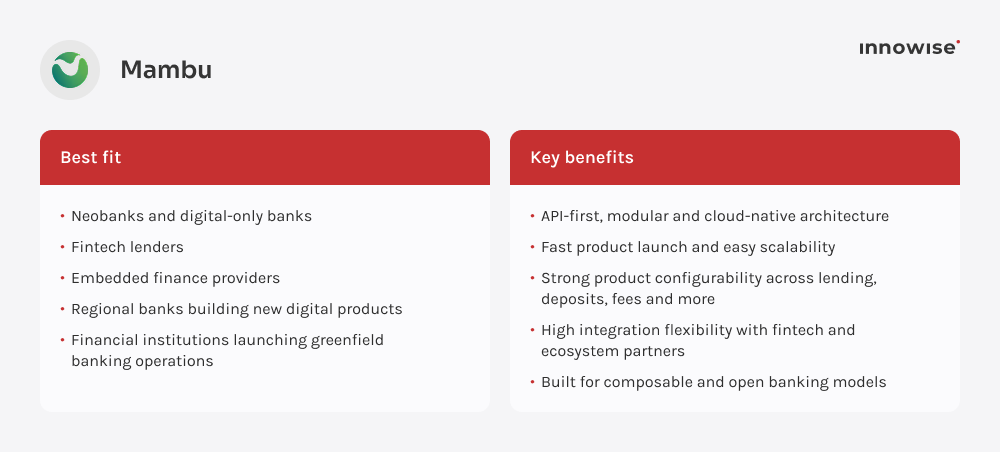
Mambu overview highlighting best-fit banking users and key benefits for digital finance

Mambu eignet sich besonders gut für Teams, die schnellere Produkt-Rollout-Zyklen und modulare Bankdienstleistungen gegenüber hochgradig maßgeschneiderten Unternehmensbankumgebungen priorisieren. Für große Tier-1-Banken mit vielschichtigen Altsystemen eignet sich Mambu oft besser als Teil einer schrittweisen Modernisierungsstrategie als für einen vollständigen Austausch der gesamten Plattform.

Kernarchitektur-Ansatz

Mambu wurde von Anfang an nach einem modularen, API-orientierten Modell konzipiert. Anstatt zu versuchen, alle Bankfunktionen in einer einzigen, eng vernetzten Plattform abzudecken, ermöglicht Mambu den Banken, verschiedene Dienste über ihren gesamten Banking-Stack hinweg zu kombinieren. Dieser Ansatz bietet Produktteams mehr Flexibilität bei der Einführung neuer Dienste oder der Anbindung externer Anbieter.

Die Plattform unterstützt:

  • Transaktionsverarbeitung in Echtzeit
  • API-lastige Bankökosysteme
  • Cloud-Installationen
  • Auf Microservices basierende Integrationen
  • Modulare Bankmodelle

Komplexität der Implementierung

Im Vergleich zu herkömmlichen Kernbankensystemen für Unternehmen sind Mambu-Implementierungen in der Regel schlanker und schneller. Das bedeutet jedoch nicht, dass die Implementierung einfach ist.

Banken müssen weiterhin:

  • Migrate customer and transaction data
  • Redesign operational workflows
  • Connect payment providers
  • Integrate compliance and KYC systems
  • Adapt reporting structures

Als Mambu partner, Innowise helps banks and fintech companies handle these implementation stages, from platform customization and integrations to migration planning and rollout support.

Produktflexibilität

This is one of Mambu’s strongest areas. Banks and fintechs can configure:

  • Lending products
  • Deposit accounts
  • Fee structures
  • Repayment logic
  • Customer segmentation rules
  • Multi-market product variations without rebuilding the platform itself

That flexibility matters for product teams testing new financial products quickly or operating across changing regulatory markets.

Ökosystem und Integrationen

Mambu performs well here because the platform was built around external connectivity. It integrates with:

  • Zahlungsanbieter
  • Digital banking applications
  • KYC and AML tools
  • Analyseplattformen
  • Card processing systems
  • Fintech service providers

For banks moving toward Embedded Finance or open banking ecosystems, this modular structure can reduce dependency on a single vendor stack.

Compliance und Unterstützung mehrerer Regionen

Mambu supports multi-country banking operations, but the level of customization and regulatory adaptation still depends heavily on the implementation setup around the platform. This is important to understand.

The platform itself provides flexibility, but banks operating across highly regulated or complex regional environments may still need additional layers for reporting, localization, and operational governance.

Let us turn your core banking shortlist into a rollout-ready plan

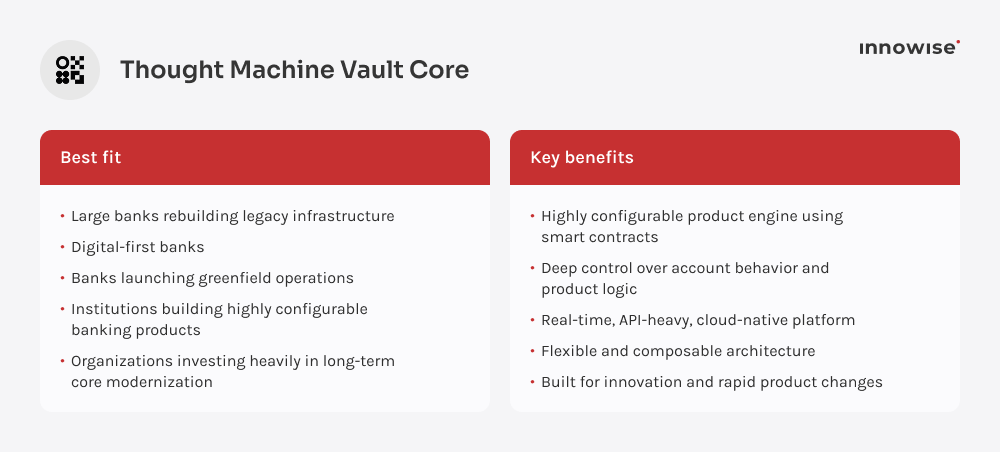
3. Thought Machine Vault Core

Thought Machine Vault Core was built for banks that want more control over how banking products are designed and managed internally. Unlike many other core banking systems, the platform wasn’t created around fixed banking products and rigid workflows. It was designed around configurable product logic from the start. That difference matters more than it sounds.

For banks trying to modernize complex legacy environments, one of the biggest frustrations is how difficult it becomes to change product rules, launch variations, or adapt workflows without touching multiple systems. Thought Machine approaches this problem differently by giving banks much deeper control over product behavior inside the core itself.

But that flexibility comes with a catch: the platform expects strong engineering maturity from the teams implementing it.

Thought Machine Vault Core summary highlighting digital banking transformation use cases

Kernarchitektur-Ansatz

Vault Core was designed around a modern, cloud-based architecture with configurable banking products managed through smart contracts. In practice, this gives banks more control over:

  • Konfiguration des Produkts
  • Account behavior
  • Fee and interest logic
  • Lending structures
  • Workflow-Anpassung

One of the biggest advantages here is product flexibility. Teams can adjust banking products without rebuilding large parts of the platform, which makes experimentation and faster product rollout more realistic.

Komplexität der Implementierung

Thought Machine gives banks a high degree of control, but that also increases implementation responsibility. Institutions need strong architecture teams, experienced engineers, and clear migration planning before rollout begins.

The complexity usually appears in:

  • Legacy migration
  • Product mapping
  • Integration orchestration
  • Operational redesign
  • Coexistence with older banking systems during transition phases

Banks without strong internal technical ownership may struggle here. At the same time, organizations with experienced engineering teams often prefer this model because it gives them more long-term control over the platform instead of locking them into rigid vendor workflows. 

If you’re somewhere in the middle, that’s completely normal. Many banks have strong internal teams but still lack specific migration or integration expertise. Innowise can support your rollout through IT Staff Augmentation, adding fintech engineers and specialists when extra hands are needed.

Produktflexibilität

This is where Vault Core stands out. Banks can configure:

  • Highly customized lending products
  • Dynamic fee structures
  • Account behavior
  • Repayment models
  • Market-specific banking rules directly inside the platform logic

For product teams, this reduces dependency on lengthy backend change cycles every time the bank wants to launch or adjust a service.

Ökosystem und Integrationen

Thought Machine was built with external connectivity in mind. This makes it attractive for banks moving toward composable banking models instead of relying on one large vendor stack.

The platform supports API-heavy banking ecosystems and works well alongside:

  • Zahlungsplattformen
  • Digital banking applications
  • Compliance services
  • Fintech tools
  • Analytics systems
  • External orchestration layers

Compliance und Unterstützung mehrerer Regionen

Vault Core supports multi-region banking operations, but implementation planning becomes important quickly in highly regulated environments. The flexibility is there, but institutions need the right operational design around it.

Banks still need to carefully design:

  • Localization logic
  • Reporting structures
  • Governance models
  • Audit processes
  • Regional operational flows around the platform

The flexibility is there, but institutions need the right operational design around it.

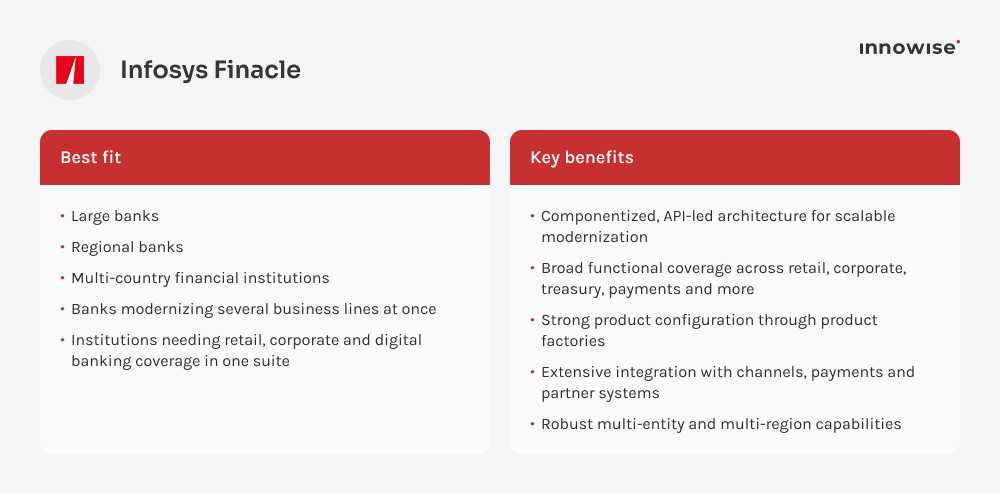
4. Infosys Finacle

Infosys Finacle is a mature core banking system with strong retail, corporate, payments, deposits, lending, and digital banking capabilities. That makes it a serious option for banks that operate across many products, channels, and regions. Finacle describes its core banking solution as componentized, cloud-ready, API-led, and built for real-time digital banking operations. 

It’s not the lightest choice for a small fintech with one lending product. Finacle is better suited to banks that already have operational depth and need a platform that can support many moving parts.

Infosys Finacle overview covering key users and modernization benefits

Kernarchitektur-Ansatz

Finacle has moved toward a componentized, API-led architecture. In practical terms, banks can modernize parts of the core instead of replacing everything in one risky move. The platform supports open APIs, cloud deployment, real-time transactions, product factories, and reusable business components.

That matters because large banks rarely get a clean slate. They need to connect old systems, new channels, payment services, reporting tools, and regional operations without breaking daily banking.

Komplexität der Implementierung

Finacle is powerful, but it’s not a small implementation. Banks should expect serious work around:

  • Legacy data migration
  • Konfiguration des Produkts
  • Channel integration
  • Meldewesen
  • Process redesign
  • Benutzerschulung
  • Phased rollout planning

The upside is breadth. Finacle can support complex banking environments. The trade-off is that the project needs strong governance from day one. Without clear ownership, configuration choices can pile up fast.

Produktflexibilität

Finacle offers strong product configuration through product factories and parameterization. That helps banks create and adjust products without rebuilding the core every time.

This is useful for banks managing:

  • Multiple deposit products
  • Lending portfolios
  • Bundled services
  • Regional product variations
  • Corporate banking needs
  • Multi-currency operations.

For product teams, the value is simple: fewer hard-coded changes, more room to adapt products as the business changes.

Ökosystem und Integrationen

Finacle is built for banks that rely on many connected systems. Its API-led model helps institutions connect digital channels, payment systems, partner services, and internal applications. This is especially important for banks with more than one core system or several regional platforms.

Compliance und Unterstützung mehrerer Regionen

This is one of Finacle’s strongest areas. Finacle is a good fit for banks operating across countries, currencies, languages, entities, and regulatory environments. Its core banking solution is built with multi-entity parameters, global migration support, regional operations, and regulatory needs in mind.

For enterprise banks, this matters. A platform that works well in one country can become painful when the bank expands into five more.

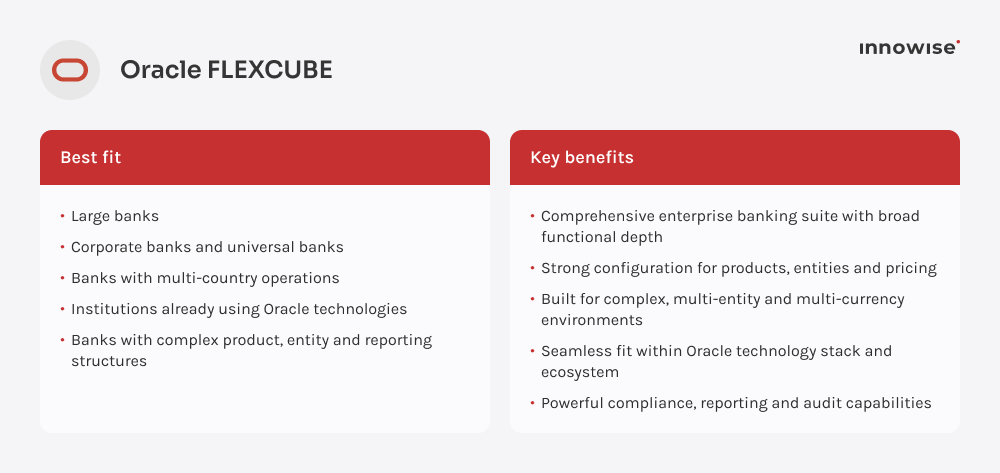
5. Oracle FLEXCUBE

Oracle FLEXCUBE is the kind of platform banks consider when they need to manage retail banking, corporate banking, lending, payments, deposits, trade finance, multi-entity operations, and strict reporting requirements under one large core banking setup. Its fit is even stronger in Oracle-heavy environments, where the core can align more naturally with existing databases, middleware, analytics, and enterprise systems.

Oracle FLEXCUBE overview showing enterprise banking users and benefits

Kernarchitektur-Ansatz

FLEXCUBE is built as an enterprise core banking suite with broad functional coverage. It supports retail and corporate banking operations, product configuration, workflow management, reporting, and multi-entity structures.

In practical terms, it gives banks a central system for many critical operations rather than forcing every business line to run on separate tools. That depth is useful, but it also means the architecture needs careful planning. Banks should be clear about what they want FLEXCUBE to own, what should stay in surrounding systems, and where integrations need to sit.

Komplexität der Implementierung

FLEXCUBE implementations can be demanding. Banks should expect serious work around:

  • Legacy data migration
  • Product and fee configuration
  • Integration with payment systems
  • Reporting setup
  • User access models
  • Compliance-Workflows
  • Testing across regions and business lines

However, for banks already using Oracle, some implementation tasks may be easier to plan and execute. Existing infrastructure standards, internal Oracle expertise, vendor relationships, and support processes can reduce friction during integration, testing, and post-go-live maintenance.

Produktflexibilität

Oracle FLEXCUBE offers strong configuration options for banking products, especially across retail, corporate, lending, deposits, and trade finance.

Banks can use it to manage:

  • Multi-currency products
  • Corporate banking workflows
  • Lending products
  • Account structures
  • Pricing and fee models
  • Entity-level rules
  • Regional variations

This makes it useful for banks with complex product catalogs. But with that flexibility comes configuration work. Product teams need clear rules before implementation starts, or the setup can become heavier than expected.

Ökosystem und Integrationen

FLEXCUBE works well in Oracle-heavy environments and can connect with surrounding banking systems, payment services, reporting tools, and digital channels. For banks using mixed vendor environments, integration planning matters more. FLEXCUBE can support complex setups, but the integration design needs to be mapped carefully from the start.

Compliance und Unterstützung mehrerer Regionen

This is one of FLEXCUBE’s strongest areas. The platform is well suited to banks operating across multiple countries, entities, currencies, and regulatory environments. It can support audit trails, reporting workflows, user controls, and localized banking processes.

That’s one reason it remains relevant for enterprise banks. Large institutions rarely need only product speed. They need control, traceability, and consistency across markets.

Each platform in this list solves a different problem, and that’s a good thing. Temenos fits large-scale modernization, Mambu works well for digital-first launches, Gedankenkraftmaschine gives teams more product control, Finacle covers broad banking operations, and Oracle FLEXCUBE supports complex enterprise banking. 

But I’ll keep repeating this: the “best” core banking system is only best if it fits your operating model, technical maturity, compliance needs, and rollout plan. Choose wisely, because once the core is in place, every product, process, and integration will depend on it.

Make your next core banking move with experts beside you

So wählen Sie die richtige Kernbankensoftware für Ihre Bank aus

Now we’re getting to the practical part. A comparison table can help you build a shortlist, but it won’t choose the platform for you. The real decision depends on how your bank works today, what has to change, and how much complexity your team can realistically handle during implementation. 

So here are my recommendations, with less theory and more “check this before you sign.”

Start with your business model, not the feature list

A common mistake is choosing a platform based on functionality alone. Instead, ask a simple question: what kind of bank are you building over the next five years?

Zum Beispiel:

  • A neobank launching savings and lending products has very different requirements than a multinational bank operating across 15 countries.
  • A digital lender processing thousands of loans per day needs different capabilities than a private bank focused on wealth management.
  • A regional bank modernizing legacy systems faces different challenges than a fintech launching from scratch.

The platform should fit your operating model, not the other way around.

Look beyond implementation and think about change

Many banks evaluate how difficult it will be to launch the platform, but fewer evaluate how difficult it will be to change it later. That’s often where costs start growing.

Before making a decision, ask vendors:

  • How are new products configured?
  • Can business teams manage product changes themselves?
  • How much development work is required to launch a new lending product?
  • How are pricing, fees, and interest rules updated?
  • What happens when regulations change?

A platform that takes six months to introduce a new product can become a serious business limitation.

Assess your integration reality honestly

Every core banking platform supports integrations. The important question is how many integrations you’ll actually need.

Create a list of systems that must connect to the new core:

  • Zahlungsabwickler
  • Card management systems
  • Fraud prevention tools
  • KYC and AML solutions
  • Reporting platforms
  • Customer-facing applications
  • Third-party fintech services

Then estimate the effort required to connect each one. In many modernization projects, integration work consumes more time than core platform deployment itself.

Don't underestimate data migration

Banks often focus on new functionality and overlook the complexity of moving years of customer records, transaction histories, loan portfolios, and accounting data.

Before selecting a platform, determine:

  • How much historical data must be migrated
  • Which systems contain the source data
  • What data quality issues already exist
  • Whether old systems must continue operating during the transition

The answers can influence platform selection more than any feature comparison.

Evaluate the operating model after go-live

Go-live isn’t the finish line. Someone still needs to manage upgrades, integrations, reporting changes, security controls, and platform governance.

Fragen Sie sich:

  • Do we have enough internal expertise?
  • Will we need external implementation support?
  • Who owns future product configuration?
  • How much vendor dependency are we comfortable with?

These questions often have a larger impact on long-term costs than licensing fees.

Choose a platform and implementation partner together

This is probably the most important advice I can give. A strong platform won’t fix poor implementation decisions. Likewise, an experienced implementation partner can help a bank avoid months of unnecessary rework by identifying migration risks, integration challenges, and process gaps early.

Having delivered multiple banking modernization projects, Innowise knows there are two sides to this decision: choosing the right platform and making it work inside the bank’s day-to-day operations. So before clients commit, we help them pressure-test the choice against the messy parts: migration, integrations, workflows, internal ownership, and the cost of changing things later.

"Core banking platform selection should include a delivery rehearsal before the contract is signed. Take a few real products, real integration points, and real reporting requirements, then test how they would be configured, migrated, connected, and governed in the new platform. That exercise tells you much more than a generic feature checklist."

Technischer Direktor

Trends shaping core banking software in 2026

The trends shaping core banking in 2026 come from day-to-day banking realities: payments need to settle faster, partners need API access, regulators need clearer data, and legacy cores need a safer path to modernization. These are the shifts I’d pay closest attention to.

Core replacement is becoming phased

More banks are avoiding one massive core replacement. Instead, they’re replacing parts of the core step by step: lending first, deposits later, payments in parallel, or a new digital brand on a separate core. This gives teams room to test the setup, move data carefully, and reduce disruption for customers.

The practical takeaway: choose a platform that supports gradual migration, not only full replacement.

Real-time payments are forcing real-time cores

Real-time payments don’t wait for end-of-day processing. If money moves in seconds, the core has to update balances, apply checks, post transactions, and feed reporting systems just as fast. If your core still depends heavily on delayed posting, every real-time payment product becomes harder to run.

Embedded finance is pulling the core outside the bank

Banking products now appear inside e-commerce platforms, payroll tools, accounting software, marketplaces, and fintech apps. That changes what a core system needs to support.

For core banking teams, this means stronger APIs, clearer product rules, better partner onboarding, and tighter control over risk. If partners depend on your banking infrastructure, your core can’t behave like a closed internal system.

Tokenized deposits and stablecoins are moving from theory to banking strategy

Large banks are exploring tokenized deposits for 24/7 settlement, treasury, and cross-border payments. The Wall Street Journal reported that JPMorgan Chase, Bank of America, Citi, and Wells Fargo are planning to build a tokenized deposit network for the first half of 2027. BMO also kündigte a tokenized cash platform with CME Group and Google Cloud, planned for release in the second half of 2026, subject to approval.

Core banking systems won’t all process tokenized deposits directly yet. But banks choosing a platform in 2026 should ask: can this architecture support new settlement models without another core rebuild?

Compliance is becoming part of the product workflow

When banks launch new products, connect partners, or enter new markets, compliance checks need to be built into onboarding, transaction monitoring, reporting, access control, and audit trails from the start.

Im Jahr 2026, a strong core banking platform has to do more than move money from one account to another. It needs to show who changed what, when rules were applied, how exceptions were handled, and where reporting data came from.

Schlusswort

The best core banking system depends on what you’re trying to achieve. A digital bank launching new products every few months faces very different challenges than a multinational bank replacing decades-old infrastructure across multiple regions.

If I were advising a bank, here’s how I’d think about it:

  • Choose Temenos Transact if you need deep banking functionality and a platform that can support large-scale modernization over the long term.
  • Choose Mambu if speed, flexibility, and digital-first banking are your top priorities.
  • Choose Thought Machine Vault Core if you want maximum control over product design and are ready to invest in a modern engineering-driven operating model.
  • Choose Infosys Finacle if you need broad banking coverage across multiple products, channels, and markets.
  • Choose Oracle FLEXCUBE if you're running complex enterprise or corporate banking operations and need strong multi-entity support.

And regardless of which platform you choose, implementation will ultimately determine the outcome. The strongest core banking system on the market won’t deliver results if the migration is poorly planned, integrations are rushed, or business processes aren’t adapted properly. That’s where experienced implementation teams can make the difference between a successful modernization project and a very expensive lesson.

FAQ

Es gibt keine einzige „beste“ Kernbankplattform, die für jede Neobank gleichermaßen geeignet ist, doch Mambu zählt oft zu den besten Optionen für „Digital-First“-Institute. Dank seiner API-First-Architektur, der flexiblen Produktkonfiguration und der relativ schnellen Implementierung eignet sich die Plattform besonders gut für Neobanken, die neue Produkte und Dienstleistungen zügig auf den Markt bringen möchten.

As a rough benchmark, banks and fintechs can expect:

  • Cloud-based platforms: from tens of thousands to several hundred thousand dollars per year.
  • Enterprise core banking systems: from several hundred thousand dollars to several million dollars for implementation and licensing.
  • Large-scale modernization projects: often exceed several million dollars once migration, integrations, customization, testing, and training are included.

It's also important to look beyond licensing costs. In many projects, data migration, third-party integrations, process redesign, and ongoing support account for a significant share of the total investment. That's why evaluating the full implementation scope is often more important than comparing vendor pricing alone.

Most major core banking systems now support cloud deployments, including Mambu, Temenos Transact, Thought Machine Vault Core, Infosys Finacle, and Oracle FLEXCUBE. The difference is in how they support it. Mambu and Thought Machine are stronger fits for cloud-first banking models, while Temenos, Finacle, and FLEXCUBE are often used in larger enterprise environments where banks may choose private cloud, public cloud, or hybrid deployment depending on compliance and internal IT requirements.

Leiter der Projektabwicklung & Leiter des Kompetenzzentrums

Siarhei ist spezialisiert auf das Navigieren durch ein anspruchsvolles regulatorisches Umfeld und komplexe Lieferhürden. Er wandelt abstrakte Geschäftsanforderungen in sichere, skalierbare Architekturen um und sorgt dafür, dass jedes Projekt technisch solide und zukunftssicher gegen Marktveränderungen ist.

Inhaltsübersicht

    Kontakt aufnehmen

    Anruf vereinbaren oder füllen Sie das Formular aus. Wir kontaktieren Sie, sobald wir Ihre Anfrage bearbeitet haben.

    Sprachnachricht senden
    Datei beifügen
    Datei hochladen

    Sie können 1 Datei mit bis zu 2 MB anhängen. Gültige Dateiformate: pdf, jpg, jpeg, png.

    Mit dem Klicken auf Senden erklären Sie sich damit einverstanden, dass Innowise Ihre personenbezogenen Daten gemäß unserer Datenschutzerklärung verarbeitet, um Ihnen relevante Informationen bereitzustellen. Mit Angabe Ihrer Telefonnummer stimmen Sie zu, dass wir Sie per Sprachanruf, SMS oder Messaging-Apps kontaktieren. Es können Gebühren für Anrufe, Nachrichten und Datenübertragung anfallen.

    Sie können uns auch kontaktieren
    bis hin zu contact@innowise.com
    Wie geht es weiter?
    1

    Sobald wir Ihre Anfrage erhalten und geprüft haben, melden wir uns bei Ihnen, klären erste Fragen und unterzeichnen bei Bedarf ein NDA, um die Vertraulichkeit zu gewährleisten.

    2

    Nach genauer Prüfung Ihrer Anforderungen, Bedürfnisse und Erwartungen wird unser Team einen Projektvorschlag mit Angaben zu Arbeitsumfang, Teamgröße, Zeitaufwand und Kosten erstellen.

    3

    Wir vereinbaren einen Termin, um das Angebot gemeinsam zu besprechen und alle Details festzulegen.

    4

    Abschließend unterzeichnen wir den Vertrag und starten umgehend mit der Umsetzung Ihres Projekts.

    Weitere Dienstleistungen, die wir abdecken

    arrow