Så här anställer du utvecklare av mobilappar: en komplett guide för företag

14 augusti 2026 15 min läsning
Sammanfatta artikeln med AI

Viktiga lärdomar

  • Get the project basics straight before you approach candidates. Scope and platform choices will shape the stack, team, budget, and schedule.
  • Pick a hiring model that fits the way your business works. An in-house hire, freelancer, staff augmentation partner, or development company will require a different level of involvement from your team.
  • Look past coding proficiency. Strong candidates should understand architecture, security, product goals, and how their decisions affect the wider project.
  • Give every candidate the same review process. Portfolios, practical assessments, structured interviews, and a scorecard make comparisons easier.
  • Set ownership and delivery terms before work begins. The contract should cover source code, acceptance criteria, post-launch support, and handover.

A mobile app can start with a strong idea and still fall apart in development. The wrong team may fail to account for differences between devices, miss app store requirements, overlook security risks, or build an app that works well on fast Wi-Fi but struggles when the connection drops.

Before you hire mobile developers, you need a clear view of the product, platform requirements, technical risks, and team setup. If you try to find mobile app developer talent without that groundwork, it’s easy to choose the wrong engagement model or overrate a candidate’s technical skills. You may also overlook experience that matters for your product. These gaps tend to surface later through missed deadlines, performance issues, security flaws, rising maintenance costs, or an app users stop returning to.

In this guide, I’ll explain how to assess candidates, compare engagement models, and hire mobile app developers who fit your budget and delivery goals.

Define your mobile app project before hiring

Before you post a job description or contact agencies, review what you already have and define the constraints that will shape the project. This step helps you understand what kind of mobile app development expertise you need and which hiring model fits the work. It also shows where extra product, UX, backend, or QA support may be required.

Clarify the business goal

Start with what the app needs to achieve. Are you testing demand with an MVP, migrating a legacy application, or building a mobile tool for internal teams? The answer will define whether you need native specialists or cross-platform developers. It will also help you decide between individual engineers and a fully managed team.

Define the initial scope

List the functional and non-functional requirements. Functional requirements include features such as push notifications, payment gateways, real-time chat, background location tracking, and offline sync. Non-functional requirements set expectations for app performance, security, behaviour under poor connectivity, and compliance with frameworks and standards such as HIPAA, GDPR, PCI-DSS, and security protocols.

Assess what you already have

Start with what is already in place. Finished designs, a working backend, existing APIs, or clear product documentation can narrow the mobile scope and help a new team start faster. Any gaps may add UX, backend, QA, DevOps, or discovery work. Also decide who will answer product questions and who has the final say on technical decisions.

Set the budget and target timeline

Decide on a budget range and a delivery timeline before hiring mobile app developers. If you have a fixed launch date, you will likely need experienced engineers who can start quickly and work independently. If your timeline is longer, you have more flexibility to build your team and adjust as the product evolves.

What type of mobile app developer do you need?

A common hiring mistake is assuming that one mobile developer can cover the whole product. A solo engineer may be enough for a simple app with a narrow scope. Once the product includes complex user flows, backend integrations, frequent releases, offline logic, or strict quality requirements, you usually need a wider team.

UX/UI designers and QA engineers often work alongside mobile developers. Depending on the scope, you may also need backend engineers, DevOps support, a business analyst, a mobile architect, or a project manager.

Till find a mobile app developer who fits the project, match the work to the right specialization first.

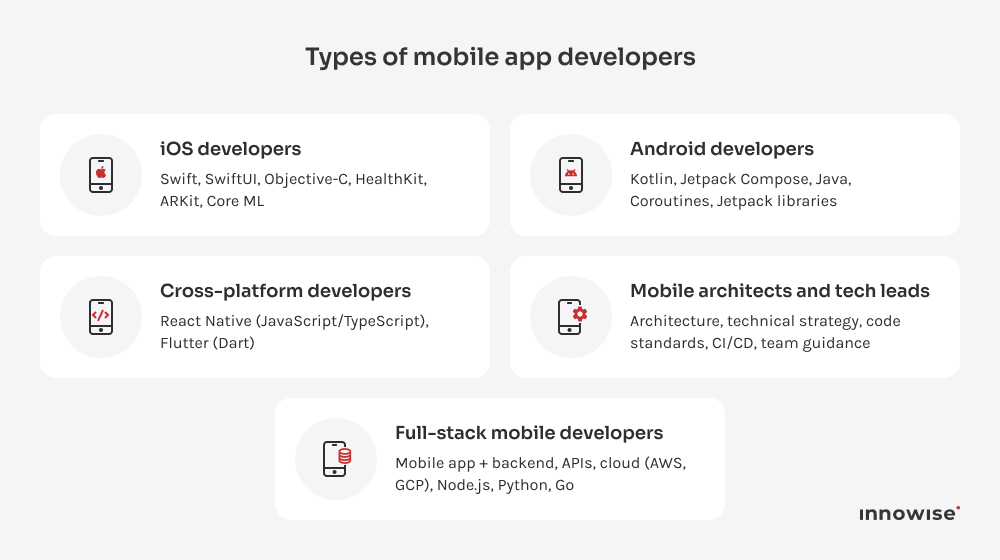
Types of mobile app developers, including iOS, Android, cross-platform, mobile architects, tech leads, and full-stack specialists.

iOS-utvecklare

Anlita iOS-utvecklare when you need an app built specifically for the iPhone, iPad, Apple Watch, or other Apple devices. They work mainly with Swift and SwiftUI, while Objective-C experience matters for older apps. They also handle Apple-specific features, App Store requirements, and updates for new devices and iOS versions.

Android-utvecklare

Android-utvecklare focus on apps for smartphones, tablets, wearables, and other Android devices. They usually work with Kotlin and Jetpack Compose, while Java experience still matters for mature codebases. They are a good fit for apps that need strong performance, deep hardware access, or support across many devices and Android versions.

Utvecklare av plattformsoberoende lösningar

For products that need to reach iOS and Android with one codebase, cross-platform developers are often the practical choice. They usually work with Flutter or React Native. This approach works well for MVPs and teams aiming to release faster across both platforms, although some features may still need native code.

Mobile architects and tech leads

Bring in a mobile architect when the app has complex integrations, demanding performance needs, or a larger development team. They decide how the product should be structured and which technologies fit it. A tech lead then guides the daily work, reviews code, and helps developers resolve blockers.

Full-stack mobile developers

Hire full-stack mobile developers when you need one person to cover both the app and its backend. They are a good fit for prototypes and smaller products where the scope is still manageable. As the platform grows, separate mobile and backend specialists usually make more sense, with dedicated QA and infrastructure support.

Need help getting your app ready for release?

Native or cross-platform development: which should you choose?

Before development starts, you should decide how similar the iOS and Android versions will be. If they share the same screens, user flows, and core logic, a cross-platform approach can reduce duplicate work and keep the team smaller. This choice also affects your budget and post-launch maintenance.

Native development is a better fit when the app relies heavily on device hardware, needs platform-specific behavior, or requires tighter control over performance. The table below compares both options across the factors that matter most for your project.

FaktorUtveckling av ursprungsbefolkningarPlattformsoberoende utveckling
PlattformarSeparate iOS and Android codebases, usually built with Swift and KotlinOne shared codebase for both platforms, commonly built with Flutter or React Native
PrestandaA strong fit for demanding workloads and platform-specific behaviorSuitable for many commercial apps, though performance depends on the framework and workload
Enhetens funktionerDirect access to platform APIs and device hardwareSome features may require native modules or custom platform code
Development speedBuilding for both platforms usually takes more workA shared codebase can speed up the initial release when platform behavior is similar
Team requirementsRequires iOS and Android expertiseUsually handled by one cross-platform team, with native support for platform-specific work
UnderhållEach platform is updated and tested separatelyMost changes are shared, though platform-specific parts still need separate maintenance
Bästa passformApps with complex interactions, deep OS integration, or demanding graphicsMVPs, internal tools, e-commerce apps, and products with similar flows across platforms

What seniority level does your project require?

Seniority defines how much guidance a developer needs and how much responsibility they can take on. I recommend starting with the work itself rather than the number of years on a CV. Consider how clearly the tasks are defined and whether someone in-house can review them. The profiles below will help you identify the level that fits your project.

Junior mobile developers

Junior developers are a good fit for clearly defined tasks with regular review. They can fix minor bugs, build UI components from finished designs, and add simple features to an existing app. They work best when a senior engineer sets the direction and checks the result.

Mid-level mobile developers

Mid-level developers can take ownership of standard features without much day-to-day guidance. They usually handle API integrations, testing, app store releases, and common performance issues. They may still need support when a task affects the wider architecture or introduces unfamiliar technical risks.

Senior mobile developers

Senior developers are the right choice when the role comes with wider technical responsibility. They make architectural and security decisions, deal with difficult performance problems, and guide other engineers. Their experience matters most on large products, complex integrations, or projects where a poor early decision would be costly to undo.

FaktorJuniorMid-levelSenior
Typical experience0 to 2 years2 to 5 years5+ years
SjälvständighetNeeds clear task breakdowns, supervision, and regular code reviewsWorks independently on standard features but may need architectural guidanceWorks autonomously and makes major technical decisions
Typical workBasic UI components, minor bug fixes, simple feature updatesCore features, API integrations, testing, app store submissions and releasesArchitecture, security, offline functionality, performance work, technical mentoring
Bästa passformExisting apps that need extra support, simple tools, tightly scoped tasksCommercial apps, regular feature development, established product roadmapsEnterprise products, complex integrations, technically demanding new applications

Choose the right model to hire mobile application developers

The right hiring model depends on what you already have in-house and how much support you need beyond development. Some companies need one specialist to fill a skill gap. Others need a stable external team or a partner that can take responsibility for planning and delivery. Below, I explain where each model works best.

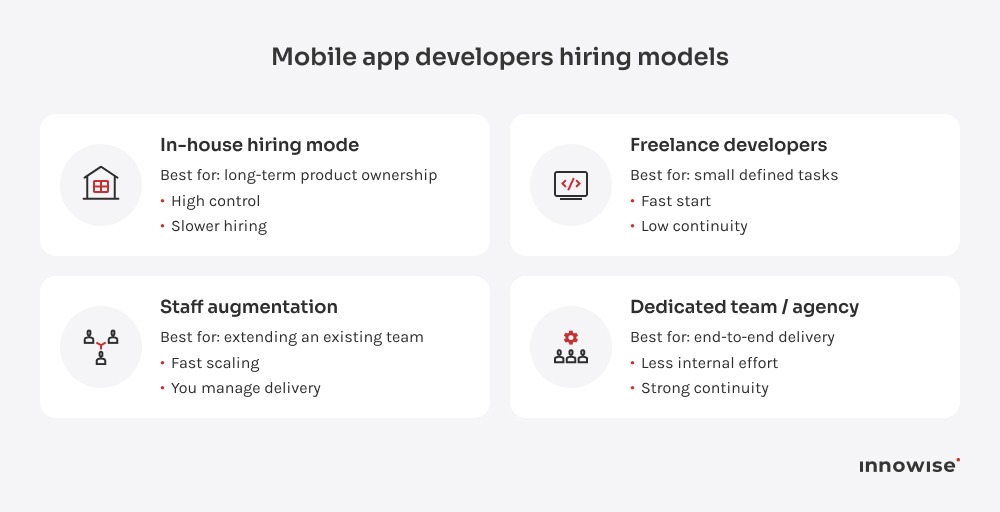
Comparison of in-house hiring, freelance developers, staff augmentation, and dedicated teams for mobile app development.

Interna utvecklare

Build an in-house team when the app is central to your business, and you expect development to continue for years. You keep product knowledge close and have direct control over daily priorities. The downside is the time and cost involved in recruitment, onboarding, equipment, benefits, and retention.

Freelance mobile developers

Freelancers work well for small tasks with a clear finish line. You might bring one in to fix a bug, build a specific screen, or add a feature with a tight scope. I’d be more careful when the work needs long-term availability or input from several teams. One contractor can quickly become a bottleneck, so agree on communication, system access, IP rights, and handover before the project starts.

Personalitökning

Staff augmentation makes sense when you already have a product team but need a skill you lack in-house. The specialist joins your workflow and reports to your project manager or tech lead, while your team keeps control of the backlog and technical direction. The vendor handles sourcing and employment, so you can fill a temporary gap without running a full hiring process.

Dedicated mobile development team

Hire dedicated mobile app developers when you need several specialists for a long-term project but don’t want to bring them all in-house. The vendor puts together a team for your product, which may include mobile developers, QA engineers, a tech lead, and a project manager. You decide what to build and which work comes first. The vendor coordinates the team and keeps the necessary roles covered throughout the project.

Mobile app development company

Choose a mobile app development company when you need one partner to take responsibility for the entire project. They can help define the scope, design the app, build and test it, and prepare it for release.

This model suits companies without an internal mobile team or the capacity to manage developers directly. You decide what the product should achieve, while the company organizes the team and handles delivery. Before hiring one, check whether they have built similar apps and how they report progress, handle changes, and involve clients in key decisions.

Hiring model comparison

If you’re weighing several options, I’ve summed up the main differences in the table below so you can quickly see which model fits your setup.

ModellBäst förOnboarding speedClient controlInternal management effortTypical continuity
InterntContinuous product developmentLågHögHögHög
FreelancerSmall, clearly defined tasksHögHögHögLåg
PersonalitökningExtending an existing teamHögHögMedelhög till högMedium
Dedikerat teamLong-term developmentMedelhög till högMedelhög till högMediumHög
Development companyLeverans från början till slutMediumMediumLågHög

Not sure which approach fits your product and budget?

Prepare a mobile developer job description or project brief

By this point, you should know what you are building and what kind of help the project needs. Now put that information into a brief that a developer or vendor can assess properly. When too much is left open to interpretation, two similar estimates may be based on very different scopes of work.

Summarize the project

Give candidates enough context to understand the app and its users. Add the current stage of development, then link to the detailed scope instead of repeating every feature in the brief.

Describe the role

State which part of the product the developer will own and where their responsibilities end. Mention whether you need implementation support, technical leadership, or a mix of both.

Set the skill requirements

Separate required experience from nice-to-have skills. Tie each requirement to the actual work instead of adding a long list of tools and frameworks.

Explain the team setup

Describe the team the developer will be joining. Mention who assigns tasks, who answers product questions, and whether the developer can make technical decisions independently.

Define the engagement terms

Include the expected start date and workload. Add the contract length, required time-zone overlap, and budget range so candidates can judge whether the terms fit before applying.

Outline the selection process

Tell candidates what happens after they apply. Include the number of interview rounds, as well as any portfolio review or technical task.

Skills to look for in mobile app developers

A clear brief should attract candidates with the right background. The interview is where you find out whether that experience fits your project. I recommend focusing on how the developer makes technical decisions and whether they understand the product. Also pay attention to how they work with the rest of the team.

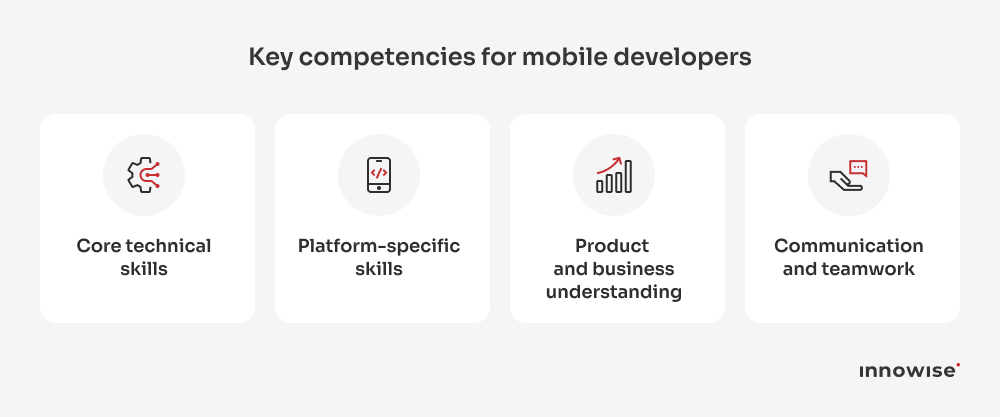
Key competencies for mobile developers across technical skills, platform expertise, product understanding, and teamwork.

Core technical skills

Start with architecture. Ask which architectural patterns the developer has used, such as MVVM, VIPER, Clean Architecture, or MVI, and why that choice worked for the product. 

Then discuss background tasks and concurrency. Poor implementation can freeze the app or put user data at risk. Check whether the developer has worked with the APIs your app needs, including REST and GraphQL APIs, as well as WebSocket connections.

Ask how the app stores data on the device as well. Depending on the platform, the developer may use Room, Core Data, SQLite, or Realm in an existing codebase. They should also be comfortable with Git and your team’s branching and code review processes.

Platform-specific skills

When hiring for iOS roles, look for experience with Swift and SwiftUI. UIKit is important if the developer will be working on older apps. Ask candidates how they use Xcode and Instruments to diagnose memory or performance issues, and make sure they understand how to distribute and test builds through TestFlight before release. 

For Android roles, focus on Kotlin and Jetpack Compose. Experience with Kotlin Coroutines and Flow shows how they handle asynchronous tasks. Gradle skills are helpful as projects get more complex. Ask how they troubleshoot in Android Studio and manage releases with the Google Play Console. 

For cross-platform positions, developers often use Flutter with Dart or React Native with TypeScript. Ask which features require native code and why. Their approach to state management, like BLoC or Provider in Flutter, or Redux or Zustand in React Native, should be based on the product’s needs.

Product and business understanding

A strong mobile developer understands how product choices play out in the app. Ask how they use Apple’s Human Interface Guidelines or Material Design when shaping screens, and how they flag features that could hurt performance or delay release. They should also know how to use Sentry or Crashlytics and interpret retention data after launch.

Communication and teamwork

Good communication matters especially when something goes wrong. A strong developer raises the issue early and explains what each option means for the project. Ask how they work with designers and backend engineers, and how they coordinate with QA during testing. Experience working in an Agile environment is also valuable because mobile development requires regular communication across the team.

How much does it cost to hire mobile app developers?

För atthe cost to hire mobile app developers can vary quite a bit. Seniority, location, project scope, and hiring model all affect the rate. Hourly rates also tend to be higher in the US and Western Europe than in Eastern Europe, India, or Southeast Asia. The final estimate depends on the factors below.

Main factors that affect the cost

Experience and specialization

Senior developers usually charge more when the work involves architecture or technically demanding features. Banking, healthcare, and other regulated industries may also require experience with specific security and compliance standards.

Plats

Rates vary with local labor costs and demand for mobile talent. Mobile developers typically charge $100 to $200 per hour in the US and Western Europe. Rates range from $40 to $80 in Eastern Europe and from $20 to $50 in India and Southeast Asia.

Val av plattform

Building separate native apps requires both iOS and Android expertise. Cross-platform development can cut duplicate work when the two versions share the same core functionality. But some features may still require native code.

Design depth

An existing design system and standard navigation patterns keep the UI scope under control. Custom interface and interactions take longer to design, build, and test across different screen sizes.

Integrations and compliance

Payment services and third-party APIs add implementation and testing time. The cost rises further when the app needs custom backend logic or has to meet industry-specific compliance requirements.

Cost by hiring model

Frilansare

Upwork lists typical app developer rates at $18–$39 per hour. Platform-specific expertise may cost more, with iOS rates reaching $45–$75+ and Android rates $35–$60+. For a small feature or a short update, this can be the cheapest way to get started. You will still need to manage the work, plan the handover, and deal with any gaps in availability.

Interna utvecklare

Indeed puts the average US salary for mobile developers at $137,858 per year, or roughly $66 per hour. In practice, the budget also covers recruitment, payroll taxes, benefits, equipment, and paid time off. This model can still make sense when mobile development is part of a long-term roadmap, and you want product knowledge to stay inside the company.

Personalitökning

Clutch reports that most IT staff augmentation agencies charge $50 to $199 per hour. Yes, that is higher than many freelance rates, but the vendor takes care of sourcing and employment while the developer plugs into your existing team.

Dedicated team or mobile app development company

Clutch puts common företag för utveckling av appar rates at $25 to $49 per hour, with most reviewed projects landing between $10,000 and $49,999. Treat that as a broad global benchmark, though. Rates in the US and Western Europe can climb much higher. The quote may also cover QA, a tech lead, or a project manager alongside the developers.

Cost by project type

A simple app with basic navigation and no custom backend will stay closer to the lower end of the range. External APIs and complex business logic add more work, while real-time processing or advanced security requirements can raise the estimate even more.

Appens komplexitetFunktionerErforderlig expertisKostnad för affärsbehovKostnad för kommersiell distribution
Enkel app
  • Enkelt användargränssnitt och navigering.
  • Grundläggande funktioner som är inriktade på en primär funktion eller uppgift.
  • Låg programmeringskomplexitet.
Grundläggande teknisk expertis$20,000–$60,000$40,000–$90,000
Medium-complexity app
  • Interaktivt gränssnitt med användarresor i flera steg.
  • Bredare utbud av funktioner och användningsområden.
  • Integrationer med externa API:er.
Måttlig teknisk expertis$50,000–$120,000$100,000–$200,000
High-complexity app
  • Rikt, dynamiskt gränssnitt med avancerade interaktioner.
  • Komplex affärslogik och arbetsflöden.
  • Custom backend logic and compliance.
Teknisk expertis på seniornivå$200,000–$500,000$300,000+

Var hittar jag utvecklare av mobilappar?

If you already know who you need, there are plenty of places to look. Some routes are faster than others, and each works better for a different type of hire. Referrals and job platforms suit direct recruitment, while staff augmentation providers and development companies can cover a larger part of the delivery.

Referrals and professional networks

Start with your network. Colleagues or former partners may know developers they have worked with directly. You still need to assess each candidate or vendor, but a referral gives you useful context on how the person communicates and approaches the work.

LinkedIn and developer communities

LinkedIn works well when you already know which platform experience and seniority you need. Job platforms such as Indeed and Wellfound can widen the search, especially for permanent hires or startup talent.

Samhällen för utvecklare

Look beyond job boards when you want to see how a developer works. GitHub and GitLab let you review public repositories and past contributions. Mobile development communities on Reddit or Discord may also lead you to relevant candidates, though forum activity should remain an early signal rather than a substitute for technical assessment.

Freelance platforms

Upwork, Toptal, and Freelancer are useful when you need one specialist for a defined assignment. Review each candidate’s project history and client feedback before starting a conversation. Then check availability before moving to an interview or paid trial.

Recruitment agencies

Start with AI tools or a regular online search, then check LinkedIn for IT recruitment agencies that specialize in mobile development roles in your market. Their websites and recruiter profiles should show whether mobile roles are a regular part of their work. Once engaged, the agency handles sourcing and initial screening before sending you a shortlist. That saves you hours of sourcing, but the convenience comes at a price. Placement fees often reach 20% to 30% of the new hire’s first-year salary.

Staff augmentation providers

IT staff augmentation companies such as Innowise can help you find mobile developers for your existing team. Share the skills and seniority you need, and the provider will send matching profiles for review. You interview the candidates and choose who joins the project, while your team stays in charge of the work.

Mobile app development companies

If the scope is too broad for one developer, a mobile app development company can put together a team for the project. Clutch and GoodFirms are good places to start, and a company’s case studies can show you what kind of mobile work they have actually done. Share what you are building, and the vendor can suggest developers with relevant experience and add QA or design support if the project needs it.

Add mobile developers without slowing down your team.

How to evaluate mobile app developers

Step 1. Screen for relevant experience

Look for projects that match yours in terms of domain and technical requirements. A developer who has worked on high-volume fintech apps will likely be more familiar with secure local storage and regulatory constraints than someone whose background is mostly simple utility apps.

Step 2. Review the portfolio

Open the candidate’s published apps in the App Store or Google Play and try them yourself. Go through the main features, see how quickly the screens load, and pay attention to whether the navigation feels smooth. You can read user reviews to spot issues you might miss in a quick test. Also, check the update history to see whether the app has been maintained or left behind since launch.

Step 3. Review technical evidence

If the developer has public GitHub or GitLab repositories, open a few and see how the code is organized. Then skim the commit history to see how clearly they document changes over time. Look for unit or integration tests as well. Another engineer should be able to follow the code and work with it without first having to untangle every decision.

Step 4. Decide whether to use a technical test or paid trial

You don’t need a long coding assignment to understand how someone works. A one- or two-hour pairing session lets you solve a small problem together and see how the developer approaches it.

For roles with more responsibility, a paid two- or three-day trial can give you a better sense of the day-to-day fit. Use a small task from the project, but keep it separate from production.

Step 5. Check delivery reliability

Talk to former clients or managers about how the developer handled deadlines. Ask what happened when technical issues came up and whether they raised them early. Then ask how the code performed after release. Did it need frequent fixes, or did the team have little follow-up work?

Step 6. Use a candidate scorecard

Create the scorecard before the first interview. Otherwise, one confident conversation can outweigh everything else. Agree on the criteria and weights in advance. Then record what supports each score, rather than relying on memory or general impressions.

KategoriSuggested weightEvaluation focus
Relevant mobile experience20%Industry background and work on apps with similar complexity
Technical competence25%Platform knowledge and command of the required programming language
Architecture and problem-solving20%System design choices and approach to state management
Kommunikation15%Ability to explain technical issues and work with the wider team
Delivery reliability10%References, track record of meeting deadlines, and follow-through
Commercial fit10%Rate, time-zone overlap, and availability to start

Mobile app developer interview questions

An interview should show how the developer approaches real project decisions. I usually mix technical questions with examples from past work and follow up when an answer sounds too broad. Below, I’ve grouped the questions by the area they help you assess.

Project and architecture questions

  • Walk me through the architecture of the last app you built. Why did you choose that structure?
  • How do you choose between MVVM, MVC, and Clean Architecture for a new project?
  • Tell me about a codebase you had to refactor. Where did you start?
  • How do you approach offline functionality and local data storage?

For the first question, listen for a specific architecture and a clear reason it suited the product. The candidate should connect the decision to the team setup, delivery schedule, or expected growth. I would also ask what they would change if they were starting again. That answer often shows whether they understand the trade-offs behind the original choice.

When they compare architecture options, the choice should reflect the size and expected life of the product. A small MVP built by one developer has different needs from a banking app that several engineers will maintain for years. I would expect them to consider testability and how easily another developer could understand the code.

Platform-specific questions

  • How do you manage memory and prevent retain cycles in Swift?
  • Where have Activity or Fragment lifecycle issues caused problems in your Android work?
  • How do you choose between native and cross-platform development?
  • How have SwiftUI or Jetpack Compose changed the way you build apps?
  • How do you handle platform-specific interface differences in a shared codebase?

For the native vs. cross-platform question, the candidate should explain whether the app needs direct access to device features or different behavior on iOS and Android. They should also say how much code can be shared and what that means for maintenance. If they recommend the same option every time, ask about a project where the other one worked better.

Testing and quality questions

  • What do you cover with unit tests, and what do you usually leave out?
  • How do you test across different devices, operating system versions, and screen sizes?
  • Tell me about a bug that reached production. How did you find it?
  • What experience do you have with CI/CD for mobile releases?

When a candidate describes a production bug, pay attention to whether they take ownership and can explain the cause. I’d also ask what changed afterward. That might be a new test case, an updated review step, or better monitoring.

Security questions

  • How do you store tokens or personal data on the device?
  • How do you secure API communication and manage authentication tokens?
  • How do you decide which permissions the app should request?
  • What would you review before releasing an app that handles payments or health data?
  • What compliance requirements have you worked with in mobile projects?

On local data, look for platform-specific knowledge. The candidate should know how iOS Keychain and Android Keystore can be used to protect sensitive information. They should also explain what should stay off the device and how they would restrict access to anything stored locally.

If the product is regulated, ask what they implemented themselves. Familiarity with terms like GDPR, HIPAA, or PCI DSS doesn’t show whether they can explain how those requirements affected data storage or access rules.

Delivery and communication questions

  • How do you respond when requirements change during a sprint?
  • What do you do when you are likely to miss an agreed deadline?
  • How do you keep the team updated as the plan changes?
  • What documentation do you leave for the next developer?

For the first two questions, I’d listen for how early the developer speaks up. A good answer should show that they assess the impact before suggesting what to change. They should raise the issue while the team still has time to adjust the scope or move the date.

The documentation question shows whether they think beyond their own task. I’d expect notes that explain the main technical decisions and give another developer enough context to continue the work without starting from scratch.

Post-launch questions

  • How do you handle an app store rejection?
  • What do you monitor after the app is released?
  • How do you ship an urgent fix without disrupting planned work?
  • How do you prepare for new operating system versions?

When the candidate talks about app store rejections, look for issues they have encountered in real releases. These may include missing privacy information, incomplete metadata, or problems with data collection. They should also explain what they review before submission to reduce the chance of the same rejection happening again.

When you hire mobile developers, the framework on the CV is only a starting point. Pay more attention to how a candidate explains past decisions and whether they can fit into the way the team works, because that usually tells you how quickly they can start contributing.

Red flags when hiring mobile app developers

Some red flags only become clear when you move beyond technical questions and ask how a developer handles real project work. The points below will help you spot delivery risks before you make a hiring decision.

Unrealistic delivery promises

Be careful with anyone who gives you a firm deadline before understanding the product. An experienced developer will ask about backend readiness and platform constraints. They’ll also want to know where edge cases are likely to appear before committing to a date.

No app store release experience

Ask the candidate to describe a release they handled personally. A candidate with hands-on release experience should understand how App Store and Google Play reviews work and be able to discuss a rejection they helped resolve.

Testing treated as optional

Manual testing has its place, but it can’t cover every device or operating system version. I’d ask what the developer automates and what they prefer to test manually. Their answer should reflect the specific risks in your product.

Poor offline handling

A mobile connection can disappear at any time. The app should respond without crashing or leaving the user on an empty screen. Ask how the developer handles cached data and what happens when the connection returns.

Resistance to code review

A private portfolio is common in commercial development, so missing public code is not a problem by itself. I’d be concerned if the candidate avoids every technical discussion or reacts poorly to feedback. They should be comfortable walking the team through a decision and taking part in code reviews.

What to include in the contract

Scope and deliverables

Detail the core system features and screen layouts in a binding statement of work (SOW). Include all third-party integrations and platforms.

Milestones and acceptance criteria

Tie payments to agreed milestones and define how each one will be accepted. A module, for example, may count as complete once it passes the automated test suite and receives staging approval.

Intellectual property and source code ownership

Make sure the contract explicitly states that all written code, architecture diagrams, graphic assets, and intellectual property transfer exclusively to your business upon payment.

Confidentiality and data protection

Include confidentiality provisions or an NDA and specify the applicable data protection requirements, such as GDPR or HIPAA. Add PCI DSS where payment data is involved.

Third-party tools and licenses

Require developers to declare any open-source libraries and commercial SDKs they use. The contract should also confirm that each license permits commercial use.

Warranty and post-launch support

Set a post-launch warranty period, typically 30 to 90 days, during which the developer or agency fixes agreed issues at no extra cost.

Termination and handover

Set out clear termination clauses, notice periods, and mandatory code handover steps, including repository access, master keys, and technical documentation.

How to onboard mobile app developers

Once the contract is signed, help the developer start without delays. Share the project context, set up access before day one, and use the first task to make sure they can work with the team’s usual process.

Give access to the required systems

Set up access to GitHub or GitLab, Jira or Linear, Figma, Slack or Teams, and the CI/CD environment before work begins. Check that the permissions match the developer’s role.

Introduce the product and users

Explain the business goal and target users, then walk through the UI prototypes and high-level platform architecture. A developer who understands why a feature exists can make better technical decisions.

Clarify responsibilities

Agree on working hours, standup routines, code review timing, commit conventions, and issue tracking. Name the people who answer product questions and approve technical decisions.

Start with a controlled first assignment

Give the developer a contained task during the first week, such as fixing a minor UI bug or writing a simple unit test. The task checks whether the setup works and shows how well they understand your build and deployment process.

Set up the ongoing working process

After the first task, bring the developer into your regular sprint cycle and code review process. They should join technical refinement sessions and receive feedback as the work progresses.

Mobile app developer hiring checklist

By this point, you should have a clear idea of hur man anlitar en apputvecklare for your project. The checklist below helps you make sure everything is in place before they join the team.

  • Define the business goal and product scope
  • Choose the target platforms: iOS, Android, or both
  • Decide between native and cross-platform development
  • Identify the roles you need and the right seniority for each one
  • Choose the hiring model: in-house, staff augmentation, a dedicated team, or an agency
  • Set the budget and target timeline
  • Prepare a project brief or job description
  • Look for candidates through channels that fit the type of hire
  • Review portfolios and published apps
  • Run technical and behavioral interviews
  • Use a technical assessment when appropriate
  • Finalize the contract, including IP ownership, the scope of work, and warranty terms
  • Complete onboarding and grant the required access
  • Review the first deliverables and assess code quality through code reviews and automated CI/CD checks

Why hire mobile app developers from Innowise

Innowise gives you access to experienced mobile developers with the exact skills you require. Whether you’re looking for dedicated mobile app developers to strengthen an existing team or want to hire a mobile app development company to take the product through release and maintenance, we can support either setup. 

In 2025, The Manifest named Innowise the No. 1 staff augmentation firm. Working with us gives you these practical advantages:

Get the right mobile expertise

Choose native iOS, native Android, or cross-platform engineers based on the product, rather than forcing the app to fit the skill set of whoever is available.

Add capacity as the work grows

Bring in one specialist or hire mobile application developers when the roadmap expands. The setup can change with the workload, without rebuilding the team around every new phase.

Keep related work in one place

The same partner can support discovery, design, development, release, and maintenance. Backend, cloud, QA, and security specialists join when the app requires them.

Stay in control of the project

Review relevant mobile work before hiring, then follow delivery through documented decisions and regular handovers. Your team retains the project knowledge and can take over the work later.

Avslutande tankar

There is no single hiring setup that works for every mobile project. A narrow gap may call for one developer, while a longer roadmap usually needs a team that can stay involved after the first release.

A portfolio is a useful starting point, but the real signal comes from discussing past work and, where appropriate, using a small task. Put the scope and ownership terms in writing, then give the developer enough product context and access to contribute without weeks of guesswork.

När du behöver hire dedicated mobile app developers, Innowise can add specialists to your existing team or assemble a complete mobile team around the product.

FAQ

En intern rekrytering tar vanligtvis flera veckor. Med Innowise kan du få matchade CV:n inom 1–2 dagar och få en utvald specialist att ansluta sig till projektet inom en vecka. Ett dedikerat mobilt team kan vanligtvis sättas samman på 3–5 dagar.

Kostnaderna varierar beroende på erfarenhet, plats, samarbetsmodell och appens komplexitet. Mobilutvecklare tar vanligtvis ut $40–$80 per timme i Östeuropa och $100–$200 i USA och Västeuropa. I Indien och Sydostasien ligger timpriserna vanligtvis mellan $20 och $50 per timme.

Välj en iOS- eller Android-specialist när appen är beroende av plattformsspecifikt beteende eller djupgående åtkomst till hårdvaran. En plattformsoberoende utvecklare är ett bättre val när båda versionerna ska ha i stort sett samma funktioner och användarflöden.

En erfaren utvecklare kan räcka för ett begränsat MVP när designen och backend-delen redan är på plats. En mer omfattande produkt kräver vanligtvis stöd för backend och kvalitetssäkring redan från början.

Anlita en frilansare för små, enstaka uppgifter, enkla justeringar av användargränssnittet eller experimentella projekt med begränsade budgetar där den administrativa belastningen kan hanteras internt. Samarbeta med ett utvecklingsföretag när ni ska bygga affärskritisk programvara, hantera känslig användardata, behöver tvärvetenskaplig expertis eller skalera plattformar på lång sikt.

En senior utvecklare bör kunna fatta arkitekturbeslut och förklara de avvägningar som ligger till grund för dem. Leta efter erfarenhet av produktionslanseringar, prestandaoptimering, testning och mentorskap.

Be om länkar till live-butiker och klargör exakt vad utvecklaren har arbetat med. Diskutera sedan ett tekniskt beslut ingående och granska referenser eller kodexempel där det är möjligt.

Fixed price works best when the scope is stable, and acceptance criteria are agreed in advance. An hourly model gives you more room when requirements are still changing.

Ownership depends on the contract. For client work, ownership of the source code should transfer to your company once the agreed payments are made, while third-party components remain under their existing licenses.

Yes. Most apps need some engineering support after release, although the role may become part-time. Production issues and new OS versions still require attention. Feature development can continue in line with the product roadmap.

A thorough handover package includes access to master source code repositories, technical architecture documentation, local environment setup guides, production deployment procedures, API documentation, automated test suites, third-party service credentials, and App Store/Google Play developer accounts.

Mitigate remote hiring risks by working with established IT partners that enforce strict NDAs, standard coding guidelines, automated CI/CD checks, and structured daily standups. Require regular milestone code commits to your private repositories and tie payments to clear acceptance criteria.

Visa mer Visa mindre

Chef för mobil utveckling

Pavel driver leveransen av högpresterande mobilappar för iOS och Android. Med en bakgrund inom native engineering ser han till att plattformsoberoende och inbyggda produkter skalar smidigt och ger en felfri användarupplevelse.

Innehållsförteckning

    Kontakta oss

    Boka ett samtal eller fyll i formuläret nedan så återkommer vi till dig när vi har behandlat din förfrågan.

    Skicka ett röstmeddelande till oss
    Bifoga dokument
    Ladda upp filen

    Du kan bifoga 1 fil på upp till 2 MB. Giltiga filformat: pdf, jpg, jpeg, png.

    Genom att klicka på Skicka samtycker du till att Innowise behandlar dina personuppgifter enligt våra Integritetspolicy för att förse dig med relevant information. Genom att lämna ditt telefonnummer samtycker du till att vi kan kontakta dig via röstsamtal, SMS och meddelandeappar. Samtals-, meddelande- och datataxor kan gälla.

    Du kan också skicka oss din förfrågan

    till contact@innowise.com
    Vad händer härnäst?
    1

    När vi har tagit emot och behandlat din förfrågan återkommer vi till dig för att beskriva dina projektbehov och undertecknar en NDA för att säkerställa sekretess.

    2

    Efter att ha undersökt dina önskemål, behov och förväntningar kommer vårt team att ta fram ett projektförslag förslag med arbetsomfattning, teamstorlek, tids- och kostnadsberäkningar.

    3

    Vi ordnar ett möte med dig för att diskutera erbjudandet och fastställa detaljerna.

    4

    Slutligen undertecknar vi ett kontrakt och börjar arbeta med ditt projekt direkt.

    Fler tjänster vi täcker

    arrow