Comparing ready-made asset tokenization platforms and custom solutions

Jul 2, 2026 20 min read
Summarize article with AI

Key takeaways

  • Ready-made platforms save you time-to-market by coming pre-packaged with all the compliance and integration needed. While doing so, they sacrifice flexibility due to being limited by the constraints of their architecture.
  • Custom-built systems cost more but are applicable when there is a need for unique financial calculation logic, complicated compliance considerations, or complex integration issues not met by any off-the-shelf product.
  • The choice between the two determines your cost model, risk profile, and long-term ownership of your systems infrastructure.

You’ve got a real asset worth tokenizing. Maybe it’s a property, a fund, a piece of private credit, or something harder to categorize. You know tokenization is the right move. So you open a browser and start searching.

One hour in trying to understand what, where, and how, and you’re drowning in the sea of new information. What should you choose: do you buy into a ready-made platform or build a custom solution from scratch? The choice affects your time-to-market, your long-term flexibility, your compliance posture, and the control you have over your own infrastructure. 

Before committing to either of the options, it’s important to consider the full spectrum of possibilities. That’s what we’re going to discuss in this article. I will explore the differences between the two models based on their core competencies, integration with AI, ecosystems, financial infrastructure, and the specific use cases where each approach wins or breaks down.

Two ways to tokenize assets: platforms vs custom-built solutions

The question of how to tokenize physical assets hits the classic ‘buy vs. build’ dilemma. The choice affects how much it costs right now, how flexible you are years down the road, and how you handle various aspects, integrations, and many other operational factors. Let’s break down what each path offers in the table below.

Factor
Ready-made platform
Custom-built solution
Getting started
Timeline to launch
Up and running in 4–8 weeks
12–18+ months of development before launch
Upfront cost
Around $25K–$150K in first-year costs
Around $100K–$3M+ in development costs
Development team
The platform manages technical infrastructure, so you need only limited in-house technical support
A full development team is required across blockchain, security, and operations
Compliance & legal
Smart contract audits
Pre-audited contracts are included
Multiple independent audits are usually needed, which can be costly and time-consuming
Legal & compliance
Built-in compliance frameworks, updated by the platform
You own all legal and compliance responsibilities and may need external legal and compliance support
KYC/AML integration
Included out of the box
You need to build it yourself or integrate a third-party solution
Regulatory updates
The platform provider manages updates
Your team monitors and implements all regulatory changes
Financial infrastructure
Banking integration
Platforms come with pre-integrated banking and fiat rails
Custom banking integrations depend on your requirements, partners, and negotiations
Ongoing costs
Monthly licensing and transaction fees apply
Ongoing maintenance and compliance costs must be budgeted for
Break-even
Typically 12–18 months
Usually takes longer, as higher upfront costs push this out
Market & liquidity
Secondary market access
The platform plugs you into existing marketplaces and liquidity pools
You need to build a marketplace infrastructure from scratch
Liquidity provision
The platform comes with existing liquidity pools and AMM support
You must establish liquidity mechanisms independently
Custody solutions
Custodian partnerships are already in place
You need to negotiate and establish custody relationships directly
Technical
Multi-chain support
Platforms are pre-configured across chains
Separate infrastructure needed per chain
Customization
The platform's design and feature set limit customization
You get full flexibility and control, so you can build exactly what you need
Technical expertise required
The platform abstracts much of the complexity, so minimal technical knowledge is needed
Building a custom solution requires deep blockchain, security, and compliance expertise
Risk level
Lower since the platform comes with tested infrastructure and established security
Higher because operational and security risks fall on you
Show more

These are the basics. However, I would recommend making these considerations before signing any contracts or coding anything, because making an incorrect decision at the start will most likely end up wasting valuable resources when you have to undergo expensive re-architecting or realize the shortcomings of a platform after implementing it in your application. If you’re unsure which path fits your project, consider going for consulting services with specialists who can assess your asset structure, compliance requirements, and technical needs. 

From there, we’ll go beyond the comparison fundamentals and look into how each approach handles advanced technology like AI, which can be a weighty decision point.

Start your tokenization project with a team trusted in 500+ launches.

AI integration in tokenization: comparing platforms and custom solutions

The rise of AI hasn’t bypassed asset tokenization. Beyond basic automation, AI models can support real-time valuation, detect sophisticated fraud patterns, and streamline regulatory workflows. 

The ready-made platforms are already integrating AI capabilities, which you can access out of the box. However, as is often the case, these capabilities may be limited and may not fully meet your needs. By contrast, when you go for custom, it gives you broader AI integration options and more control over what to implement.  

Let’s compare how ready-made and custom-built tokenization solutions handle AI capabilities.

AI capability
Ready-made platform
Custom-built solution
Pricing & valuation
Asset valuation
Pre-built AI pricing models are based on market data
You can build custom valuation models tailored to your asset types
Data sources
Data sources are limited to the platform's integrated feeds
You can combine structured and unstructured data from any source you choose
Dynamic pricing
Pricing is automated based on standard market factors
You can build fully customized AI-driven pricing logic around your needs
Risk & security
Risk assessment
Standard AI risk analytics are included and ready to use
Custom ML models are built for your specific risk profile
Fraud & AML
Monitoring and AML automation are built in
You can design detection logic using on-chain and off-chain signals
Anomaly detection
Standard anomaly detection is available out of the box
You can integrate advanced ML-based detection tuned to your data
Asset authentication
Standard verification checks are included
You can build more sophisticated AI-powered forgery and authenticity detection
Compliance & contracts
Compliance automation
Automated monitoring for common jurisdictions is available and managed by the platform
You can build custom AI workflows for specialized or niche regulatory requirements
Regulatory AI
The platform keeps you aligned as regulations change
AI compliance and governance are your team's responsibility to maintain
Smart contracts
Pre-audited contracts with automated optimization included
AI-assisted custom development, but you own the audit process
Trading & liquidity
Liquidity bots
Basic AI-powered liquidity management comes built in
You can build custom AI trading and market-making bots from the ground up
Market-making
Standard spread management is available
You can build adaptive AI-driven strategies that respond to market conditions
Behavioral analytics
Platforms offer basic analytics, sufficient for most standard use cases
You can set advanced ML-based analytics for deeper insight, but this requires a higher investment
Infrastructure & scale
Data scale
Platforms handle standard transaction volumes well
You can architect scalable systems optimized for high throughput and your expected load
Model training
General-purpose models are trained and maintained by the platform
Models are trained on your proprietary datasets and are yours to build
Explainability
Standard AI reporting included
You can implement custom explainable AI (XAI) and full audit trails, so you define what transparency looks like
Continuous learning
The platform handles model improvements over time
Your models adapt and retrain as your data evolves
Ongoing maintenance
The platform provider manages ongoing maintenance
Your internal team owns AI maintenance and upkeep
Getting started
Integration effort
Minimal setup, as pre-integrated tools get you moving fast
Pipelines, models, and integrations all need to be built from scratch
Time to deploy
AI features are available from day one
4–8+ months before AI features are ready to ship
AI cost
Included in platform pricing, so no separate AI budget needed
You can expect higher development and infrastructure costs on top
Show more

The custom vs. ready-built dilemma is rarely a question of technology only. It depends on how much your asset’s legal and economic model diverges from the default models. When we see our customers add like ‘except when’ or ‘depending on,’ when describing their token descriptions, that’s what tells us we have to design a custom architecture to meet these requirements. Platforms are excellent tools, but they’re designed around the median use case.

Head of Blockchain R&D & Senior Solution Architect

Ecosystem integration: platforms vs custom solutions

When you choose between a ready-made platform and building your own system, you’re deciding how your token is going to plug into the financial world. It’s the difference between gaining instant connections to banks, custody services, and DeFi protocols, or having to build every single bridge yourself. 

This table breaks down what the ‘plug and play’ vs ‘build-it-all’ decision means for key integrations.

Integration area
Ready-made platform
Custom-built solution
Traditional finance
Banking & payment rails
ACH, wire, and SWIFT may be pre-built and ready to go
You need to build or integrate these connections yourself
Institutional custody
Platforms offer pre-set integrations with licensed custodians
Custom solutions require sourcing and integrating custody partners independently
Currency conversion
Built-in fiat/crypto conversion with liquidity access
You source your own liquidity and build the conversion infrastructure
Settlement systems
Settlement and valuation are automated by the platform
Settlement and reporting systems need to be built internally
TradFi flexibility
Strong out-of-the-box compatibility with traditional finance systems
Significant custom integration work is required
Time to deploy
Up and running in 1–3 months
6–12+ months before traditional finance integrations are live
DeFi
Protocol access
Access is limited to the platform's approved protocols
You can choose which DeFi protocols to integrate, subject to technical and compliance requirements
DEX integration
DEX access is limited, with compliance controls applied
You can build permissionless or controlled DEX integrations, depending on your requirements
Smart contract composability
Restricted to what the platform allows
Greater composability, as you can design how contracts interact
Liquidity pool integration
Access to approved liquidity pools only
You can integrate with selected liquidity protocols across the ecosystem
Cross-chain operations
Supported only on approved chains and bridges
Greater cross-chain flexibility, as you choose which chains and bridges to support
Custom DeFi functionality
Platform design sets limits
You can build DeFi logic or feature your use case requires
Stablecoin & payment support
You can use only approved stablecoins and payment flows
You can choose which stablecoins and payment protocols to support
DeFi yield strategies
Limited to approved strategies
You can integrate selected yield strategies across the DeFi ecosystem
Adaptability to new protocols
Depends on when the platform adds support
New protocols can be integrated once they meet your technical, security, and compliance requirements
DeFi ecosystem flexibility
Platform restrictions limit flexibility
Greater interoperability across the DeFi ecosystem
Time to deploy
Immediate access to all approved integrations
It can take 12–18 months to build DeFi integrations from scratch
Show more

“How does your token connect to banks and DeFi?” is often the final piece of the buy-versus-build puzzle. Platforms give you a faster path into traditional financial infrastructure through existing banking and custody integrations. Custom solutions give you more freedom across the DeFi ecosystem, but you have to build much more yourself. Again, neither path is inherently superior. What matters is to understand which of the approaches matches your asset, compliance model, and business goals. This is exactly what I’ll cover below.

When a platform is enough and when custom development is unavoidable

Ready-made platforms work well right up until the moment your project starts needing something more specific than the template was built to handle. I’d move away from the question “Should I buy a platform or build a custom solution?” Instead, I would ask, ‘What makes my project unique, and will a template break if I try to force that uniqueness  into it?”

What makes your project unique may come down to several factors:  asset structure, compliance, trading complexity, financial logic, and more. 

Let’s look at how these two approaches address them.

Decision area
Ready-made platform
Custom-built solution
Asset structure
Standard structures (real estate SPVs, funds, bonds, simple cash flows)
Complex or non-standard financial instruments with bespoke logic
Investor onboarding
Standard KYC/AML, accredited investor checks, basic jurisdiction rules
Custom eligibility rules, tiered investor rights, dynamic access logic
Speed vs differentiation
Speed to market is the priority (1–3 months)
Product uniqueness matters more than launch speed (6–12+ months)
System integration
Minimal integration; the token layer sits on top of existing systems
Deep integration with legacy systems, proprietary databases, and internal workflows
Compliance model
Platform-provided KYC, custody, and market infrastructure
Fully custom compliance logic, providers, and rule design
Financial logic complexity
Simple payouts, standard distributions, basic fund mechanics
Complex waterfalls, multi-class shares, and conditional financial rules
External data/oracles
Basic price feeds and standard data inputs
Custom oracle systems, multi-source verification, edge-case handling
Transfer & compliance rules
Standard whitelist/KYC-based transfer restrictions
Advanced jurisdiction logic, sanctions handling, and dynamic compliance rules
Secondary market needs
Basic transferability or simple marketplace trading
Exchange-grade trading systems (order books, matching engines, liquidity tools)
Trading complexity
Low-frequency, simple investor-to-investor transfers
High-frequency trading, advanced order types, market-making systems
Product strategy
Single-asset or single-use-case tokenization
Platform/business model with multiple issuers and asset types
Scalability model
Fixed workflows provided by the platform
Modular architecture with APIs, multi-tenancy, and extensibility
Control & ownership
Accepts platform infrastructure and constraints
Full control over infrastructure, logic, and compliance design
Show more

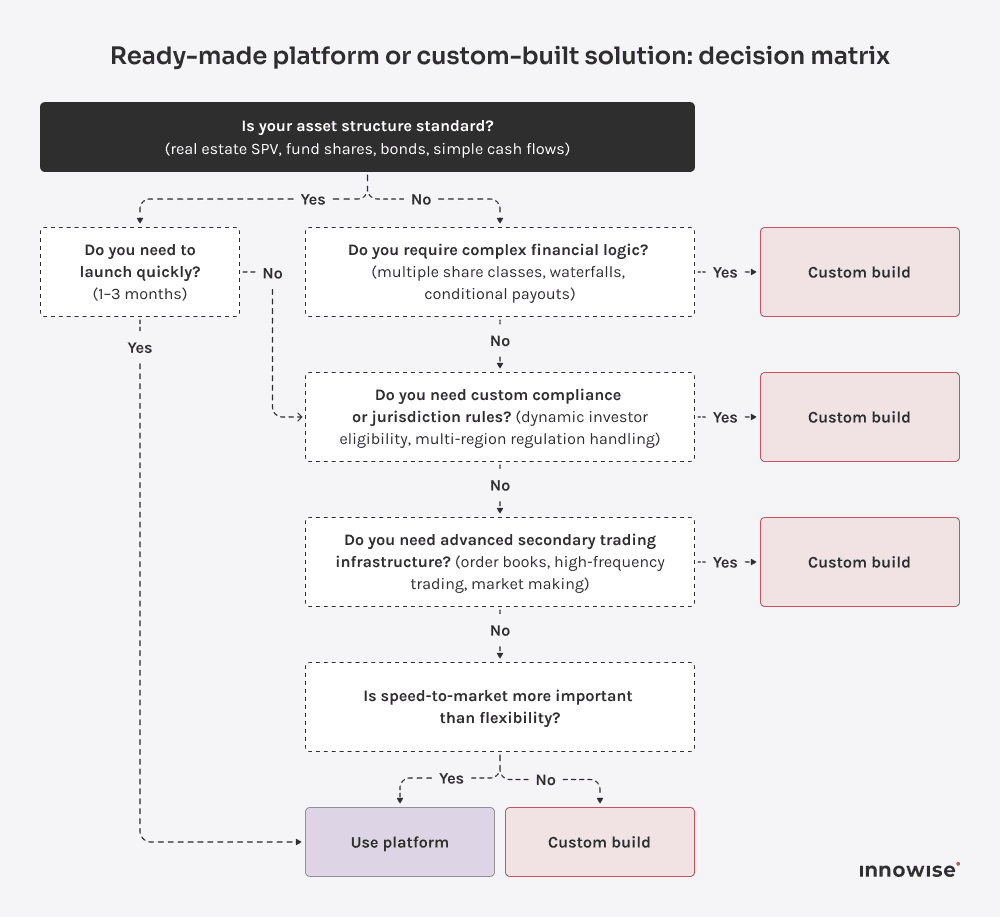
In the end, the choice is straightforward: go with a ready-made platform if you have a standard project and want to move fast with proven compliance. But if your asset requires its own unique financial logic, complex integrations, or advanced trading tools, then a custom-built solution is the way to go, as it gives you the long-term control you’ll eventually need.

Decision tree helping choose between platform solutions or custom builds based on needs

Businesses often underestimate what custom development requires. Six months can become twelve. $200K can become $500K. And in month eight, you may discover edge cases that require architectural changes.

But platforms also have limits, and you may discover them too late. “Can we add a custom compliance check?” “Can we integrate our proprietary pricing model?” “Can we change how distributions work?” Often the answer is “no” or “that’s a separate engagement.”

Take this test: can you describe your token’s economic and legal structure in three sentences that would make sense to a traditional securities lawyer?

If yes, you will probably need a ready-made platform. If the explanation takes multiple sentences with lots of “except when” and “depending on”, a custom-built solution will work better.

Trust experts to navigate legal, technical, and compliance layers

Build, white-label, or hybrid: choosing the right tokenization architecture

Where to land on — building, white-label, or hybrid — comes down to making it reflect your asset, timeline, and level of control over the legal and technical logic. 

When you opt for building your product from scratch, you get total control over the contract logic, compliance requirements, and architectural design, but in return, you’ll have the longest development timeline and the largest initial financial outlay. With white-labeling, you’ll get to go live faster and with minimal costs, but you’ll have little freedom when it comes to altering the vendor’s compliance approach, token standard, and roadmap. The hybrid approach has the key logic and compliance built to your structure, but with third parties providing custody, KYC, and on-off ramp solutions.

Click an approach below to see how the architecture changes.

Trade-offBuild from scratchWhite-labelHybrid
Time to liveBuild from scratchSlowestWhite-labelFastestHybridFast
Control / fitBuild from scratchFullWhite-labelVendor-boundHybridHigh where it counts
Lock-in riskBuild from scratchNoneWhite-labelHigh (fees, roadmap)HybridLow — we own the glue
Upfront costBuild from scratchHighestWhite-labelLowHybridMedium
Best whenBuild from scratchUnique model, long horizonWhite-labelStandard case, speed firstHybridMost real projects

Swipe the table sideways to compare all three →

Which ready-made tokenization solution fits your use case? Comparing the market players

Suppose you’ve decided that a ready-made platform meets your needs: a standard asset structure, clear compliance rules, no complex financial logic, and speed to market as a priority. The next question is which platform. You will need to identify your objective to decide on the appropriate tokenization provider for your needs: financial ownership, DeFi usage, or an infrastructure provider that will assist in developing a financial product.

I’d single out three to consider, each representing a different approach:

  • DigiShares is the compliance-first choice for regulated asset tokenization and digital securities.
  • Defactor brings a stronger RWA-to-DeFi angle, with tools for tokenized assets, on-chain capital, and yield use cases.
  • Gateway.fm is more of an infrastructure play, helping fintechs and institutions build tokenized assets, payments, and other on-chain financial products.

DigiShares: blockchain infrastructure for traditional investment structures

If you’re selling shares in an apartment building, a private investment fund, or a debt instrument, investors expect the basics to be handled properly:

  • Legal paperwork
  • Identity checks
  • Dividend payments
  • Ownership tracking
  • Compliance restrictions
  • Reports

DigiShares uses the familiar tools of financial markets but puts them on blockchain rails. Instead of spreadsheets, transfer agents, and disconnected systems, everything lives in one integrated platform.

You get:

  • Investor onboarding with KYC
  • ERC-3643-compliant token workflows
  • Cap table management
  • Automated distributions
  • Voting mechanisms
  • Compliance restrictions, including transfer whitelisting
  • Investor dashboards

An important thing to note: these tokens are designed to behave like regulated securities. You can’t deploy these tokens on Uniswap for permissionless trading because the compliance module blocks non-whitelisted transfers. 

DigiShares is best suited for compliance-heavy use cases, such as real estate funds, private equity tokenization, and debt instruments.

Defactor: RWA tokenization for DeFi collateralization

Defactor isn’t the “opposite” of digitizing ownership. It does tokenize real-world assets, but its focus is on making those assets usable as collateral in DeFi protocols.

Its specialty areas include:

  • Trade finance
  • Private credit
  • Invoice financing
  • Asset-backed lending
Process diagram of RWA tokenization, collateralization, and access to DeFi liquidity

Defactor integrates with RWA and DeFi infrastructure, its own factoring protocol, and selected DeFi lending pools. 

This is a different approach from DigiShares, which focuses on regulated investment products. Defactor is dedicated to using tokenized assets to unlock liquidity.

The trade-off is that you take on more responsibility for traditional financial infrastructure, including:

  • Banking relationships
  • Fiat on/off ramps
  • Traditional compliance workflows
  • Investor verification (though they do support identity integration)

Best for companies with receivables or cash-flow-generating assets that need working capital and want to tap DeFi liquidity instead of relying on traditional banks.

Gateway.fm: layer2 infrastructure for building fintechs

Gateway.fm is a rollup-as-a-service and Web3 infrastructure provider. It provides L2 infrastructure for institutions and fintechs to build on. It’s not building your neobank or investment app for you, but giving you the infrastructure to build and scale it yourself.

What you get:

  • Custom L2 chain deployment
  • White-label rollup infrastructure
  • Built-in compliance hooks
  • Payment rail integrations
  • Wallet infrastructure
  • Exchange integrations

Their value prop: instead of deploying directly on the Ethereum mainnet, which is expensive, slow, and competing for block space, you get your own appchain optimized for your use case.

Use cases:

  • Neobanks that need fast, cheap transactions
  • Investment platforms with high transaction volumes
  • Tokenized asset marketplaces
  • Hybrid TradFi/crypto products

The dependency risk: you’re building inside Gateway.fm’s ecosystem. Your chain runs on its infrastructure. If you want to move later, the migration can be expensive and time-consuming.

How Innowise supports asset tokenization projects

Before your decision even comes into play, you will have to ensure the tokenization process will be conducted successfully. It requires verifying legal ownership, structuring the asset correctly, designing compliance infrastructure, selecting the right blockchain, and managing the full post-issuance lifecycle. All of these we discussed in our guide on how to tokenize real-world assets. However, once they are all in place, it’s time to pick a technology stack and build a platform around it.

Choosing the right tokenization approach

Before writing any code, we analyze what is actually being built underneath the “token.” We look at:

  • Asset type
  • Legal structure
  • Jurisdiction
  • Investor model
  • Business goals

This analysis determines a key trajectory: a platform-based solution or a custom-built tokenization system.

The way we break this down for clients:

If the asset behaves like a standard fractional ownership product, a ready-made platform may be enough. For example, you may be selling shares in an SPV that owns real estate, using standard compliance rules, targeting accredited investors with straightforward distributions. Platforms such as DigiShares or Tokeny can handle this.

If the asset behaves like a financial system with its own rules, conditions, and lifecycle logic, you need custom development. Multi-class shares with different voting rights, complex waterfall distributions, corporate actions, custom oracle integration for asset-specific valuations, and atomic DvP settlement requirements all push you toward custom architecture.

When helping you choose between platform-based vs custom tokenization systems, we also consider:

  • How soon is the market entry expected
  • Does the asset fit standard issuance templates
  • Is compliance defined by the ERC-1400/ERC-3643 standards
  • Is there a need for complex financial logic
  • Do standard custody and banking integrations work
  • Can one accept platform limitations on DeFi composability
  • Is a jurisdiction unique
  • Does one have multi-class token structures with different economic rights
  • Is there a complex share structure that requires partition management

Here is how we define complex financial logic:

  • Revenue waterfalls
  • Redemption or buyback conditions tied to real-world events
  • Dividend reinvestment options
  • Rights offerings with exercise windows

Also, you may need advanced integration that we also determine during this stage:

  • Custom oracle contracts for asset valuations, such as Chainlink, Pyth, RedStone, or proprietary feeds
  • Atomic DvP settlement infrastructure
  • Deep integration with legacy systems
  • "Proof-of-X" logic where off-chain events affect on-chain behavior

If you go custom, we need to decide on secondary market infrastructure:

  • Order book matching engines
  • Market-making bots
  • Cross-chain bridges
  • Compliant DEX integration

Implementing the chosen approach

Implementation usually follows one of two tracks.

Integration of ready-made platforms

When we use existing infrastructure, we focus on:

Configuration and customization

  • Configuring issuance workflows based on your legal structure
  • Setting up investor onboarding with proper KYC providers
  • Connecting wallets and fiat on-ramps
  • Integrating with your existing systems (CRM, accounting, investor portals)

Compliance implementation

  • Mapping your legal restrictions to the platform's compliance module
  • Setting up an identity registry with the required claims
  • Configuring transfer restrictions and lock-up periods
  • Establishing ongoing monitoring and alerts

User experience layer

  • Building a product layer on top of platform APIs
  • Creating custom investor dashboards
  • Setting up reporting and analytics
  • Building mobile apps, if needed

Our goal is to make the platform feel like your product.

Building a custom tokenization platform

When we build from scratch, we design the full system architecture, including: 

Smart contract architecture

  • ERC-1400, ERC-3643, or hybrid token contracts
  • Custom compliance modules for your specific rules
  • An identity registry integrated with selected providers
  • Distribution contracts with tax withholding logic
  • Administrative functions for corporate actions
  • Recovery mechanisms such as multisig, social recovery, and transfer agent override

Oracle integration

  • Chainlink contracts for asset valuations
  • Pyth or RedStone for real-time pricing
  • Custom oracle contracts for property-specific data
  • Attestation services for off-chain event verification

Backend infrastructure

  • Investor database synchronized with on-chain registry
  • Reconciliation systems
  • Distribution calculation engines
  • Tax withholding and reporting automation
  • Corporate actions management
  • Compliance monitoring and alerting

Frontend applications

  • An investor portal to buy, sell, view holdings, and receive distributions
  • An issuer dashboard to manage offerings, trigger distributions, and handle compliance
  • An admin panel for KYC management, whitelist updates, and emergency actions

Integration layer

  • Banking APIs for fiat on/off ramps
  • KYC provider integrations
  • Custody service connections
  • Exchange and marketplace APIs
  • Accounting software synchronization

Security

  • Multiple smart contract audits
  • Penetration testing
  • Bug bounty programs
  • Ongoing monitoring and incident response

Launch and post-launch support

After launch, we help teams operate, improve, and scale the tokenization system across several areas: 

Ongoing asset onboarding and lifecycle management

  • Adding new properties or assets to the existing structure
  • Managing corporate actions like splits, redemptions, and conversions
  • Handling investor elections and voting
  • Processing distribution calculations and tax withholding

Compliance updates as regulations evolve

  • Updating compliance modules when rules change
  • Adding support for new jurisdictions
  • Integrating new identity providers
  • Adapting to new securities regulations

Expansion into new asset classes and jurisdictions

  • Extending the platform to support additional asset types
  • Supporting multi-chain deployments
  • Enabling cross-border offering

Secondary market development and liquidity improvements

  • Integrating with new exchanges
  • Supporting market maker relationships
  • Designing liquidity mining programs
  • Implementing DvP

Continuous smart contract and infrastructure upgrades

  • Adding new features based on user feedback
  • Optimizing gas costs
  • Scaling infrastructure as usage grows
  • Managing protocol upgrades and migrations when necessary

Security audits and risk reviews

  • Running annual security audits
  • Conducting penetration testing
  • Reviewing code for new features
  • Supporting incident response when issues arise

In my experience in such projects, tokenization becomes difficult when real investors, cash flows, compliance obligations, and corporate actions enter the picture. That is why it matters to have a development team you can count on after launch — not only for bug fixes, but also for the operational challenges that inevitably come with production systems.

Skip the trial and error and get expert advice before you commit

Tokenizing real-world assets in practice

It’s one thing to talk about the theory of putting assets on a blockchain, but it’s a whole different story when you’re actually building it. The work starts when you have to figure out the legal side, stay compliant, and manage how investors actually buy and sell. That’s why seeing how these systems work in the real world is more valuable than looking at a simple demo.

Blockchain-based certificates of authenticity for artwork

Provenance fraud and counterfeit works have always been a struggle in the art world. Proving the authenticity and origin of the art piece is usually a challenge for artists, and conventional certification systems are slow, expensive, and easy to forge.

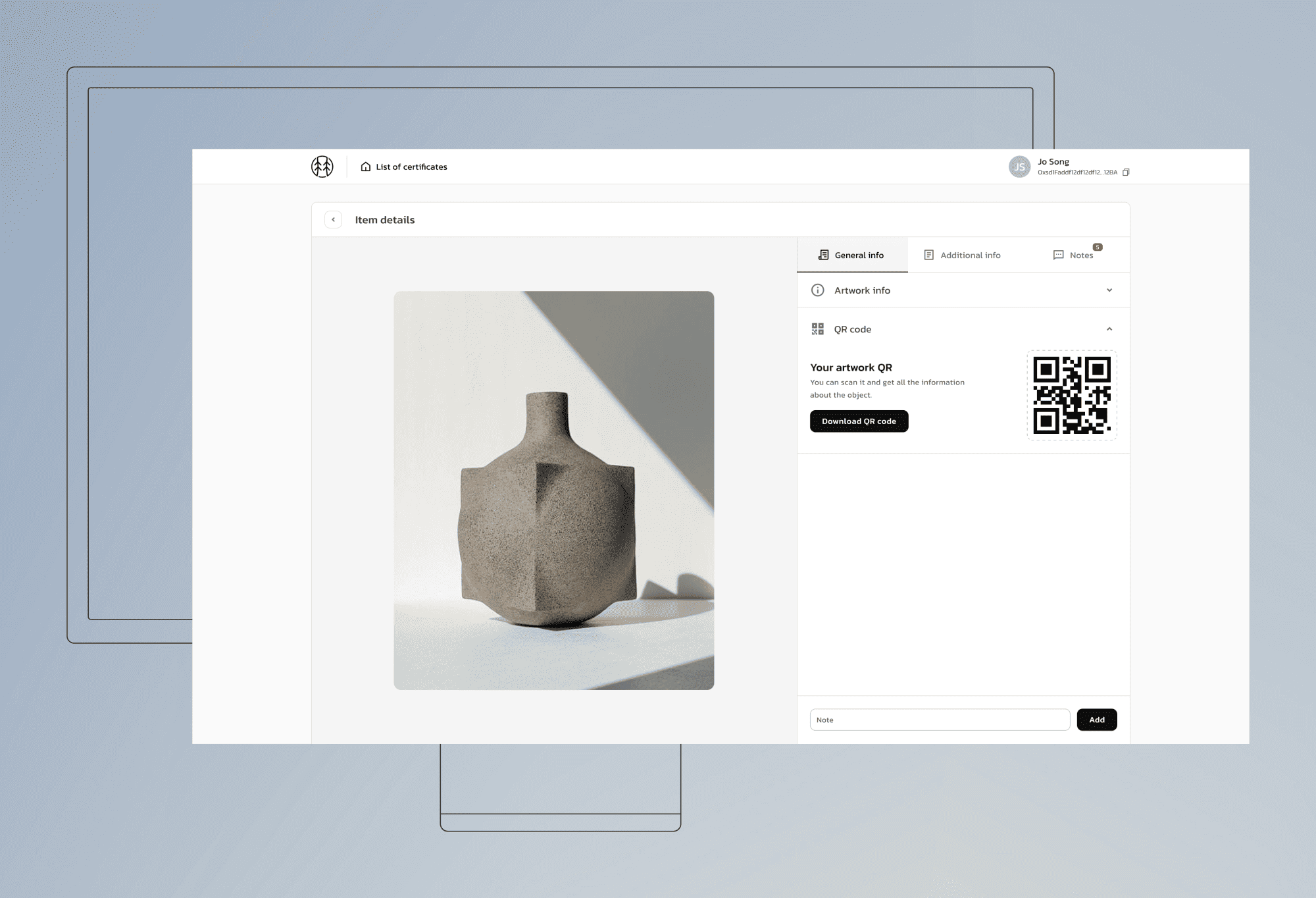
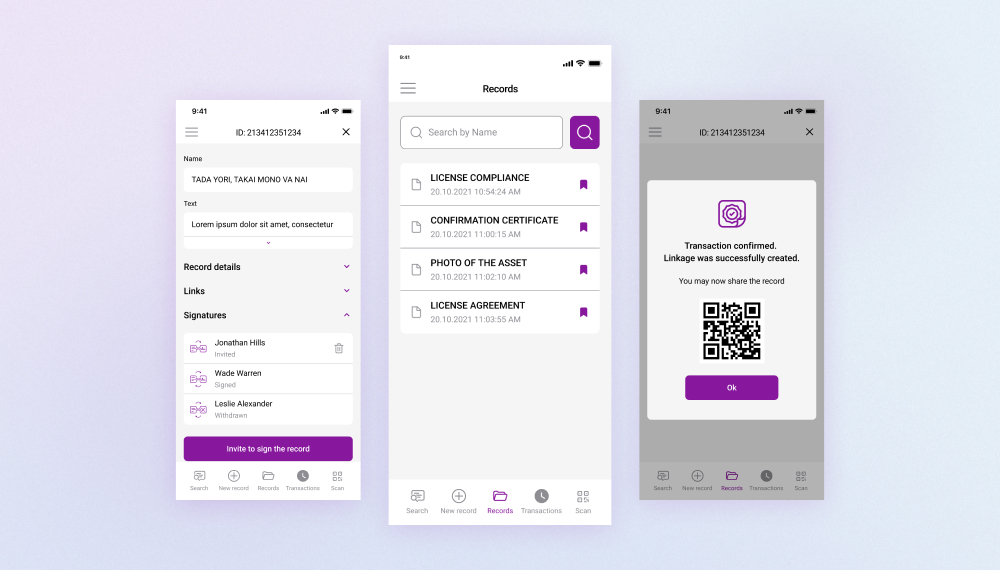
We built a management system that allows artists and galleries to tokenize their artwork and issue blockchain-based certificates of authenticity, securely stored and accessible via QR codes. Each artwork is assigned a unique ERC-721 token, with ownership and transaction history recorded on-chain and verifiable through a blockchain explorer. Certificates are also backed by IPFS, meaning the data remains accessible and tamper-proof even if centralized servers go down. Upon certificate issuance, owners receive a QR code they can share to let buyers and collectors instantly verify authenticity.

Digital certificate system for artwork tracking, ownership records, and verification management

The outcome is a process that ensures no questions of origin, prevents any potential for fraud, and provides access to a worldwide market of collectors, all while employing the very same concepts as any other reputable RWA initiative.

Drawing the line

The decision between a ready-made platform and a custom-built tokenization system comes down to how unique and complicated your asset’s financial and legal structure is. A careful assessment helps determine which path fits your project. 

If you have a standard asset, such as fractional real estate shares or a simple investment fund, the ready-made platforms are the winner. They give you speed, lower upfront costs, and built-in compliance right out of the box. 

If your asset has bespoke financial logic, you have to build. This includes things like complex revenue waterfalls, multi-class shares with different voting rights, or the need to integrate deeply with your proprietary legacy accounting systems. A custom solution is necessary to give you the long-term control and flexibility you need.

Your choice is a compromise: you are choosing between gaining speed and simplicity sooner versus high control and flexibility for the future. Yet, regardless of your chosen route, implementation is as important as selection. Given the intricate nature of compliance issues, unique financial considerations, and ongoing post-issuance lifecycles, there are ample opportunities for errors. That’s why having an experienced partner in your corner makes the difference. 

The experts at Innowise have helped clients navigate each pathway: configuring existing platforms for standard issuance or designing tokenization systems from scratch. If you’re still weighing your options or ready to move forward, we’re here to help you make the right call.

FAQ

A ready-made platform is a pre-developed solution that comes with standard compliance frameworks, pre-integrated banking and custody infrastructure, and out-of-the-box token issuance workflows. You configure it to your needs within the boundaries of what it supports. A custom solution is developed from scratch to match your specific asset structure, financial logic, compliance requirements, and integration landscape. It has no inherited constraints, but requires significantly more time and cost to build.

One of the useful tests is to try to explain the economic and legal structure of your token in three clear sentences such that an experienced securities lawyer would understand without follow-up questions. If you notice that you’re adding terms like “except” or “depending on,” it signals that the nature of the token cannot be squeezed into a platform.

Ready-made platforms can get you operational in 4–8 weeks when configuration is basic, or 1–3 months if you need deeper integrations. Custom-built solutions may require 12–18 months of development before launch, with AI features and advanced integrations adding time on top of that.

To a degree, yes. Most platforms allow configuration of compliance rules, investor onboarding flows, and basic distribution logic. However, there are limits. Custom compliance logic, proprietary pricing models, non-standard distribution mechanics, and deep legacy system integrations are usually outside the scope of what a platform can accommodate.

Look for a team with demonstrated experience across platform configuration and custom builds, so their recommendation isn't biased by capability gaps. Beyond technical execution, they should understand the legal and compliance layer well enough to flag architectural decisions that create regulatory problems downstream. Post-launch tokenization systems require ongoing compliance updates, lifecycle management, and security audits, so a partner who disappears after delivery is an operational risk.

Technically, yes, but it's not easily doable. Much of the work done on a platform, such as compliance configuration, investor registry, and token issuance history, doesn't migrate cleanly to a custom architecture. In practice, migrations tend to require rebuilding significant portions of the system. If you have a strong sense that your project will outgrow a platform within 2–3 years, it's often more cost-effective to build custom from the start rather than paying for a platform and then paying again to replace it.

Blockchain Expert & DeFi Analyst

Andrew translates decentralized concepts into secure, functional financial tools. He navigates the volatile DeFi landscape to build scalable blockchain infrastructures that address real-world utility, moving past the buzzwords to deliver technical value.

Table of contents

    Contact us

    Book a call or fill out the form below and we’ll get back to you once we’ve processed your request.

    Send us a voice message
    Attach documents
    Upload file

    You can attach 1 file up to 2MB. Valid file formats: pdf, jpg, jpeg, png.

    By clicking Send, you consent to Innowise processing your personal data per our Privacy Policy to provide you with relevant information. By submitting your phone number, you agree that we may contact you via voice calls, SMS, and messaging apps. Calling, message, and data rates may apply.

    You can also send us your request
    to contact@innowise.com
    What happens next?
    1

    Once we’ve received and processed your request, we’ll get back to you to detail your project needs and sign an NDA to ensure confidentiality.

    2

    After examining your wants, needs, and expectations, our team will devise a project proposal with the scope of work, team size, time, and cost estimates.

    3

    We’ll arrange a meeting with you to discuss the offer and nail down the details.

    4

    Finally, we’ll sign a contract and start working on your project right away.

    More services we cover

    arrow