Your message has been sent.
We’ll process your request and contact you back as soon as possible.
The form has been successfully submitted.
Please find further information in your mailbox.
Select language
Aug 8, 2026
How much would you trust an AI agent to manage your money? Analyze your portfolio? Prepare a transaction? Trade on your behalf? What about moving funds across multiple blockchains without having to understand what’s happening behind the scenes?
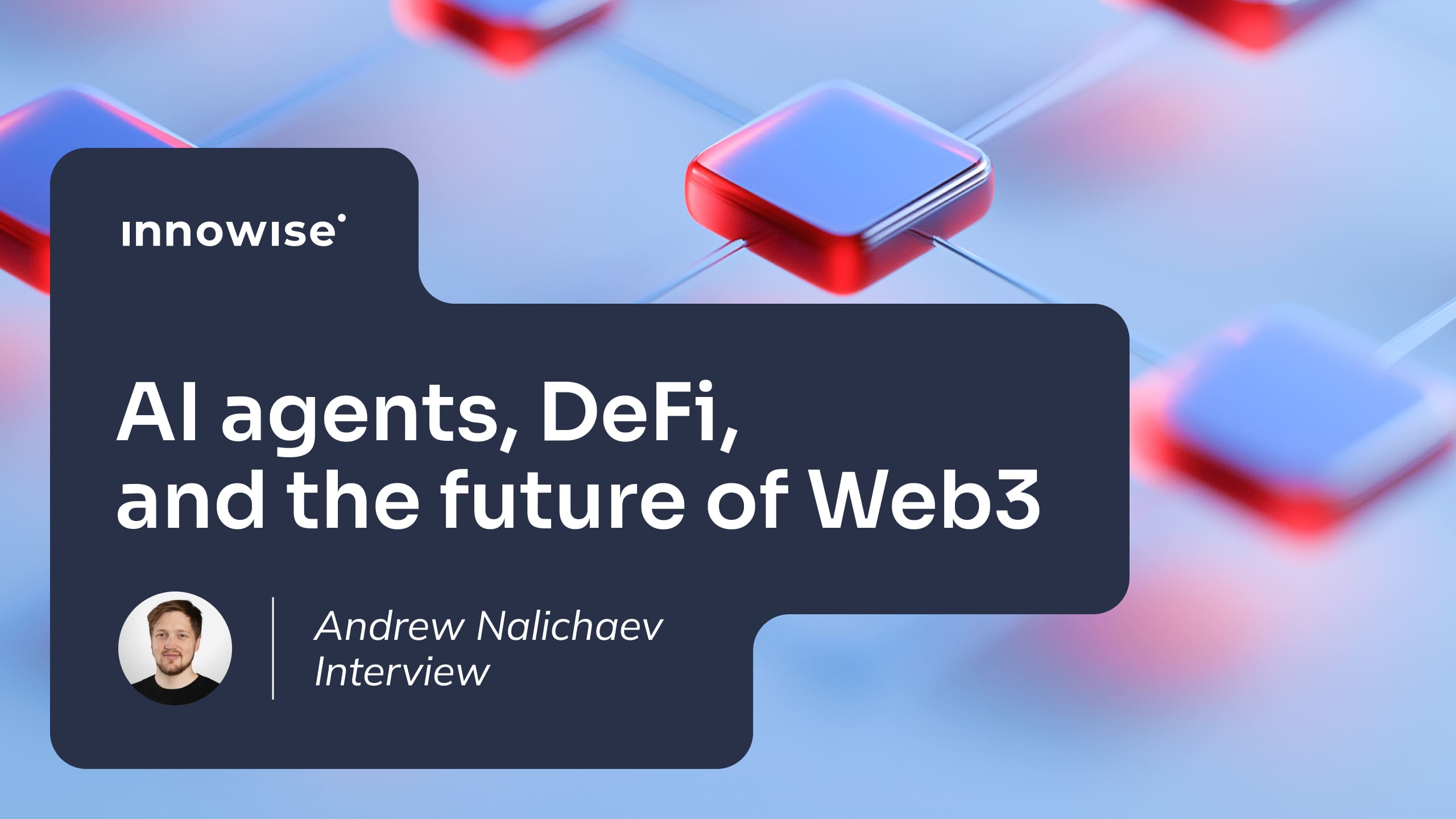
These questions are at the heart of episode 755 of the BlockHash Podcast, where host Brandon Zemp speaks with Andrew Nalichaev, Blockchain Domain Expert at Innowise, CEO of Haia, and CTO of Haust Network.
Tune in for Andrew’s take on why blockchain may work best when users barely notice it, how AI agents could change DeFi, what separates a useful Web3 product from another hype-driven launch, and what founders should get right from the start.

Brandon: Andrew, I would love to hear a bit about yourself, if you don’t mind. Tell us a bit about your background. How did you get interested in this space? Everyone’s kind of got an interesting story, so I would love to hear yours.
Andrew: I think I’ve been in this space for a long time, more than eight years now, maybe more. It’s difficult to count. But the most important part is that throughout this time, I’ve never switched to any other domains. So eight years here is a real eight years.
I started with classical finance, and I completed another bachelor’s degree in blockchain. It’s pretty funny that I actually work in line with my education. Initially, it was just about new financial mechanisms, something unique in this space. But then I realized that blockchain as a technology, and the DeFi space, can change not just fintech or how we think about banks.
There’s a pretty popular slogan that we will bank the unbanked, but in reality, the potential of this technology is much greater. Nowadays, at Innowise, we work not only with fintech, but also on transforming supply chains, logistics, medical and healthcare data, and even DNA tokenization. There are more and more use cases.
I’m pretty sure we’ll at least touch on AI agents, machine learning in general, and GPTs or Claude, whatever. I see huge potential in integrating what we have in blockchain with what AI agents can provide. So, it would be nice if we could touch on this topic.
Brandon: Yeah, it’s very exciting. I think what we’ve seen with AI and how they’ve been able to find an intersection with blockchain, and some of the exciting niches that are starting to pop up over the last two years, is really interesting. I think it was around 2024 when I saw this start to crop up for the first time.
I think there are a lot of cool things that can be done on-chain with agents, and vice versa, for security in the space and whatnot. I definitely have some questions in regard to that.
Before we do, I’d love to hear a little bit about your roles with both Haia and Haust. I know you’re CEO of Haia and CTO of Haust Network. Do you want to give us a brief overview of what those are all about, what your role comprises, and what your day-to-day looks like, just to give a bit more context?
Andrew: So, let’s start with Haust because it was the first project. Haust Network is an L2 ZK-rollup with some native DeFi mechanisms and account abstraction.
We developed the chain itself, the whole DeFi layer on top of it, and wallets that allow people to work not just with Haust Network, but with some other major chains. The core concept with Haust was that it should have a native yield mechanism. In the last crypto summer, let’s say, it really sounded like an interesting idea, and basically, we developed it.
But then we recognized that the next step should be integrating this DeFi stuff and on-chain activities, or any on-chain actions, with AI agents. We decided to create Haia, an agentic web solution that allows people to interact with many different DeFi components, different chains, and on- and off-ramping.
I can say it’s an alternative interface for interacting with blockchain in a non-custodial way. Right now, anyone can create an agent with whom you need to share your private key and then just pray for something. But we’re absolutely on the other side. I can’t agree that people should share their private keys with agents.
It’s a fully non-custodial solution. A user can just say, “Okay, I want to transfer 1,000 USDT to my grandma. Let it be on Arbitrum.” The agent says, “Sorry, but you don’t have enough liquidity on the destination chain. Let me aggregate the liquidity across many chains, across your Ethereum, Polygon, or whatever chain it is, and then make one transfer.” The user signs it in a non-custodial way.
What I’m trying to say is that we see these possibilities. We see that more and more projects are trying to create their own agents. For example, OpenSea says, “Okay, you’re able to trade NFTs with our AI agents,” which is cool. It’s really good, but it can’t satisfy all users or cover the biggest part of user intent around how to work with blockchain.
It could be trust, investment, or whatever it is. The good news, and the coolest part about Haia, is that it’s an agentic web. That means there are different agents responsible for different actions: analysis, news, trading, on- and off-ramping, sharing, or whatever. Any external agents can be added to this.
At Innowise, Haia was the first time we tried to build something like this. It wasn’t the first time we integrated blockchain with AI agents in a different way, but Haia is the first for real interaction.
Nowadays, we work on more cases for banks, institutions, and companies that want to add this to their products. It can be a wallet, a fintech application, or whatever. All of it should include some AI components, but it can be implemented in many different ways.
We see that Haia can be one MCP used to connect external services and be connected inside a bigger agentic AI system.

Brandon: What opportunities do you see for AI being integrated into the financial side of blockchain, with DeFi, for example? I imagine there are a lot of different possibilities that we’ve briefly touched on here.
Fundamentally, how do you think that will change the way people interact with centralized finance in the future, given their ability to do things autonomously or perhaps give agents access to their private keys, which scares me a little but might become a reality? They may also do trading and analysis for us. I imagine that’s going to change DeFi quite a bit.
Andrew: Sure. Let’s start with the basics. The most understandable use case is analysis. AI can analyze a portfolio, a DeFi position, the health factor, or whatever it is. Basically, we implemented this in Haia, but it’s just a low level.
The next step is converting the user’s intent into on-chain transactions without execution. So, using my example, I want to send 1,000 USDT to my granny. Can you prepare the transaction for me? Or can you analyze the transaction? It can also provide notifications, news analysis, or whatever else.
The next step, which I honestly don’t really like, is trading. For example, if you’re a memecoin trader and you want to allow your agent to interact with a trading platform, that’s also possible. But if something happens, who will be responsible for it? Or you need to sit close to your laptop and just approve, approve, approve, approve. So, it’s definitely not the best user experience.
But the next step, and what I really like, is this concept of Web4. What does it mean? It means integrating agents with blockchain. Blockchain is a layer of truth, and it’s also a way to provide a mandate to the agent: “You can do only this with my account.”
This can be done without sharing or disclosing any private key. You can define what the agent can do, for what amount, in which scenarios, what the limitations are, and in which cases it can act. It should also be time-limited.
Basically, I’ve written a lot of articles about this concept. For fintech and blockchain to work with AI agents, we need tools that limit what agents can do, in which situations, what the triggers are, and who is responsible. It should definitely be limited by money, time, or whatever else is required.
Luckily, what I can see now is that the biggest companies are starting to think about agent-to-agent payments and mandates. Blockchain is a pretty powerful tool for being this source of truth and recording the result of AI activity.
You mentioned that you first heard about the integration of AI agents with blockchain in 2024, right?
Brandon: Yeah, I think so.
Andrew: Our first contact with this idea was in 2023, when we started building a solution that used blockchain to record the results of compliance checks performed by AI agents on-chain. At that time, it was more about algorithms and machine learning.
Nowadays, agents can execute actions. For execution, we need to record what they can do, under which conditions, and somehow limit them by design, let’s say.
Brandon: Yeah, we don’t need a Skynet-type scenario. I don’t think we’re necessarily in that realm, but it leads into another question I wanted to ask you about innovation versus products.
When you have something like AI, it’s fun to move fast and see what you can do with it. Agents are a great example of that, considering what they can do on our behalf and how much we can delegate to them, whether that’s trading, running accounts, or interacting economically with other agents. There are so many possibilities, but they come with risks too. There’s a reward and a risk to moving fast and breaking things, as the old Silicon Valley notion goes.
Do you think a lot of blockchain projects fail, despite having impressive technology, because they pursue innovation so quickly that they lose sight of the problem they’re trying to solve? This doesn’t apply only to AI. I think we’ve seen it with many things in the blockchain space.
What are your thoughts on innovation versus building a product?
Andrew: It’s a cool question. I’m coming at it more from the development and technology side. I’ve participated in many projects with absolutely brilliant technology that didn’t achieve any significant results from a financial or use-case perspective.
Even now, you can see many projects with really impressive technology behind them, and I’m a big fan of some of those solutions, but they don’t achieve user adoption or find real use cases.
Each time, I say, “Okay, guys, we need a pretty strong marketing team just to let people know that this thing exists, that we can be the best solution for a particular problem, and that the services we provide can be used to solve it.”
Over the last five years, I’ve spoken with maybe 600 different leads or projects that wanted to build something. Each time, I tell them, “You should be prepared to spend half of your budget on marketing. Just accept it.” Without marketing and without hype around the project, unfortunately, even brilliant technology can fail.
But on the other side, I’ve heard people from marketing and product teams say, “We can spend any budget on marketing, but without technology and real use cases, it still means nothing.”
I think the industry should start treating Web3 like a regular business. For businesses, having a roadmap for the next two or three years is completely normal. We can compare it with Anthropic or OpenAI. They’re prepared to spend a lot of money on compute and even on tokens, because we pay less than what the tokens actually cost. They accept that.
Unfortunately, most crypto projects think, “We’re in the trend right now. We’re riding the hype, so we can achieve some goals within a few months.” But what happens next? They don’t know, because the trend can change.
I think these are really just the first baby steps. It’s like a gold rush. But in reality, we should be more careful with our budgets and start with the problem. Technology should be the answer to a problem, rather than the reason to build something.
Brandon: If you’re a builder looking for a project, or maybe even an investor looking to invest in one, with hundreds of thousands of different projects out there, sometimes chasing narratives and hype cycles, is there a way to determine whether a Web3 project has genuine product-market fit versus simply benefiting from market excitement? Or is that actually very hard to see because so many projects do that?
Andrew: For me, the most important question is: do we really need a token for this project? If the token answers a real pain point, then all good.
The next question is whether the project is just trying to get a bigger slice of the pie or trying to make the pie itself bigger. If it’s the second option, then it’s really cool.
In my ideal world, and Haia is also an answer to this, users should start using your product without understanding that they’re actually interacting with blockchain.
You can imagine a granny trying to pay her bills or buy food. She uses blockchain, but she doesn’t need to understand it. It’s the same as with email. We just send an email. Who really knows how it works? The same goes for smartphones or iPhones. Almost no one knows how they actually work, but everyone uses them.
I think that if your product meets a few of these criteria, then it may have product-market fit. We can name a few more criteria, but the most important one is this: without blockchain, without the Web3 hype, and without everything around it, does the product really solve a problem or address a pain point?
If the answer is yes, then all good. Then you can ask the next question: do we really need the token?
Unfortunately, even projects with the best technology and the best solutions can see their token price go down if there are no real use cases for the token. What’s happening with your product or business and what’s happening with the price of your token can be two completely different processes that aren’t connected to each other.
Brandon: I mean, I’m so tired of token launches, man. I swear, after 2021, I think a lot of people got tired of them too. There have just been so many chasing that short-term speculation. I think it has burned out a lot of the space.
Do you have any thoughts on how founders should approach that going forward? I know token launches can sometimes be a good mechanism for raising capital for a project, and I don’t think they’re necessarily all bad. It’s just when they’re approached with that short-term mindset, right?
What do you think needs to change in the incentive structure or tokenomics to create a launch or token that’s more focused on long-term value rather than this short-term crap?
Andrew: We’re still talking in Web3 terms: tokenomics, token launches, and so on. But these aren’t answers. They’re just tools for achieving something.
I think we need to grow up a bit and start thinking of it as a business. For example, when you build a business strategy or create a real-world or digital business, you calculate your revenue, ROI, and other parameters.
If you start with those parameters, then a token launch, raising Web3 capital, or getting funding for your idea is simply a tool for launching your product. It isn’t the final step for the project.
I really think we need to use the same metrics for crypto-related projects that we use for traditional businesses. The good news is that we’ve accumulated a lot of expertise in how to make deals and launch businesses. We’ve had thousands of years to learn how to establish entities that solve problems, starting from when people exchanged oil for water, let’s say.
Today, we can apply the same metrics to blockchain projects. You can already see this in cross-border payments, where blockchain, stablecoins, and other tokens are simply the answer to a problem, not the main idea.
For example, we see many businesses in Africa that need to make payments to the United Kingdom, but bank transfers take a lot of time and involve many fees and commissions. We can avoid some of these issues and solve the problem using stablecoins. Blockchain is simply a low-level tool here, not the main point.
Today, we work with many institutions, including banks and fintech companies. They don’t look at blockchain only as a libertarian idea or concept. For them, it’s a tool.
If it provides the answer, then we need to apply the same metrics we use in regular business to achieve success in this field as well.
Brandon: I agree. What other advice would you give to a founder at the beginning of their entrepreneurial journey? What do people often learn only through experience and mistakes but should definitely know much earlier?
Andrew: Okay, first of all, I’ve seen a lot of projects trying to build something that’s relevant right now, but during development, in six months or a year, it may no longer be relevant. So you need to make some predictions about trends and expectations.
You also need to conduct deep due diligence into what already exists. Each time, ask yourself, “If this is such a brilliant idea, why hasn’t anyone implemented it before?”
Then, when you see that you have some comparative advantage, something unique that only you have, it’s totally fine. For example, if we’re talking about tokenization and someone says, “Okay, I want to tokenize something,” in most cases, it’s apartments or real estate. It’s a slightly boring topic because anyone who owns at least one property can try to tokenize it.
But in some cases, you may have a mine, a unique asset, or industrial diamonds, and your own factories producing those industrial diamonds. Only you have that asset. You can see that a secondary market doesn’t exist for it, so tokenization could be an answer. That sounds great because only you can implement it.
That’s the first question. Only then can you start looking for technologies that can be used or implemented to achieve your business goals.
Your first research will probably involve deep research with ChatGPT, Claude Code, or whatever. But then you’ll still need to talk to a real expert who has spent years in the industry.
Most of the difficulties will appear where your solution sits between two or more worlds, components, or narratives. For example, IoT plus blockchain plus AI agents.
The biggest mistake is doing some small amount of research and saying, “Okay, I can connect blockchain with IoT and AI, and everything will be good.” In reality, most of the issues and effort won’t be in the blockchain or IoT itself, but somewhere between them, in the gaps between the technologies and even in communication.
I really advise working with third parties. One party provides one service, another provides another service, and you try to combine them. But you still need experts who have previously worked with both and can say, “Okay, you’ll face this problem, this issue, and these difficulties. You’ll also spend time waiting for documentation,” or whatever it may be.
A lot of documentation isn’t public, so you need access to internal knowledge and to talk with an expert. But start with the question, “Why hasn’t anyone else tried to build this?”
Make sure you understand what you’re getting into. You can’t just vibe through life. Due diligence and research are very important. Make sure you fully understand what you’re getting into, and only then start a discovery phase with an expert to go even deeper and gain knowledge you can’t collect from AI agents or the internet.
Brandon: So, what are you up to this year? What can we expect from you? What’s on the horizon for Haia and Haust? Is there anything we should keep an eye out for?
Andrew: Yeah, definitely. As I said, with Haia, we want to implement mandates based on account abstraction in the next update to simplify how people interact with blockchain, funds, and everything around them.
I also think we’ll see more integrations, including external services, new blockchains, and other components. More broadly, I think we’ll go deeper into working with institutions.
This applies not only to the Haust and Haia concepts. Our crypto community, development teams, and people at Innowise will also go deeper into institutional integrations and the connection between blockchain and AI agents, or the Web4 narrative.
I’m not talking about agents that simply analyze my transactions. That definitely isn’t Web4. Agents should be able to execute or do something without our constant attention, but we still need to control the process.
I think this will apply not only to financial use cases, but also to areas such as defense, government, and identity. I’m pretty sure this will become one of the next major trends in the industry.
Brandon: Exciting. Where can people go to learn more and keep up with everything you’re working on? Do you have websites, social media, or a blog? Where would you suggest people go?
Andrew: Definitely my own website. That’s where you can find the most in-depth articles. You don’t need to read all of them. You can just go to andrewnalichaev.com and ask your agent to analyze them for you. That’s probably the easiest way.
We’ve also posted many articles, expert tips, and interviews on the Innowise website. Those are more useful for getting a general overview. If you’re thinking, “What should I create?”, visit the Innowise website and look through the articles, expert tips, and interviews.
If you already know what you want to build and need additional information, you can check my website or contact Innowise. We have a very strong technical team, with many architects and domain experts.
The coolest part about the company is that we have separate teams for different domains, including machine learning, fintech, and IoT. We can collaborate internally to answer almost any question.
You can also find me on X, although it provides less detailed information than the websites or blogs.
Brandon: So many social platforms these days, but yes, those are the key ones.
Andrew: And there will be more.
Brandon: Oh, of course. At some point, we’ll probably have agents doing these episodes for us, managing our social media, and acting as our public-facing identities. So we should enjoy it while we can, right?
Awesome. Andrew, I appreciate it. It’s been a good conversation. I loved learning about what you’ve been working on at Haia and Haust, and hearing your take on AI in the industry, founders, and what they should be doing, and token launches. We covered quite a bit.
I appreciate it. Let’s definitely talk again in the near future.
Andrew: Sure thing. See you. Take care.

Andrew translates decentralized concepts into secure, functional financial tools. He navigates the volatile DeFi landscape to build scalable blockchain infrastructures that address real-world utility, moving past the buzzwords to deliver technical value.
Shape the right use case, architecture, and safeguards with Innowise.
Your message has been sent.
We’ll process your request and contact you back as soon as possible.