What is real estate tokenization and how does it work?

Rate this article:

4/5

4.8/5 (45 reviews)

Summarize article with AI

Key takeaways

  • Real estate tokenization converts physical property assets into digital tokens on a blockchain. This way, investors can purchase fractional ownership rather than the entire asset.
  • The tokenization process includes asset valuation, legal SPV formation, smart contract development, KYC verification, and the deployment of an investor portal.
  • Tokenization increases market liquidity, lowers entry barriers for small-scale investors, reduces transaction costs, and strengthens transparency and security.
  • Regulations in the sphere are complex. You have to ensure cybersecurity for digital assets, audit smart contracts, and harmonize transactions with local land registries.

The real estate industry has traditionally been associated with high entry barriers, illiquidity, and limited accessibility for small-scale investors. However, with the advent of blockchain technology, a new concept called “tokenization” is revolutionizing the way property assets are bought, sold, and traded. This article explores the tokenization of real estate and its potential as the future of real estate asset management.

What is the tokenization of real estate?

Tokenization pertains to the conversion of tangible assets from the physical and digital world, like properties and land, into digital tokens on a blockchain. Each token signifies a portion of the underlying asset, granting investors partial ownership without requiring them to purchase the entire asset in its entirety. These tokens derive their value from the corresponding property, granting investors the advantages and potential returns linked to owning properties.

Tokenized real estate is still new, but it’s gaining ground. The market size is projected to reach $19.4B by 2033, growing at a CAGR of 21%. While fractional real estate investment existed long before tokenization, blockchain-based tokens can lower entry barriers and make ownership interests easier to divide, transfer, and potentially trade. 

How does real estate tokenization work?

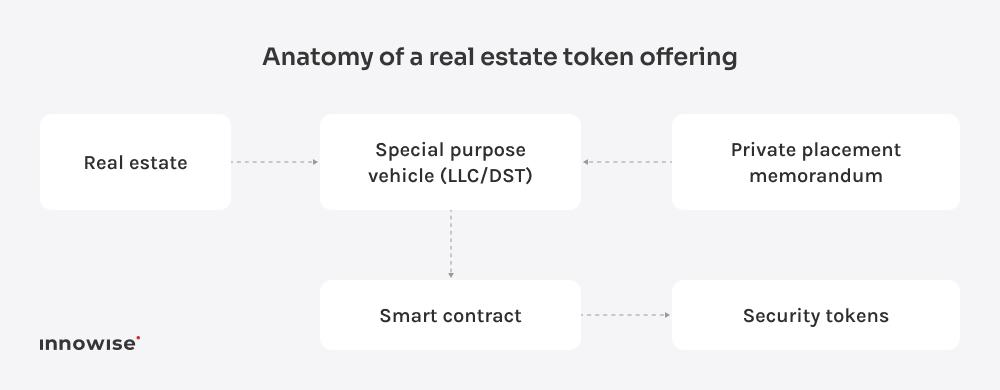
Property tokenization involves several key steps. First, a property undergoes due diligence and valuation by experts to determine its market value. Next, a special purpose vehicle (SPV) is created to hold the property, ensuring legal compliance and protecting token holders. The property is then divided into fractional ownership units, represented as real estate crypto tokens on a blockchain platform.

Investors can then purchase these tokens, which provide them with proportional ownership rights, including rental income, capital appreciation, and the ability to trade their tokens on secondary markets. Smart contracts, programmed on the blockchain, automate and enforce the terms of the investment, ensuring transparency and security.

Make your assets more accessible

Tokenize your real estate and attract a new generation of investors

Real estate tokenization process step by step

Tokenizing a real estate asset involves a sequence of legal, structural, and engineering steps that have to happen in the right order. If you neglect one of them, you risk regulatory non-compliance, a broken transfer, or a token with no exit.

Step 1. Select the asset

Start with what you’re tokenizing: a single property, a portfolio, a fund, or a debt product. The upcoming decisions will depend on your choice, including the legal wrapper, the token standard, and the compliance model.

Step 2. Run valuation and due diligence

An appraisal will determine token value and quantity. Due diligence will uncover ownership conflicts, liens, and encumbrances before they become issues on the blockchain. So, complete independent appraisals, title searches, and legal due diligence first.

Step 3. Choose the jurisdiction and legal structure

The regulations you have to apply are defined by where the offering is conducted and where your investors are located. Many projects use an SPV to hold the asset because this is a familiar legal structure for courts and regulators. Direct blockchain-based property ownership, in most jurisdictions, is not.

Step 4. Define investor rights

Your token may represent rental income, capital appreciation, voting rights, redemption rights, or a combination of these. You define it. These rights must be consistent across the legal documentation and the smart contract.

Step 5. Prepare legal agreements and disclosures

Next, you will need to draft subscription agreements, offering documents, and investor disclosures. Check the requirements in your jurisdiction and prepare the documents accordingly. When your tokens fall under the category of securities, which happens to be the case in most instances, prospectus requirements or applicable exemptions become relevant at this point.

Step 6. Design the token model

Before you start coding, you need to decide on fungibility, the appropriate token standard (ERC-20, ERC-1400, ERC-3643), supply, pricing, and transfer restrictions. At this stage, you should also specify lock-up periods, investor caps, and jurisdiction-based trading rules.

Step 7. Develop smart contracts

The smart contract enforces the investor whitelisting, jurisdictional blocks, and lock-up periods defined in step six. After you design the token, it’s time to build, test, and audit the smart contracts, compliance logic, and transfer restriction rules. What’s not in the contract won’t be enforced automatically on-chain.

Step 8. Set up KYC, AML, and investor whitelisting

To integrate identity verification, you can use providers such as Civic, Quadrata, or Privado ID. Once done, connect the verification system to the on-chain compliance layer. Investors who haven’t passed KYC will be unable to receive or transfer tokens.

Step 9. Connect wallets, payments, and custody providers

Payment rails can include bank transfers, stablecoins, or both. You also need to wire investor wallets and the appropriate digital asset custodians into them. Institutional investors often require licensed custody. The infrastructure has to align with the type of capital you seek.

Step 10. Launch the investor portal

You’ve completed all the steps above, and it’s time to give investors a user-facingportal. Deploy the issuance interface: onboarding flows, KYC verification, token purchases, and portfolio management.

Step 11. Issue and distribute tokens

Before a full offering, run a limited primary issuance to spot any gaps. Investors register, complete KYC, get whitelisted, commit capital, and receive tokens. Every step runs through the identity and compliance infrastructure that you have put in place before.

Step 12. Automate reporting, voting, distributions, and transfer restrictions

Post-issuance, the platform handles income distributions, corporate actions, KYC refresh, AML monitoring, and regulatory filings. Distributions aren’t fully autonomous, and production systems use admin-triggered flows that confirm funds are available and that tax withholding is calculated before anything executes. Secondary market access and the liquidity that comes with it depend on how well this layer was designed from the start.

How much capital can real estate tokenization unlock?

Tokenization turns illiquid shares into tradable assets and therefore unlocks locked-up capital that is present within the asset without having to sell it entirely. The model below calculates how much capital could be unlocked based on the asset’s value and the percentage of the tokenized share. The ‘cost of waiting’ table displays the potential effect of each quarter of delay on the locked capital and opportunity premium.

Monetization

Capital you unlock
€15M
Liquidity premium recovered (+5–15%)
€1.50M

Cost of waiting

Every quarter it stays unlisted you carry the illiquidity discount, and your capital sits in bricks instead of working.

Liquidity premium left on the table
€5.0M
Capital kept locked
€25M

Get an accurate calculation from our experts

Benefits of real estate tokenization

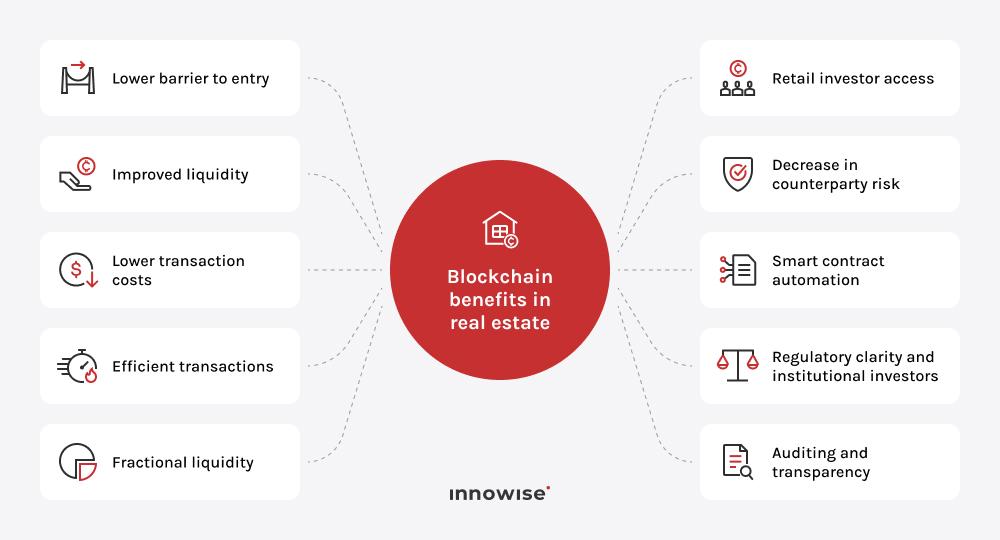
Lower barrier to entry: broadening access to real estate investments

Tokenization of properties acts as a driving force in broadening investment prospects by enabling partial ownership of physical assets. This innovative method facilitates the involvement of small-scale investors in the property market, dismantling conventional entry barriers. Unlike traditional real estate investments that often require significant initial capital, tokenization offers lower minimum investment requirements, granting retail investors access to potentially lucrative returns without imposing a heavy financial burden.

Ability to create liquidity: diversify, minimize risk, and enhance market dynamics

One of the key advantages of tokenization of property is its ability to create liquidity in the market. By harnessing the capabilities of blockchain technology, tokens representing physical assets can be transferred with ease and with strong security measures. This feature allows investors to enhance portfolio diversification and mitigate risk. Through investing in fractional portions of assets, individuals obtain the freedom to engage in buying and selling tokens on secondary markets, thereby unlocking assets that were previously difficult to liquidate. This newfound liquidity empowers both investors and asset owners, fostering a more dynamic and inclusive market for tangible assets.

Lower transaction costs: streamlined processes and enhanced returns

Real estate tokenization brings forth the potential for lower transaction costs through automated processes and the utilization of a permanent, tamper-proof digital ledger. By leveraging blockchain technology, investment transactions can be streamlined, reducing time-consuming paperwork and administrative burdens. The automation and efficiency of tokenization not only expedite transaction completion but also contribute to cost savings for all parties involved. Ultimately, this leads to enhanced returns for investors, as higher efficiency translates into increased profitability.

Furthermore, tokenization offers additional benefits such as real-time capitalization table tracking, improved accessibility, and greater transparency for potential investors. With blockchain’s decentralized ledger, stakeholders can gain valuable insights into the investment landscape, empowering them to make informed decisions based on accurate and up-to-date information.

More transparent and efficient transactions: revolutionizing the buying and selling process

Tokenization revolutionizes conventional transactions involving physical properties by eliminating intermediaries like brokers or agents. This simplified process accelerates the buying and selling of assets, reducing complexities and improving transaction efficiency. The incorporation of blockchain technology guarantees transparency, as all transactions are recorded and unchangeable on a decentralized ledger. This increased transparency cultivates trust among investors, mitigates the risk of fraudulent activities, and enhances the overall integrity of transactions.

Better liquidity: fractional ownership and secondary markets

Tokenization of tangible assets breaks the liquidity barrier of traditionally difficult-to-sell assets by dividing them into tokens. This model of fractional ownership empowers investors to trade fractions of these assets on secondary markets, presenting an exit opportunity and augmenting overall liquidity. Property owners can unlock the value of their assets, while investors enjoy increased flexibility and diversification in their investment portfolios. The secondary market for these tokens further amplifies liquidity by offering a platform for seamless interaction and efficient transactions between buyers and sellers.

Opportunity for small-scale investors: democratizing real estate investments

Tokenization expands the accessibility of the property market, making it inclusive for a wider range of investors, including those with limited budgets. By reducing the minimum investment requirement, tokenization enables individuals to invest in valuable properties that were previously out of reach. This democratization of property investments empowers small-scale investors to engage in this asset class and reap the potential returns associated with real estate ventures. Through tokenization, individuals now have the opportunity to explore and capitalize on real estate prospects that were previously limited to a privileged few.

Decrease in counterparty risk: enhancing trust and security

Tokenization of assets harnesses the secure features of blockchain technology, effectively minimizing counterparty risk. Smart contracts, which are integral to tokenization, guarantee that transactions only take place upon meeting predetermined conditions. This eradicates the potential for fraud or non-compliance, establishing a secure investment environment for investors. Additionally, fractional ownership made possible through tokenization disperses risk among multiple investors, rather than concentrating it solely with one owner. Through the reduction of counterparty risk, tokenization bolsters investor confidence and cultivates a more robust investment landscape.

Driving down transactional costs and enhancing efficiency: the power of smart contracts

Tokenization introduces the transformative potential of “smart contracts,” revolutionizing transactional processes in the real estate industry. By replacing traditional paperwork and laborious administration, smart contracts streamline and automate complex tasks, significantly reducing operational costs and enhancing overall efficiency. This innovative technology enables the frictionless transfer of digital property assets, opening new avenues for investors to navigate previously cumbersome processes swiftly and securely. Smart contracts hold the promise of reshaping the way transactions are conducted in the real estate market, paving the way for a more efficient and cost-effective investment landscape.

Regulatory clarity and institutional investors: paving the path for growth

Although the benefits of secondary markets for digital property assets are clear, attracting active participation from institutional investors hinges on regulatory clarity. As institutional investors anticipate clearer regulations, the market stands ready for substantial expansion once necessary frameworks and guidelines are established. The market’s development will be expedited by increased involvement from institutional investors, resulting in additional growth and the fulfillment of real estate tokenization’s full potential.

Auditing and transparency: adding value to investment portfolios

Digital assets incorporated into investment portfolios bring added transparency and traceability, thanks to the inherent properties of blockchain technology. The utilization of blockchain’s immutable and decentralized nature ensures that transactions are transparent and trackable, instilling investor confidence and promoting accountability. By embracing digital assets, investors benefit from an audit perspective, as the underlying technology enhances the clarity and reliability of financial records. The incorporation of blockchain-based digital assets represents a significant step forward in portfolio management, as it adds value through increased transparency and instills trust among investors.

Build and launch your fractional ownership end-to-end

Real estate tokenization risks and challenges

While tokenization presents numerous benefits, it also comes with certain challenges and risks. These include regulatory uncertainties, potential market volatility, the need for robust cybersecurity measures, and the reliance on blockchain infrastructure. Addressing these challenges through regulatory frameworks, industry standards, and technological advancements will be crucial for the widespread adoption of tokenized real estate.

Ensuring regulatory compliance

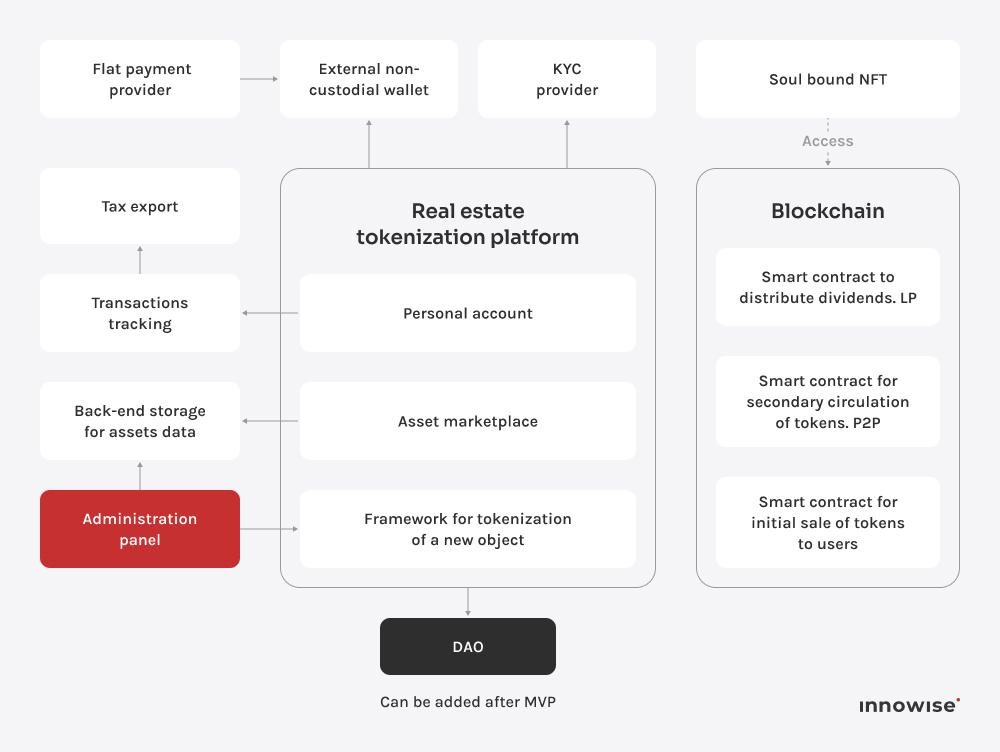
To comply with local regulations, it is essential to enforce mandatory user identification before selling tokens. For instance, no state would allow token issuance unless they are confident that people from terrorist organizations can’t obtain them. To meet these requirements, we implement a smart contract-based token access blocking system by combining SoulBound NFT technology and KYC procedures. As a result, users who have not undergone KYC or dont possess the corresponding SoulBound NFTs in their wallets will be unable to engage in any token-related operations or access the platform.

Securities law implications

In general, the categorization of real estate tokenization as a security is common, but it is crucial to assess each individual token separately from the beginning. If a token is deemed a security, the issuance of said token will be governed by relevant prospectus requirements or the possibility of relying on an exemption, such as the “accredited investor” exemption. Furthermore, the issuer must also take into account the relevant registration obligations, in addition to the prospectus requirements.

Reconciliation with the land registries

To ensure distinctiveness in the tokenization of properties, it is crucial to align the transaction with the prevailing land registration systems. For instance, given that each region in Canada maintains its own land registration system, a property token issuer must take on the responsibility of harmonizing the transaction with the land registration systems in the specific regions where the physical properties are located. 

Managing liquidity risk

The majority of tokens are still traded on the platform on which they were issued. This restricts the investor base and reduces the benefits of increased liquidity, which tokenization can bring. The market is not balanced, as there are some assets that have regular transactions on a daily basis, whereas there are other assets that don’t have any activity even after weeks.

Strengthening cybersecurity

The private keys, the KYC information, payments, and investor account management records on your platform are targets for attackers. The institutional custodian uses a layered approach, with cold storage in combination with hardware security modules (HSMs), multi-party computation (MPC), and multi-signature authorization, since one is not enough. The custody service affects compliance programs, risk frameworks, insurance, and scale. Cybersecurity has to be considered from the architectural point of view.

Auditing smart contracts

Smart contracts can’t be changed once deployed. A vulnerability in transfer logic, access controls, or distribution functions is therefore not simply a bug to address in the next routine release. It can create an immediate risk for every token governed by the affected contract. Smart contract auditing goes beyond code review: it examines security weaknesses, legal compliance, and possible exploits before deployment. Manual audits by expert developers tackle complex vulnerabilities and, for critical contracts in 2026, can take several weeks and cost up to $150,000. For production tokenization systems, that cost is not optional.

Maintaining platform reliability

Distribution, KYC verification, transfer limitation, and reporting run all the time. Downtime becomes a compliance problem when investors’ transactions can’t be settled and regulatory reports can’t be submitted within a certain timeframe. The platform architecture must have SLAs for uptime, infrastructure redundancy, and incident management protocols that take into account on-chain finality since there is no way to reverse transactions when things go wrong.

Securing custody of digital assets

Institutional custodians typically use a combination of security controls, which may include cold storage, HSMs, MPC, and multi-signature authorization.  Usually they’re used in layering hybrid forms. In the United States, the OCC has conditionally approved national trust bank charters for firms including BitGo and Fidelity Digital Assets. Institutional investors have a clear benchmark to use when selecting suitable custodians. The infrastructure of platforms intended for large capital must adhere to these standards.

Handling tax reporting

Rental income distributions incur withholding based on the investor’s jurisdiction. The treatment of capital gains varies from one market to another. Year-end reporting duties, such as Form 1099 reporting for US investors and their equivalents elsewhere, must be made automatic and audit-ready. Production infrastructure takes care of that with an external compliance module and an Oracle data feed, which compute the withholding per investor prior to any distributions.

Maintaining transparent investor records

The custodian, the beneficial owner, and the blockchain address are not necessarily the same party. In the case of an institutional investor, whose assets are held by the third-party custodian, the blockchain will register the custodian’s blockchain address, while the legal ownership is that of the institutional investor. The platform should therefore include processes for reconciling on-chain records with custody and beneficial-ownership records. Note: The ratings above reflect Innowise’s assessment and may change depending on jurisdiction, asset class, and the specific implementation details.

Check the liquidity setup

Whether a venue may accept your token depends on three factors: jurisdiction, investor base, and token standard. Select an option for each below to see which venue may be suitable and whether your proposed setup appears feasible. 

Verdict
Yes — clear path

Permissioned standard + defined investor base = multiple regulated venues will accept this token.

Venue landscape — eligible for your setup
RealT marketplace
US · platform
Secondary trading for fractional US rentals.
Lofty
Algorand
Daily rent, low-fee secondary for single homes.
21X
EU · DLT MTF
First licensed EU DLT exchange for security tokens.
Archax
UK · FCA
Exchange + broker + custody for digital securities.
tZERO
US · SEC ATS
Regulated secondary for security tokens.
P2P bulletin board
Any · whitelist
Manual whitelisted offers — earliest liquidity.

Real-world use cases

The tokenization of property has introduced a groundbreaking approach that is transforming the conventional landscape of property ownership and investment. This innovative concept, although relatively new, has already witnessed notable success stories in the realm of digital real estate. Here are a few examples of digital real estate.

Pioneering tokenization: Elevated Returns and St. Regis Resort

In 2018, Elevated Returns, an asset management firm based in New York, made headlines by completing its first tokenization real estate deal. The company embarked on a groundbreaking initiative by tokenizing the prestigious St. Regis Resort in Aspen, Colorado, with an estimated value of $18 million, using the Ethereum blockchain. Initially planning to sell the property as a single asset, Elevated Returns opted to offer 18.9% ownership through the sale of tokens.

To facilitate the token sale, Elevated Returns partnered with Templum Markets LLP and utilized the Indiegogo platform. This collaborative effort opened doors to new possibilities in tokenized real estate investment, attracting a wider range of investors keen on participating in fractional ownership.

Red Swan and the power of tokenization

Red Swan, a Texas-based commercial real estate marketplace, has also made significant strides in the field of tokenization. Leveraging the security token platform Polymath, Red Swan successfully tokenized a staggering $2.2 billion worth of real estate assets, with an additional $4 billion in properties lined up for tokenization, as reported by CoinDesk in February 2020. This impressive achievement underscores the growing recognition of tokenization as a catalyst for liquidity, efficiency, and cost reduction within the real estate market.

T-RIZE and Project Champfleury

In December 2024, T-RIZE Group secured a $300 million deal to tokenize Project Champfleury, which is a 960-unit residential project located in Montreal, Canada. This deal was remarkable in two ways: first, this tokenization involved a project that was under construction, and second, this deal involved accredited investors from the US and abroad via Texture Capital, an SEC-registered ATS and FINRA broker-dealer. It’s among the largest single tokenized real estate transactions on record.

Dubai: a government-backed pilot

In March 2025, the Dubai Land Department launched the pilot phase of its Real Estate Tokenisation Project. The initiative was supported by VARA. This project estimates that about 7% of the total real estate transactions in Dubai can be conducted through tokenization and will be worth around AED 60 billion by 2033. Most projects related to tokenization in the private sector are usually not supported by regulatory frameworks; however, this particular one operated within a regulatory framework developed by the Dubai Land Department and VARA, which made it one of the few cases where governments are working on tokenized property deals.

The future of tokenized real estate assets

The future of tokenized real estate assets holds great promise for transforming the industry and revolutionizing investment opportunities. As technology continues to advance and regulatory frameworks adapt, we can anticipate a widespread adoption of tokenized real estate on a global scale. This shift will likely be accompanied by the emergence of specialized platforms and tokenized real estate marketplaces dedicated to trading real estate tokens, which will enhance liquidity and expand investment options.

Tokenization offers a convenient and cost-effective method for investing in real estate assets. However, due to its novelty, there is still a lack of consistent regulatory frameworks governing real estate tokenization. The application of securities laws varies depending on the nature of the tokenized asset, and this lack of clarity can pose challenges for market participants.

Despite these challenges, tokenization has the potential to revolutionize real estate investment by increasing liquidity in an otherwise illiquid asset class, reducing barriers to entry for retail investors, and lowering transaction costs. However, it is crucial to address key issues such as establishing clear market regulations, reconciling tokenized assets with land title registries, and implementing centralized reporting of transactions.

If you’re looking to capitalize on the opportunities presented by real estate tokenization, Innowise’s industry experts will advise you on navigating the complexities and making it efficient.

FAQ

Real estate tokenization transforms the right to own or earn from real estate into a digital token on the blockchain. Every token denotes a certain fraction of the property or the rights linked to it, such as a share of rental income, equity, or debt. The underlying property doesn’t change hands but still acts like an investment instrument.

The asset is set up within a legal structure such as an SPV, and tokens representing interests within the legal structure are created on a blockchain. Investors complete the KYC procedure and are listed within the smart contract to buy the tokens from the issuing platform. At this stage, all distribution, transfer rules, and regulations take place on-chain. The asset itself stays in its place while its ownership changes.

The main ones are fractional access, faster capital deployment, and secondary market liquidity. A $50 million asset that previously required a large institutional investment can be split into smaller positions and sold to a broader investor base. Distributions are automated, and transfers settle faster than traditional property transactions. For issuers, it means more investors, lower minimums, and capital that doesn't require a full asset sale to access.

It doesn’t work that way. In most cases, the token is just a representation of equity in the SPV, which owns the physical asset. It’s not a claim directly on the physical asset. This is important for regulatory and tax purposes and in the event of a dispute or insolvency. The rights associated with the token — income, voting, and redemption rights — will be defined in the contractual documents and programmed in the smart contract.

Tokenization has been applied to residential property, apartment complexes, commercial property, hotels, development projects, real estate debt, mortgage pools, and fund interests in practice. The kind of asset determines the legal structure, token standard, and compliance model that is applied. While a single asset usually requires the establishment of an SPV, a portfolio of assets can be structured through a fund or trust, and debt tokenization requires another approach. The nature of the asset doesn’t determine tokenization feasibility. The legal structure and jurisdiction do.

Certainly, in jurisdictions which have such frameworks. In Europe, tokenized securities generally remain subject to existing financial-services legislation, while the DLT Pilot Regime provides a framework for trading and settling certain tokenized financial instruments. In the US, security token offerings may rely on exemptions such as Regulation D or Regulation S. Switzerland’s DLT Act and the regulatory regimes administered by ADGM and VARA in the UAE and MAS in Singapore address tokenization in different ways.

Smart contracts determine the conditions under which the token can be held and transferred, when a distribution will occur, and any other rules required by the relevant jurisdiction. Smart contracts don’t substitute for any legal agreement; they simply fulfill the conditions.

It depends on the chosen architecture, jurisdictions, and compliance requirements. Based on our project estimates, an MVP that includes token generation, KYC implementation, investor dashboard, and secondary market wiring takes between 2,400 and 3,500 engineering hours.

Show more Show less

Blockchain Expert & DeFi Analyst

Andrew translates decentralized concepts into secure, functional financial tools. He navigates the volatile DeFi landscape to build scalable blockchain infrastructures that address real-world utility, moving past the buzzwords to deliver technical value.

Table of contents

    Contact us

    Book a call or fill out the form below and we’ll get back to you once we’ve processed your request.

    Send us a voice message
    Attach documents
    Upload file

    You can attach 1 file up to 2MB. Valid file formats: pdf, jpg, jpeg, png.

    By clicking Send, you consent to Innowise processing your personal data per our Privacy Policy to provide you with relevant information. By submitting your phone number, you agree that we may contact you via voice calls, SMS, and messaging apps. Calling, message, and data rates may apply.

    You can also send us your request
    to contact@innowise.com
    What happens next?
    1

    Once we’ve received and processed your request, we’ll get back to you to detail your project needs and sign an NDA to ensure confidentiality.

    2

    After examining your wants, needs, and expectations, our team will devise a project proposal with the scope of work, team size, time, and cost estimates.

    3

    We’ll arrange a meeting with you to discuss the offer and nail down the details.

    4

    Finally, we’ll sign a contract and start working on your project right away.

    More services we cover

    arrow