Hoe bouw je een app voor maaltijdbezorging: functies, werkwijze en kosten

18 september 2026 10 min lezen
Operationeel Directeur Levering & Hoofd van het Competence Center
Gecertificeerde deskundige
Elk artikel op Innowise is geschreven door auteurs met praktijkervaring. Zij hebben niet alleen theoretische kennis van het onderwerp, maar delen ook inzichten uit concrete projecten.
10+ jaar ervaring
Gecertificeerde deskundige
10+ jaar ervaring
Siarhei specializes in high-stakes regulatory environments and complex delivery hurdles. He transforms abstract business requirements into secure, scalable architectures, ensuring that every project is technically sound and future-proof.
Expertise
Fintech Regtech AI & ML
Laten we praten

Belangrijkste opmerkingen

  • Fintech hiring is not general software hiring with extra paperwork. A developer who has never worked with a ledger, a settlement cycle, or a compliance control will cost you more in rework than you save on their day rate.
  • The engagement model matters almost as much as the individual. Working with freelancers, augmenting your staff, and outsourcing to a dedicated team carry different risk profiles, and the wrong choice is a common reason fintech projects stall before launch.
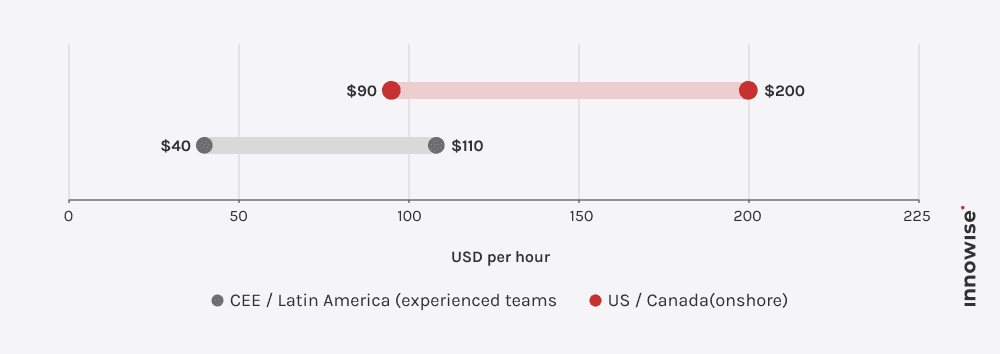
  • Rates vary widely by region and by how much real financial domain experience you’re paying for. US onshore rates typically run $90 to $200 an hour, while rates for experienced CEE or Latin American teams land closer to $40 to $110, plus a modest fintech premium on top.
  • Security assessment isn’t a box to check. It’s the difference between catching a problem in code review and explaining it to a regulator later.
  • Hiring realistically takes longer than most product roadmaps assume, and that’s before you add domain vetting to a standard technical interview.
  • AI coding tools are now everywhere in developer workflows, but trust in their output has fallen as usage has risen. That combination should change how carefully you review code, not how much of it gets written.
 
Artikel samenvatten met AI

I lead Innowise’s fintech direction, so I spend a lot of my time watching companies hire developers for products that move real money, and seeing what happens when the hire doesn’t hold up. The pattern is consistent: a strong generalist gets brought on for a payment or lending product, ships something that works fine in every demo, and then a reconciliation error, a duplicate charge, or a compliance gap surfaces months later, always at a much worse moment than if the right questions had been asked during the interview.

This guide is built around avoiding that pattern. I’ll cover what actually separates a fintech developer from a developer who happens to be building a fintech feature, where to find one, a nine-step hiring process, real cost and timeline numbers, and where AI tools help versus where they just add a new category of risk to account for.

What makes hiring fintech developers different?

A lot of job postings ask for someone who genuinely cares about quality. Fintech is one of the fields where that claim gets tested, because the cost of not caring shows up as a wrong number in someone’s account. And this is much more serious than a slightly ugly button, isn’t it? So, what should you look for when hiring a fintech developer? Here are the skills and qualities that matter most.

Toekomstbestendige functies

Hiring a general developer to build a payment or lending product is a bit like hiring a talented home cook to run a restaurant kitchen. They can cook. What they haven’t done is pass a health inspection, manage inventory that has to reconcile to the cent, or work a service where a mistake means a customer gets sick. A fintech developer needs to understand double-entry accounting, settlement and clearing cycles, currency rounding, chargebacks, and why retrying a failed payment automatically is a much harder problem than it sounds. None of this shows up on a typical resume, which is exactly why it needs to show up in your interview.

Beveiligingseisen

Financial services had the second-highest average data breach cost of any industry in IBM’s 2025 Cost of a Data Breach Report, at $5.56 million, behind only healthcare. That figure reflects forensic investigation, regulatory fines, customer notification, and the slower bleed of customers who leave once a breach makes the news. A fintech developer should be able to talk fluently about encryption in transit and at rest, tokenization, least-privilege access, and secure development lifecycle practices.

Reliability and data integrity

Banking software doesn’t get away with the kind of bugs a lot of consumer software tolerates. A bug in a photo app loses someone a like. A bug in a ledger loses someone’s rent money, and it usually does so silently, which is worse. A fintech developer needs to build with idempotency, audit trails, and reconciliation in mind from the start.

Regulatory awareness

Your developers don’t need to be compliance officers, but they do need to recognize when an elegant technical shortcut could create a compliance issue under  PCI DSS, SOX, GLBA, or a state money transmitter requirement, and say so before it ships. This is one area where a specialized fintech consulting partner earns its fee, because working out which regulations apply to your product is a different skill from writing the code that complies with them.

Where can you hire fintech developers?

Once you know what you’re actually looking for, the next decision is where to look, and this is where a lot of teams default to whatever channel they used for their last hire instead of matching the hiring model to the risk.

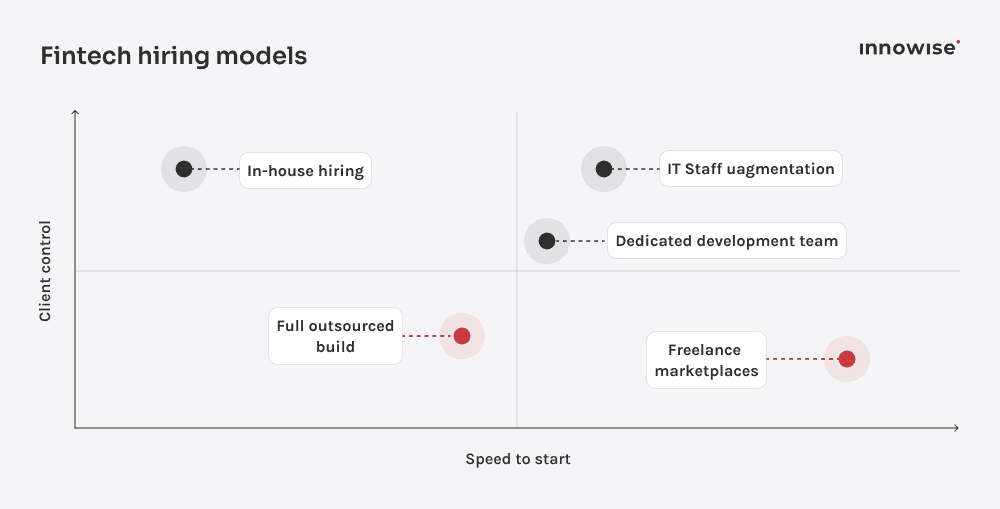
  • Freelance marktplaatsen. Fast and flexible for a narrow, well-defined task, but vetting financial domain knowledge and security discipline falls entirely on you, and continuity isn’t guaranteed.
  • IT Staff Augmentation: You add vetted specialists to your existing team and keep architecture and code review under your own control. This is a solid fit when you already have technical leadership in-house and just need to fill specific skill gaps.
  • Toegewijd ontwikkelingsteam. An outsourced team works as an extension of yours under your direction. It’s really useful when you need several roles at once (back end, QA, DevOps) without running separate hiring processes for each.
  • In-house hiring. It gives you the most control and the deepest institutional knowledge, at the cost of a slower and more expensive hiring cycle, which matters if your roadmap can’t wait two to three months for the right candidate.
  • A full outsourced build. You hand an entire product to a vendor, which can be reasonable for a well-scoped MVP. But the model demands the most careful vendor vetting, since you’re trusting someone else’s judgment on architectural decisions you’ll be living with for years.

Not sure which hiring model fits your fintech project?

How to hire fintech developers: 9-step process

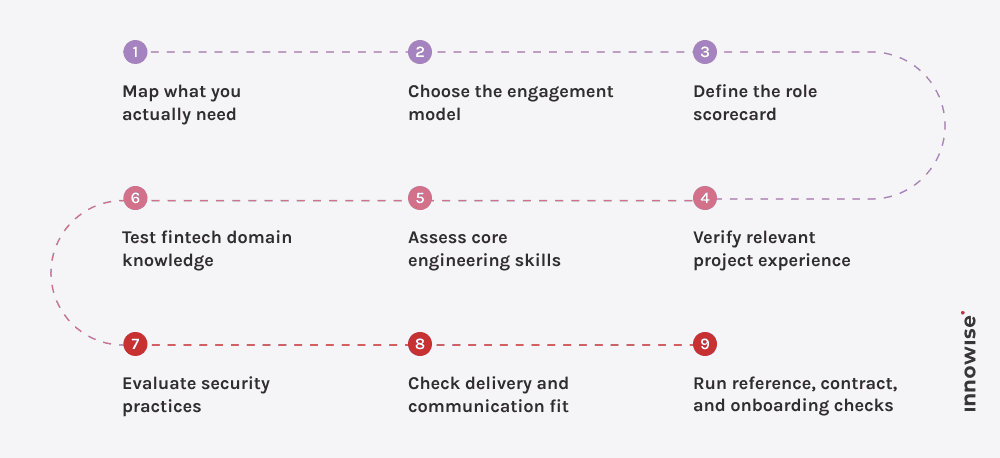
I’m listing nine steps here, but the real first one is deciding what you really need before you write a job description. It gets skipped more often than any of the others, so that’s where I’m starting.

1. Map what you actually need

Decide what you’re building (a payment processor, a lending platform, a trading tool) before you write a single interview question, because each one draws from a different pool of specialized experience. Also decide, honestly, whether this is a permanent in-house role, long-term external support, or a project with a defined end, since that answer should drive the engagement model you pick next.

2. Choose the engagement model

Weigh urgency, budget, and how much architectural control you need to keep in-house against the options above. If you need one specialist to plug a gap for a few months, staff augmentation usually beats standing up a full recruiting pipeline. If you need six roles filled at once, a dedicated team usually beats hiring six people separately.

3. Define the role scorecard

Write down, before any interviews happen, which skills are non-negotiable and which are nice to have. A scorecard keeps you from falling for a candidate who’s a great conversationalist but weak on the two or three things that matter for your product.

4. Verify relevant project experience

Fintech experience on a resume can mean anything from architecting a core banking system to building a marketing site for a bank. Ask for specifics: which part of the payment flow they owned, what happened when something broke, what they’d do differently now. Vague answers here are a bigger red flag than a thin resume with specific, verifiable detail.

5. Assess core engineering skills

This part looks like a normal senior developer interview, and it should, because a fintech developer still needs to write clean, testable code, design sensible architecture, and review a pull request properly. The difference is that they do it in the context of financial data models instead of a generic to-do app.

6. Test fintech domain knowledge

Ask scenario questions that a general developer won’t have a ready answer for: how would you design a payment retry so a network timeout doesn’t cause a double charge, how do you handle rounding for currencies with different decimal places, what happens to your ledger if a webhook arrives twice. Real domain knowledge sounds different from a good guess.

7. Evaluate security practices

Go beyond asking whether they’ve heard of PCI DSS, and ask them to walk you through the security work they did on their last project, including secrets management, dependency scanning, and secure code review. Certifications are a starting point, but they are not proof of anything on their own.

8. Check delivery and communication fit

Time zone overlap, communication style, and how someone handles disagreement matter more in fintech than in a lot of other software work, because financial features tend to involve more stakeholders (compliance, finance, sometimes legal) who all need clear updates, not just working code.

9. Run reference, contract, and onboarding checks

Call actual references and ask about failure, not just success. Read the contract for IP ownership, liability, and what happens if the developer needs to be replaced. Then plan onboarding deliberately: grant production access on a least-privilege basis, and save the parts of the system that can cause damage for last, not first.

Fintech developer skills checklist

Pulling from the process above, here’s the checklist I’d actually hand to a hiring manager, grouped by category instead of one long undifferentiated list.

Architecture questions

  • How would you design a system that processes payments reliably even when a downstream service is temporarily unavailable?
  • Walk me through how you’d structure a ledger to make every transaction auditable after the fact.
  • What’s your approach to treating money as a data type, and what’s gone wrong for you in the past when it wasn’t handled carefully?

Beveiligingsvragen

  • How do you handle secrets and credentials in a financial application, and what’s your plan if one leaks?
  • What did a secure code review look like on your most recent project?
  • How would you design access controls for a system where different roles need very different visibility into transaction data?

Domain questions

  • How would you prevent a duplicate charge if a payment request times out and gets retried?
  • What’s the difference between authorization and settlement, and why does that distinction matter for your architecture?
  • How do you handle currency conversion and rounding without introducing drift across millions of transactions?

Delivery questions

  • Tell me about a time a compliance requirement changed a technical decision you’d already made. What did you do?
  • How do you communicate a delay or a bug to a non-technical stakeholder on a regulated product?
  • What does your testing strategy look like for a feature that touches real money?
The technical bar is table stakes at this point. Most experienced developers can write clean code. What separates a good fintech hire is whether they ask about edge cases before you bring them up. Someone who immediately asks what happens if a payment gets retried twice, or what happens to a transaction if the service crashes halfway through, has probably been burned by that exact problem before. That's worth more than a stack of certifications.
Yuliya Pantsiuk, Head of Business Analysis.
Yuliya Pantsiuk
Hoofd bedrijfsanalyse

How to evaluate a fintech development company

Everything above applies to hiring an individual developer. If you’re evaluating a company instead, the questions shift toward the organization’s processes instead of one person’s resume.

CriteriumEvidence to requestRed flag
Fintech experienceRelevant case studiesOnly generic industry logos
EngineeringArchitecture discussion / technical interviewSales-only discovery
BeveiligingProcesses, certifications, secure SDLC evidenceUnsupported bank-grade security claims
TeamNamed roles and CVsUnclear staffing
LeveringGovernance modelNo escalation process
KostenTransparent assumptionsSingle number without scope
ContinuityReplacement / knowledge-transfer processDependency on one specialist

What does it cost to hire fintech developers?

Rates vary by region more than almost anything else in this process. Onshore US and Canadian developers typically run $90 to $200 or more an hour, while Central and Eastern European and Latin American teams with genuine financial domain experience generally land between $40 and $110, depending on seniority and country. Financial domain expertise itself adds a premium on top of standard software rates, roughly 10-12% according to one 2026 outsourcing benchmark, which is a modest number given how much it can save you in avoided rework.

  • Seniority and role. A senior engineer with real payment or lending experience costs meaningfully more than a mid-level generalist, and it’s usually worth it for the parts of the system that touch money directly.
  • Compliance scope. PCI DSS, SOC 2, or GDPR requirements add review cycles and documentation effort that show up in the quote whether or not the vendor itemizes it.
  • Engagement model. Staff augmentation and dedicated teams tend to have more predictable monthly costs than piecemeal freelance work, which can look cheaper per hour and end up costing more per finished feature.

How long does it take to hire and onboard fintech developers?

Plan for longer than your product roadmap wants you to. Recent hiring data puts the average time to fill a software engineering role at around 62 days, while average time to hire has been reported at 41 days , and that’s for a general technical hire, before domain-specific vetting gets added on top.

Onboarding adds more time, and it’s worth resisting the urge to skip it under deadline pressure. A new fintech developer needs time to understand your specific compliance obligations, your existing ledger design, and which parts of the codebase are dangerous to touch without review, before getting production access to any of it. Two to four weeks of structured onboarding is a reasonable expectation, and it’s cheaper than the alternative.

Need experienced fintech developers without extending your hiring cycle?

AI and modern engineering skills to consider

AI coding assistants are now standard tooling. 84% of developers say they use or plan to use AI tools in their workflow, according to Stack Overflow’s 2025 Developer Survey, up from 76% the year before. What’s more interesting is that trust in the accuracy of that output actually dropped over the same period, down to 29% from 40% (source).

That gap between using AI constantly and not fully trusting what it produces should worry you more in fintech than almost anywhere else. Nobody wants a model quietly inventing a rounding rule for currency conversion because it looked plausible in training data. When you’re evaluating candidates, ask how they review AI-generated code differently from their own. The honest answer is usually more revealing than the confident one.

Beyond AI literacy, look for comfort with event-driven architecture, since most modern payment and banking systems run on message queues instead of simple request-response calls, along with observability practices (structured logging, tracing, alerting) that let a team catch a reconciliation problem in hours instead of at the end of a monthly close.

Innowise fintech experience

I’ll keep this section shorter than the marketing team probably wants, partly because of the red flag about unverifiable security claims a few sections up, and partly because specifics are more convincing than adjectives anyway. Innowise builds fintech software across payments, lending, and banking, with development practices built around PCI DSS, GDPR, SOC 2, and other relevant compliance frameworks from the start, not added on afterward. Our fintech consulting practice also helps work out which regulations apply before a single line of code gets written.

Hoe Innowise kan helpen

If you’re at the point of actually staffing this, we provide fintech developers who already understand ledgers, settlement, and the regulatory landmines covered above, and we can bring them on through IT staff augmentation if you need one or two specialists, or as a full team if you need several roles filled at once. Either way, the goal is the same one this whole guide has been arguing for: fewer surprises after launch.

FAQ

Voor een eenvoudige interne tool volstaat een generalist. Maar bij alles wat te maken heeft met betalingen, kredietverlening of klantgelden, komt de gebrekkige domeinkennis uiteindelijk aan het licht, meestal op het slechtst mogelijke moment.


Freelance-platforms, IT-personeelsuitbreiding, toegewijde uitbestede teams, interne werving en volledig uitbestede ontwikkelingsprojecten zijn de belangrijkste opties, die elk geschikt zijn voor een ander niveau van controle en urgentie.

Een gedegen basiskennis van back-end engineering, kennis van het financiële domein (grootboeken, afwikkeling, afstemming), beveiligingspraktijken zoals versleuteling en een veilige SDLC, en bekendheid met de regelgeving die van toepassing is op jouw markt.

De kernvaardigheden op het gebied van engineering overlappen elkaar in hoge mate. Het verschil zit hem in de domeinkennis: het begrijpen van geld als een gegevenstype, wettelijke beperkingen en de betrouwbaarheidsverwachtingen van systemen die geen transactie mogen verliezen zonder dat dit wordt opgemerkt.

Een freelancer kan worden ingezet voor een beperkte, duidelijk omschreven opdracht. Een ontwikkelingsbedrijf is een betere keuze voor werkzaamheden die meerdere rollen vereisen, doorlopende ondersteuning of verantwoordelijkheid die verder reikt dan de beschikbaarheid van één persoon.

Ja, vooral wanneer je al over intern technisch leiderschap beschikt en alleen specifieke vaardigheidstekorten hoeft aan te vullen zonder de controle over de architectuur uit handen te geven.

Ongeveer $90 tot $200 per uur voor Amerikaanse ontwikkelaars die in de VS zelf werken, en $40 tot $110 voor ervaren ontwikkelaars uit Centraal- en Oost-Europa of Latijns-Amerika, waarbij expertise op het gebied van fintech doorgaans een bescheiden toeslag oplevert.

Plan for six to nine weeks for hiring alone, based on recent industry benchmarks, plus two to four weeks of onboarding before granting broader production access.

Encryption in transit and at rest, tokenization, secrets management, and working familiarity with PCI DSS and relevant privacy and data-security requirements such as GDPR or GLBA.

Ask scenario-based questions: how they'd prevent a duplicate payment, how they'd design an auditable ledger, and how they've handled a compliance requirement that changed a technical decision.

Ask for specifics, not summaries: which part of a payment flow they owned, what broke, and what they changed afterward. Vague answers are a bigger warning sign than limited experience.

There isn't one universal answer. Java and Python show up most often in backend financial systems, but the right choice depends on your existing stack and integration requirements more than any inherent property of the language.

They need to use AI coding tools productively and review the output critically, especially given how many developers report low trust in the accuracy of AI-generated code.

Yes. A dedicated team model lets you fill several roles at once through a single vendor relationship instead of running separate hiring processes for each.

Alles tonen

Inhoudsopgave

    Contacteer ons

    Boek een gesprek of vul het onderstaande formulier in en we nemen contact met je op zodra we je aanvraag hebben verwerkt.

    Stuur ons een spraakbericht
    Documenten bijvoegen
    Bestand uploaden

    Je kunt 1 bestand van maximaal 2 MB bijvoegen. Geldige bestandsformaten: pdf, jpg, jpeg, png.

    Door op Verzenden te klikken, stemt u ermee in dat Innowise uw persoonsgegevens verwerkt volgens onze Privacybeleid om u van relevante informatie te voorzien. Door je telefoonnummer op te geven, ga je ermee akkoord dat we contact met je opnemen via telefoongesprekken, sms en messaging-apps. Bellen, berichten en datatarieven kunnen van toepassing zijn.

    U kunt ons ook uw verzoek sturen
    naar contact@innowise.com
    Wat gebeurt er nu?
    1

    Zodra we je aanvraag hebben ontvangen en verwerkt, nemen we contact met je op om de details van je projectbehoeften en tekenen we een NDA om vertrouwelijkheid te garanderen.

    2

    Na het bestuderen van uw wensen, behoeften en verwachtingen zal ons team een projectvoorstel opstellen met de omvang van het werk, de teamgrootte, de tijd en de geschatte kosten voorstel met de omvang van het werk, de grootte van het team, de tijd en de geschatte kosten.

    3

    We zullen een afspraak met je maken om het aanbod te bespreken en de details vast te leggen.

    4

    Tot slot tekenen we een contract en gaan we meteen aan de slag met je project.

    Meer diensten die we aanbieden

    arrow