Healthcare data warehouse: benefits, architecture, and use cases

Sep 21, 2026 12 min read
Aleh Yafimau, Healthcare and MedTech Delivery Manager..
Healthcare IT Consultant
Verified expert
Every article at Innowise is created by authors with real-world experience. They understand the topic beyond theory and bring insight from real projects.
19+ years of experience
Verified expert
19+ years of experience
Aleh bridges the gap between clinical needs and engineering execution. He applies deep domain knowledge to ensure MedTech systems are not just compliant, but reliable enough to make a measurable impact in real-world healthcare.
Expertise
Healthcare IT Medtech Algorithms
Let's talk

Key takeaways

  • When patient, claims, lab, financial, and operational data are stored in different systems, reporting usually requires manually reconciling information across sources. A healthcare data warehouse combines data from these systems so teams can use it for reporting and analysis.
  • Even the best-designed warehouse can’t compensate for poor data quality. Issues like duplicate patient records, inconsistent formats, and conflicting definitions can make reports unreliable.
  • The warehouse model defines how broadly common data and definitions are shared. An enterprise DWH serves organization-wide reporting, while data marts are built around specific departments or use cases. Hybrid architectures use both. 
  • The business case should start with the decisions the warehouse needs to support, from population health and patient risk assessment to clinical research, claims analysis, or staffing and capacity planning.
Summarize article with AI

If your patient records, lab results, claims, and operational data sit in different systems, getting a trustworthy answer can take more work than the analysis itself. Teams may have to reconcile records and check what the numbers actually mean before they can use them. A healthcare data warehouse (DWH) consolidates data from these systems and structures it for reporting and analysis.

In this article, I’ll explain how a healthcare DWH is built and which features matter in practice. We’ll also look at the main warehouse models, common healthcare use cases, business benefits, implementation challenges, and the decisions to make before the project starts.

What is a healthcare data warehouse?

A healthcare data warehouse is a central environment where data from different healthcare systems is cleaned, harmonized, and prepared for reporting and analysis. It can combine EHR and EMR data with claims, lab results, patient portal data, ERP or CRM records, and connected device data.

An operational database usually supports one application and its day-to-day operations. A DWH is built for questions that require data from several systems at once. If a hospital wants to understand why readmissions are rising, for example, analysts can compare diagnoses and treatment history with claims, lab results, and staffing data instead of pulling each dataset separately.

Unlike a DWH, a data lake typically stores data before it has been structured for a specific analytical use. It can hold large volumes of raw or lightly processed data in different formats. A DWH, by comparison, contains prepared data that teams can use for BI, recurring reports, and ongoing analysis.

Operational databaseData warehouseData lake
Main purposeRun day-to-day application transactionsBring data from several systems into a form teams can report on and analyzeKeep large volumes of different types of data for later use
Data sourcesData created and used by operational applicationsData from EHRs, claims systems, ERP, CRM, and other business or clinical systemsData from many sources, including structured, semi-structured, and unstructured data
How data is storedOrganized around the needs of the applicationCleaned and structured around reporting and analytical needsOften kept close to its original form and structured when a use case requires it
Typical healthcare useEHR transactions, appointments, or CRM activityCross-system reporting, BI, and healthcare analyticsLarge-scale datasets, exploratory analysis, or ML workloads

Healthcare data warehouse architecture

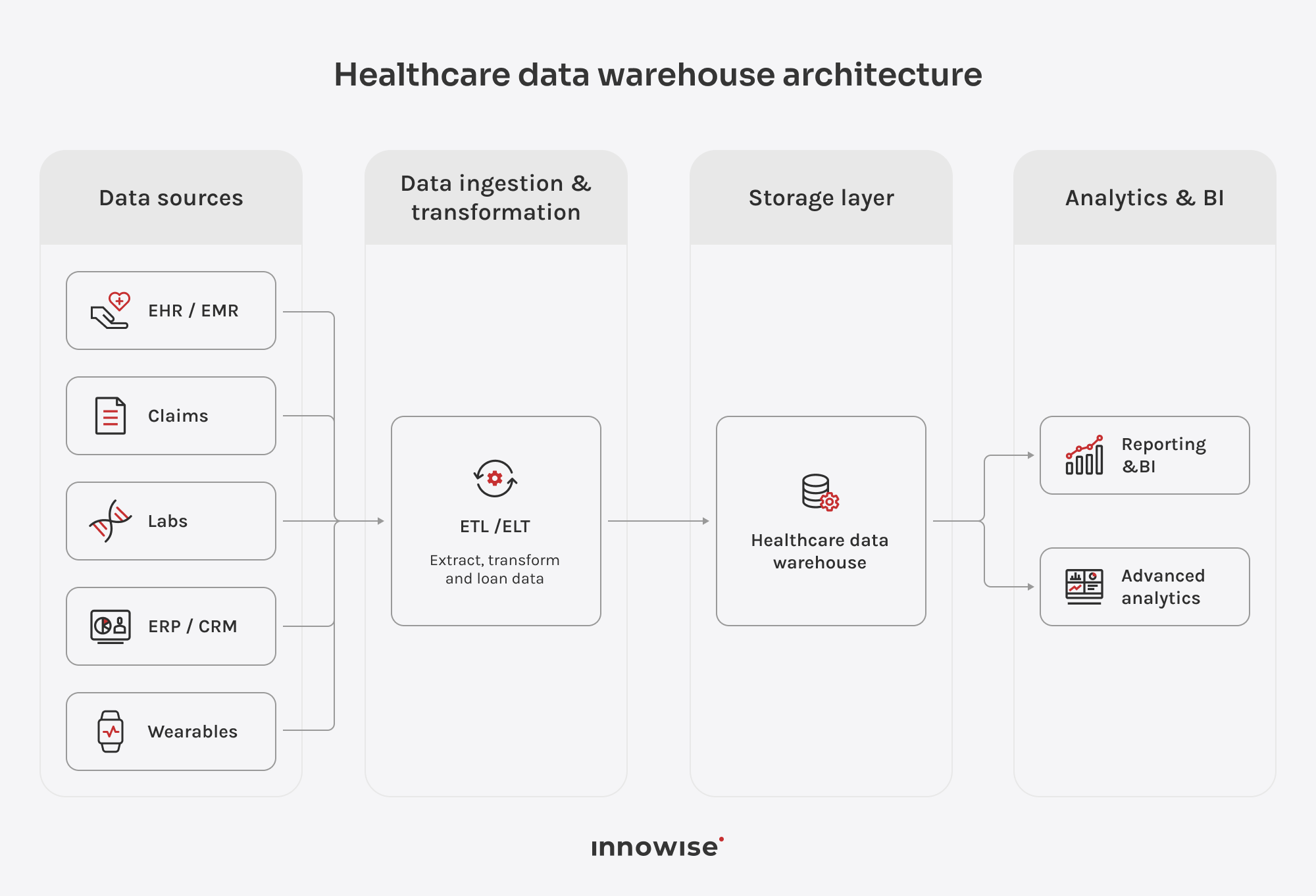
To better understand how a healthcare data warehouse works, let’s look at the main layers behind it. Each one has a specific role in moving data from source systems into storage and then making it available for reporting, analytics, and applications.

Data sources

The source layer includes the systems already used for clinical and business work, such as EHRs and EMRs, claims platforms, LIS and RIS/PACS, and ERP or CRM software. The same patient or event may be recorded differently across these systems, so you need to reconcile formats and match identifiers before using the data together.

Ingestion and ETL/ELT

This layer collects source data and prepares it for analysis. With ETL, data is transformed before loading into the warehouse; with ELT, transformation happens after loading. The process can also include format standardization, duplicate removal, and temporary staging.

Storage

The storage layer keeps historical data in a structure designed for reporting and analysis. Depending on the architecture, it may also provide data marts for a specific department or use case.

Analytics and BI

BI tools use warehouse data for dashboards and recurring reports, while analysts can run ad hoc queries against the same dataset. This gives teams a shared source for analysis instead of rebuilding the logic for each report.

Applications

Warehouse data can also support downstream clinical or business applications. Research tools or planning systems, for example, can use prepared data from the warehouse instead of connecting separately to each source system.

Need one trusted view across clinical and business data?

Key features and capabilities

Now that we’ve talked about the architecture, I’ll look at the features you’re likely to see in a healthcare data warehouse. Each organization is a bit different, but many of the same needs come up when data from different systems has to be combined and remain usable for reporting and analysis.

Data integration and ETL/ELT

Healthcare systems often store the same information differently. An EHR, claims platform, or lab system may use different fields and formats for comparable records. ETL and ELT pipelines collect that data and align it in the warehouse for analysis. Depending on how often the data changes, pipelines can run on a schedule, load only new records, or process updates as they arrive.

Healthcare data also changes retroactively: labs get corrected, encounters get updated or cancelled, and claims get adjusted or voided. Pipelines have to apply those amendments to records already loaded; otherwise, a rerun of last month’s report may no longer match the source.

Data quality and deduplication

Duplicate patient records and conflicting values can distort reports once the data reaches the warehouse. Quality checks catch missing or invalid data, while matching rules help link records that belong to the same patient across systems. Teams need this cleanup before they compare results or build analytics.

Metadata management

Metadata explains what each field means and where it came from. It also records changes made before the data reached the warehouse. Analysts can trace a figure in a dashboard back to its source and check which definition was used.

Data governance

Data governance defines who owns the data and which definitions everyone should use. Without clear rules, two departments can use the same warehouse and still report different numbers for the same metric. Data owners and stewards review changes and keep those definitions consistent over time.

Security and access control

A healthcare warehouse may contain PHI alongside sensitive operational or financial data, so access can’t be the same for everyone. Permissions can limit what a user sees based on role and, where needed, down to particular rows or columns. Encryption protects data in storage and during transfer, while audit logs show who accessed it.

Structured and semi-structured data support

Most recurring reports use structured tables, but healthcare systems also produce data in other formats. APIs and connected devices, for example, may send JSON. A warehouse can work with this data without converting every field into a fixed table first. Unstructured files, such as medical images, usually stay in a data lake or object storage and link back to warehouse data when needed.

Scalability and performance

As the amount of stored data and the number of queries increase, the warehouse needs to keep reporting responsive. Platforms can use partitioning, indexing, caching, or separate compute resources to handle larger workloads without rebuilding the warehouse architecture.

Interoperability

A healthcare data warehouse needs to exchange data with EHRs, lab systems, and other clinical platforms. HL7 standards such as FHIR and HL7 v2 give teams common formats for that exchange, which reduces custom mapping. Legacy or proprietary systems may still need custom connectors before the warehouse can use their data.

In healthcare projects, I wouldn’t look at outcomes or costs in isolation. A DWH lets you compare things like length of stay and readmissions with resource use and staff time. That matters in value-based care, where you need to understand both the result and what it took to get there.
Philip Tikhanovich, Head of Big Data.
Philip Tikhanovich
Head of Big Data

Healthcare data warehouse integrations

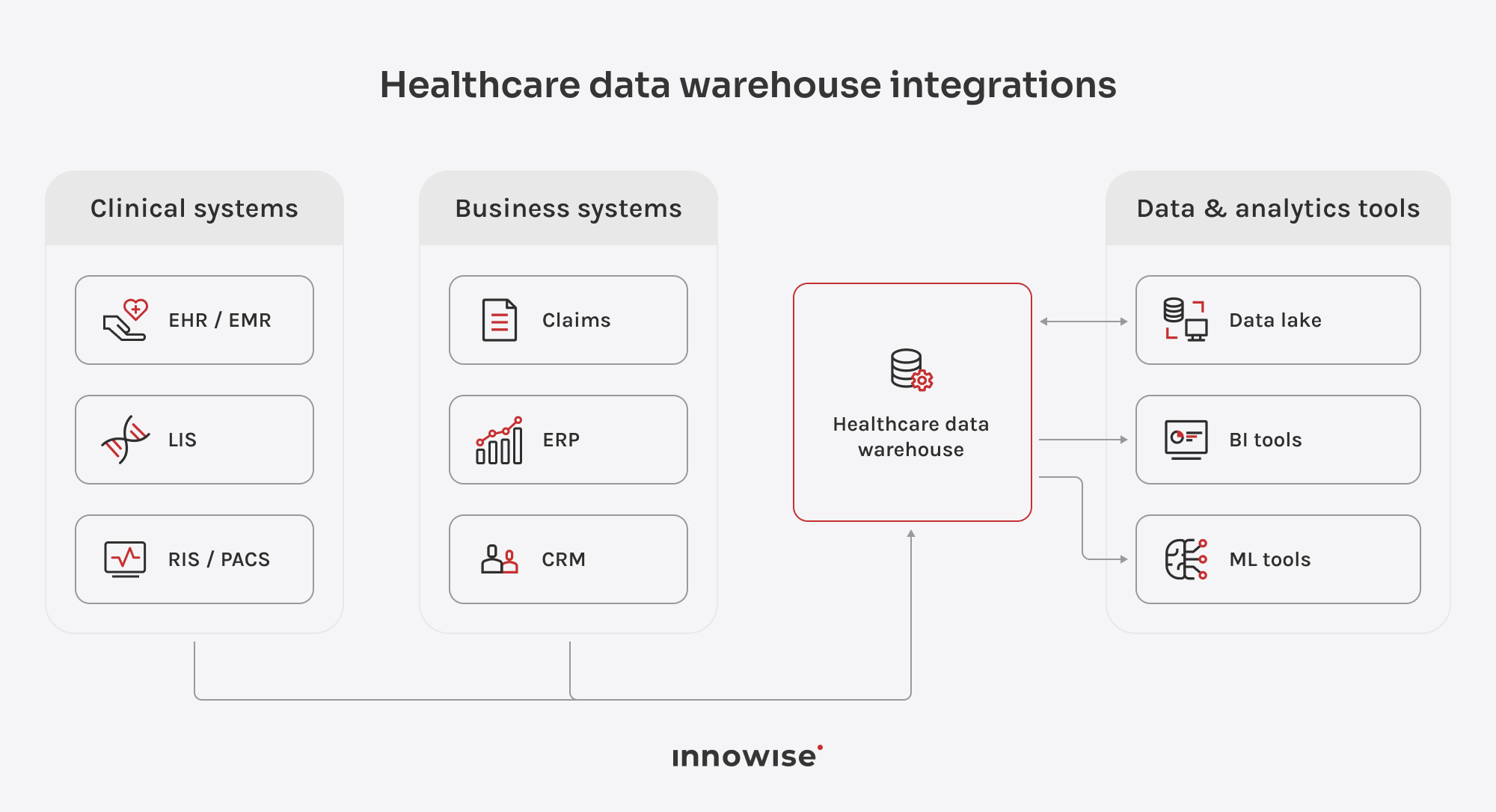
If you’re building a clinical data warehouse in healthcare, you’ll usually connect the systems your teams already use every day. The most common integrations bring in data from clinical and business systems and make it available to BI and ML tools.

Clinical systems

EHR and EMR systems usually send structured clinical data through FHIR APIs or HL7 v2 feeds. FHIR works well for resources such as Patient and Encounter, while HL7 v2 remains common for hospital events and lab results. LIS systems often use HL7 v2 ORU messages to send test results into the warehouse.

Radiology works differently because imaging data is typically kept outside the warehouse itself. PACS or object storage keeps the images, while the warehouse stores the report and study metadata with links back to the corresponding DICOM file.

Business systems

Claims systems show what providers billed and what payers reimbursed. In the US, they often exchange data through X12 transactions, including 837 claims and 835 remittance files. Keeping both claim-level and line-level data lets analysts compare total costs with the individual services behind them.

ERP systems provide cost and workforce data, while CRM systems capture patient outreach outside the medical record. When teams combine that information with clinical data, they can study questions such as whether appointment reminders improve attendance or whether staffing levels match clinical activity.

Data and analytics

A data lake stores raw or less structured data before teams prepare it for the warehouse. Selected datasets can be cleaned in the lake and then loaded into the warehouse. In some setups, the warehouse queries lake data directly instead of copying it first.

BI tools such as Power BI or Tableau connect to the warehouse through native connectors or ODBC/JDBC and read prepared data. ML platforms use historical warehouse data for training or scoring, then send model outputs, such as risk scores, back to the warehouse for reports or other applications.

Business benefits

If you’re weighing the business case for a healthcare data warehouse, I’d look at what it changes for the teams using the data. The benefits of an enterprise data warehouse in healthcare listed below are where that impact tends to show up most clearly.

Faster reporting

Instead of pulling numbers from multiple systems and reconciling them manually, teams can work with data already prepared in the warehouse. Recurring reports require less effort, and analysts can spend more time investigating the numbers rather than assembling them.

Unified patient view

Clinical, claims, and other patient-related data can be linked across source systems to give teams a broader view of a patient’s history. That makes it easier to follow care across encounters without jumping between separate records.

Better clinical decisions

Clinicians and analysts can use historical data from across the organization when answering questions that depend on more than one system. That broader context supports decisions around treatment patterns, patient risk, and care quality.

Cost and resource optimization

Linking clinical activity with financial or operational data helps hospitals see where resources go. Teams can compare service volumes with staffing levels or costs and use the results when planning capacity.

Better claims analysis

Once claims and clinical data are in the same warehouse, analysts can compare billed services with the care clinicians documented. They can investigate why insurers denied or underpaid claims and spot recurring billing issues.

Predictive analytics

Because the warehouse keeps historical data in one place, teams can use it to estimate what is likely to happen next. A model might flag patients with a higher risk of readmission or predict periods of higher demand. Care and operations teams can then plan follow-up care or staffing earlier.

Research support

Researchers often need records covering many patients over long periods. A warehouse gives them data ready for cohort analysis or retrospective studies without rebuilding the dataset from separate systems each time.

Value-based care analytics

In value-based care, teams need to know whether the resources they use actually lead to better outcomes. When the warehouse links outcomes with resource-use data, analysts can compare patient groups and see whether higher spending or heavier service use leads to better care results.

Common healthcare DWH challenges

The benefits I’ve covered above come with a few implementation challenges, but they’re much easier to deal with when you plan for them early. An experienced team can spot many of the risks before they turn into rework or reporting problems. These are the ones I’d keep an eye on from the start.

Fragmented data and interoperability

One system may identify a patient by medical record number, while another uses a different ID. Data formats can vary too. Teams have to map those differences correctly and update the mappings whenever a source system changes.

Poor data quality

A warehouse inherits problems from the systems that feed it. Missing values or inconsistent codes can produce unreliable reports and affect later analysis. Teams need to catch these issues before other reports or models start relying on the same data.

Duplicate patient records

The same patient may appear more than once when systems use different identifiers or contain slightly different personal details. Matching rules need to find those duplicates without accidentally combining records from different people.

Security and privacy

A healthcare warehouse may contain patient records alongside financial and operational data, but not every user should see everything. Clinicians may need patient-level details, while finance teams may only need billing data. Set access by role and review permissions whenever you add a new data source.

Governance

Teams need clear rules for who owns shared data and who makes decisions about it. For example, if two departments calculate the same metric differently, someone has to choose the definition everyone will use. The same goes for approving access to sensitive data.

Scaling data volumes

As the warehouse accumulates more years of data and adds new sources, queries can slow down, and storage costs can rise. Teams need to plan how they organize older data and how long they keep it, so growth doesn’t make everyday reporting harder.

Lack of internal data engineering expertise

Your team may know the healthcare systems well but have limited experience building a data warehouse around them. In that case, external data engineers can help design the pipelines and data model, while your internal team defines what the data needs to support.

Healthcare data warehouse models

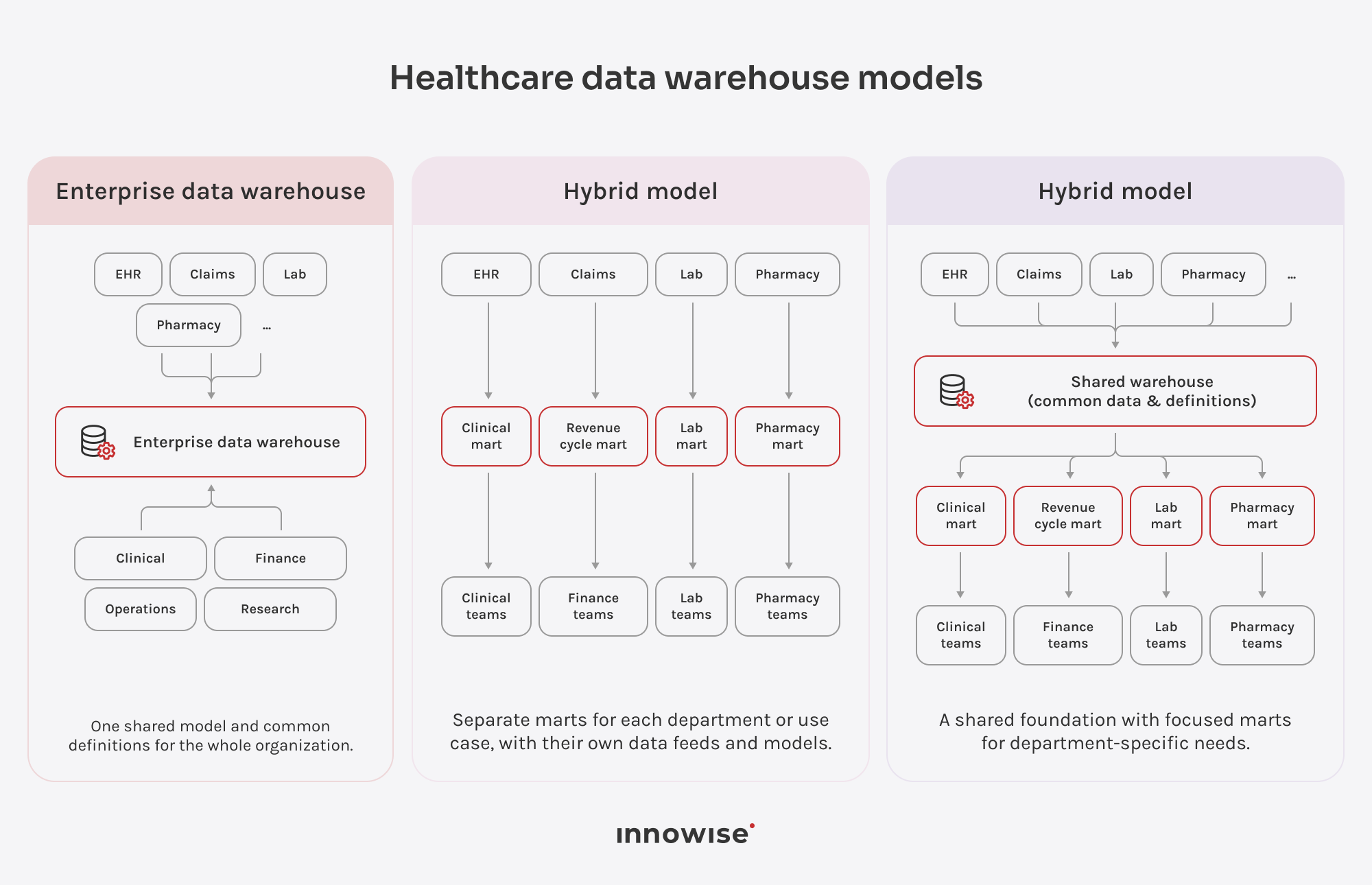
The right healthcare data warehouse model depends on how centralized you want data management to be and how much independence individual departments need. In practice, organizations usually choose between three models:

Enterprise data warehouse

An enterprise data warehouse in healthcare uses a shared data model across the organization, so different departments work with consistent definitions and reporting rules. Clinical and financial teams, for example, can calculate average length of stay in the same way instead of defining the metric separately in their own reports.

At the data level, teams may standardize core entities such as patients, encounters, providers, and facilities and map source-system records to those shared structures. The trade-off is that they need to agree on those definitions early and keep them aligned as the warehouse grows. That takes more work upfront, especially in a large organization where terminology and reporting needs keep changing. Once many reports depend on the shared model, even a small change to a core definition can affect several teams at once.

Independent data marts

An independent data mart focuses on one department or analytical use case rather than modeling data for the whole organization. An oncology team, for example, might build a mart around the clinical systems it needs, while revenue-cycle analysts create another focused on claims and billing data.

Because each mart has a smaller scope, teams can often get the first reports running sooner. As more marts are added, the same source system may need separate pipelines and mappings for each one. Definitions can also drift between departments. And because marts often store data already shaped or summarized for a particular use case, they may lack the detail needed for a different analysis later.

Hybrid model

A hybrid model combines a shared enterprise warehouse with data marts built for particular departments or analytical needs. Core data and shared definitions stay in the central layer, while each mart shapes that data for its own reporting needs. Because the marts draw from the warehouse, teams do not have to build a separate integration back to every source system.

This setup lets organizations add new marts as reporting needs change without trying to model every future use case at the start. The harder part is deciding what should be standardized centrally and what can remain specific to one mart. If too much logic moves into individual marts, definitions can drift over time.

Planning a healthcare DWH and weighing your options?

Healthcare DWH use cases

Healthcare organizations use data warehouses for very different tasks, depending on the data they collect and the decisions they need to make. The healthcare data warehouse examples below show how that plays out in clinical and operational work.

Population health management

Population health teams use warehouse data to find groups of patients with similar care needs. For example, they can identify people who are overdue for screening or follow-up and pass those lists to outreach teams.

Chronic disease management

For chronic conditions, care teams need to see what changes between appointments. A warehouse can combine lab results and medication history across visits, with connected-device readings added when available. The combined history helps teams spot changes in a patient’s condition and decide when earlier follow-up may be needed.

Predictive patient risk analytics

Teams use historical warehouse data to estimate which patients have a higher risk of readmission or missing an appointment. Those scores usually reach clinicians through a care-management or outreach system. Writing them back into the EHR itself is usually a separate integration: EHR vendors tend to keep tight control over write access.

Clinical research and trials

Finding eligible study participants often starts with a long list of inclusion and exclusion criteria. Researchers can run those criteria against de-identified warehouse data first and narrow the pool before reviewing individual charts. For multi-site research, teams can also map records from different facilities into a common structure before analysis.

Revenue cycle and claims analytics

Payment issues can appear at any point between the original charge and final reimbursement. By linking clinical, billing, and claims data, revenue teams can see where a claim stalled and whether the same denial reason keeps recurring for a particular payer or procedure.

Staffing and capacity planning

Managers compare patient volumes by unit and shift with the staff scheduled at the same time. If the same unit repeatedly runs short on coverage on certain days or during peak periods, they can adjust future schedules to account for that pattern.

Operational cost optimization

When financial data is linked with clinical activity, teams can see where operating expenses are actually coming from. They can compare spending by procedure, facility, or type of care and investigate why costs are higher in some areas than in others.

Implementation process

Each healthcare data warehouse project begins differently. The steps depend on your current systems, the quality of your data, and what you want the warehouse to do. Here’s how we usually approach it.

01
Discovery

Our team defines the initial reporting or analytical use cases for the first release and identifies the people who need them. We also confirm which source systems are in scope and flag regulatory constraints before making architecture decisions.

02
Data assessment

Before we build pipelines, we inspect each source for missing data and inconsistent formats, then check for duplicates. The findings show what can stay as-is and where we need cleanup rules before those issues affect production reporting.

03
Architecture

Our data architects choose the warehouse model based on how broadly teams need to share data and definitions. They then design the ingestion and storage layers around the organization’s systems and decide how analytics tools will access the warehouse.

04
Technology selection

After the architecture is set, the team chooses the platform, ETL/ELT approach, and BI or ML tools based on the data volume and existing tech stack. Budget and compliance considerations narrow the list, especially where access controls or audit logging are required.

05
Integration

Data engineers connect the warehouse to source systems. Depending on the environment, they may use FHIR or HL7 v2 for clinical data, X12 for US claims, and APIs or native connectors for business applications. Testing each feed against real data helps catch mapping errors early.

06
Development

Innowise engineers build pipelines that standardize formats and resolve duplicate records before applying the agreed business definitions. If the design includes data marts, they build them on the shared layer instead of reconnecting to every source.

07
Migration and testing

The team loads historical data and checks it against the original sources to catch missing or altered values. Analysts then test reports against the use cases defined in discovery, while business users review the results before go-live.

08
Launch

At launch, our team often runs old and new reports in parallel so users can compare the numbers before switching over. We also watch early production use closely, because data or performance issues missed in testing tend to surface here.

09
Support

After go-live, we monitor performance, add new sources, and maintain the governance processes that keep shared definitions consistent. Usually, it’s one of the longest project stages and one of the easiest to underestimate during planning.

arrow-icon. arrow-icon.
01 Discovery

Our team defines the initial reporting or analytical use cases for the first release and identifies the people who need them. We also confirm which source systems are in scope and flag regulatory constraints before making architecture decisions.

arrow-icon. arrow-icon.
02 Data assessment

Before we build pipelines, we inspect each source for missing data and inconsistent formats, then check for duplicates. The findings show what can stay as-is and where we need cleanup rules before those issues affect production reporting.

arrow-icon. arrow-icon.
03 Architecture

Our data architects choose the warehouse model based on how broadly teams need to share data and definitions. They then design the ingestion and storage layers around the organization’s systems and decide how analytics tools will access the warehouse.

arrow-icon. arrow-icon.
04 Technology selection

After the architecture is set, the team chooses the platform, ETL/ELT approach, and BI or ML tools based on the data volume and existing tech stack. Budget and compliance considerations narrow the list, especially where access controls or audit logging are required.

arrow-icon. arrow-icon.
05 Integration

Data engineers connect the warehouse to source systems. Depending on the environment, they may use FHIR or HL7 v2 for clinical data, X12 for US claims, and APIs or native connectors for business applications. Testing each feed against real data helps catch mapping errors early.

arrow-icon. arrow-icon.
06 Development

Innowise engineers build pipelines that standardize formats and resolve duplicate records before applying the agreed business definitions. If the design includes data marts, they build them on the shared layer instead of reconnecting to every source.

arrow-icon. arrow-icon.
07 Migration and testing

The team loads historical data and checks it against the original sources to catch missing or altered values. Analysts then test reports against the use cases defined in discovery, while business users review the results before go-live.

arrow-icon. arrow-icon.
08 Launch

At launch, our team often runs old and new reports in parallel so users can compare the numbers before switching over. We also watch early production use closely, because data or performance issues missed in testing tend to surface here.

arrow-icon. arrow-icon.
09 Support

After go-live, we monitor performance, add new sources, and maintain the governance processes that keep shared definitions consistent. Usually, it’s one of the longest project stages and one of the easiest to underestimate during planning.

Healthcare data warehouse services

If you’re building a healthcare DWH from scratch, you’ll need different support than if you’re fixing or expanding an existing one. Innowise can join at either stage and take on the work your setup requires.

  • Healthcare data warehouse consulting
  • Architecture and design
  • DWH development
  • Data integration and migration
  • Legacy DWH modernization
  • BI and analytics integration
  • Support and optimization

Healthcare data warehouse consulting

If you already have reporting problems or an existing warehouse that no longer fits the job, we work out what needs to change. Our team reviews the current setup and compares the available options. From there, we help you decide which use cases should come first.

Nurse reviews lab results and medication history in EHR system before patient rounds.

Architecture and design

With the requirements agreed, our architects design a warehouse structure around your systems and expected workloads. They define how the main components connect and where shared data lives. The structure can then accommodate new sources or reporting needs as they appear.

Building layouts and style guides for a new web application project.

DWH development

Once the design is approved, our engineers build the DWH, including transformation logic and any necessary data marts. They add quality checks and security controls during development, so the warehouse can support the reports and analytics the project requires.

IT specialist analyzing software code during an evening sprint session.

Data integration and migration

We connect the warehouse to EHR/EMR, claims, lab, ERP/CRM, and other source systems. Historical data then moves into the target model with the required mappings and transformations. Before cutover, reconciliation checks compare the migrated data against its source.

Data engineer interacts with a visual dashboard to orchestrate real-time data synchronization across systems.

Legacy DWH modernization

As data sources and reporting needs change, an existing warehouse may need more than routine maintenance. We update outdated data models and pipelines, move workloads when the current platform becomes a constraint, and automate repetitive data-management tasks where it makes sense.

IT operations team tracks software patch rollout in real time via a mobile device interface.

BI and analytics integration

Our experts connect the warehouse to the BI and analytics tools your teams already use. Depending on the setup, they can import data or query the warehouse directly. Shared metrics and reporting rules stay in one place instead of being rebuilt in every dashboard.

Accessing a centralized analytics portal to evaluate company operations and outcomes.

Support and optimization

After launch, the warehouse keeps changing with your data and reporting needs. Our team can troubleshoot pipeline or data issues, add new sources, tune slow queries, and update models when business requirements shift.

The consulting team reviews analytics on screen, focusing on data-driven IT strategy and solutions.
Healthcare data warehouse consulting

If you already have reporting problems or an existing warehouse that no longer fits the job, we work out what needs to change. Our team reviews the current setup and compares the available options. From there, we help you decide which use cases should come first.

Nurse reviews lab results and medication history in EHR system before patient rounds.
Architecture and design

With the requirements agreed, our architects design a warehouse structure around your systems and expected workloads. They define how the main components connect and where shared data lives. The structure can then accommodate new sources or reporting needs as they appear.

Building layouts and style guides for a new web application project.
DWH development

Once the design is approved, our engineers build the DWH, including transformation logic and any necessary data marts. They add quality checks and security controls during development, so the warehouse can support the reports and analytics the project requires.

IT specialist analyzing software code during an evening sprint session.
Data integration and migration

We connect the warehouse to EHR/EMR, claims, lab, ERP/CRM, and other source systems. Historical data then moves into the target model with the required mappings and transformations. Before cutover, reconciliation checks compare the migrated data against its source.

Data engineer interacts with a visual dashboard to orchestrate real-time data synchronization across systems.
Legacy DWH modernization

As data sources and reporting needs change, an existing warehouse may need more than routine maintenance. We update outdated data models and pipelines, move workloads when the current platform becomes a constraint, and automate repetitive data-management tasks where it makes sense.

IT operations team tracks software patch rollout in real time via a mobile device interface.
BI and analytics integration

Our experts connect the warehouse to the BI and analytics tools your teams already use. Depending on the setup, they can import data or query the warehouse directly. Shared metrics and reporting rules stay in one place instead of being rebuilt in every dashboard.

Accessing a centralized analytics portal to evaluate company operations and outcomes.
Support and optimization

After launch, the warehouse keeps changing with your data and reporting needs. Our team can troubleshoot pipeline or data issues, add new sources, tune slow queries, and update models when business requirements shift.

The consulting team reviews analytics on screen, focusing on data-driven IT strategy and solutions.

Need to modernize your healthcare data setup?

Healthcare data warehouse vendors

If you’re comparing platforms for a healthcare warehouse, your existing cloud environment is a good place to start. The options below handle healthcare data differently, and their compute and pricing models vary as well.

Amazon-Redshift-Logo (1)

Amazon Redshift

Redshift fits naturally when most of your data already sits in AWS. It works with S3 and AWS Glue, while HealthLake can export FHIR data to S3 for downstream analysis through Redshift or other AWS analytics services.

Key features

  • SQL for structured and semi-structured data
  • S3 access through Redshift Spectrum
  • Federated queries to supported AWS databases
  • Row- and column-level access controls
  • Separate compute and managed storage
  • HIPAA-eligible AWS service 

Pricing

  • On-demand pricing for provisioned clusters
  • Serverless compute billed by usage
  • Separate managed storage charges
  • Reserved pricing for steady workloads
Azure Synapse Analytics

Azure Synapse Analytics

Synapse works well when your data and reporting already run in Azure and your teams use Power BI. It brings SQL warehousing and Spark into one workspace, with pipelines for moving data between Azure services. FHIR data from Azure Health Data Services can also be copied into Synapse for analysis.

Key features

  • Dedicated and serverless SQL
  • Apache Spark pools
  • Queries over Azure Data Lake
  • Built-in ETL/ELT pipelines
  • Power BI and Azure ML integrations
  • FHIR analytics with Azure Health Data Services

Pricing

  • Serverless SQL billed by data processed
  • Dedicated SQL billed by DWU usage
  • Spark billed by vCore usage
  • Pre-purchase options for committed workloads

For teams that want more freedom across cloud providers, Snowflake keeps the warehouse layer less dependent on a single ecosystem. It runs on AWS, Azure, and Google Cloud, while separate virtual warehouses let teams give different workloads their own compute resources.

Key features

  • Multi-cloud deployment options
  • Independent compute for different workloads
  • Multi-cluster warehouses on Enterprise Edition+
  • Native semi-structured data support
  • Secure Data Sharing
  • PHI support with Business Critical+

Pricing

  • Consumption-based compute credits
  • Separate storage charges
  • On-demand or prepaid capacity 
  • Rates vary by cloud, region, and edition
GCP BigQuery

Google BigQuery

BigQuery fits organizations that already use Google Cloud or want a serverless warehouse without managing compute clusters. Cloud Healthcare API can export FHIR resources and DICOM metadata to BigQuery, giving analytics teams access to healthcare data through SQL.

Key features

  • Serverless SQL data warehouse
  • Separate storage and compute
  • Built-in machine learning capabilities
  • External and federated queries
  • Cloud Healthcare API integration
  • BigQuery covered by Google Cloud’s HIPAA BAA

Pricing

  • On-demand compute billed by data processed
  • Capacity pricing based on slots
  • Storage billed separately
  • Commitments available for reserved capacity

Cost and timeline

Healthcare data warehouse budgets can vary by more than an order of magnitude. A limited production mart with a couple of clean sources may cost around $60,000–$100,000 and take 2–4 months. A multi-system enterprise warehouse with historical data migration and several data marts can reach $400,000–$1 million or more and take 9–18 months or longer.

Project scaleTypical scopeTimelineImplementation budgetOngoing cloud & software costs
Department data mart1–2 source systems, one department, limited history, basic BI reporting2–4 months$60k–$100k$1k–$5k/month
Mid-sized healthcare DWH3–6 sources, shared data model, historical data migration, 2–4 marts, BI integration5–9 months$150k–$350k$5k–$20k/month
Enterprise DWH / lakehouse7+ sources, extensive historical data, multiple marts, custom clinical integrations, advanced analytics9–18+ months$400k–$1m+$20k–$80k+/month

Healthcare solutions delivered by Innowise

Why choose us

A healthcare DWH project sits between data engineering and healthcare IT. Innowise has experience on both sides, backed by relevant ISO certifications and partnerships with the cloud and data vendors used in warehouse projects.

Healthcare experience

We bring 19+ years of healthcare IT experience, including work with EHRs, laboratory systems, medical imaging, and connected healthcare platforms. That experience matters when clinical workflows or healthcare data standards shape the warehouse design.

Data engineering expertise

Our data teams work with Snowflake, BigQuery, Amazon Redshift, and Azure Synapse, along with the ETL/ELT and orchestration tools that support them. That means we can design the warehouse around the client’s existing stack rather than one preferred platform.

Relevant certifications

Innowise holds ISO 9001, ISO 27001, and ISO 13485 certifications covering quality, information security, and medical device standards.

Delivery record

Our track record includes 1,600+ projects across industries and 60+ healthcare IT solutions. For a precision medicine company, we improved data pipelines and AWS infrastructure used to process diagnostic data from multiple sources.

Security and compliance experience

Our healthcare teams work with HIPAA and GDPR requirements and healthcare exchange standards such as HL7 v2 and FHIR. That experience is relevant when sensitive health data moves between the warehouse and regulated clinical systems.

Technology partnerships

As a partner of AWS, Microsoft, Google Cloud, and Databricks, Innowise brings certified platform expertise to DWH projects and can draw on vendor support when platform-specific issues arise.

ISO 13485 certification.
ISO 9001 certification.
ISO/IEC 27001 certification.
GDPR
Select partner AWS
Google_Cloud_Partner

Conclusion

I wouldn’t start a healthcare data warehouse project by trying to move every dataset into one place. Instead, choose a reporting or analytics problem that is worth solving and connect only the systems needed for that task. For example, you might start with revenue cycle reporting or readmission analysis. Once that’s working, you can decide what the warehouse needs next based on real demand. 

This approach should continue as the project grows. Add new sources or data marts only when there is a clear reason, rather than trying to prepare for every possible future need. The important thing is to keep definitions and access rules consistent as the warehouse expands and to make sure compliance requirements are always met. 

If you need outside support, specialists from Innowise’s Healthcare & Pharma IT Hub can review your existing data warehouse or help build one around your healthcare systems and reporting needs, with healthcare data compliance requirements in mind.

FAQ

A healthcare data warehouse keeps prepared data for reporting and analysis. A data lake usually holds larger volumes of raw or lightly processed data. In many architectures, the lake stores broader datasets while the warehouse contains the data teams need for recurring clinical, financial, or operational analysis.

Timelines vary with scope, source systems, and data quality. A focused mart with a few integrations can take 2–4 months. A larger enterprise data warehouse healthcare setup may take 9–18 months or more when the project includes legacy data migration, multiple integrations, and several marts.

The right healthcare data warehouse model depends on how many teams need the data and whether they should use the same reporting definitions. An enterprise model supports organization-wide reporting, while independent marts focus on specific departments or use cases. A hybrid model combines a shared core with more focused marts. Healthcare data warehouse design should reflect the use cases you need to support first.

Yes. We can modernize your existing healthcare data warehouse without replacing it all at once. Our team rebuilds outdated pipelines, revises data models, moves selected workloads, and connects newer analytics tools in stages. Healthcare data warehouse automation also reduces manual work in ingestion and recurring data-quality checks.

Innowise designs the warehouse around HIPAA requirements from the start, with access to PHI restricted by role and security controls built into data flows. We also validate data as it moves through the warehouse, checking for incorrect mappings, duplicate patient records, or altered values before they affect reporting.

Show all

Table of contents

    Contact us

    Book a call or fill out the form below and we’ll get back to you once we’ve processed your request.

    Send us a voice message

    Attach documents
    Upload file

    You can attach 1 file up to 2MB. Valid file formats: pdf, jpg, jpeg, png.

    By clicking Send, you consent to Innowise processing your personal data per our Privacy Policy to provide you with relevant information. By submitting your phone number, you agree that we may contact you via voice calls, SMS, and messaging apps. Calling, message, and data rates may apply.

    You can also send us your request

    to contact@innowise.com
    What happens next?

    1

    Once we’ve received and processed your request, we’ll get back to you to detail your project needs and sign an NDA to ensure confidentiality.

    2

    After examining your wants, needs, and expectations, our team will devise a project proposal with the scope of work, team size, time, and cost estimates.

    3

    We’ll arrange a meeting with you to discuss the offer and nail down the details.

    4

    Finally, we’ll sign a contract and start working on your project right away.

    More services we cover

    arrow