Voice recognition in healthcare: use cases, benefits, and challenges

Aug 26, 2026 10 min read
Summarize article with AI

Key takeaways

  • Voice recognition in healthcare now spans everything from basic dictation to ambient documentation tools that draft the note while the clinician just talks to the patient.
  • The clearest win is time. Speech-driven documentation cuts the minutes clinicians spend fighting the EHR after each visit, and across a clinic day that adds up fast.
  • Medical terminology, accents, and background noise remain the main sources of transcription errors, and most vendors handle them with specialty language models plus mandatory human review.
  • A working deployment touches more than the microphone. It needs HIPAA-grade security, EHR integration through HL7 V2 or FHIR, and clinician buy-in, or it turns into expensive shelfware.

I’ve sat through enough healthcare IT meetings to notice a pattern. Every conversation about reducing clinician burnout eventually circles back to typing. Doctors didn’t train for years to become data entry clerks, yet a sizable chunk of their workday is spent doing exactly that.

Voice recognition in healthcare is one of the few technologies that attacks this problem head on by letting clinicians talk instead of type. This article walks through what the technology is, how it works end to end, where it’s already earning its keep, and what it takes to get from a slick demo to a system doctors trust with real patients.

What is voice recognition in healthcare?

Medical voice recognition software captures spoken language, whether it’s a clinician dictating a note or a patient describing symptoms on a call, and turns it into structured, usable data inside a clinical workflow. That sounds simple until you notice how many overlapping terms get thrown around the same idea. Here’s how they differ:

  • Speech recognition converts audio into raw text, nothing more. It doesn’t care who’s talking or what the words mean clinically.
  • Voice recognition goes a step further and can identify who is speaking, which matters in multi-speaker settings like an exam room with a doctor and a patient.
  • Speech-to-text is the general consumer term for the same underlying conversion, minus any medical-specific processing.
  • Medical dictation is the oldest use case in the book: a clinician talks, the software transcribes, and the clinician edits and signs off.
  • Ambient clinical documentation listens to the whole visit and drafts a structured note without anyone dictating on purpose. The conversation itself is the input.
  • Conversational voice AI takes it further still. It can ask clarifying questions, pull up records, or complete tasks like scheduling, not just transcribe what it hears.

How healthcare voice recognition works

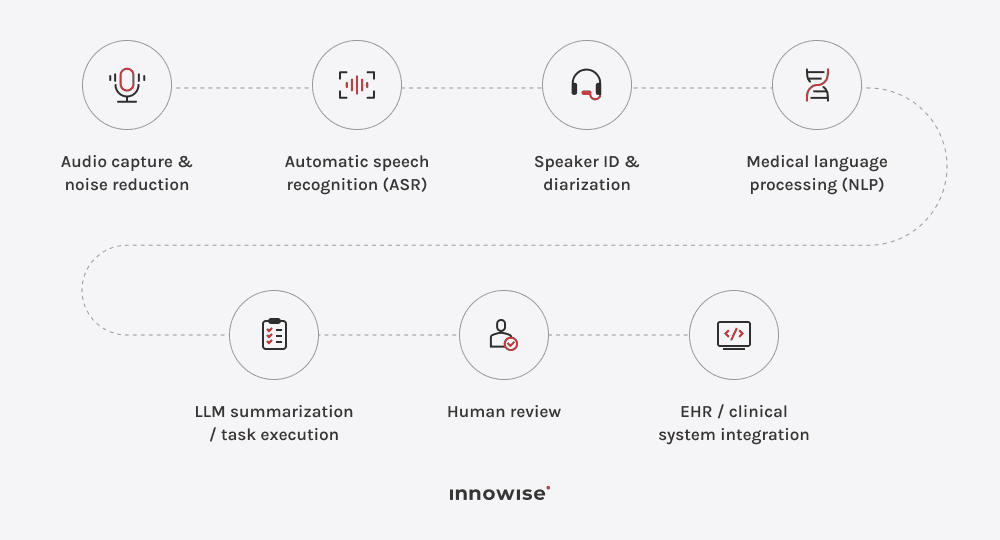
Underneath the marketing language, most healthcare voice systems follow the same pipeline, whether it’s a simple dictation app or a hospital-wide ambient scribe. It looks roughly like this:

  • Audio capture and noise reduction. A microphone or telephony line picks up the conversation and strips out background noise before anything else happens.
  • Automatic speech recognition (ASR). The audio is converted into raw text using an acoustic and language model trained on speech.
  • Speaker identification and diarization. The system works out who said what, separating clinician from patient in a shared recording.
  • Medical language processing. Natural language processing (NLP) models map the raw text onto clinical concepts, medications, and terminology.
  • LLM-based summarization or task execution. A large language model (LLM) transforms the transcript into a structured note, or in agentic setups, retrieves information through retrieval-augmented generation (RAG) and triggers actions via APIs.
  • Human review. A clinician checks the output before it becomes part of the record. This step isn’t optional in any serious deployment.
  • EHR or clinical system integration. The final note or data is written back into the electronic health record, usually through HL7 V2 or FHIR standards, sometimes paired with text-to-speech for voice replies.
The healthcare voice recognition pipeline

Types of voice recognition systems in healthcare

Vendors love giving every small variation on “software that listens” its own shiny name, which makes shopping for one feel like ordering coffee at a place with forty syrup options when all you wanted was something hot and caffeinated. Strip away the branding, though, and healthcare voice tools come in just a handful of flavors, each built for a different moment in a clinician’s day.

Medical dictation systems

The classic setup. A clinician dictates directly into a microphone or handheld recorder, and the software converts speech to text in real time or after the fact for review and signing.

Ambient clinical documentation tools

Also called AI scribes, these listen passively to a patient visit and generate a structured note afterward, without the clinician having to dictate anything on purpose.

AI voice assistants and agents

Conversational systems that go beyond note-taking. They can answer clinician questions, pull chart data, or handle patient-facing tasks like intake and follow-up calls.

Voice-controlled clinical interfaces

Hands-free controls for EHR navigation, imaging systems, or surgical equipment, letting staff keep their hands sterile or free while working.

Voice analytics and biomarkers

A newer category that analyzes vocal patterns, pitch, pauses, and tremor, for early indicators of conditions like Parkinson’s disease, depression, or cognitive decline.

Voice recognition use cases in healthcare

Ask a vendor how speech recognition is used in healthcare and you’ll get a slide deck with about thirty bullet points, most of which boil down to “we made typing optional.” Fair enough, honestly. Typing optional is underrated. Here’s where that plays out in a real clinical setting, beyond the note-taking everyone already assumes.

Clinical documentation

The biggest and most mature use case. Whether through dictation or ambient scribing, this is how speech recognition technology in healthcare earns most of its ROI, by cutting the time clinicians spend writing notes after hours.

EHR navigation and data entry

Voice commands let clinicians pull up patient charts, enter orders, or search records without touching a keyboard, which matters more than it sounds in a sterile or gloved environment.

Appointment scheduling and patient intake

Voice bots handle routine scheduling calls, collect intake information, and confirm appointments, freeing front-desk staff for more complicated conversations.

Telehealth and remote patient support

Voice technology in healthcare powers real-time transcription during video visits and voice-based check-ins for remote patients, an area we work in directly through telehealth app development.

Clinical trials and medical research

Researchers use voice tools to transcribe patient interviews, capture adverse event reports, and speed up case report form completion during trials.

Accessibility and hands-free workflows

Voice interfaces give clinicians with mobility limitations, or anyone whose hands are full, a way to interact with clinical systems without a keyboard or mouse.

Voice-based health analysis

Beyond documentation, some systems analyze the voice itself as clinical data, flagging respiratory issues, fatigue, or neurological symptoms from speech patterns.

Curious where voice tech fits your clinical workflow?

Benefits of voice recognition in healthcare

Every piece of healthcare software gets sold with the same three promises: it’ll save time, improve outcomes, and make everyone happier. Most of the time that’s wishful marketing wearing a lab coat. Voice recognition is one of the cases where the benefits of speech recognition technology in healthcare hold up once you look past the pitch, and they land differently depending on who you ask.

Benefits for clinicians

Less time spent on notes after a shift is the headline benefit. A study by Mass General Brigham and the University of California found that clinicians using AI scribes saw roughly a 10% drop in daily documentation time.

Benefits for patients

When a clinician isn’t staring at a screen typing, they’re looking at the patient. That alone changes how a visit feels, and it tends to show up in patient satisfaction scores wherever ambient documentation gets adopted.

Benefits for healthcare organizations

Faster documentation means faster billing cycles, fewer after-hours charting sessions, and a real shot at reducing clinician turnover, which is a far bigger line item than most software budgets.

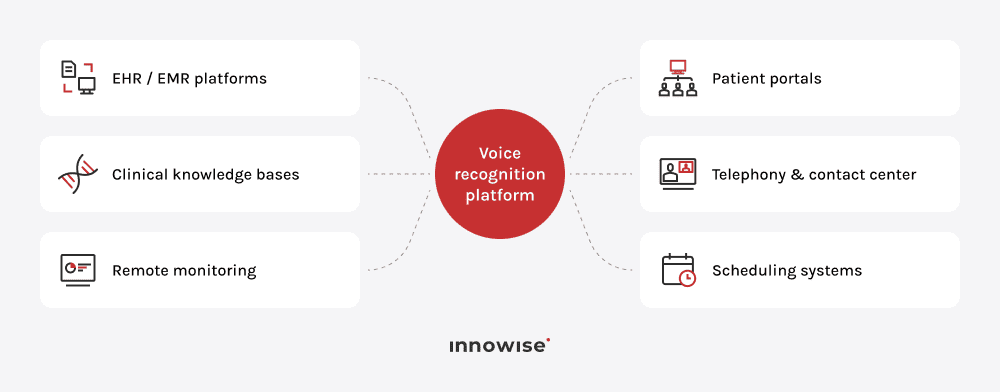
Voice recognition integration with EHR and clinical systems

A voice tool that transcribes beautifully but then just sits there, disconnected from everything else, is basically an expensive notepad with better handwriting than most doctors. The real value only shows up once it’s wired into the systems clinicians already live in, which usually means:

  • EHR and EMR platforms, where structured notes need to land in the right fields automatically, something we handle as part of our EHR and EMR integration work.
  • Scheduling systems, so a voice intake call can book, reschedule, or cancel an appointment without a human touching it.
  • Telephony and contact center tools, for voice agents handling inbound patient calls at scale.
  • Patient portals, where transcribed visit summaries or after-visit instructions get delivered automatically.
  • Remote monitoring systems, correlating voice-based symptom checks with device data.
  • Clinical knowledge bases that give voice assistants something authoritative to draw answers from instead of guessing.

Under the hood, this runs on APIs and healthcare data standards like HL7 V2 and FHIR, plus careful data mapping, so a transcribed term lands in the correct structured field. Identity management controls who can trigger or approve a voice-generated entry, and nothing should reach the permanent record without clinician approval first.

Voice recognition platform integration

Need voice data flowing cleanly into your EHR?

Challenges of voice recognition in healthcare and how to address them

Now for the part vendors tend to gloss over in a footnote. Pros and cons of speech recognition systems in healthcare don’t split evenly, because the cons are the kind that can end up in a patient’s chart if nobody’s paying attention. None of this makes the technology a bad bet. It just means the rollout deserves the same rigor as any other clinical tool, not the same enthusiasm as a new phone. Let’s look at the typical challenges and how to mitigate them.

Medical terminology and specialty-specific language

Challenge: General-purpose speech models stumble on drug names, abbreviations, and specialty jargon.

Impact: Misheard terms can silently distort a clinical note, which is a much worse outcome than a typo in an email.

Mitigation: Use ASR models fine-tuned on medical corpora and specialty-specific vocabularies, and route anything uncertain to human review.

Accents, dialects, and multilingual speech

Challenge: Accuracy drops noticeably for non-native accents and regional dialects, a well-documented weak spot across the industry.

Impact: This can lead to poorer documentation quality for both clinicians and patients from underrepresented language groups.

Mitigation: Train or fine-tune models on diverse accent datasets and support multilingual models where the patient population calls for it.

Background noise and speaker separation

Challenge: Busy wards, overlapping conversations, and equipment noise all degrade transcription quality.

Impact: Garbled audio means more manual correction, which erodes the time savings the tool was supposed to deliver.

Mitigation: Combine directional microphones with noise suppression models and diarization tuned for clinical environments.

Transcription errors and LLM hallucinations

Challenge: LLM-based summarization can occasionally invent details that were never said, a risk specific to generative systems.

Impact: A hallucinated symptom or medication in a note is a patient safety issue, not just an inconvenience.

Mitigation: Keep a mandatory human-in-the-loop review step, log source audio alongside generated text, and evaluate models against clinical accuracy benchmarks before rollout.

Workflow and user adoption

Challenge: Clinicians already juggling a packed schedule are, understandably, wary of adding a new tool to learn.

Impact: Low adoption means the organization pays for a platform that mostly sits idle.

Mitigation: Start with a small pilot group of willing early adopters, gather feedback fast, and let peer results, not a mandate, drive wider rollout.

Legacy system integration

Challenge: Older EHRs and hospital systems weren’t built with modern APIs in mind.

Impact: Without integration, voice tools become a parallel workflow clinicians have to manually reconcile, which defeats the purpose.

Mitigation: Use HL7 V2 and FHIR interface engines, and where no clean API exists, build a middleware layer instead of forcing a rip-and-replace of core systems.

Privacy, security, and regulatory requirements for voice technology in healthcare

The moment a microphone catches someone describing their symptoms, that recording stops being a harmless audio file and becomes protected health information (PHI) with legal teeth. It doesn’t care that it was just a routine check-in call. Treating it casually is how organizations end up on the wrong side of a headline. A serious deployment has to account for:

  • Patient consent, collected clearly before recording begins
  • PHI protection throughout the entire pipeline, not just at the storage stage
  • HIPAA and GDPR compliance, depending on where the organization and patients are located
  • Encryption at rest and in transit for every recording and transcript
  • Role-based access control limiting who can hear or read the data
  • Audit logs tracking every access and edit
  • Data residency requirements, which vary a lot by country
  • Audio retention policies defining how long raw recordings are kept versus deleted
  • Third-party vendor agreements, including business associate agreements where required
  • Private cloud or on-premises deployment options for organizations that can’t use public cloud for clinical audio
  • Incident response plans specific to a breach involving voice data

Exactly which of these apply, and how strictly, depends on the country, the type of organization, and what the voice data is used for. A hospital recording full clinical encounters has a very different risk profile than a scheduling bot collecting a phone number. This is also where healthcare-grade cybersecurity work earns its cost, since a voice pipeline is only as trustworthy as its weakest data-handling link.

Does your voice pipeline meet healthcare security standards?

Healthcare voice recognition technology stack

Nobody buys “healthcare voice recognition” off a shelf the way you’d buy a stapler. It’s assembled, piece by piece, from tools that were never really designed to sit next to each other. A typical stack looks less like a single product and more like a well-organized toolbox:

  • Audio processing: WebRTC, LiveKit, SpeechBrain
  • Speech recognition: OpenAI Whisper, Amazon Transcribe Medical, Azure Speech
  • Speaker diarization: pyannote.audio, NVIDIA NeMo
  • Medical NLP and LLMs: OpenAI GPT, Google Gemini, Llama, MedGemma
  • RAG and knowledge retrieval: LangChain, Qdrant, pgvector
  • Voice generation: Amazon Polly, OpenAI Realtime API, Amazon Nova Sonic
  • Healthcare integrations: HL7 V2, FHIR, SMART on FHIR, Epic APIs
  • Telephony: Twilio, Amazon Connect
  • Cloud platforms: AWS, Microsoft Azure, Google Cloud

Picking from this list isn’t the hard part. The hard part is getting the pieces to talk to each other reliably inside a regulated environment, which is where most in-house attempts stall out. That’s the gap Innowise’s engineering teams are built to close.

How much does healthcare voice recognition software cost?

Costs vary enormously depending on scope. The biggest cost drivers are the depth of EHR integration, whether the solution needs custom model fine-tuning for a specialty or accent, the level of security and compliance work required, and how much ongoing human review and monitoring the workflow builds in. Final costs depend on your specific scope, existing infrastructure, and requirements, and the only reliable way to get a real number is a proper technical assessment from Innowise.

The future of voice recognition in healthcare

Predicting the future of any AI-adjacent technology is a bit of a fool’s errand these days, given how often this year’s breakthrough becomes next year’s footnote. Still, a few directions are showing up consistently enough across research and product roadmaps that they deserve to be taken seriously, not dismissed as hype:

  • Ambient clinical intelligence that goes beyond note-taking into proactive clinical decision support
  • Real-time speech-to-speech agents that can hold a live conversation instead of just transcribing one
  • Multilingual medical assistants closing the accuracy gap for non-English speakers
  • Specialty-specific small language models tuned for fields like oncology or cardiology instead of one generic medical model
  • Voice biomarkers moving from research papers into approved diagnostic tools
  • Agentic clinical workflows where a voice assistant doesn’t just document a task but completes it
  • Lower-latency edge processing, running models on local hardware for speed and privacy
  • Deeper EHR automation, closing the loop between what’s said and what’s entered
  • Stronger evaluation and governance controls as regulators catch up with how fast this space is moving

Innowise is already tracking these shifts across active healthcare projects, so the next section is less theory and more a look at how we help.

How Innowise can help with healthcare voice solutions

We’ve built healthcare software for long enough to know that a voice recognition project rarely fails because of the speech model. It fails because of everything around it: the integration, the compliance work, the change management. That’s the part we focus on. Our team covers:

  • Use case assessment, to figure out where voice saves time versus where it just adds a new interface to learn
  • Architecture and technology selection, matching the stack to your compliance and latency requirements
  • Custom speech and voice agent development, built around your specialty and patient population
  • EHR and telephony integrations, so the output lands where clinicians already work
  • AI model adaptation, tuning for medical terminology, accents, or a specific language
  • Healthcare data security, covering encryption, access control, and compliance documentation
  • Testing and monitoring, catching accuracy drift before it becomes a clinical problem
  • Pilot delivery and scaling, starting small and expanding once clinicians trust the tool

If the voice recognition feature ends up qualifying as Software as a Medical Device (SaMD), that’s already covered too. Innowise is ISO 13485 certified, which is the quality management standard auditors look for on medical device software specifically.

We’ve handled similarly sensitive integration work in regulated settings before, like our project for Telea Medical, an EU medical device manufacturer, where our team overhauled a data decoding module against strict medical device standards. You can read the Telea Medical case study for a sense of how we approach healthcare compliance in practice. It’s also part of why organizations keep recognizing the work, so it’s worth browsing our healthcare awards for the fuller list.

FAQ

It's software that converts spoken clinical language, from a clinician's dictation or a full patient conversation, into structured text that can be reviewed and entered into a medical record.

Traditional medical transcription usually involves a human transcriptionist listening to a recording and typing it up. Voice recognition automates that conversion, though a human still reviews the output before it's finalized.

It varies widely by setting. Controlled dictation can be highly accurate, while noisy, multi-speaker conversations are much harder, which is exactly why human review stays part of every serious workflow.

Yes, through standard healthcare data interoperability protocols like HL7 V2 and FHIR, or through vendor-specific APIs for major EHR platforms. The depth of that integration is usually what separates a good deployment from a frustrating one.

The technology can be built to be HIPAA-compliant, but compliance depends on how it's implemented: encryption, access controls, vendor agreements, and audit logging all have to be in place. It's not a feature you get by default.

A basic dictation tool can be live in weeks. A production-grade ambient documentation platform with full EHR integration typically takes several months, mostly because of the compliance and integration work and not the AI itself.

Show all

Senior Technical Delivery Manager in Healthcare & MedTech

Aleh bridges the gap between clinical needs and engineering execution. He applies deep domain knowledge to ensure MedTech systems are not just compliant, but reliable enough to make a measurable impact in real-world healthcare.

Table of contents

    Contact us

    Book a call or fill out the form below and we’ll get back to you once we’ve processed your request.

    Send us a voice message
    Attach documents
    Upload file

    You can attach 1 file up to 2MB. Valid file formats: pdf, jpg, jpeg, png.

    By clicking Send, you consent to Innowise processing your personal data per our Privacy Policy to provide you with relevant information. By submitting your phone number, you agree that we may contact you via voice calls, SMS, and messaging apps. Calling, message, and data rates may apply.

    You can also send us your request
    to contact@innowise.com
    What happens next?
    1

    Once we’ve received and processed your request, we’ll get back to you to detail your project needs and sign an NDA to ensure confidentiality.

    2

    After examining your wants, needs, and expectations, our team will devise a project proposal with the scope of work, team size, time, and cost estimates.

    3

    We’ll arrange a meeting with you to discuss the offer and nail down the details.

    4

    Finally, we’ll sign a contract and start working on your project right away.

    More services we cover

    arrow