

Healthcare business ideas: profitable medical business opportunities for startups

Updated: Apr 17, 2026 20 min read
hero preview image

Key takeaways

  • Healthcare business ideas now favor technology-driven solutions because software scales faster when compared to establishing new facilities, and the amount of time it takes to get regulatory approval for digital health products has been shortened.
  • Digital health startups raised $14.2 billion in funding in 2025, with AI-focused companies taking 42% of total investment.
  • Telemedicine is less capital-intensive than physical clinic operations and reaches more patients using HIPAA-compliant software.
  • Healthcare providers don’t have to assemble an internal technology group because they can work with dev firms that know clinical workflows + compliance issues to develop self-made digi-health products.

The digital health market hit $312.9 billion in 2024, and analysts project a mind-blowing $2.19 trillion by 2034. That’s almost 7x in just a decade.

Aside from these numbers, there are three main reasons proving that now is a good time to develop a healthcare or medical business:

  • As the baby boomer population gets older, there is an ever-increasing number of people who will need to receive medical services.
  • Cloud platforms, open-source frameworks, and SaaS tools that handle the heavy lifting have made building healthcare software way more affordable than a decade ago.
  • Digital healthcare business models reduce the need for expensive physical infrastructure, which has historically barred entry for many new healthcare entrepreneurs.

This guide is intended for healthcare entrepreneurs, startup founders, and business leaders seeking to create or expand their practices outside a traditional model, as well as exploring profitable opportunities in medical technology and digital health.

Validated your medical business ideas, but can't build?

Types of healthcare businesses you can start

There has been an evolution of traditional healthcare into five business models and their many subcategories, each with different capital requirements, regulatory pathways, and scalability potential. Let’s look at each of them now

Digital healthcare businesses

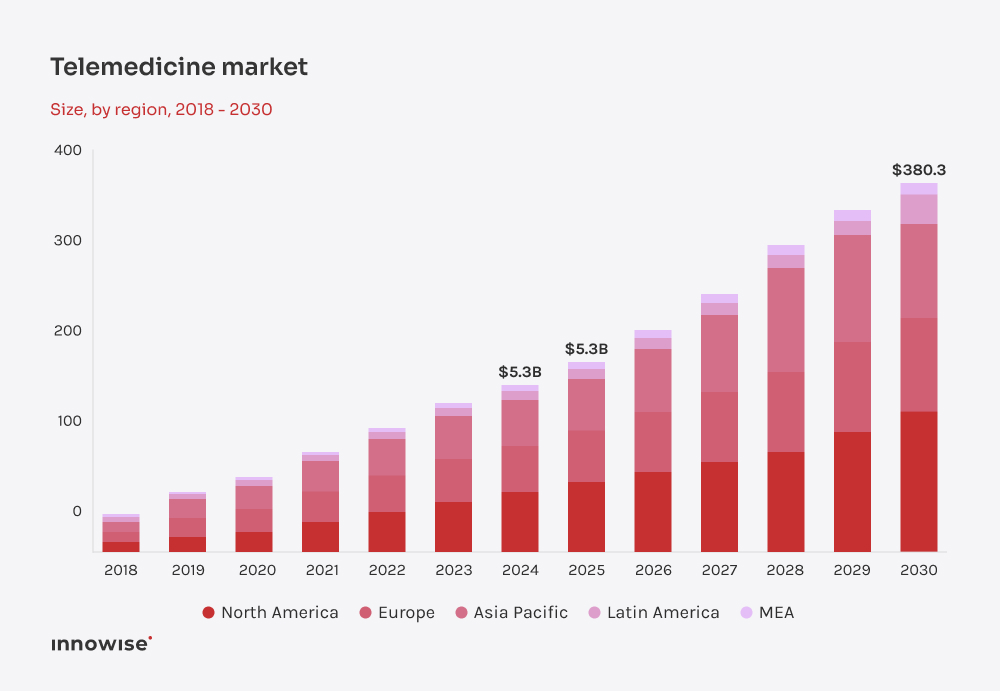
Telemedicine apps and patient engagement software connect patients with caregivers to enable remote monitoring of their health and wellness. The telemedicine market reached $141.19 billion in 2024 and is projected to grow to $380.33 billion by the end of the decade. Real-time consultations account for 38.23% of market revenue, proving a stable investment opportunity.

A diagram showing the telemedicine market size in the article Healthcare business ideas.

Clinical and medical services

Specialized clinics like urgent care centers, fertility clinics, pain management practices, and diagnostic labs provide focused medical care in physical locations and represent reliable customers that generate steady revenue from insurance reimbursements.

Many healthcare startups build digital patient tools like practice management software and EHR systems for these clinics to help them improve appointment-scheduling efficiency, automate billing, and ensure compliance with state and federal regulations.

And if you’re a physician with specific expertise and you’re in an underserved area, opening a focused practice (fertility, sports medicine, pain management) can be more profitable than joining a larger healthcare system.

Health and wellness

Fitness app development, nutrition coaching, and corporate wellness programs generate revenue through subscription-based business models that have fewer regulatory challenges than traditional healthcare and therefore result in a shorter time-to-market.

B2B healthcare solutions

Clinical data management systems, revenue cycle management platforms, healthcare analytics tools, credentialing software, and care coordination systems provide operational solutions for healthcare organizations, payers, and pharma companies. You’ll make more per customer and deal with less regulatory red tape than consumer products, though closing enterprise deals takes months instead of days.

These represent just a fraction of B2B opportunities, as hospitals and health systems need specialized software for dozens of operational functions.

Education, training, and consulting

Digital education platforms and healthcare IT consulting businesses provide educational content, courses, certifications, and expert guidance to assist healthcare professionals with continuing learning and compliance training necessary to enhance their practice.

15 Most profitable healthcare business ideas

The examples listed below illustrate various types of healthcare software that target a defined market, with clear revenue models and realistic startup requirements.

Telemedicine and virtual care platforms

Target audience: Rural patients, physically disabled patients & chronic disease patients. 

Revenue model: Subscriptions, charges/visit, insurance coverage. 

Complexity: Medium — HIPAA compliance, state licensing, provider credentialing. 

Profit: High, with over 70% use by providers. 

Tech: Video streaming protocols, EHR integration, real-time communication systems & scheduling integration. 

Best for: Healthcare IT startups.

AI-driven diagnostic services

Target audience: Hospitals, diagnostic laboratories, and imaging centers.

Revenue model: Licensing, per-analysis fees, revenue sharing.

Complexity: High — Will require various processing functions to meet FDA regulations and to produce clinically useful levels of machine learning model governance.

Profit: Very high post-approval.

Tech: ML, data analytics, medical image processing, cloud-based infrastructure, and data science.

Best for: Tech startups with data science and clinical partnerships.

Remote patient monitoring solutions

Target audience: Patients with chronic disease, as well as elderly & discharged patients.

Revenue model: Monthly charges for monitoring and sales of bundled contracts.

Complexity: Medium to High — HIPAA compliance, potentially FDA clearance depending on device claims.

Profit: High, with recurring revenue.

Tech: Integration of IoT devices, mobile app development, real-time data analytics, and cloud infrastructure.

Best for: MedTech startups, healthcare systems.

Mental health and therapy platforms

Target audience: Those looking to engage in therapy, employers, and universities. 

Revenue model: Subscription fees, per-session fees, B2B contracts. 

Complexity: Medium — Requires HIPAA compliance, state telehealth laws/protocols related to telehealth delivery of therapy services, provider credentialing, and crisis intervention protocols. 

Profit: High, with sustained demand. 

Tech: End-to-end encryption, video conferencing systems, secure messaging protocols, and integration of payment processing. 

Best for: Healthcare entrepreneurs, licensed therapists.

Home healthcare and elderly care services

Target audience: Elderly, post-surgical patients, and people who need help caring for aging relatives.

Revenue model: Hourly or monthly fee basis plus insurance reimbursement.

Complexity: Medium — license for home health agencies provided by the government, credentials for professional caregivers, and HIPAA regulations.

Profit: Moderate but stable.

Tech: Scheduling algorithms, workforce management systems, real-time communication platforms.

Best for: Healthcare administrators, entrepreneurs in regions with the highest density of senior citizens.

E-pharmacy and medical e-commerce

Target audience: Chronic prescription patients and the elderly, plus people with limited mobility.

Revenue model: Product margin and delivery fee revenues, and subscriptions.

Complexity: High — Pharmacy licenses required (state-by-state), DEA registration needed for dispensing schedule drugs, must comply with HIPAA.

Profit: High with repeat purchases.

Tech: Pharmacy management systems, inventory tracking software, payment gateway connections, and prescription verification APIs.

Best for: Pharmacists, entrepreneurs in the retail healthcare market.

Health data analytics and reporting platforms

Target audience: Hospitals, insurance companies & health networks. 

Revenue model: Licensing, implementation, and ongoing services. 

Complexity: High — Requires HIPAA compliance, data security & cloud services, and experience integrating healthcare data.

Profit: Very high with enterprise contracts. 

Tech: Data analytics, BI tools, data migration, ETL pipelines, data warehouse architecture.

Best for: Data scientists who have experience with the healthcare industry.

Wearable health technology solutions

Target audience: Health-conscious consumers, corporate wellness programs, and those with chronic illnesses.

Revenue model: Device sales, premium monthly/annual subscriptions, and B2B contracts. 

Complexity: High — Hardware development, possible FDA clearance for making medical claims, FCC certification. 

Profit: High with differentiation. 

Tech: Hardware engineering, sensor technology, mobile app development, cloud infrastructure, data analytics. 

Best for: MedTech startups with hardware capabilities.

Specialized medical clinics and centers

Target audience: Patients requiring specialized treatment. 

Revenue model: Insurance, cash payments, or memberships. 

Complexity: High — Multiple layers of requirements for medical licensing, facility, and credentials needed to be in compliance with Federal HIPAA requirements. 

Profit: Very profitable in markets that are underserved. 

Tech: Integration of an EHR system, practice management software development, patient portal architecture. 

Best for: Physicians with specialty training.

Healthcare staffing platforms

Target audience: Hospitals, clinics, long-term care facilities. 

Revenue model: Placement fees, monthly subscription fees, percent of employee pay. 

Complexity: Medium to High — background checks, compliance with labor laws, compliance with HIPAA. 

Profit: High potential due to persistent shortages of healthcare professionals. 

Tech: Marketplace platform development, credential checking systems, scheduling algorithms, back-office apps (for tracking new hires), and integration of payment processing.

Best for: Healthcare administrators and entrepreneurs building workforces.

Digital health education and training platforms

Target audience: Nurses, physicians-in-training, allied health professionals, and patients with chronic disease. 

Revenue model: Course fees, subscriptions, B2B training. 

Complexity: Low to medium — content, LMS, have to be accredited if CE credits are offered. 

Profit: Moderate yet scalable. 

Tech: Learning management systems, audio/video streaming networks and infrastructure, development of assessment engines, and certification studies/tracking. 

Best for: Medical educators, experienced clinicians.

Preventive and personalized healthcare services

Target audience: Employers, at-risk individuals, and health-conscious people. 

Revenue model: Fees from service, coaching on a subscription basis, and wellness companies as clients. 

Complexity: Medium — HIPAA compliance if handling health data, lab partnerships, and evidence-based protocol development. 

Profit: High due to recurring sources of income. 

Tech: Genetic data analytics, mobile app development, patient portal systems, lab integration APIs. 

Best for: Wellness-focused healthcare startups.

Medical equipment rental and on-demand services

Target audience: Post-surgery patients, temporarily disabled individuals, and insurance companies. 

Revenue model: Charged a monthly rental fee (for the duration of time a patient is expected to need a medical device), delivery charges, and reimbursement from the insurance company.

Complexity: Medium — As relates to inventory management systems, medical device maintenance protocols, and state requirements for renting medical devices. 

Profit: Moderate with stable cash flow. 

Tech: Inventory management systems, booking platform development, logistics software, payment integration. 

Best for: Small business owners, healthcare supply entrepreneurs.

Healthcare IT and practice management solutions

Target audience: Private practices, specialty clinics, small healthcare networks. 

Revenue model: Software licensing, implementation services, and ongoing support contracts. 

Complexity: Medium to High — Complying with HIPAA, employing standards for HL7/FHIR interoperability, ability to understand clinician workflow.

Profit: Very high with recurring revenue. 

Tech: Custom software development, EHR integration expertise, cloud architecture, workflow automation implementation. 

Best for: Healthcare IT consultants, enterprise developers.

Healthcare marketplaces

Target audience: Patients seeking to evaluate multiple healthcare providers/treatment options. 

Revenue model: Lead generation, commissions, provider subscriptions. 

Complexity: Medium — Provider credentialing, HIPAA compliance, marketplace platform development. 

Profit: High, the potential for profit increases as a result of the network effect. 

Tech: Marketplace platform development, search algorithms integration, review/rating systems, payment processing infrastructure. 

Best for: Digital marketplace entrepreneurs, healthcare IT startups.

Show less Show more

Unique healthcare ideas need custom development.

Technology considerations for healthcare business ideas

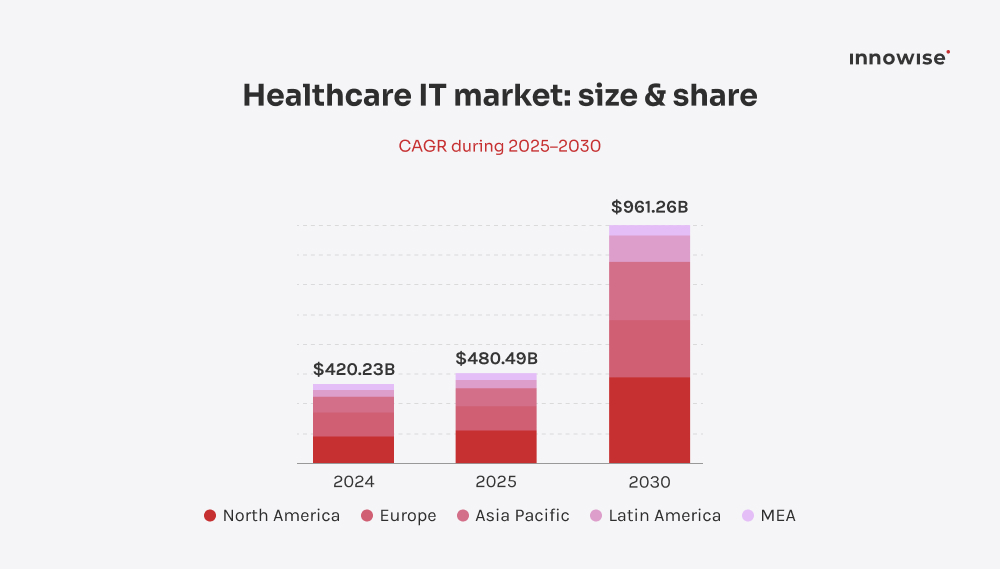
The healthcare IT market was valued at $480.49 billion in 2025 and is forecast to reach $961.26 billion by 2032. With this tremendous growth in mind, there is an opportunity for healthcare startups, as hospitals are looking to replace old-hat systems and integrate modern platforms into existing infrastructure.

A diagram showing the healthcare IT market size and share in the article Healthcare business ideas.

The key technical decisions below that you must consider as you develop your concept into a prototype will help determine whether your project will scale or stall.

Choosing between custom software and off-the-shelf solutions

A white-label platform offers faster deployment but forces you to design your business model around its limitations. Custom development is more expensive but makes sense when differentiation matters, though many startups fall somewhere in between, purchasing commodity features while developing their own proprietary workflows.

Common healthcare technologies

You should only choose features that apply specifically to your product type, unless you intend to create a multipurpose platform that provides the maximum number of functions to the greatest number of user groups.

Modern healthcare products combine web applications for administrative interfaces, mobile apps for patient-facing experiences, cloud infrastructure for data storage plus computational power for AI workloads & unlimited scalability, AI systems for analysis automation and decision support, and IoT devices for capturing real-time health metrics. 

Most successful healthcare startups focus on mastering 2-3 of these technologies deeply rather than implementing them all at once, since each technology domain requires specialized expertise and increases development complexity.

Data security and scalability considerations

You have to build compliance and security into your system from day one, as adding it later costs 10-30 times more because you’ll need to rebuild the core architecture. And do not underestimate the importance of planning for scalability, as larger health systems can quickly scale from hundreds to thousands of users with little notice.

Which standards apply to your product depends on what you’re building and where you’re selling it:

  • HIPAA (U.S.): Use encryption, audit logs, and access levels based on roles and responses for breaches that will secure a patient’s health information.
  • GDPR (EU): How a person’s data is collected, stored, processed, and shared, plus each person’s rights to their personal data.
  • FDA 21 CFR Part 11 (U.S.): The regulations regarding the use of electronic records and signatures on FDA-regulated products.
  • FDA 21 CFR Part 820/QMSR (U.S.): Requires manufacturers of medical devices to maintain a quality management system.
  • MDR (EU): All medical devices sold within the EU must be clinically evaluated and subjected to post-market surveillance, according to the Medical Device Regulation.
  • ISO 13485 (International): The International Standard for Quality Management Systems (QMS) developed explicitly for medical device manufacturers, recognized throughout the globe.
  • ISO 14971 (International): The framework for risk management in the development and use of medical devices.

Medical business ideas by professional background

Your existing credentials and experience determine which healthcare initiatives make sense to pursue, with three backgrounds dominating the field of healthcare entrepreneurship.

Business ideas for doctors

Physicians leverage clinical expertise and patient relationships to launch businesses others can’t replicate: private and specialty clinics with digital patient management, telehealth practices that expand reach without additional physical locations, maternal and child health services addressing pregnancy care through pediatrics, and medical consulting platforms that monetize expertise by helping providers or digital health companies solve clinical problems.

Business ideas for medical students

Students build health education platforms that serve peers, create medical content that generates income while building expertise, and develop early-stage digital health MVPs to validate clinical assumptions when regulatory requirements are lighter.

Small healthcare business ideas

Entrepreneurs without medical backgrounds focus on home care services, where licensed caregivers handle patient care, patient advocacy services help individuals navigate insurance claims and healthcare system complexity, and renting medical equipment addresses demand through logistics coordination.

Healthcare startup ideas with high growth potential

Six trends offer large-scale healthcare business opportunities for founders who can move fast enough to establish themselves as leaders in the early market.

AI and automation in healthcare

Startups entering this space benefit from proven reimbursement models, as insurers already pay for AI-assisted diagnostics that reduce radiologist workload and improve the overall accuracy.

Here are a few stats for AI in healthcare to prove that:

The AI diagnostics market was valued at $1.94 billion in 2025 and is expected to reach a total of $10.28 billion by 2034. Artificial intelligence in diagnostics, treatment planning, and administrative automation captures 42% of digital health investment as these types of technologies increase clinician productivity without causing an equivalent increase in costs.

Aside from the amount of AI in diagnostics, the global artificial intelligence in healthcare market is estimated to be worth $505.59 billion by 2033.

Remote patient monitoring and connected care

RPM works because hospitals can bill insurance for it, that’s the key reason. Medicare covers remote monitoring through established billing codes, and 41 state Medicaid programs now reimburse for RPM services. 

This matters for startups because hospitals won’t adopt your monitoring platform unless they can bill for using it, which removes the biggest obstacle to getting customers. Doctors can track hundreds of patients through connected devices and get paid for catching problems early, before they become expensive emergency room visits.

Preventive and personalized healthcare models

Hospitals and insurers now pay for disease prevention under value-based care contracts because keeping patients’ health costs less than treating complications later. Therefore, when startups demonstrate the ability to measure improved health through data, they can generate predictable, recurring revenue as healthcare organizations continue to seek ways to reduce costs.

Digital mental health platforms

Employers pay for these services because mental health support reduces sick days and keeps employees productive, and B2B contracts like this bring in steadier revenue than trying to get individual consumers to subscribe.

Scalable healthcare marketplaces

You can build healthcare marketplaces because finding doctors is honestly still a mess: people Google specialists, call around to check availability, compare prices if they’re lucky, and waste hours on phone tag. 

If you solve that friction by aggregating providers with real-time booking and transparent pricing, you’ve got a product people will actually use. Revenue comes from charging providers for patient referrals, taking commissions on bookings, or subscription fees for premium placement in search results.

Aging care software

You can build chronic disease management solutions for elderly patients that track patient vitals, remind them to take medications, and alert doctors when something looks wrong, as they need ongoing monitoring for diabetes, heart disease, hypertension, and similar conditions.

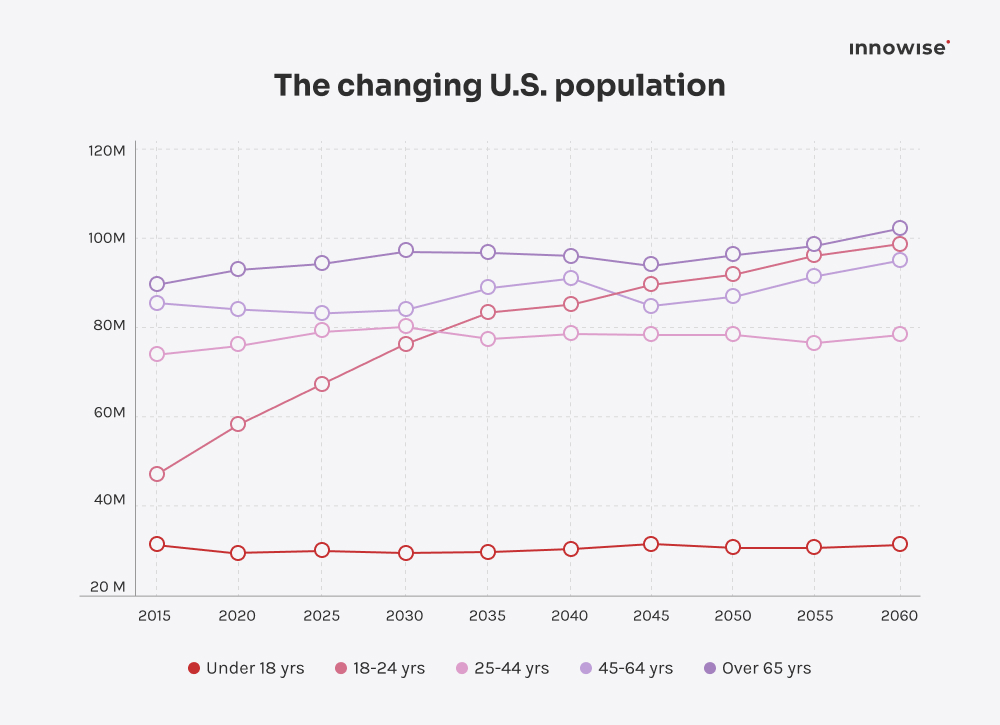
This means recurring monthly revenue from continuous care services, and the demand keeps growing — Americans over 65 will reach 73.1 million by 2030.

A diagram showing the projections of the older adult population in the US in the article Healthcare business ideas.

How to choose the best healthcare business to start

Healthcare business ideas succeed when founders match opportunities to personal capabilities, available capital, and market realities. Use these five factors to check whether a business model actually makes sense for you.

Regulatory and compliance requirements

Research specific compliance requirements for your business type early to understand approval timelines and avoid discovering regulatory barriers after investing in development.

Required startup capital

Calculate initial investment, monthly expenses, and expected ROI to determine how long you can operate before reaching profitability and whether you have sufficient funding runway.

Time-to-market

Choose business models that match your timeline expectations and team capabilities to avoid overcommitting to technical complexity you cannot execute.

Personal expertise and professional background

Match business models to the expertise you already possess rather than learning entirely new domains to reduce learning curves and execution risks during early stages.

Technology-driven vs service-based models

Evaluate your available capital to decide between technology models with higher upfront investment or service models that require ongoing staffing costs as you grow.

From idea to execution: building a healthcare product

At Innowise, we’ve walked through this process with dozens of successful healthcare projects, so we know where things typically go wrong and how to avoid those pitfalls. We handle the technical side while making sure everything stays compliant with regulations.

Below are 5 distinct phases a product moves through, with defined development tasks/activities and areas of expertise for each.

Validating the idea and defining product scope

Conduct 20-30 interviews with potential customers to determine if they have pain points in relation to your idea and will pay to solve them. Ask them how they currently address their problems, what frustrates them about the existing solutions they are currently using, and what they would pay for a solution that resolves that frustration. 

Define the minimum viable product scope by identifying the smallest feature set that covers the complete workflow from start to finish.

Designing user-centric healthcare applications

Identify all relevant healthcare user types (patient, clinician, administrator, payer) and their varying requirements and technical capabilities. Map the workflows before developing the application’s interface to understand how the product will fit into the user’s day-to-day routine and what information will be needed at each step of the process.

Developing secure, compliant, and scalable solutions

For a product to be compliant, you must build in all security measures, such as encryption, auditing, and access controls, from the start. Select technology and database architectures that can accommodate growth and scalability expectations, plus an additional 10x headroom for unforeseen success.

Integrating with existing systems

Healthcare products must be able to transfer data to/from existing EHRs, medical devices, and payer platforms, where integration complexity often exceeds core development. Begin planning the integration aspects of the project early in the design phase, and allocate 30-40% of development time to mapping data fields, handling errors, and maintaining connections as external systems change.

Supporting long-term growth

Healthcare products require ongoing support, so plan to spend 20-30% of the initial development cost annually on regulatory compliance updates, security patch releases, and new features based on customer requests.

Have healthcare startup ideas but need compliant execution?

Why work with a healthcare software development partner

Building healthcare software is different from building regular apps. At Innowise, we’ve been doing this for 19 years, so we’ve seen what trips up teams that don’t specialize in healthcare. Three things make healthcare projects harder:

  • You need to build compliance into the architecture from day one: HIPAA, GDPR, and FDA regulations can’t be added later without rebuilding everything.
  • Clinical workflows are complex, and if your software doesn’t match how doctors actually work, they won’t use it.
  • You have to connect with old EHR systems, medical devices, and insurance platforms, which often takes longer than building your core product.

Below, we’ll explain how working with healthcare specialists helps you avoid expensive mistakes and get to market faster.

Why general development teams struggle with healthcare projects

General software teams don’t have healthcare experience, so they miss things that seem obvious to us now but weren’t when we started. For example, for HIPAA compliance, you need audit logs that track who accessed what data and when, role-based permissions that match clinical hierarchies, and incident response plans for data breaches. 

Most teams discover these requirements halfway through development, which means rebuilding major parts of the system. We’ve seen startups burn through six months and their entire budget fixing problems that could’ve been avoided if someone with healthcare experience reviewed the architecture early.

How Innowise's healthcare expertise prevents costly mistakes

We know what’s coming because we’ve been through FDA clearances, state licensing processes, and insurance credentialing dozens of times. When you’re designing workflows, we can tell you “that won’t work in practice because doctors need to see X before they can do Y” based on actual clinical experience, not guesses. 

We design systems that pass compliance audits the first time because we know what auditors look for. This saves you months of back-and-forth revisions.

Why Innowise builds custom solutions instead of using templates

Off-the-shelf templates force you to change your business to fit the software, not the other way around. Custom software development for healthcare means building workflows that match exactly how you want to operate, which becomes your competitive advantage. 

A mental health platform needs completely different scheduling logic than a dermatology telehealth service since templates can’t handle both well. We build systems optimized for your specific use case, so they scale efficiently as you grow instead of requiring expensive rewrites later.

How Innowise accelerates your path to market

We can help speed up your development process by supplying reusable components, compliance frameworks, and proven architectural patterns. We also help reduce the technical risk of your project by finding integration problems and security vulnerabilities during the design phase rather than post-launch.

If you have any remaining questions or need professional consultation regarding your healthcare business ideas, please contact us anytime.

FAQ

Healthcare startups that provide telemedicine and remote patient monitoring services tend to produce the greatest profit margins, as these services can be scaled via software without the need for an increase in personnel or additional office space.


Most economically viable healthcare startups have custom-built software for their differentiating features and use off-the-shelf solutions for non-core components, such as payment services, documentation, and scheduling.

Yes, a physician can conduct adequate research and due diligence to determine product-market fit before product readiness, then partner with experienced development firms to assist with the technical aspects and compliance.

Yes. Many small businesses in the healthcare industry would find value in using practice management software, scheduling software for patients, telehealth software, and billing automation software, as all of these can help streamline operations.

The time required to build a healthcare application depends on how complex its features are, how much regulation you must comply with, and the integrations required.

The three biggest mistakes made by healthcare entrepreneurs include: underestimating the regulations related to their application, building features prior to determining if there is sufficient market demand, and trying to solve too many problems at once.

Yes, focus on non-clinical areas like medical equipment rental, nutrition coaching, home care coordination, or healthcare IT solutions that don't require medical licenses.

You should consider partnering with a healthcare development firm when you feel your team cannot address the compliance complexities, or when integrating your application with EHR systems and/or medical devices is necessary.

author avatar

Head of Healthcare Business Practice

Dedicated to tech innovation in the healthcare industry, Anastasiya Dziemieszkiewicz is a powerhouse behind many of Innowise’s cutting-edge projects — AI apps, digital health tools, and such. She works closely with cross-functional teams and healthcare businesses to shape solutions that meet industry regulations and clients’ objectives. With a genuine interest in improving patient outcomes and healthcare workflows, Anastasia never ceases to impress the clients with her practical approach and fresh ideas.

Table of contents

    Contact us

    Book a call or fill out the form below and we’ll get back to you once we’ve processed your request.

    Send us a voice message
    Attach documents
    Upload file

    You can attach 1 file up to 2MB. Valid file formats: pdf, jpg, jpeg, png.

    By clicking Send, you consent to Innowise processing your personal data per our Privacy Policy to provide you with relevant information. By submitting your phone number, you agree that we may contact you via voice calls, SMS, and messaging apps. Calling, message, and data rates may apply.

    You can also send us your request
    to contact@innowise.com
    What happens next?
    1

    Once we’ve received and processed your request, we’ll get back to you to detail your project needs and sign an NDA to ensure confidentiality.

    2

    After examining your wants, needs, and expectations, our team will devise a project proposal with the scope of work, team size, time, and cost estimates.

    3

    We’ll arrange a meeting with you to discuss the offer and nail down the details.

    4

    Finally, we’ll sign a contract and start working on your project right away.

    More services we cover

    Business insights
    3D product modeling 3D product rendering Adtech Agriculture software AI chatbot Apple TV apps AR apps ATS software Automation testing BI BigCommerce Biotech Business process automation Clinical intelligence Clinical trials software Cloud Migration Consulting Services CMS CRM Custom LMS software development services Desk booking apps Drupal E-commerce E-commerce apps E-commerce apps QA E-commerce consulting E-commerce migration E-commerce web design EHR & EMR EHR integration EHS solutions Embedded finance Enterprise blockchain Enterprise software ESG consulting Finance apps QA Finance software Fintech consulting Fitness apps Government apps GRC Headless CMS Healthcare Healthcare AI Healthcare analytics Healthcare data migration Healthcare IT consulting Healthcare mobile apps Healthcare software Hire healthcare app developers Imprint Insurance Investment apps Legacy apps upgrade Life-cycle assessment LMS Magento Magento PWA Manufacturing Marketplace development Medtech Microsoft 365 Microsoft Dynamics 365 MS Dynamics 365 migration NopCommerce Odoo consulting Odoo development Odoo implementation Odoo migration Oil & gas software OpenCart Patient engagement Payment gateway API Payment hub Pharma Pharma AI PIM implementation Pimcore Population health management PoS software Practice management PWA development Quality management RCM software Retail Retail data analytics Robotics Salesforce CRM SaMD & SiMD SharePoint SharePoint Intranet Shopify Shopify developers Shopify integration Shopify migration Shopware Sitecore Supply chain management Sustainability consulting Telemedicine Travel apps Travel portals Value-based care apps Video-on-demand VR/AR in healthcare Wellness apps White-label HRM White-label LMS WooCommerce Wordpress
    See more

    arrow