voka_logo_black

VOKA 3D Anatomie & Pathologie

Innowise initiated the development of a medical learning app, VOKA 3D Anatomy & Pathology, to help students, doctors, and patients explore anatomy and pathology with interactive 3D models. As of 2026, the platform stands as one of the global leading products in digital medical visualization.

1,000+

interactive 3D models developed

1,000,000+

active app users worldwide

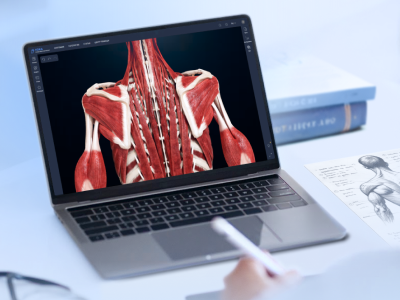
VOKA 3D anatomy interface dispaying muscular structure
Industrie Gezondheidszorg
Werknemers 100+
Regio Wereldwijd
Diensten Mobile development, 3D design
Klant sinds 2017

Overzicht klanten

Artikel samenvatten met AI

In 2017, Innowise partnered with leading medical experts from hospitals and research institutions to explore how 3D visualization can transform healthcare. This collaboration resulted in the creation of a range of MedTech solutions under the VOKA brand name, designed to support patient care and medical education worldwide.

Uitdaging

Navigating the intricacies of medicine and its vast complexities in both pathology and normal anatomy often presents numerous challenges.

  • Lack of advanced digital resources. There is a shortage of high-quality, interactive digital ecosystems that bring together clinically accurate content. Many institutions still rely on static or outdated materials that fail to meet modern medical standards and reflect the latest research data.
  • Scalability issues. Traditional textbooks and static 2D diagrams are difficult to scale across large audiences or multiple institutions. Creating digital platforms is essential to deliver consistent learning experiences for students and medical staff, expanding educational reach and impact.
  • Engagement gaps. Lecture-based learning is not enough to capture students’ attention. Without visually rich materials, learners struggle to stay focused and retain complex information. This lack of engagement reduces the effectiveness of education and slows skill acquisition.
  • Patient trust and retention issues. Many patients struggle to understand their diagnosis and prescribed care, which results in confusion and poor treatment adherence. Providing doctors with clear, interactive tools to explain these mechanisms helps build trust, improve understanding, and ultimately boosts patient satisfaction and retention.
  • Poor spatial visualization. Scientific papers and flat diagrams can’t show how anatomical structures fit together in their true spatial context. As a result, students and patients often get an incomplete understanding of the human body and its pathologies.
  • Interactivity limitations. Resources such as textbooks don’t allow users to interact with the content. If students and medical professionals can’t rotate, dissect, zoom, or isolate structures, it becomes harder to grasp complex medical topics. Without interactive tools, learning becomes passive and less effective.
  • Data updating & validation. Medicine moves fast, and printed materials can’t keep up. You can’t rewrite a textbook in real time, but in 2026, digital tools are the only way to keep content current and aligned with the latest clinical protocols.

Oplossing

Ons team introduceerde VOKA 3D Anatomie & Pathologie, a comprehensive digital 3D atlas of human anatomy and pathologies, tailored to web, iOS, en Android platforms. 

To meet the standards of the global medical community, every 3D model within the library is developed in close collaboration with our in-house medical team of 30 professional doctors. This partnership ensures that every anatomical structure and pathology is designed and rendered with absolute clinical accuracy.

To support international collaboration and learning, the application offers full localization in English, German, and Russian, with more languages to come.

3D-modellen

The core of our solution is high-fidelity 3D models of normal anatomy and pathological conditions. To ensure absolute precision, every model is developed based on MRI/CT scans, histology references, and authoritative clinical manuals. Additionally, the catalog is regularly updated to remain strictly aligned with evolving global clinical standards.

Pathology conditions

The 3D atlas features an extensive pathology section that currently hosts 600+ high-fidelity models of pathological conditions. This library provides a comprehensive overview of numerous diseases and disorders across 19 medical specialties, including cardiology, gastroenterology, dermatology, obstetrics and gynecology, endocrinology, and more.

The collection is continually expanding, with new clinical models and rare pathologies added regularly. As a result, the atlas becomes a dynamic, comprehensive ecosystem for studying human health in a realistic, three-dimensional environment.

Normal anatomy

For the anatomy aspect, VOKA 3D Anatomy & Pathology includes over 350 models divided into several categories:

  • Regional anatomy. Depicting male and female anatomy by region (head and neck, back, thorax, upper and lower limbs) and visualizing the interconnected structures (skin, muscles, joints, bones, vessels, and more).
  • System anatomy. Demonstrating the systems of the human body (skeletal system, system of joints) and their key components (for example, all the bones of the free part of the upper limb).
  • Embryology. Visualizing human development from blastocyst to a birth-ready fetus.
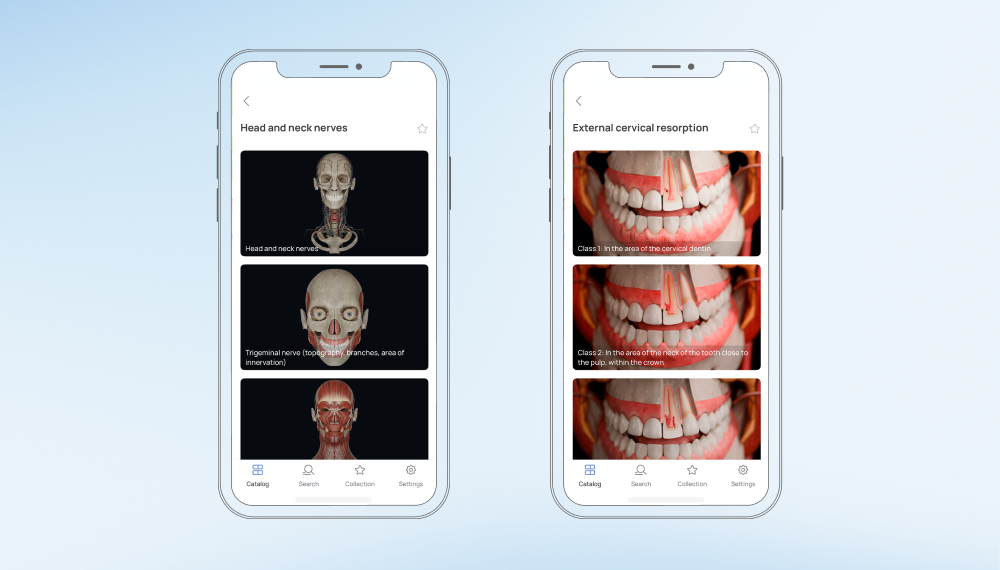
  • Microanatomy. Showcasing the anatomy of various human body systems on cellular and subcellular levels.
  • Biomechanics. Revealing the mechanisms of human body movements, including joint and muscle motion patterns.

Essential features

To maximize the impact, VOKA 3D Anatomy & Pathology offers a comprehensive suite of features for advanced exploration. Our platform transforms lectures into an immersive experience through the following core functionalities:

  • Variety of interactive tools. Users can virtually dissect the models to visualize internal anatomy and pathology structures, draw directly on models with a 2D or 3D pen to mark specific structures, place text and images next to the model to support explanation, and use color highlights or an on-screen pointer to distinguish important structures.
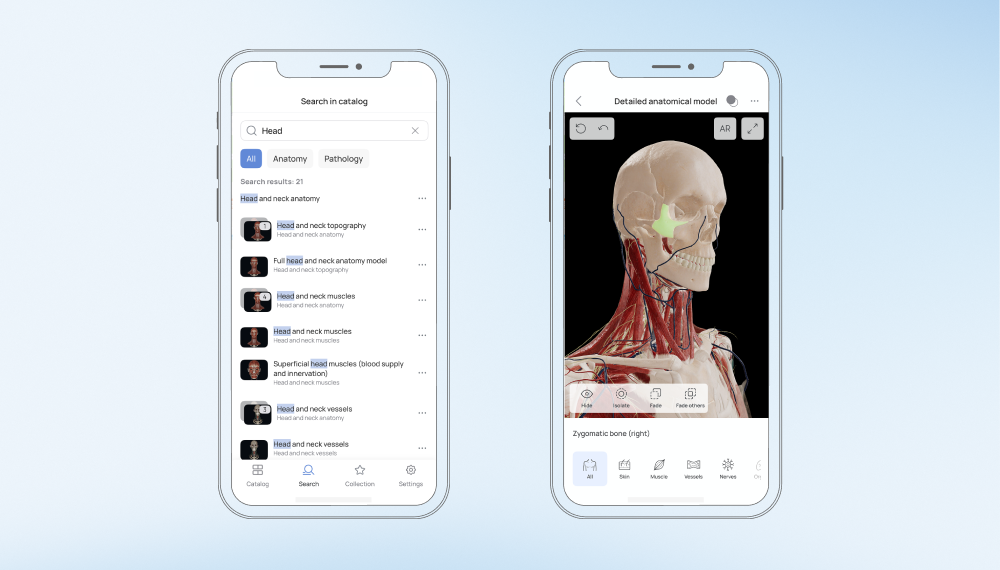
  • Display modes. You can zoom and rotate models, isolate and hide anatomical structures, visualize organs within their anatomical context via the ‘Topography’ function, and capture 3D model snapshots for further use in presentations and learning materials.
  • Quick access functionality. It’s possible to search for a required model across the entire catalog via a search bar, create custom personal collections of models, and share content with students and colleagues via the deeplinks function.
  • AR mode. This feature is available in the mobile app and lets you interact with structures at a realistic scale. Users can project high-fidelity 3D models directly into physical space (on a mannequin or table), offering a level of spatial depth and anatomical perspective unavailable on standard screens.

Medische artikelen

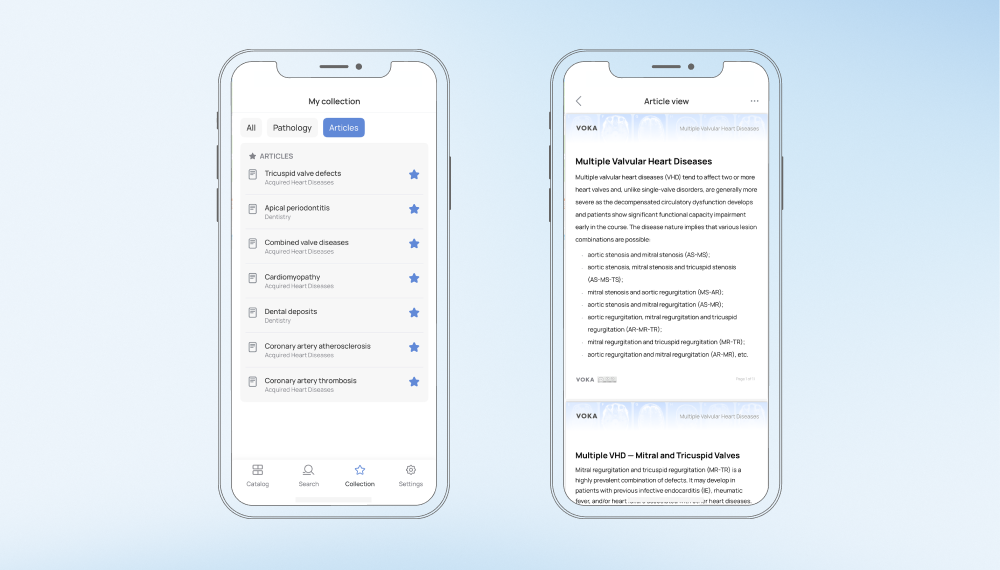
The ‘Articles’ section serves as a high-level clinical reference that bridges the gap between 3D visualization and theoretical medical knowledge.

It is a digital library consisting of expert-written clinical guides. Each article is designed to provide a deeper theoretical context for the 3D models in the atlas, ensuring that users also understand the theoretical aspect of real clinical conditions.

Every article is structured to follow a standardized medical logic, covering:

  • General overview. Detailed descriptions of pathologies from anatomical and statistical points of view, including organs and systems affected, prevalence, and more.
  • Clinical presentation. Insights into symptoms, types, and subtypes of various pathologies.
  • Pathophysiology. Explanations of how diseases progress and affect the human body.
  • Diagnostics & treatment. Expert-approved guides on modern diagnostic methods and treatment pathways.

The articles can be used as an exam preparation tool for medical students and a patient education resource for doctors. They are suitable for a layered learning approach: a user can read about a condition in the dedicated article and then instantly jump to the corresponding 3D model to visualize the pathology from multiple angles.

The ‘Articles’ section in the VOKA 3D Anatomy & Pathology app is perfect for quick reference. If deeper research is needed, you can also use VOKA Wiki. This resource includes expert articles supported by visual content, interactive quizzes, a medical glossary, and AI-generated summaries.

App compatibility

To provide a truly versatile educational experience, VOKA 3D Anatomy & Pathology is designed for cross-platform compatibility, and each platform offers unique advantages for medical students, educators, and clinicians.

Mobile Devices (iOS & Android)

Provides portability and “on-the-go” access. It allows students to study during rotations or breaks and enables doctors to use the app for quick bedside patient consultations.

PCs

Offers maximum performance and detail. The larger screen is ideal for deep-dive research into complex pathologies and is the primary tool for creating detailed medical presentations or studying course materials.

Interactive boards & whiteboards

Perfectly optimized for classroom engagement. Professors can project 3D models during lectures, using touch gestures to rotate and annotate structures in real-time, while doctors can do the same during clinical case discussions.

Learning Management Systems

By connecting our atlas with universities’ LMS platforms, educators can embed 3D models directly into assignments, track student progress, and centralize all curriculum resources.

Touch displays

Large touch screens in libraries or hospital hallways serve as interactive booths, where users can intuitively explore human systems through direct physical engagement with the digital models.

VR devices

VR provides an unparalleled sense of spatial relationships and scale that are essential for pre-surgical planning and understanding of internal structural concepts.

AR devices

It helps bridge the gap between digital and physical reality. AR overlays 3D anatomical models onto real-world environments (like a physical mannequin or a desk), helping learners visualize how internal organs align with external body landmarks.

Proces

01
Gebruikersanalyse
Ons team heeft zich verdiept in de behoeften van chirurgen, artsen, opleiders en studenten.
02
Initieel ontwerp
Vervolgens stelden we een intuïtieve voorlopige applicatieopmaak op.
03
Technologie selecteren
Op basis van feedback van gebruikers hebben we gekozen voor Unity 3D voor superieure 3D-weergave.
04
Samenwerking tussen experts
With medical professionals, we shaped 3D models of anatomical structures and pathological conditions.
05
Ontwikkeling
Met een blauwdruk in de hand begonnen we aan de reis om software te maken.
06
Testen
De volgende fase bestond uit rigoureuze tests om eventuele problemen op te lossen.
07
Beoordeling door experts
Vervolgens vroegen we deskundigen om advies om de medische precisie van de software te garanderen.
08
Lancering
Upon validation, we rolled out VOKA 3D Anatomy & Pathology to our audience.
09
Feedbacklus
We luisteren actief naar onze gebruikers en verzamelen voortdurend feedback.
10
Updates en releases
We improve the app based on user insights and add new categories in consultation with the medical board.

Technologieën

Backend

Java, Microservices, JWT, Redis, Gateway, Spring Boot, PostgreSQL, MongoDB, k8s, GCP, Spring Security, Flyway.

Frontend

Angular 20+, JavaScript, CSS, HTML.

Android

Kotlin, Clean Architecture, MVP, RxJava2, Single-Activity, Toothpick, Retrofit, Room, Firebase (Crashlytics, Analytics, AppDistribution), JUnit, Jetpack Compose, Coroutines, MVVM.

iOS

Swift, Objective-C, UIKit, SnapKit, SwiftUI, MVVM, GCD, Swift Concurrency (async/await), Alamofire, URLSession, Core Data, Firebase (Crashlytics, Analytics, App Distribution), XCTest.

3D

Unity3D, C#, webGL, ZBrush, Blender, Cinema4d, Redshift.

Platformen

iOS, Android, Web.

Team

Icon 10
3D ontwerpers
Icon 2
Unity-ontwikkelaars
Icon 2
Frontend Angular Developers
Icon 3
Java-ontwikkelaars
Icon 2
iOS-ontwikkelaars
Icon 2
Android-ontwikkelaars
Icon 4
QA Engineers
Icon 30
Doctors
Innowise team

Resultaten

Duur van het project
2017 - ongoing

Since 2017, VOKA has been at the cutting edge of MedTech, growing into a leading 3D human anatomy resource for medical schools, universities, and healthcare institutions worldwide. Thanks to the ever-growing library of 3D models, interactive tools, and reliable performance, VOKA 3D Anatomy & Pathology has become a trusted resource for 1,000,000+ users across 190 countries.

Our commitment to innovation has earned prestigious international recognition, including winning the 2019 World Summit Award in the Health & Well-Being category.

Reflecting our impact on medical education, the VOKA app has been integrated into the academic curricula of several medical universities, providing students with a digital alternative to traditional anatomical study.

Today, we continue to push the boundaries of medical visualization by actively developing immersive AR and VR experiences, ensuring that VOKA remains a dedicated partner in medical education and patient learning worldwide.

Inhoudsopgave

Launch your cutting-edge project now

    Contacteer ons

    Boek een gesprek of vul het onderstaande formulier in en we nemen contact met je op zodra we je aanvraag hebben verwerkt.

    Stuur ons een spraakbericht
    Documenten bijvoegen
    Bestand uploaden

    Je kunt 1 bestand van maximaal 2 MB bijvoegen. Geldige bestandsformaten: pdf, jpg, jpeg, png.

    Door op Verzenden te klikken, stemt u ermee in dat Innowise uw persoonsgegevens verwerkt volgens onze Privacybeleid om u van relevante informatie te voorzien. Door je telefoonnummer op te geven, ga je ermee akkoord dat we contact met je opnemen via telefoongesprekken, sms en messaging-apps. Bellen, berichten en datatarieven kunnen van toepassing zijn.

    U kunt ons ook uw verzoek sturen
    naar contact@innowise.com
    Wat gebeurt er nu?
    1

    Zodra we je aanvraag hebben ontvangen en verwerkt, nemen we contact met je op om de details van je projectbehoeften en tekenen we een NDA om vertrouwelijkheid te garanderen.

    2

    Na het bestuderen van uw wensen, behoeften en verwachtingen zal ons team een projectvoorstel opstellen met de omvang van het werk, de teamgrootte, de tijd en de geschatte kosten voorstel met de omvang van het werk, de grootte van het team, de tijd en de geschatte kosten.

    3

    We zullen een afspraak met je maken om het aanbod te bespreken en de details vast te leggen.

    4

    Tot slot tekenen we een contract en gaan we meteen aan de slag met je project.

    arrow