RPA market trends 2026: future directions in robotic process automation and hyperautomation

Updated: Apr 16, 2026 10 min read
Summarize article with AI

Key takeaways

  • RPA market size 2026 is accelerating fast. Growth is driven by industry-specific automation, cloud adoption, and AI-powered efficiency gains.
  • The future of RPA leans toward hyperautomation. RPA, AI, ML, and analytics will work together to manage complex workflows and support quicker, more accurate decisions.
  • No-code RPA and citizen development expand adoption. Non-technical teams can build and adjust automations on their own, which cuts deployment time and keeps processes aligned with real day to day work.
  • RPA as a service (RaaS) reshapes automation costs. Flexible subscriptions replace heavy upfront investments and scale with workload volumes and actual business demand.
  • Stronger governance and security become essential. More autonomous, AI-enabled bots call for clear rules, monitoring, and lifecycle control to keep automation safe and compliant.

If I asked you today to describe robotic process automation (RPA) in five words, what would you say? Automation, efficiency, bots, repetition, optimization — these might be the first ones that come to mind. But what if I threw in low-code, GANs, and process mining? You’d probably think, Wait, what do those have to do with RPA?

Well, a lot, actually.

Like any technology, RPA isn’t stagnant. It’s always evolving, with new trends emerging every year. That’s exactly why we’re here — to explore the key robotic process automation trends for 2026 and what they mean for businesses worldwide.

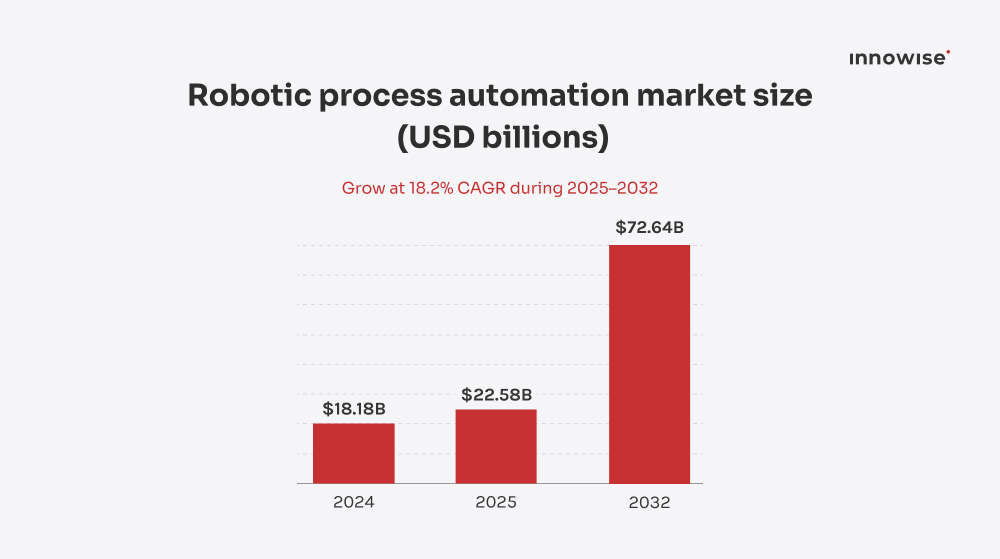
But before we dive into these RPA trends, let’s assess the state of play. The global robotic process automation market size is projected to grow from $22.58 billion in 2025 to $72.64 billion by 2032, growing at a remarkable CAGR of 18.2%. According to Deloitte, 69% of Global Business Services (GBS) organizations consider RPA a key transformation technology, making it the most sought-after digital enabler. So, we can deduce that as demand grows, RPA will continue advancing and integrating new tech to push automation to the next level.

So, what’s the future of RPA in 2026? Let’s dive into the key trends.

RPA market growth projection to 2032, with revenue increasing at an 18.2 percent CAGR.

Automate smarter, innovate faster — with RPA doing the heavy lifting.

Key RPA market trends 2026

Industry-specific RPA is taking over

In 2026, businesses continue to fine-tune RPA to meet their exact needs. Industry-specific RPA solutions are no longer optional — they’re essential. Generic tools that fail to address real challenges are a thing of the past. Instead, tailored automation drives smarter, faster, and more cost-effective operations by directly tackling industry-specific pain points.

The shift to cloud-based RPA

The cloud-based RPA revolution is making automation easier, faster, and more scalable in 2026. Businesses no longer need expensive hardware or complex setups. They can deploy instantly, scale bots as needed, and rely on top cloud providers for security. Best of all, implementation is quick, so businesses can see real results in days, not months.

Smarter workflows with collaborative RPA

In 2026, collaborative RPA will define automation strategies. Businesses won’t need human intervention for repetitive tasks, only for critical thinking and decision-making. This seamless collaboration between bots and people boosts efficiency and allows employees to focus on strategic, value-driven work without losing oversight or control.

Hyperautomation changes the game

Hyperautomation is one of the key trends in RPA. It’s transforming how businesses automate workflows from start to finish. In 2026, it goes beyond bots running scripts — RPA, AI, machine learning, and analytics work together to handle any task you throw at them. The result is smarter automation, lower costs, fewer errors, and more agile businesses. ​

Process mining to optimize business workflows

In 2026, businesses will put processes and workflows under the microscope in the name of efficiency. Process mining helps companies identify inefficiencies and optimize automation efforts. Instead of applying RPA blindly, businesses are leveraging real-time data to pinpoint bottlenecks, eliminate redundancies, and automate with precision for maximum efficiency and impact.

Analysts estimate that the global process mining software market will grow from $3.66 billion in 2025 to $42.69 billion by 2032, with a CAGR of around 42.0%. This growth shows how quickly process mining is becoming a standard part of automation and hyperautomation programs rather than a nice-to-have add-on.

Empowering citizen developers with low-code RPA

Automation no longer belongs only to professional developers. In 2026, low-code RPA is putting the power of automation into the hands of citizen developers. With simple drag-and-drop interfaces, employees can set up and launch automated workflows without waiting in the IT queue. This approach speeds up delivery, cuts routine work, and keeps operations more responsive when processes change.

Recent research shows how fast this model is scaling. According to the EY survey, 68% of organizations already allow citizen developers to create or deploy their own AI agents, but only 6 in 10 provide formal guidance on how to do this safely. 

For RPA, the trend is clear. By 2026, no-code and low-code RPA platforms will give non-technical staff much more control over how bots are designed and run. At the same time, these platforms will sit inside stronger governance frameworks, so all this freedom still follows security rules, compliance requirements, and proper bot lifecycle management.

Stronger security for safer automation

Businesses today are fortifying their RPA systems with stronger cybersecurity. Encrypted data, strict access controls, and AI-driven threat detection are now the norm. With zero-trust security models, only authorized users and bots can interact with critical workflows, ensuring safer and more resilient automation.

The rise of robot-as-a-service (RaaS)

The robot-as-a-service market is projected to grow from about $1.892 billion in 2025 to $3.879 billion by 2030, with a CAGR of 15.44%. This growth shows how quickly RaaS is becoming the standard way for adopting automation.

RaaS gives companies:

  • on-demand access to robots and automation
  • lower upfront costs
  • built-in scalability as workloads grow

Instead of buying and owning all the infrastructure, businesses subscribe to cloud-based bots and scale them up or down as needed. They move away from rigid automation setups and choose services that grow and change with their operations.

The competitive edge of RPA for industries

Now that we’ve talked about where RPA is headed in 2026, let’s get into one more crucial aspect — how it’s actually making industries run better. It’s not just about automation for the sake of it. It’s about cutting costs, speeding things up, and taking the grunt work off people’s plates. Let’s dig in.

Education

By integrating RPA with student information systems (SIS), learning management systems (LMS), and financial platforms, schools and universities can automate complex workflows with precision. With cloud-based RPA, API integrations, and AI-driven analytics, they can automatically process student applications, verify documents, and reconcile tuition payments within financial systems.

Healthcare and pharma

RPA is giving healthcare workers more time for what really matters — caring for patients. Take patient record transfers, for example. Instead of a receptionist manually entering past health records from PDFs or paper documents into an EHR system, an RPA bot can handle it in minutes. And it’s not just hospitals: pharmacies are jumping on board too. RPA bots help track medication inventory, update stock levels, and send alerts when supplies run low.

Finance and banking

Banking and finance deal with endless transactions, reports, and compliance checks. RPA bots in banking handle it all faster, smarter, and error-free. They automate data entry, transactions, and reporting with near-zero mistakes. With AI, bots read messages, interpret requests, and generate responses, helping support teams work faster. They also extract financial data from scanned documents and turn messy paperwork into structured information.

Logistics and transportation

Logistics and transportation run on tight schedules, and RPA is helping businesses keep up. Bots handle order processing, shipment tracking, invoicing, and compliance checks. In warehouses, RPA automates inventory management, stock updates, and returns processing. AI-powered bots also optimize delivery routes and update tracking systems in real time. The result? Fewer delays, lower costs, and more efficient supply chains.

Retail and e-commerce

Retailers and e-commerce platforms are turning to RPA to automate high-volume, time-sensitive operations. From real-time inventory tracking and automated order fulfillment to AI-driven demand forecasting, automation is making processes faster and smarter. RPA syncs stock levels across warehouses, updates product listings, and manages pricing dynamically. Bots also handle fraud detection, payment verification, and customer support automation.

Manufacturing

Manufacturers are using RPA to streamline operations, reduce downtime, and boost efficiency. Integrated with ERP, MES, and inventory systems, automation handles repetitive tasks, enabling teams to focus on quality and strategy. Bots track inventory, coordinate suppliers, and optimize schedules in real time. With data automation and predictive analytics, manufacturers cut costs, increase productivity, and maintain top-quality output — without the increased workload.

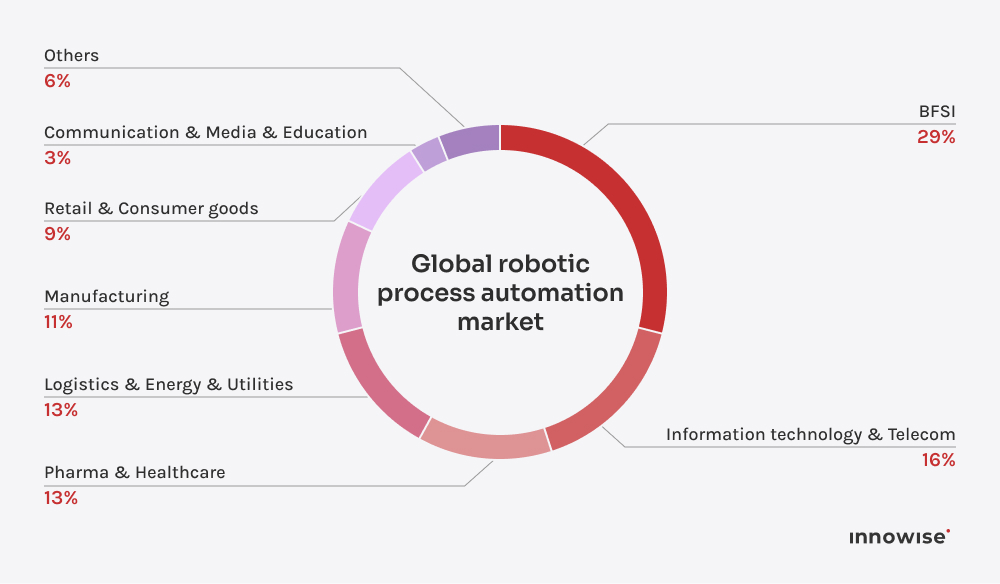
Global robotic process automation market share chart by industry

Turn time-consuming tasks into automated wins with RPA.

Boosting RPA with AI and ML

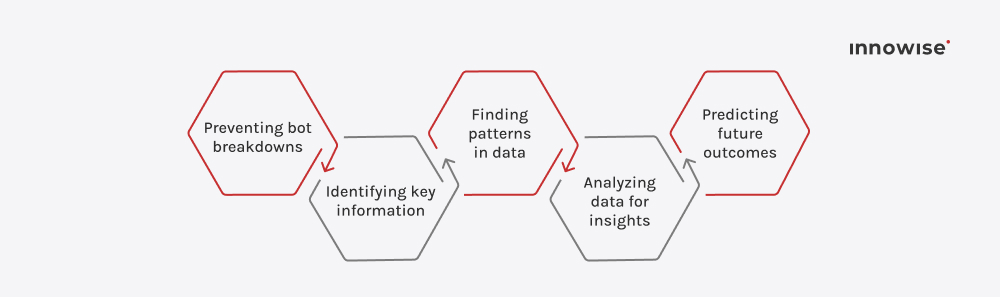
AI and ML are transforming many technologies, and RPA is no exception. When you bring AI and ML into the mix, RPA bots get smarter, adapt faster, and predict what’s coming next, which means fewer breakdowns and way more efficiency. 

Take finance — RPA gathers payment data, while ML predicts who might pay late, helping businesses stay ahead of cash flow issues. In customer service, AI-powered bots pick up on customer sentiment, flag urgent cases, and suggest replies that actually make sense. In supply chains, ML-driven bots spot demand trends before they happen, so businesses can avoid running out of stock or overordering.

With AI and ML, RPA moves beyond rule-based automation to self-learning systems, driving smarter decisions and greater efficiency across industries.

Workflow diagram of intelligent automation steps from detecting issues and key info to analytics and outcome prediction

These days, RPA is doing far more than just automating repetitive tasks. With AI, ML, and advanced analytics, automation is learning and adapting on the go. That means fewer manual headaches, smoother workflows, and better collaboration between people and digital workers. I’m sure that companies that embrace this shift will lead the way in a world where automation and data rule.

Chief Technology Officer

RPA market trends: the future of automation

RPA never sits still. Businesses constantly want smarter, faster, more powerful automation, which means the tech behind it is always evolving. Right now, there are a few exciting RPA market trends starting to emerge — still fresh enough that many companies are cautiously testing them out, but promising enough to make waves soon. Let’s dive in and explore what is next after RPA.

Generative adversarial networks (GANs) for smarter RPA

GANs, commonly used in AI-driven automation, are the future of process automation. They improve RPA bots by improving data synthesis, anomaly detection, and process optimization. By training on adversarial networks, RPA systems can generate realistic test data, simulate business scenarios for better automation training, and detect fraudulent or abnormal patterns in real time. This allows RPA to handle more complex, unpredictable workflows with higher accuracy and adaptability.

Quantum, edge, and next-gen computing for RPA scalability

Quantum and edge computing are pushing the boundaries of how RPA bots process, store, and execute automated workflows. Quantum computing can dramatically boost encryption, complex decision-making, and massive parallel data processing — allowing RPA bots to tackle high-speed financial modeling, real-time fraud detection, and multi-variable supply chain optimizations. Edge computing, on the other hand, enables RPA bots to process data closer to the source and reduces latency in IoT-driven automation, smart factories, and real-time logistics management.

More precise natural language processing (NLP) for intelligent RPA

NLP advancements make RPA bots more effective at understanding, processing, and generating human-like responses. This is crucial for intelligent document processing (IDP), AI-driven chatbots, and automated customer support workflows. Advanced NLP allows bots to extract key data from unstructured text, summarize legal and financial documents, and translate real-time conversations with near-human accuracy. The result is higher automation accuracy and better human-bot collaboration in complex workflows.

More accurate predictive analytics for decision-making in RPA

Predictive analytics is evolving beyond static rule-based automation, allowing RPA bots to make data-driven decisions proactively. AI-powered predictive models help bots forecast demand fluctuations, anticipate system failures, detect financial risks, and optimize workforce planning. By leveraging reinforcement learning and AI-driven forecasting, RPA solutions can autonomously adjust processes in real time and improve operational efficiency and risk management across industries.

Agentic AI for fully autonomous RPA

Traditional RPA is great for automating repetitive tasks, but as workflows get more complex, its limits will become clearer. That’s where agentic AI steps in. It allows RPA bots to think, learn, and adapt in real time. Instead of just following set rules, these bots will make decisions on the fly, improve from past actions, and handle unpredictable situations without constant human input. This will make RPA far more flexible and powerful, especially in industries like finance, logistics, and healthcare, where automation will need to be smart, not just fast.

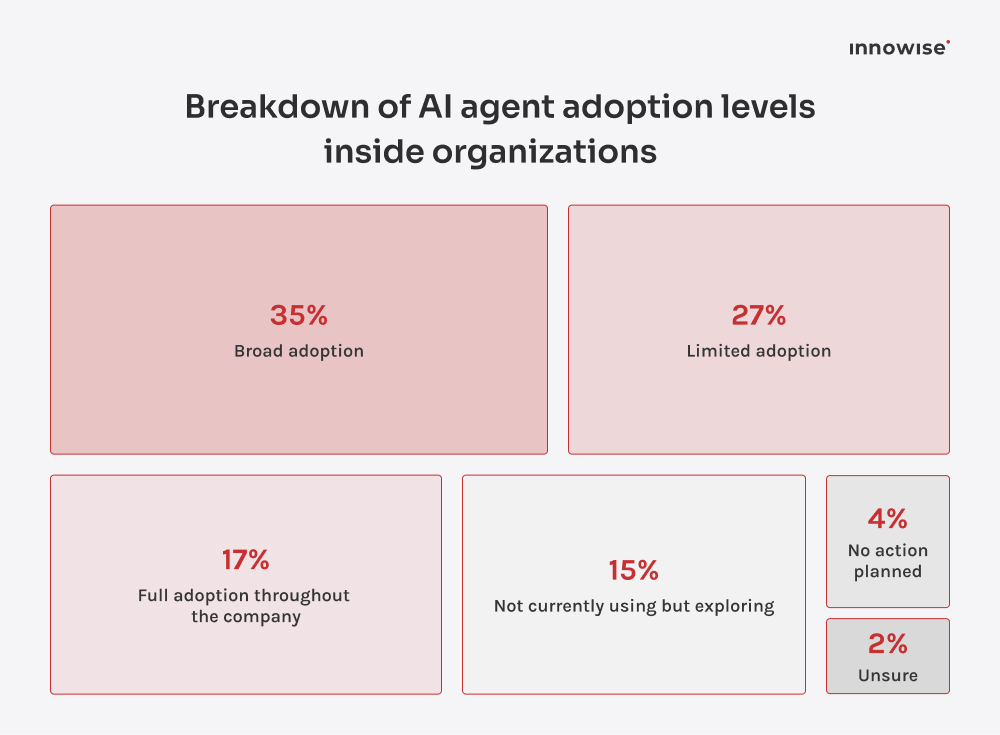
PwC’s latest research shows how quickly this shift is happening. 79% of companies already use AI agents, 88% plan to increase AI budgets because of agents, and 66% of adopters see measurable productivity gains. These numbers highlight how agentic systems are moving from early pilots into everyday business operations, which makes autonomous RPA a practical next step rather than a future concept.

Breakdown of AI agent adoption levels inside organizations

Final thoughts

The future of robotic process automation looks brighter than ever, and these emerging trends are absolutely worth your attention. Businesses that keep pace will unlock powerful competitive advantages through automation. If you’re thinking about automating smarter or testing some of these new robotics automation trends 2026, teaming up with RPA experts like Innowise — who truly understand both the technology and your business goals — will help you automate confidently, securely, and effectively.

FAQ

Businesses adopt RPA mainly to cut down tedious manual tasks, save costs, and let employees focus on the important stuff. It's all about working smarter, faster, and easier. Plus, the best RPA solutions 2026 reduce errors, boost productivity, and scale easily as a business grows, which makes it a no-brainer for companies looking to stay competitive.


If you look at any recent RPA market analysis, the biggest challenges for RPA include handling complex workflows beyond basic tasks and integrating smoothly with existing legacy systems. There's also the issue of managing security risks. Plus, keeping bots reliable as processes evolve requires ongoing maintenance and updates. Without proper planning, RPA can become more of a headache than a solution.

RPA is shifting employee roles away from repetitive tasks toward strategic, high-value activities. Rather than replacing people, it empowers them to focus on tasks that need human creativity and insight. With automation handling the grunt work, teams can be more productive, creative, and efficient, leading to higher job satisfaction and better business outcomes.

Cloud-based RPA drives market growth by making automation affordable, flexible, and quick to deploy. Businesses can start small, add more bots as needed, and avoid the high upfront costs of traditional automation. This flexibility is fueling adoption across industries, which helps businesses of all sizes optimize operations without the hassle of complex infrastructure.

Siarhei Sukhadolski

Chief Delivery Officer & Head of Competence Center

Siarhei leads our FinTech direction with deep industry knowledge and a clear view of where digital finance is heading. He helps clients navigate complex regulations and technical choices, shaping solutions that are not just secure — but built for growth.

author
Siarhei Sukhadolski FinTech Expert

Share:

Table of contents

    Contact us

    Book a call or fill out the form below and we’ll get back to you once we’ve processed your request.

    Send us a voice message
    Attach documents
    Upload file

    You can attach 1 file up to 2MB. Valid file formats: pdf, jpg, jpeg, png.

    By clicking Send, you consent to Innowise processing your personal data per our Privacy Policy to provide you with relevant information. By submitting your phone number, you agree that we may contact you via voice calls, SMS, and messaging apps. Calling, message, and data rates may apply.

    You can also send us your request
    to contact@innowise.com
    What happens next?
    1

    Once we’ve received and processed your request, we’ll get back to you to detail your project needs and sign an NDA to ensure confidentiality.

    2

    After examining your wants, needs, and expectations, our team will devise a project proposal with the scope of work, team size, time, and cost estimates.

    3

    We’ll arrange a meeting with you to discuss the offer and nail down the details.

    4

    Finally, we’ll sign a contract and start working on your project right away.

    More services we cover

    arrow