How IoT remote monitoring cuts utilities costs

May 12, 2026 10 min read
Summarize article with AI

Key takeaways

  • Expenses drop significantly when automated digital checks replace manual meter revisions and routine truck rolls.
  • Grid stability is much easier to maintain when equipment hiccups are caught early enough to fix during regular business hours.
  • Modern IoT platforms rely on standardized communication protocols, high-speed data transmission, and improved data quality to connect distributed infrastructure into a unified monitoring system.
  • Continuous monitoring replaces the slow “break-fix” cycle with a system based on predictive rather than reactive maintenance.

IoT remote monitoring lets utilities keep a constant watch over energy systems and catch abnormal behavior early. That helps teams plan maintenance, improve billing accuracy, optimize energy distribution, and reduce losses across electricity, gas, and heat infrastructure. There’s a lot more going on under the hood, though.

This guide breaks down how these systems actually work for electricity, gas, and heat infrastructure. We’re going to look at the massive hurdles to setting them up (and trust me, there are a few) and how they solve the classic headaches like messy billing and aging infrastructure. It’s time to move past guesswork and run a tight ship.

Why invest in data-driven infrastructure now?

Sticking fancy sensors on a few old pipes is not yet the great shift we talk about here. Honestly, it’s a complete rethink of how we treat the grid. 

Manual data collection and a lack of remote monitoring lead to human error, delayed data, and no centralized visibility. That makes it almost impossible to monitor infrastructure in real time or use advanced analytics to predict failures and consumption patterns.

Why are we still sending people out for manual inspections when the tech exists to monitor every heartbeat of the system? (I know it sounds like 1995 called and wants its clipboards back).

When we talk about IoT for the utilities industry, we’re talking about creating a system where data flows continuously to support operational decisions. In practice, that means a small leak does not grow into a service outage, fines, and expensive emergency repairs. You catch it early, fix it earlier, and avoid a much bigger problem.

Utilities deal with distributed infrastructure, and without remote monitoring, a lot of decisions rely on delayed or incomplete data. When you have real-time visibility across the network, you can detect abnormal behavior early, plan maintenance instead of reacting to failures, and manage energy distribution much more precisely.

Marina Zaretskaya

Head of Energy, Oil & Gas Business Practice

For me, one of the biggest “face-palm” moments in this industry is the manual meter revision. Sending a truck and a specialized technician onsite just to verify a reading is a massive waste of time and fuel. IoT for utilities turns that audit into a five-second digital check.

If you’re still using isolated legacy systems, you’re essentially flying a plane with half the dials blacked out. IoT for power and utilities bridges that gap and pulls everything into one view. It’s the difference between reacting to a crisis and stopping one before it starts. By leaning into utility infrastructure monitoring, you build an environment that can actually handle the messiness of the utilities sector.

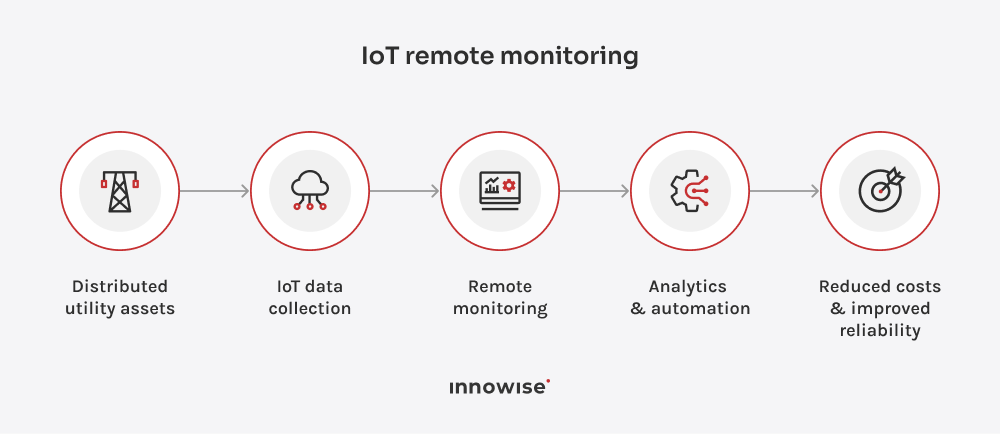
A 4-step infographic showing the flow of IoT utility data

Upgrade your utility operations with real-time IoT monitoring that drives efficiency and control

How do you kill the "break-fix" cycle once and for all

IoT remote monitoring does two big things: it saves you cash, and it stops the unplanned “lights out” drama. It optimizes energy distribution by showing you exactly how energy moves in real-time. You find the leaks or inefficiencies and fix them before they become a line-item disaster in the budget.

But the real magic is predictive maintenance. Most maintenance is still reactive: we fix it only after it breaks (classic). IoT remote monitoring flips that script. It gives you systems that can hear the “whispers” of a failing part weeks before it dies.

  • Catching anomalies: Instead of abstract signals, you detect real-world patterns, for example, sudden jumps in consumption from 0.2 kW to 5 kW without a clear usage scenario, which may indicate illegal connections or abnormal activity.
  • Avoiding "emergency mode": You fix things during a planned window on a Tuesday afternoon instead of paying triple overtime for a midnight emergency on a Sunday.
  • Fewer "ghost hunts": You stop sending crews out to find intermittent faults that vanish before the truck even arrives. (We’ve all been there, right?)
  • Smarter load management: You analyze consumption patterns and can recommend better tariff plans to customers based on actual usage.
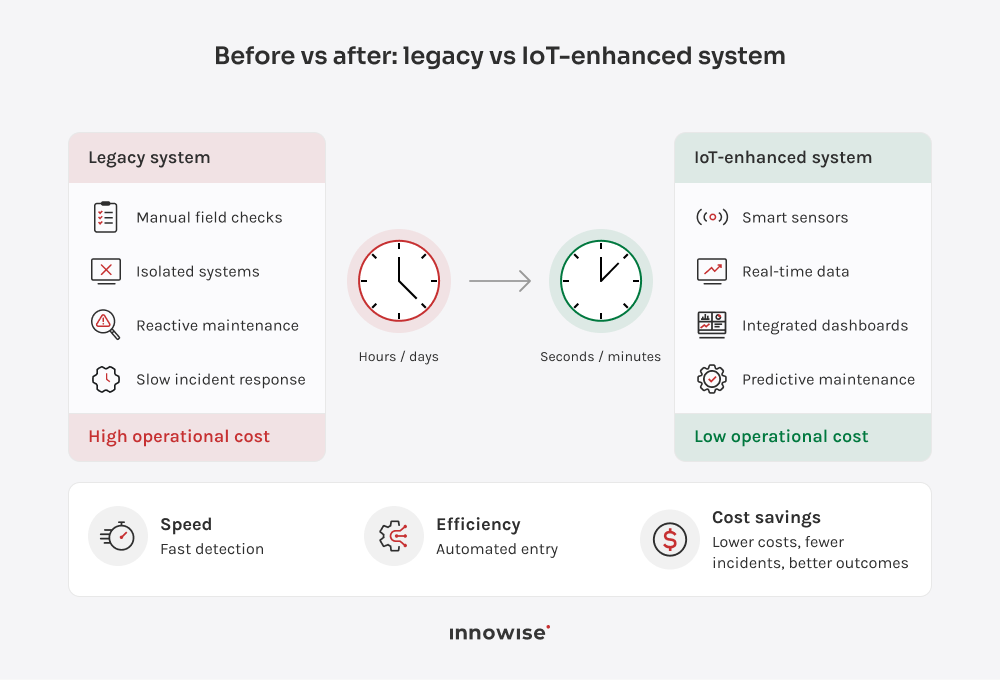
A side-by-side comparison of manual legacy utility management versus an integrated IoT-enhanced system, highlighting improvements in speed, efficiency, and operational costs.

What does IoT look like for power, gas, and heat?

No two utility sectors are the same, so the monitoring shouldn’t be either. Whether you’re moving electrons, gas, or hot water, the “red flags” look totally different.

Electricity: speed is everything

In IoT for electric utilities, speed is the whole game. Since electricity moves at the speed of light, you’re looking for small deviations that may affect network stability, damage equipment, disrupt industrial operations, or impact data centers. Real-time dashboards allow operators to track power engineering parameters and measurements in one unified view.

Gas: safety first (obviously)

For gas, it’s all about safety and volume. Take GRDF in France — they rolled out millions of smart IoT-connected gas meters. These allow for automatic daily readings and much better visibility. You catch a tiny leak before it becomes a neighborhood-wide headline.

Heat: stopping the "bleeding" effect

IoT remote monitoring gives heat utilities something they rarely had before at full scale: a live picture of what is happening across the network. That helps teams balance heat distribution in real time, reduce energy losses, and react faster to pressure, temperature, or flow deviations. In practice, this means fewer cases of overheating and underheating, fewer surprises from aging infrastructure, and better decisions during routine operations and emergencies.

Turn raw energy data into smarter decisions with a tailored IoT solution for your infrastructure

What are the real hurdles you'll face?

While the potential is huge, it’s not as simple as buying sensors off a shelf and calling it a day. Scaling IoT for energy and utilities industry involves a few hurdles that can be a real pain:

  • Legacy hardware: Most utility companies operate on a patchwork of old systems that don’t talk to each other. Getting a 1980s valve to talk to a 2026 cloud platform is a major engineering feat.
  • The data tsunami: A single smart grid installation can produce millions of data points every day. Without the right setup, all that data just turns into "noise" you can't use.
  • Cybersecurity: Every connected device is a potential door for a hacker. Since you’re handling critical infrastructure, your security has to be ironclad. No exceptions.
  • Interoperability: The real headache? Breaking down the walls between old SCADA systems and modern IoT platforms so you have one single source of truth.
Utility domain
Monitoring focus
Key operational challenge
Business impact
Electricity grids
Voltage levels, current, frequency, power quality, energy consumption, faults/outages, environmental monitoring, equipment health
Huge volumes of real-time data require robust storage and analytics Grid is critical infrastructure - IoT devices can be entry points for attacks.
Info security posture
Gas infrastructure
Gas flow, gas composition & quality, temperature, pressure, leak detection, environmental conditions, consumption, access signals
Limited physical access and safety risks
Faster incident response, lower risk exposure
Heat supply systems
Temperature, pressure, flow rate, heat energy consumption, leak detection, equipment state
Seasonal variability and asset degradation
Lower energy losses, improved efficiency
Cross-utility infrastructure
Data consistency and availability
Fragmented and delayed operational data
Better decision-making and cost control

How is an IoT monitoring system built?

You don’t need to be a coding genius to get the structure. Think of it like a relay race with four main players:

  1. The edge: Sensors on your meters, valves, or assets grab the raw data.
  2. The bridge: Communication gateways (using 5G, LoRaWAN, or satellite) send that data to the cloud.
  3. The brain: A central platform cleans and harmonizes data to ensure consistent quality regardless of sensor manufacturer.
  4. The action: Dashboards and automated commands turn that data into alerts you can actually use.

Building this takes a mix of hardware grit and software smarts. To build these layers without breaking your existing gear, professional IoT development is usually the smartest first move.

Wrapping it up

At the end of the day, IoT remote monitoring isn’t just some flashy tech upgrade to show off at conferences. It’s how a utility survives the next twenty years. As grids become more decentralized and energy patterns get weirder, IoT is the only way to stay ahead of the curve.

Moving from “blind” operations to real-time sight is a journey, but it pays for itself in fewer truck rolls, accurate billing, and, honestly, a lot more sleep for your ops team.

FAQ

Most business cases for this start seeing "black ink" in the 12-to-18-month range. For me, the real win isn't some abstract number; it’s the immediate drop in truck rolls. If you stop sending three guys in a van just to check a "flickering" light that isn't actually there, the system starts paying for itself almost instantly. It’s funny how much money you save when you stop chasing ghosts.


Thankfully, no. Most modern IoT systems use "retrofitting", which is basically sticking a digital brain on an old analog body. It isn’t replacing every pipe and wire. It’s making that 1980s valve finally talk to a cloud platform (I know, it sounds like a weird science experiment, but it works).

This is the number one worry for every tech head I talk to. If you’re just plugging in cheap, off-the-shelf sensors, then yeah, you’re asking for trouble. But if you use industrial-grade encryption and private networks, you’re essentially building a digital vault. Is it 100% unhackable? Nothing is. But it’s a lot safer than a physical lock on a substation that hasn’t been checked since 2012.

This is basically the "VHS vs. Betamax" of the utility world. For me, there’s no single winner. 5G is great for high-speed data in cities, while LoRaWAN is the king of long-range, low-power signals (perfect for a sensor buried in a field three miles from anywhere). Usually, you’ll end up with a hybrid "Frankenstein" setup of both.

If you just dump raw data on them, they’ll probably quit. The key is "filtering at the edge." You don't need a report every five seconds saying "everything is fine." You only want the system to scream when it says, "Hey, this transformer is vibrating weirdly, you might want to look at it." It’s about giving them answers, not more homework.

It’s definitely not fluff. Regulators are getting obsessed with "green" data and reliability metrics. Instead of your team spending two weeks every quarter manually compiling spreadsheets, which is a soul-crushing job, let's be honest, the system spits out a compliant report in seconds. It’s hard for an auditor to argue with an automated, ironclad audit trail.

For me, it’s "pilot purgatory." Companies start a tiny trial, get some cool data, and then... nothing happens for two years. The trick is to start with a specific, painful problem (like leaky pipes or frequent substation failures) and solve that first. Once you prove it works there, scaling up is a lot less scary.

Head of Digital Transformation, CIO

Maksim modernizes legacy enterprises without breaking day-to-day operations. He specializes in cloud strategy and enterprise architecture, focusing on sustainable technical evolution that aligns with global regulatory standards and long-term business health.

Table of contents

    Contact us

    Book a call or fill out the form below and we’ll get back to you once we’ve processed your request.

    Send us a voice message
    Attach documents
    Upload file

    You can attach 1 file up to 2MB. Valid file formats: pdf, jpg, jpeg, png.

    By clicking Send, you consent to Innowise processing your personal data per our Privacy Policy to provide you with relevant information. By submitting your phone number, you agree that we may contact you via voice calls, SMS, and messaging apps. Calling, message, and data rates may apply.

    You can also send us your request
    to contact@innowise.com
    What happens next?
    1

    Once we’ve received and processed your request, we’ll get back to you to detail your project needs and sign an NDA to ensure confidentiality.

    2

    After examining your wants, needs, and expectations, our team will devise a project proposal with the scope of work, team size, time, and cost estimates.

    3

    We’ll arrange a meeting with you to discuss the offer and nail down the details.

    4

    Finally, we’ll sign a contract and start working on your project right away.

    More services we cover

    arrow