AI agents in banking: the 4-layer trust architecture behind safe deployment

Apr 29, 2026

10 min read

Illustration of the AI agent in banking
Summarize with AI

Off-the-shelf agent frameworks are insufficient for banking. Yes, that’s the point I’d start with, and no, a cleaner prompt strategy or a stricter API gateway doesn’t change it.

A standard stack with LangChain, tools, vector DB, and an API gateway can make an agent functional. It can route an intent, fetch context, call a tool, and return a polished answer. Fine. But banking doesn’t fail at the “can it call the API?” level. Banking fails at the “was this call allowed, scoped, verified, logged, and safe to show to this customer?” level. That’s a different architecture problem.

There are three reasons I wouldn’t put a generic agent stack near production banking workflows without adding a dedicated trust layer.

First, financial data is liability data. A hallucinated answer in a retail chatbot is embarrassing. A hallucinated balance, transaction status, fee explanation, or credit decision can become legal exposure. Under the FCA Consumer Duty, for example, the institution has to show that customers receive fair, understandable, and appropriate support. If the model invents a repayment option or explains a product incorrectly, you can’t shrug and blame “the AI.” The bank owns the output. So the architecture has to treat every factual claim as something to verify against a source system.

Second, multi-tenancy is not just a product design choice. If you serve several banking clients, merchants, business units, or regions from one platform, tenant isolation has to exist at every layer: prompts, memory, vector indexes, tool permissions, logs, Redis keys, database rows, secrets, and audit exports. One cross-tenant leak is not a bug ticket. It can be a reportable incident. This is why I don’t like architectures where the agent has broad access and the app layer “remembers” to filter things later. Filtering later is how data leaks happen.

Third, the LLM is the least trustworthy component in the chain. That sounds harsh, but it’s the right assumption. The model is probabilistic. It can follow malicious instructions, over-trust retrieved context, or expose PII in a summary. It can produce a tool call that looks valid until you inspect the parameters. So I would never let the model sit directly next to core banking APIs.

The safer pattern is to let the model reason, but keep enforcement in deterministic systems. Reasoning belongs in the agent layer. Enforcement belongs in schema validators, policy checks, tenant-scoped permissions, approval gates, and audit logs. Once you make that split, the architecture stops being a chain of model-driven API calls and becomes a controlled trust system, with the LLM treated as a useful but unreliable reasoning component.

One framing makes that split easier to apply. When I look at a banking agent, the question I care about is how much authority it holds and how far that authority has to travel from the human who granted it. Capability tells you how good the demo is. Authority determines how much control the system is allowed to exercise. A brilliant model wired to read-only tools is a thin assistant. A dull model holding a standing key that can move funds is a different problem, and it needs every layer below. I split that authority axis into four classes — assistant, orchestrator, operator, and economic actor — in the article Not every agent is an economic actor.

Blockchain Expert & DeFi Analyst

Andrew translates decentralized concepts into secure, functional financial tools. He navigates the volatile DeFi landscape to build scalable blockchain infrastructures that address real-world utility, moving past the buzzwords to deliver technical value.

The 4-layer trust model for banking AI agents

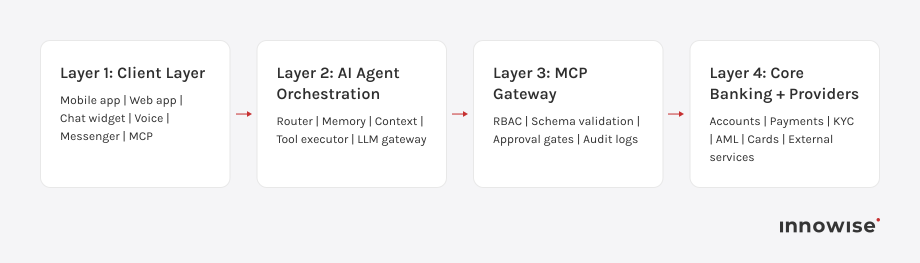
For banking, a four-layer trust model makes the architecture easier to control, audit, and defend. It forces one uncomfortable question at every step: what should this part of the stack be allowed to know, decide, and touch? 

A banking agent can talk like one product, but it should not run like one flat system. The client should not know the banking core. The agent should not call financial APIs directly. The gateway should not improvise. Core banking should not trust model-generated requests just because they came from an approved channel. 

Here’s the path I’d expect to see in a production-grade setup:

AI banking agent workflow with layered controls for routing, validation, approvals, and provider access.

The enforced path is simple:

Banking AI control sequence showing requests routed through MCP and core systems before providers.

These four layers should be enforceable boundaries between trust zones. If the agent needs account data, it goes through the gateway. If it prepares a payment, it goes through the gateway. If it needs an external KYC, AML, card, or fraud provider, the request still moves through core banking first.

With that control path in mind, let’s go layer by layer and look at what each part should own, what it should never touch, and where the handoff needs a real check.

Layer 1: Client layer

The client layer is where the user meets the agent, but it should stay thin. Mobile apps, web apps, chat widgets, voice interfaces, and messengers should not carry banking logic. Their job is to capture the request, pass identity and session context, render the response, and hand off anything sensitive to the layers below.

Client surface
Typical stack
What it should own
Mobile app
React Native
User interaction, device context, push notifications
Web app
React
Authenticated banking sessions, UI state, response rendering
Chat widget
Web SDK
Embedded support flows, merchant portals, customer service entry points
Messengers
WhatsApp, Telegram, iMessage
Channel-specific formatting and delivery
Voice
WebSocket
Real-time speech sessions and interruption handling
External agents
MCP
Controlled agent-to-agent or agent-to-system entry points

That thin-client rule also shapes the edge stack. You still need the usual perimeter pieces: Cloudflare for traffic filtering, an API Gateway for routing and rate limits, and a BFF layer tied into Auth0 or Firebase for channel-specific session handling. But none of that should turn the client into a banking component. The client talks to the platform. It doesn’t know how accounts, payments, KYC, AML, or cards work, and it definitely doesn’t reach into those systems directly.

Layer 2: AI agent orchestration

The orchestration layer is the control room of the agent system. It decides whether a request is a quick support turn or a regulated workflow, what state needs to be restored, which context is safe to expose to the model, and whether a tool call should even be prepared.

This is where I’d check for architectural debt early: payment rules buried in prompts, old chat used as workflow state, or tools visible outside the current tenant, channel, or user role. If you see that, the design is already drifting. 

Six control points usually tell you whether the architecture is serious:

Component
Main job
Banking-specific control
Agent Router & Dispatcher
Classifies the request and picks the agent path
Prevents regulated workflows from being handled by a shallow agent
Conversation Manager
Keeps session and workflow state
Supports channel switching, recovery, and human escalation
Context Window Manager
Decides what the model can see
Reduces PII exposure, stale context, and noisy prompts
Tool Executor
Runs tool calls under runtime rules
Controls parameters, timeouts, retries, and structured errors
LLM Gateway
Routes model requests
Applies tenant policies, fallback rules, and token budgets
Safeguard Pipeline
Checks input and output
Blocks injection, PII leakage, unsupported claims, and policy breaches

Agent Router & Dispatcher

The router should classify the request before the agent starts thinking too hard. A card status question and a payment-preparation flow don’t belong on the same path. One should be fast and tightly scoped, while the other needs planning, checks, and approval points before anything moves forward.

Route
Agent pattern
Best for
Main control
SIMPLE
SimpleReactAgent
Balance explanation, card status, FAQ, recent transaction lookup
Short context, limited tools, low latency
DEEP
DeepAgent
Underwriting, disputes, KYC remediation, payment preparation
Multi-step planning, state, branching, approval pauses

The latency impact matters. If every request goes through a DeepAgent, the product feels slow and expensive. If everything goes through a SimpleReactAgent, the system becomes risky once the user asks for work that touches regulated data or financial action. The router keeps that trade-off visible.

Build safer banking AI agents with a trust-first architecture

Conversation Manager

The Conversation Manager keeps the case alive across sessions, devices, and escalation paths. Banking users don’t always finish a task in one chat: they may start in mobile, continue on web, upload documents later, or move to a human operator.

State layer
Storage
What it keeps
Hot state
Redis
Current turn, short-lived session context, temporary tool results, channel state
Cold state
PostgreSQL + LangGraph checkpointing
Workflow step, prior decisions, approvals, failed checks, recovery points
Escalation state
Structured transfer package
User goal, completed checks, open risks, tools called, next expected action

LangGraph checkpointing helps here because the workflow doesn’t have to live inside the chat transcript. It can pause, resume, branch, or recover from a known state. And if the case goes to a human, the operator should get the case as it stands now: what was checked, what failed, what’s pending, and what should happen next.

Context Window Manager

The Context Window Manager decides what the model gets to see. In banking, that choice affects data exposure, answer quality, and auditability. The model needs enough context to answer well, but it shouldn’t get every old message, every retrieved document, or every raw customer value.

Mechanism
What it does
Why it matters
Sliding window
Keeps the latest turns available
Preserves short-term conversation flow
Semantic summarization
Compresses older messages into a structured record
Keeps history useful without flooding the prompt
Vector retrieval
Pulls relevant policy, product, or document fragments
Reduces irrelevant context
Structured action log
Records tool calls, approvals, denials, source responses
Gives the model an audit-friendly view of what happened

The structured action log is the part I’d pay close attention to. Chat history is messy because it includes user corrections, partial answers, abandoned paths, and stale assumptions. The model should reason from the action trail when it needs to know what the system actually did.

Tool Executor

The Tool Executor is where model intent becomes a system call. The agent may suggest a tool call, but the executor controls the runtime.

Runtime control
Expected behavior
Sandboxing
Tool execution runs in an isolated context
Timeouts
Long-running calls fail cleanly instead of blocking the workflow
Context injection
user_id, tenant_id, chat_id, and correlation_id come from the platform
Zod validation
Inputs are checked before execution
Structured errors
Failures return machine-readable reasons
Retry policy
Temporary failures can retry; forbidden or invalid calls cannot

The identity fields are worth calling out. The model should not provide user_id, tenant_id, or correlation_id. Those values should come from authenticated platform context. Otherwise, the model can shape the access boundary, which is exactly what this architecture is trying to avoid.

LLM Gateway

The LLM Gateway keeps model access in one place. Without it, provider logic spreads into services, workflow code, and prompt templates. That becomes difficult to govern in a multi-tenant banking platform.

Gateway function
Example control
Provider routing
Claude as primary, GPT-4o as fallback
Per-tenant model policy
One tenant allows fallback; another requires a specific provider
Workflow-based routing
Deep workflows use stronger models; routine turns use lighter models
Token budgets
Limits per tenant, workflow, user session, or turn
Failover rules
Fallback runs only when the tenant and task allow it

Even as providers change, the platform still needs one controlled place to decide which model handles which request, under which tenant policy, within which budget, and with what fallback allowed.

Safeguard Pipeline

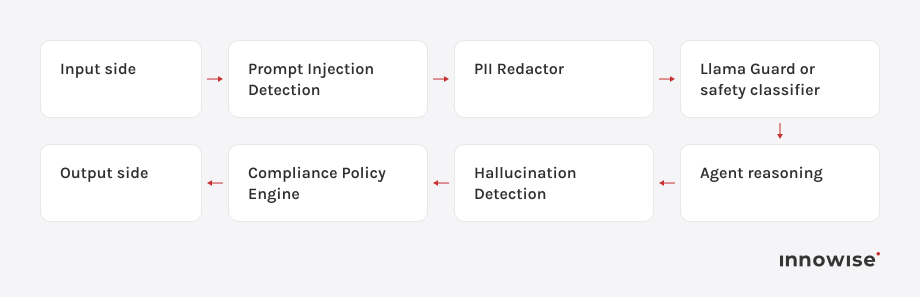
The Safeguard Pipeline wraps the agent before and after reasoning. Here, the important architectural point is timing: input checks need to run before the model plans, and output checks need to run before the user sees the answer or the system stages an action.

Banking AI safeguard flow for injection checks, data redaction, hallucination review, and compliance.
Guard
Position
What it checks
Prompt Injection Detection
Input
Attempts to override instructions, expose hidden context, or misuse tools
PII Redactor
Input
Sensitive values that should not enter unnecessary model context
Llama Guard
Input
Unsafe, suspicious, or disallowed user content
Hallucination Detection
Output
Unsupported balances, transaction IDs, limits, rates, statuses, or KYC results
Compliance Policy Engine
Output
Transfer caps, cross-tenant isolation, OFAC blocking, approval thresholds

The agent can draft the response or prepare the next step. The pipeline decides whether that response can be shown, blocked, retried, escalated, or sent into an approval flow.

Layer 3: MCP Gateway

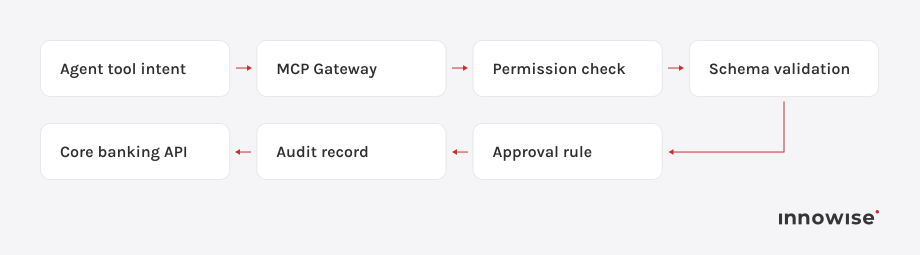
In this article, I’ll keep the gateway at the architecture level. The short version: it should turn model-shaped intent into a controlled system request. That means checking tenant permissions, validating the payload against schemas, applying approval rules, logging the action, and deciding whether the request can continue, fail, or move to a human.

MCP gateway process for validating permissions, schemas, approvals, and audit records.
This layer is where the architecture stops trusting the agent’s wording and starts trusting deterministic checks. A prompt can say, “prepare a transfer,” but the gateway decides whether this tenant, user, channel, amount, beneficiary, and workflow state are allowed to produce a staged transfer request.That’s why I see the gateway as more than a connector. It’s the line between a useful agent demo and something a bank can actually review. In the related article on MCP Gateway for banking AI agents, I go deeper into RBAC, schema validation, approval workflows, immutable audit logs, circuit breakers, and token scoping.

Layer 4: Core banking + providers

Layer 4 is where the actual banking systems live: accounts, payments, cards, KYC, AML, fraud, ledger services, and external providers. In many builds, this layer is already there, often as Spring Boot microservices or an existing core banking API estate.

The AI platform should not modify this layer. It should integrate against it. That separation matters because it keeps the agent portable. If a bank changes a KYC provider, adds a fraud vendor, or moves from one core banking system to another, the AI layer should not need a full rebuild. The gateway and core APIs absorb that complexity.

I’d also avoid letting the agent call external providers directly. If AML screening, card issuing, payment routing, or KYC checks live behind core banking services, the agent should respect that boundary. Core banking remains the source of execution and record. The agent remains a controlled consumer of approved capabilities.

Building AI agents for banking?

Let’s make them safe enough for real financial workflows.

Why these layers need firm boundaries

Here’s the smell test I use: if an engineer can say “just this once” and bypass a layer, the layer doesn’t exist. In banking, bypasses rarely announce themselves as bypasses. They arrive as latency fixes, support shortcuts, incident workarounds, or temporary fallback routes. Authority creeps the same way bypasses do. A workflow that used to stage actions for human review starts committing them. A tool that only reads balances picks up a transfer- preparation path. A standing token gains a slightly broader scope: no single change looks like a promotion, so nobody re-runs the question of what this agent is now allowed to do, and the control plane stays sized for what it used to be. That gap, between what the agent can now do and what its boundaries assume, is where the expensive failures live.A good boundary removes the tempting paths. The agent can describe what needs to happen, but the request still has to arrive at the MCP Gateway with tenant, user, channel, workflow state, and correlation context attached. If that context holds, agent intent becomes a controlled banking request. If it doesn’t, it dies before it reaches the core. That decision point deserves its own article, so I unpack the mechanics in MCP Gateway for banking AI agents: the control layer between AI and core banking.

More on this topic

    Contact us

    Book a call or fill out the form below and we’ll get back to you once we’ve processed your request.

    Send us a voice message
    Attach documents
    Upload file

    You can attach 1 file up to 2MB. Valid file formats: pdf, jpg, jpeg, png.

    By clicking Send, you consent to Innowise processing your personal data per our Privacy Policy to provide you with relevant information. By submitting your phone number, you agree that we may contact you via voice calls, SMS, and messaging apps. Calling, message, and data rates may apply.

    You can also send us your request
    to contact@innowise.com
    What happens next?
    1

    Once we’ve received and processed your request, we’ll get back to you to detail your project needs and sign an NDA to ensure confidentiality.

    2

    After examining your wants, needs, and expectations, our team will devise a project proposal with the scope of work, team size, time, and cost estimates.

    3

    We’ll arrange a meeting with you to discuss the offer and nail down the details.

    4

    Finally, we’ll sign a contract and start working on your project right away.

    arrow