





Your message has been sent.
We’ll process your request and contact you back as soon as possible.
The form has been successfully submitted.
Please find further information in your mailbox.

Select language

Innowise audited and refactored the Baker-to-Vegas event platform for the Los Angeles Police Revolver and Athletic Club to restore the actual codebase, close security gaps, and simplify future support.
Up-to-date codebase synced with the live application
60x faster PDF reports from around 1 hour to 1 minute

The client is the Los Angeles Police Revolver and Athletic Club (LAPRAAC), a private organization with a long history of supporting the Los Angeles Police Department through training and community activities. LAPRAAC is also behind the Annual Baker to Vegas Challenge Cup Relay, the largest law enforcement relay race in the world.
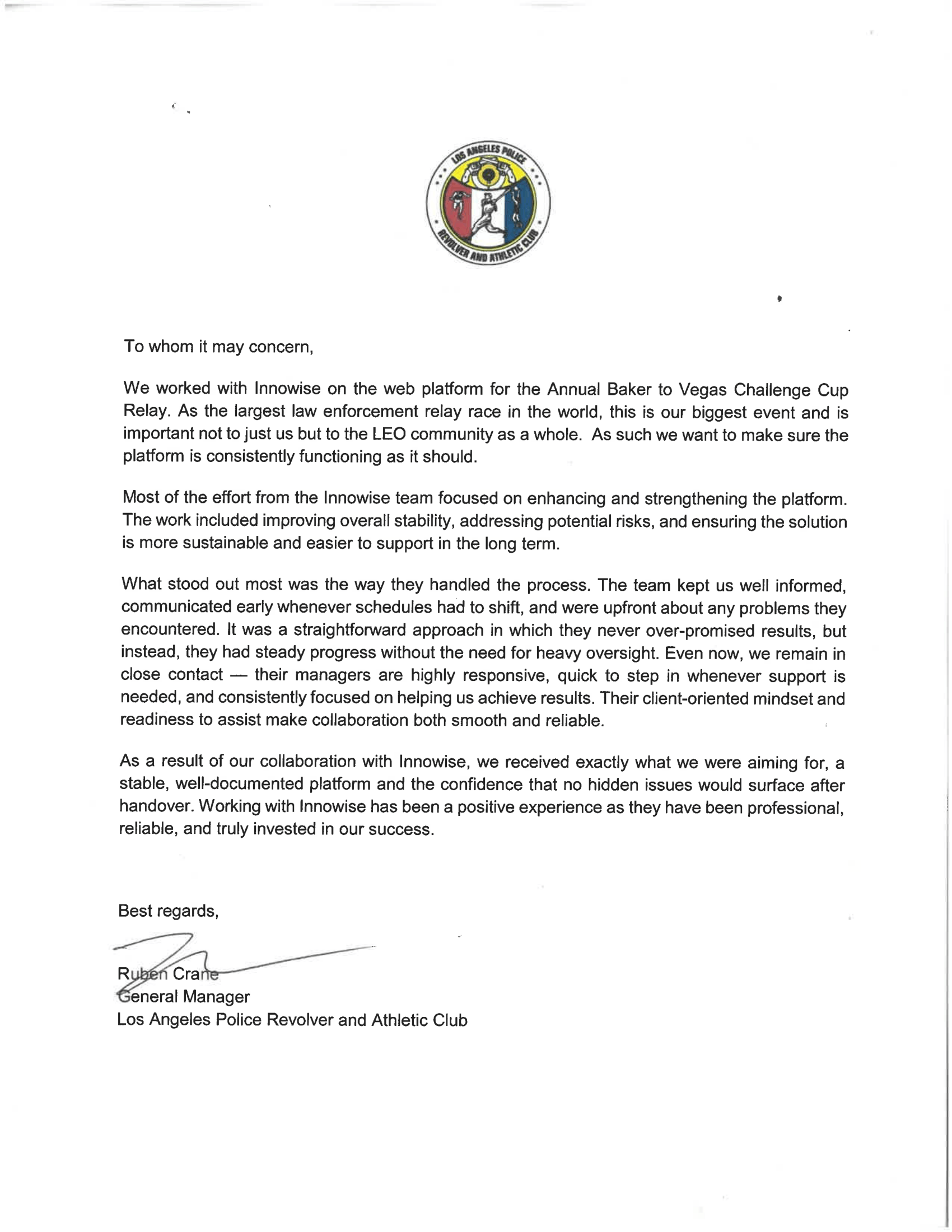
What stood out most was the way they handled the process. The team kept us well informed, communicated early whenever schedules had to shift, and were upfront about any problems they encountered. It was a straightforward approach in which they never over-promised results, but instead, they had steady progress without the need for heavy oversight. Even now, we remain in close contact. Their client-oriented mindset and readiness to assist make collaboration both smooth and reliable.
During the initial discovery and audit, Innowise reviewed the live Baker-to-Vegas platform, the available source code, and the client’s requirements for future maintenance. It helped specify the following business and technical challenges.
The project started with a presale phase that combined discovery and audit work. Our team got access to the server and reviewed the live Baker-to-Vegas platform against the latest source code archive provided by the previous contractor. That helped us understand the gap between the running application and the available source code, estimate the scope, and define the next steps.
During the review, we also saw that the project needed more than code recovery. Our team identified security gaps, code quality issues, and inconsistencies in core development practices. Based on that, we moved from assessment to hands-on improvements.
Our team restored the source code, so it reflected the live Baker-to-Vegas platform. Functionality that had existed only on the server was added back to the codebase, giving the client a well-structured project version they could easily maintain and update.
We carried out a full refactoring of the project. Our team cleaned up the code, addressed security-related issues, applied security patches, and aligned the application with current development standards. This way, the platform became more stable, secure, and resilient.
To make the platform more sustainable over time, we introduced a proper version control system so the client would always have access to the current codebase instead of relying on outdated archives. We also automated deployment to the client’s server, which made releases faster, smoother, and easier to handle whenever updates were needed.
The team also introduced a simple CMS approach that lets the client update website content through a simple admin interface.
Another important improvement was PDF report generation. As data volumes grew, report exports could take about an hour. After optimization, the same process took around one minute, which removed a major bottleneck in one of the platform’s key workflows.
After the main phase was completed, the client kept coming back with new requests. Since the platform already had an updated codebase, proper version control, and automated deployment in place, our team could step in quickly, make changes without unnecessary risk, and deliver updates with very little overhead.
The delivery setup stayed lean. A tech lead stayed close to the project, kept the context clear for the engineering team, and handled communication with the client. Since requests came in gradually, this approach kept the work efficient without adding unnecessary overhead. Most communication occurred via email, with Zoom calls when live discussion was required.
When a platform is connected to an event like Baker-to-Vegas, even a minor update can cause issues if the code on the server doesn’t match the code you have. We wanted to eliminate that uncertainty and make sure the client had a codebase they could use months later, without wasting time comparing it with the live version.


June 2024 –
The client received an updated application on a newer tech stack, with security fixes in place and a current codebase they can keep working from. Instead of relying on an old ZIP archive, they now have the real platform in source form, which makes future changes far easier to manage.
Delivery also sped up. With version control and repeatable deployment steps in place, the team could implement new requests and release them without the extra confusion and delays that used to slow updates down. That reduced support effort and made day-to-day changes simpler.
Overall, the platform became easier to maintain, safer to run, and cheaper to support. The client could protect their reputation around a high-visibility event platform while keeping ongoing costs under control.
Your message has been sent.
We’ll process your request and contact you back as soon as possible.