Leveraging the key benefits of automated underwriting in insurance

May 8, 2026 10 min read
Summarize article with AI

Key takeaways

  • Implementing automated insurance underwriting shifts risk assessment into a high-speed mathematical engine powered by heavy ML models.
  • Automated scoring algorithms analyze credit histories and financial patterns so your business generates individual insurance rates in just a few seconds.
  • A properly wired digital pipeline slashes operational costs and completely eliminates silly junior mistakes from your daily enterprise workflows.
  • The platform handles the entire user lifecycle from intelligent raw document parsing to the final policy generation.

Whenever my engineering crew steps into a massive insurance project and sees their underwriters still living in Excel and Microsoft Access, I immediately know we’re in for a very long conversation.

This exact setup plagued one of our actual enterprise clients. The underwriting team manually analyzed risks, manually approved policy conditions, and manually calculated tariffs, so every single one of these steps cost the company massive amounts of time and money, while frustrated clients simply left for faster competitors.

Manual underwriting acts as a pure architectural dead end because you physically cannot scale the process without aggressively inflating your payroll. You also completely fail to guarantee decision consistency since two different underwriters will easily make completely different calls on the exact same application on different days. You definitely cannot give a client an answer in minutes if your manual pipeline requires several days to process basic information.

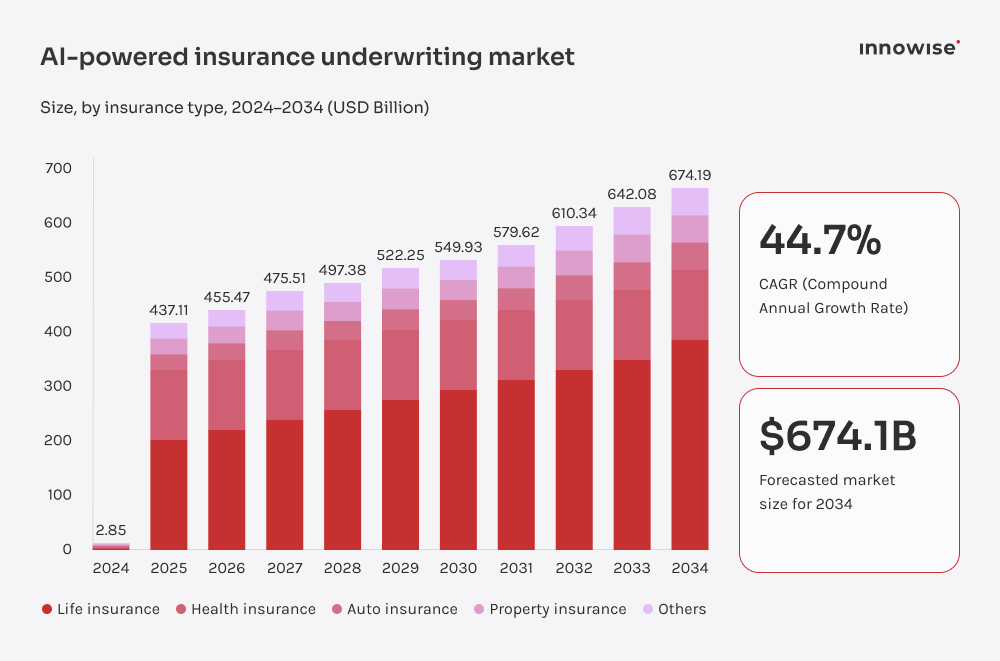
This is exactly where insurance underwriting automation takes the stage. McKinsey data shows fully automated pricing and underwriting will handle over 90% of individual and small business policies by 2030. The market for automated underwriting technology currently grows at a massive 44.7% CAGR and is expected to reach $674.1 billion by 2034, so this represents a massive industrial shift happening right now.

The AI-powered insurance underwriting market growth expectations from 2024 to 2034.

Let’s look at how automation in insurance underwriting actually works.

What is automated underwriting in insurance?

Underwriting essentially serves as the core process of evaluating risk on an insurance application to figure out who we are dealing with, calculate the probability of an insurance event, and determine the exact policy conditions. This sits at the very heart of the insurance business to dictate both your corporate profitability and your overall customer experience.

The manual underwriting cycle forces an analyst to receive an application, manually request data from different sources, check everything against internal guidelines, and make a decision based purely on personal experience before sending the result back to the client. This cycle takes anywhere from a few days to several weeks, so every single step carries a massive risk of human error or highly subjective judgments.

Automated underwriting in insurance replaces this slow cycle with hardcoded software logic, so ML models, rule engines, and external database integrations execute the exact same job in just a few seconds. The algorithm does this consistently without having a bad day or dealing with human fatigue, greatly reducing the risk of conflicting decisions between different employees.

Manual vs automated: where your money leaks unnoticed

I often see the exact same picture when insurance companies assume they have a perfectly normal underwriting process until we actually look at their hard numbers.

Here is what happens inside a manual setup:

  • The average application processing time stretches from a few days to several weeks. Companies running automated underwriting solutions slash this time by 90%, so tasks that previously took 15 days now finish in just a few hours.
  • Deloitte reports AI-driven underwriting drops operational expenses by up to 60%, and McKinsey confirms automation cuts operational costs by 40%.
  • The research recorded a 43% improvement in risk assessment accuracy after deploying AI into the underwriting pipeline.
  • A manual process scales exclusively through aggressive hiring. Automated insurance underwriting systems easily process any volume of applications without requiring a proportional increase in your payroll.

Manual risk checks bleeding your budget? Deploy an AI scoring engine.

How automated insurance underwriting works

To connect a server-based analytical engine to a live enterprise environment requires pure pragmatic architecture. Therefore, we create a multi-layered microservice setup, each layer of which performs one and only one specific function of technology or process.

Now, let me explain how we implement this entire pipeline on a production server.

Applicant data collection & verification

The entire process begins with raw data. As soon as an applicant submits his/her application via a digital form or REST API, automated underwriting verifies the submitted documents by creating a request for verification via OCR technology. It checks the applicant’s credit history and pulls external registry data.

For one of our implementations for a major insurance company in the EU, we implemented a UiPath document understanding solution that allowed for the automatic extraction, validation, and processing of all incoming document data without any manual input from a human. This was an architectural change that allowed us to eliminate one of the major bottlenecks in their process immediately.

Risk assessment through ML models

Once the data is collected, the system pushes it through the rule engine and heavy ML models. The ML algorithm evaluates the applicant according to a predefined ruleset based on a number of factors, including the applicant’s historical insurance claims, requested insurance policy, and risk profile. 

The pipeline then outputs a precise scoring mark and a definitive risk category. A well-trained ML model simultaneously analyzes thousands of factors like regional claim frequencies, real-time asset valuations, health records, localized accident probabilities, hidden financial patterns, and more. According to a study performed by the Geneva Association, there is an improvement of 43% in accurate predictions as a result of using large-scale computing to evaluate these conditions simultaneously.

Rule and business logic programming

A rules engine is comprised of several different layers and types of information, such as a set of general condition rules, complex exceptions, manual review flags, and automatic thresholds for approval. This logic is hard-coded to meet our clients’ specific product needs, and we also create well-defined escalation conditions that dictate when the systems can make an independent decision and when it flags the application for a live underwriter. This setup ensures automation kills the routine while keeping human expertise exactly where it brings the most value.

Automated underwriting decision

After passing through all verification layers, the system delivers a final decision to approve, reject, or request additional information about an application. The platform also calculates the exact rate and conditions of coverage in real time. 

As an example from a recent bank project, we developed an automated scoring system that assigned numerical scores to each application parameter and provided the decision of the amount of credit available for each applicant, completely without human intervention. The result of this implementation was a significant reduction in the processing time compared to the previous legacy underwriting solution.

Documentation and audit trails

The platform automatically logs every single system action. The backend records exactly what data it used, which rules triggered, and what final result it generated to create an audit trail. This serves as pure gold for regulators because you always have full documentation of every single decision. And what’s more, you don’t need to dig through physical paper archives.

Communication

We make the whole process totally transparent for everyone involved. The system pushes application statuses directly to the client’s mobile app or web dashboard via REST API. The person immediately sees live updates like “documents accepted,” “risks evaluated,” and “policy ready.”

Monitoring and compliance

We never leave the system unattended in production. Automated underwriting solutions act as a continuous operational engine. The system constantly monitors issued policies, updates conditions when the risk profile changes, and ensures strict adherence to regulatory requirements. The system automatically factors in any new client data during the next control cycle.

If you depend entirely upon manual data routing in your backend system, you cannot scale an insurance pipeline, or at least it’s very hard to do so. We inject intelligent algorithmic agents directly into your legacy systems to perform the heavy mathematical calculations needed for automation. This architecture allows you to dramatically expand your corporate portfolio without having to hire new analysts constantly.

Siarhei Sukhadolski

Chief Delivery Officer & Head of Competence Center

How automated underwriting systems benefit insurance services

When we push a fully automated underwriting pipeline to production, your business begins to patch the massive leaks in the operational budget caused by manual reviews because the new architecture organizes your scattered data into a highly predictable workflow.

Operational efficiency for less chaos

Your business will lag forever if your databases cannot talk to each other natively. We solve this massive headache by building a unified engineering ecosystem.

  • We merge disjointed ERP and CRM setups into one clear pipeline with strict data transfer protocols.
  • The algorithm calculates risks in seconds, and analysts no longer need to burn their valuable working hours manually gathering data from ten different browser tabs.
  • Moving to a modern microservices architecture on .NET, Python, or Java finally lets you bury your old monoliths.
  • Deep automation removes the need to keep a massive staff on the payroll just for shuffling papers and doing mindless routine tasks.
  • Approved applications fly down the conveyor belt with zero system delays.
  • Detailed real-time dashboards show the exact state of your portfolio right now to help you make grounded strategic moves.

Better customer experiences

In the modern IT market, you buy customer loyalty with pure speed and flawless convenience.

  • Machine scoring gives the person a definitive result right here and now.
  • The client simply snaps photos of their documents on a phone, so our parsers can extract everything needed automatically.
  • The client clearly sees every review stage right in their digital profile.
  • The system automatically suggests extra options based on the specific person's actual financial behavior.
  • Slashing your internal costs allows you to offer much more competitive tariffs and win the pricing race.

Improved security

Data security always becomes a matter of absolute survival when big enterprise money is on the line.

  • The machine never gets tired or loses focus, and it won’t mess up the zeros in the insurance coverage amount.
  • The models catch weird behavior patterns on the fly and block document fraud attempts before they even reach a human manager.
  • Automated reporting covers all compliance questions to protect your brand from fines and regulator audits.

Routine data entry draining your payroll budget?

The absolute pragmatism of modern insurance architecture

From our direct engineering practice, delaying this specific backend upgrade constantly drains your corporate budget because your underwriters waste their expensive hours on routine paperwork, while frustrated clients simply leave for faster digital competitors. 

Your operational costs remain permanently high as your daily application volume grows, meaning the massive gap between automated companies and hesitant businesses will only continue to widen over the next few years.

Deploying automated insurance underwriting systems serves as a fundamental architectural shift to help your company manage complex risks and scale the entire business without constantly inflating the payroll.

My engineering squad at Innowise tackles these heavy backend integrations every single day, so we know exactly how to design robust ML models and connect them natively, even with the most ancient legacy databases. 

We build everything from AI-driven risk evaluation platforms to fully automated application pipelines with minimal to zero manual data entry, meaning we can turn your chaotic data into a highly profitable business tool. If you want to figure out how this specific architecture fits into your existing infrastructure, take a closer look at our deep engineering experience in the insurance sector.

Please don’t hesitate to drop us a line whenever you see fit.

FAQ

The ongoing expenditure incurred from using a manual process leads to inefficiencies and delays in growing your business. Your company should use automation so that you can grow faster in your market and make an immediate decision to approve all applications. This way, clients get an excellent digital service and stay with your brand.


Our modular solution allows for integration into your existing architecture. Our experts create a specialized bridge to safely obtain the data from your old-hat systems while providing continuous operation of your business throughout the entire update of the backend.

When the platform is released to production, you immediately feel the impact of the launch. The queue of piled-up applications clears out instantly, and your managers stop being overwhelmed by day-to-day tasks, allowing them to focus on true complexity when it comes to clients.

The decision model is tuned in accordance with your risk policy. The algorithm evaluates applicants absolutely objectively based on hard metrics. In the case of any questionable or borderline applications, those go to a senior specialist for a mandatory manual review.

The architecture creates very comprehensive logs of all of the scores created by the system. All of the logs provide an audit trail for any auditor to inspect, and as a result, you can pass compliance audits and consistently protect your company’s brand from regulatory fines.

The technology behind the platform is extremely adaptable from a technical perspective. Corporate guidelines are embedded directly into the analytic core of the system so that it is easy to modify the scoring algorithms when launching new insurance products in the market.

Our OCR parsers perfectly handle crooked text from scans of questionable quality. The algorithm simply requests the missing information from the user during a real data shortage. The system guarantees the processing of only high-quality and complete document packages.

No, we build a scalable microservices architecture with very easy maintenance protocols. We take over all technical support after the release, and you get a ready business tool without the constant headache of hiring new engineers.

Chief Technology Officer

Dmitry leads the tech strategy behind custom solutions that actually work for clients — now and as they grow. He bridges big-picture vision with hands-on execution, making sure every build is smart, scalable, and aligned with the business.

Table of contents

    Contact us

    Book a call or fill out the form below and we’ll get back to you once we’ve processed your request.

    Send us a voice message
    Attach documents
    Upload file

    You can attach 1 file up to 2MB. Valid file formats: pdf, jpg, jpeg, png.

    By clicking Send, you consent to Innowise processing your personal data per our Privacy Policy to provide you with relevant information. By submitting your phone number, you agree that we may contact you via voice calls, SMS, and messaging apps. Calling, message, and data rates may apply.

    You can also send us your request
    to contact@innowise.com
    What happens next?
    1

    Once we’ve received and processed your request, we’ll get back to you to detail your project needs and sign an NDA to ensure confidentiality.

    2

    After examining your wants, needs, and expectations, our team will devise a project proposal with the scope of work, team size, time, and cost estimates.

    3

    We’ll arrange a meeting with you to discuss the offer and nail down the details.

    4

    Finally, we’ll sign a contract and start working on your project right away.

    More services we cover

    Insurance
    Insurance
    See more

    arrow