Centre de développement offshore (CDO) : définition, modèle et principaux avantages

30 avril 2026 17 minutes de lecture
Résumé par l'IA

Principaux enseignements

  • An offshore development center (ODC) is a long-term delivery model with a dedicated, fully integrated team
  • ODCs are controlled by you and offer better safety and growth potential than standard outsourcing
  • Agile workflows and Scrum team leaders make ODCs more productive and clear
  • ODCs work best for creating products over a long period with a clear plan
  • The right ODC partner means a guarantee of compliance, talent retention, and high-quality work

Here’s what a typical board meeting looked like in 2020. The CTO presents a deck with two columns: En interne et Offshore. The in-house column has a headcount number and a salary figure. The offshore column has the same headcount, roughly half the cost, and a vendor name. The CFO’s eyes light up at the appealing cost cuts. The decision to go offshore is made in about twenty minutes, mainly due to the cost factor.

Si 70% of businesses cited cost savings as their primary driver for an offshore development center (ODC) in 2020, only 34% do so now. Instead, 42% of executives give the top spot to “access to specialized talent”, while 35% choose it to “meet customer demands.” 

This change happened due to the tech talent shortage. In the US alone, the shortfall is expected to reach 1.2 million software engineers in 2026, with senior roles in AI, cloud computing, and security the hardest to fill, regardless of salary. A modern ODC is built to solve the local lack of access to talent.

The ODCs’ processes now follow disciplined agile rituals: sprint planning, regular retrospectives, and structured async standups. In a distributed setup, even minor misunderstandings can grow into major setbacks. Teams running agile report a 28% increase in project success and a 37% improvement in on-time delivery. 

Today, the offshore team is an integrated engineering department in a different time zone, operating on the same schedule, pursuing the same goals, and maintaining the same level of accountability as their remote colleagues.

In this guide, I cover what ODC is, how it works, and what your business gains from it.

Bridge your talent gap with a dedicated offshore team.

To its core: what is an offshore development center?

Un offshore development center is a team of software engineers based in another country, often in a different time zone, from the parent company. Unlike typical vendors, these engineers work only for your company and act as a permanent part of your internal team, aligned with your internal structure and goals.

Dans le cadre de la offshore development center model, a team attends your sprint planning, participates in your architecture reviews, and builds product domain knowledge that deepens with every quarter. 

In a day-to-day work, an offshore software development center looks like this: 

Workflow diagram showing HQ team and ODC daily operations

Offshore software development center vs. other delivery models

Before committing to an ODC, engineering leaders consider at least three alternatives: externalisation the work on a project-by-project basis, augmenting the existing team with individual contractors, or simply hiring in-house. 

Each model solves a real problem, but also creates challenges that the others don’t. The choice depends on which one fits your timeline, your control requirements, and where you are in the product lifecycle.

ODCExternalisation par projetStaff augmentationEn interne
Meilleur pourDéveloppement de produits à long termeDefined, time-bound deliverablesFilling specific skill gaps fastCore product, full control
Team dedication100% yoursShared across vendor clientsIndividual contributorsFully dedicated
Time to hire2-6 weeks1-2 semaines1-3 semaines2-4 mois
Conservation des connaissancesCompounds over timeResets after deliveryLeaves with the contractorPermanent
IP ownershipClearly yoursRequires explicit agreementsRequires explicit agreementsClearly yours
Structure des coûtsFixed monthly (operational)Per-project or milestoneTaux horaire ou journalierSalary + benefits + overhead
Cost vs. in-house40-60% lowerVariableVariableBaseline
Process controlCompletLimitéeModéréComplet
ÉvolutivitéHautFaibleMoyenFaible
Adaptation à la cultureDevelops over time with intentRarely achievedPartielNatural
Ideal team size5-200+ engineersAny team size1-10 individualsAny team size
Engagement length12 months to indefiniteDes semaines aux moisDes semaines aux moisIndefinite

How the offshore development center model works

The concept behind offshore development center services is that you own the team. You define the hiring criteria, interview every engineer before they join, set the tech stack, establish the coding standards, and decide what gets built. The team reports to you. 

The ODC provider handles the operational layer: legal entity, payroll, office, and local HR compliance. 

Delivery governance and reporting

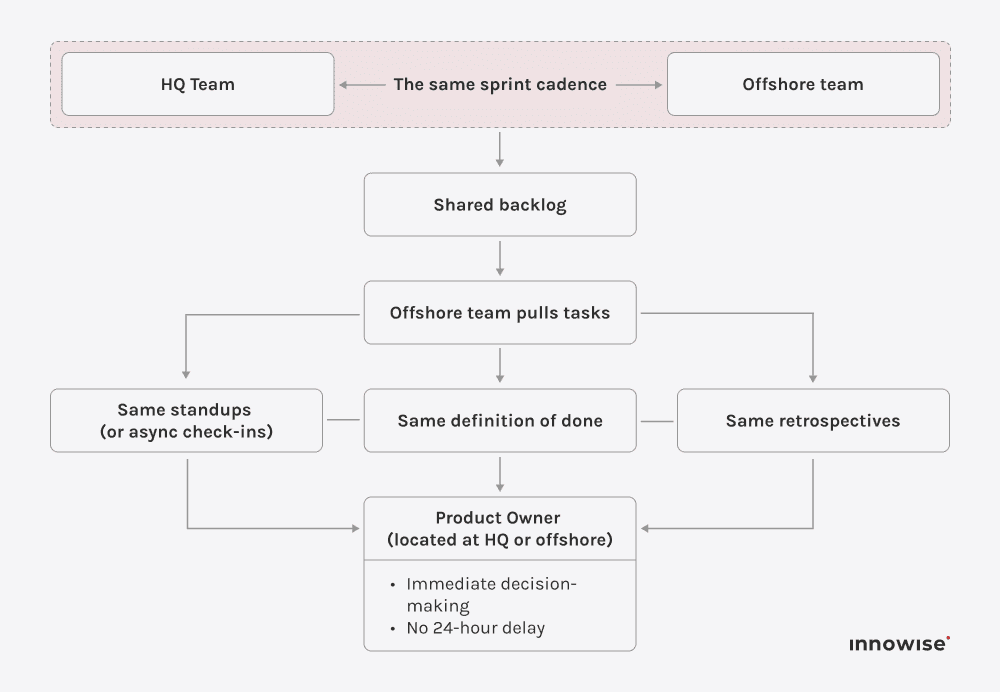
How successful your collaboration will be depends on how you build your communication. To make a team that’s miles away feel like they’re sitting right next to you, you may set up this Delivery Governance and Reporting pattern:

Flowchart for offshore and onshore team communication workflow.

The in-house and offshore teams achieve an effective collaboration by means of four:

  • A shared backlog from which both teams take the tasks
  • A named onshore counterpart for every offshore engineer, with enough overlap for natural weekly collaboration
  • A 90-minute daily synchronous overlap reserved for decisions
  • Annual two-week on-site visits to build more cohesion between teams

Efficient offshore development centers follow Agile delivery.

According to the Business Agility Institute, teams that stick to disciplined agile methods report 86% better project delivery

To avoid disruptions, they run ceremonies across time:

Sprint planning requires a genuinely ready backlog before the session opens: written acceptance criteria, mapped dependencies, and discussed estimates. 

Retrospectives require explicit psychological safety mechanisms. Anonymous retrospective tools, like Parabol and EasyRetro, reduce the social pressure that stops offshore engineers from raising real issues with a client-side team.

Team setup, onboarding, and scaling

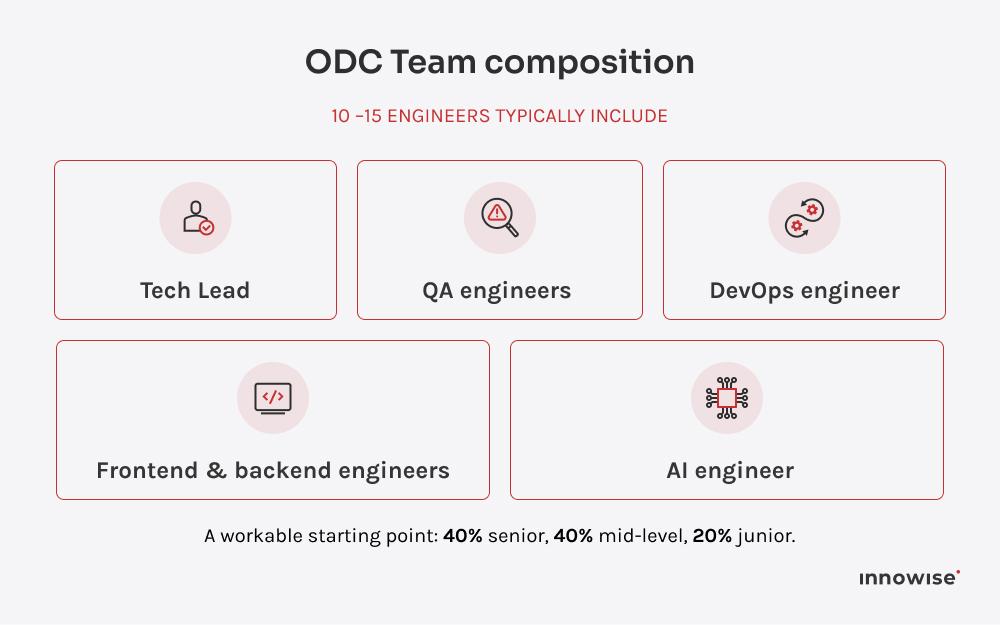
To keep things moving fast without sacrificing quality, you need a team with clearly defined roles and a healthy balance of experience levels. Based on my experience of managing the ODC team, here’s the core team composition I would recommend:

Diagram showing an offshore development center team structure with engineering roles and seniority ratios

These roles make the process work in a distributed setup:

Le site Scrum Master tracks when the team is blocked while waiting for an HQ decision and escalates the issue before it becomes a sprint failure.

Le site Responsable de produit is the most vital role for ODC software success, yet it is often handled poorly. When the PO stays at headquarters and treats the offshore team merely as recipients of instructions, it causes decision delays that slow down the entire development process.

The fix is a Product Owner proxy embedded offshore: a senior engineer with authority to make day-to-day scope decisions and escalate only strategic ones to the HQ Product Owner. This keeps the team unblocked during the eight hours when the primary PO is unavailable.

Scaling is a task of your ODC vendor, but as with the other processes, you remain in control. Two mistakes end almost every ODC expansion.

  1. Adding engineers too fast overwhelms the senior engineers responsible for mentoring: their delivery drops, new joiners ramp up more slowly, and the expansion produces less output than the original team. A sustainable pace is two to three engineers per quarter per Tech Lead.

  2. If QA is already the bottleneck, adding engineers without checking downstream constraints means that more backend capacity doesn’t help. First, identify the constraint in the current pipeline, then add the role that removes it.

Why businesses choose an offshore development center

Companies set up ODCs to hire skilled engineers from around the world, lower their spending compared to local hiring, and bring products to market faster. When talking to our clients, most describe the following gains from their collaboration with our ODC teams:

Predictable and optimized costs

Hiring a senior engineer in major hubs like San Francisco ou Londres typically costs between $150,000 and $200,000 annually, excluding benefits or recruitment fees. In contrast, professionals with the same level of experience in countries like Pologne, Inde, ou Colombie usually earn between $50,000 and $90,000. This cost gap allows companies to reduce their total engineering spend by 35% to 50% as they grow their teams.

Access to a global talent pool

Every year, Poland produces 15,000 tech graduates, while India’s developer community is expanding by 14% annually. Romania, Vietnam, and Colombia also provide large pools of skilled engineers at a much lower cost. In these regions, an offshore development center services company can often fill the same role in just two to three weeks, thanks to its existing talent network.

Faster time-to-market through agile delivery

Issues found at the end of the day in one office can be resolved by the next morning in another, thanks to global time zone coverage. Testing that would usually take three days can be completed in just one. As a result, businesses launch products faster.

Long-term team stability and deep product knowledge

Dedicated offshore team models achieve 95% engineer retention (based on Innowise’s experience). This is a major advantage because engineers who have spent two years in your codebase carry undocumented edge cases, architectural constraints, and third-party integration quirks that cannot be fully captured in a handover document.

High transparency and delivery control

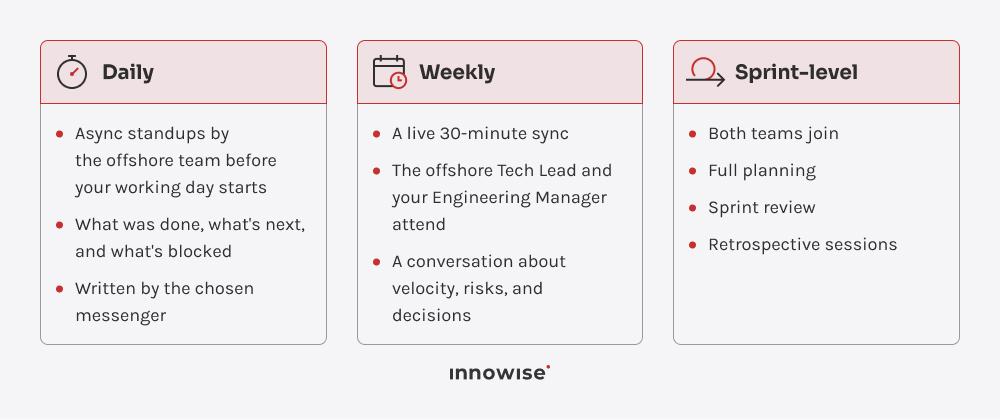
A shared Jira or Linear board where every task is visible and assigned. Daily async standups that surface blockers before they become sprint failures. A CI/CD pipeline that both teams monitor in real time. Sprints review every two weeks, with working software as the deliverable. The result: velocity is measurable, blockers surface within hours, and nothing reaches delivery as a surprise.

24/7 development continuity and business resilience

Public holidays, infrastructure outages, and regional disruptions that shut down a single-location team leave an ODC unaffected. When your main office faces disruption, your offshore team keeps operations running without delay.

I would suggest looking at an ODC not just as a way to add extra hands, but as a way to find specialized talent you can’t get locally. You’re building a team that actually learns your product and grows with you, operating at the same enterprise standards as your home office, but with much more flexibility to scale up or down as your roadmap changes.

Siarhei Sukhadolski
Siarhei Sukhadolski

Directeur du Delivery et Responsable du Centre de Compétences

Let’s build the right ODC team for your roadmap

How to handle compliance and security with ODC

To keep an ODC secure, your company and the hired team must sign clear contracts and follow the same security rules used at headquarters. These documents and processes help protect your data, ownership rights, and system access.

Data protection and regulatory compliance

An ODC must comply with the data laws of both the country where the team is located and the country where your company is based.

For US companies, specific industry rules still apply offshore: HIPAA for healthcare, SOC 2 for SaaS, and PCI-DSS for payments. Your ODC contract must clearly state that the provider is responsible for meeting these standards, and you must retain the right to audit their work at any time.

For EU companies, GDPR applies to every offshore engineer who handles personal data. You must have signed data processing agreements and standard contractual clauses in place. Additionally, every offshore team member must complete GDPR training as a mandatory contractual requirement of their contract.

From August 2, 2026, the EU AI Act starts applying key compliance obligations to high-risk AI systems, including in areas such as healthcare and finance. s. You must document exactly how these requirements are met, regardless of where the engineers are actually working.

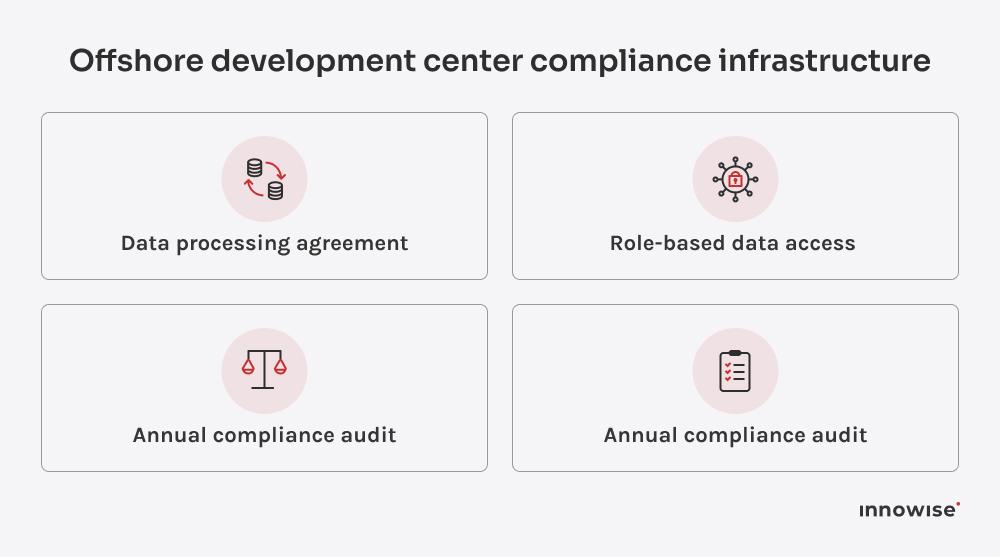
The minimum offshore development center compliance infrastructure:

Minimum ODC infrastructure checklist featuring data agreements, access controls, training, and yearly audits

Protection de la propriété intellectuelle

When intellectual property (IP) is lost in an offshore team, it’s usually not because of deliberate theft. Instead, it happens because of unclear contracts, a failure to properly revoke access when engineers leave, or the absence of clear rules around contributing to public code projects during work hours.

Sign these three documents to eliminate most of the risk:

  • An IP ownership agreement with every offshore engineer. It must clearly state that all work, including code, documents, and designs, belongs to you (the client) from the moment they are created.
  • A non-disclosure agreement (NDA) must specifically list what is confidential, such as the product roadmap, customer data, and internal business operations. It should also clearly state which country's laws will govern the agreement, which is necessary if you need to take legal action in a foreign court.
  • Offboarding checklist to recover company equipment and ensure that all local copies of your code and data are deleted on the engineer's last day.

Security processes and access control

An ODC should follow the same security rules as the main company. When offshore engineers use the company’s systems, data, or code, they face the same risks as local employees. However, there is an added risk because they work over a network that the main company does not manage.

Your team is accessing your systems over a network that your main company doesn’t manage, which creates an inherent security blind spot. To close this exposure and reduce the risk, you need to implement the following mandatory access and device controls:

  • Authenticate every connection with multi-factor authentication
  • Access only to the specific systems required for their roles
  • Ensure peer reviews for all code merges and auditable logs of all repository access
  • Use company-issued or managed devices
  • Include incident response integration with clear 24/7 communication paths

The challenges you may face when working with an offshore development center

The benefits of an ODC are structural — they exist because of how the model is designed. The challenges are operational — they emerge from how the model is run. The good news is that most of them can be avoided, and I’ll show you how below.

Communication challenges

Without a clear communication process across time zones, global teams often struggle with delays and misunderstandings.

For example, if an offshore developer needs clarification on a task while the headquarters team is offline, they might make an incorrect assumption to avoid stopping work. When the headquarters team reviews the result the next day and finds it wrong, two days of effort are wasted. Repeated across a full team, this pattern can significantly increase project costs.

To prevent this, every task must be fully defined with written requirements and dependencies before the team starts work. Additionally, companies should assign specific people to make decisions during overlapping hours and set a four-hour deadline for resolving blockers before they escalate.

Delivery misalignment

When a dedicated offshore development center team delivers the right features poorly, or strong features that don’t align with the company’s long-term plan, it usually comes down to three main causes:

  • No clear decision owner.
    The fix: Appoint a Product Owner proxy who is immediately accessible to the offshore team.
  • Poor sprint reviews.
    The fix: Include real customers, users, or external partners in your reviews every three months.
  • Offshore engineers only know their current sprint, not the long-term plan.
    The fix: Share the full product roadmap with the offshore team.

Attrition and knowledge loss

Offshore engineer turnover is usually a key cause of lost project-specific knowledge. Use these three methods to retain engineers on your team and minimize the impact if they do leave.

  • Review compensation annually to stay aligned with the local market.
  • Offer clear career growth and a defined path from mid-level to senior or lead roles within the ODC.
  • Make documentation mandatory: architecture decisions, system guides, and onboarding steps as part of their daily work.

Not sure if your company is ODC-ready?
Share your team structure and delivery model, and we’ll define your next step.

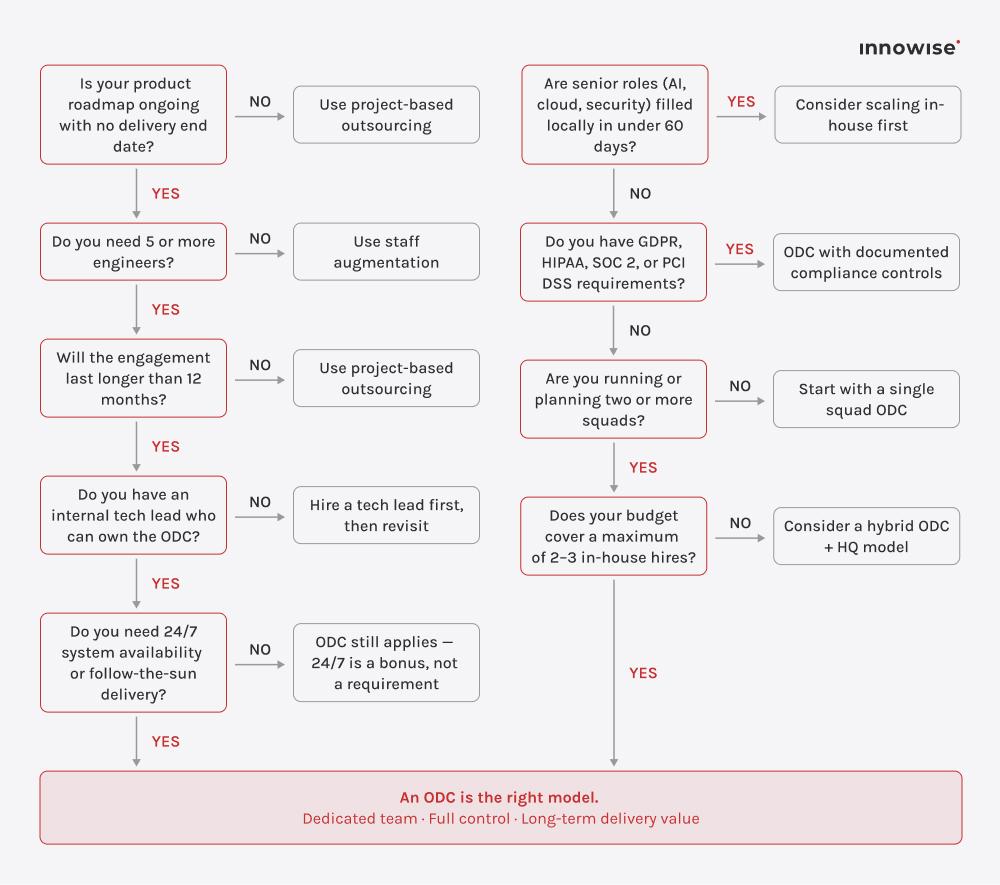
When does an ODC make sense?

Not every company is ready for an ODC, and not every problem it can solve is best addressed through this model. The decision matrix below maps the conditions under which an ODC is the right choice and those under which a different model serves better.

The decision matrix for the right offshore development center partner

decision matrix helping to choose an offshore development center partner

Key factors to consider about ODC locations

The most popular ODC locations are five: Poland, India, Vietnam, Colombia, and the Philippines. The right location optimizes across five criteria simultaneously, and the tradeoffs between them are senior developer rates, time zone overlap with the US/EU, and compliance readiness.

Since no single location wins on every point, your final choice must be based on what is most important for your specific business goals. Below, I’ve made up a detailed comparison table so you can clearly map these trade-offs against your requirements.

PologneIndeVietnamColombiePhilippines
Senior dev rate (annual)$45k-65k$18k-35k$20k-35k$25k-45k$15k-30k
Talent pool size650,000+4.5M+650,000+200,000+190,000+
Tech graduates/year20,000+1.5M+57,000+45,000+100,000+
AI/cloud specializationFortVery strongGrowing fastGrowingModéré
English proficiencyHautHautModerate to highHautTrès élevé
Overlap with EU (CET)Complet3-4 hrs2-3 hrs4-6 hrs2-3 hrs
Overlap with US EST3-5 hrs1-2 hrs1-2 hrsComplet1-2 hrs
GDPR complianceNative (EU member)ContractualContractualContractualContractual
Protection IPStrong (EU law)ModéréModéréModéréModéré
Geopolitical riskFaibleLow to moderateFaibleLow to moderateFaible
Cultural fit with EU/USTrès élevéHautModerate to highHautHaut
Attrition riskModéréHautModéréModéréModerate to high
Convient le mieux àEU-regulated, long-term, compliance-heavyLarge-scale, high-volume, 24/7Cost-quality balance, APAC clientsUS nearshore, real-time agileEnglish-first, BPO-adjacent roles

Check if your ODC team is success-material

Choosing the right collaboration is one step, and the rest of the way involves compiling the partner you select for ODC. Their technical maturity, security standards, and communication style must align with your own corporate culture. Factors you need to pay attention to include the vendor’s domain expertise, ability to scale resources quickly, and commitment to data protection.

Below, I created a checklist to determine if a team will deliver or drift.

Agile maturity

  • Certified Scrum Masters
  • Embedded Product Owner proxies on every engagement
  • Sprint ceremonies run to a defined standard
  • Definition of Ready enforced before planning
  • Definition of Done agreed before sprint one
  • Velocity is tracked, shared, and reviewed every two weeks

Delivery transparency

  • Shared Jira or Linear boards.
  • Daily async standups that surface blockers before HQ starts its day
  • Bi-weekly sprint reviews where working software is the deliverable
  • Clients retain direct access to all repositories, pipelines, and delivery metrics
  • No intermediary reporting layer

Sécurité et conformité 

  • Individual IP assignment agreements
  • NDAs signed at onboarding by each engineer individually
  • Role-based access is provisioned before day one, reviewed quarterly, and revoked on the day of any departure
  • Documented compliance coverage for GDPR, HIPAA, SOC 2, and ISO 27001
  • Audit rights are a contractual default

Team stability and scaling

  • Average engineer tenure on client ODCs exceeds two years
  • Compensation benchmarked against local market rates every six months
  • Compensation is adjusted proactively
  • Two to three engineers per quarter per Tech Lead, with a three-phase onboarding framework

Future trends to expect about the offshore development center model

ODCs are changing due to new technology (like AI), stricter rules on compliance, and a willingness to pay for results instead of hours. I can suggest there are at least five trends we can expect in the coming years.

Agile at scale and distributed product teams

Companies will move toward squad-based models where each offshore group is fully responsible for a specific part of the product. In practice, this means that companies that successfully run one offshore team will set up several more. Each new team will have its own leader and schedule, but follow the same technical standards and goals. Instead of managing these teams through a complex hierarchy, they will stay coordinated by a shared list of priorities and unified rules for building the software.

AI-assisted development

Selon un March 2026 McKinsey report, developers using AI assistants are 35–45% more productive. This means an offshore developer in 2027 will be able to produce the same amount of work as two or three developers did in 2023, but at a much lower cost.

However, AI-generated code already requires stricter quality checks since it often looks correct but contains logic errors. Partners who will establish clear AI rules will deliver higher-quality results than those who will let engineers use AI without oversight.

Hybrid offshore/nearshore models

Now, companies tend to combine both offshore and nearshore: they keep internal experts for strategy and use global teams for large-scale engineering work. We can expect this to continue in the coming years.

In this model, a small nearshore team of five to ten people will handle daily meetings and planning. At the same time, a larger offshore team of twenty to thirty people will focus on building the software.

Companies using this method will treat location as a practical choice, picking the best spot for each type of work based on cost, time zone, and available skills.

Increased focus on compliance and security

Based on the EU AI Act, if you use AI for healthcare, credit scoring, hiring, or identification, you must legally document your processes, include human check-ins, and keep clear records of how the AI was built.

Offshore teams must have engineers who know these rules, use tools that automatically create required paperwork, and sign contracts that clearly state who is responsible for meeting legal standards. This creates a new trend: companies will only hire offshore partners who can prove they follow the same strict security and legal standards as internal teams.

Outcome-based delivery models

Hourly billing tracks how much developers work, but outcome-based models track what they actually deliver. According to Deloitte’s 2024 survey, 67% of companies now value results more than low costs.

In these contracts, part of the pay depends on specific performance metrics: how often code is released, the number of bugs found, how many people use new features, and how fast ideas become working software. 

To work, this model will need two things: a clear, measurable definition of “success” agreed upon before the project starts, and a shared dashboard that shows these results to everyone instantly.

Drawing the line about the offshore development center

As you can see now, the offshore development center is structurally different in ownership, process discipline, talent integration, compliance maturity, and long-term accountability for product outcomes.

A well-run offshore development center is more than a way to save money. By choosing the right location and partner, it becomes a powerful engineering asset that grows more valuable over time, helping companies build technology at the speed the market demands.

If you are looking for that trusted, de-risked partner, Innowise provides a ready-to-use solution. Headquartered in Warsaw, Poland, with development centers and offices across the EU, we are already certifié in critical standards, including ISO 27001, SOC 2, HIPAA, and GDPR. 

Our 3,500+ IT professionals, 75% of whom are senior- or mid-level engineers, are equipped to staff your team quickly and deliver measurable results. The right ODC partner is here to help you build technology at the speed and standards the market demands.

FAQ

An ODC (Offshore Development Center) is a software engineering team that a company sets up in a different country. This team works only for your company and follows your rules and product quality standards.

In regular outsourcing, a vendor gives you people from a shared group for a specific task. These people might work for other clients at the same time and leave once the project is done. In an ODC, the team works only for you, reports to you, and keeps getting better at understanding your business over several years.

Setting up an ODC usually takes between two and six months. If you partner with an established provider that already has a local office and a list of available talent, you can hire your first engineers in just two to four weeks.

Running agile in a distributed ODC involves the same core practices as an in-house team, such as sprint planning, daily meetings, and reviews, but adapted for different time zones. Success depends on having a clear list of requirements ready before planning and a local decision-maker who can keep the team moving while the headquarters team is offline.

You can pick the right location by asking four simple questions. First, do you need to follow specific laws like GDPR? Second, do you need the team to work in the same time zone as you? Third, do you need experts in special areas like AI or security? Finally, how long do you plan to work together? A long-term project usually makes it worth choosing a more stable, lower-risk location.

An ODC usually needs at least five people to work well. This core team should have a Tech Lead, two or three developers with the required technical expertise, and a QA engineer to validate the work.

Table des matières

    Contactez-nous

    Réserver un appel ou remplissez le formulaire ci-dessous et nous vous contacterons dès que nous aurons traité votre demande.

    Envoyez-nous un message vocal
    Joindre des documents
    Charger fichier

    Vous pouvez joindre un fichier d'une taille maximale de 2 Mo. Formats de fichiers valables : pdf, jpg, jpeg, png.

    En cliquant sur Envoyer, vous consentez à ce qu'Innowise traite vos données personnelles conformément à notre politique de confidentialité. Politique de confidentialité pour vous fournir des informations pertinentes. En communiquant votre numéro de téléphone, vous acceptez que nous puissions vous contacter par le biais d'appels vocaux, de SMS et d'applications de messagerie. Les tarifs des appels, des messages et des données peuvent s'appliquer.

    Vous pouvez également nous envoyer votre demande
    à contact@innowise.com
    Que se passe-t-il ensuite ?
    1

    Une fois que nous aurons reçu et traité votre demande, nous vous contacterons pour détailler les besoins de votre projet et signer un accord de confidentialité.

    2

    Après avoir examiné vos souhaits, vos besoins et vos attentes, notre équipe élaborera une proposition de projet avec l'étendue des travaux, la taille de l'équipe, les délais et les coûts estimés projet avec l'étendue des travaux, la taille de l'équipe, les délais et les coûts estimés.

    3

    Nous prendrons rendez-vous avec vous pour discuter de l'offre et régler les détails.

    4

    Enfin, nous signons un contrat et commençons immédiatement à travailler sur votre projet.

    Autres services couverts

    arrow