El poder del mapeo de datos en la atención sanitaria: ventajas, casos de uso y tendencias futuras. La rápida expansión del sector sanitario y de las tecnologías que lo sustentan genera una inmensa cantidad de datos e información. Las estadísticas muestran que alrededor de 30% del volumen mundial de datos se atribuye al sector sanitario, con una tasa de crecimiento prevista de casi 36% para 2025. Esto indica que la tasa de crecimiento es muy superior a la de otras industrias como la manufacturera, los servicios financieros y los medios de comunicación y entretenimiento.

What is a neobank? Neobank vs. digital bank and the future of fintech banking

30 de enero de 202610 minutos de lectura
What is a neobank_ Neobank vs. digital bank and the future of fintech banking

Principales conclusiones

  • Neobanks win on speed. You can open an account, issue cards, and sync with tools like Xero or Stripe in a matter of hours.
  • Digital banks offer what neobanks don’t. Think business loans, lines of credit, treasury services, and stronger regulatory backing.
  • FDIC protection comes from the partner bank. Neobanks don’t hold banking licenses, so your coverage depends on who they work with.
  • Neobanks suit lean, remote, global teams. If you need checks, credit, or in-person services, a digital bank is the better fit.
  • Before choosing a neobank, check its partner bank, licensing setup, and long-term business model.
A few years ago, I was helping a SaaS founder set up banking for their freshly funded startup. They had just closed a seed round, were hiring fast, and needed a business account that could handle international payments, multiple users, and expense tracking.We opened an account with a neobank on a Monday morning. By lunch, the card was live, the dashboard was syncing with their accounting stack, and they were sending their first vendor payment without branch visits, “approval teams”, or submitting tedious forms.Sounds dreamy, right? But getting to that reality meant answering a few critical questions beforehand:
  • Should we go with a neobank or a digital bank?
  • What’s the difference, and why does it matter?
  • How safe is one compared to the other?
  • Will the choice affect international payments, compliance, or funding down the road?
  • And how do you even compare them when every site says “fast, easy, low-fee”?
If you Google it, you’ll find definitions like:"A neobank is a digital-only financial service built by a fintech company, often without its own banking license.” Or, “A digital bank is a traditional, licensed bank that offers its services online, usually through a mobile app or website.”Both definitions are technically true. But also… incomplete. Yes, they both let you skip the paperwork and the branch visits, but what’s going on behind the curtain is very different.In this guide, I’ll break down all these differences in layman’s terms. You’ll also get a revised look at the top neobanks for business in 2026, so you can choose wisely. 

Simplify business banking with the right fintech solution

What is a neobank?

A neobank is no a traditional bank. It’s a fintech company that builds a digital interface for banking services, usually without holding a banking license of its own. Instead of becoming a bank, a neobank partners with one.

This setup runs on the Banking-as-a-Service (BaaS) model. The licensed bank handles the back-end: deposit holding, regulatory compliance, and FDIC insurance. The neobank handles the front-end: product design, app experience, customer support, and features.

If you’ve ever opened a business account with one of these platforms and thought, “Wow, that was fast”, you’ve likely used a BaaS-powered neobank. Today, there are strong contenders in this space, such as Mercury, Revolut Business, or Qonto. Each has its own strengths, and I’ll go into more detail on the best ones a bit later.

So why are these fintech banks attracting so many small businesses, especially founders and remote teams?

A few reasons stand out:

  • Velocidad: Account setup can take minutes
  • Precios: Most offer transparent, flat monthly pricing with far fewer surprise fees.
  • Automatización: Tools like invoice scanning, rule-based approvals, and smart notifications help lean teams do more without adding headcount.
  • Integraciones: Many connect natively with platforms like Xero, QuickBooks, Stripe, or PayPal, saving finance teams hours of manual work.

Neobanks work best for companies that value control, speed, and modern tooling, but don’t necessarily need every service a traditional bank offers. If your business runs on Slack, uses Notion, and pays international contractors through Deel or Wise, odds are a neobank will feel more in sync with how you already work.

But while the surface looks smooth, there’s more going on under the hood, which we’ll get to in the next section.

What is a digital bank?

If neobanks were built from scratch for the internet, digital banks took another route. These Chase for Business, Capital One 360, o Wells Fargo Digital. All of them have apps, dashboards, and online account access, but underneath, they’re part of institutions with deep roots in traditional finance.

The key difference comes down to estructura.

Neobanks are fintech companies wrapped around a partner bank. Digital banks are licensed banks that operate entirely online. That distinction matters when it comes to how your money is insured, who answers to regulators, and what kind of services you get access to.

For example, a digital bank can offer everything from basic checking to long-term business loans, credit lines, treasury services, and legacy tools like wire transfers or physical checks. These aren’t always available or even supported by most neobanks.

That said, don’t conflate “digital” with “modern.”

While many digital banks have rolled out apps and web platforms, they often sit on top of legacy systems. And those interfaces can show their age. The onboarding process may involve manual review. And some still require branch visits for certain services.

What you gain with a digital bank:

  • Direct relationship with a licensed, regulated institution
  • Full FDIC coverage without relying on third-party partners
  • Access to a wider range of financial products (loans, credit, treasury, etc.)
  • Legacy services like wire transfers, physical checks, and in-person support

What you trade off:

  • Slower onboarding, sometimes involving paperwork or in-person steps
  • Interfaces that may feel dated or unintuitive
  • Fewer integrations with automation and collaboration tools (Zapier, Slack, etc.)
  • Less flexibility around automation, user permissions, and custom workflows

A digital bank can be the right fit if you value breadth of services, prefer direct relationships with licensed banks, or need things like business credit, multi-entity support, or more complex account structures. But the user experience may come second to infrastructure, and that compromise is something to weigh carefully.

Neobank vs digital bank: key differences in 2026

We’ve established the differences, but sometimes, it helps to see everything laid out side by side. Below is a breakdown of how neobanks y digital banks compare across the areas that matter most to business owners in 2026.

Característica Neobank Digital bank
Licencias Fintech company, no banking license Fully licensed bank
FDIC protection Provided via partner bank (BaaS model) Direct coverage under the bank’s own license
Tasas Lower, transparent pricing; often subscription-based Varies widely; may include maintenance, transfer, or overdraft fees
Diseño UX Mobile-first UX design, clean interface, fast updates Functional, but may lag due to legacy systems
Account setup Fully online, with fast KYC/AML compliance May involve manual review or branch verification
Servicios Core SME banking: cards, multi-currency accounts, FX tools Full suite: credit lines, business loans, CDs, wires, and more
Innovación Agile, API-driven; often integrates with modern finance tools Slower to adopt new features, but usually more battle-tested
Atención al cliente Live chat, email, chatbots — digital-first support only Hybrid: phone, branch, and digital channels
Target audience Startups, freelancers, remote-first teams Broad customer base; often long-standing clients or established firms
Profitability & risk Lower ARPU, fintech-reliant, lean ops Higher capital reserves, more regulatory oversight
A few quick takeaways:
  • If fast onboarding, low fees, and clean integrations are your top priorities, neobanks are hard to beat, especially if you’re running a lean operation or working across borders.
  • If you need access to lending products, complex account structures, or deeper regulatory coverage, digital banks still offer a more traditional (and sometimes more secure) path.
Choosing between a banking license vs a fintech company model is about how much control and flexibility your business needs today y what it will likely need tomorrow.

Your bank plays a central role in how your business runs. The real cost of a poor choice doesn’t show up on day one. It hits when your finance stack cracks under scale, and switching banks feels harder than replatforming your product. This is an infrastructure decision. Treat it like any platform your business relies on to move, grow, and stay compliant.

Dzianis Kryvitski

Director de entrega en FinTech

Neobank risks and realities for businesses in 2026

Neobanks are safe as long as two things are true:

  1. The neobank partners with a properly licensed, FDIC-insured bank.
  2. That partner bank keeps clear, verifiable records of your individual account.

If either of those breaks down — say, the fintech folds or recordkeeping is incomplete — you’re not guaranteed immediate access to your funds.

In the US, FDIC insurance only applies to the partner bank, not the neobank itself. This means:

  • If the partner bank fails, the FDIC steps in and covers up to $250,000 per depositor, per account category.
  • If the neobank fails, you may not have direct recourse through the FDIC. Instead, you’d be dependent on how well your funds were recorded and separated, and how quickly the partner bank can reassign and release them.

In short, the safety of your funds depends not just on regulation but on operational clarity between the fintech and its partner.

What can go wrong?

Many neobanks remain relatively young players in the banking space. And that means business banking customers face risks beyond what they might expect from a legacy institution:

  • Platform failure or acquisition
  • Data breaches or poor security protocols
  • Regulatory noncompliance (which could trigger account freezes or shutdowns)
  • KYC/AML issues, especially if the onboarding process is rushed or relies too heavily on automation

This doesn’t mean neobanks are inherently unsafe. It means they’re only as safe as their architecture, partnerships, and recordkeeping practices.

What you can do to protect your business

Before you trust a neobank with your operating capital, take a few minutes to check the following:

  • Who’s the licensed partner bank? Is it FDIC-insured? You can verify this on the FDIC website.
  • Is the neobank upfront about deposit protection? Look for clear disclosures in the FAQ or legal section. Vague language is a red flag.
  • Do they mention how KYC/AML is handled? En 2026, a serious neobank should explain its onboarding process, recordkeeping, and fraud controls.
  • What happens if the neobank shuts down? Check the terms of service or disclosures to see how account continuity is managed.

Regulatory changes for neobanks in 2025-2026

Regulators across the US, EU, and beyond are no longer taking a hands-off approach. Several developments now affect how fintech banks operate:

In the United States:

In the European Union:

These updates mean neobanks must now operate with greater transparency and operational discipline, or face exclusion from regulated markets.

So, my advice to any business facing the choice of a neobank? Treat it like any other strategic vendor choice: ask the hard questions, read the fine print, and confirm the structure matches your risk tolerance. Because what matters most in business banking is knowing exactly who’s on the hook when things go wrong.

When to choose a neobank vs a digital bank for your business

There’s no shortage of banking options in 2026, but that doesn’t make the decision any easier. So, how do you decide? The answer depends on how your business operates today, and where it’s headed next.

Choose a neobank if you:

  • Want to open an account in hours, not days
  • Care more about APIs and integrations than in-person support
  • Operate across borders and need multi-currency support
  • Work with contractors or team members in multiple countries
  • Want better visibility into team spending and real-time controls
  • Prefer flat pricing, minimal fees, and a modern mobile-first UX
  • Don’t need checks, loans, or legacy financial products right now

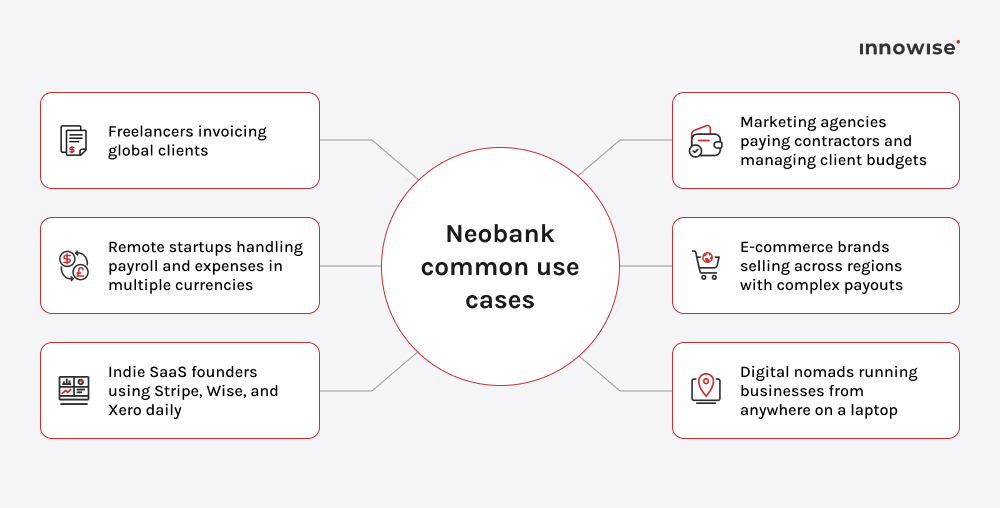
Common use cases:

  • Freelancers invoicing global clients
  • Remote startups handling payroll and expenses in multiple currencies
  • Indie SaaS founders using Stripe, Wise, and Xero daily
  • Marketing agencies paying contractors and managing client budgets
  • E-commerce brands selling across regions with complex payouts
  • Digital nomads running businesses from anywhere on a laptop
Diagram showing common neobank use cases: freelancers, startups, SaaS founders, agencies, and e-commerce brands.
Choose a digital bank if you:
  • Need access to credit lines, business loans, or treasury products
  • Regularly send or receive wire transfers or physical checks
  • Operate in a regulated or paperwork-heavy industry
  • Want the backing of a licensed bank, rather than just a fintech interface
  • Rely on in-person services (cash deposits, branch notarizations, etc.)
  • Need full-service business banking under one roof
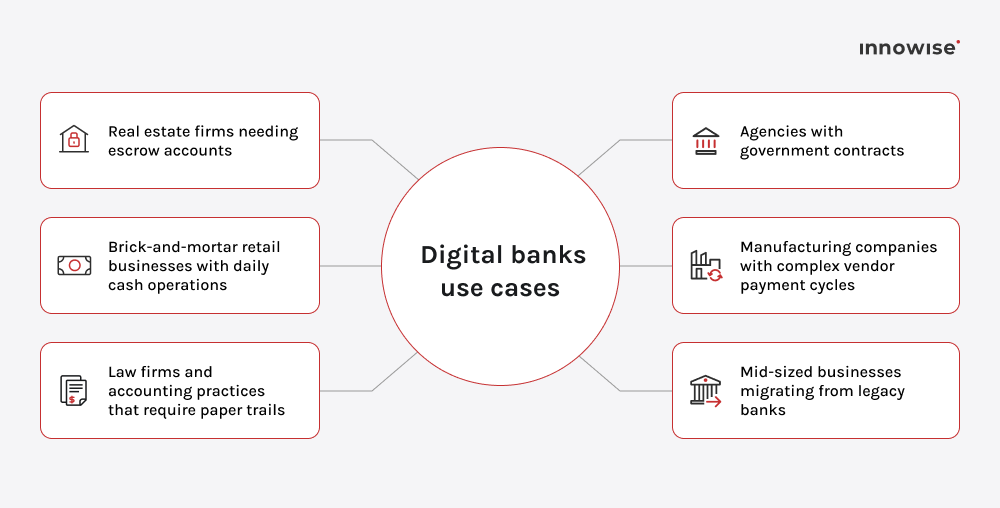
Common use cases:
  • Real estate firms needing escrow accounts
  • Brick-and-mortar retail businesses with daily cash operations
  • Agencies with government contracts 
  • Law firms and accounting practices that require paper trails
  • Manufacturing companies with complex vendor payment cycles 
  • Mid-sized businesses migrating from legacy banks
Diagram showing common digital bank use cases: real estate, retail, legal, manufacturing, and mid-sized businesses.

If your current needs are simple, and you value speed, clarity, and modern features, a neobank may be the right move.

But if you’re building toward complexity, such as multiple accounts, credit products, physical checks, or financial reporting, a digital bank may offer more of the tools you’ll eventually need.

Stop compromising. Choose a fintech solution that fits.

Top 5 neobanks for business in 2026

Here are my top 5 fintech banks (aka neobanks) for businesses right now, each chosen based on strong UX, transparent structure, solid integrations, and a clear BaaS or partner‑bank model.

Mercury (US)

Built with startups in mind, Mercury offers business checking and savings accounts with no monthly fees, deep API access, and fast onboarding. They support direct integrations with QuickBooks Online, Xero, and NetSuite.

Ideal para: Early‑stage tech companies, lean teams, businesses that prioritise speed and flexibility.

Consider: US‑based and focused on USD operations, international FX/currency support is more limited than some global options.

Qonto (Europe)

Focused on SMEs across Europe, Qonto provides business accounts, expense cards, multi‑currency transfers, bookkeeping integrations, and real‑time dashboards. It offers a business API, and supports integrations with spreadsheets, Stripe, Slack, and more via Zapier.

Ideal para: European SMEs (mainly France, Germany, Spain, Italy) who need lean, digital‑first banking and integrated finance workflows.

Consider: Because they are still in transition toward a full banking licence, some legacy bank‑type products (credit, complex treasury) may be more limited.

Wise Business (Global)

Known for its multi‑currency account features: you can hold, send, or receive in many currencies, get local bank details in several regions, with competitive FX rates and modern integrations. Wise supports an open API and syncs with accounting software like Xero, QuickBooks, and FreeAgent.

Ideal para: Businesses with significant cross‑border operations, international clients/contractors, or those that manage multi‑currency payout flows.

Consider: It’s less of a full‑service bank for loan or treasury products and is primarily built for FX and cross‑border flows.

Revolut Business (Global)

A strong global player among the top neobanks for business, Revolut Business provides multi‑currency accounts, team spending controls, virtual and physical cards, and fast account setup. It supports a wide range of integrations across accounting (Xero, FreeAgent, QuickBooks), HR (Google Workplace, BambooHR), and productivity tools (Make, Zapier, Slack).

Ideal para: Companies that need global reach, multi‑currency operations, team spending oversight, and modern UX.

Consider: Licence status varies by country; in some regions, your funds may still be held via a partner bank rather than a direct banking charter.

Monzo Business (UK)

Monzo Business offers a mobile‑first UX, quick online account setup (often same‑day), expense cards, and bookkeeping integrations. It syncs with Xero, FreeAgent, or QuickBooks and supports bank‑feed integration for UK businesses.

Ideal para: UK‑based freelancers or small companies who prioritise UX, domestic integration with UK accounting tools, and fast digital experience.

Consider: If your business has large international flows, complex treasury needs, or operates outside the UK, a more global neobank may serve you better.

Comparison of top neobanks for business in 2026

Neobank Monthly/access fee Transaction/usage fees Integrations & highlights
Mercury $0 monthly fee for basic account in the US Few core fees for basic use; charges apply for non‑USD cards, non‑USD currency exchange, and advanced “Treasury” features Direct API access; supported integrations with accounting apps
Qonto From around €9/month (or equivalent) for basic SME plan Example: Payment link fee 1.4% + €0.25/transaction 2,000+ integrations listed; supports bookkeeping tools, invoice management
Revolut Business Tiered plans: e.g., UK “Grow” plan £30/month; “Scale” £90/month Example: 0.6% FX markup after allowance; international transfer fees from £5 each Broad integrations: accounting (Xero, QuickBooks), HR & productivity tools
Wise Business No monthly fee; pay‑as‑you‑go model Sending money from ~0.33% and other currency‑specific fees Open API, integrates with Xero, QuickBooks, FreeAgent
Monzo Business Free “Lite” plan (~£0), Pro/Team from ~£9/month Basic account setup is free; higher-tier plans add features Integrations: Xero, FreeAgent, Sage; bank‑feeds supported

Nota: Always verify region‑specific pricing and terms, as these can vary by country or plan.

Reflexiones finales

By now, you’ve probably realized there’s no “best” bank. There’s just the right one for where your business is and where it’s going. Need speed, great UX, and global tools? A neobank might be perfect. Need credit, complex accounts, or tighter compliance? A digital bank has the edge. 

If you are unsure which banking model fits your business, product, or operational roadmap, Innowise can help you evaluate the options objectively. We work with companies across fintech, SaaS, and regulated industries to assess banking structures, partner models, compliance implications, and long-term scalability. The goal is not to push a specific solution, but to help you make a well-informed decision before committing your capital and processes.

FAQ

A neobank is a fintech company that provides banking services entirely online, typically through a mobile app or web platform. Unlike traditional banks, most neobanks don’t hold a banking license. Instead, they partner with licensed banks for services like deposit holding, compliance, and insurance while focusing on UX, automation, and integrations.

Digital banks are licensed institutions offering full-service banking online. Neobanks are fintech platforms that deliver digital banking experiences but rely on partner banks for licensing and deposit insurance. While both are online-first, digital banks offer traditional products like loans, whereas neobanks focus on speed, automation, and user-friendly tools.

Neobanks are often better for startups needing fast setup, low fees, and international tools. They integrate easily with platforms like Xero and Stripe. Digital banks offer broader financial services like loans or credit lines, which growing businesses may need. The right choice depends on whether you need speed and simplicity versus full-service functionality.

No, most neobanks aren’t regulated as banks. They operate under fintech or e-money licenses and rely on a partner bank for regulatory compliance. That means deposit protection, KYC, and AML processes are handled by the licensed bank, not the neobank directly. Always check the partner bank’s regulatory standing and FDIC or EU coverage.

Most neobanks don’t offer traditional loans or credit lines. Their focus is on transactional banking: accounts, cards, and payments. A few provide invoice financing or credit tools via partnerships, but offerings are limited. If your business needs structured lending products, a digital bank or traditional lender may be a better fit.

Yes, many businesses use neobanks as their primary bank. Neobanks provide fast setup, team spend controls, and global payment tools. However, they may lack services like checks, credit, or in-person support. If you don’t need those features, a neobank can fully replace a legacy account, especially for lean, remote-first operations.

Neobanks don’t directly offer FDIC insurance, but your funds can be insured through their partner bank, which must be FDIC-insured. Always check who the licensed partner is and how your deposits are held. Clear disclosures should explain the insurance coverage structure. In the EU, equivalent protections apply under the Deposit Guarantee Scheme.

Risks include relying on a third-party partner bank, lack of credit access, or platform shutdowns. If the neobank fails, fund access depends on how well records are maintained by the partner. Data breaches, compliance issues, or unclear terms can also affect safety. Always verify deposit protection, service continuity, and legal structure before choosing.

Jefe del Departamento de Móviles

Eugene impulsa nuestra visión móvil con un ojo agudo en el rendimiento, la usabilidad y la tecnología a prueba de futuro. Ayuda a las empresas a convertir grandes ideas en aplicaciones rápidas e intuitivas que la gente realmente quiere usar.

Índice

    Contáctenos

    Reserve usted una llamada o rellene usted el siguiente formulario y nos pondremos en contacto con usted cuando hayamos procesado su solicitud.

    Envíenos un mensaje de voz
    Adjuntar documentos
    Cargar archivo

    Puede adjuntar 1 archivo de hasta 2 MB. Formatos de archivo válidos: pdf, jpg, jpeg, png.

    Al hacer clic en Enviar, autoriza a Innowise a procesar sus datos personales de acuerdo con nuestra política de privacidad. Política de privacidad para proporcionarle información relevante. Al enviar su número de teléfono, acepta que nos pongamos en contacto con usted a través de llamadas de voz, SMS y aplicaciones de mensajería. Pueden aplicarse tarifas de llamadas, mensajes y datos.

    También puede enviarnos su solicitud
    a contact@innowise.com
    ¿Qué pasa después?
    1

    Una vez recibida y procesada su solicitud, nos pondremos en contacto con usted para detallarle las necesidades de su proyecto y firmar un acuerdo de confidencialidad. Proyecto y firmaremos un acuerdo de confidencialidad.

    2

    Tras examinar sus deseos, necesidades y expectativas, nuestro equipo elaborará una propuesta de proyecto con el alcance del trabajo, el tamaño del equipo, el tiempo y las estimaciones de costes.

    3

    Concertaremos una reunión con usted para hablar de la oferta y concretar los detalles.

    4

    Por último, firmaremos un contrato y empezaremos a trabajar en su proyecto de inmediato.

    flecha