IT team extension outsourcing: guide to scaling a software team

May 29, 2026 10 min read
Summarize article with AI

Key takeaways

  • Hiring locally usually takes months, but team extension gets senior experts onto your project in about two weeks.
  • You save the most money by skipping “hidden” costs like recruiter fees, laptops, office space, and employee benefits.
  • Your code stays high-quality because these developers work directly in your Slack and follow your specific way of doing things.
  • You have the freedom to grow your team for a big launch and shrink it back down afterward without any HR or legal headaches.
  • Look at your project’s biggest bottleneck today and ask a partner for two or three resumes to see how quickly they can fix it.

Scaling a software team is usually a choice between hiring slowly and expensively or outsourcing and dealing with rigid workflows. IT team extension is the middle ground that lets you add specific expertise to your existing workflow without the HR nightmare of full-time recruiting.

This guide covers how the IT team extension works, the specific differences between this model and traditional outsourcing, and the practical steps for choosing a partner that fits your technical culture. We are going to discuss how to scale your development capacity without the friction of local hiring or the lack of control that comes with hands-off project management.

What is a software development team extension?

Software development team extension is a collaborative model where you hire external engineers to work alongside your in-house team on a long-term basis. It adds the specific developers or skills your project is missing right now without the slow, expensive paperwork of full-time hiring. 

Unlike project-based outsourcing, where you hand over the keys and hope for the best, development team extension keeps you in the driver’s seat. You manage the developers, they attend your daily stand-ups, and they use your Jira boards. 

I believe the biggest mistake people make is treating extended developers like “vendors” rather than teammates. If they don’t feel like part of the crew, they won’t care about the technical debt they’re leaving behind.

How the team extension model works

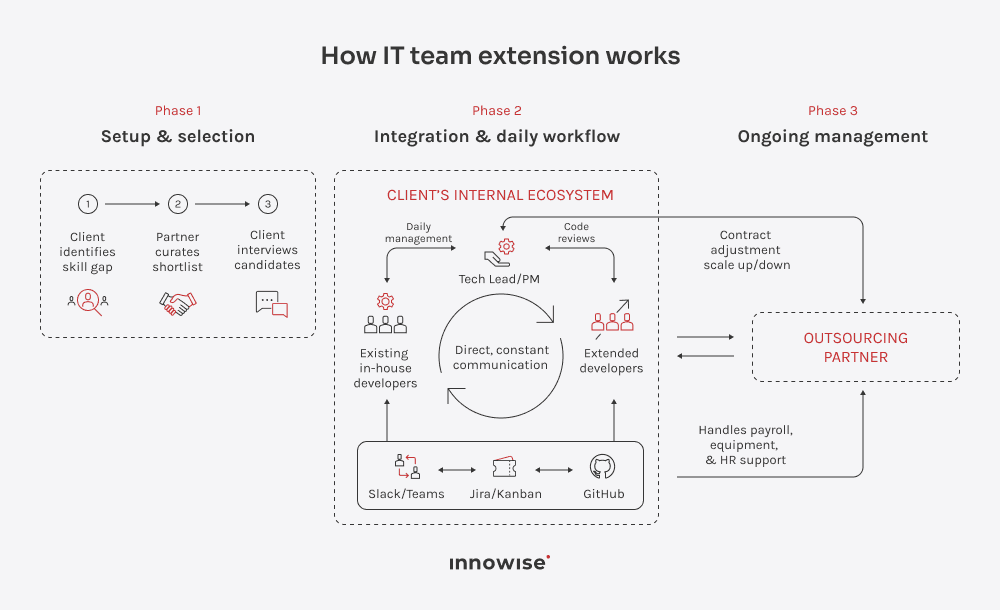
The team extension model works by integrating external talent into your internal communication channels and development workflows. You maintain management control and technical leadership while the provider handles the administrative side, like payroll, equipment, and office space.

The process usually looks like this:

  1. Gap analysis: You identify that your current team is drowning or lacks a specific skill (e.g., you need a DevOps wizard or a niche IT staff augmentation specialist).
  2. Selection: The partner gives you a shortlist of candidates. You interview them just like you would a local hire. (Pro tip: if the partner doesn't let you talk to the devs before signing, run away).
  3. Onboarding: The new devs get access to your Slack, GitHub, and documentation.
  4. Integration: They start picking up tickets.

I think the “magic” of this model is that it scales with your needs. If the project peaks, you add two more devs. When it levels off, you scale back. And there will be no awkward firing conversations. We call it a contract adjustment.

three phases of How IT Team Extension Works: Phase 1: Setup & Selection (identifying gaps and interviewing). Phase 2: Integration & Daily Workflow, showing in-house and extended developers collaborating within the client's ecosystem using tools like Slack, Jira, and GitHub under a Tech Lead. Phase 3: Ongoing Management, illustrating how the outsourcing partner handles payroll and HR while allowing for flexible scaling.

IT team extension vs traditional outsourcing

IT team extension focuses on integration and shared responsibility, whereas traditional outsourcing is based on delivering a defined project outcome with minimal client involvement. In extension, you own the process; in traditional outsourcing, the vendor owns it.

Feature
IT team extension
Traditional outsourcing
Management
You manage the devs daily
Vendor manages the team
Communication
Constant, direct, and transparent
Periodic reports via a Project Manager
Scope
Flexible and evolving
Often fixed-price or milestone-based
Integration
High (they use your tools)
Low (they use their own tools)

How to choose between team extension and outsourcing

Choose team extension if you have an in-house technical lead and want to keep full control over the code quality and architecture. Go for traditional outsourcing if you have a one-off project with a clear beginning and end, and don’t want to manage the “how” of the build.

In my experience, if you are building your core product, you should never fully outsource it. You need that “tribal knowledge” to stay close to home. Use a dedicated team or extension to keep the soul of the product in-house while the external guys do the heavy lifting on features.

Team extension vs staff augmentation vs dedicated team

While these terms are often used interchangeably, team extension is a subset of staff augmentation focused on long-term integration, while a dedicated team is a self-contained unit that includes its own PM and QA. Staff augmentation is usually about filling a single “hole,” whereas extension is about growing the capacity of an entire department.

I’ll be honest: the industry loves jargon. You’ll hear people use these terms differently every day. To keep it simple:

  • Staff augmentation: "I need one Java dev for three months."
  • Team extension: "I need three devs to work with my team indefinitely."
  • Dedicated team: "I need a whole squad to build this new module from scratch while I focus on the main app."

If you need to hire developers quickly, knowing which “flavor” you need will save you hours of circular conversations with sales reps.

Why companies choose IT team extension outsourcing

Companies choose IT team extension because it allows them to bypass the local talent shortage and scale their technical capabilities without the long-term risk of increasing permanent headcount. It’s about agility — being able to pivot your tech stack or team size in weeks rather than months.

Faster access to developers and tech expertise

You can typically find and onboard an extended team member in 2–4 weeks, compared to the 3–4 months it takes to hire locally. Furthermore, you gain access to global talent pools with niche skills that might not exist in your city. Let’s face it, finding a Senior Rust developer in a mid-sized city is like hunting for a unicorn in a basement.

Flexible team scaling

This model lets you scale up for a big release and scale down afterward without the legal and emotional headache of layoffs. I believe flexibility is the ultimate competitive advantage in the 2020s. If you’re locked into a massive fixed payroll, you can’t move fast when the market changes.

Reduced time to market for software products

With more hands on deck, you can run more parallel workstreams, meaning your features get in front of users faster. Software development team extension eliminates the “bottleneck” effect where five developers are waiting for one person to finish the backend.

Better cost control compared to in-house hiring

You save on recruitment fees, office space, hardware, benefits, and payroll taxes. While the hourly rate for a high-quality partner might look similar to a local salary on paper, the “all-in” cost is almost always 30-50% lower when you account for the hidden costs of full-time employees.

How to choose the right software development team extension partner

Choosing the right partner requires looking beyond the hourly rate and evaluating their cultural alignment, technical vetting processes, and long-term stability. A bad partner isn’t just a waste of money; they are a risk to your codebase and your sanity.

1. Check technical expertise and industry experience

Verify that the partner has actually worked in your domain and understands the specific challenges of your industry. If you’re in Fintech, don’t hire a team that only does e-commerce landing pages. Ask for their “internal” vetting process — how do they test their own devs? If their “senior” devs can’t pass a basic architecture interview, that’s a red flag.

2. Review communication processes and delivery standards

Ensure the partner uses the same (or compatible) tools and methodologies as you, such as Agile, Scrum, or Kanban. Communication is the first thing to break. I think you should ask: “What happens if a developer goes MIA for a day?” Their answer will tell you everything you need to know about their management maturity.

3. Evaluate team scalability and availability

Ask how quickly they can provide replacements or additional developers if your needs change. A small boutique agency might be great, but if they only have 10 people, they can’t help you scale from 2 to 20. You want a partner with a deep bench.

4. Ask about security, compliance, and IP protection

Confirm that the partner follows standard security protocols (ISO, SOC 2) and that the contract explicitly states you own 100% of the Intellectual Property. Don’t gloss over this. I’ve seen legal battles over code ownership that would make your head spin. Get it in writing, clearly.

5. Review case studies, testimonials, and client feedback

Look for long-term partnerships in their portfolio, as these prove the partner can maintain quality over years, not just weeks. Call their references. Seriously. Ask a previous client: “What was the most annoying thing about working with them?” No partner is perfect, and you want to know what the “predictable” problems are.

Final thoughts

IT team extension outsourcing is the most practical way to grow a software product without losing your mind to HR processes. It doesn’t work on autopilot — you still have to lead, you still have to communicate, and you still have to care about the code. But if you find a partner who acts more like a stakeholder than a vendor, it’s the fastest way to hit your milestones.

I’ve seen this work brilliantly when the CTO stays involved and treats the extended devs like humans, not just Jira-ticket-solving robots. Give them a Slack channel, invite them to the “all-hands” meetings, and you’ll be surprised at how much they contribute.

FAQ about IT team extension outsourcing

Team extension integrates external developers into your existing team and management structure, while traditional outsourcing involves handing off an entire project to be managed and delivered by a third party. In extension, you manage the "how"; in outsourcing, you only care about the "what."


Yes, because it eliminates the costs of recruitment, benefits, office space, and specialized hardware, while allowing you to pay only for the hours worked. It also reduces the "cost of delay" by getting your product to market faster.

Typically, a partner can present candidates within 3–10 days and have them onboarded within 2–4 weeks. This is significantly faster than the traditional hiring cycle, which usually lasts 60+ days for senior roles.

Absolutely! That is the core purpose of the model. They use your communication tools (Slack, Teams), participate in your meetings, and follow your internal coding standards and deployment pipelines.

Quality is managed through shared code reviews, automated testing, and inclusion in your standard Sprint demos. Because they work directly under your technical leadership, you apply the same definition of "done" and the same QA standards as you do for your local devs.

Global Development Director

Ivan orchestrates complex, multi-regional development operations. He focuses on resource optimization and engineering discipline, ensuring that large-scale technical projects remain aligned with business objectives while maintaining a relentless pace of delivery.

Table of contents

    Contact us

    Book a call or fill out the form below and we’ll get back to you once we’ve processed your request.

    Send us a voice message
    Attach documents
    Upload file

    You can attach 1 file up to 2MB. Valid file formats: pdf, jpg, jpeg, png.

    By clicking Send, you consent to Innowise processing your personal data per our Privacy Policy to provide you with relevant information. By submitting your phone number, you agree that we may contact you via voice calls, SMS, and messaging apps. Calling, message, and data rates may apply.

    You can also send us your request
    to contact@innowise.com
    What happens next?
    1

    Once we’ve received and processed your request, we’ll get back to you to detail your project needs and sign an NDA to ensure confidentiality.

    2

    After examining your wants, needs, and expectations, our team will devise a project proposal with the scope of work, team size, time, and cost estimates.

    3

    We’ll arrange a meeting with you to discuss the offer and nail down the details.

    4

    Finally, we’ll sign a contract and start working on your project right away.

    More services we cover

    arrow