Full breakdown of the typical mobile app maintenance costs

Apr 8, 2026 14 mins read
Summarize article with AI

Key takeaways

  • Mobile app maintenance costs are the real burn rate you need to worry about because the release is just an entry ticket to the market.
  • Leaving your code to rot without regular refactoring guarantees that shipping even simple new features will eventually cost a fortune.
  • Catching bugs early in the staging environment is the only way to save your reputation from getting tanked by angry user reviews.
  • Picking the right team location is your secret weapon to cut operational expenses while keeping the engineering culture top-notch.

The market is oversaturated, and people are less forgiving of technical stagnation: users delete or abandon almost 50% of apps in the first 30 days if they encounter bugs, lags, or see that the last update was a year ago.

I constantly see cases where a cool project dies simply because stakeholders budgeted for development but forgot to consider app maintenance costs after product launch. 

The thing is, a mobile app starts aging literally the second you upload the builds to the store. The ecosystem around your product changes non-stop: Apple and Google roll out new major OS versions, social network and payment gateway APIs update, and regulatory requirements for personal data processing change.

App maintenance is a mandatory part of the software development life cycle (SDLC), and without budgeting for regular bug fixes, security patches, and system updates, your digital asset will simply depreciate and stop generating revenue.

So, let’s figure out exactly where the money goes when we talk about app maintenance costs, and how not to flush your budget down the drain.

Core components of mobile app maintenance

When people hear technical support, some imagine a bored admin pinging the server once a day to check if it’s alive. In reality, app maintenance is an active, full-time engineering battle that typically covers constant commits, merge requests, code reviews, deploys, and monitoring.

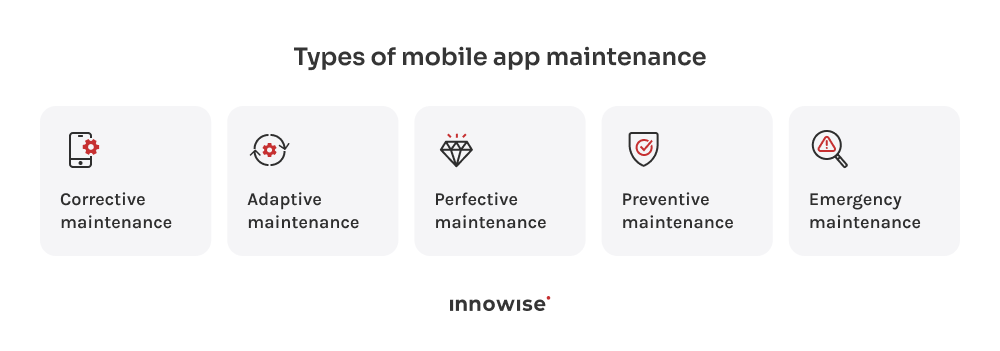
At Innowise, we divide app maintenance into 5 categories.

An image showcasing the key types of mobile app maintenance in the article mobile app maintenance costs.

Preventive maintenance

We take a proactive approach to stop the codebase from collapsing under its own weight, because code has a nasty habit of “rotting” if you turn your back on it. When outdated libraries pile up, and architecture gets overgrown with quick fixes and workarounds, we perform extensive refactoring to clean up spaghetti code, optimize complex SQL queries, and update the Swagger docs.

Should you ignore this stage, the system will eventually ossify, and technical debt will strangle development so badly that shipping even a simple feature will cost x3 because the codebase is a mess.

Corrective maintenance

Since every piece of software ever created has some bugs in its code, we consider our work here to be a classic “search and destroy” mission. Whether it’s logic failures, crashes on specific devices, or layouts breaking on new screens, all this nasty stuff inevitably surfaces right in prod. Our job is to monitor crash reports in Sentry or Firebase, spot the issue the second it occurs, and roll out a hotfix before those 1-star reviews start tanking your store rating.

Adaptive maintenance

This is where we dodge all those external irritants you have zero control over, like when Apple drops iOS 18, and we have to ensure push notifications or background location tracking didn’t just die. The same goes for whenever Google raises the Target API level, or Stripe changes their auth protocol. We have to update the SDKs and rewrite the backend integrations immediately just to keep the app from getting kicked out of the Play Store search results.

Emergency maintenance

We call this the “everything is down” mode, where every minute of a 500 error or a DDoS attack burns a hole in your wallet, especially if you’re running fintech or e-commerce. In these critical moments, our DevOps engineers and back-enders wake up at 3 AM from a PagerDuty scream to restart instances and patch security holes. There is absolutely no time for code beauty here because the only goal is to bring prod back to life at any cost.

Perfective maintenance

Now we’re talking about refining the product based on actual user feedback, whether it’s simplifying a registration flow that users find too annoying or finally shipping that dark mode everyone is asking for. While these may not be new or large-scale features, they are certainly very important UX/UI configurations to keep your application retention high.

Mobile app maintenance cost breakdown & benchmarks

Let’s translate all this engineering stuff into the language of money, because at the end of the day, you just want to know one thing: “How much does it cost to maintain an app?” 

To assist you, I have compiled a summary table based on our internal benchmarks to show the real cost structure broken down by business type.

Just a quick heads-up, though: the final costs for your app may vary significantly from the numbers provided here, depending on its functionality, the types of third-party integrations used, and strict compliance rules in highly regulated sectors like banking or healthcare.

Cost driverShare of budgetSMBMid-sizeEnterprise
Hosting & cloud10–20%$70 – $300 / mo$300 – $2,000 / mo$2,000 – $15,000+ / mo
Monitoring tools1–5%$0 – $50 / mo$100 – $500 / mo$1,000+ / mo
Feature backlog & updates40–60%$1k – $3k / mo$5k – $15k / mo$20k+ / mo
Bug fixing & QA15–20%$500 – $1k / mo$2k – $5k / mo$10k+ / mo
Rates & team locationMultiplierCEE: $40–80 / hUS/UK: $100–180 / hMultiplier: ~2.5x
Total cost (CEE team)Annual$19k – $52k / yr$89k – $270k / yr$396k – $924k / yr
Total cost (US team)Annual$46k – $112k / yr$215k – $570k / yr$936k – $1.8M+ / yr

Take a close look at how team location drastically changes the final check.

Now let’s break down each point in detail so you understand the nature of these costs.

Hosting

Even though the app lives on the phone, its brains are sitting in the cloud, so you are essentially paying rent to providers like AWS, Azure, or Google Cloud for computing power, traffic, and data storage. The math is pretty simple here: if you grow your daily active users (DAUs) and monthly active users (MAUs), there will be an increase in the load on your servers, resulting in significantly higher monthly invoices. 

At the startup level, this costs only cents on average per month, but without fully optimizing your app for cloud resources, the expenses will grow exponentially.

Monitoring

To resolve issues, you must first identify them. In order to achieve this goal, we employ paid observability tools like Datadog or New Relic to keep an eye on system health. These SaaS subscriptions allow us to see errors in real time and collect logs. This is an important investment that saves hundreds of developer hours on debugging, as we don’t have to hunt for issues blindly.

Feature backlog

A feature backlog should be accounted for as a main expense category of your project because businesses never stand still, and you’re always going to need new stuff like payment methods or gamification. 

The price here rides on the complexity of the feature and your tech team’s rates. I mean, one task could be a quick two-hour job while another requires migrating database schemas and rewriting complex business logic. The last one might burn weeks of the entire squad’s time just to put in a new working feature.

Bug fixing

There is a golden rule here that says the earlier a bug is found, the cheaper it is to fix. Catching it on stage costs $10, but letting it slip to prod, where users find it, might cost $1000 in reputation and urgent hotfixes. 

Keep in mind that $1,000 is considered a low estimate for the corporate market because the potential sales volume is enormous. When a company’s transaction is experiencing downtime or there are customers leaving the company, the total damage will be in tens of thousands of dollars.

Your budget for this depends entirely on code quality, because if the project is overgrown with technical debt, the team is going to spend 80% of their time just putting out fires instead of developing.

Updates (OS, devices & libraries)

We consider updates to be a platform tax since Apple & Google launch new OS versions annually, which often break backward compatibility from previous versions. Android fragmentation has created a significant headache for developers, simply because guaranteeing stable ops on 50 low-budget smartphones costs way more in QA labor and layout adaptation than supporting a few flagships.

Rates & team location

This is one of the biggest levers at your disposal for managing a budget, yet people often ignore the fact that a senior iOS dev in the US costs $150–200/hour while an equivalent skill set in Eastern Europe (CEE) is just $50–80. The annual budget savings can be colossal, so by outsourcing your maintenance team to CEE, you’ll be able to reduce your OPEX by 2-3x and still maintain an excellent engineering culture.

Key drivers that inflate maintenance spend

What makes application maintenance a fairly moderate expense for some organizations, while others seem to be draining millions into nowhere? Most of the time, the underlying reason isn’t development costs but the number of technical errors created within the app over time.

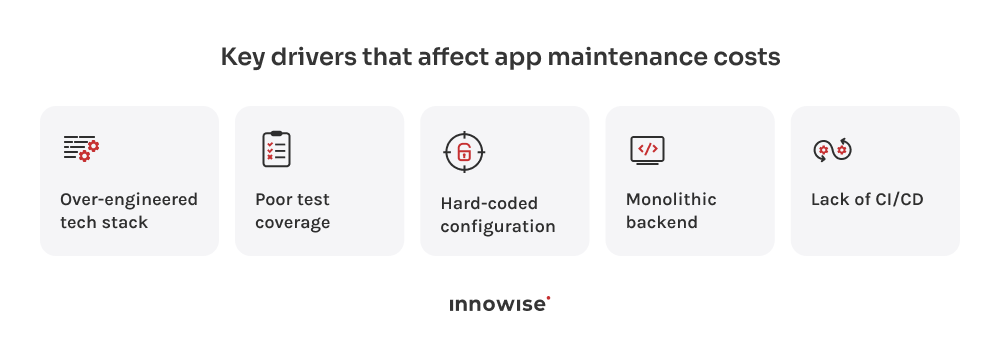
To address this issue, let’s highlight some of the major budgetary black holes associated with app maintenance costs and explain how Innowise avoids them.

An image highlighting the key drivers that affect app maintenance costs.

Over-engineered tech stack

I often see tech leads chasing hype instead of business value, shoving Kubernetes where a simple VPS would do, or picking some rare frameworks that just popped up on GitHub yesterday. Finding specialists for this type of zoo is next to impossible and often extremely expensive. 

How we do it: At Innowise, our choice of technology is always based on the client’s needs. And we opt for only proven, established tech stacks because they are very easy to find qualified developers to hire for and guaranteed to be supported a few years down the line.

Poor test coverage

Without automated testing in place, every release turns into a game of Russian roulette since every screen must be manually clicked to verify that nothing is broken. In 2026, manual regression testing is long, expensive, and basically impossible due to massive Android device fragmentation and various iOS screen configurations, like notches and dynamic islands. 

Because the quality assurance team simply does not have every single device sitting on their desk, chances are you’re going to have bugs flying straight to prod because manual checks can’t spot all issues.

How we do it: We implement a test pyramid coverage right from day one, with unit tests for business logic and UI tests running on a cloud device farm like AWS or Firebase to mimic user behavior. It allows us to ship releases faster without fear of breaking existing functionality.

Hard-coded configuration

If you are unable to edit text on a banner or change an API URL without having to call a programmer to dive into the code, that is a total architectural failure. You are likely wasting costly development hours to perform tasks that should be automated. 

Worse, waiting around for the app store review team to approve an emergency bug fix creates a temporary blackout period that costs the business significant sums while your app is broken.

Plus, a lack of feature flags means you can’t run canary releases on 5-10% of your users or instantly disable a failed feature without rolling out a completely new patch.

How we do it: We move everything that might change to remote config via Firebase or a custom admin panel, so a marketer can tweak promotion text or enable a feature for a user segment in a second without ever bothering the dev team.

Monolithic backend

When you have everything in one backend container, a simple error in the comments module can take down your payment processing. Scaling a monolith is also a pain because you have to pump up the power of the entire server just for the sake of one function. 

How we do it: Whenever appropriate, we take advantage of both modular monolithic and microservices architectures to isolate failure points and scale only the parts of the system that are actually under load.

Lack of CI/CD

The manual process of assembling and deploying software is an archaism that steals hours of precious time, and honestly, if a developer is building on their laptop and uploading via FTP, you should expect trouble.

For mobile apps, this manual mess usually triggers the dreaded code sign issue with certificates, where the signing process periodically breaks and just eats up development time.

How we do it: We set up CI/CD pipelines using GitLab CI or GitHub Actions immediately, ensuring any push to the repository automatically runs tests, generates the build, and sends it to TestFlight.

Optimizing mobile app maintenance budgets

We analyzed how money gets drained, so my next step is to share what we do at Innowise to help our clients successfully forecast & optimize expenses with our smart maintenance approach.

Implement automated monitoring & crash analytics

Why: To find out about a crash before users bury you with angry 1-star reviews in the store, because fast reaction is the only way to preserve user lifetime value. 

How we do it: Instead of just slapping on Sentry, we set up custom alerting rules: if the crash-free user rate goes below 99.8%, our on-duty developer receives a notification with the exact stack trace of the crash/event. This saves us dozens of hours spent diagnosing the issue, because rather than having to search for a needle in a haystack, the system literally points its finger at the bug.

Adopt modular architecture

Why: To ensure that a change in one area of your application does not cause problems for another part, and so functionality can be updated without rewriting the whole thing.

How we do it: We follow clean architecture principles to split the app into independent modules, meaning if we need to update the chat functionality, we modify only the chat code and leave the payment gateway untouched. This dramatically lowers the chances of regression bugs and makes shipping new features way cheaper.

Schedule quarterly technical debt sprints

Why: So the code doesn’t turn into unmanageable spaghetti, and the team’s velocity doesn’t drop over time.

How we do it: Everyone has tech debt, that’s normal, but there comes a time when you must address it, so we agree on the Boy Scout Rule and run a dedicated sprint once a quarter to perform refactoring and library updates. This is an investment that will pay back many times over in the future.

Negotiate cloud commitments

Why: For direct savings on infrastructure, and the reason is that most cloud usage is billed on a pay-as-you-go basis. This is the equivalent of throwing away your cash. 

How we do it: We conduct an audit of your cloud setup and implement FinOps practices. For predictable workloads, we secure reserved instances or savings plans from AWS or Azure to get that 70% discount. For background tasks, we switch to Spot instances, which cost pennies, and set up auto-scaling to help you avoid paying for unnecessary resources during off-traffic hours when resources aren’t needed.

Why enterprises choose Innowise for mobile app maintenance

Theory is great on paper, but out in the wild, things get messy fast. At Innowise, we’ve been in the game for over 19 years, and we know how to handle someone else’s legacy spaghetti code that other vendors ran away from. 

We build mature CI/CD pipelines and optimize costs so that your maintenance budget actually pays for itself. We are the technology partner that genuinely takes responsibility for your SLA and uptime, because downtime is not an option.

If you are sick of your product being a constant liability that demands endless budget injections and loses users due to bugs, stop the bleeding and flip the script. 

Please don’t hesitate to contact us for our hands-on mobile app maintenance services, and we’ll audit your setup, find where the cash is leaking, and tune your product to run like a Swiss watch, bringing in profit instead of a migraine.

FAQ

The primary cause is accumulated technical debt that overcomplicates the existing codebase. Developers typically spend more time than expected making minor updates to a poorly structured system design, which results in higher total costs for your development project.

Companies can take advantage of their budget by outsourcing application maintenance to a region with lower hourly rates and by leveraging automated testing. It reduces their overall QA manual testing effort while maintaining high technical standards.

No, bug fixing is only a component of the ongoing maintenance. Adapting the app to new versions of iOS or Android, updating third-party libraries, and maintaining security compliance are all examples of ongoing maintenance.

The most prevalent factor is new features added or improvements made within an app. The more extensively a company expands the capabilities of its application, the larger its annual maintenance budget will be.

Failure to maintain and update an app will ultimately lead to performance degradation, crashing of the app on a regular basis, and compromised data security. As a result of technical stagnation, there is a rapid decline in active users and damage to the brand's reputation.

The cost of cloud services increases proportionately with the number of users on your application and the volume of backend activity in your application. If both server-side code and data access are not regularly optimized by the maintenance team, then increased usage or volume will typically result in excessive amounts of invoices from the cloud service provider.

This is an extremely risky strategy for a company to take, as it will ultimately result in greater total expenses rather than saving money. Releasing code that has not been properly tested can result in severe failures in production and often requires emergency hot-fixes that are far more expensive and resource-intensive to resolve.

On the contrary, maintenance expenses will usually increase after the app has been launched. Operating in a real-world environment requires active server monitoring, scaling infrastructure for new users, and continually developing new versions of the app based on actual user feedback.

Head of Mobile Development

Pavel drives the delivery of high-performance mobile apps across iOS and Android. With a background in native engineering, he ensures that cross-platform and native products scale smoothly and provide a flawless user experience.

Table of contents

    Contact us

    Book a call or fill out the form below and we’ll get back to you once we’ve processed your request.

    Send us a voice message
    Attach documents
    Upload file

    You can attach 1 file up to 2MB. Valid file formats: pdf, jpg, jpeg, png.

    By clicking Send, you consent to Innowise processing your personal data per our Privacy Policy to provide you with relevant information. By submitting your phone number, you agree that we may contact you via voice calls, SMS, and messaging apps. Calling, message, and data rates may apply.

    You can also send us your request
    to contact@innowise.com
    What happens next?
    1

    Once we’ve received and processed your request, we’ll get back to you to detail your project needs and sign an NDA to ensure confidentiality.

    2

    After examining your wants, needs, and expectations, our team will devise a project proposal with the scope of work, team size, time, and cost estimates.

    3

    We’ll arrange a meeting with you to discuss the offer and nail down the details.

    4

    Finally, we’ll sign a contract and start working on your project right away.

    More services we cover

    Business insights
    3D product modeling 3D product rendering Adtech Agriculture software AI chatbot Apple TV apps AR apps ATS software Automation testing BI BigCommerce Biotech Business process automation Clinical intelligence Clinical trials software Cloud Migration Consulting Services CMS CRM Custom LMS software development services Desk booking apps Drupal E-commerce E-commerce apps E-commerce apps QA E-commerce consulting E-commerce migration E-commerce web design EHR & EMR EHR integration EHS solutions Embedded finance Enterprise blockchain Enterprise software ESG consulting Finance apps QA Finance software Fintech consulting Fitness apps Government apps GRC Headless CMS Healthcare Healthcare AI Healthcare analytics Healthcare data migration Healthcare IT consulting Healthcare mobile apps Healthcare software Hire healthcare app developers Imprint Insurance Investment apps Legacy apps upgrade Life-cycle assessment LMS Magento Magento PWA Manufacturing Medtech Microsoft 365 Microsoft Dynamics 365 NopCommerce Odoo consulting Odoo development Odoo implementation Odoo migration Oil & gas software Online marketplaces OpenCart Patient engagement Payment gateway API Payment hub Pharma Pharma AI PIM implementation Pimcore Population health management PoS software Practice management PWA development Quality management RCM software Retail Retail data analytics Robotics Salesforce CRM SaMD & SiMD SharePoint SharePoint Intranet Shopify Shopify developers Shopify integration Shopify migration Shopware Sitecore Supply chain management Sustainability consulting Telemedicine Travel apps Travel portals Value-based care apps Video-on-demand VR/AR in healthcare Wellness apps White-label HRM White-label LMS WooCommerce Wordpress
    See more
    Expert tips
    .NET MAUI 3D design 3D medical animation 3D product modeling 3D product rendering Agriculture software AIOps Android apps Android TV apps Angular Apple TV apps Architecture consulting Automation testing Automotive software AWS AWS cloud consulting B2B web portal Backend development BI consulting Biometric payments BNPL apps Business process automation C++ Cloud consulting Cloud development Cloud engineers Cloud migration Cobol Codeigniter Construction software CRM consulting CRM development CRM implementation Cross-platform apps Cryptocurrency exchange Cryptocurrency wallet Custom software Custom software development Custom software development services Database consulting DevOps DevSecOps Digital transformation consulting Dynamics 365 integration E-commerce apps E-commerce apps QA E-commerce migration Elearning Embedded software Energy & utilities ERP ERP consulting ERP development ERP implementation ERP integration ERP migration ERP testing ESG ETL migration Fintech development Flutter Front-end development Game development GCP Golang Healthcare data migration Healthcare mobile apps Hybrid apps Hyperledger iBeacon apps iGaming Insurance InterSystems IRIS Ionic iOS apps IT consulting IT outsourcing services company IT support Java Kotlin KseF integration Kubernetes Logistics Machine learning Magento Manufacturing Marketing MEAN stack Mendix MERN Stack Microsoft Power Apps Microsoft Power Platform Mobile app design Mobile app QA Mobile app upgrade Mobile apps Mobile banking Motion design MVP development Nearshore development Node.js Odoo consulting Odoo developers Odoo development Odoo implementation Odoo integration Odoo migration Odoo services Odoo support Pentesting PHP PIM implementation PoS software PWA development QA engineers React React Native React Native developers Responsive web design Roku RPA RPA developers Ruby on Rails SaaS development SAP SAP consulting SAP developers SAP implementation SAP integration Security testing ServiceNow ShareGate SharePoint migration Shopify integration Shopify migration Snowflake Social media Software development outsourcing Software development technologies Solidity Startup web design Super apps Swift Symfony Telecom Telegram mini apps Testing Top rated software development Top rated software development Transportation Travel portals UiPath developers Unity Unreal Engine Vue 2 to Vue 3 migration services Wearable apps Web development Web development consulting Web penetration testing Web portals WebRTC Xamarin Xamarin to .NET MAUI
    See more

    arrow