The form has been successfully submitted.
Please find further information in your mailbox.


The client’s aviation software solutions required improvements, especially the system for supply purchases. The company suffered losses due to inefficient food supply chains, warehouse stock deterioration, and delivery delays. Therefore, the food provision and distribution process needed to change. Acknowledging this problem, the company approached a software provider, which developed the solution from scratch. However, three years later, the service became outdated and cumbersome, containing errors and vulnerabilities. The customer decided to reach out to Innowise to eliminate aviation software development issues and improve existing features.
Though our team did not face the necessity to build the solution from scratch, Innowise had the challenging task of optimizing and refactoring existing features and smoothly integrating them into the customer's ecosystem. BA evaluated business requirements and tech documentation to deeply understand how to satisfy the demand for accurate supply chain calculations. We updated the software deployed three years ago that currently corresponds to modern realities and allows integration with third-party services.
Supply Chain Service (SCS)
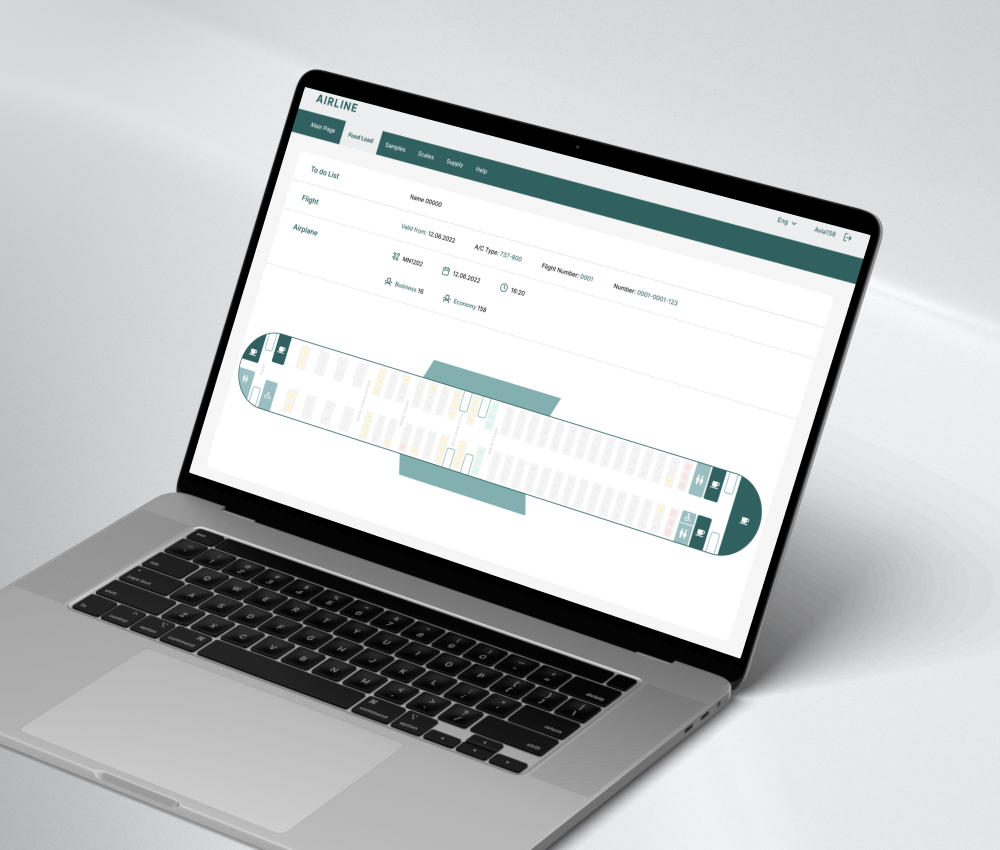
The main functionality of SCS is to visualize the aircraft cabin of a flight, kitchen (galleys, trolleys), racks, refrigerators, galley stoves, carts, and other supplementary surroundings to calculate the average food load. Then this data accumulates to make forecasts for other flights if the conditions are similar (the same plane models, number of registered passengers, etc.).Food On Board Platform (FOBP)
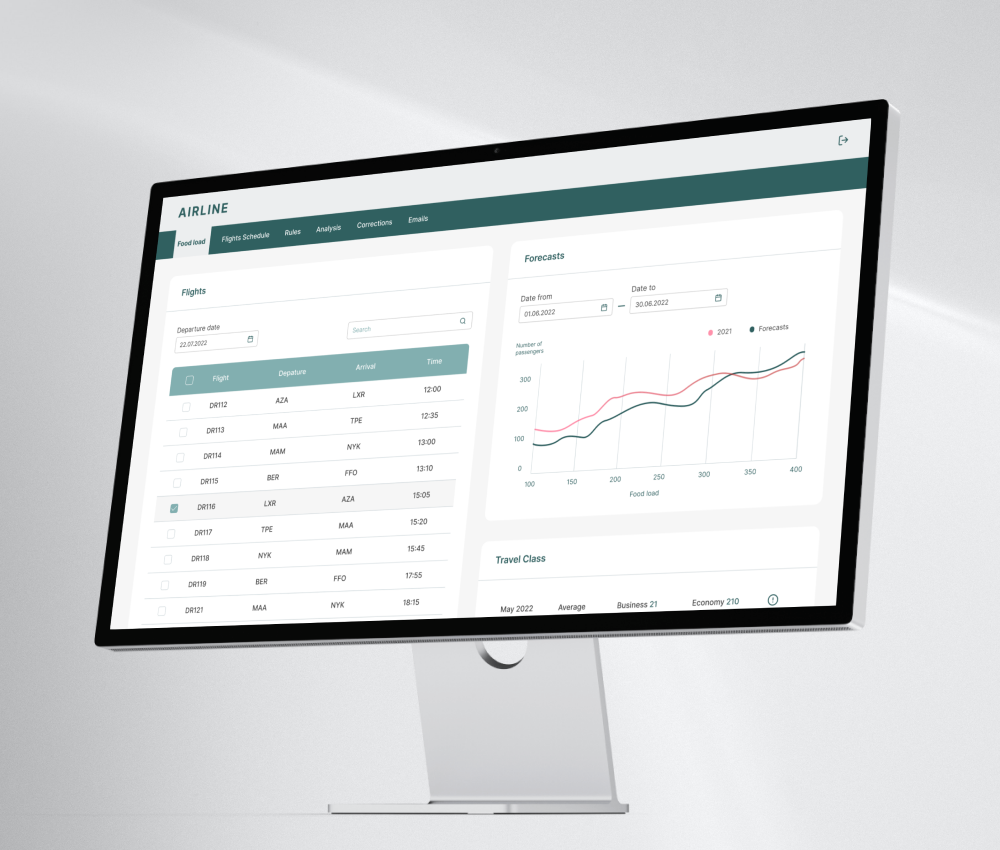
FOBP gathers information from third-party services about scheduled flights and predicts the plane’s load with food considering individual menus for certain passengers, cabin class, and other parameters of a particular flight. Subsequently, the forecasts are reported to the catering companies or flight station managers.
To introduce the basic flow, let’s consider the example. Firstly, FOBP scans the information in open sources about planned flights (websites of the airlines, etc.). Then the service receives a message (via a message broker) with information that, suppose, in 17 days, flight number ML4416 will fly from London to New York, and there are N economy class and M business class passengers. This message passes through the chain of service handlers that implement various forecast correction strategies. Finally, the forecast is stored in the system and transmitted to the catering company. It is worth mentioning that platform allows developing strategies for adjusting the forecast and viewing the history, status, and forecasting effectiveness.

Our vetted software engineers updated the customer’s software, fixed crucial bugs, and conducted system optimization and refactoring. They finalized and enhanced two major aviation supply chain solutions – Supply Chain Service (SCS) and Food On Board Platform (FOBP).
The implementation of these features facilitated the process of creating sustainable purchase chains. From now on, the process is automated with the ability to make alterations and make supply chain predictions using forecast templates. Now, flight station managers receive accurate information about the food load on a particular plane thanks to the visualization of the aircraft kitchen environment (SCS) and predictions about the plane’s load with passengers (FOBP). At the same time, catering companies build stable supply chains with no food surpluses or shortages, warehouse stock waste, and delivery delays.
Your message has been sent.
We’ll process your request and contact you back as soon as possible.

By signing up you agree to our Privacy Policy, including the use of cookies and transfer of your personal information.