It uses alternative data signals to assess near-term ability to repay, consisting of rent, phone bills & cash flow patterns.
Su mensaje ha sido enviado.
Procesaremos su solicitud y nos pondremos en contacto con usted lo antes posible.
El formulario se ha enviado correctamente.
Encontrará más información en su buzón.

Seleccionar idioma


It’s no surprise that banks reject loan applications every day. Sometimes, with good reason, and other times… not so much.
A typical example of “great on paper,” but doesn’t meet the criteria, is the gig economy. A place chock full of hard-working, well-compensated individuals who tick virtually all the boxes — their rent is paid on time, no crazy debts. Except they’re missing one crucial piece of documentation, a W-2.
Application = Denied.
The same can be said of newly arrived immigrants who are working, doing all the right things on the surface, but at the time of application have no bureau record. Same outcome.
For context, we can look to the numbers provided by the Consumer Financial Protection Bureau (CFPB). In 2020, about 2.7% of U.S. adults had NO credit record. That translates as 7 million people are invisible to bureaus.
Why? It’s all about a thin credit file. Legacy scoring systems look at five things: payment history, how much you owe, credit history length, new credit, and loan portfolio. That’s it.
The algorithm is looking for history and finds a blank space. Therefore, potential applicants leave. Very likely, they will move to another lender with better technology.
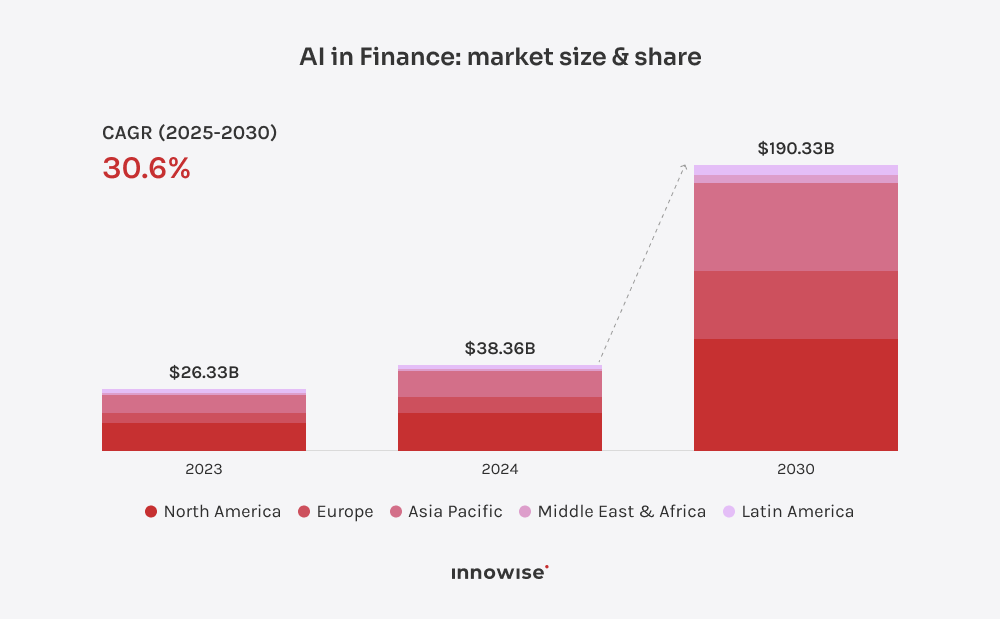
AI credit scoring helps FinTech reach unbanked customers and analyze data faster. Since lenders want quicker decisions with fewer losses, an AI-fueled credit scoring system provides this opportunity. The numbers tell the story best — AI in the financial market is forecast to grow from $38.36 billion in 2024 to over $190 billion para 2030.

Let’s now look at how artificial intelligence credit scoring works and which benefits it brings.
AI credit scoring is a method that uses artificial intelligence and machine learning to determine the likelihood of a borrower repaying a loan. It does this by sifting through large datasets to find signals that can’t be caught through manual review or are missed by humans.
The concept itself is straightforward: you train a model on past repayment outcomes and assess risk using a broader range of indicators than a traditional credit score.
Here’s how it works.
A machine learning model examines the borrower’s data, determines how closely it matches patterns from historic loans, calculates a risk value, and gives you an AI credit score.
And here’s a look at how raw data becomes a usable number:
The foundation of traditional models is that they operate on linear logic. Event A always follows event B. Regulators appreciate this predictability because it’s easy to explain. However, fundamental limitations make it impossible to make significant improvements. And models like FICO can’t learn or adjust when unforeseen events occur.
Traditional scoring assesses everyone identically: a missed payment lowers the score, a thin history is penalized, and job loss or hospitalization makes no difference.
AI credit models work on a completely different principle. They can see the difference between a missed payment during a documented medical emergency and a borrower who regularly pays late. They can notice that a recent immigrant with a master’s degree and a stable job at a Fortune 500 company might be safer than their limited credit history suggests.
Note: this logic should use only allowed data sources and borrower-submitted hardship proof.
Although the score may seem mysterious, an AI loan system emerges from a precise sequence of steps based on big data and machine learning.
Here’s how it actually works.
To either deny or approve the credit, a system automatically collects and organizes enormous volumes of structured data (i.e., spreadsheets, databases, etc.) and extracts unstructured data (text files, PDF, images, etc.) from various sources.
Key categories include:
To train a predictive model, data scientists analyze historical repayment data from over 1 million loans, identifying characteristics of borrowers who repaid versus those who defaulted.
Here’s how data scientists train a model:
After training, lenders deploy a validated model as a cloud-based REST API to integrate it into loan ecosystems.
Here’s what happens in the live environment:
Deployment does not mark an endpoint. The model trained based on spending in 2024 may not perform as well in 2026 if economic conditions change, so professionals employ monitoring, drift detection, and scheduled retraining.
In situations where a borrower has been evaluated as having a low risk of default and then defaults, an AI-powered monitoring system will alert human experts for additional manual checks. Data scientists will also investigate mistakes and retrain the model using real-time data. This loop keeps the system sharp and well-adapted to new fraud schemes and changing consumer behavior.
Key practices in continuous learning include:
When viewed in totality, and when we consider the inner workings of financial institutions, it’s easy to see the immense value of AI-based scoring machines.
Now, let’s move on to discussing a few prominent AI credit scoring benefits.
AI credit platforms help lenders authorize more customers while minimizing losses and disputes and reducing manual work.
Below are the main ways AI changes credit scoring.
Accuracy is the holy grail of lending and is the only thing that really matters here. Poor accuracy brings mistakes that cost money: approving a bad loan results in a write-off, while rejecting a good borrower costs revenue and hands them to a competitor.
AI credit scoring models leverage additional data and pattern-detection algorithms to make more accurate predictions of defaults and delinquencies. For lenders, this means fewer nasty surprises in their loan portfolios. A McKinsey analysis found a 20–40% reduction in credit losses among companies that used better default-estimation models.
What this means in practice:
The model accurately forecasts loan repayments, which reduces default rates. It detects anomalous repayment patterns and triggers a fraud review. With better risk prediction and control, lenders can offer loans with appropriate interest rates to maximize their revenue.
Underwriting was slow and repetitive: teams had to look for documents, calculate debt-to-income ratios on a calculator, and pull reports one by one. In fact, many people still do it the old-fashioned way.
En AI credit scoring engine automatically processes documents, calculates DTI, and retrieves credit reports within minutes, if not seconds. Suddenly, a decision that used to take three days happens almost immediately. Borrowers get an instant answer, and the loan is processed before they can even look at a competitor’s website.
Utilizando AI for credit scoring allows lenders to serve customer segments that traditional models consider too risky or difficult to underwrite. They mark them as “too risky” simply because they don’t fit the standard template.
Underbanked borrowers, such as young people or those with spotty financial histories, are basically not eligible under traditional scoring. AI models that include alternative data improve small-business and consumer loan approvals because they spot value where traditional scoring sees risk.
Moreover, AI algorithms may employ grouping methods when creating granular risk sections. Rather than putting thousands of clients into a single “moderate” category, an AI grouping process will break those people down into smaller groups, each with its own specific risk estimate.
This allows low-risk customers to avoid negative consequences simply because they share the same demographic/credit score band as higher-risk clients.
Beyond the credit decision itself, artificial intelligence credit scoring optimizes every phase of the lending process.
Digital credit scoring platforms verify income and identity through database checks and document scanning. For example, some AI services use computer vision to read pay stubs or tax forms and confirm employment income in seconds.
In traditional setups, an application is a hot potato. It moves from front-office operations to credit analysis and then to risk assessment. Lenders can shorten approval times and reduce manual review with AI scoring for verification and decisioning. McKinsey described this type of end-to-end setup as a way to improve customer experience and reduce back-office costs.
Plus, standardizing procedures reduces training time, creates transparent logs for oversight, and gives customers a consistent experience.
A decade ago, building AI systems required substantial upfront costs (data scientists, GPUs, data pipelines). That barrier has dramatically reduced.
AI credit scoring technology is now becoming accessible to lenders of all sizes. Today, cheaper cloud computing and open-source libraries make it easier for lenders to hire or train machine-learning staff.
Various FinTech firms, like Zest AI, Lenddo, and Upstart, offer AI-powered credit scoring provided as SDKs that lenders can integrate. With the rise of cloud computing, even smaller lenders can access AI infrastructure on cloud platforms such as AWS or Google Cloud.
McKinsey found that AI and machine learning solutions cut paper steps and reduce document requests, which lowers support costs and speeds approvals.
On the technical side, costs drop for a simple reason: the system retrieves and validates data once, then enforces consistent rules. Reducing one-off exceptions significantly reduces staff review hours, not to mention that it also cuts paperwork and boosts approval.
The CFPB reported a lender test in which the model approved 27% more applicants and reduced average APRs for approved loans by 16%, while keeping overall risk and fair-lending compliance unchanged.
Financial institutions use several types of AI models to predict borrower risk. Selecting the right AI credit scoring depends on the specific needs of the lending institution and the data at hand.
Here’s how to approach the decision:
Different situations require different optimal models. The right choice depends on how you balance accuracy with system complexity and the resources you have available.
Creating your own custom risk model gives you complete ownership of your risks and allows you to differentiate your business from competitors who use a one-size-fits-all scorecard. To do this, you must break your project down into different phases, assigning owners and milestones to each phase, so you can measure where you are in the process.
Let’s look at these stages in more detail.
The first step is to construct your reservoir. Gather your internal performance information about loans, as well as credit reports and alternative datasets. Create a minimal security ETL (extract, transform, load) pipeline to pull those datasets into a common repository. The ideal storage scenario is the cloud, as it offers the greatest flexibility for growth.
Raw transaction lists contain hundreds of entries that don’t really tell you anything on their own, so you must first convert them to a feature form that can be processed by a model.
If you calculate the “average balance over the last 90 days,” that single metric becomes a feature that helps the model determine your financial stability. It takes a good understanding of banking operations to know which features are relevant, though.
Pick one algorithm, such as Random Forest or XGBoost, and split the entire dataset between the training and test sets. Train the selected algorithm on the training set and also tune the learning_rate and n_estimators hyperparameters. Evaluate the model’s performance in the test dataset by calculating the AUC score. When the AUC is 0.8 or higher or continues to improve, stop tuning.
Validation identifies bias through stress tests that monitor performance during economic downturns. This step is critical for compliance with regulators who demand to know how your system makes decisions.
In the final stage of AI model development, the model is transferred from testing/experimenting in the lab to actual usage. Your AI development partner wraps the model in an API and integrates it into your loan origination system. When a customer clicks “Apply”, the system generates an instant credit score so that underwriters can approve loan applications within minutes instead of days or longer.
Now you establish dashboards to monitor the daily default rate, approval rate, and AUC of your model. In addition, if the default rate increases by more than two percentage points or if the approval rate decreases sharply, you need to conduct a data drift examination and set up an updated calibration for your model.
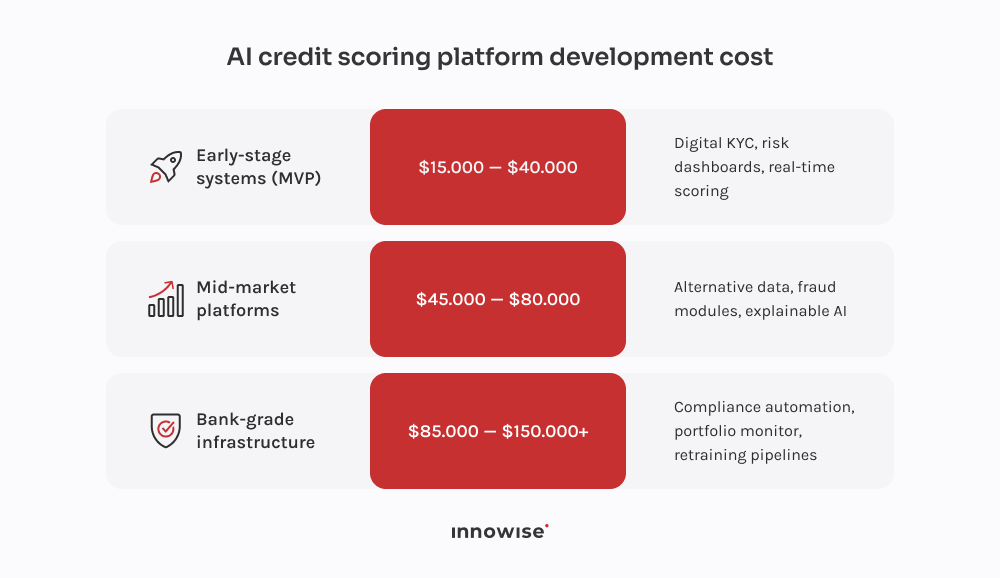
Building a smart credit scoring platform requires a minimum investment of $15,000, while enterprise builds will reach $150k or above, depending on specific compliance needs and feature requirements.

There are three key categories based on scale and functionality.
It includes only essential features like digital identity verification, basic risk dashboards, and automated real-time credit decisions. MVPs designed for market testing typically cost between $15,000 and $40,000.
This tier is ideal for startups targeting thin-file consumers or FinTech companies testing market fit. It’s the best option to begin with: only essential functionality without unnecessary features.
These solutions add alternative data, fraud detection, and predictive analytics, helping lenders expand credit access for thin-file borrowers while maintaining strict risk controls. Explainable AI provides decision reasoning that shows how a model reached its conclusion, not just the outcome.
The costs can vary from $45,000 to $80,000.
Enterprise deployments for high-volume processing range from $85,000 to $150,000 and above. This investment provides lenders with automated compliance workflows for audit-ready reporting, alongside deep-learning models that retrain monthly, and dashboards that track thousands of loans in real time.
We believe that the best approach is a hybrid one. You leverage AI to power decisions while keeping humans “in the loop” for oversight. This way, you balance automated speed and insight with prudent judgment of veteran underwriters.
Making the switch feels heavy. We get it.
You literally change the way you manage your risks. But you can begin with a small step. The best implementations we have seen start small, often running a “shadow model” alongside the legacy system until the team trusts a new system.
At Innowise, we have navigated this path with banks and FinTech before. We know where data pitfalls are and what challenging questions regulators ask. With 19+ years of practical experience, our Desarrolladores AI have implemented dozens of FinTech projects.
If you are ready to update your credit scoring engine, our Ingenieros de IA can develop a tailored credit scoring solution that meets your product and risk profile.
Please don’t hesitate to contacto cuando lo consideres oportuno.
It uses alternative data signals to assess near-term ability to repay, consisting of rent, phone bills & cash flow patterns.
Models that use historical data may reflect bias found within the training data. Therefore, lenders must frequently test their models for fairness and correct any disparities that arise as a result of the model's predictions.
For lenders who use AI credit algorithms, regulators insist that they demonstrate fair lending decision-making, do not discriminate, and keep records of inputs related to lending outcomes.
Teams test all models on a holdout dataset, none of the models were trained upon, and compare predictions against actual outcomes for new borrowers.
First, lenders should run a model next to their traditional credit scoring process. Next, lenders should use a human review process for high-risk accounts and expand when stable.
A typical low-end custom credit scoring system will generally cost a minimum of ~ $15,000, whereas large-scale systems can exceed $150,000 or more.
Improved credit risk models allow lenders to score borrowers using additional data, which is beneficial for gig workers or immigrants who are rejected by traditional credit models.
Lenders leverage public cloud storage and compute services on AWS or Google Cloud because they scale and do not require an initial investment in on-premise hardware.

Director de Entrega y Jefe del Centro de Competencia
Siarhei lidera nuestra dirección de FinTech con un profundo conocimiento del sector y una visión clara de hacia dónde se dirigen las finanzas digitales. Ayuda a los clientes a navegar por complejas normativas y opciones técnicas, dando forma a soluciones que no solo son seguras, sino que están pensadas para el crecimiento.


Su mensaje ha sido enviado.
Procesaremos su solicitud y nos pondremos en contacto con usted lo antes posible.

Al registrarse, acepta nuestra Política de privacidadincluyendo el uso de cookies y la transferencia de su información personal.