AI development costs in 2026 explained: Pricing, factors, and ROI

Imagen del héroe

Principales conclusiones

  • AI development cost in 2026 primarily depends on scope, data quality, model complexity, and integration depth.
  • Small features are affordable; custom LLM systems and enterprise platforms are priced higher.
  • The biggest overruns come from unclear goals, messy data, and late-stage integration anomalies.
  • Costs are significantly reduced when using pre-trained models, early integrations are limited, and production is factored in early.
  • The right partner keeps the project focused, predictable, and tied to agreed business outcomes, not experiments.

I’m 100% sure I know the question companies care about most isn’t “what model should we use?” It’s “how much will this thing cost, and will it pay off?"

And if you’ve asked that question too, good. That means you’re thinking like someone who has already seen a few tech waves come and go. Maybe even paid for a project that took too long, burned too much money, and shipped too little.

En 2026, AI isn’t mysterious anymore. It’s just… expensive when done wrong. And surprisingly reasonable when done right.

So let’s walk through what an AI development cost really looks like today. With concrete ranges, practical trade-offs, and the kind of context you wish someone had given you before you opened your budget spreadsheet.

What influences the cost of AI development in 2026?

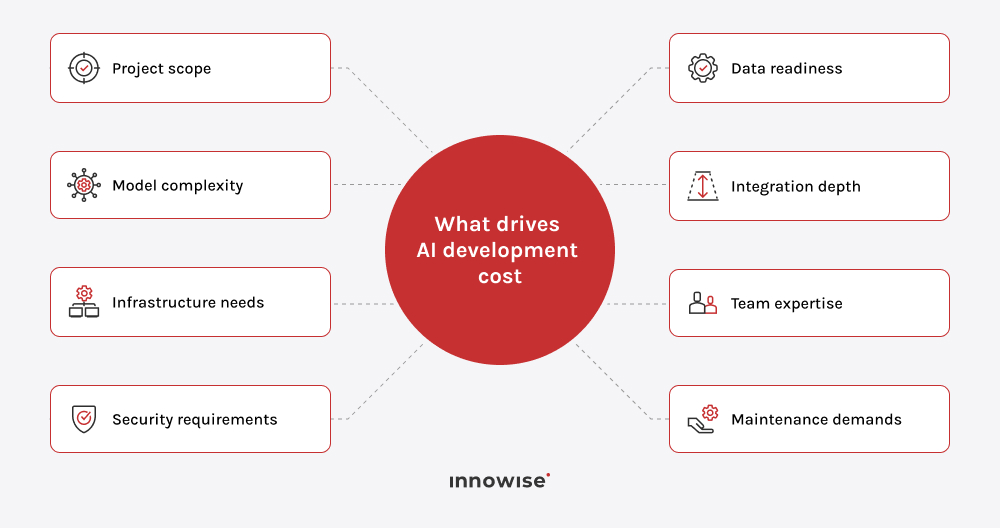
En AI development cost in 2026 doesn’t behave like a fixed menu. It moves with your business goal, your data, the type of model you choose, the tools in your stack, and the people you trust to build the thing.

If you’ve ever priced an AI project and wondered why two vendors gave estimates that were miles apart, the answer usually lives in these factors (not in the hourly rate only).

Let’s unpack them one by one, without turning this into a lecture.

The main factors that influence AI development cost in 2026, including scope, data readiness, model complexity, integrations, infrastructure, team expertise, security, and maintenance.

1. Business problem and scope: Vague ideas drain budgets, clear targets save them

Every AI project starts with a question: What problem are we solving? When that question gets a fuzzy answer like, “We want AI somewhere in our product,” the project becomes a moving target. Requirements shift, timelines wobble, and AI development cost estimation becomes a frustrating guessing game. A clear use case changes everything. You need something measurable. Something real. For example:
  • Cut support ticket handling time
  • Shrink invoice processing
  • Flag risky transactions before they hit your dashboard
That level of focus lets the technical team pick the right AI type, plan the workflow, and estimate the scope without hand-waving.And the payoff? Less back-and-forth, fewer rewrites, and a development cost of AI that isn’t inflated by uncertainty.

2. Data: The part everyone forgets until it’s the only thing that matters

Most people think AI development starts with coding. It doesn’t. It starts with your data, whatever form it happens to be in.Sometimes it’s neatly stored in a warehouse. More often, it’s scattered across systems, half-documented, and full of missing fields that no one wants to admit exist.In my experience, data work often consumes 20–40% of the total budget because AI refuses to work with chaos. You either clean the data early or pay for problems later.Some things tend to inflate cost:
  • Data from multiple systems
  • Inconsistent fields or missing values
  • Sensitive records that need masking
  • Large datasets that require labeling
The way out is simple but not always easy: run a real data audit before getting a quote. Once you know the quality and structure of what you’re working with, artificial intelligence cost estimation becomes grounded in reality rather than optimism.Proactive data work speeds up the whole project and reduces maintenance headaches down the road.

3. Model choice: Not every project needs a custom LLM

Here’s something people rarely admit: a big chunk of AI software development cost comes from choosing the wrong level of complexity.There’s a world of difference between using a pre-trained API and training a custom model with your data. One is fast and affordable. The other requires serious engineering, infrastructure, and time.Most use cases fall into three buckets:
  • Light AI features: quick wins using existing cloud models
  • Custom ML or fine-tuned LLMs: for domain-specific behavior or accuracy
  • Large, specialized systems: heavy workflows, real-time needs, complex integrations
Each level pulls different parts of the budget. What matters is choosing the smallest model that genuinely solves the business problem (not the one that sounds good in a board meeting).When companies match model type to actual impact, they avoid paying “research prices” for simple use cases.

Bring us the problem — we’ll handle the messy parts

4. Integration: The quiet budget killer

Everyone loves the model demo. The real test starts when you plug it into your existing systems: CRM, ERP, warehouse, mobile app, or whatever stack your business runs on.This is where many “cheap” AI projects collapse. Because integration wasn’t scoped properly.The real blockers rarely appear on day one:
  • Legacy APIs
  • Strict security rules
  • Multi-environment setups
  • Real-time constraints no one discussed
Integration deserves its own estimate. The teams that treat this as part of the core project, not an afterthought, ship AI that actually reaches production instead of living in a slide deck.

5. Infrastructure and cloud spend: The monthly bill that sneaks up on you

Even when model pricing drops, GPUs, databases, and API usage still shape your ongoing spending.Once the solution gains adoption, the bill grows with it.Companies often underestimate the run cost by a wide margin because they only ask, “How much does it cost to build?” not “What will it cost to operate for a year?"Good planning means answering:
  • Where the model runs
  • How often it processes data
  • How fast responses need to be
  • What monitoring looks like
When these decisions are made early, your AI development cost becomes predictable instead of volatile.

6. Team structure and collaboration style: Two teams can charge the same but deliver completely different outcomes

I’ve watched this play out too many times: one vendor ships a fragile model that barely survives pilot testing; another delivers a stable product you can rely on for years. Both charged similar rates.

What makes the difference?

It’s not just skills. It’s how well the outsourced team works with your employees, how they communicate, how they handle unknowns, and whether they behave like partners or ticket processors.

Strong outsourced teams bring product thinking, not just code. They help you cut noise, avoid rework, and keep the roadmap stable.

That reduces management overhead and speeds up delivery in a way that actually matters to your timeline.

7. Security, compliance, and governance: The sooner you address this, the cheaper the project becomes

If your business deals with regulated data, AI projects involve more than training models. They involve audit trails, access control, safe data handling, and sometimes strict deployment rules.

Many companies push this discussion to the end of the project. That’s usually the moment the budget detonates.

Early alignment with security and legal teams avoids painful rewrites and delays. It also produces an AI system your organization can use without anxiety.

8. Lifecycle and maintenance: AI is not “build once and forget”

Models shift over time as your data and business environment change. APIs update. User behavior evolves. So, AI maintenance is not optional. It’s the reason the solution keeps working year after year.Planning for this phase protects your investment and prevents slow degradation. Think of it like oil changes for a car. You can ignore them, but you won’t like the long-term result.A realistic AI budget includes:
  • Supervisión
  • Retraining
  • Incident handling
  • Small feature updates
  • Model quality checks
Companies that plan this from the start get reliable systems instead of one-hit wonders.

AI development cost by AI type

One thing clients always ask is, “Okay, but what’s the number?” Which is fair. You need a starting point. The truth is, the cost bands aren’t random. Each AI type tends to fall into a predictable range because the engineering, data work, and integration patterns repeat across projects.

Below are the typical 2026 ranges companies see when scoping new AI initiatives.

AI type Typical 2026 cost range When it’s low When it’s high
Chatbots / virtual assistants $25k–$250k Simple Q&A, light tuning Deep integrations, sensitive workflows
Predictive analytics / ML $40k–$300k Clean structured data Heavy pipeline and data prep work
Computer vision $60k–$400k+ Basic OCR or pre-trained models Large datasets, labeling, GPU-heavy training
Recommender systems $70k–$350k Simple product/content suggestions Real-time personalized models
Custom LLM systems $80k–$600k Basic RAG setups Complex domain logic, multi-step reasoning
Enterprise AI platforms $250k–$1M+ Limited scope Multi-team rollout with governance

Chatbots y asistentes virtuales

If you ever needed proof that “AI pricing varies,” then chatbots are it. Some are built by calling an API. Others need custom logic, domain knowledge, integrations, and guardrails that take weeks to get right.

At the simpler end, you get a conversational layer over an existing LLM. These are quick to build, but the moment you introduce real workflows (HR queries, IT support, loan applications, claims processing), the cost changes rapidly.

There’s an important category worth calling out separately: classic automation tasks. For many companies, especially SMBs, AI chatbots and assistants are not public-facing products but internal tools (task-oriented agents that help teams move faster). Think internal support bots, document lookup assistants, CRM helpers, or simple approval flows.

When these flows are narrow and well-defined, teams can rely on RAG-based setups, pre-trained LLMs, and existing orchestration tools instead of custom logic. In practice, this often means smaller teams, shorter timelines, and AI development costs that can be two to three times lower than complex, customer-facing chatbot systems.

Things that shape the budget:
  • The number of workflows the bot must handle
  • Required accuracy (generic answers vs domain-specific)
  • Connections to CRMs, ticketing systems, or internal tools
  • Authentication, logging, and access rules
  • Whether you fine-tune a model or rely on prompt logic
Most fall between $25,000 and $250,000, depending on how far you go beyond simple Q&A.

Predictive analytics and classic machine learning

These projects look simple from the outside: “predict X based on Y.” In reality, they depend heavily on data quality and clarity of the target metric.A churn model, risk scoring tool, or demand forecasting system has a predictable development pattern. You explore data, define your target label, pick a model, evaluate it, and then integrate the result into your product.Costs shift based on:
  • How clean your data is from the start
  • Whether the team needs to build new pipelines
  • How hard it is to measure the target outcome
  • The number of features and complexity of the dataset
  • The need for near real-time prediction
These usually land between $40,000 and $300,000.Projects with clean, well-structured data sit near the low end. When you need data cleaning, complex pipelines, or custom evaluation logic, the number climbs.

Sistemas de visión por ordenador

Vision projects often come with more infrastructure and data work because images and videos are larger, harder to label, and require more computing power. Think detection, classification, face recognition, quality inspection, or OCR workflows. Building these properly requires balanced datasets, prudent evaluation, and careful handling of edge cases. Miss any of these steps and accuracy falls off a cliffCost drivers include:
  • Volume and quality of images
  • Labeling requirements
  • Choice between pre-trained models and custom training
  • Storage and GPU needs
  • Deployment targets (cloud, mobile, embedded devices)
Vision almost always costs more because of compute, labeling, and integration requirements. Typical range: $60,000 to $400,000+.OCR projects are on the lower end. Industrial inspection, medical imaging, or video-based use cases sit much higher.

Recommender systems

Companies often underestimate how complex recommender systems can get. Suggesting products, content, or actions seems simple, yet these models require rich historical data, clear engagement signals, and ongoing monitoring.Budget swings usually come from:
  • The volume of user activity data
  • A need for real-time recommendations
  • Algorithm choice (collaborative filtering vs deep models)
  • Personalization complexity
  • Integration with customer-facing apps
Recommenders typically run between $70,000 and $350,000.Simple catalog recommendations are easier. Real-time learning loops, large datasets, or personalization across user groups add significant engineering work.

Custom LLM-based systems

This is also where agentic AI enters the picture. And where costs can either stay controlled or spiral quickly. Agentic systems are LLM-driven setups that follow goals, use tools, and execute steps across applications. When designed carefully, they replace entire chunks of manual work: validating data, moving information between systems, or handling routine decisions.The key distinction is scope. Agents built around clear rules and limited actions behave predictably and remain affordable. Agents designed to “think broadly” or operate without guardrails require far more engineering, testing, and monitoring. That difference alone can double the cost of an LLM-based project.In other words, agentic AI lowers cost when it automates mundane, repetitious work. And raises costs when it tries to replace human judgment wholesale.These systems go beyond “ask the model a question.” They blend multiple components:
  • Retrieval with vector databases
  • Domain-specific knowledge
  • Custom instructions and evaluation
  • Grounding in internal data
  • Action-taking workflows
  • Model routing or hybrid architectures
  • Monitoring for hallucinations and errors
Even when you use hosted LLMs instead of training your own, the solution’s architecture drives a lot of the cost. The more decisions the AI must make, the more engineering goes into making those decisions predictable.LLM projects usually sit between $80,000 and $600,000.

Enterprise-grade AI platforms

Some companies don’t come asking for one model. They want a long-term foundation: shared data pipelines, a permission model, deployment workflows, governance, audit trails, and support for dozens of AI features.

This level of build usually requires:

  • Cloud architecture
  • DevOps and MLOps
  • Monitoring and observability
  • Security and compliance planning
  • Ongoing maintenance across many models

An enterprise-grade AI platform is the top tier. When companies want a reusable platform (shared pipelines, permissions, model registry, audit trails), the spend starts around $250,000 and grows toward $1M+ depending on scale.

It’s essentially building long-term AI capability, not just one model.

Bring us your toughest workflow — we’ll make it workable

Hidden cost traps that quietly inflate AI budgets

AI projects rarely go over budget because someone misjudged the length it takes to tune a model. The real inflation comes from the quiet traps that show up once the work is already underway. The ones no one talks about during kickoff, yet everyone pays for later. These traps compound. One small oversight early on can trigger three more tasks down the line, and suddenly, the entire AI development cost estimation looks nothing like the original plan.Here are the scenarios that cause the most financial damage:
  • Shifting or unclear goals: When the target changes mid-project (“make it smarter,” “add one more workflow,” “let’s also automate decisions”), the team has to redo architecture, logic, and testing. Even small directional changes cascade through the entire build.
  • Data that’s messier than expected: Teams often assume the data is clean until they open it and find missing values, inconsistent fields, or multiple unsynced systems. Fixing the data becomes a project of its own and quickly consumes more hours than model training.
  • Integrations that aren’t as simple as promised: Connecting the AI to CRMs, ERPs, or internal tools often reveals undocumented APIs, outdated endpoints, tricky authentication, or multi-environment quirks. These issues stretch both timelines and budgets.
  • Infrastructure costs that weren’t scoped: GPUs, LLM API usage, vector databases, logs, and monitoring all create ongoing expenses. When no one estimates these at the start, the first cloud invoice becomes an unpleasant surprise.
  • Security and compliance showing up late: If the system touches personal, medical, or financial data, governance is mandatory. Audit logs, encrypted storage, restricted environments, and review cycles are expensive when added at the end instead of being baked in upfront.
  • A team that builds prototypes instead of products: Some teams can train a model but struggle with production-quality engineering, documentation, handoff, and integration. This leads to rework, delays, and extra involvement from your own engineers, all of which eat budget fast.
  • Ignoring maintenance until the model drifts: Models degrade as data changes. Without monitoring and periodic updates, accuracy slips, users lose trust, and fixing the system later costs far more than steady upkeep.
One pattern shows up repeatedly in projects that stay on budget: teams resist the urge to overcomplicate early. Internal agents, simple RAG pipelines, and narrow automation flows often deliver most of the value without triggering the heavier traps listed above. When companies start small and expand only after the workflow proves itself, the cost stays predictable instead of compounding.Each of these traps looks small when viewed in isolation. Together, they’re the reason projects run long and budgets expand. The companies that stay ahead of these issues do less work. They simply catch the costly parts before they happen.

How to reduce AI development costs without losing quality

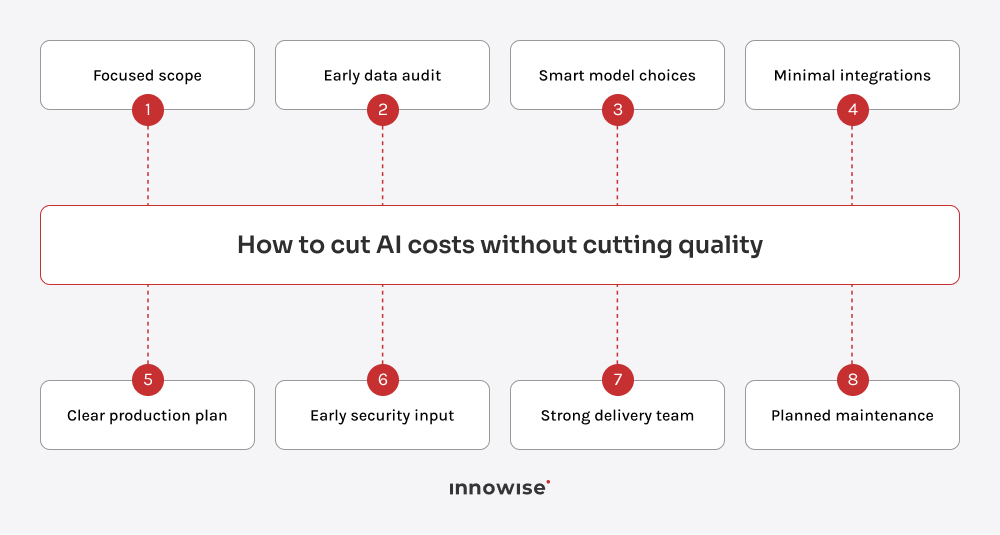
If you want to lower the AI software development cost without hurting results, you don’t trim the work; you trim the waste. Most AI overspending comes from unclear scope, messy data, unnecessary complexity, and slow decision cycles. When those are addressed early, the project gets faster, cheaper, and cleaner to maintain.

Here are the moves that bring success in real projects:

Practical ways to reduce AI development costs without losing quality, covering scoping, data prep, model choices, integrations, production planning, security, team structure, and maintenance.

Focus on one measurable use case

AI projects get cheaper when the target is stable. Instead of scoping “AI for the whole product,” start with one workflow or decision.Consejos profesionales:
  • Define one success metric (resolution time, accuracy, processing time, etc.).
  • Treat everything else as phase two.
  • Write a short problem statement and share it with all stakeholders before the project starts. This alone removes weeks of back-and-forth.

Audit your data before development

Most overruns come from discovering broken data too late. A one-week audit can save a two-month delay.Consejos profesionales:
  • Check data location, structure, completeness, and ownership.
  • Confirm whether labels exist. And if not, estimate labeling work early.
  • Identify sensitive fields upfront so anonymization isn’t a surprise task.

Start with pre-trained models or managed AI services

You don’t need custom training for most early versions. Pre-trained LLMs, vision APIs, and ML services deliver fast, predictable results.Consejos profesionales:
  • Evaluate whether “good enough” accuracy meets business value.
  • Use managed services for the MVP and switch to custom only if the use case truly requires it.
  • Compare API vs infrastructure cost for long-term traffic. Sometimes the simple option stays affordable.

Keep integrations minimal at first

Integrations are where budgets disappear. Limit the MVP to the systems the AI truly needs.Consejos profesionales:
  • Integrate only with the single system required for your first release.
  • Push secondary integrations (ERP, analytics, user portals, etc.) to phase two.
  • Document integration assumptions early, especially authentication and data flow.

Define your production setup early

Architecture decisions you make in week one influence both development cost and ongoing monthly spend.Consejos profesionales:
  • Pick a cloud provider before development starts.
  • Estimate traffic and model usage to avoid infra surprises.
  • Use simple, predictable monitoring tools for the MVP. Save advanced observability for scale.

Involve security and compliance from day one

Late-stage compliance findings are expensive because they force redesigns.Consejos profesionales:
  • Bring legal/security teams into the discovery phase.
  • Confirm data handling rules before architecture decisions.
  • Document what data stays inside your environment and what can be sent to external services.

Choose a team that reduces your management load

Two vendors can charge the same price, but one moves the project forward while the other waits for instructions.This matters even more for classic automation and agent-based projects, where a small, experienced team can often deliver more value than a large group chasing unnecessary complexity.Consejos profesionales:
  • Look for teams that propose architecture, not just ask for it.
  • Check prior experience with similar AI types, not generic “AI skills.”
  • Ensure the team integrates smoothly with your internal developers to avoid handoff chaos.

Want to build AI without the budget headaches?

When the project can’t afford missteps, Innowise keeps it on track

Plan maintenance as part of the build

AI that isn’t monitored or updated will degrade. A stable maintenance plan prevents expensive rebuilds.Consejos profesionales:
  • Set up model monitoring from the very beginning.
  • Schedule retraining cycles or prompt updates every few months.
  • Assign internal ownership so the system doesn’t fall between departments.

How Innowise approaches AI so your project lands on time, in budget, and in production

After building AI systems for years, I’ve seen more projects stall from bad assumptions than bad models. Companies come in thinking they have a “data problem,” but nine times out of ten, they actually have an inefficiency problem. People drowning in repeat tasks. Teams fighting brittle workflows. Decisions stuck behind manual checks. And usually someone in the corner quietly admitting, “We should’ve fixed this ages ago."

That’s the kind of stuff our AI team gets pulled into at Innowise. Not abstract research, not fancy demos, but real bottlenecks inside real companies. And when you spend long enough fixing these things, you learn what keeps costs sane and what sends budgets flying off the rails. We’ve made it a point to stay on the first side of that line.

We see this play out in real projects. For a telecom provider, we built an internal document system with an RAG-based chatbot so employees could pull exact answers from company files during daily work. The goal was to remove time wasted searching and cross-checking documents, while keeping access tightly controlled.

In insurance, we combined RPA, OCR, and ML to automate claim registration and underwriting checks that were previously handled by hand. Bots extracted data from reports, validated it, and flagged edge cases for review. This cut processing time and improved pricing accuracy without expanding the team

Here’s how we approach AI so it lands in production on time, stays maintainable, and doesn’t wreck your budget along the way.

  • We scope the problem, not the buzzwords: Before touching a model, we pinpoint the workflow that’s slowing your business down. No vague goals, no inflated estimates. Clear targets lead to predictable budgets.
  • We recommend the simplest approach that delivers results: If a pre-trained model or managed service handles the job, we say so. You don’t pay for custom work unless it gives you measurable value: faster decisions, fewer errors, lower operational costs.
  • We integrate the solution into your existing stack cleanly: AI is only useful if it lives where your users work. Our engineers adapt to your tools, pipelines, and rules, so you don’t pay for unnecessary rebuilds or the dreaded “it works in staging but not in prod.”
  • We build for production from day one: Architecture, pipelines, monitoring, permissions, environments. Nothing gets bolted on at the end. You avoid the costly scramble most teams face right before launch.
  • We offer full-spectrum AI expertise under one roof: Custom development, AI-powered apps, consulting, audits, MLOps, decision intelligence, or whatever the project demands, we already have the people for it. No hunting for freelancers. No delays.
  • We give you AI that your team can actually maintain: Clean pipelines. Clear documentation. Predictable retraining cycles. You get a system you can support internally, not a mystery box that becomes expensive to touch.

We stay involved after launch: AI ages. Data shifts. User needs change. We handle monitoring, updates, drift fixes, and performance tuning so the system stays sharp instead of becoming another forgotten experiment.

Conclusión

AI isn’t cheap, and it isn’t simple. But the cost makes sense when it solves the right problem with the right plan. The companies that win in 2026 aren’t the ones chasing hype. They’re the ones that strip away noise, pick clear targets, and work with teams who understand how to get AI into production without burning through time and budget. If you approach it that way, AI stops being a gamble and starts being a practical advantage.

FAQ

AI development is expensive because the model is only a small part of the work. Most of the cost comes from data preparation, integrations, infrastructure, security, and all the engineering required to make the system behave reliably in real workflows. You’re paying for a full product that must work under real conditions, at scale, without breaking your existing processes.

En 2026, most AI projects fall somewhere between small chatbot builds and complex enterprise systems. Typical ranges go from tens of thousands for lightweight features to several hundred thousand for multi-model workflows, advanced LLM systems, or platforms supporting many teams. The “average” depends entirely on complexity, data readiness, and how deeply the AI integrates into your environment.

A basic AI feature can take a few weeks, while a full production system often spans several months. Timelines stretch when the project requires significant data cleaning, complex integrations, multiple user flows, or strict compliance checks. The real drivers aren’t the model itself, but the engineering and validation steps needed to make the solution stable enough for everyday use.

Maintenance cost depends on how often data changes, how fast the business evolves, and whether the model needs regular retraining to stay accurate. Systems with heavy traffic, multiple integrations, or sensitive decision-making require more monitoring and updates. Infrastructure spending also grows as usage increases. AI isn’t “set and forget”; it needs ongoing attention to remain trustworthy.

Choose a partner who can explain your problem back to you in plain language and propose a focused, testable scope. Look for teams that ship production systems, not just prototypes, and ask how they handle data, integration, security, and long-term support. The right partner reduces your management load, makes decisions confidently, and builds AI that fits your real workflows.

Responsable de Big Data y AI

Philip dirige los departamentos Innowise, Big Data, ML/DS/AI con más de 10 años de experiencia a sus espaldas. Aunque es responsable de establecer la dirección en todos los equipos, se mantiene al tanto de las decisiones de arquitectura central, revisa los flujos de trabajo de datos críticos y contribuye activamente a diseñar soluciones para retos complejos. Su trabajo gira en torno a convertir los datos en valor empresarial real, y siempre está buscando formas más inteligentes y eficientes de conseguirlo.

Índice

    Contáctenos

    Reserve usted una llamada o rellene usted el siguiente formulario y nos pondremos en contacto con usted cuando hayamos procesado su solicitud.

    Envíenos un mensaje de voz
    Adjuntar documentos
    Cargar archivo

    Puede adjuntar 1 archivo de hasta 2 MB. Formatos de archivo válidos: pdf, jpg, jpeg, png.

    Al hacer clic en Enviar, autoriza a Innowise a procesar sus datos personales de acuerdo con nuestra política de privacidad. Política de privacidad para proporcionarle información relevante. Al enviar su número de teléfono, acepta que nos pongamos en contacto con usted a través de llamadas de voz, SMS y aplicaciones de mensajería. Pueden aplicarse tarifas de llamadas, mensajes y datos.

    También puede enviarnos su solicitud
    a contact@innowise.com
    ¿Qué pasa después?
    1

    Una vez recibida y procesada su solicitud, nos pondremos en contacto con usted para detallarle las necesidades de su proyecto y firmar un acuerdo de confidencialidad. Proyecto y firmaremos un acuerdo de confidencialidad.

    2

    Tras examinar sus deseos, necesidades y expectativas, nuestro equipo elaborará una propuesta de proyecto con el alcance del trabajo, el tamaño del equipo, el tiempo y las estimaciones de costes.

    3

    Concertaremos una reunión con usted para hablar de la oferta y concretar los detalles.

    4

    Por último, firmaremos un contrato y empezaremos a trabajar en su proyecto de inmediato.

    flecha