Die Macht des Data Mapping im Gesundheitswesen: Vorteile, Anwendungsfälle und zukünftige Trends. Mit der rasanten Expansion der Gesundheitsbranche und der sie unterstützenden Technologien wird eine immense Menge an Daten und Informationen erzeugt. Statistiken zeigen, dass etwa 30% des weltweiten Datenvolumens auf die Gesundheitsbranche entfallen, mit einer prognostizierten Wachstumsrate von fast 36% bis 2025. Dies zeigt, dass die Wachstumsrate weit über der anderer Branchen wie Fertigung, Finanzdienstleistungen sowie Medien und Unterhaltung liegt.

IT staff augmentation vs. managed services: key differences and how to choose

Updated: Jan 9, 2026 10 Minuten Lesezeit

Kernpunkte

  • Staff augmentation and managed services solve different problems and require different levels of internal involvement.
  • Ownership of delivery is the core difference between these two IT engagement models.
  • Both models carry trade-offs that impact speed, cost, risk, and long-term scalability.
  • The wrong delivery model can create friction, delay outcomes, or drain internal resources.
  • Understanding how each model fits into your structure is key to scaling without disruption.

It’s a situation most tech leaders know too well. The backlog keeps expanding, internal teams are stretched thin, and demands for speed, quality, and output aren’t slowing down anytime soon. You need to move faster, but without burning out your people or throwing strategy out the window.

You’ve got two options on the table. Do you throw more engineers at the problem, or take the problem off your team’s plate entirely?

That’s the heart of it.

Staff Augmentation gives you skilled people who plug into your workflows. They’re part of your team, but the responsibility still sits with you.

Verwaltete Services hand that responsibility to a provider. You define the outcomes, they make it happen under an SLA that puts skin in the game.

This isn’t just a question of capacity. It’s about where risk lives, who owns delivery, and whether your core team should be focused on building or firefighting.

In this piece, I’ll break down how both models work in the real world, where they shine, where they fall short, and how to choose the one that won’t backfire six months in.

Was bedeutet IT-Personalvermittlung?

Stellen Sie sich IT-Personalverstärkung as borrowing top-tier engineers without hiring them full-time. You get access to skilled people who join your team, work inside your environment, and help you deliver faster.

You stay in control. You assign the tickets, set the priorities, run the sprints, and own the outcomes. The provider simply gives you vetted specialists, usually senior developers, DevOps engineers, cloud architects, or whoever you need to fill the gap.

It’s a smart move when you’re dealing with things like:

  • Temporary workload spikes. You’re pushing a product release, scaling a feature, or covering seasonal demand without overhiring.
  • Lack of internal expertise. You need cloud-native experience, AI/ML capabilities, advanced security skills, or specific technology stacks that your current team doesn’t cover.
  • Headcount ceilings. Budget, headcount, or hiring delays block you from growing your team, even when the work demands it.

You typically pay by the hour or day. No rigid contracts, no hiring paperwork, no benefits packages — just talent on your terms with full flexibility. These engineers work inside your stack, in your Slack or Teams, using your tools, building your product.

And no, this isn’t “just like hiring a freelancer.” Proper staff augmentation comes with structure: the vendor verifies the talent, handles onboarding, offers a backup plan if someone drops out, and supports you throughout the engagement.

Vorteile

  • Transparent rates, easy to budget
  • Full control over the work
  • Fast ramp-up without long-term commitment

Trade-offs

  • Potential communication snags
  • Requires strong internal leadership (PM, tech leads, architecture)
  • Integration risk if your team lacks structure or delivery discipline

If your team just needs more fuel, staff augmentation is a reliable way to get there. But if you’re hoping someone else will steer the ship for you, it’s probably not the right tool.

Hier kommt Managed Services might be a better fit.

What are managed IT services?

If staff augmentation is about adding more people to your team, managed services are about handing the keys to someone else and saying, “It’s your problem now.”

In a managed services model, you don’t just rent engineers. You übertragen an entire function, such as infrastructure monitoring, cybersecurity, application support, or even full product operations. The provider takes responsibility for delivery, backed by a Service Level Agreement (SLA) that defines uptime, response times, and success metrics.

Your job is to set the outcomes. Their job is to make those outcomes happen.

This model works best when you want predictability, stability, and fewer moving parts to juggle internally. You pay a recurring fee; the costs are usually more predictable than hourly billing, and the provider shoulders the operational risk.

When managed services shine

  • You’re running business-critical systems that can’t afford downtime.
  • You need specialist expertise, but don’t want to build (or keep) that capability in-house.
  • You’re focused on long-term IT strategy and don’t want day-to-day ops slowing your team down.
  • You want to align costs with results instead of tracking hours and utilization rates.


Vorteile

  • Clear accountability through SLAs
  • Stable costs and easier financial forecasting
  • Stronger risk management and governance
  • Freed-up internal bandwidth for innovation and strategy


Trade-offs

  • Less direct control over execution
  • Vendor dependency (choosing the wrong partner hurts)
  • Less flexibility if priorities change quickly
  • Switching providers can be disruptive


In short, managed services shift the burden. Instead of worrying about uptime, security incidents, or who’s on call this weekend, you have your provider take on the day-to-day. You stay focused on strategy, while they keep the lights on and the servers ticking.

KriterienStaff AugmentationVerwaltete Services
FokusTalent under your managementDelivery of defined outcomes
KontrolleYou get the staff but retain control over the roadmap, task assignment, and priority settingThe provider controls the roadmap, manages tasks and priorities, and owns the processes, tools, and staffing
Payment modelHourly/daily rates per specialistSubscription or fixed fee tied to SLA
Budget predictabilityVariable, depends on hours and scopeFixed, easier for forecasting and financial planning
FlexibilitätHigh: scale team size up or down fastLower: scope is predefined, changes = renegotiation
Risk ownershipYou carry delivery risk (deadlines, quality, integration)Provider carries operational risk (uptime, security, incident response)
Governance & complianceStays in-house: you ensure standards are metProvider owns compliance, reporting, and SLA metrics
MarkteinführungszeitFaster ramp-up when you already have leadership and processFaster stabilization of ongoing operations, less disruption
Integration effortNeeds onboarding, knowledge transfer, team alignmentMinimal: provider runs independently, you just track outcomes
Scalability horizonGreat for temporary projects or bursts of growthBetter for long-term functions and predictable workloads
Best fit forShort-term projects, scaling product deliveryOngoing operations, monitoring, compliance, 24/7 support

Need clarity before you commit? Let’s map your options.

IT managed services vs. staff augmentation: how it works in practice

So far, we’ve defined both models and lined them up in a neat table. But you don’t make decisions from tables. You make them when you see how things actually play out.

So what does this look like in the real world? Let’s walk through a few scenarios.

Staff augmentation example: scaling a product team

Your SaaS company is gearing up for a big AWS migration. The roadmap is clear, your CTO has the architecture mapped out, and the only problem is you’re short on cloud engineers. Easy call, right? Bring in three specialists for six months, plug them into your Jira board, and keep the migration on track.

That’s staff augmentation at its best: you’re in control, and the external talent gives you the extra horsepower you need.

But here’s the twist. What if your processes aren’t as strong as you thought? Maybe sprint planning is shaky, the backlog isn’t groomed, and nobody’s really tracking dependencies. Now those three extra engineers aren’t accelerating delivery. They’re stuck waiting for direction, burning budget, and amplifying the gaps in your system.

So is augmentation still the right answer? Not unless you’ve got the leadership and structure to handle it.

Managed services example: ensuring uptime and compliance

Now, picture a healthcare provider. Sensitive patient data, 24/7 operations, regulators watching closely. Downtime isn’t just annoying; it’s dangerous. Of course, you could try to hire a security team, set up monitoring, and build compliance reporting in-house. But realistically? That’s a full-time job for a team you don’t have.

So the answer seems obvious: bring in a managed services provider. They handle monitoring, incident response, and compliance, all backed by an SLA. You sleep at night knowing someone else is on call at 3 a.m.

But here’s the catch. What if your business model shifts fast? Say you’re rolling out new digital services every quarter, experimenting with integrations, and pivoting scope all the time. Now that fixed SLA feels like a straitjacket. Every change order costs extra. Every pivot slows down while you renegotiate.

Still sound like the right fit? Not if agility is your real priority.

How to choose between staff augmentation and managed services

So you see, on the surface, the choice looks simple: augmentation for speed, managed services for stability. But the real question is what’s hiding underneath. Do you have the leadership and processes in place to handle more people? Or do you actually need stability, but risk outgrowing a rigid SLA in six months?

Here’s a quick way to stress-test your situation:

1. Do you have leadership and process in place?

  • Yes (strong CTO, PMs, tech leads) → Staff Augmentation
  • No (bandwidth is already maxed) → Verwaltete Services

2. Do you need flexibility?

  • Priorities shift, speed-to-market is key → Staff Augmentation
  • Stability, compliance, and uptime matter more → Verwaltete Services

3. What kind of need is this?

  • Short-term project or peak workload → Staff Augmentation
  • Ongoing functions like monitoring, SOC, or IT operations → Verwaltete Services

4. How predictable does your budget need to be?

  • You can handle variable costs month-to-month → Staff Augmentation
  • You need fixed costs and forecasting accuracy → Verwaltete Services

6. What’s your scalability horizon?

  • This is a project with an end date → Staff Augmentation
  • This will only grow over time → Verwaltete Services

Stuck between answers? That’s your signal that a hybrid model is probably the right fit.

Hybrid model: combining staff augmentation and managed services

If choosing between staff augmentation and managed services feels like trying to fit a square peg into a round hole, you’re not alone. Mature organizations rarely commit 100% to one model. Instead, they design a hybrid workflow architecture where both coexist.

The magic of the hybrid model is in de-risking scale. Product teams don’t get stuck firefighting outages, and operations teams don’t become bottlenecks when the business needs speed. You match investment to business need, not to HR cycles.

What hybrid actually gives you day to day:

  • Geschäftskontinuität: The MSP ensures 24/7 coverage so your in-house engineers don’t get paged at midnight for server alerts.
  • Faster innovation: Augmentation helps you move from prototype to production without overburdening your core team.
  • Budget balance: Fixed costs (MSP) + variable costs (augmentation) = predictable forecasting while keeping flexibility to spin up expertise when needed.
  • Governance clarity: You know who owns what — the provider delivers uptime, your team delivers product, and augmented specialists fill tactical gaps.

However, a hybrid model is not a silver bullet. Hybrid collapses when:

  • Boundaries blur: If leadership doesn’t define what’s “core IP” versus “commodity IT,” responsibilities leak, and suddenly you’re paying an MSP for innovation they can’t deliver.
  • Internal maturity is weak: Without strong governance, hybrid turns into duplication: MSP handles something halfway, augmented engineers redo it, and accountability gets lost.
  • It’s used to avoid decisions: Some leaders treat hybrid as a political compromise: “We’ll do both.” That’s not strategy, it’s punting the ball. Hybrid only works when responsibilities are designed around it, rather than patched with it.

The hybrid model is about making sure your company can keep moving fast without breaking when the pressure’s on. If you need both innovation and reliability — and let’s be honest, that’s every business worth its salt — then hybrid isn’t some fancy option. It just becomes how you run IT, day in and day out.

You can fix bad code. You can’t easily fix a misaligned delivery model once the budget’s committed and teams are running. At Innowise, we make sure yours fits your goals, your team, and your runway, before you’re too far down the road to change it.

Staff augmentation vs managed services: the cost factor

Whenever executives weigh staff augmentation against managed services, the conversation almost always comes back to money. But the real question isn’t which is cheaper. It’s how the costs show up, and what you’re really paying for.

Staff augmentation: transparent rates, hidden overhead

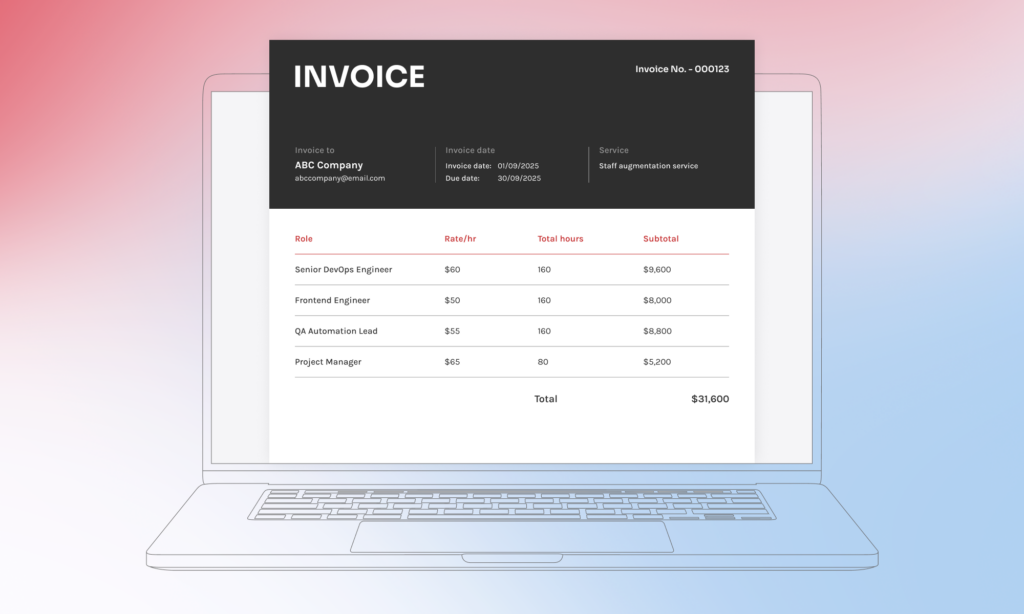
With augmentation, what you see is what you pay for: hours of engineering time. Your invoice will list each resource, their rate, and the number of hours billed.

A typical billing summary might look like this:

Invoice for staff augmentation services listing roles, hourly rates, hours worked, and total cost.

Rates will vary, of course, depending on region, seniority, and scope, but the structure stays the same: it’s pay-as-you-scale. Simple, clean, flexible.

But here’s the catch: that simplicity hides real operational effort. Those neat hourly rates don’t include onboarding time, knowledge transfer, integration into your workflows, or the ongoing oversight your team still needs to provide.

So, you might think, “Alright, then maybe managed services are the answer. Let someone else handle the mess.”

Well… let’s not jump to conclusions just yet.

Managed services: subscription for outcomes

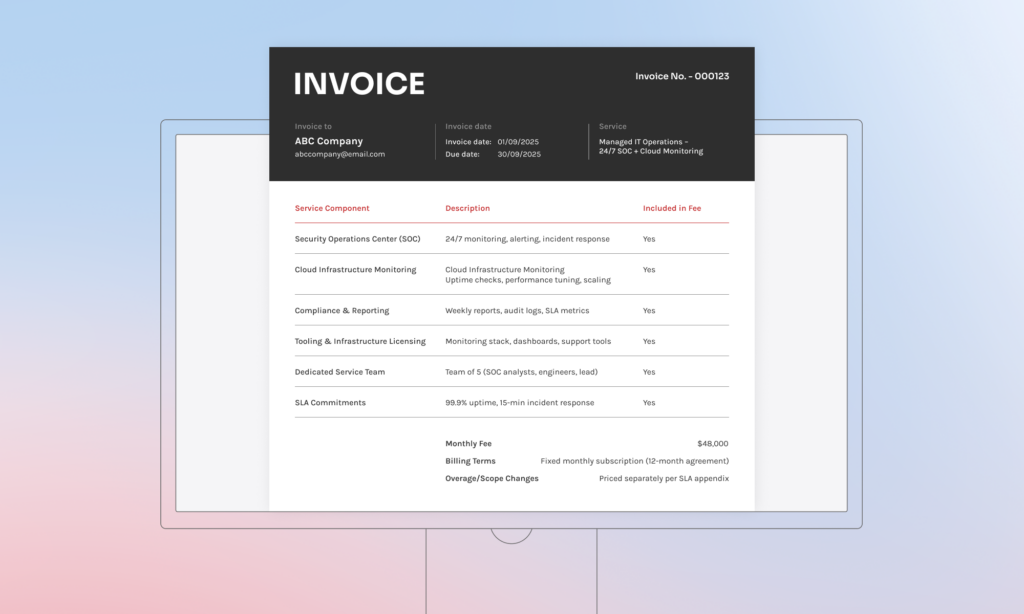
Unlike with staff augmentation, managed services providers don’t bill you by the hour. You’re not paying for people, you’re paying for outcomes. Everything is bundled into a fixed monthly fee, tied to performance metrics defined in your SLA.

So your invoice might look more like this:

Invoice for managed IT operations detailing SOC, monitoring, SLA, and included services

Sounds clean, right? And it is, until things change. You’re not paying for flexibility here. You’re paying for stability, predictability, and coverage within a defined box. Need to pivot fast? Expand scope? Shift infrastructure mid-sprint? That’s where the SLA starts pushing back.

So, which model wins on cost?

Both models can be cost-effective. Both can turn costly fast if misaligned. That’s why many companies end up somewhere in the middle with a hybrid model that blends predictable spend (managed services) and flexible delivery (augmentation).

And if you’re even slightly unsure about what suits your structure best, surface that now, not mid-project when the stakes are higher and the costs harder to unwind. This is exactly where the richtigen Partner adds real value: asking the hard questions early, helping you weigh the trade-offs, and designing the mix that fits your reality and your budget.

Cost control starts with model control. Let’s get clear.

Zusammenfassung

If you’re scaling, stabilizing, or stuck in between, your delivery model will make or break it.

Staff Augmentation gives you speed.
Verwaltete Services give you stability.
Hybrid gives you control without the overhead.

The key is aligning the model with how your business actually works.

If you’re looking for more than “here’s some developers” or “here’s your SLA,” let’s talk about what you’re really building and how to structure your team around it.

FAQ

Staff augmentation gives companies on-demand access to vetted engineers who work under internal management, offering flexibility and speed. In contrast, managed services transfer ownership of an entire function or process to a provider, who delivers results under a Service Level Agreement (SLA). The key difference lies in who owns the outcome: augmentation adds capacity; managed services shoulder the responsibility.

Staff augmentation is often cheaper upfront, making it ideal for short-term projects or temporary skill gaps. Managed services, while typically more expensive monthly, offer predictable costs by covering tools, support, and outcomes under a fixed fee. If you have strong in-house leadership, augmentation may save money. If you lack bandwidth or need 24/7 coverage, managed services can reduce total overhead in the long run.

It depends on the type of IT project. Staff augmentation is better for short-term, high-velocity projects where you need to boost your internal team’s capacity without losing control. Managed services are better when the focus is on long-term operations, stability, and predictable outcomes. The best choice comes down to your goals, internal capabilities, and risk tolerance. In many cases, a hybrid model is the smartest move.

A company should choose staff augmentation when it has a strong internal team but needs to scale quickly, access specialized expertise, or cover a temporary skills gap without committing to full-time hires. It’s ideal for short-term IT projects, fast product development, or tech initiatives where you want full control over execution. If your organization can manage delivery internally but just needs more hands, augmentation is the right fit.

Managed services are a better choice when your company needs long-term operational stability, clear SLA-backed outcomes, or lacks the internal bandwidth to manage additional staff. They’re ideal for infrastructure management, cybersecurity, 24/7 support, and other repeatable functions where performance and uptime are critical. If you’re looking to reduce internal overhead or free up your team, managed services deliver more value than staff augmentation.

Yes, staff augmentation and managed services can be combined in a hybrid IT delivery model. This approach allows companies to retain control over core product development with augmented staff, while outsourcing operational or repeatable tasks to an MSP. A hybrid model offers the best of both worlds: flexibility, speed, and scalability from augmentation plus predictability, stability, and SLA-backed performance from managed services.

To decide between staff augmentation and managed services, start by assessing three things:

  • Do you have the leadership (CTO, PMs, tech leads) to manage additional resources? If yes, Personalaufstockung may work well.
  • Is it a short-term project or a long-term function? Augmentation suits project-based needs; Managed Services fit ongoing operations.
  • If you want to own the process, choose von IT-Personal. If you want guaranteed results with less oversight, go managed.

Many companies ultimately use a hybrid model, combining both based on function, risk, and strategic priority.

Dmitry leitet die Technologiestrategie hinter maßgeschneiderten Lösungen, die auch wirklich für Kunden funktionieren – jetzt und in der Zukunft. Er verbindet die Vision des großen Ganzen mit der praktischen Umsetzung und stellt sicher, dass jede Entwicklung intelligent, skalierbar und auf das Geschäft abgestimmt ist.

Inhaltsübersicht

    Contact form

    Anruf buchen oder füllen Sie das Formular aus. Wir kontaktieren Sie, sobald wir Ihre Anfrage bearbeitet haben.

    Sprachnachricht senden
    Datei beifügen
    Datei hochladen

    Sie können 1 Datei mit bis zu 2 MB anhängen. Gültige Dateiformate: pdf, jpg, jpeg, png.

    Mit dem Klicken auf Senden erklären Sie sich damit einverstanden, dass Innowise Ihre personenbezogenen Daten gemäß unserer Datenschutzrichtlinie verarbeitet, um Ihnen relevante Informationen bereitzustellen. Mit Angabe Ihrer Telefonnummer stimmen Sie zu, dass wir Sie per Sprachanruf, SMS oder Messaging-Apps kontaktieren. Es können Gebühren für Anrufe, Nachrichten und Datenübertragung anfallen.

    Sie können uns auch kontaktieren
    Jetzt contact@innowise.com
    Wie geht es weiter?
    1

    Sobald wir Ihre Anfrage erhalten und geprüft haben, melden wir uns bei Ihnen, klären erste Fragen und unterzeichnen bei Bedarf ein NDA, um die Vertraulichkeit zu gewährleisten.

    2

    Nach der Analyse Ihrer Ziele, Anforderungen und Erwartungen erstellt unser Team einen Projektvorschlag mit Leistungsumfang, Teamgröße sowie Zeit- und Kostenschätzung.

    3

    Wir vereinbaren einen Termin, um das Angebot gemeinsam zu besprechen und alle Details festzulegen.

    4

    Abschließend unterzeichnen wir den Vertrag und starten umgehend mit der Umsetzung Ihres Projekts.

    Pfeil