How to move USDT from Tron to EVM without getting trapped by liquidity

Apr 2, 2026 15 mins read

If you’ve been around DeFi long enough, the CrossCurve exploit probably didn’t surprise you. On February 1, 2026, CrossCurve experienced a cross-chain incident that resulted in approximately $3M in losses. For us, this is not just “market news”. It’s a mandatory quality check before any partner integration. We are accountable both for our own architecture and for our clients’ safety. That’s why, in parallel with CrossCurve’s public updates, we reviewed the incident details and evaluated how the root cause could (or could not) impact our planned integrations.

The context behind this article

So what exactly happened to CrossCurve? Without going unnecessarily deep into terminology, the issue was not a blockchain hack, but an unintuitive design pattern originating from the Axelar GMP SDK (v5.10.0) that can slip through even professional audits if the risk isn’t explicitly understood. The ReceiverAxelar contract itself had been audited and verified on-chain, yet the vulnerability sat deeper in an accelerated execution path for cross-chain messages, where a critical operation could be triggered without full source validation via the gateway. In CrossCurve’s specific case, the situation was further amplified by a weak confirmation threshold configuration (threshold = 1), which reduced the overall robustness of the validation model.

This incident is also a broader signal for Axelar integrators: by following official examples and inheriting from “express” execution contracts, projects can unintentionally expose a dangerous attack surface even if the rest of the code is correct and looks production-ready. Another important point is that the risk doesn’t disappear by itself when updating: even newer SDK versions contain similar patterns, and if teams migrate without recognizing the architectural issue, they may carry the risk forward. Practically, the takeaway is simple: any fast execution path must either be strictly restricted or reinforced with strong origin/authorization checks on the integrator side; otherwise, express-style mechanics can become a bypass of your own security assumptions.

At the same time, our stance on CrossCurve remains positive, and ironically, the complexity of their architecture makes this incident less of a universal, repeatable scenario than it might look at first glance. The exploit relied on a specific messenger/execution pattern (a particular SDK design choice), whereas the solution CrossCurve is now moving toward — and the one we are considering in our own products for secure cross-chain asset transfers — is not dependent on that vulnerable linkage. For that reason, even if we had already been integrated with CrossCurve at the time of the incident, this exact attack vector would not have impacted our architecture, because our trust and validation points are structured differently and do not rely on the same express execution path.

Finally, CrossCurve’s official update, published on February 13, 2026, effectively confirmed the conclusions our team reached independently. They are restoring the system in stages, starting with components that were not affected (the aggregator is already live, with routing via Rubic and Bungee), and then re-enabling the Token Bridge and Consensus Bridge with additional security measures. Notably, they stated the Consensus Bridge will only go live after completing enhanced security checks. This “restore only what is confidently verified, and harden before reactivation” approach aligns well with how we evaluate partner protocol maturity prior to integration.

That’s exactly why moving USDT from Tron into EVM networks isn’t as simple as plugging in a bridge and calling it a day. Tron is where a huge amount of USDT actually moves: fees were cheap (no more, hence the need for bridges), flows are familiar, and volumes are real. So when you say “we need Tron liquidity”, the real question is where the money sits, who’s allowed to move it, and what breaks when one assumption turns out to be wrong.

This article is here to slow that conversation down in a good way. I’ll walk you through the main ways USDT moves from Tron into EVM networks, how those approaches behave when real volume hits, and then step back to ask the only question that really matters: which risks are you actually willing to carry.

Get a quick review of your cross-chain message path

Setting the frame: Tron, liquidity, and the real trade-offs

At this point, the question becomes how USDT actually moves from Tron into an EVM network, and what you’re assuming when you choose one path over another.

Most discussions get stuck at the protocol level, but this one won’t. Before naming specific solutions, I want to be explicit about the dimensions that actually matter once real volume is involved. In practice, every cross-chain design ends up making trade-offs along the same axes, even if the marketing language differs.

The first is liquidity. Some models require capital to be pre-positioned on both sides. Others avoid that entirely but introduce different forms of trust. The second is asset identity. Sometimes users receive what everyone agrees is “the” USDT. Sometimes they don’t, and that distinction has real downstream effects in DeFi. Then there’s cost behavior under load, finality speed, security assumptions, integration effort, and how dependent you become on someone else’s roadmap.

If you line these dimensions up, the design space collapses into four broad approaches. They’re not variations of the same thing because they solve different problems and fail in different ways. The table below is a quick orientation.

A quick map of the four approaches

ApproachWhere liquidity livesAsset typeUX at real volumePrimary risk
LP bridges / poolsPre-funded on both sidesNative USDTGood until pools drainLiquidity exhaustion, imbalance
Lock-mint / burn-unlockLocked on TronBridged / wrappedPredictableTrust, fragmentation
Intent-based executionWith solvers / MMsDepends on routeVery good if solvers staySolver exit, pricing
Hybrid entryExternal liquid chainsCanonical-by-designStable if routing holdsMessaging, aggregation

The important thing to note is that none of these approaches removes risk; they only redistribute it. Some concentrate risk in liquidity provisioning, while others push it into trust, execution logic, or external operators. Once that’s clear, the rest of the discussion becomes much simpler.

With this frame in mind, we can now walk through each approach in detail and look at what you actually get, and what you quietly take on, when you choose it.

Approach #1. LP bridges and native liquidity pools

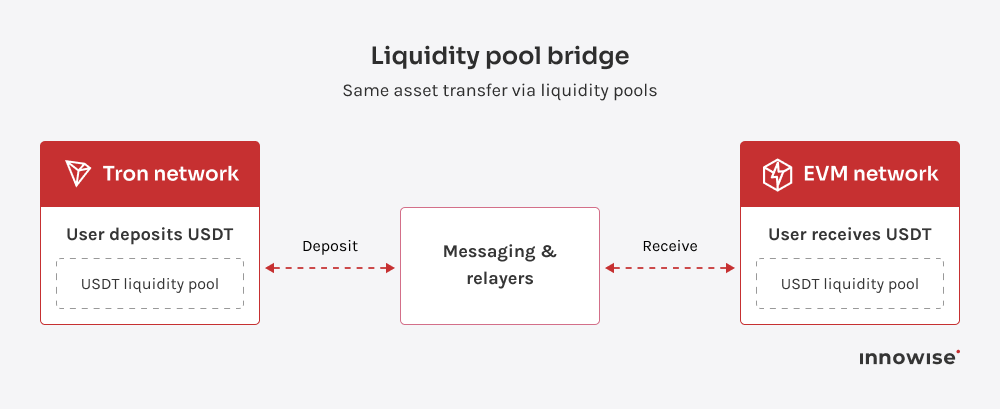
The model is straightforward. A user deposits USDT into a pool on Tron and receives USDT from a corresponding pool on the target EVM chain. Ideally, no wrapped or synthetic tokens appear. The same asset moves across chains, but liquidity is required “here and there” to make that possible.

From the user’s point of view, this often feels close to a direct transfer. The bridge does not mint a new asset. It redistributes existing liquidity between pools deployed on different networks.

Cross-chain bridge illustration where USDT moves from Tron to an EVM chain through pooled liquidity and messaging relayers.

Pros

When LP bridges are set up correctly, they offer several clear advantages.

  • UX is usually very good. Transfers are fast, flows are easy to understand, and users feel like they “got the same asset” on the other side.
  • No liquidity fragmentation at the asset level. There is no proliferation of “different versions of USDT”, which simplifies DeFi integrations on EVMs.
  • Transparent economics for liquidity providers. Fees behave “like on a DEX pool”, which makes returns easier to explain and reason about.

Cons

The main downside is liquidity. LP bridges require seed liquidity, sometimes in the millions. Without it, large transfers will “eat the pool”, leading either to hard limits or to a sharp increase in fees and slippage. This constraint applies regardless of which EVM network is on the receiving side.

There is also a critical dependency on messaging infrastructure. Bridges of this type rely on cross-chain messaging to coordinate pool releases, and most ready-made solutions integrate with major messaging providers. In practice, this means:

  • onboarding a tier-one messaging protocol,
  • paying integration costs that typically range from $250k to $500k depending on urgency,
  • waiting through integration queues that can stretch up to half a year.

At that point, this is no longer “just connecting a bridge”. It is the launch and maintenance of a liquidity market.

Risks

LP bridges carry multiple layers of risk simultaneously.

  • Smart contract risk and messaging or relayer infrastructure risk. Failures in contracts or message handling can freeze funds or release them incorrectly.
  • Bank-run scenarios under imbalance and panic. If flows tilt heavily in one direction, pools can drain faster than they can recover.
  • Stablecoin compliance risk. Blacklisting or pausing by an issuer applies to all approaches, but in pool-based bridges, it is especially visible because pools represent a clear and concentrated target.

Recent cross-chain incidents have shown how failures in message validation can cascade across networks. While those incidents did not necessarily involve LP pools, they underline that correct message handling sits on the critical path for pool-based bridges as well.

Real-world examples and what they imply

Allbridge Core (messaging inside Allbridge)
Allbridge is positioned as a cross-chain stablecoin swap built around the pool model, with fees distributed in favor of liquidity providers. Public materials emphasize that security does not rely on a single check, but on multiple practices and layers of control. Public communications also describe a fee split along the lines of “80% to LPs and 20% to the treasury”.

Stargate / LayerZero ecosystem (messaging via LayerZero)
Stargate historically addresses unified pools and imbalance dynamics by adjusting fees in response to flow direction. At the same time, the ecosystem has moved toward “official omnichain distribution” of stablecoins, including the emergence of USDT0 as an OFT asset under the LayerZero standard.

LayerZero documentation explicitly lists USDT0 as OFT-compatible. In public descriptions, the USDT0 launch follows a “lock on Ethereum, mint on target networks” model.

This is an important nuance. It shows that LP logic and lock-and-mint logic often blend in practice. In some cases, “nativeness” comes not from pools, but from issuer or infrastructure-level creation of a canonical omnichain asset.

Celer cBridge / Symbiosis State (messaging and validation via the Guardian Network)
These solutions typically offer broad chain coverage, but they return to the same underlying question: where does liquidity sit, and who holds it?

For EVM networks, the answer usually reduces to two options:

  • partners or investors seed liquidity into pools,
  • or the system accepts limits on volume and route quality.

That recurring question of who funds the liquidity is what ultimately defines how far LP bridges can take an EVM ecosystem.

Get a plain risk memo on your current bridge setup

Approach #2. Lock-and-mint / burn-and-unlock bridges

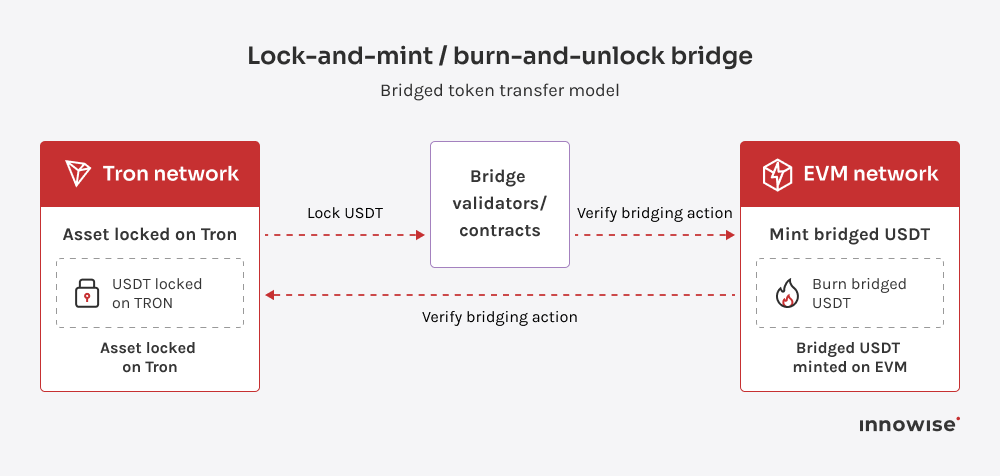
This model follows a different logic than liquidity pools. On Tron, the original asset is locked. On the destination side, a “bridged” version of that asset is minted. When funds move back, the bridged asset is burned, and the original asset is unlocked on Tron.

There are no pools that need to be balanced across chains. Capacity is determined by how much is locked, not by how much liquidity happens to be available elsewhere. However, there is a technical complexity to keep in mind. Because Tron and EVM-based networks differ significantly, most lock-and-mint bridges rely on different technologies on each side. This increases implementation complexity and raises the bar for correct operation, especially when stablecoins are involved.

Illustration of burn-and-unlock process, with USDT locked on Tron and bridged tokens issued on the EVM network.

Advantages of the canonical bridge model

  • No two-sided liquidity requirement
    • LP pools are not required as a mandatory condition.
    • There is no need to pre-fund liquidity on the destination chain.
  • Predictable capacity
    • Transfers do not fail because a pool “ran out”.
    • Capacity scales with how much is locked.
  • Fast to bootstrap
    • Can be launched “from zero”, even with a small TVL.
    • Does not depend on partners or investors seeding pools upfront.

The cost of wrapped assets

The trade-off is asset identity.

In almost all cases, a wrapped or bridged asset appears on the EVM network. This introduces several issues:

  • Trust and redemption risk
    • Users must trust that the lock-and-unlock mechanism works correctly.
    • Redemption depends on the bridge continuing to function as intended.
  • Fragmentation of “USDT”
    • Multiple versions of USDT can coexist on the same network.
    • Each version competes for liquidity and adoption.
  • DeFi adoption resistance
    • Protocols and pools may refuse to support the “wrong” version.
    • Integrations become more selective and fragmented.

For stablecoins, this problem is especially acute. The market consistently prefers the most canonical version of an asset.

Risk profile of lock-and-mint bridges

  • Validator, key, or admin risk
    • If the bridge is not fully trust-minimized, control over minting and unlocking becomes a critical trust assumption.
  • Messaging and consistency risk
    • Bridges that depend on orchestration or asynchronous messaging can suffer from eventual consistency issues.
    • Failures or delays in coordination can lead to stuck or inconsistent states.

Lock-and-mint bridges remove the constant pressure of funding pools, but they replace it with questions of trust, asset identity, and long-term acceptance inside DeFi ecosystems.

Approach #3. Intent-based execution (solvers and market makers)

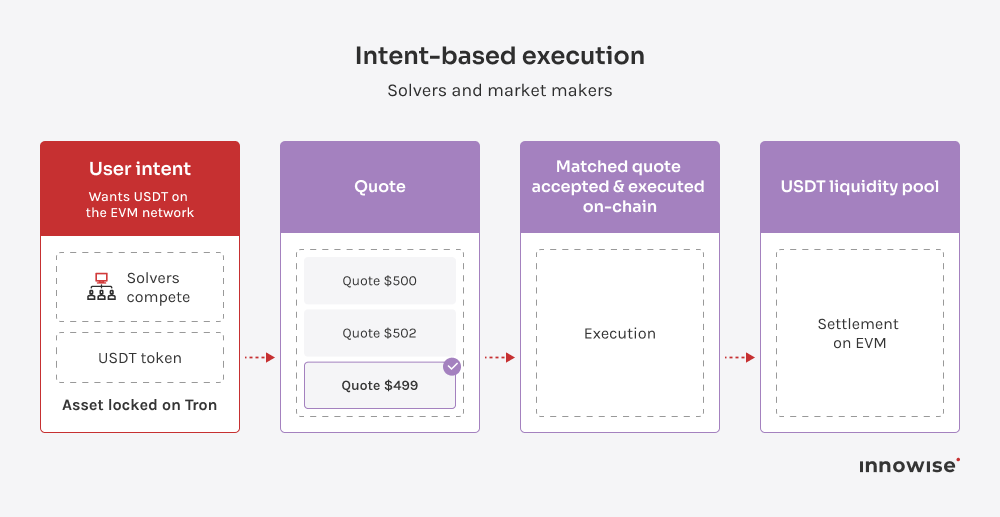
Intent-based systems flip the usual flow on its head. Instead of telling the system how to move assets step by step, the user declares the outcome they want. For example, “I want USDT on the EVM network”. The routing, swapping, and bridging details are left to the market.

Solvers compete to fulfill that intent by offering quotes. Execution rules are enforced on-chain, so once a solver’s quote is accepted, settlement follows the protocol’s conditions. Atomicity comes not from a single bridge contract, but from the rules that govern how intents are matched and executed.

Visual of intent-based execution model showing user request, competitive quotes, and on-chain settlement on EVM.

Why intents look attractive for Tron

This model fits the Tron use case for a few concrete reasons:

  • Speed: Solvers already hold inventory, so execution can happen quickly without waiting for pools to rebalance.
  • Capital efficiency: Liquidity is not locked into protocol-owned pools. It sits with market makers who decide how to deploy it.
  • Willingness of MMs to hold inventory: Some market makers are prepared to hold USDT and related assets if there is clear yield or reliable orderflow, shifting the capital burden away from the network itself.

Where intent-based systems shine

When solver participation is healthy, intent-based execution delivers strong results.

  • Best-in-class UX: Users perform a single action instead of chaining bridge, swap, and bridge steps together.
  • Potentially lowest cost: Solver competition can compress spreads, making intents cheaper than multi-hop routes.
  • Network-scale liquidity access: Coverage grows with the solver market rather than with protocol-owned liquidity, which allows expansion without rebuilding pools on every network.

Where the model starts to strain

The same properties that make intents attractive also define their limits.

  • Solver dependency: If solvers leave or reduce activity, execution quality drops immediately.
  • Implicit pricing risk: Costs are embedded in solver quotes, which can widen or become aggressive in thin markets.
  • Limited predictability for very large flows: Pricing reflects fixed accounting rules instead of market maker behavior, which is why mint-and-burn models often remain preferred for heavy rails.

Risk profile of intents

Intent-based execution carries three main risks. There’s liveness risk if solvers leave. There’s price integrity risk if quotes become aggressive or distorted in low-liquidity conditions. And there’s operational risk, which means execution quality needs to be monitored and fallback routes must be available when intent execution degrades.

Send your call flow, and we’ll map the trust gaps

Approach #4. Hybrid model. Meta-aggregation plus one-to-one entry

The hybrid model starts from a different premise than pool-based designs: don’t own liquidity.

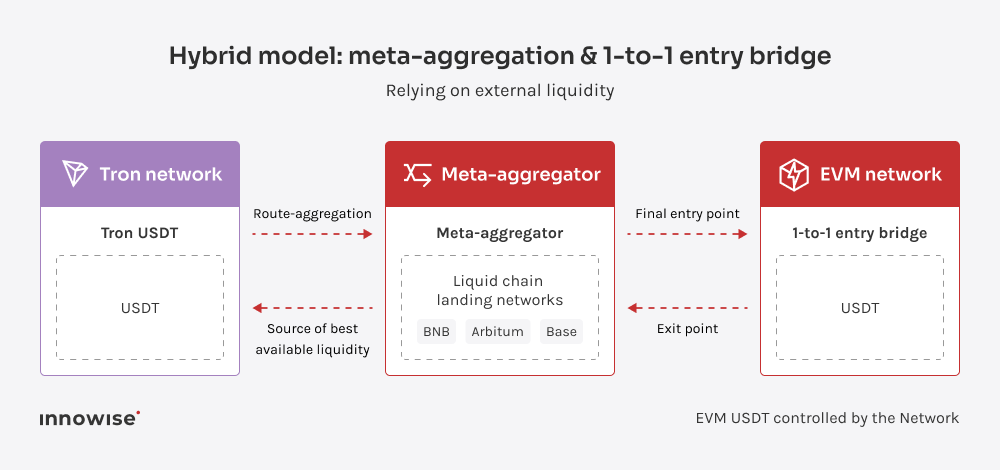
Instead of trying to attract and maintain capital inside protocol-owned pools, the system relies on liquidity that already exists on large, liquid networks. The EVM network itself only controls the final entry and exit point, rather than the entire cross-chain route.

This design avoids the main constraint of LP-based bridges. There is no local pool to exhaust, because liquidity is not concentrated inside the destination network. There are no hard volume caps imposed by local TVL. Transfers scale with the depth of external markets, not the amount of capital the network managed to attract.

Liquidity stays where it already exists, on large chains, in established DEXs, and in mature routing systems.

Visual of cross-chain hybrid model combining route aggregation and 1:1 entry bridge for USDT transfer.

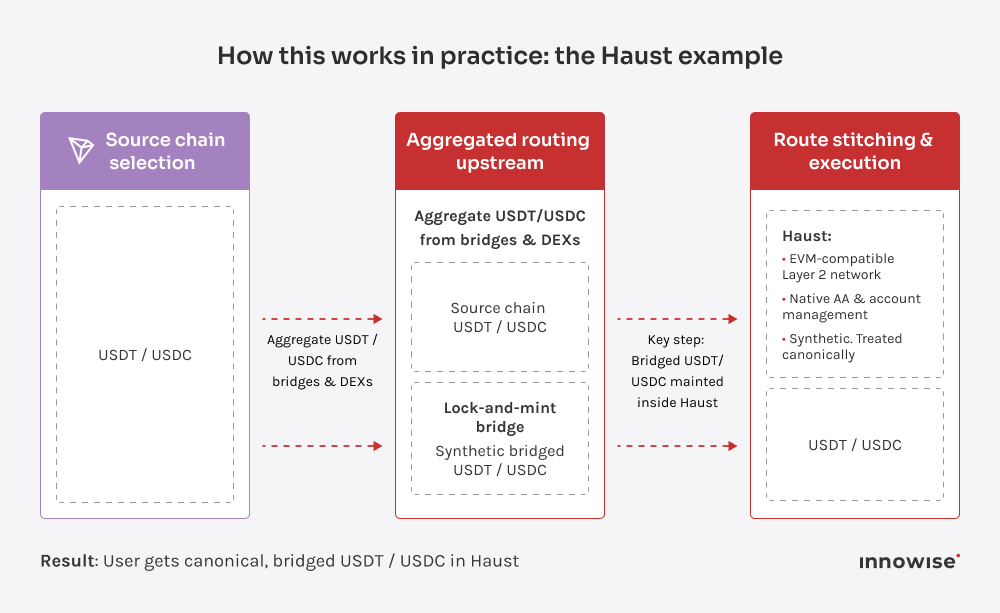
How this works in practice. The Haust example

Haust is an EVM-compatible Layer-2 network built on zk-rollups, with native support for account abstraction, cross-chain execution, and aggregated routing. That makes it a good reference case for the hybrid model, because it already treats cross-chain entry as infrastructure, not an add-on.

In practice, the flow looks like this:

  1. Source chain selection
    Haust selects one or two EVM chains where stablecoin liquidity is already deep and actively routed. Typical candidates are BNB Smart Chain, Arbitrum, or Base. No attempt is made to replicate that liquidity inside Haust.
  2. One-to-one entry into Haust
    A dedicated bridge connects each selected source chain to Haust. The bridge follows a lock-and-mint or equivalent one-to-one model:
    • USDT is locked on the source chain.
    • A bridged representation is minted inside Haust.

    This asset is synthetic at the protocol level, but treated as canonical within Haust’s own DeFi stack.

  3. Aggregated routing upstream
    Users do not interact with the bridge directly. Instead:
    • The user enters via a route aggregator from any supported chain,
    • The aggregator routes funds into the chosen source chain and normalizes them into the required stablecoin,
    • The final hop into Haust is executed through the one-to-one bridge.
  4. Route stitching and execution
    All steps are stitched at the aggregation layer. From the user’s perspective, this is a single route. From Haust’s perspective, only the final entry is owned and enforced.

The key property is that liquidity never sits inside Haust pools. It remains on large chains, DEXs, and aggregators. Haust controls execution correctness at the boundary and integrates the result directly into its wallet and account abstraction layer.

Visual walkthrough of aggregated USDT and USDC transfer, stitched and settled on an EVM-compatible Layer 2.

The architectural trade-offs

The hybrid approach does not come for free.

One trade-off is asset identity. A one-to-one bridge into the destination network creates a version of the stablecoin that is canonical within that network, but not globally. This requires a conscious decision about which assets are treated as canonical and which are considered imported or legacy.

There are also integration requirements. Messaging, indexing, and wallet support must be handled cleanly so the entry and exit experience feels coherent, even though the route spans multiple systems.

Finally, there can be timing constraints. Support for specific source chains, such as Tron, depends on aggregator and bridge roadmaps, which can introduce temporary delays.

Risk profile of the hybrid model

It is important to understand that the hybrid model doesn’t shift risk, but eliminates it.

  • Dependency on aggregators: Execution quality depends on external aggregators, including their coverage, routing logic, and degradation behavior.
  • Reduced financial exposure compared to LP models: The network avoids the ongoing cost of subsidizing pools and managing imbalance.
  • Timing risk tied to chain enablement: Availability depends on when specific source chains are supported by the surrounding infrastructure.

In exchange for giving up direct control over liquidity, the network gains flexibility and avoids becoming permanently dependent on its own balance sheet.

Don’t panic. Think clearly.

This incident wasn’t about a flashy “hack.” It was about one execution path that let a sensitive action run without the checks people assumed were there. My advice: use incidents like this the right way. Treat them as a forced audit of your assumptions. Write down what you trust, why you trust it, and what breaks if that trust is wrong.

If you want to go through your exact flow, step by step, and see where it can bend or snap, our blockchain consultants can review it with you before liquidity makes the decision for you.

Blockchain expert & DeFi analyst

Andrew lives and breathes blockchain. He helps clients navigate a space that’s constantly evolving — translating big ideas into technical strategies that are secure, scalable, and built for real-world use.

Table of contents

    Contact us

    Book a call or fill out the form below and we’ll get back to you once we’ve processed your request.

    Send us a voice message
    Attach documents
    Upload file

    You can attach 1 file up to 2MB. Valid file formats: pdf, jpg, jpeg, png.

    By clicking Send, you consent to Innowise processing your personal data per our Privacy Policy to provide you with relevant information. By submitting your phone number, you agree that we may contact you via voice calls, SMS, and messaging apps. Calling, message, and data rates may apply.

    You can also send us your request
    to contact@innowise.com
    What happens next?
    1

    Once we’ve received and processed your request, we’ll get back to you to detail your project needs and sign an NDA to ensure confidentiality.

    2

    After examining your wants, needs, and expectations, our team will devise a project proposal with the scope of work, team size, time, and cost estimates.

    3

    We’ll arrange a meeting with you to discuss the offer and nail down the details.

    4

    Finally, we’ll sign a contract and start working on your project right away.

    More services we cover

    arrow