The power of data mapping in healthcare: benefits, use cases & future trends. As the healthcare industry and its supporting technologies rapidly expand, an immense amount of data and information is generated. Statistics show that about 30% of the world's data volume is attributed to the healthcare industry, with a projected growth rate of nearly 36% by 2025. This indicates that the growth rate is far beyond that of other industries such as manufacturing, financial services, and media and entertainment.

Energy management systems: how they bring efficiency and reliability to wind energy

Mar 13, 2026 14 min read

Author’s note: Key reasons why you need energy management systems

Who is this for?

  • Wind farm operators tired of bleeding cash on grid imbalance penalties.
  • Asset managers trying to squeeze ROI out of aging hardware without CapEx.
  • CTOs struggling to unite a “zoo” of legacy turbines and modern IoT into one stack.
  • Analysts and engineers responsible for planning and management.

Today, the architecture of your energy management systems directly dictates your wind farm’s profitability. If you are stuck with poor data quality, legacy systems, and integration issues between systems, you are basically burning cash on grid imbalance penalties and downtime. A properly engineered EMS architecture unifies equipment, data pipelines, and forecasting algorithms to shift management from reactive firefighting to systemic optimization.

At Innowise, we engineer custom EMS solutions that let operators slash losses and boost generation using their
existing infrastructure, with no need to rip and replace a single turbine.

Here is exactly what we deliver within our custom energy management software development services:

  • We architect the middleware that hooks up your SCADA systems to modern cloud platforms without breaking a sweat.
  • Our engineers set up bulletproof pipelines using Kafka, RabbitMQ, MQTT, AMQP, and the rest of the industrial stack to ingest, buffer, and scrub terabytes of raw telemetry right at the edge.
  • We deploy heavy-duty machine learning models to handle precise wind power prediction and spot component failures before they happen.
  • We write custom connectors for hardware protocols to rip data out of your legacy equipment.
  • Our team builds real-time dashboards that actually make sense to dispatchers and give operators and engineers total visibility over the fleet.
  • We implement edge computing logic to crunch high-frequency vibration logs locally before pushing the clean signal to the cloud.
  • Our experts automate the boring regulatory compliance and internal reporting so you hit grid standards without lifting a finger.

Read more in this article.

Key takeaways

  • The efficiency of a wind farm today depends more on the architecture of energy management systems (EMS) and less on blade aerodynamics, so the battle for margins is now fought exclusively in the software field.
  • Data engineering is the absolute baseline, because predictive analytics and smart forecasting won’t take off until you clean up the “mess in the basement” regarding data and set up normal integration.
  • Implementing wind power forecasting and operational analytics shifts management from “putting out fires” to precise planning, which remains the only way to avoid draining the budget on imbalance penalties.
  • Building intelligent energy is a complex architectural task of uniting a bunch of equipment, where data quality is more important than the hype around neural networks.

For the last ten years, the industry really suffered from gigantomania, competing on mast heights and blade lengths, and yes, we certainly learned how to build these monsters.

And statistics don’t lie, the market is growing like crazy. Global capacity has already smashed the 1’245 GW (1,25 terawatts) barrier by mid-2025 and is rocketing toward doubling, with the industry adding 72.2 GW in just the first six months of the year.

The vector of development has shifted radically, though, and the main challenge for business now is operations, because a wind farm today has transformed from a bunch of generators in a field into a complex, distributed IT system.

Margins in this business now depend not on the wind, which we can’t control, obviously, but on how fast and effectively software ingests terabytes of data. At Innowise, we constantly see the same picture: operators are literally drowning in the chaos of a growing equipment zoo and a sea of data that currently offers little real value.

The industry is inevitably shifting to a predict-and-optimize paradigm, and this is exactly where energy management systems take the stage. Without implementing a proper EMS and without a built-in culture of working with data and AI, you are essentially flying your expensive assets blind.

Let’s look under the hood of this problem and figure out exactly where the money is leaking and why having an expensive SCADA system and piles of sensors doesn’t save the day.

Why efficiency and reliability are system-level problems


In an ideal world, wind energy systems should function as a single, unified organism, but in reality, we most often see a Frankenstein monster stitched together from parts that refuse to be friends.

We view efficiency and reliability as system-level problems because wind energy is a distributed network where dependencies are tight, and a bottleneck in one layer inevitably kills performance in another.

When we break down efficiency, we see it bleeding out exactly at the integration points:

  • Power generation typically has a mismatch between the theoretical power curve and actual production due to a lack of coordination between local control and regional fleet operations.
  • Transmission & distribution losses usually occur from resistance in lines, transformers, or grid congestion acting as a bandwidth bottleneck, throttling power before it even hits the meter.
  • Load management becomes a guessing game with no historical consumption data at your disposal to manage loads, meaning that you are flying blind on demand peaks.
  • Control & optimization is the orchestration layer where an EMS has to balance these inputs, or else the whole system runs sub-optimally.

Reliability becomes a system-level issue for us because:

  • Redundancy and fault tolerance turn into a dependency nightmare where one inverter glitch can cause a chain reaction that brings down the entire sector like a domino effect.
  • High communication (data transmission) latency can degrade the performance of wide-area control systems, which potentially affects system stability margins.
  • Predictive monitoring has become a race against the clock where uncaught anomalies in the data stream escalate, turning a minor bug into critical downtime that crashes the entire production environment.

What does this lead to? Energy systems optimization in real time is impossible, and management slides into a reactive mode of responding to accidents.

In other words, energy losses due to downtime, inaccurate weather forecasts, missed demand peaks (since you don’t have adjusted ML algorithms), and running equipment in suboptimal modes eat up a huge chunk of profit. It makes old management methods like “it broke again, send a crew” economically meaningless.

  • A turbine trips due to an overheating bearing, and you deploy a crew (losing output and spending money on the truck roll).
  • The wind forecast doesn’t match actuals because you don’t have enough historical data to train your models, and you get hit with grid imbalance penalties.
  • Even small changes, such as having different pitch settings than those necessary for the current turbulence, cause around a 1–2% decrease in efficiency. While this may seem like an insignificant amount, the cost of that difference is millions of dollars annually.

As long as your data is fragmented, there will be no AI in energy management, so to turn this chaos into a system, you need to implement a proper architectural solution first.

Wind farm data trapped in disconnected ecosystems?

Energy management systems as an engineering foundation

The solution to the fragmentation problem is modern energy management systems, which we view not as a pretty dashboard for top management, but as a heavy engineering foundation. It is, in essence, middleware that must physically and programmatically link all your hardware and software into a single network, regardless of either the protocols involved or how old the hardware is.
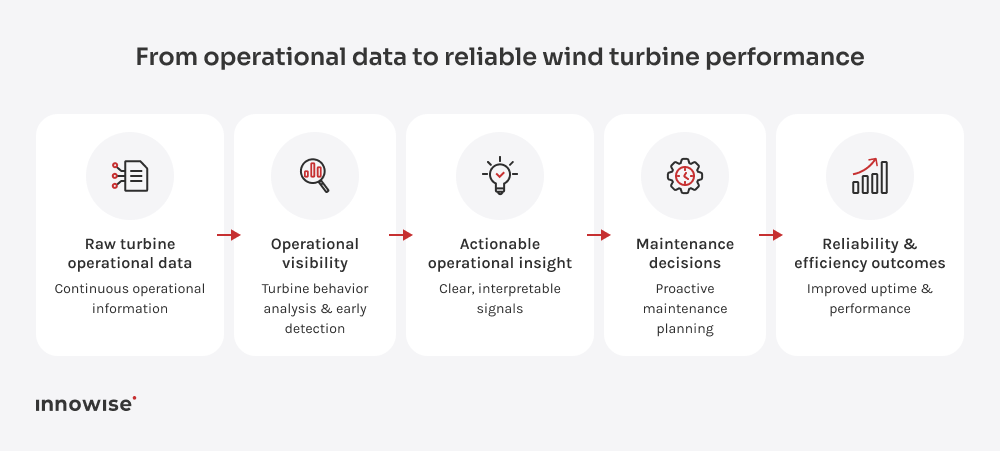
A simple linear diagram showing the transformation from raw turbine data to actionable operational insight and maintenance decisions backed by energy management systems.

The heterogeneous hardware challenges

For an integrator, any large wind farm is a nightmare, where turbines of different generations from different vendors coexist.

There are ancient SCADA systems from the Windows XP era that work side-by-side with the newest IoT vibration sensors, and every device speaks its own unique language. For example, some devices may be communicating via Modbus, while other devices prefer OPC UA, and yet others may be locked into vendor-proprietary protocols, so trying to manage this manually is total madness.

The majority of the engineering challenges start here, and this is where we at Innowise build a solid data architecture that allows all of the disparate devices to communicate with each other, thereby creating a digital “talking zoo”.

EMS as a central integration hub

A normal EMS integrates disjointed streams like SCADA, sensors, and DERs into a coherent picture for analysis and control, creating the necessary abstraction layer for all systems, and therefore making all of the disparate parts compatible with each other. Our goal is to provide structured, high-quality data that the EMS logic can actually use for dispatching and optimization.

It’s important to understand that an EMS doesn’t replace the existing turbine SCADA but rather is built on top of it. It aggregates telemetry (rotor RPM, oil temp, active power), meteorological mast data, and grid status in one place, so the operator finally starts seeing all key operating parameters across turbines and the grid.

Data engineering role and scalability

A wind turbine generates a wild amount of data, as a modern machine is equipped with hundreds of sensors sending high-frequency signals. The amount of data generated by these turbines is an example of a classic Big Data and time-series problem, so if you build the system on a standard SQL database, it will likely lead to performance issues under such load.

We design the wind data management and processing system on time-series-optimized databases like TimescaleDB or InfluxDB so that if we connect 50 additional turbines to the system tomorrow, it will not experience performance degradation. Skills in data engineering are paramount here to ensure low latency, as a data set that takes 15 minutes to reach a display is no longer considered monitoring but is instead deemed an obituary.

Now that we have designed the skeleton of our wind data management and processing system, let’s discuss how we process the data within this system to extract useful insights.

Adjusting data and AI for intelligent energy systems

Let’s be honest, if you just dump terabytes of telemetry into a data lake, you won’t come up with intelligent energy systems because raw turbine data is essentially dirty fuel.

I’ll tell you about our internal kitchen and how we turn this informational noise into a useful signal suitable for analytics.

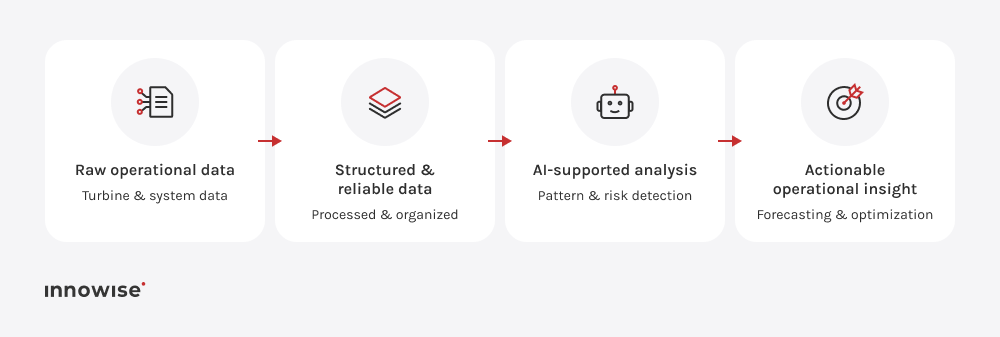
A simple linear flow diagram illustrating how data engineering and AI turn operational data into actionable insight within energy management systems.

Data complexity specifics

Wind data is, by itself, a beast. First, it’s gigabytes of high-frequency vibration and acoustic logs. Second, rain, icing, and static during thunderstorms create strong sensor noise. Third, wind farms often stand in the middle of nowhere, which means unstable connections in remote locations lead to packet loss.

If you feed this “holey” data to neural networks, you’ll get hallucinations instead of a forecast, which is why we always start by establishing strict data hygiene.

Pipelines and data engineering

Reliable pipelines are the foundation of every smart system, which we create based on the classic ETL/ELT scheme. To reliably transmit all of the data between the edge and the cloud, we use message brokers like Kafka and protocols like MQTT as buffers when there is a connection interruption. If the connection dies, data piles up locally and flies over in a batch once the link is restored.

Next, data goes through stream processing for instant alerts and batch processing for training heavy models, after which it’s neatly stored in a data warehouse for quick access by analysts.

Our experts in data engineering build these pipes so they don’t leak or clog under load.

Cleaning and normalization:

This is probably one of the most boring parts, but it’s what actually makes the system work, without which no AI magic happens, as many people like to say these days. Though we don’t treat ML models as magic, it’s rather a standard software component for us.

  • Outlier detection: If an oil temp sensor shows +500°C, and a second later +40°C, it’s a sensor glitch. We filter it, otherwise the model will decide the turbine burned down and trigger a false alarm.
  • Imputation: If the connection dropped for a minute, we must interpolate the data and patch holes in the data using mathematical interpolation.
  • Timestamp synchronization: This is one of the biggest headaches we encounter. When we analyze the data, it’s necessary to synchronize both SCADA and vibration sensor data to the millisecond. Without this precision, it is impossible to properly correlate the cause and effect, and thus, the model will not produce usable results.

AI development and integration

Only when the data is scrubbed and groomed do we proceed to full-fledged AI development, creating models as separate microservices within the pipeline. We train them on net historical data, for example, vibration patterns from the month before a gearbox actually blew up in the past, so the system stops simply writing logs and starts predicting the future.

Forecasting, predictive maintenance, system optimization, and decision-making

Now let’s look at how energy management systems, pumped full of quality data and models, change the game for an operator and plug the money leaks.

Wind power forecasting

Wind is a chaotic thing, but the grid loves stability with no surprises, and that’s why accurate wind power forecasting is the Holy Grail for energy traders. Say you promised 50 MW, but nature had other plans, and you delivered only 30, so you get hit with an imbalance penalty.

To avoid situations like this, we take historical generation data, overlay advanced weather models, and run it through our ML algorithms. Our goal is to know the farm’s output down to the megawatt for hours and days ahead. This allows for making maximally accurate bids on the energy market, minimizing the imbalance penalties you pay the regulator for your forecast errors.

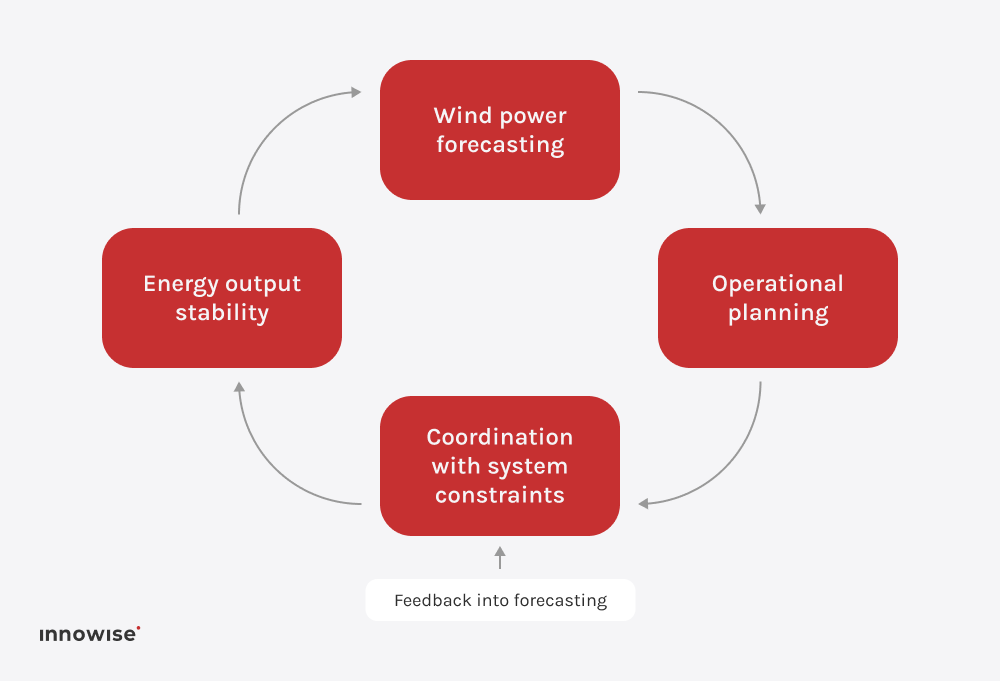
A simple loop diagram showing the data flow: forecast, planning, coordination, stable output, and back to forecast within energy management systems.

Predictive maintenance

Predictive maintenance for wind turbines is a killer feature that supports your move away from scheduled maintenance and expensive emergency repairs.

Basically, we shift from a “wait till it breaks” scheme to “fix it before it breaks,” where algorithms monitor vibration and temperature 24/7 and notice micro-anomalies even a super-human is guaranteed to miss. Instead of a simple alarm about a breakdown, the system issues a forecast, something like: “Main shaft bearing on Turbine #4 will fail in 3 weeks. Probability 85%.”

System optimization

Energy systems optimization is a non-stop process where a smart EMS can tweak turbine settings on the fly. For instance, a system can automatically control yaw, mitigate the wake effect from neighboring turbines, or adjust blade pitch in order to squeeze maximum efficiency from the current flow without killing the mechanics.

Decision-making support

Ultimately, the human is still in charge, but now they have a superpower in their hands. Dashboards and smart alerts help the dispatcher react instantly, relying on hard facts instead of Uncle Nick’s intuition, who has worked here for 20 years.

A system like this highlights real problems and suggests a playbook: “Reduce power on Turbine 5, there is a risk of overheating.” This filters out the noise and lowers the risk of human error when things heat up on the control panel.

Can't predict failures or optimize turbine performance?

Practical challenges of building intelligent energy management systems

It all sounds beautiful, but let’s be realistic: in practice, we constantly face a pile of problems related to both technology and processes.

Data integration challenges

One of the most frequent pain points is trying to befriend modern cloud environments with 15-year-old hardware and old-hat systems with seriously restricted integration capabilities. We have to write custom parsers, install IoT gateways, and literally claw data out of closed systems, which always turns into “jumping through hoops,” but there’s no other way.

Quality and scalability

Manually processing data from five turbines is manageable with tools such as Excel, but when you have 500 turbines generating terabytes of logs, all errors scale instantly. Often, we have seen homegrown systems simply choke under the pressure of handling Big Data and result in long alert times.

This shows how maintaining data quality adds another layer of complexity for large organizations as their needs grow beyond the capabilities of their current systems to process large collections of data.

Aligning AI with operations

Plus, the human factor hasn’t been eliminated, meaning old-school engineers are often skeptical of black-box AI. The model could tell them to stop the turbine, while at the same time, all the sensors indicate they should continue to operate normally. The operator ignores the alert, and two days later, the turbine falls apart.

That’s why implementing intelligent energy systems requires serious change management to define the system logic to staff and make AI forecasts explainable.

How we do it: solving real-world energy challenges

At Innowise, we’ve walked this path for over 19 years and have completed enough projects to understand how energy management systems can provide our customers with both monetary savings and increased peace of mind.

When it comes to deploying logic at the edge for immediate anomaly detection or architecting scalable cloud data lakes to process massive amounts of telemetry data, we build the infrastructure that enables effective intelligent energy management actually work. We focus on cutting down technical debt and building robust architectures that turn raw noise into lower OpEx and higher output.

Moving to intelligent management is something that needed to be done yesterday if you want to stay in a market where everyone has the same hardware, but the winner is the one with smarter software.

Please don’t hesitate to reach out with your questions. Whether you need help developing your energy management software system or require a technical consultation regarding best practices for energy management, we will be glad to assist you!

FAQ

SCADA is used to monitor the condition of the equipment in real time and provide notifications, visualization, and basic controls. On the other hand, EMS integrates all assets into one central system, providing the ability to optimize performance, anticipate performance outcome & maximize the economic efficiency of an organization. An EMS is the only way to identify the true economic performance of your farm and stop wasting money due to lost revenue from downtime.

Yes, we can develop custom connectors to extract data from older or "closed" equipment so that there is no requirement to replace old wind turbines just to convert them into a digital format.

This is a pragmatic approach where you can use AI to identify bearing failure up to 30 days before it happens, and therefore, you reduce A) the amount of time it takes to plan for the repair, and B) ultimately save on expensive emergency repairs by being proactive.

In many cases, it is not the equipment, but the disjointed systems themselves that are causing "informational blindness." The disconnection between the different systems prevents you from aligning their operations for maximum efficiency in real time.

You will need to implement accurate forecasting of your wind-generated power so the system can accurately predict how much power you will produce when you do so. This will prevent you from losing your margin due to imbalances.

Creating intelligent energy systems does not take as long as it may appear if the design is correct at the outset. After cleaning up the data, your first results will show up in transparent analytics very quickly.

Basically, yes. It won’t eliminate them completely, but it will drastically reduce the unplanned firefighting. You will replace the components of your wind turbine in calm weather, in a planned manner, and without panic.

Yes. By using algorithms to recommend smarter adjustments to rotor pitch and yaw angles, you can extract more value from the same wind resource, provided these adjustments remain within the strict safety limits we program into the system.

Dmitry Nazarevich

Chief Technology Officer

Dmitry leads the tech strategy behind custom solutions that actually work for clients — now and as they grow. He bridges big-picture vision with hands-on execution, making sure every build is smart, scalable, and aligned with the business.

Table of contents

    Contact us

    Book a call or fill out the form below and we’ll get back to you once we’ve processed your request.

    Send us a voice message
    Attach documents
    Upload file

    You can attach 1 file up to 2MB. Valid file formats: pdf, jpg, jpeg, png.

    By clicking Send, you consent to Innowise processing your personal data per our Privacy Policy to provide you with relevant information. By submitting your phone number, you agree that we may contact you via voice calls, SMS, and messaging apps. Calling, message, and data rates may apply.

    You can also send us your request
    to contact@innowise.com
    What happens next?
    1

    Once we’ve received and processed your request, we’ll get back to you to detail your project needs and sign an NDA to ensure confidentiality.

    2

    After examining your wants, needs, and expectations, our team will devise a project proposal with the scope of work, team size, time, and cost estimates.

    3

    We’ll arrange a meeting with you to discuss the offer and nail down the details.

    4

    Finally, we’ll sign a contract and start working on your project right away.

    arrow