AMR vs AGV: Choosing the right mobile robotics solution for modern operations

Hero image for article -AMR vs AGV

Key takeaways

  • The debate over the difference between AMR vs AGV misses a point — many companies use both types of mobile robotics to handle distinct workflow zones based on their stability and volume requirements.
  • Fleet complexity explodes at 50+ robots when task coordination, traffic management, and multi-robot optimization require software packages that only specialized suppliers develop.
  • MassRobotics and VDA 5050 standards let you use robots from multiple suppliers without custom integrations, but the level of support can vary greatly between manufacturers and must be verified before purchase.
  • Building production mobile robots demands 11+ distinct roles from embedded Linux engineers to cloud developers, and trying to cut corners with smaller teams is one of the leading reasons why many robotics projects fail.

Mobile robotics stopped being treated as a research concept somewhere around 2015. All major distribution centers now have mobile robots, some with many hundreds of them in operation at the same time, transporting pallets, totes, and parts.

The global autonomous mobile robots market reached $2.01 billion in 2024, and analysts project it will hit $4.56 billion by 2030. That growth suggests companies are purchasing and deploying logistics robots at scale.

When you decide to review the possibilities of mobile robotics for your facility or warehouse, you will come across two categories that work differently: autonomous mobile robots (AMRs) and automated guided vehicles (AGVs).

The discussion surrounding AMRs vs. AGVs is not about which type of robotics is superior today. The short version: both types of technology are functional. The key is understanding which technology is the best option for your operation’s specific configuration, layout, and future plans.

Let’s break down the operational realities of both systems so you can decide which machine belongs on your floor.

Picking between AMR and AGV without understanding your 5-year layout plans?

What are automated guided vehicles? (AGVs)

As their name implies, automated guided vehicles follow the guidance you give them, either through physical (magnetic tape on the ground, wires buried into concrete) or digital (laser reflectors, data matrix codes, pre-mapped routes) methods.

Here’s how the basic flow works. 

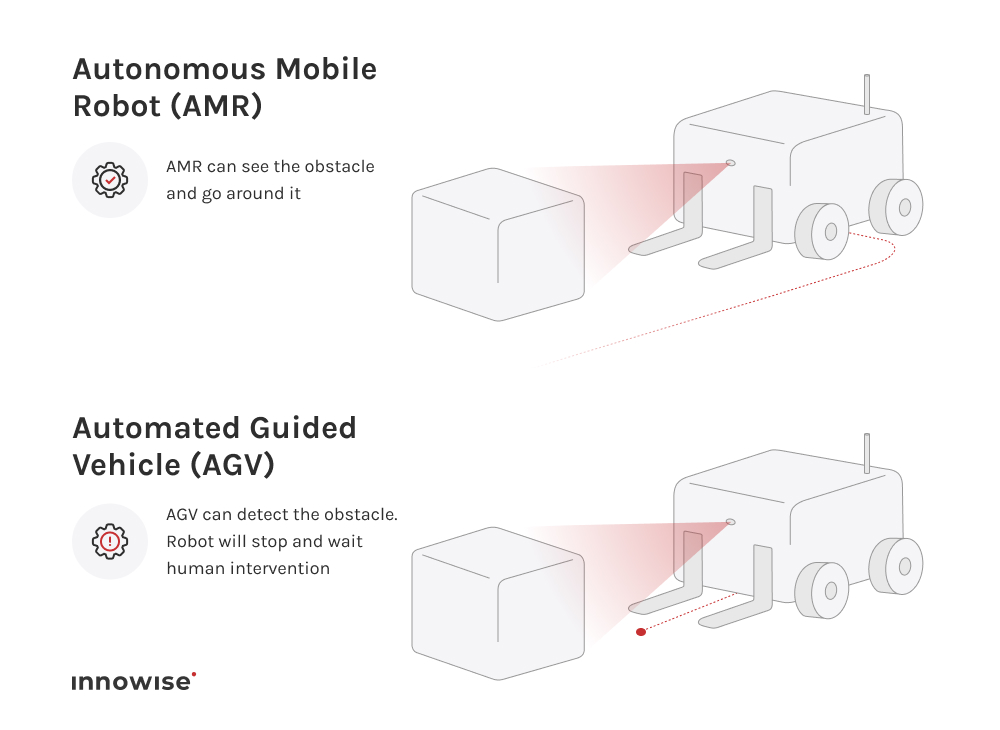
The system controller tasks the AGV with picking up a pallet from location X and delivering it to Y. The AGV then automatically follows its allocated route between those points, and if something blocks that route, it stops and waits. The AGV does not alter its designated path, so someone has to clear the obstacle or manually redirect the vehicle.

In controlled environments such as automotive assembly lines, where building layouts have remained relatively unchanged over time, AGVs have been able to operate efficiently for many years without interruption. But they don’t improvise, which means they don’t make unexpected decisions or create routes in real time themselves.

This predictability has been both a pro and a con for AGVs, providing the basis for the first generation of warehouse automation robots.

The technology has matured over decades, so AGVs can now handle complex paths, carry heavy loads, and integrate with warehouse management systems to coordinate multiple vehicles. Some modern AGVs use laser-guided navigation instead of physical tape, which gives you more flexibility to adjust routes without tearing up the floor.

What are autonomous mobile robots? (AMRs)

AMRs leverage LiDAR, cameras, radar, and sometimes ultrasonic sensors that provide a live view of their surroundings. Autonomous mobile robots use a technique called simultaneous localization and mapping (SLAM) to build a map, determine their location on that map, and plan an appropriate response for safe navigation. These logistics robots continue to update mapping info as they go.

Why does this matter? In a constantly changing environment, it’s hard to predict the route from one point to another. Forklifts move around, cart racks block aisles, and people block paths. An AMR will safely avoid and reroute around these changes without human intervention.

AMRs have become increasingly popular as transportation systems have grown more complex. E-commerce distribution facilities have grown in size, with thousands of product types, and layouts changing often to facilitate optimal shipping. Additionally, some manufacturing companies are no longer large enough for fixed routes, given smaller batch sizes and more frequent equipment changes.

You can deploy an AMR and have it build a map of the facility and perform tasks quickly with no need for tape, reflectors, or a long process to establish infrastructure. The robot adapts to the environment rather than requiring the environment to adapt to it.

Many modern AMRs can also communicate with each other and a central robot fleet management system. When multiple AMRs operate in the same physical space simultaneously, they can work together to mitigate congestion and maintain smooth traffic flow within the facility. As the number of AMRs increases, this coordination becomes critical.

How mobile robotics evolved: from fixed routes to autonomous fleets

The shift from AGVs to AMRs didn’t happen overnight, nor was it driven by a single technological advancement. Three converging forces caused companies to rethink mobile robot automation.

An image showcasing the difference between AMR vs AGV in the article AMR or AGV: Pick the right mobile robotics solution for modern operations.

Early reliance on predictable layouts and fixed routes

As we mentioned earlier, industrial automation has historically relied heavily on predictable, stable environments. Production facilities were designed for a fixed production flow, in which materials would move in predetermined sequences and factory layouts would remain unchanged for extended periods. Investing in permanent guidance infrastructure for AGVs made perfect sense back then.

Increasing operational complexity in warehouses and factories

Then operations got complicated. Consumer demand began moving toward a more personalized, more varied approach. Warehouse operational processes shifted from storing full pallets to picking individual line items, so the product lifecycle became shorter and seasonal peaks became more drastic.

It was nearly impossible to maintain a fixed route with all the changes occurring at the facilities every month or quarter. Consequently, tearing out and reinstalling magnetic tape was costly and resulted in process disruptions. Even laser-guided AGVs required remapping and reprogramming.

Growing demand for flexibility, scalability, and rapid reconfiguration

The need for flexibility led to increased demand for effective mobile robot navigation

At that time, LiDAR sensors became less expensive and more reliable. Computing capabilities increased, and open-source frameworks like ROS provided developers with tools to build sophisticated vehicle autonomy systems. Besides, SLAM and localization algorithms improved dramatically and, by the mid-2010s, were robust enough for production use.

This convergence of business needs and technical capability pushed autonomous mobile robots from research labs into warehouses. Businesses have discovered that the operational layout of their facilities can be adjusted without significant changes to the robot system and the entire workflow. 

For instance, if a new pick station is installed, all that is needed is to update the software with new destination coordinates for AMRs. If the storage layout changes, the robots will automatically remap themselves based on the new layout.

AMR vs AGV: how to choose the right solution

Choosing the wrong technology means months of repairing infrastructure and dealing with limitations. The following nine factors help determine which technology is best for your operation.

Criteria AGV AMR
Flexibility Fixed routes only; layout changes require infrastructure updates Adapts to layout changes automatically; reroutes in real-time
Infrastructure Requires magnetic tape, reflectors, or wire installation; ongoing maintenance needed Works with existing facility; no floor or wall modifications
Deployment time Weeks to design routes, install infrastructure, and test paths Days to map space and configure; operational same day possible
Human interaction Segregated lanes and barriers; predictable but requires dedicated zones Navigates around people; shares workspace, but behavior may seem unpredictable
Initial cost Lower robot cost, but infrastructure adds expenses Higher robot cost, but no infrastructure expenses
Reconfiguration Requires physical changes and reprogramming Software updates only; robots remap automatically
Best for High-volume, repetitive tasks in stable environments Dynamic operations with frequent layout changes
Maintenance Simple mechanical wear items; tape/reflector upkeep Sensor calibration; software updates
ROI Lower cost pays off in stable, long-term operations Flexibility value compounds with each layout change avoided

Traffic jams stop your robots more than actual tasks do?

Where AMRs and AGVs are used today

The same warehouse may use both AGV and AMR technologies, but in different zones, or stick with one across the entire facility. Application patterns have emerged across three main operational environments.

Warehouses and intralogistics

Distribution centers use a combination of AGVs and AMRs for different tasks. 

AGVs typically handle repetitive routes and are a good fit for transporting pallets from receiving to storage and for delivering full cases to picking stations because these operations are predictable and can be matched to a repetitive route.

AMRs are more appropriate for dynamic picking areas, as order profiles may change day to day, and workers choose from hundreds or thousands of SKUs, making flexible mobile robot navigation more practical. Some facilities run hybrid fleets: AGVs for heavy, predictable work and AMRs for variable tasks.

Manufacturing and line-side delivery

Automotive plants have relied on automated guided vehicles for decades to deliver parts to assembly stations because of the layout stability, strict delivery schedules, and the weight of the components they handle.

Electronics manufacturing facilities often use automated mobile robots instead because they undergo frequent product mix and configuration changes. AMRs can support multiple assembly lines without dedicated pathways, and are used to transport lightweight parts that do not require heavy-duty equipment.

Logistics environments with mixed human-robot workflows

The hardest logistics environments to manage are those with humans, forklifts, and robots all sharing a common workplace. AGVs work best when traffic patterns are segregated, with dedicated lanes for the robots and easily identifiable right-of-way rules.

AMRs perform best in a truly mixed work environment. They can move around forklifts and will stop to allow pedestrians to pass. They also adapt to temporary obstacles, such as pallets on the floor, or when there are no defined lanes for the robots to use.

What it takes to build modern mobile robots

Today’s mobile robotics systems require more than just mechanical engineering. They combine all aspects of hardware, embedded software, cloud-based infrastructure, and operational tools.

Discovery and architecture

Before any code or hardware design begins, the first step is to determine what functions the robot will perform and what limitations it will encounter. You’ll need to identify the types of sensors needed, the processing power, the communication standards, and how everything integrates into one complete system.

Hardware and electronics

The physical robot includes motors, controllers, power systems, sensors, and chassis design. Industrial robots work 24 hrs a day for many years, and this creates the need for robust components that can withstand vibration, extreme temperatures, and constant use.

Embedded (C/C++/RTOS)

Developers build low-level code that controls motors, reads sensors, and manages operations on dedicated microcontrollers using real-time operating systems. These systems require precise timing for the motor control because milliseconds can affect proper operation during emergencies.

Embedded Linux (drivers, Yocto, ROS/ROS2)

Higher-level autonomy runs on Linux-based computers embedded in the robot. Engineers build custom Linux distributions using tools like Yocto, write device drivers for sensors and actuators, and integrate everything with ROS or ROS2.

Perception, SLAM, navigation

This is where robots become autonomous. Perception software processes sensor data to identify obstacles, free space, and landmarks. SLAM algorithms create a map of the environment and keep track of where the robot is on that map, while navigation software helps the robot plan a route, avoid obstacles, and execute maneuvers.

Simulation testing

It’s hard to test every scenario that could potentially happen to a robot in the field, which is why development teams build simulation environments using Sim2Real & Real2Sim methodologies with platforms like Gazebo, NVIDIA Isaac Sim, and Isaac Lab. Robots operate in a virtual warehouse setup with thousands of test cases, which prevents expensive field failures.

Cloud and backend

Engineers develop backend infrastructure to coordinate tasks, monitor robot health, log telemetry data, and optimize multi-robot operations within the robot fleet management system. This infrastructure handles data from hundreds or thousands of connected robots.

HMI/UI/operator tools (Qt/QML, mobile, desktop)

Operators need interfaces that allow them to manage their industrial automation robots: assign tasks, monitor status, handle exceptions, and view maps. You can create desktop applications using the Qt/QML framework, mobile apps for on-floor management, or web dashboards.

Video/streaming/telemetry

Modern robots generate huge amounts of data, including video feeds from cameras, LiDAR scans, positional logs, and system metrics. Engineers build pipelines to compress and stream this massive amount of info for remote monitoring and troubleshooting.

QA/validation

Engineers validate every single subsystem, including sensors, motor controllers, power modules, and communication links to the fleet management systems via unit, integration, and system testing, and then measure robot performance metrics like navigation accuracy, battery efficiency, and task completion rates.

Roles and expertise required to build and scale AMR and AGV systems

One strong engineer can build a demo but shipping 100 robots into a warehouse requires coordinated expertise.

Role Key skills
Robotics architects Systems design, sensor fusion, real-time constraints Hire
Robotics developers ROS/ROS2, C++, Python, navigation algorithms
Simulation engineers Simulation tools, Sim2Real & Real2Sim methodologies
Firmware engineer HAL/BSP development, industrial protocols (CAN/Modbus), memory management Hire
Embedded developers C/C++, RTOS, microcontrollers Hire
Embedded Linux engineers Linux kernel, device drivers, Yocto
Hardware design engineer Circuit design, motor control, power systems
C++ backend engineers Distributed systems, databases, APIs Hire
Video & audio processing engineers Video codecs, streaming protocols Hire
Cloud/back-end developers Cloud platforms, microservices, scalability Hire
QA & validation teams Testing frameworks Hire
Mobile & web app developers Mobile platforms, web applications Hire Hire

Built a demo robot, but can't scale to 50+ units without your team drowning?

Interoperability and standards in mobile robotics

Starting with one brand, you may later add other models. Then, you may acquire an existing company with its own fleet or purchase custom-built manufacturing robots for very specific jobs. Regardless of how you get them, the challenge is how to make all these systems work together.

Companies that produce robotic solutions build their own robot fleet management platforms where Robot A speaks one API and Robot B uses a different one. Without standards, you end up with custom integration work for every combination.

Industry associations recognized this problem.

MassRobotics developed the AMR interoperability standard to create common protocols for fleet coordination. The standard allows robots from various manufacturers to use the same map, coordinate their movement and traffic, and receive tasks from a single central management system without custom integration. 

VDA 5050 is another standard gaining traction, especially in Europe, that defines and establishes the communication layer between fleet management systems and mobile robots.

The need for good standards only increases as fleets expand. When you’re running 10 robots, custom integration is manageable, but at 100+ robots across multiple facilities, standardization becomes a practical necessity.

Aside from standards, you might also need middleware and adapters to facilitate coordination across your robot units.

AGV vs AMR: making the choice that actually fits your operation

The AMR vs AGV decision comes down to one question: how often will your layout change in the next five years? 

If the route you’ve identified will usually remain the same and you typically have a predictable volume of activity, use AGVs because they are a simple, proven technology that will provide the lowest overall cost. AMRs win when flexibility matters more than upfront cost because every avoided delay of a layout change pays you back.

Many facilities end up running both AGVs for stable, high-volume operations and AMRs for dynamic picking environments that may undergo significant changes every quarter. The most common mistake we see among companies is either forcing one technology everywhere or waiting until they identify the perfect solution that delivers the greatest benefit at the lowest possible cost.

Mobile robotics delivers value when it solves a specific bottleneck better than alternatives, not when it automates everything at once. Begin with the highest pain points in your operation by testing 5-10 robots to establish true productivity gains and employee satisfaction. Use this data to deploy solutions wherever ROI is clearest and scale what works.

If you need a piece of professional advice or you’re thinking about implementing warehouse automation robots into your ecosystem, please contact us anytime you see fit.

FAQ

AGVs cost less per robot but require infrastructure installation that adds weeks and expense. AMRs cost more upfront, but they can be set up quickly without any additional installation, so your total price will depend on how many times your warehouse layout will be modified in the future.

The installation of AGVs is an ongoing process that can take multiple weeks to finish adjusting the routes. The installation of AMRs will take only a few days since robots create their own maps and need only software configuration.

AMRs have sensors that allow them to detect and avoid people in shared spaces. When working with AGVs, it is best to dedicate lanes and use barriers to keep robots and personnel in separate areas.

Upgrading AGVs may require reinstalling the infrastructure and reprogramming the routes. For AMRs, all you have to do is update your software with new destination points whenever you move shelves or add workstations.

No, the vendors provide fleet management software and have remote technical support services you can contact for help. You will need an employee to monitor the robot dashboard and respond to basic troubleshooting requests but you don't have to build robots.

E-commerce and the automotive sector represent the largest volume of mobile robots, primarily used in distribution centers for picking orders and moving pallets. Manufacturing companies use mobile robots for transporting components to the production line and other product-related activities.

Consider how often you will change the physical layout of your facility. If you will have set routes for long periods (3-5 years), AGVs are generally less expensive. Conversely, if you need flexibility to adapt to changes, AMRs are less labor-intensive and time-consuming to update the robot's routing system.

Yes, many companies begin their automation journey by implementing units in one zone to test performance, then expand where ROI is clearest. AMRs scale more easily than AGVs because you don't reinstall infrastructure.

Dmitry leads the tech strategy behind custom solutions that actually work for clients – now and as they grow. He bridges big-picture vision with hands-on execution, making sure every build is smart, scalable, and aligned with the business.

Table of contents

    Contact us

    Book a call or fill out the form below and we’ll get back to you once we’ve processed your request.

    Send us a voice message
    Attach documents
    Upload file

    You can attach 1 file up to 2MB. Valid file formats: pdf, jpg, jpeg, png.

    By clicking Send, you consent to Innowise processing your personal data per our Privacy Policy to provide you with relevant information. By submitting your phone number, you agree that we may contact you via voice calls, SMS, and messaging apps. Calling, message, and data rates may apply.

    You can also send us your request
    to contact@innowise.com
    What happens next?
    1

    Once we’ve received and processed your request, we’ll get back to you to detail your project needs and sign an NDA to ensure confidentiality.

    2

    After examining your wants, needs, and expectations, our team will devise a project proposal with the scope of work, team size, time, and cost estimates.

    3

    We’ll arrange a meeting with you to discuss the offer and nail down the details.

    4

    Finally, we’ll sign a contract and start working on your project right away.

    arrow