De kracht van data mapping in de gezondheidszorg: voordelen, use cases & toekomstige trends. Naarmate de gezondheidszorg en de ondersteunende technologieën zich snel uitbreiden, wordt een immense hoeveelheid gegevens en informatie gegenereerd. Statistieken tonen aan dat ongeveer 30% van het wereldwijde datavolume wordt toegeschreven aan de gezondheidszorg, met een verwachte groei van bijna 36% tegen 2025. Dit geeft aan dat de groeisnelheid veel hoger is dan die van andere industrieën zoals productie, financiële diensten en media en entertainment.

Technical team augmentation 2026: Costs, risks & when to use it

Jan 06, 2026 18 min gelezen

So you’re a US company looking to hire a senior software engineer.

How does 3 to 6 months sound?

That’s the typical timeframe for landing a hire you’ve shortlisted. And that’s assuming a thousand things that could go wrong, don’t.

For most technology leaders, that’s precious time they don’t have. Product launches, compliance deadlines, and customer expectations don’t care about a long recruitment cycle.

That’s why more and more companies are opting for technical team augmentation. So what is that? In simple terms, it means embedding external engineers directly into your in-house team. You keep control of the roadmap and priorities, while cutting ramp-up time from months to weeks.

If you’re a CTO, Head of Delivery, or VP of Engineering, this guide is for you. You’ll find practical advice on when software development team augmentation makes sense, what it costs, the risks to plan for, and a vendor checklist you can copy-paste into your RFP.

What is team augmentation exactly?

At its core, technical team augmentation is a way to extend your in-house capabilities without going through the full hiring cycle. It’s not outsourcing. You’re not handing off outcomes. Instead, you’re plugging vetted engineers directly into your delivery pipeline. Think of it as external team integration with your management staff still in the driver’s seat.

Here’s how team augmentation works in practice:

  • Gap assessment. It starts with identifying what’s missing: extra velocity, niche expertise, or temporary coverage for someone on leave.
  • Talent sourcing. The vendor then presents pre-vetted engineers matched to your stack, seniority level, and domain context.
  • Seamless onboarding. Once selected, developers are integrated into your repositories, sprints, and workflows, collaborating as if they were part of your in-house team from day one.
  • Delivery management. You stay in charge of the backlog and priorities, while the vendor takes care of HR, contracts, payroll, and replacements when needed.

The point is, a well-integrated augmented team may feel like an extension of your own staff. Over time, augmented developers can step into broader roles: mentoring juniors, owning parts of the architecture, or even stabilizing legacy systems. You get the benefits of long-term capability growth while the vendor continues handling all resourcing and administrative overhead behind the scenes.

Need developers yesterday? Augment your team in days, not weeks

The real benefits of team augmentation

If I had to sum up the biggest advantage of technical team augmentation, it’s this: speed with control. You can expand delivery capacity in weeks instead of months, but without handing your product over to a black-box vendor. That combination is why so many CTOs choose it over outsourcing.

But speed and control aren’t the only benefits. Once you look closer, you’ll see other advantages that matter just as much in practice:

  • Flexibility without long-term risk. Bring in specialists quickly without committing to permanent headcount. You can protect delivery timelines while keeping your core team lean.
  • Access to niche expertise. Need an AI engineer, blockchain dev, or security specialist? With developer augmentation, you can plug in rare skills on demand instead of stretching your team thin.
  • Reduced management overhead. You manage delivery; the vendor manages administrative tasks: payroll, HR, replacements, and compliance. That’s less distraction for your internal workforce.
  • Scalable development capacity. Ramp up when roadmap pressure spikes, scale down when it stabilizes. This flexibility makes augmentation ideal for companies navigating uncertainty.
  • Stronger knowledge transfer. External developers don’t just code; they sometimes bring in processes, tools, and standards learned from other projects. Your team benefits long after the engagement ends.
Visual list of benefits of team augmentation including speed with control, flexibility, niche expertise, reduced management overhead, scalability, knowledge transfer, and cost advantage.

And here’s the kicker: these benefits aren’t just theoretical. The economics back them up. A senior developer in San Francisco costs $180K–$200K per year in salary alone — closer to $250K once you add overhead. Through software development team augmentation in Eastern Europe, you can access the same caliber of talent for 40–60% less, without the long-term liability of a permanent hire.

“We’ve seen too many augmentation partnerships fail because developers felt like outsiders. At Innowise, we do it differently. We make sure every engineer joins as part of your culture and process. That’s why our clients say they feel less like they hired help and more like they gained a true partner.”

Directeur wereldwijde ontwikkeling

Team augmentation vs outsourcing vs dedicated team vs freelancers

If you’ve been in delivery long enough, you know there’s no shortage of ways to get extra hands on deck. The real question isn’t “kan I get more developers?”, it’s which model gives me control without slowing me down. Here’s the quick comparison:

Model Who manages delivery Geschikt voor Trade-offs
Staff Augmentation Internal PM Filling skill or capacity gaps Requires strong internal leadership
Toegewijd team Vendor with your oversight Long-running projects requiring stable ownership Higher cost, less direct control
Project uitbesteding Vendor Clear specs, non-core work, fixed outcomes Risk of black-box execution, limited agility
Freelancers U One-off niche expertise or urgent fixes Reliability, scaling, and continuity challenges

Here’s the nuance most blogs gloss over: What truly separates these models is how risk is distributed. At one end, a toegewijd softwareontwikkelingsteam shifts most of the outcome risk to the vendor. They handle delivery, but you sacrifice some flexibility and day-to-day control. On the other end, freelancers place all the risk back on you: delivery, churn, and quality management. It’s cheap, but incredibly brittle.

Development team augmentation sits right in the middle. You keep delivery and product risk in-house while shifting people risk (hiring overhead, bench time, and churn) to the vendor. It’s the balance between autonomy and support that most modern engineering leaders are looking for.

And if you’re curious how this fits into the bigger picture of operating models, I’d recommend also checking personeelsuitbreiding vs beheerde diensten and the guide to toegewijde softwareontwikkelingsteams. They expand on how each model affects ownership, governance, and cost structures.

Stay compliant and hit critical deadlines with the right experts

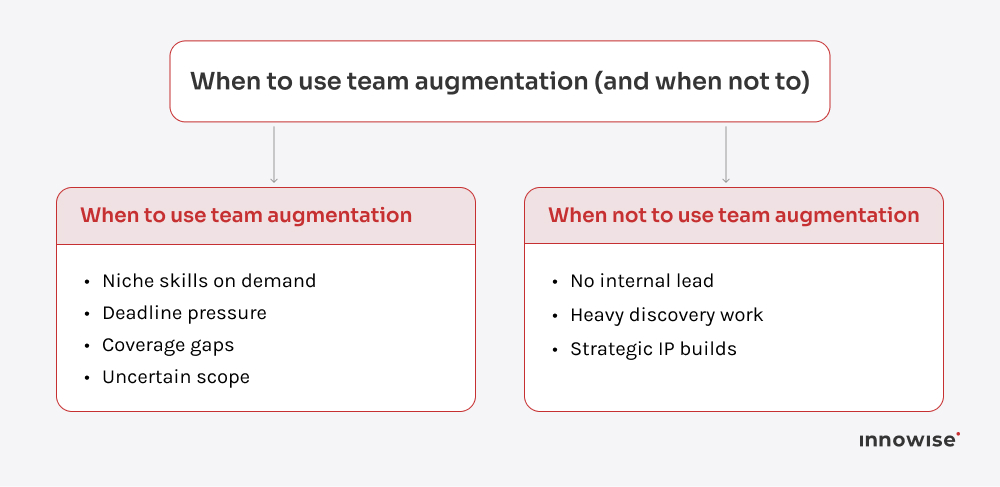
When to use team augmentation (and when not to)

Here’s the simplest way to frame it: software team augmentation works when you know what needs to be built but don’t have enough hands to build it. Het fails when you expect outsiders to invent your roadmap for you.

Think about it in terms of pressure points. If your backlog is clear but your capacity isn’t, augmentation is the lever. For example:

  • Demand for niche skills. Maybe you need a Go developer for a payment gateway or an ML engineer to tune an LLM pipeline. Hiring full-time makes no sense for a six-month window.
  • Deadline pressure. A product launch, compliance milestone, or client demo that simply cannot slip. Augmentation protects your timeline without derailing your core team.
  • Coverage gaps. A senior dev is on parental leave, or attrition hits unexpectedly. A temporary tech team extension keeps velocity steady while you regroup.
  • Uncertain scope. In early-stage prototypes or discovery spikes, permanent hiring is a gamble. Augmentation gives you flexibility while you figure out the long-term play.

On the other hand, there are cases where augmentation almost always backfires:

  • No internal lead. If no one owns delivery, augmented staff spin wheels. You end up paying for drift instead of progress.
  • Heavy discovery work. When the “what” is still fuzzy, it’s better to bring in a vendor under an extended team model or full outsourcing.
  • Strategic IP builds. If the project involves proprietary algorithms or deep domain retention, you’ll want permanent hires to lock in knowledge.
Two-column table showing when team augmentation is a good fit (niche skills, deadlines, coverage gaps, uncertain scope) and when not to use it (no internal lead, heavy discovery work, strategic IP builds).

So here’s the micro decision rule: If you have a delivery lead, a prioritized backlog, and a definition of done, development team augmentation works. If you don’t, you’re better off with outsourcing or a dedicated team.

What team augmentation really costs (rates and TCE)

Before committing to a technical staff augmentation partnership, it’s important to understand that hourly rates alone don’t tell the full story. To budget wisely and compare options fairly, you need to know what goes into those rates — and what the total cost of engagement (TCE) looks like once you factor in management, tooling, and ramp-up. That’s what helps you confirm you’re truly saving money compared to hiring in-house.

So what shapes those rates in the first place? A few main factors usually drive them:

  • Seniority. Mid-level, senior, and principal engineers sit in very different bands, often doubling in cost as you go up the ladder.
  • Region. Geography remains the biggest cost variable. For example, here’s a snapshot of average rates for 2026 across key markets:
Rol US/UK Oost-Europa LATAM
Senior backend engineer $100–$150/h $45–$70/h $40–$65/h
Mobiele ontwikkelaar $90–$130/h $40–$65/h $35–$60/h
DevOps/cloud engineer $110–$160/h $50–$75/h $45–$70/h

The US and UK command premium rates, while Oost-Europa en LATAM often offer the best balance of quality and affordability. Asia tends to be cheaper, but consistency varies.

  • Skill scarcity. Specialized domains like AI/ML, DevSecOps, or blockchain usually carry a 20–40% premium.

That’s the visible part of the equation. But the full picture (what actually determines your ROI) comes from calculating the TCE (Total Cost of Engagement):

TCE = vendor rate × hours + internal management load (10–20%) + tooling/licenses + onboarding + roll-off and knowledge transfer.

Why does this matter? Because a $60/h Eastern European developer doesn’t equal $60/h once you include management and ramp-up. But even after you add those hidden costs, the value is usually still strong. You’re getting access to high-quality talent at 40–60% less than a US hire, without the long-term liability of permanent headcount. That’s what makes software development team augmentation competitive against alternatives like contract staffing.

Add skills for a sprint, a quarter, or long-term — your call, our talent pipeline

The risks of team augmentation and how to handle them

No matter how good the vendor pitch sounds, technical team augmentation comes with risks. The trick isn’t to pretend they don’t exist, but to spot them early, set up the right guardrails, and keep control before anything slips. With the right plan, you don’t just deflect these risks. You reduce your exposure to almost none. Here are the big ones I’ve seen play out, and how to stay ahead of them.

Management overhead

Augmented engineers don’t magically self-organize. They need context, backlog grooming, and clarity on what “done” means. I’ve seen teams add three developers and then lose two sprints’ worth of productivity because no one had time to onboard them properly.

Mitigation: Treat onboarding as part of delivery, not an afterthought. Build a 72-hour starter plan: repo access, coding guidelines, environment setup, and a first small PR. Then use a RACI chart (who’s responsible, accountable, consulted, informed) so augmented staff know who to escalate to. Weekly cadences with clear KPIs (velocity, PR throughput) keep alignment tight.

Business impact: Instead of burning cycles, you get productivity from week two, not month two.

Security and IP protection

Every new laptop connected to your infrastructure is a new attack vector. I’ve seen companies give augmented staff admin rights right away, not because they needed it, but because no one stopped to define roles properly. That’s the real issue. On the IP side, vague contracts can leave ownership murky, especially if subcontractors are involved.

Mitigation: Enforce least-privilege access (start with read-only, expand gradually). Require VPN, SSO, and MFA. Contractually, insist on IP assignment clauses, NDA coverage, and confirm whether the vendor uses employees or sub-vendors.

Business impact: Protects you against data breaches and ensures code ownership is indisputable in case of audits, M&A, or investor due diligence.

Time zone friction

Distributed teams often underestimate the lag created by asynchronous work. A PR sitting idle for 18 hours can derail sprint velocity. Worse, a lack of overlap means small blockers snowball.

Mitigation: Secure at least 2–3 hours of timezone overlap with your core team. Establish async rituals: written stand-ups in Slack, PR templates with context, and Loom walkthroughs for complex tasks. Document decisions in Confluence or Notion instead of burying them in chat.

Business impact: Prevents time zone differences from slowing delivery. With structured overlap and clear async habits, your team stays responsive. Blockers get resolved fast, and work keeps moving even across continents.

Talent churn

Vendors’ promises about “stable staffing” don’t always match reality. Developers get reassigned, leave mid-project, or rotate internally. Even subtle bench swaps can kill momentum if knowledge transfer isn’t managed.

Mitigation: Demand a trial sprint before workforce scaling. Negotiate replacement SLAs (e.g., like-for-like replacement within 10 business days). Build documentation into your definition of done (diagrams, ADRs, onboarding notes) so knowledge doesn’t walk out the door with one engineer.

Business impact: Protects your delivery velocity from people risk, keeping deadlines intact even if an engineer rolls off.

Cultural misalignment

This one’s underrated. Some teams expect daily proactive updates; others value independence until a blocker arises. I’ve seen talented engineers labeled “underperforming” simply because they didn’t match communication norms.

Mitigation: Run a cultural onboarding session: how to raise blockers, who approves merges, and expected update cadence. Pair them with an internal buddy for the first sprint. Align on collaboration tools (Slack vs. Teams, Jira vs. ClickUp).

Business impact: Prevents “silent friction” that eats morale and productivity, ensuring external staff feel like a true remote team extension, not outsiders.

Handled proactively, these risks may become advantages. You build a more resilient, documented, and process-driven team. That’s the hidden benefit of software development team augmentation done right: you emerge not just with more capacity, but with better engineering hygiene across the board.

Accelerate backlog delivery without burning out your core team

The team augmentation playbook (5 steps to start fast)

Rolling out technical team augmentation isn’t just “hire and plug in.” To make it work, you need a repeatable playbook that covers scoping, vendor evaluation, onboarding, and governance. Here’s the framework I’ve used across multiple engagements:

1. Scope the gap

Don’t start with the headcount, start with the gap. Define what’s blocking delivery right now: velocity, niche skill, or coverage. Be specific: “We need a senior React developer for the payments module for 3 months” is actionable. “We need more frontend capacity” is not.

  • Pro tip: Tie the augmentation request directly to backlog items or roadmap milestones. That way, you can measure ROI.

2. Shortlist vendors

Skip the glossy decks, look under the hood. You want a partner that can provide not just CVs but bench depth, replacement guarantees, and proven experience in your domain (fintech, healthcare, e-commerce).

  • Checklist to use: candidate screening depth, security posture, ramp-up speed, and trial policy.

3. Interview with intent

Treat it like a hire. Go beyond assessing coding skills, test for communication, async readiness, and problem-solving. I’ve had great coders fail because they couldn’t work across time zones.

  • Rubric to include: live coding or take-home, system design, plus a written task to test clarity of documentation.

3. Interview with intent

Treat it like a hire. Go beyond assessing coding skills, test for communication, async readiness, and problem-solving. I’ve had great coders fail because they couldn’t work across time zones.

  • Rubric to include: live coding or take-home, system design, plus a written task to test clarity of documentation.

4. 72-hour onboarding plan

This is where most teams fail. If augmented developers spend their first week waiting for repo access, you’ve already lost money.
  • Day 1–2: tool setup, security clearance, walkthrough of coding guidelines, assign internal buddy.
  • Day 3: small PR merged (bug fix, test case). This proves that the environment is working and the developer can navigate your stack.
  • Deliverable: developer is on the sprint board by the end of week one.

5. Quality governance

Once the team is live, shift focus to outcomes, not hours. Track quality with objective metrics:

  • Definition of Done baked into Jira tickets.
  • Peer reviews (2 reviewers per PR).
  • DORA metrics: lead time, deployment frequency, failure rate, MTTR.
  • PR review density: if code isn’t getting reviewed, that’s a red flag for disengagement.

6. Trial sprint before scaling

Before you expand from one developer to a full, scalable development team, run a 2-week trial sprint. Measure fit, collaboration, and delivery. If it works, scale confidently. If not, you can rotate talent with minimal sunk cost.

Remember: Augmented developers should be slotted in thoughtfully. See “How to build software development team structure” for tips on structuring teams for optimal collaboration.

How to choose the right vendor: the checklist I would use myself

If you’re weighing a partner for software team augmentation, don’t be swayed by branding alone. The only thing that matters is how they’ll actually support your delivery. Use this checklist to cut through the noise and see who’s really fit to work with your team.

  1. Depth of technical screening. Don’t settle for vendors who rely only on HR interviews. Ask who evaluates candidates: do senior engineers join the interviews for live coding, system design, or architecture reviews? The difference between “resume matching” and rigorous technical vetting is the difference between a productive developer in week two versus dead weight you’re forced to babysit.
  2. Ramp-up speed. Speed isn’t everything. But if a vendor takes three weeks just to show you a CV, they’re not prepared for modern delivery needs. A good partner can provide initial profiles within 48–72 hours and onboard within 1–2 weeks. This is critical when you’re filling gaps due to attrition or a looming launch deadline.
  3. Replacement SLA. Engineers may leave. And that’s alright. What matters is how fast you get a replacement. Demand a clear SLA: e.g., like-for-like replacement within 10 business days. Vendors without one push their bench risk onto you.
  4. Security posture. This is non-negotiable. Confirm certifications (ISO 27001, SOC 2), secure VPN usage, access controls, and data residency practices. Every augmented developer is effectively a new endpoint on your network, so treat them as such.
  5. IP assignment clarity. I’ve seen contracts that left code ownership ambiguous because of subcontractors. Make sure the vendor guarantees all deliverables are work-for-hire and IP is automatically transferred to you. This protects you in audits, M&A, or investor scrutiny.
  6. Time zone overlap. Don’t be fooled by “24/7 coverage” claims. You need at least 2–3 hours of daily overlap with your core team. Without it, feedback cycles stretch for days. Clarify this upfront.
  7. References in your domain. Generic experience is fine; domain experience is better. A fintech project isn’t the same as a medtech one. Ask for references or case studies in your industry — it shortens ramp-up because developers already understand regulatory and architectural constraints.
  8. Trial policy. The best vendors let you run a 2-week pilot or trial sprint with minimal commitment. If they resist, ask yourself why. A trial gives you a low-risk way to test fit, communication, and productivity.
  9. Transparency of resourcing. Some vendors quietly subcontract. That’s a red flag, it introduces risk you can’t control. Ask directly: “Are these employees on your payroll?” and insist on transparency in contracts.

Check all these boxes, and you avoid the pitfalls of pure supplemental staffing. Instead, you end up with a scalable development team, one that integrates cleanly, respects IP, and stays resilient under pressure.

Tap into niche skills your in-house team doesn’t cover

FAQ

Augmentation doesn’t replace a core team, it complements it. Think of it as a bridge: you get immediate delivery power without committing to permanent headcount. Many executives use it to validate whether they really need a role long-term, or to stabilize delivery until full-time hires are made. Done well, it reduces the risk of overhiring while still protecting timelines.

Yes, but it depends on the maturity of both the vendor and your internal governance. While most engagements start with execution tasks, senior augmented developers can step into tech lead, mentorship, or even architectural responsibilities. The key is clear scope, strong onboarding, and ensuring knowledge transfer mechanisms are in place so expertise isn’t locked with one individual.

Any industry where tech demand outpaces local hiring supply benefits, but I’ve seen it particularly impactful in fintech, healthcare, SaaS, and e-commerce. These fields face both regulatory deadlines and rapid innovation cycles. Augmentation allows companies to bring in specialists (PCI, HIPAA, AI/ML) without waiting months for permanent hires, protecting both compliance and competitiveness.

Don’t measure it just by hourly rate. ROI shows up in backlog burndown, delivery velocity, and ability to hit roadmap milestones without slipping. A good benchmark: compare projected vs. actual time-to-market if you had relied only on in-house capacity. If augmentation helps you launch sooner, capture revenue earlier, or avoid penalties, it’s paying for itself.

The biggest cultural risk is creating a “them vs. us” dynamic. If augmented developers are treated as outsiders, communication slows and accountability blurs. The mitigation is to onboard them like real team members: give them access to rituals, channels, and context. When external staff feel included, they align with your culture instead of creating friction.

Dmitry leidt de technische strategie achter aangepaste oplossingen die echt werken voor klanten - nu en wanneer ze groeien. Hij combineert visie met praktische uitvoering en zorgt ervoor dat elke build slim, schaalbaar en afgestemd op het bedrijf is.

Inhoudsopgave

    Contacteer ons

    Boek een gesprek of vul het onderstaande formulier in en we nemen contact met je op zodra we je aanvraag hebben verwerkt.

    Stuur ons een spraakbericht
    Documenten bijvoegen
    Bestand uploaden

    Je kunt 1 bestand van maximaal 2 MB bijvoegen. Geldige bestandsformaten: pdf, jpg, jpeg, png.

    Door op Verzenden te klikken, stemt u ermee in dat Innowise uw persoonsgegevens verwerkt volgens onze Privacybeleid om u van relevante informatie te voorzien. Door je telefoonnummer op te geven, ga je ermee akkoord dat we contact met je opnemen via telefoongesprekken, sms en messaging-apps. Bellen, berichten en datatarieven kunnen van toepassing zijn.

    U kunt ons ook uw verzoek sturen
    naar contact@innowise.com
    Wat gebeurt er nu?
    1

    Zodra we je aanvraag hebben ontvangen en verwerkt, nemen we contact met je op om de details van je projectbehoeften en tekenen we een NDA om vertrouwelijkheid te garanderen.

    2

    Na het bestuderen van uw wensen, behoeften en verwachtingen zal ons team een projectvoorstel opstellen met de omvang van het werk, de teamgrootte, de tijd en de geschatte kosten voorstel met de omvang van het werk, de grootte van het team, de tijd en de geschatte kosten.

    3

    We zullen een afspraak met je maken om het aanbod te bespreken en de details vast te leggen.

    4

    Tot slot tekenen we een contract en gaan we meteen aan de slag met je project.

    pijl