The power of data mapping in healthcare: benefits, use cases & future trends. As the healthcare industry and its supporting technologies rapidly expand, an immense amount of data and information is generated. Statistics show that about 30% of the world's data volume is attributed to the healthcare industry, with a projected growth rate of nearly 36% by 2025. This indicates that the growth rate is far beyond that of other industries such as manufacturing, financial services, and media and entertainment.

Nearshoring software development to Poland: 2026 rates & key insights

Dec 5, 2025 12 min read

Key takeaways

  • Nearshoring to Poland enables scaling engineering capacity without quality loss. Its 500K+ talent pool, backed by deep academia and a global tech presence, has nurtured high-end services that go far beyond “working hands”.
  • Poland’s IT sector offers solid niche expertise. With its tech hubs building strong domain knowledge, it became easier to nearshore development teams in Poland for AI, healthtech, fintech, and other specialized projects.
  • Lower TCO without hidden costs is achievable with Poland’s vendors. You get high service quality thanks to maintainable code and a culture of ownership. Pricing stays transparent and vendor turnover remains low.
  • Partner with a trusted vendor to get started quickly and ensure compliance. Experienced firms with a large talent pool and a distinguished track record bring you top expert teams and help you stay compliant with Polish laws.

Over a decade ago, Poland began moving from a low-cost outsourcing hub to a high-value technology destination. And this shift has paid off, as the numbers clearly show. Revenue from Poland’s IT services is expected to hit USD 13 billion by 2029 — about 3x that of Romania and the Czech Republic, and about 5x that of Hungary and the Baltic countries combined.

Today, companies that choose Poland for nearshoring seek high quality, enterprise-grade capabilities, and long-term partnerships — in short, strategic outsourcing. For years, Poland has cultivated the favorable conditions to make this happen through a business-friendly ecosystem, strong economy, and Western cultural alignment, gradually adopting global best practices. Sounds promising, but how does it work on the ground? And how can you apply it to your own project?

Let’s dive into the fresh data on opportunities, rates, and challenges of software nearshoring to Poland.

Why nearshore software development to Poland

Talent maturity

High-end IT talent is one of the main reasons to outsource software development to Poland. Polish specialists are known for their skill depth and strong industry-specific expertise. It starts with academia: students gain hands-on experience through strategic collaboration between universities and industry. Tech-led courses, company-run programs, and internships at global giants are common at Polish universities.

IT in Poland has matured with a broad global tech presence. There are over 40 technology parks and accelerators across the country, while Google, Microsoft, Intel, IBM, Nokia, Samsung, and other global players have held their R&D centers here for nearly two decades. This has shaped development standards and a corporate culture that have essentially become national.

As a result, specialized tech hubs in Poland have emerged, fostering highly skilled experts in the most in-demand IT domains.

FieldIn-demand applications
Fintech
  • Fraud detection and AML/RegTech tools
  • Open banking and payment APIs
  • Crowdfunding and peer-to-peer lending marketplaces
Healthtech
  • Telemedicine and virtual care platforms
  • AI-based remote diagnostics & screening
  • E-prescriptions, referral systems, and patient data management
AI & Machine Learning
  • Computer vision and image analysis
  • Natural Language Processing and virtual assistants
  • Predictive analytics in finance, marketing, logistics & manufacturing
Cybersecurity
  • AI-powered threat detection & incident response
  • Cloud and infrastructure security
  • Fraud & anomaly detection for finance and e-commerce
Blockchain
  • Smart contracts and tokenization systems
  • Document verification and digital identity solutions
  • DeFi infrastructure & decentralized exchanges

Cross-functional teams for large-scale projects

Poland’s IT talent pool is the largest among Europe’s nearshoring destinations, exceeding 500K experts. Much of this talent is concentrated in large and corporate enterprises that have 250–1,000+ engineers on board. This mature ecosystem means development teams are built faster, especially for extensive projects where versatile skills, complex processes, and strict regulatory compliance are required.

Poland also bridges both ends of the market: startups needing agile, multi-skilled engineers and enterprises modernizing mission-critical systems. A strong development crew with flexible processes can be found for virtually any need. This allows companies to increase engineering capacity without loss of quality.

Optimal cost-to-quality balance

Countries like the Czech Republic, Hungary, or Latvia can promise Poland-grade code quality, but Poland leads in terms of scale and breadth of enterprise delivery. That vast experience translates into faster delivery without losing time on process alignment, onboarding, or rework.

Polish teams rely on advanced engineering practices: CI/CD integration, automated testing, peer code reviews, and ISO/ISTQB compliance are a must. When it comes to regulated industries, Polish software developers require less onboarding and learning, which in turn minimizes error risks or rework, because they have a working regulatory knowledge.

To sum up: IT nearshoring services in Poland are of high quality all around, even for one-of-a-kind projects. Costs, in turn, are equal to or lower than what nearby competitors offer.

Thriving & stable business environment

Poland demonstrates economic and policy resilience, which makes the country less vulnerable to external shocks. Back in 2008–2010, Poland was the only EU country that passed through the financial crisis without falling into recession. Poland has outperformed many EU peers in recent years due to strong domestic demand and EU-backed investment. Q2 2025 GDP growth of around 3.4% is one example. Such stability encourages Polish companies and their clients to plan multi-year (and multi-decade) delivery centers or vendor relationships.

As an EU member, Poland continues to strengthen its credibility. Billions in EU digital and green investments are powering cloud, cybersecurity, and infrastructure projects in Poland, which gives nearshoring partners access to modern tools and processes. Its policy environment is stable, with laws rarely changing drastically, which enables confident long-term planning for business.

Communication & cultural compliance

Poland has adopted a Western-oriented business culture with agile development practices. This ensures cross-border teams integrate quickly and work as one unit. Polish software developers bring direct and transparent communication and a proactive approach to problem-solving. In doing so, they address unclear requirements, technical constraints, and feasibility doubts before they can affect your project. As a result, you experience fewer misunderstandings and better product alignment.

With little time-zone overlap, teams collaborate in real time and solve issues as they arise, while shared EU business norms minimize contractual friction.

Poland ranks 13th globally in the EF English proficiency index, ahead of Romania, Hungary, and the Czech Republic. High English proficiency is common across Polish development teams, ensuring productive daily collaboration and rapid issue resolution.

Leo Iannacone VP of Engineering Plentific

“High seniority, high proactivity and high work independence and reasonable price. Really great people.”

  • Industry Software
  • Team size 10 specialists
  • Duration 28 months
  • Services Staff augmentation

What to expect: salaries & rates in 2026

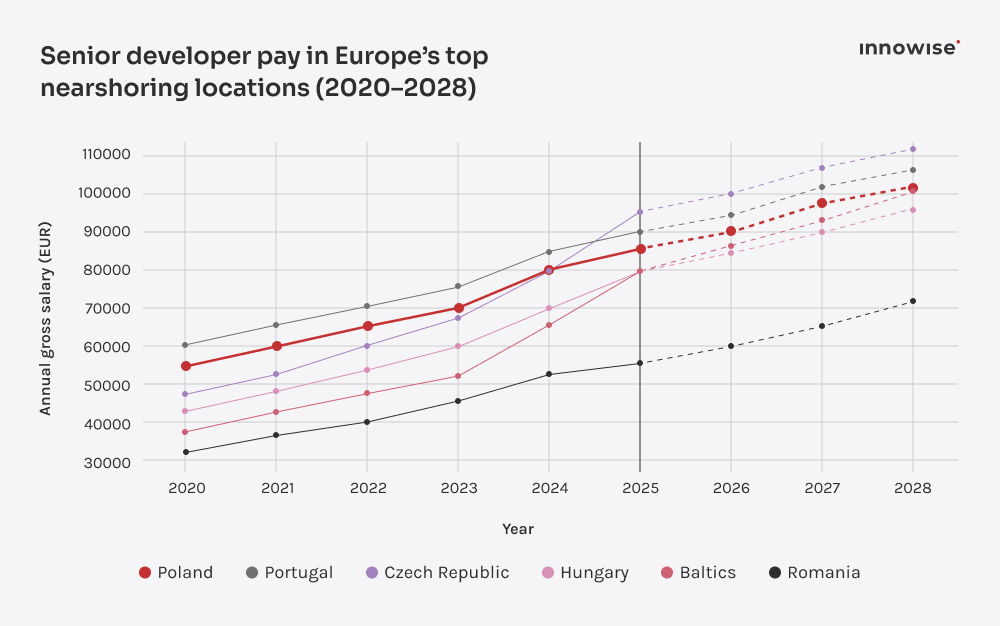
Poland is no longer positioned as the region’s lowest-cost nearshoring destination. However, recent trends show that many of Poland’s traditional nearshoring competitors are experiencing sharp outsourcing rate increases, and this is expected to continue. The Czech Republic has already overtaken Poland in average rates, while the Baltic countries are projected to catch up soon. Hungary is now almost on par with Poland. So, price can no longer be seen as the decisive factor, as rates across the region are nearly equal.

Remarkably, Poland manages to keep this pace despite inflation running 1–3% higher than in Latvia, Lithuania, and the Czech Republic throughout 2024. Poland’s market is more advanced and enterprise-driven, filled with large clients operating under 12–18 month fixed-rate contracts that create a stabilizing price gravity. This makes Poland a more reliable nearshoring destination, less dependent on external shocks and pricing volatility.

Vendor hourly rates, 2025: Poland vs Western EU

Polish IT rates range from €30 to €70, depending on experience level and role. Even at the higher end, these rates remain significantly lower than Western European averages. Let’s take a closer look.
PositionPolandWestern European averagesSavings vs EU
Mid Software Engineer€30–45€50–75↓30–40%
Senior Software Engineer€45–60€70–100↓30–40%
Tech Lead / Architect€30–45€30–45↓30–40%
QA Engineer€60–80€90–130↓25–35%
DevOps / Cloud Engineer€55–75€80–120↓30–40%
Data Engineer€55–75€80–120↓30–40%
ML Engineer€65–85€90–140↓25–40%
Project / Delivery Manager€55–70€80–110↓25–35%
As you see, nearshoring to Poland cuts development costs by more than a third without sacrificing quality.

Plan your project with Polish IT experts

Transparent rates, detailed cost breakdowns, and clear staffing scenarios — all with Innowise.

Poland vs. other Eastern European destinations

When nearshoring to Poland, you get enterprise-grade quality and advanced security backed by EU regulations. Despite similar compliance standards, a close business culture, and English proficiency in other top nearshoring destinations, Poland has what makes the strategic difference.

Poland vs. Romania

Romania is hard to beat on cost — it’s really affordable. However, with an average rate of €28, you trade that for a talent pool that’s about half the size and a less concentrated market. Compared with Poland’s density of 500–2,000+-engineer firms, Romania has fewer mid-sized providers able to ramp multiple squads at once. The market is largely formed with vendors relying on one or two major clients, putting your project at risk in case one gets canceled.

English is widely spoken in Romania’s major hubs, reaching a proficiency level comparable to Poland. Still, it might be hard to find strong teams for cloud and DevOps for hyperscaling — that’s rarely an issue in Poland. If your project is short-term, Romania can be a safe bet, while Poland is a more stable and reliable choice for building complex systems that need to scale and evolve over time.

Poland vs. Czech Republic

The Czech Republic is strong in fintech, embedded, and cybersecurity, which is also reflected in higher pricing. With comparable expertise, you’ll pay about 10–15% more for Czech teams than for Polish ones. You’ll find it very convenient to hire freelancers in the Czech Republic who use the OSVČ trade-license system — the country’s framework for self-employed professionals. But when you’re seeking a crew for an ambitious endeavor and need more freedom with project changes, Poland wins again with flexible B2B contracting as the dominant model. Moreover, Czechia’s IT workforce is two times smaller than in Poland. Building a complete, multi-role team through a single Czech vendor can take several months, particularly for mid- to large-scale projects.

For projects requiring specialized fintech or embedded expertise, Czech vendors may be suitable. In most other scenarios, Poland offers a larger talent pool and more cost-effective options.

Poland vs. Baltics

One of the reasons the Baltics are often considered as one IT region is their relatively small talent pool — <100k IT professionals across Lithuania, Latvia, and Estonia in total. In each country, you may face challenges ramping up fast and or finding benches for niche role mixes. The Baltics are innovative, with over 2,500 startups registered. Startup culture runs deep here, especially in fintech, medtech, and transportation. It’s a product-minded region, yet local hyperscaler hubs for deployment are rare.

If your project needs lean, senior-heavy squads with a strong startup DNA, Baltics may be the right call. But if you need the same plus quick enterprise-grade scalability, Poland covers it all in one go.

DestinationAvg. hourly rateStrengthsWeaknesses
Poland~€37Largest IT talent pool in EU, mature IT hubs, strong enterprise vendors, deep domain expertise (fintech, cloud, data)Wage growth pressure (cost creep), competition for seniors in top cities
Romania~€28Lowest EU costs among peers, good English in major hubsSmaller pool vs Poland, faster wage inflation, some policy volatility
Czech Republic~€46High delivery quality, strong R&D presence (Prague/Brno)Higher rates, smaller scale, harder to ramp large teams
Baltics~€40Very digital, large ICT-specialist share, good for product squads and startupsLimited absolute scale, senior premiums in niche stacks
At Innowise, we help make your nearshoring choice a strategic advantage. With our well-vetted talent pipeline and reasonable pricing, you can ramp up and down quickly on your terms. Throughout the project, you stay in full control through transparent reporting and communication designed for long-term collaboration.
Global Development Director

Risks of software nearshoring to Poland and how to mitigate them

Talent competition for high-end experts

Talent competition is fierce in Poland. With Big Tech, local unicorns, and global startups expanding their engineering teams, securing top talent can take time. This is especially true for high-demand fields like AI/ML, DevOps, and cloud.

Experienced providers already maintain vast in-house talent pools, pre-vetted pipelines, and stable retention frameworks. For example, at Innowise, we have:

  • 3,000+ experts onboard
  • 70,000+ vetted profiles across major tech stacks
  • 5-day hiring turnaround
  • Project-ready teams with AI, DevOps, and cloud experience

This means you don’t compete for talent — you just get access to it.

Rising costs

Developer salary in Poland is projected to grow at a CAGR of around 8%, reaching roughly 50% higher levels by 2030. To mitigate long-term financial exposure, cooperate with partners who offer flexible pricing and engagement models and are ready to agree on growth “corridors” tied to market benchmarks. For instance, a dedicated team provides a long-term agreement with fixed or corridor-based rates that enable predictable costs while allowing gradual adjustments to market conditions. Full outsourcing allows for the highest price stability, as both the scope and total cost can be fixed from the outset.

Complex regulations

Poland has strict labor and IP frameworks that differ from Western norms. For instance, if a contract lacks clearly defined roles, working hours, or probation terms, parts of the agreement can be rendered unenforceable. If developers hired under B2B contracts perform duties resembling employment, authorities may reclassify them as employees. Such disputes can delay projects, block payments, or even void the agreement entirely.

As for Intellectual Property (IP), it’s not always automatically assigned to the client in Poland. If IP clauses are poorly drafted, you may face disputes over ownership, licensing, or commercialization.

Since most bureaucratic responsibility falls on the Polish vendor, find one you can trust — a reputable provider that has a proven and legally compliant track record.

Steps to nearshoring efficiently in Poland

1 – Define goals & engagement model

Start with a core priority for your project, e.g., faster delivery, niche expertise, or cost optimization, and align these goals with KPIs before selecting a vendor. In Poland, you don’t need to sacrifice one or another. Then, clarify if you need team extension, a dedicated squad, or full-cycle delivery. Poland’s vendor ecosystem is developed enough to support all three models with equal quality.

2 – Choose a software development partner

Use directories (Clutch, SoDA, ABSL), review case studies, and check domain expertise to find the right match across all your strategic priorities. Prefer vendors that already serve Fortune 500 clients, as it proves enterprise-grade experience with rigorous compliance.

3 – Structure transparent contracts

Although Poland’s EU legal environment minimizes hidden risks, you should still ensure IP rights, GDPR compliance, service levels, and scaling flexibility are covered. Wrong employment arrangements can lead to delays or even canceled contracts. Proven partners are typically open to consulting you on legal aspects.

4 – Focus on smooth integration

Strong English proficiency in Polish IT teams and cultural alignment make integration with in-house teams smooth — but don’t neglect onboarding. Align workflows with Agile, CI/CD, DevOps, and shared tools (Jira, GitHub, Slack). Ensure a single point of contact is assigned from day one.

5 – Prioritize long-term TCO over day rates

Don’t chase the cheapest vendor — it’s the fastest way to lose money in the long run. Focus on well-developed code practices, low turnover, and robust compliance, which reduce hidden costs and make your outsourcing investment pay off over time. Run a pilot project to test this.

Full-cycle outsourcing team

Get Poland’s best in quality, culture, and ownership — driving outcomes you can rely on.

Why choose Innowise as your nearshoring partner

  • In-depth expertise in EU projects. We specialize in AI/ML, fintech, medtech, blockchain, sustainability, and other in-demand areas in the EU. Our engineering teams are well-versed in GDPR, PSD2, MDR, and other European compliance frameworks.
  • Free scaling with a 3,000+ talent pool. We have well-formed HR processes to attract and retain high-end talent across custom software, AI, cloud, DevOps, and other in-demand specialties. We are fast, processing your requirements, picking up candidates, and organizing interviews within several days. Our processes are designed to scale teams up or down easily, depending on your project needs.
  • Praised & recognized. We have a long track record with globally known companies, delivering both mission-critical and innovative software. Innowise regularly appears in Clutch’s top rankings: top development company (three years in a row), as well as top AI, web, mobile, enterprise, e-commerce, and financial app developer.
  • Strong industry compliance. Innowise holds multiple international certifications, such as ISO 13485 for medical devices / SaMD & SiMD, ISO 9001 for quality management, and ISO 27001 (with ISO 27017/27018 extensions) for security. Innowise-developed products get approved faster and maintain recognized quality and the highest data safety standards.
  • Wide partner network. We help our clients integrate their solutions faster in a more reliable way through our partnerships with AWS, Google Cloud, SAP, IBM, and others. This ensures swift access to the latest cloud, data, and enterprise technologies.
  • Flexible engagement & pricing. Working with Innowise, you can add extra hands, complete a team with specialized experts, or delegate management and development end-to-end, with the same high quality. Pricing terms are negotiable, so you can hire both teams and single specialists at your convenience.

FAQ

Not usually, the two belong to two different segments, with Poland’s rates 15–20% higher than Romania’s. Romania is known as a low-cost option, suitable for assembling small teams when budget is the top priority. Poland is a high-quality destination, chosen for flexible and enterprise-wide projects, and an optimal cost-to-quality ratio.

Polish experts are ranking among the top in Europe, outpacing its traditional nearshoring competitors, such as the Czech Republic, Romania, and the Baltic countries. Baltic countries. They communicate fluently on complex technical issues and work comfortably with English-language documentation.

Vendors in Poland draw from one of the largest IT talent pools in Central Europe, with over 500,000 professionals. Many IT firms employ 500–2,000+ engineers and have robust HR processes to quickly add extra people to complete squads. These vendors also leverage agile practices and a broad contractor network to start with a pilot and expand smoothly to production scale.

Yes, especially when you nearshore in Poland. You eliminate risk from timezone gaps and cultural misalignment. You gain EU-level compliance, specialized experts, and enterprise-grade practices that Poland has accumulated over the years of hosting global tech giants.

Contracts in Poland follow EU standards, including GDPR compliance. Outsourcing agreements include clear clauses transferring intellectual property rights to the client upon delivery and payment. Combined with strong IP enforcement, Poland is one of the safest choices for nearshoring in Europe.

Dmitry leads the tech strategy behind custom solutions that actually work for clients — now and as they grow. He bridges big-picture vision with hands-on execution, making sure every build is smart, scalable, and aligned with the business.

Table of contents

    Contact us

    Book a call or fill out the form below and we’ll get back to you once we’ve processed your request.

    Send us a voice message
    Attach documents
    Upload file

    You can attach 1 file up to 2MB. Valid file formats: pdf, jpg, jpeg, png.

    By clicking Send, you consent to Innowise processing your personal data per our Privacy Policy to provide you with relevant information. By submitting your phone number, you agree that we may contact you via voice calls, SMS, and messaging apps. Calling, message, and data rates may apply.

    You can also send us your request
    to contact@innowise.com
    What happens next?
    1

    Once we’ve received and processed your request, we’ll get back to you to detail your project needs and sign an NDA to ensure confidentiality.

    2

    After examining your wants, needs, and expectations, our team will devise a project proposal with the scope of work, team size, time, and cost estimates.

    3

    We’ll arrange a meeting with you to discuss the offer and nail down the details.

    4

    Finally, we’ll sign a contract and start working on your project right away.

    arrow