Building management system (BMS) for corporate buildings: practical guide

Mar 9, 2026 17 min read

Key takeaways

  • Building management systems function as the central nervous hub that unites separate engineering communications into a single killer interface.
  • Smart orchestration of equipment operation allows cutting operational expenses by wiping out system idling without sacrificing employee comfort.
  • Predictive analytics transforms the approach to operations by detecting hardware failures before they occur and moving from emergency repairs to scheduled preventative maintenance.
  • Automated management of environmental parameters directly results in increased employee productivity via independent control of optimal indoor CO2 and temperature levels.
A modern office building today is a highly complex engineering organism, packed with miles of wiring, sensors, servers, and controllers. And if this organism doesn’t have a single digital ecosystem, let’s call it brains, it’s a guaranteed way to burn through your operational budget. I’m talking about a building management system. Without implementing a BMS, you get chaos where facility managers rack up miles manually adjusting the climate, and electricity & heat bills grow due to high usage from lights left on at night. The lack of centralized control also hits people: employees might complain about stuffiness or cold, which reduces their productivity. Moreover, uncontrolled resource consumption ruins your ESG indicators, which is critical today for business reputation and relations with investors. Furthermore, you are most likely leaving massive amounts of money on the table because 10-30% of the energy consumed by a commercial building is wasted. If your company isn’t currently using a BMS, you are paying for that waste every month. I always tell executives that buying the software is only half the battle because you absolutely need a hardcore integration partner to guide you through the total chaos of upgrading your facility. And here’s why:
  • Our goal is to make sure every single isolated system finally talks to the main brain of the building.
  • We take your high-level corporate goals and wire them directly into the logic of the building so the software actually serves your business and not the other way around.
  • We train your old-school engineers to embrace the new digital tools so nobody gets left behind or tries to sabotage the new upgrade.
  • Our experts totally customize the interface and the daily workflows to match your exact corporate structure instead of forcing your team to adapt to generic software.
  • We dodge vendor traps so nobody squeezes you for endless licensing fees or forces you to rip out perfectly good hardware just to buy their overpriced proprietary equipment.
  • We also lock down your network from hackers because treating your physical building like a highly vulnerable IT environment is absolutely mandatory today.

In this guide, I’m going to break down how a smart building management system brings order to the engineering chaos, what happens under the hood, and how we at Innowise build these solutions to stop the cash bleed.

What a building management system delivers in corporate buildings

Some people still mistakenly think that a BMS is just a convenient monitoring panel for a security guard at the reception. This is fundamentally wrong because the main goal of implementing such a system is to deliver concrete business value, measured in money and process efficiency.

When clients ask me about the feasibility of costs, I always explain that we are investing in optimizing your live cash and human resources, not pretty charts for sure. Though we still make them pretty and intuitive.

Now, let’s have a look at the key use cases of building management system software for corporate buildings.

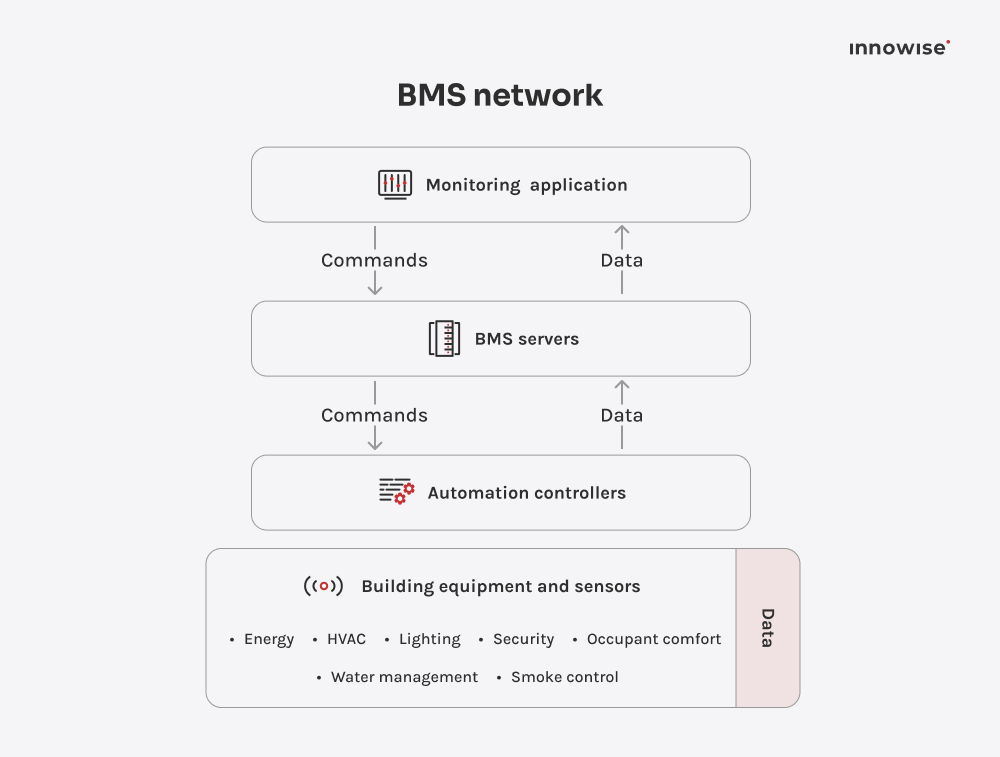
A diagram showing the network of building management systems.

Centralized control

I honestly think it is an absurd situation when a facility manager has to run to the 15th floor just to tweak a temperature setpoint or turn off the lighting on a local panel. 

A BMS solves this problem through a unified window where an operator in the control room or even on a tablet manages the entire zoo of systems: HVAC (climate), lighting, access control, and energy systems. And it feels great to switch the whole building to weekend mode with one click or pop the turnstiles open for evacuation without ever leaving the chair.

Energy efficiency and cost savings

I always tell clients they are basically burning cash if their software lets equipment run when nobody is looking. We see reduced utility bills immediately because a BMS dims the lights and switches ventilation to recirculation mode the second the motion sensors see an empty building wing.

Plus, you get optimized equipment use since air conditioners and pumps aren’t running 24/7, which means they last much longer, and you don’t have to blow your budget on new hardware every few years.

Safety systems

Running isolated security cameras and door locks is a recipe for disaster during an emergency. Let’s be real, if a fire breaks out or an intruder enters, you cannot afford to waste time checking three different screens. A BMS merges all your access control, surveillance video, and fire detection straight into one killer dashboard, so your team can spot threats and lock things down instantly without wasting precious time.

Water supply systems

Nothing destroys an expensive office faster than a busted pipe flooding the floors, so we always make sure a BMS keeps a very close eye on your pumps, drainage systems, and water pressure. An automated leak control can slam the valves shut the exact moment things go wrong, protecting your massive hardware investments.

Fire and smoke dampers position monitoring

Blindly hoping your fire dampers did their job during a real fire is a terrible operational strategy because you cannot guess when it comes to life preservation. We provide a direct connection from the fire panel to the main brain of the building so that you can see all open/closed positions of your smoke dampers in real time, right on your screen, without any dangerous guesswork.

Occupant comfort

In my experience, if your employees are freezing or sweating, they inevitably become frustrated, get distracted from tasks, and start complaining in a group chat. A BMS handles environmental parameters like temperature, humidity, and air quality in the background without staff needing to do anything! 

For example, when there is a spike in CO2 levels in an overcrowded meeting room, the system will spot it and deliver additional fresh air to the room, keeping productivity high without anyone realizing the automation is working.

Environmental impact

I see how investors are watching ESG ratings like hawks these days, so being green is actually a survival skill. It’s no wonder because the operations of buildings account for 30% of global final energy consumption, and buildings-related emissions must drop significantly to meet net-zero targets by 2050. Implementing a BMS gives you real energy-reduction numbers instead of just marketing fluff, which cuts your carbon footprint and hits those corporate sustainability goals. It is a massive reputation boost that proves to the market you actually treat resource consumption responsibly and are not just greenwashing.

Operational visibility for facility teams

You simply cannot manage what you do not measure, and I’m sure everyone hates flying blind when it comes to operations. BMS gives your team eyes with monitoring and reporting tools to see the real picture on the user-friendly dashboards.

You instantly spot where you are burning energy or where voltage is spiking, so you can make decisions based on hard analytics instead of guessing. This way, a facility director knows exactly where the budget is going without having to dig through piles of spreadsheets.

Booking modules

Integrating BMS with workspace management systems helps you use expensive office square footage more efficiently through smart booking logic. The business gets a real-time heat map of the load, which helps you avoid renting extra space and use existing equipment efficiently. It feels like a seamless experience for an employee who books a desk or room in the app and sees the lights and plugs turn on automatically the moment they show up.

Predictive maintenance and fault detection

Sudden equipment downtime costs businesses too much, so we at Innowise try to move clients from a fix-it-when-it-breaks model to predictive maintenance to drastically reduce downtime.

An intelligent building management system software spots micro-deviations way before a crash and pings an engineer to address them early. Planned equipment maintenance is always cheaper than emergency repair costs and prevents your business processes from stopping on a busy Monday morning.

Now that we understand the financial benefit for businesses, let’s look under the hood and break down the solution architecture.

Stop burning cash on high energy bills and manual repairs.

How building management system software works

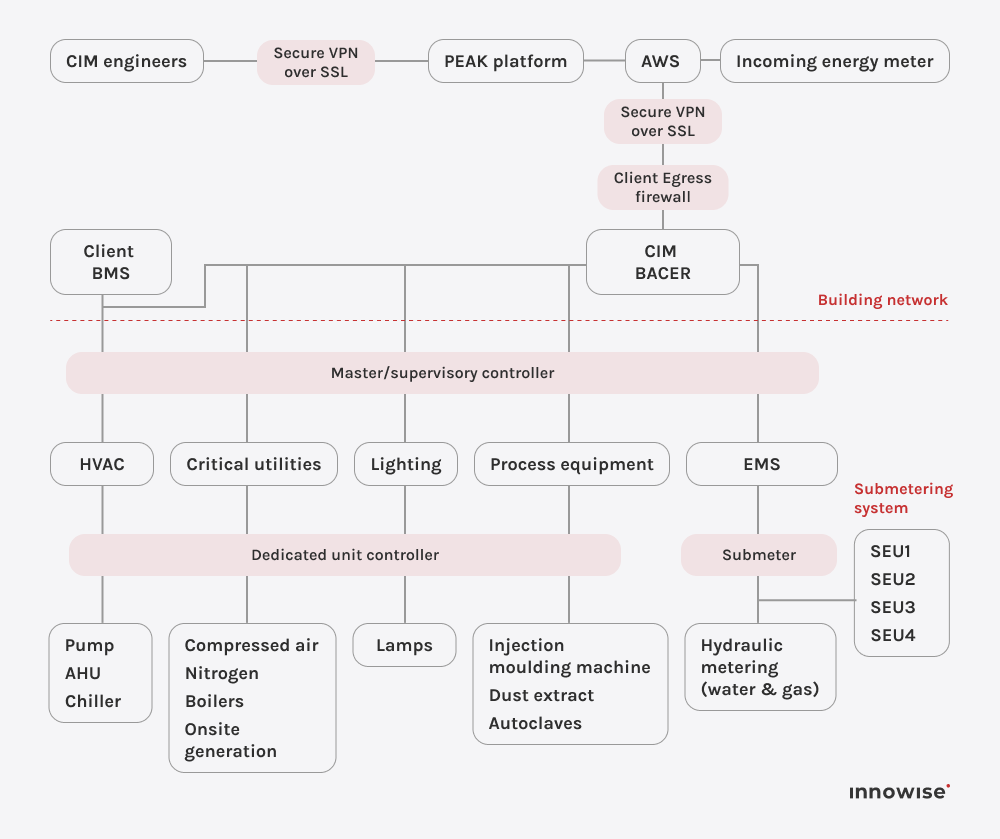
A modern BMS is a beast of a multi-layer IT ecosystem that requires a rigorous engineering approach to data and logic, so you need to respect the architecture.

An operational scheme showing how building management systems work.

Data collection from sensors and building equipment

Any automation starts with data collection from the fields: temperature sensors, damper actuators, water meters, elevator controllers, and other variables. From what I saw, the biggest headache we face is the zoo of protocols, because equipment from different vendors speaks different languages and doesn’t want to play nice together.

At Innowise, we develop what we call omnivorous software, where the ingestion layer pulls data through any protocol: LoRaWAN, BACnet/IP, Modbus (IP and RTU), M-Bus, LON, KNX, LPB, and more.

We simply build custom connectors that aggregate this entire stream into a single data lake for further processing because ripping out working hardware is a waste of money.

Predictive maintenance

When data is collected, analytics kicks in. Humans are bad at spotting subtle patterns, which is why we use ML algorithms for detecting issues before failures.

How does it work? For example, an ML model knows the normal operation profile of a fan motor, like vibration, current, and temperature indicators. If a bearing starts to wear out, vibration changes, even though the fan is still spinning. 

A human won’t notice if a fan’s vibration profile shifts, but the algorithm will see the anomaly and say: “In 2 weeks, this unit will break down.” This is how we implement an extending equipment life strategy by replacing a part for $50 now, instead of the entire unit for $5000 after a crash.

Management and automation through the software platform

You shouldn’t rely on humans to flip switches, so we deploy a fully automated rules engine to act as the central brain that handles all the decision-making logic in the background, so the software makes smart moves without you having to intervene constantly.

We set up cloud processing logic, such that if the CO2 sensor in zone B shows over 800 ppm during working hours, it opens the intake damper to 80%. 

For emergencies and critical safety scenarios, we rely on edge computing, so if the connection to the server is lost, the local controller immediately shuts off water in the event of a leak. This way, the building can protect itself even if the internet goes down.

Third-party integrations

I believe a BMS that lives in a vacuum is useless because it cannot talk to your other tools, so we build powerful APIs for communicating with the outside world. We integrate a BMS with booking modules so that when you create a meeting, the BMS sees the booking and turns on the climate 15 minutes before the start. 

We also link the system with access control: once you pass through the turnstile, the light turns on above your desk. And we integrate a BMS with your facility’s fire detection system so you have real-time visual proof of whether your fire dampers actually closed during an emergency. Finally, we push data to CRM and ERP systems to support end-to-end analytics and department-level expense billing.

BMS and related systems: understanding the differences

The industry loves throwing a million acronyms at you, and I see clients get confused trying to figure out what software they actually need. Let us slice through the jargon right now and map out exactly what these systems do.

BMS vs building automation system (BAS)

The line here is pretty thin, but it definitely exists because a BAS is mostly about lower-level hardware and local automation, which means the actual physical controllers that turn the dampers. We build a BMS as the top-level software, acting like a giant umbrella covering the whole building and managing all those local systems, so if a BAS is just a basic reflex, a BMS is the actual brain running the show.

BMS vs building energy management systems (BEMS)

Everything is pretty clear from the name here, since a BEMS is tailored exclusively for tracking your power consumption and optimizing your kilowatts. I see a BMS as a massive all-in-one platform that steers your energy, security, and elevators, so energy management is usually just one small module plugged into the main system.

A traditional BMS vs intelligent building management systems

Back in the day, these systems were closed and reactive, but today we only build smart building management systems, and the difference in what they can actually do for your building is absolutely colossal.

Feature Traditional BMS Intelligent BMS
Data analysis Reactive (react to breakage) Predictive (prevent failures)
Integration Siloed (proprietary protocols) Open API (open ecosystem)
Scalability Hard (physical server increase) Cloud-native (flexible scaling)
Updates Manual (engineer with flash drive) OTA (over-the-air updates)
Interface Complex schematics for engineers Intuitive dashboards for users
Show more

Why companies implement or modernize a BMS today

You might wonder why you need to modernize right now instead of waiting another couple of years, and the simple truth is the market is just pressuring businesses from all sides.

Rising energy and operational costs

This is definitely the ultimate economic driver since keeping the lights on and fixing outdated equipment is just bleeding your budget dry. Companies finally look at their crazy high electricity bills and understand that dropping cash on a modern platform is going to pay for itself in a year or two, just on the pure energy savings alone.

Regulatory and reporting requirements

The government is putting pressure on everyone with new carbon taxes and green standards. I always warn clients that this is a major legal driver, because missing those green marks means you are eating huge fines and losing your top-tier tenants, while upgrading your software just automates the reporting and actually cleans up your environmental footprint.

Outdated or fragmented legacy systems

This is a massive technical headache because old-hat hardware constantly breaks, and it’s hard to find the spare parts or the guys who actually know how to fix those ancient systems. I constantly run into buildings with a total zoo of hardware and software that are difficult to manage centrally, so modernizing your digital setup is the only real way to dodge a total system meltdown. Because a modern BMS can actually integrate those legacy solutions into a single platform.

Scaling building portfolios efficiently

Managing one office manually is fine, but when you are running a giant campus or fifty different branches, you desperately need a unified command center. Executives always want to see performance analytics across their entire real estate portfolio in one window to compare efficiency, and you are just not going to make that happen without a proper cloud solution.

How to choose building management system software

Choosing software in this niche is a real minefield where it’s easy to buy a pretty wrapper that won’t work with your hardware. As an Innowise expert, I compiled a checklist of what you really need to consider when choosing building management system software to avoid getting burned.

Compatibility with existing equipment and communication protocols

A solid BMS must support open standards and communicate with your older gear, so you don’t get trapped in terrible vendor lock-in. I see it as a massive red flag if a supplier demands you rip out perfectly working equipment just to buy their overpriced proprietary hardware instead.

Integration capabilities

Building an isolated system is a total waste of money, so having an API and SDK to talk to the outside world is absolutely mandatory. We will assist you in linking our software to any of your existing CRM, ERP, or parking booking tools to build a truly integrated and seamless digital enterprise environment.

Scalability across multiple buildings

Choosing the right solution today, which has true scalability, allows your infrastructure to grow at the same pace that your business grows in the future. The architecture that we build will allow you to start with a single floor and scale up to a large campus of multiple buildings without ever having to change your code or pay for an excessive number of licenses.

Usability for non-technical teams

I believe that the user interface should be so simple that it would be very easy to understand by a chief engineer with 40 years of hands-on expertise, and someone who has only 1 month of experience as a receptionist or office manager. If turning on the lights means typing in a command line, you have a terrible setup because the design needs to be user-friendly with intuitive dashboards that normal people can actually use.

Deployment models security and data ownership

We help clients choose between cloud and on-premises based strictly on their security needs, but locking down your data from hackers is always the top priority. I remind everyone that a physical building is just as vulnerable to cyberattacks as your IT network, so the system needs rock-solid encryption, and you must own your data instead of the vendor.

Drowning in a zoo of incompatible legacy systems?

How Innowise implements and modernizes BMS solutions

There is a myth I sometimes hear from clients that putting in a new system means dealing with dirt and construction that totally paralyzes the office. But at Innowise, we know exactly how to work with surgical precision, so your business keeps running smoothly.

Deploying BMS software in existing corporate buildings

To deploy a new building management system, we do not perform any demolition work. Our experts are rather integrators, and I see the task like this: find connection points, neatly install IoT gateways, connect to existing data buses, and output all this into our software. Most of the time, you won’t even have to stop using your offices because we simply overlay a digital layer on top of your existing infrastructure.

Upgrading or extending legacy BMS systems

The most frequent case we see in our practice is clients saying they have an old system that is pretty dumb, but still pushes air around, and we never suggest throwing all that working gear away. I am a huge fan of upgrading legacy BMS by adding a modern brain to the old hardware, so our team just installs top-level controllers that collect data and push it to the cloud for analytics. This fully revives your legacy setup, giving it a second life and new functions without wasting capital on replacing perfectly good peripherals.

Phased rollout across building portfolios

If a client has a massive portfolio of 50 buildings, we never try to implement everything at once because taking on that much risk is just crazy. 

We always stick to a phased rollout across building portfolios, where we take just one single building or floor as a pilot to test all integrations and set up the dashboards to show real efficiency first. Once we have a working template, we roll out the solution across the entire real estate portfolio, keeping the process safe and manageable.

Your concrete walls might be permanent, but your daily operations definitely are not. If growing your footprint means buying expensive new servers, you have a totally broken architecture because a solid cloud platform lets you push new efficiency rules to your entire global portfolio with just one click. And I know for a fact that a proper upgrade is just about dropping a smart digital brain right on top of your old equipment, so everything finally talks to each other without wasting your budget.

Marina Zaretskaya

Head of Energy, Oil & Gas Business Practice

Why trust Innowise with your BMS development

The market is absolutely flooded with generic boxed products that completely ignore how your specific business actually runs, so at Innowise, we focus on developing custom solutions that fit your workflow perfectly. We build a BMS that allows your hardware, daily processes, and your people to work together as one massive unified mechanism. My experience in the field proves over and over that choosing the right software delivers way more value than just blindly replacing your hardware, especially when we get into complex integrations and scalable cloud architectures. We know the gritty details of real estate in practice and build solutions that slash your OPEX and scale as you expand. If you are totally sick of bleeding cash and want absolute control over your assets, please feel free to contact us to discuss developing smart building management systems tailored to your technical specifications.

FAQs

Is BMS software suitable for existing corporate buildings?

Yes, we use slick wireless tech and IoT gateways to deploy the software in a fully operational office without disrupting your daily business.

What is the difference between BMS and building energy management systems?

The main difference is that a building energy management system is a tool for obtaining information about your total power usage, while a BMS can monitor and manage various aspects of your facility, including security, power consumption, and comfort level.

How does BMS software improve comfort for building occupants?

It works perfectly because the system adjusts the temperature and air quality in real time based on the exact number of people in the room, which wipes out discomfort and improves team productivity.

Can BMS software integrate booking modules for workspaces and equipment?

Yes, because we always integrate the system with calendars like Outlook, so your climate control automatically preps the meeting room before anyone even walks through the door.

How long does it take to implement BMS software?

Because our team relies on launching a fast pilot project, we can deliver the first real results and working basic functionality in just two to three months after we kick things off.

What is a building management system in simple terms?

Think of it as the ultimate digital brain of the building, bringing your lights, climate, and security into one killer app.

Why is a smart building management system worth the investment?

When investing in an intelligent building management system, you can expect a significant ROI from reduced utility costs and the prevention of expensive assets from malfunctioning, thanks to predictive analytics that provide preventive maintenance schedules.

Can an intelligent building management system work with old hardware?

Yes, our BMS uses gateways to integrate older equipment into the system, so you can modernize your engineering networks without replacing the entire existing physical infrastructure.

Chief Technology Officer

Dmitry leads the tech strategy behind custom solutions that actually work for clients — now and as they grow. He bridges big-picture vision with hands-on execution, making sure every build is smart, scalable, and aligned with the business.

Table of contents

    Contact us

    Book a call or fill out the form below and we’ll get back to you once we’ve processed your request.

    Send us a voice message
    Attach documents
    Upload file

    You can attach 1 file up to 2MB. Valid file formats: pdf, jpg, jpeg, png.

    By clicking Send, you consent to Innowise processing your personal data per our Privacy Policy to provide you with relevant information. By submitting your phone number, you agree that we may contact you via voice calls, SMS, and messaging apps. Calling, message, and data rates may apply.

    You can also send us your request
    to contact@innowise.com
    What happens next?
    1

    Once we’ve received and processed your request, we’ll get back to you to detail your project needs and sign an NDA to ensure confidentiality.

    2

    After examining your wants, needs, and expectations, our team will devise a project proposal with the scope of work, team size, time, and cost estimates.

    3

    We’ll arrange a meeting with you to discuss the offer and nail down the details.

    4

    Finally, we’ll sign a contract and start working on your project right away.

    More services we cover

    arrow