FinOps in practice: learn how to optimize cloud costs

Apr 8, 2026 11 min read
Summarize article with AI

Key takeaways

  • FinOps shifts the focus from reducing cloud costs to maximizing business value from technology spend.
  • Shared ownership is critical — engineering, finance, and business teams must all be accountable for cloud usage.
  • Most cost savings come from continuous optimization, not one-time cleanups.
  • In 2026, FinOps is expanding beyond cloud to AI, SaaS, and other areas, making it a core part of strategic decision-making.

See related pages

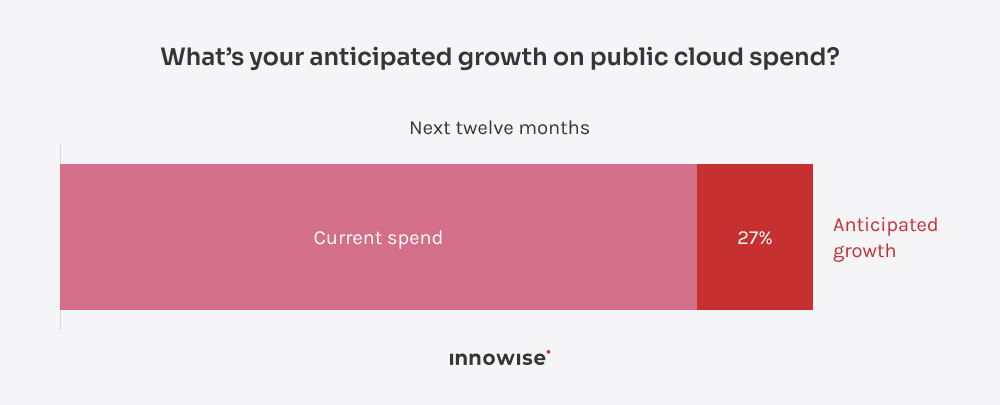
Cloud spending isn’t slowing down, but control over it still is.According to the latest Flexera 2026 State of the Cloud Report, 27% of organizations expect to increase their cloud spending, while 17% have already exceeded their budgets in the past year. And as companies adopt more services, especially AI, cloud cost forecasting and control are becoming even harder. In fact, estimated wasted spend has climbed back up to 29%, reversing years of improvement.
Chart showing current cloud spend and anticipated growth over the next twelve months

That combination is telling.

Companies struggle to keep cloud spending predictable, efficient, and aligned with business value. Even more surprisingly, fewer than half of organizations are fully using basic cost optimization tools like commitment-based discounts.

So the problem now is how that technology is managed. That’s where FinOps steps in to bring order to the chaos.

In this article, we will walk through what FinOps cost management really means, what good FinOps looks like in the real world, why it matters more than ever in 2026, and where companies usually go wrong when they try to optimize cloud costs.

What is FinOps?

FinOps is, at its simplest, a practice to keep cloud spending under control without slowing innovation down. It helps organizations manage and optimize cloud costs through shared responsibility, real-time visibility, and continuous optimization.

You might also come across related terms: cloud financial management, cloud optimization, or even cloud business office. But all of them are trying to solve the same problem: how do we get real value from what we spend in the cloud?

And that problem exists for a reason.

In a cloud environment, spending is variable and usage-based. As a result, traditional budgeting approaches don’t work well. Teams can provision infrastructure instantly, scale workloads automatically, and deploy new services at any time, which makes costs harder to predict and control.

In practice, that changes how decisions are made:

  • engineers see the cost of what they build and run,
  • finance gets clearer visibility and more accurate forecasts,
  • and business leaders can clearly link spending to business results and ROI.

So FinOps creates a culture where speed, quality, and cost are all part of the same decision-making process.

What “Good FinOps” looks like: Core principles

At a high level, FinOps follows a simple cycle: Plan RunSee Save.

But this cycle only works when it’s supported by the right principles across the organization.

  1. Teams need to collaborate. FinOps starts with collaboration. Finance, engineering, product, and leadership all need to work together instead of in silos. In reality, each of these groups sees the cloud differently: engineers focus on performance, finance on budgets, and business on outcomes. FinOps connects them, so decisions are made with all perspectives in mind.
  2. Business value drives decisions. FinOps is about getting the most value from what you spend. That means sometimes spending more is the right decision — if it improves performance, speeds up delivery, or drives revenue. The key is making conscious trade-offs between cost, speed, and quality.
  3. Everyone takes ownership. One of the biggest shifts in FinOps is ownership. Instead of finance being the only team responsible for costs, engineering and product teams own their cloud usage too. They see what they spend and are responsible for optimizing it — from architecture decisions to daily operations.
  4. Data must be accessible and timely. You can’t manage what you can’t see. FinOps relies on real-time, accurate cost and usage data that is available to everyone. This allows teams to react quickly, understand trends, and adjust before costs become a problem.
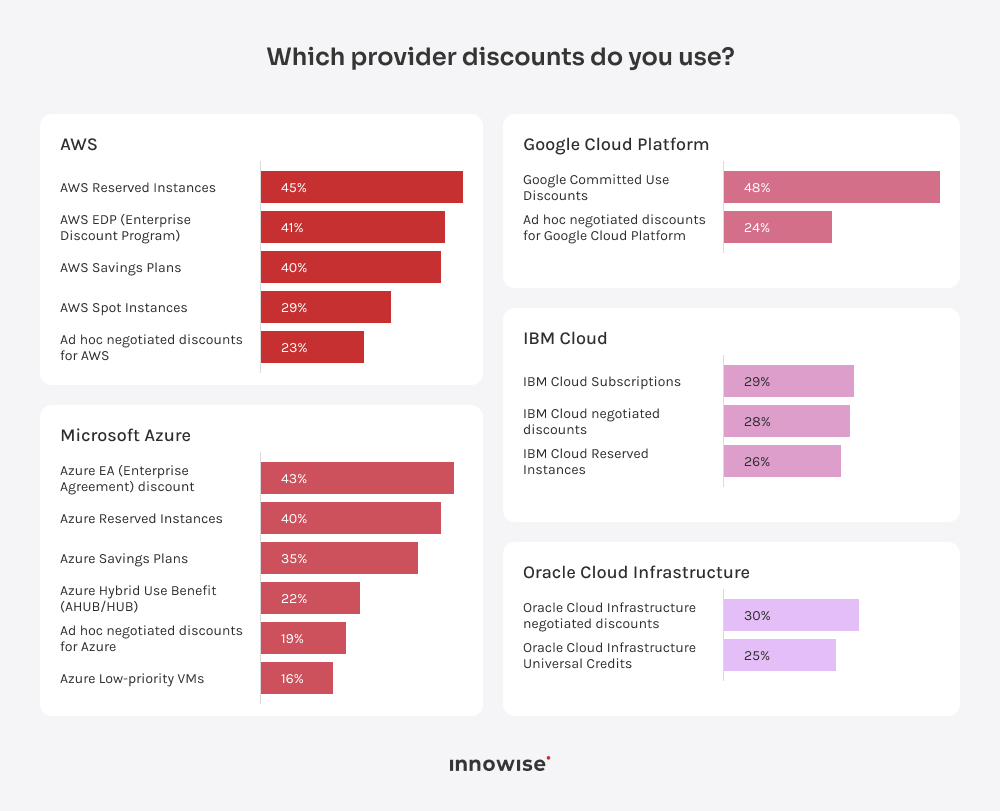
  5. Take advantage of the cloud’s flexibility. One of the cloud’s biggest advantages is pricing flexibility. FinOps encourages teams to actively use that flexibility: things like savings plans, reserved capacity, or scaling resources up and down based on demand. That’s exactly what we’re seeing in practice. According to the Flexera report, 48% of companies now use Google Committed Use Discounts, 45% leverage AWS Reserved Instances, and Azure commitments have also grown year over year.
Comparison of discount usage, including reserved instances and savings plans

Why FinOps matters in 2026

A few years ago, FinOps was mainly about cloud cost optimization. That made sense when cloud costs were the biggest concern and relatively predictable.

The 2026 State of FinOps report shows a different reality.

According to the State of FinOps report, 98% of organizations now track AI spend, which is a massive jump from just a few years ago. 

At the same time, FinOps has expanded well beyond traditional cloud cost management. Today, organizations are applying FinOps practices across a wide range of technology domains, including:

  • SaaS (90%)
  • Licensing (64%)
  • Private cloud (57%)
  • Data centers (48%)

This creates a simple but important problem: technology spend is now highly fragmented and distributed across different cost models, teams, and environments.

Because of that, the old approach (optimizing cloud costs) no longer works well. Lots of companies have already done that. In many organizations, the major optimization gains have already been realized, and further savings are incremental.

The question has therefore changed.

Instead of asking:
“How do we reduce costs?”

Organizations must now ask:
“Are we generating value from our technology spend?”

Another important shift is where FinOps sits in the organization. The report shows 78% of FinOps teams report to the CTO or the CIO. This indicates that FinOps is increasingly embedded in strategic decision-making rather than operating as a purely financial or operational function.

Common FinOps pitfalls

From my experience working with different teams, FinOps rarely fails because people don’t care about costs. It usually fails because everyone assumes someone else is handling it.

The first thing I see all the time is the “one-time cleanup mindset.” A company realizes the bill is too high, runs a quick optimization sprint, deletes some unused resources, and celebrates the savings. And yes, the bill drops. But a few months later, it’s back where it started. Why? Because nothing actually changed in how decisions are made. FinOps only works when it becomes part of daily operations.

Then there’s the ownership problem. I’ve been in meetings where everyone agrees costs should go down, and yet no one can clearly say, “This part is mine.” When costs are shared, accountability disappears. And without accountability, optimization simply doesn’t happen.

Another trap is relying too much on tools. I’ve seen teams invest in great dashboards, full of charts and insights — and still not reduce costs. The reason is simple: tools show you the problem, but they don’t fix it. Without good tagging, clear allocation, and regular reviews, data just sits there unused.

So if I had to sum it up simply, most FinOps problems come down to this:
no clear owner, no clear data, and no consistent process.

Fix those three, and FinOps starts to feel a lot less complicated.

Conclusion

If I had to put it simply, FinOps brings structure to something that has become inherently complex: managing fast-growing, distributed technology spend. As cloud, AI, and SaaS continue to expand, the challenge is consistently linking them to business value. That’s why FinOps works best when it’s treated as an ongoing practice, built on clear ownership, shared accountability, and continuous optimization.

FAQ

You can start saving money within a few weeks by addressing obvious issues such as unused resources or oversized infrastructure. However, building a proper FinOps setup with clear ownership, good data, and regular cost reviews usually takes around 12 months. And even then, it doesn’t really end. FinOps becomes part of how you run the cloud day-to-day.

It’s tempting to focus on total cloud spend, but in FinOps, the key KPI is ROI — the value you get from what you spend.

To improve ROI, teams rely on a few supporting metrics:

  • Cost per unit (per customer, transaction, or workload) — shows efficiency
  • Resource utilization — highlights overprovisioning
  • Idle resources — reveals pure waste

At the same time, strong cost visibility across teams is a critical outcome, helping everyone make faster and better-informed decisions.

At a high level, traditional IT looks backward — checking if you stayed within budget after the money is already spent. FinOps, on the other hand, looks forward and sideways, helping teams make smarter decisions in real time. As a result, cost ownership shifts from a centralized finance function to a shared responsibility across engineering, finance, and business teams.

Chief Technology Officer

Dmitry leads the tech strategy behind custom solutions that actually work for clients — now and as they grow. He bridges big-picture vision with hands-on execution, making sure every build is smart, scalable, and aligned with the business.

Table of contents

    Contact us

    Book a call or fill out the form below and we’ll get back to you once we’ve processed your request.

    Send us a voice message
    Attach documents
    Upload file

    You can attach 1 file up to 2MB. Valid file formats: pdf, jpg, jpeg, png.

    By clicking Send, you consent to Innowise processing your personal data per our Privacy Policy to provide you with relevant information. By submitting your phone number, you agree that we may contact you via voice calls, SMS, and messaging apps. Calling, message, and data rates may apply.

    You can also send us your request
    to contact@innowise.com
    What happens next?
    1

    Once we’ve received and processed your request, we’ll get back to you to detail your project needs and sign an NDA to ensure confidentiality.

    2

    After examining your wants, needs, and expectations, our team will devise a project proposal with the scope of work, team size, time, and cost estimates.

    3

    We’ll arrange a meeting with you to discuss the offer and nail down the details.

    4

    Finally, we’ll sign a contract and start working on your project right away.

    More services we cover

    arrow