




Thank you!
Your message has been sent.
We’ll process your request and contact you back as soon as possible.
The form has been successfully submitted.
Please find further information in your mailbox.
 Hire us
 About us
 TechnologiesIndustriesPortfolio
Hire us
TechnologiesIndustriesPortfolio
Hire us
Programming languages evolve quickly. Not just in syntax, but in the role they play for businesses. Today, the choice of language influences far more than code readability. It affects hiring, scalability, performance, and even long-term costs. For example, while Python remains a favorite for rapid prototyping and AI research, many teams turn to Go or Rust when scalability and efficiency become critical.
What was once a purely technical decision has become a business-defining one. The right language can accelerate product growth and attract top talent; the wrong one can create bottlenecks that slow everything down.
That’s why we’ve compiled this programming languages ranking for 2026, to highlight what’s trending, unpack why they matter, where they’re headed, and how companies can use them strategically. Backed by insights from TIOBE, Stack Overflow, GitHub, and Innowise’s own research, this ranking offers a practical look at the languages shaping software development today and tomorrow.
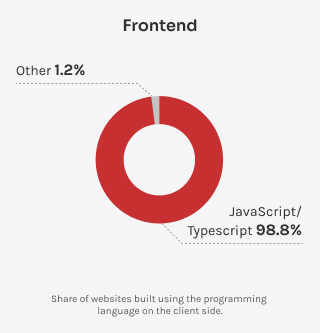
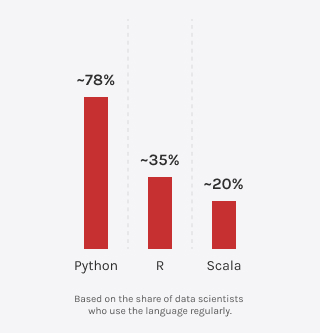
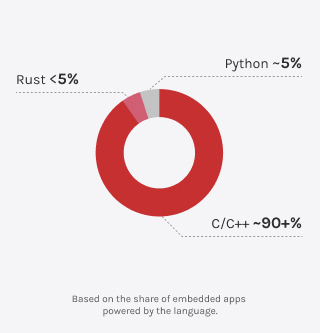
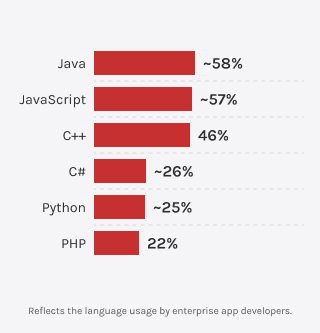
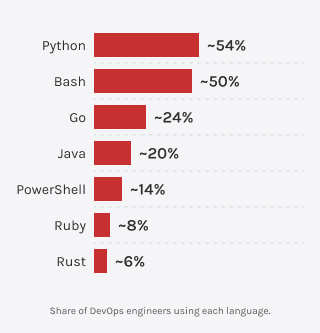
Python is a versatile and beginner-friendly programming language, backed by a vast ecosystem and a strong community of developers. You can think of Python as the Swiss Army knife of coding — clean, readable, and ready for multiple tasks: building web apps, crunching data, automating workflows, scripting APIs, and more. Python is a core skill for backend developers, data scientists, and AI engineers, as it powers more than 80% of today’s machine learning and AI projects.
| Ranking | Share | |||
|
January 2026 |
1-year trend |
January 2026 |
1-year trend | |
TIOBE
Reflects a share of search engine visibility, including hits, mentions, and related content | 1 | – | 22.61% | -0.68% |
PYPL
Reflects the share of Google searches for programming language tutorials | 1 | – | 27.89% | -2.1% |
JavaScript (JS) has long been at the heart of the web experience, serving as one of the core building blocks of modern websites. It enables real-time interactivity in all major browsers, powering dynamic style changes, live search suggestions, interactive charts, visualizations, and other advanced, user-centered features. Moreover, JS extends to server-side and full‑stack applications through environments like Node.js, and supports mobile-friendly frontends built with frameworks like React and Vue.
| Ranking | Share | |||
|
January 2026 |
1-year trend |
January 2026 |
1-year trend | |
TIOBE
Reflects a share of search engine visibility, including hits, mentions, and related content | 6 | – | 3.03% | -1.17% |
PYPL
Reflects the share of Google searches for programming language tutorials | 5 | -1 | 5.24% | -2.7% |
TypeScript (TS) is a statically typed superset of JavaScript, built for large-scale apps, both browser and server, that need to stay easy to maintain as they grow. It adds optional type safety to JavaScript, helping developers catch errors early on and benefit from features like safe navigation and smart code suggestions in modern IDEs. For frontend and full-stack working on complex codebases that need to scale cleanly, TS is usually the go-to choice.
| Ranking | Share | |||
|
January 2026 |
1-year trend |
January 2026 |
1-year trend | |
TIOBE
Reflects a share of search engine visibility, including hits, mentions, and related content | 32 | +3 | 0.32% | +0.01% |
PYPL
Reflects the share of Google searches for programming language tutorials | 12 | -2 | 1.84% | -1.0% |
Java stands out for its maturity and its “write once, run anywhere” philosophy, which emphasizes platform independence. Its reputation for safe and scalable code comes from features like garbage collection, multithreading, exception handling, and strong memory management, making it adaptable to a wide range of use cases. Java shines when it comes to maintaining long-running, mission-critical applications, though it’s no longer the go-to for modern greenfield projects.
| Ranking | Share | |||
|
January 2026 |
1-year trend |
January 2026 |
1-year trend | |
TIOBE
Reflects a share of search engine visibility, including hits, mentions, and related content | 3 | +1 | 8.71% | -1.44% |
PYPL
Reflects the share of Google searches for programming language tutorials | 3 | –1 | 11.74% | -1.6% |

Go, often called Golang, is a fast, compiled programming language originally built for system programming, now growing into wider use, especially in projects that demand scalability. It’s syntactically similar to C, but adds modern features like goroutines for lightweight multitasking and built-in garbage collection to help developers write clean, efficient code. Mastery of Go is increasingly seen as essential for backend and infrastructure engineers building modern, high-performance systems.
| Ranking | Share | |||
|
January 2026 |
1-year trend |
January 2026 |
1-year trend | |
TIOBE
Reflects a share of search engine visibility, including hits, mentions, and related content | 16 | -9 | 1.24% | -1.37% |
PYPL
Reflects the share of Google searches for programming language tutorials | 21 | -8 | 0.68% | -1.4% |

One of the most loved languages among developers, Rust is a community-driven systems language widely used for building high-performance, reliable software. It delivers C/C++-level control while avoiding many typical runtime headaches, enforcing thread-safety at compile time, reducing null-pointer and unchecked-error bugs, as well as unpredictable pauses. While Go and Rust both emphasize performance and memory safety, the latter takes it further with zero-cost abstractions, fine-grained control over memory and concurrency, and a mature tooling ecosystem. However, anyone drawn to Rust’s perks will first need to get comfortable with its strict compiler and steep learning curve.
| Ranking | Share | |||
|
January 2026 |
1-year trend |
January 2026 |
1-year trend | |
TIOBE
Reflects a share of search engine visibility, including hits, mentions, and related content | 13 | +1 | 1.51% | +0.34% |
PYPL
Reflects the share of Google searches for programming language tutorials | 10 | -1 | 2.95% | -0.1% |
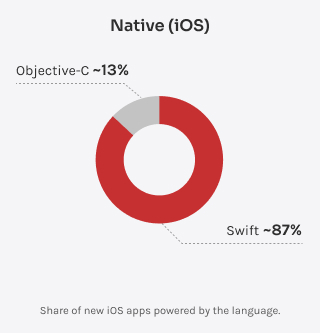
Today’s Apple ecosystem runs almost entirely on Swift. Its predecessor, Objective-C, now feels clunky in comparison — Swift is more concise, safer, and far easier to pick up. With features like optionals, type inference, and structured concurrency, Swift helps developers write clean, crash-resistant code. It keeps teams productive and codebases maintainable across iOS, macOS, watchOS, and tvOS apps.
| Ranking | Share | |||
|
January 2026 |
1-year trend |
January 2026 |
1-year trend | |
TIOBE
Reflects a share of search engine visibility, including hits, mentions, and related content | 22 | –1 | 0.91% | +0.6% |
PYPL
Reflects the share of Google searches for programming language tutorials | 6 | +5 | 5.24% | -2.7% |
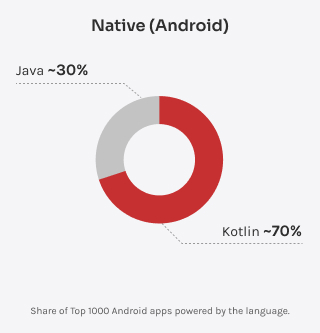
Think of Kotlin as Java’s younger cousin — modern, tidy, and surprisingly flexible, designed to be compatible with Java’s libraries and frameworks, and running on the Java Virtual Machine. Before 2019, it was yet another general-purpose language, until Google tipped the scales by declaring it the preferred language for Android development. Since then, it’s gone mobile-first, with less boilerplate, more safety, and a much smoother ride.
| Ranking | Share | |||
|
January 2026 |
1-year trend |
January 2026 |
1-year trend | |
TIOBE
Reflects a share of search engine visibility, including hits, mentions, and related content | 20 | - | 0.97% | +0.23% |
PYPL
Reflects the share of Google searches for programming language tutorials | 17 | -3 | 1.03% | -0.8% |

C++ is C’s high-powered evolution — just as close to the metal, but equipped with modern features for object-oriented, generic, and even functional programming. It has long been an engine room for embedded development, running under the hood of most performance-critical and safety-critical systems. And while safer, easier-to-maintain contenders like Rust are starting to step on its toes, C++, with its flexibility, massive ecosystem, and tight memory control, remains the industry standard in automotive, aerospace, medtech systems, game engines, and more.
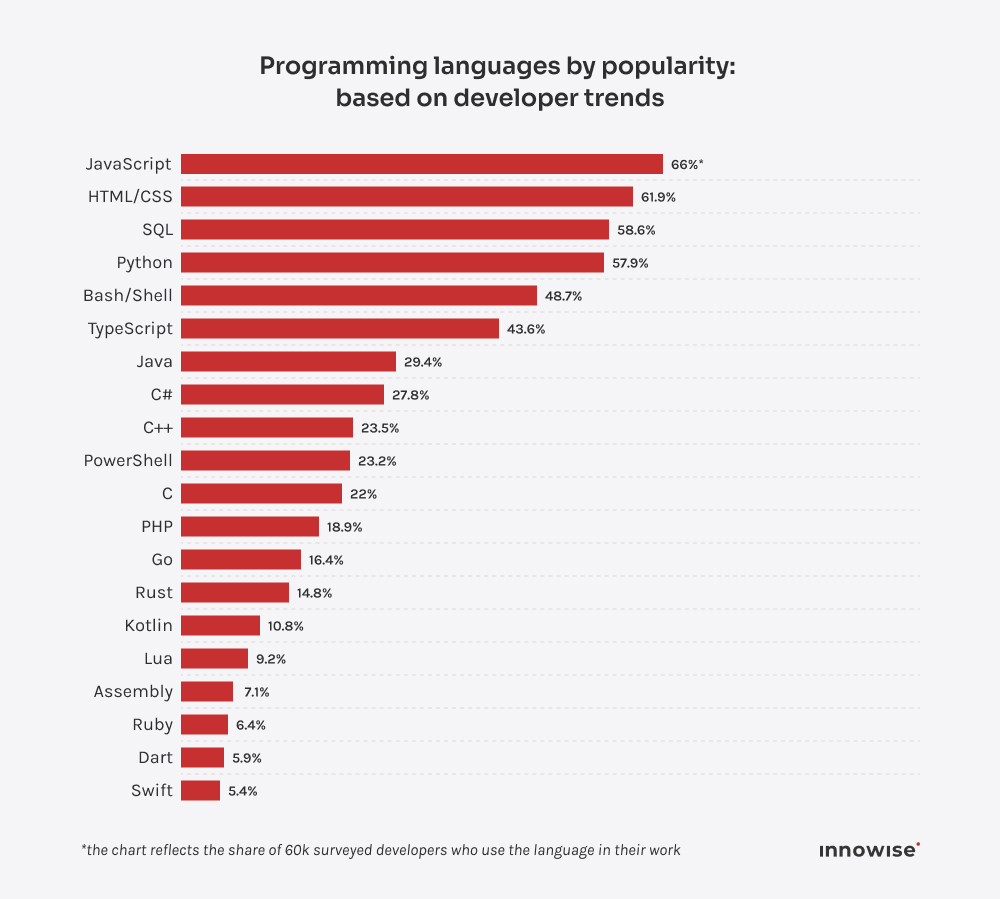
As of 2025, C++ has been used by 23.5% of developers.
| Ranking | Share | |||
|
January 2026 |
1-year trend |
January 2026 |
1-year trend | |
TIOBE
Reflects a share of search engine visibility, including hits, mentions, and related content | 4 | –2 | 8.67% | -1.62% |
PYPL
Reflects the share of Google searches for programming language tutorials | 2 | +2 | 16.17% | +8.7% |

Under the motto “Optimized for developer joy”, Ruby quickly gained a loyal following thanks to its elegant, expressive syntax and strong object-oriented roots. Much time has passed since Ruby’s Rails-fueled explosion in the early 2000s, which shook up rapid prototyping. Today, it’s a mature and stable choice, still powering over 600,000 live websites and loved for keeping development smooth.
| Ranking | Share | |||
|
January 2026 |
1-year trend |
January 2026 |
1-year trend | |
TIOBE
Reflects a share of search engine visibility, including hits, mentions, and related content | 27 | –4 | 0.58% | –0.18 |
PYPL
Reflects the share of Google searches for programming language tutorials | 16 | +1 | 1.1% | +0.1% |

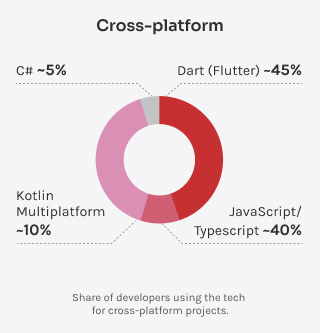
Dart is Google’s client-optimized language for building apps across mobile, web, desktop, and server. With its class-based, object-oriented structure and C-style syntax, it feels familiar to developers coming from JavaScript or TypeScript. Dart’s real breakout came with Flutter, Google’s UI toolkit for crafting sleek and user-centered cross-platform apps. Dart and Flutter now go hand-in-hand, especially for native Android development.
| Ranking | Share | |||
|
January 2026 |
1-year trend |
January 2026 |
1-year trend | |
TIOBE
Reflects a share of search engine visibility, including hits, mentions, and related content | 26 | +2 | 0.63% | +0.02% |
PYPL
Reflects the share of Google searches for programming language tutorials | 15 | +4 | 1.16% | +0.2 |

As data engineering takes off, it’s no surprise R is seeing renewed momentum too. You won’t find many apps built with R, but it’s widely used to run statistical analyses and create data visualizations — implementing regression models, classifications, clustering, and more. Its syntax might feel a bit quirky at first, but for statisticians and data scientists, it’s a trusted tool of the trade. While not as mainstream as Python, R holds steady demand in pharma, health, and research, thriving where datasets are dense and insights matter.
| Ranking | Share | |||
|
January 2026 |
1-year trend |
January 2026 |
1-year trend | |
TIOBE
Reflects a share of search engine visibility, including hits, mentions, and related content | 10 | +8 | 1.82% | +0.81% |
PYPL
Reflects the share of Google searches for programming language tutorials | 4 | +2 | 7.0% | +2.5% |
MATLAB (short for Matrix Laboratory) is the engineer’s sandbox built for crunching numbers, simulating systems, and visualizing results with math-like clarity. It’s a high-level language and computing environment that uses matrix-centered syntax, perfect for developing algorithms, building simulations, and modeling complex control systems. Its extensive set of built-in functions and toolboxes is fine-tuned to engineering workflows, covering areas like signal processing, control design, optimization, and machine learning.
| Ranking | Share | |||
|
January 2026 |
1-year trend |
January 2026 |
1-year trend | |
TIOBE
Reflects a share of search engine visibility, including hits, mentions, and related content | 14 | +1 | 1.40% | +0.34% |
PYPL
Reflects the share of Google searches for programming language tutorials | 13 | +2 | 1.59% | -0.1% |
Yet another modern Java alternative? Sure, but Scala brings its own flair. It runs on the JVM, speaks fluent Java (libraries and frameworks), but swaps out the boilerplate for functional programming, concise syntax, and first-class pattern matching. Scala excels when wrangling big data or building systems that need to scale, especially with tools like Apache Spark, Akka, and the Play Framework in the stack.
| Ranking | Share | |||
|
January 2026 |
1-year trend |
January 2026 |
1-year trend | |
TIOBE
Reflects a share of search engine visibility, including hits, mentions, and related content | 33 | +1 | 0.32% | –0.09% |
PYPL
Reflects the share of Google searches for programming language tutorials | 22 | – | 0.4% | -0.2% |
C# (that’s “C-sharp”) is Microsoft’s answer to modern, all-purpose development. While it shares some DNA with C in terms of syntax and structure, C# is built for application-level programming — fully object-oriented, feature-rich, and equipped with automatic memory management. It’s tightly woven into the .NET ecosystem, leaning on its runtime and libraries to build secure cross-platform apps. You can build just about anything with it, but it’s most at home in the Microsoft universe.
| Ranking | Share | |||
|
January 2026 |
1-year trend |
January 2026 |
1-year trend | |
TIOBE
Reflects a share of search engine visibility, including hits, mentions, and related content | 5 | – | 7.39% | +2.94% |
PYPL
Reflects the share of Google searches for programming language tutorials | 8 | -3 | 3.12% | -3.1% |
“Let it crash” isn’t negligence — it’s a design philosophy of this language. Elixir systems are built to recover gracefully, earning the language a solid reputation for building fault-tolerant applications. It runs on the Erlang virtual machine (BEAM), and can spawn hundreds of thousands of lightweight processes using minimal memory and CPU. Influenced by Ruby, it’s clean, elegant, and surprisingly beginner-friendly for such a robust language.
| Ranking | Share | |||
|
January 2026 |
1-year trend |
January 2026 |
1-year trend | |
TIOBE
Reflects a share of search engine visibility, including hits, mentions, and related content | 39 | +5 | 0.20% | +0.03 |

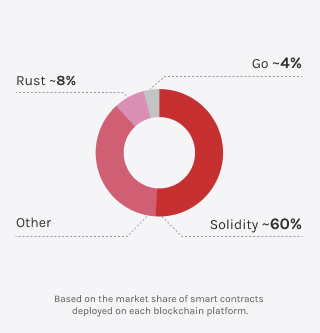
If Ethereum is the world computer, Solidity is its native tongue. This language was created for writing smart contracts that live forever on-chain, making it perfect for turning bold blockchain ideas into code. To power decentralized applications like NFTs and DAOs, it comes equipped with guardrails, tripwires, and a stack of cryptographic tools.
| Ranking | Share | |||
|
January 2026 |
1-year trend |
January 2026 |
1-year trend | |
TIOBE
Reflects a share of search engine visibility, including hits, mentions, and related content | 41 | – | 0.19% | +0.01% |

It can be said that Ada gained its “Top Secret” security clearance. Born in the early 1980s and raised by the U.S. Department of Defense, it was engineered for mission-critical systems that had to be free of errors or surprises. Everything in Ada is designed to leave nothing to chance: types are explicit, contracts are enforced, and the compiler is among the strictest and thorough in the programming world. Surprisingly, the language is now experiencing a second dawn thanks to its growing use in blockchain.
| Ranking | Share | |||
|
January 2026 |
1-year trend |
January 2026 |
1-year trend | |
TIOBE
Reflects a share of search engine visibility, including hits, mentions, and related content | 18 | +8 | 1.19% | +0.54% |
PYPL
Reflects the share of Google searches for programming language tutorials | 9 | +4 | 3.01% | +1.08% |

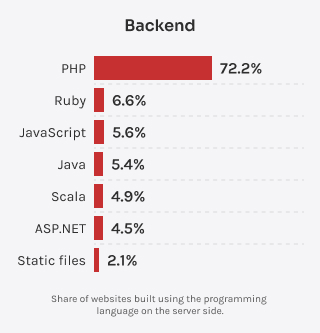
Before slick frameworks and frontend hype took over, PHP was already quietly running the internet, and it never really stopped. It remains a major server-side scripting language for building dynamic websites and web apps, handling form submission, session management, instant HTML generation, and more. Today, PHP is widely seen as the default language for web hosting and content management systems, though its capabilities extend well beyond the web.
PHP is utilized by 72.2% of all websites in server-side programming. This includes major platforms like Facebook, Wikipedia, and WordPress.
| Ranking | Share | |||
|
January 2026 |
1-year trend |
January 2026 |
1-year trend | |
TIOBE
Reflects a share of search engine visibility, including hits, mentions, and related content | 15 | +2 | 1.38% | +0.10% |
PYPL
Reflects the share of Google searches for programming language tutorials | 7 | – | 3.35% | -0.4% |
Before the introduction of Swift, Objective-C ran the show across iOS, macOS, watchOS, and tvOS development. It’s an extension of C, enhanced with object-oriented features such as classes, methods, and inheritance. While Objective-C’s popularity has waned, it remains a crucial skill for developers involved in maintaining and updating legacy applications within the Apple ecosystem.
Objective-C is mostly used today to maintain older iOS and macOS apps, or in a few niche Apple-focused systems where it’s still a good fit. For most new development, teams have moved on to Swift, which has become the go-to choice.
| Ranking | Share | |||
|
January 2026 |
1-year trend |
January 2026 |
1-year trend | |
TIOBE
Reflects a share of search engine visibility, including hits, mentions, and related content | 29 | +2 | 0.46% | +0.04% |
PYPL
Reflects the share of Google searches for programming language tutorials | 11 | -2 | 1.9% | -0.8% |
Most of the original iOS apps were indeed built using Objective-C.

One of the few veterans still holding its place. Perl rose to prominence for its unmatched text processing capabilities and report generation. However, it quickly outgrew that niche, evolving into a general-purpose. Perl’s expressive syntax, powerful regular expressions, cross-platform portability, and “there’s more than one way to do it” philosophy made it a staple for rapid scripting and large-scale development alike. It may no longer be center stage, but it still holds its ground in legacy stacks and behind-the-scenes systems.
| Ranking | Share | |||
|
January 2026 |
1-year trend |
January 2026 |
1-year trend | |
TIOBE
Reflects a share of search engine visibility, including hits, mentions, and related content | 11 | - | 1.63% | +1.14% |
PYPL
Reflects the share of Google searches for programming language tutorials | 30 | –1 | 0.05% | -0.05% |

SQL (structured query language) is the language that data speaks, and it’s been fluent since the 1970s. SQL lets developers create, shape, and interrogate relational databases with just a few declarative lines. It’s the tool behind everything from inserting customer records to pulling revenue reports, and it’s as at home in old-school enterprise servers as it is in today’s cloud-native stacks. Its simple, readable syntax made it the default dialect for anyone working with structured data across systems and teams.
| Ranking | Share | |||
|
January 2026 |
1-year trend |
January 2026 |
1-year trend | |
TIOBE
Reflects a share of search engine visibility, including hits, mentions, and related content | 8 | -5 | 2.27% | -0.14% |

Julia was created to eliminate the trade-off between performance and ease of use that scientists and engineers often face with other languages. Designed for high-performance computing, data analysis, and numerical work, Julia feels like a dynamic language but performs like a compiled one. You get readable syntax, math-friendly semantics, and serious speed without having to rewrite your prototypes in C later. It was built to address the pain points of Python, R, and MATLAB in one go, offering a single language that scales from quick plots to parallelized simulations.
| Ranking | Share | |||
|
January 2026 |
1-year trend |
January 2026 |
1-year trend | |
TIOBE
Reflects a share of search engine visibility, including hits, mentions, and related content | 28 | +7 | 0.57% | +0.16 |
PYPL
Reflects the share of Google searches for programming language tutorials | 20 | +3 | 0.89% | +0.5 |

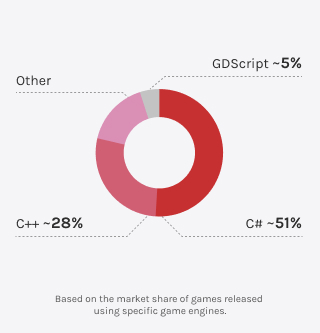
Lua is a lightweight scripting language built to live inside other software rather than run on its own. It’s dynamically typed, easy to embed, and famously small in footprint, making it a favorite for configuring behavior, scripting logic, and extending core applications without bloating them. Lua slots in where simplicity matters: game engines, embedded devices, and tools that need flexible user-side scripting.
| Ranking | Share | |||
|
January 2026 |
1-year trend |
January 2026 |
1-year trend | |
TIOBE
Reflects a share of search engine visibility, including hits, mentions, and related content | 30 | –1 | 0.43% | –0.06 |
PYPL
Reflects the share of Google searches for programming language tutorials | 18 | +2 | 1.0% | +0.2% |

Built specifically for the Godot Engine, GDScript is a scripting language tailored for writing game logic quickly and intuitively. Unlike general-purpose languages, it’s designed to work directly with Godot’s node and signal system, reducing boilerplate and making common game patterns feel natural. GDScript’s Python-like syntax keeps things approachable, especially for newcomers, while its engine-first design means smoother workflows and fewer barriers between code and in-game behavior.
(for game developers)

F# is a functional-first programming language developed by Microsoft and runs on the .NET platform. Although F# plays nicely with multiple programming paradigms, it’s particularly well-suited for tasks involving complex data manipulation, concurrency, and computation-heavy applications. It is known for its strong typing, immutability, and support for higher-order functions, and has a strong following in financial services, data science, and machine learning.

Shell scripting, often referred to as Bash scripting, is a powerful and flexible way to automate tasks in Unix-based systems like Linux and macOS. You can think of a Bash script as a recipe: it tells the system what to do and in what order — run programs, move files, set permissions, manage servers, and much more. Bash is a core skill for system administrators and DevOps engineers.
| Ranking | Share | |||
|
January 2026 |
1-year trend |
January 2026 |
1-year trend | |
TIOBE
Reflects a share of search engine visibility, including hits, mentions, and related content | 48 | –5 | 0.16% | –0.02% |
PowerShell is Microsoft’s command-line tool turned automation powerhouse, built for scripting, system management, and keeping IT in check. Originally Windows-only, it’s now open-source and runs across macOS and Linux as well. It’s object-based, has a clean scripting syntax, letting sysadmins handle everything from file cleanup to complex network configs. PowerShell excels at automating repetitive tasks, whether used for managing a single machine or an entire enterprise.
| Ranking | Share | |||
|
January 2026 |
1-year trend |
January 2026 |
1-year trend | |
TIOBE
Reflects a share of search engine visibility, including hits, mentions, and related content | 44 | +1 | 0.17% | +0.01% |
PYPL
Reflects the share of Google searches for programming language tutorials | 14 | +2 | 1.27% | +0.3% |
Vala is a high-level programming language designed to make native Linux development feel a little more modern without leaving the GObject-based C world behind. Developed by the GNOME project, it brings features like classes, interfaces, properties, and generics into a familiar C#-like syntax, while compiling directly to efficient C code. With Vala, developers get the structure and expressiveness of a modern language, while still producing fast, native binaries that fit right into the Linux desktop ecosystem.

Haskell is a purely functional programming language known for its strong static typing, lazy evaluation, and clean, expressive syntax. It encourages writing programs as a series of composable, side-effect-free functions, a style that’s made it a favorite in academia, research, and industries where correctness and mathematical clarity really matter. While it rarely grabs headlines, Haskell has quietly influenced a generation of modern languages and powers everything from financial systems to compilers.
| Ranking | Share | |||
|
January 2026 |
1-year trend |
January 2026 |
1-year trend | |
TIOBE
Reflects a share of search engine visibility, including hits, mentions, and related content | 36 | –5 | 0.32% | –0.11% |
PYPL
Reflects the share of Google searches for programming language tutorials | 27 | –1 | 0.16% | +0.05% |
Every technology decision should start with a strategy. Ask: What are we trying to achieve? Languages like Go, Java, and C++ are designed with performance and concurrency in mind, making them a strong fit for enterprise-grade and high-scale systems. Meanwhile, Python, JavaScript, and Dart emphasize developer productivity and rapid iteration, making them popular for startups, MVPs, and cross-platform applications.
However, with the right architecture, all of these languages can power large-scale systems, but each comes with trade-offs. To make the right choice, weigh factors such as:
At Innowise, our IT consulting team maps these needs to the right tech stack so you don’t have to gamble on guesswork.
The ideal language should fit naturally into your existing stack, not feel like an add-on. A good fit minimizes integration risks and accelerates delivery. That’s why our assessments go deeper than syntax or speed. We evaluate:
This ensures your developers can move faster and avoid unnecessary friction.
A great language is useless without skilled people to build with it. Popular options like JavaScript, Python, and Java offer massive global communities, abundant libraries, and hiring flexibility. More niche languages may promise cutting-edge performance or security, but they often come with smaller talent pools and higher recruitment costs.
The good news: in many business cases, several languages can solve the same problem. What matters most is alignment with your business goals, team capacity, and infrastructure. That’s why Innowise evaluates every angle, be it technical, strategic, or operational, and recommends a language that’s best-suited to your reality.
In technology, standing still means falling behind. Some programming languages can rise and fall quickly as ecosystems evolve. And if your stack lags, your product can too. Staying competitive means keeping an eye on emerging languages that deliver speed, security, scalability, and staying power.
Think of your language choice like laying tracks for a train: the wrong rails may work for a short ride, but when it’s time to scale, derailment is costly. The smartest move isn’t chasing hype, but investing in tools that grow with your business long-term.
Bottom line: future-ready languages build future-ready companies. If you want to make confident decisions about your stack — not just for today, but for the next few years — Innowise is here to help. Let’s sharpen your tech stack and set you up for tomorrow.
Dmitry leads the tech strategy behind custom solutions that actually work for clients — now and as they grow. He bridges big-picture vision with hands-on execution, making sure every build is smart, scalable, and aligned with the business.












Your message has been sent.
We’ll process your request and contact you back as soon as possible.

By signing up you agree to our Privacy Policy, including the use of cookies and transfer of your personal information.
