The power of data mapping in healthcare: benefits, use cases & future trends. As the healthcare industry and its supporting technologies rapidly expand, an immense amount of data and information is generated. Statistics show that about 30% of the world's data volume is attributed to the healthcare industry, with a projected growth rate of nearly 36% by 2025. This indicates that the growth rate is far beyond that of other industries such as manufacturing, financial services, and media and entertainment.

Smart home app development: from concept to household companion

Feb 25, 2026 8 min read

Key takeaways

  • Smart home users don’t value features for the sake of features. Now, convenience, security, and savings matter more than novelty, so apps that simplify routines and reduce bills win loyalty.
  • Making a smart home app adaptive is critical. Scalable IoT architecture with a cloud-based backbone enables real-time data processing and allows users to continue adding devices over time.
  • AI makes automation predictive. Predictive control and anomaly detection reduce manual effort and help homes adapt to user behavior automatically.
  • Long-term success requires evolution and measurable impact. Flexible APIs, high modularity, and AI fine-tuning keep the platform future-ready — while clear KPIs like lower utility costs and stronger engagement prove its value.

More and more people are working from home, entertaining at home, and investing in their spaces. They demand more comfort and convenience at home, now backed by intelligent systems. Nearly half of U.S. households own smart home devices, with numbers continuing to rise year after year, and projected to reach 84.9 million U.S. households by 2026.

Smart home solutions have moved past the initial hype, as cost-efficiency, security, and other practical needs have taken center stage. If you can offer scalability, safe data transmission, and insights that help users trim rising utility bills, you’re well on your way to winning them over. And behind every great app in this space? A comprehensive smart home app development approach that blends IoT and AI: one to ensure smooth connectivity, and the other to provide advanced personalization.

In this article, I’ve pulled from Innowise’s cumulative experience to walk you through the use cases that work and where the real monetization opportunities lie.

Understanding the smart home ecosystem

First of all, what is it? A smart home environment brings together devices such as lighting, appliances, thermostats, locks, and security cameras into a single digital ecosystem controlled remotely via a central hub. Advanced smart home solutions rely on the Internet of Things (IoT), cloud computing, and artificial intelligence to create personalized experiences that adapt to how people live.

A well-designed smart home app should embrace the chaos of heterogeneous devices and scale without breaking a sweat as users keep adding more gadgets to the mix. As all those devices pump out large volumes of data constantly, the app needs to process it in real time and turn it into insights that users can do something with.

Picking smart home app use cases

The smart home apps that win user loyalty are the ones grounded in everyday scenarios.

We start by asking a few simple questions:

  • What are the routines and habits people do every day?
  • Of these, which routines can be made fully automated?
  • Where do energy, water, or safety risks occur?

A good example of this sort of thing would be a person waking up, flicking the lights on, heating water, and boiling the kettle. Smart apps intelligently pick up on these habits and routines and then offer to automate them, which saves time and power. And customers love it. The more ways you can be helpful and deliver pragmatic value to a person, the more they’ll want your app as their companion around the home.

Feature prioritization is a big deal, too. Almost half of consumers buy into smart home tech for remote control and convenience factor, while around 39% of users are looking for peace of mind — security first. A smaller slice is seeking energy and water consumption tracking.

Then it becomes clear which devices to connect to, and you shape the basics for requirements.

How to develop a smart home app effectively

IoT architecture for home automation

A smart home is architected as a distributed system where a bunch of devices all talk at once, generating thousands of events every day. In such a system, a software platform acts as the brain of the operation. A smart home app developer unites this system, layer by layer:

  • Sensor nodes scattered throughout the house collect data from lighting, HVAC, stoves, security systems, and more. They’re constantly measuring temperature, motion, gas levels, water usage, etc., and sending that data up the chain for processing.
  • Microcontrollers like Arduino and Raspberry Pi process events locally, transferring data to the cloud and carrying out commands.
  • The connectivity layer enables smooth and secure communication between components via Zigbee, Z-Wave, BLE, Wi-Fi, MQTT, HTTP/HTTPS, and other protocols.
  • A cloud service, like Azure IoT Hub, ingests data from every endpoint and routes it to storage, analytics engine, or user app.
  • Application logic sits at the “intelligence” layer. Server-side code takes incoming data and runs AI/ML models to detect anomalies and trigger a response.
  • The user app provides a web or mobile dashboard where users monitor their home status segment by segment, adjusting settings.

Build modular features that grow over time

Going modular, your platform can expand without architectural rewrites and related expenses.

Smart lighting

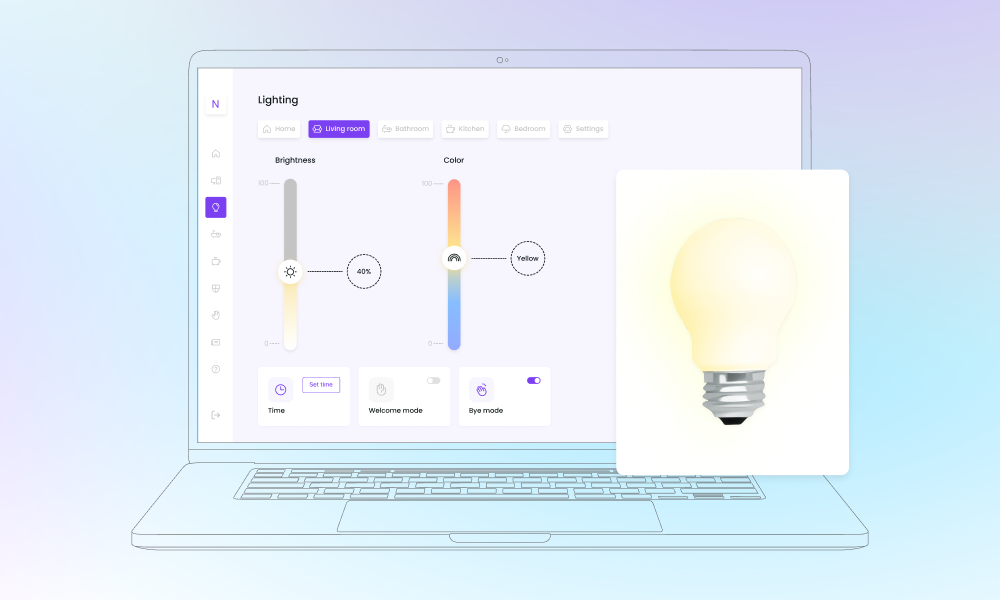
To make the lighting system “smart”, it should go beyond basic scheduling and on/off control. What users really appreciate is lighting scenarios they can customize to their routines and moods.

For instance, scheduling lights to turn on or off across the house or in specific rooms, brightening them for reading or cleaning, or dimming and adjusting color tones for a movie night. Lights can switch on automatically when someone enters the home, and turn off when everyone leaves. In addition to convenience, users appreciate this as yet another way to save energy.

Another popular feature is synchronizing lighting with an alarm clock, allowing for a gradual morning wake-up.

Smart lighting interface for a smart home app

Smart kitchen

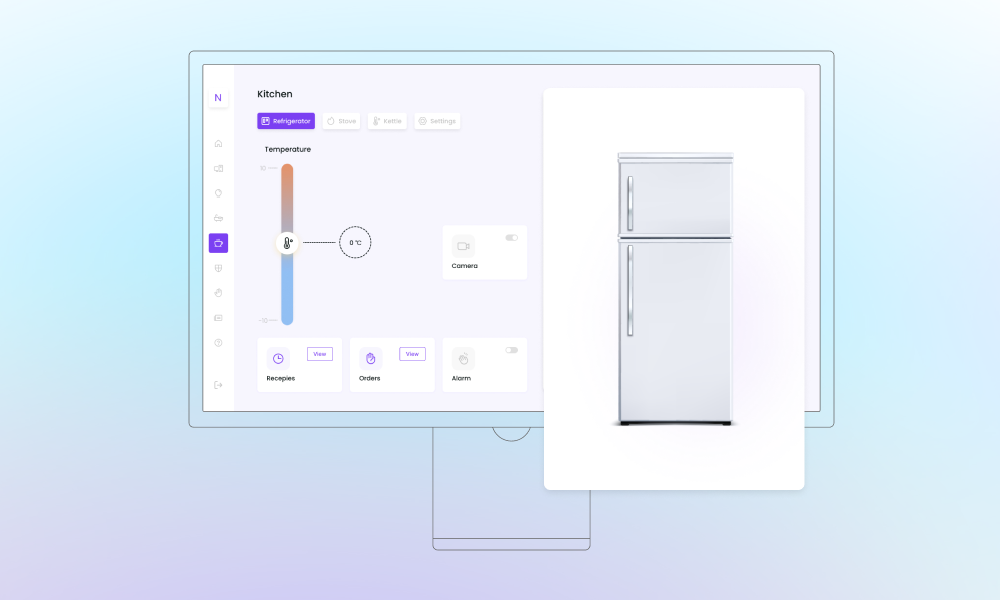
Smart refrigerators with internal cameras let users peek inside from their smartphone. Smart kitchen apps with AI features can suggest recipes based on what’s actually in the fridge, plus personal preferences, dietary restrictions, whatever it learns over time. It can generate weekly meal plans, create shopping lists, and go further, supporting grocery ordering when supplies run low.

For the smart kitchen system, it becomes essential to detect gas, smoke, or water leaks and automatically shut off electricity if readings move beyond safe limits. Voice integration is also in demand as a highly practical feature. Residents can install custom settings this way, such as preheating the oven to 180°C while preparing ingredients.

Smart kitchen interface for managing house appliances and safety

Smart bathroom

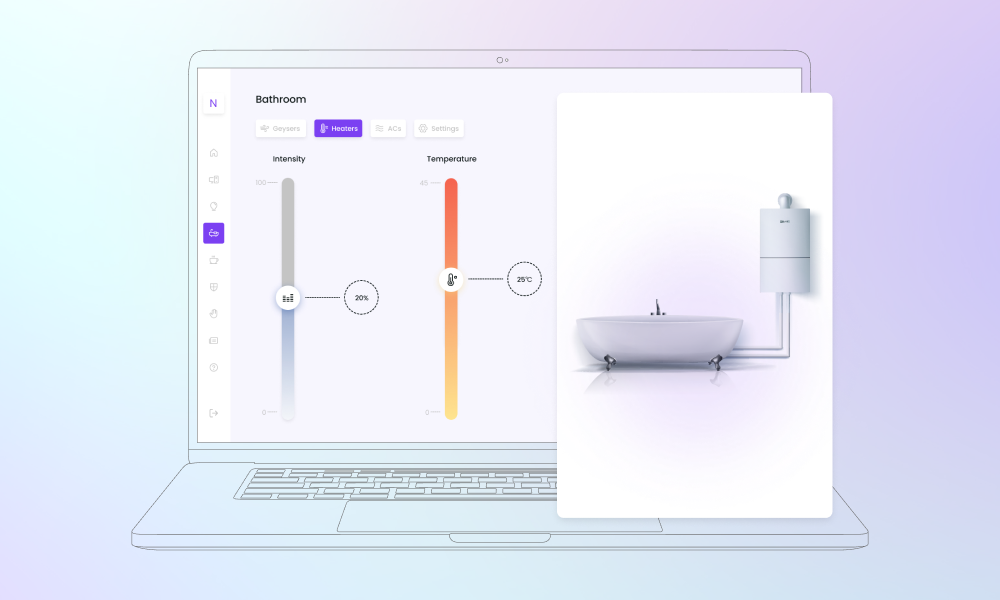
The best that the IoT and AI tandem can do for a bathroom is reduce wasted water. Proven practices involve tunable geysers that automatically turn on and off based on usage patterns. This ensures hot water is available when needed. As for daily shower routines, automation lets users set time limits and water budgets, regulate water flow, and pause during soaping.

Controllers also detect idle high-power appliances, such as heaters, geysers, or AC units, and switch them off automatically.

Smart bathroom interface for managing water use

Smart home security & safety

A modern smart home system operates both reactively and proactively.

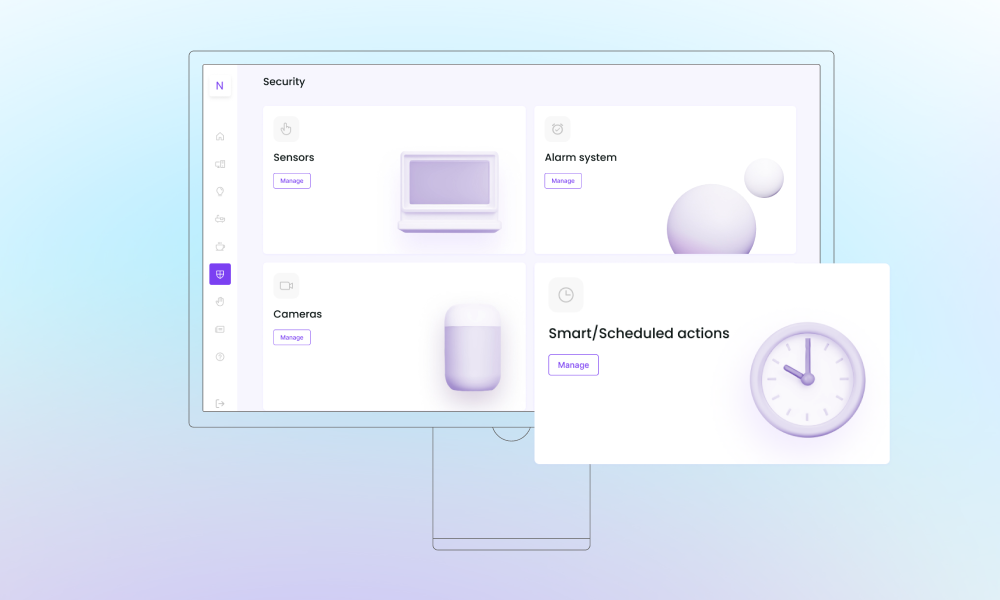
In reactive mode, sensor nodes continuously monitor the environment and instantly notify residents once detecting potential threats. Motion, proximity, and video sensors can identify unauthorized access and automatically trigger alarms, switch on lights, or initiate emergency responses. The system can also execute scheduled tasks, helping children or elderly family members stay on track by checking that appliances are off and doors are locked when residents leave.

In proactive mode, the IoT platform analyzes household data over time to identify patterns and generate daily insights. Based on previous behavior, it can recommend or automate actions, such as adjusting lighting schedules or optimizing energy usage.

Smart home security interface featuring an alarm system and emergency response protocols

AI/ML-based intelligence

Without intelligence, a smart home follows orders but never adapts. With an AI/ML layer, the system can learn: sleep/wake patterns from light and motion sensors, arrival/departure times from door sensors, and geolocation, device usage rhythms — which devices, when, for how long, among other insights.

What it does with that knowledge:

  • Predictive control. If you manually turn off lights at 11:30 PM every night, the system suggests automating it.
  • Anomaly detection. Unusual water flow at 2 PM? The system flags potential leaks before the bill arrives.
  • Smart suggestions. Once the system notices the thermostat is adjusted down every night at 10 PM, it proposes a “bedtime” routine with no programming required.

User-friendly interfaces

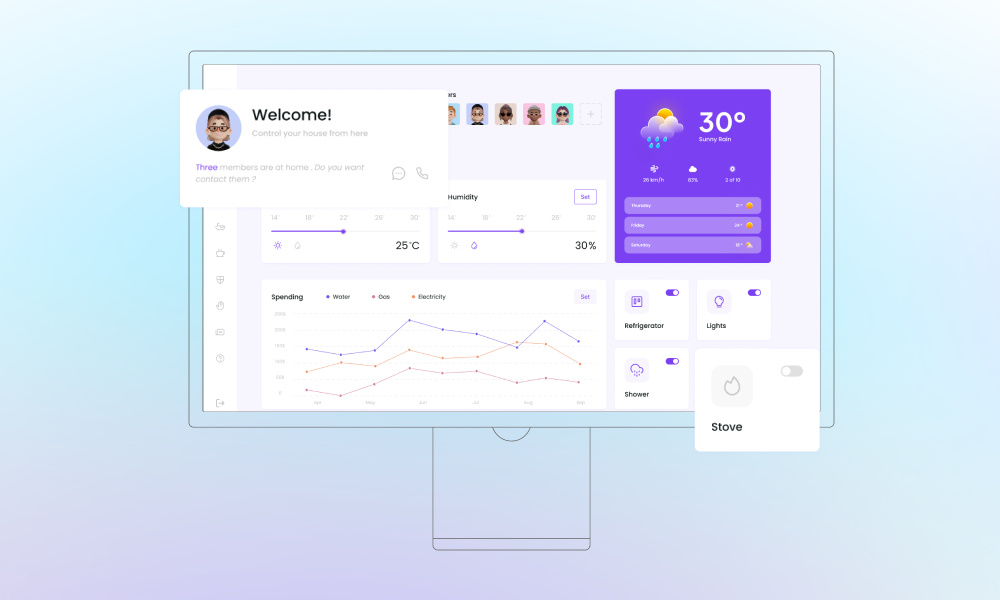
As a smart home app gets used every day, it should be simple and attractive, not overwhelming. At a glance, a user should be able to:

  • Instantly track real-time device status
  • Control each system from the web or mobile apps
  • Overview insights as recommendations, not raw data
  • Customize settings without getting lost

At Innowise, we take care of consistency between web and mobile platforms, so users can manage their home efficiently from anywhere.

Smart home dashboard with core metrics

Reliability, security, and compliance built in

Smart home application development is focused on safety, as failures can have serious consequences, such as a flooded floor, an unlocked door, or worse. At Innowise, we take care of multi-layer protection, implementing strong authentication and access control, encrypting communication between devices and the cloud, setting up event logging and monitoring for rapid issue detection, and compliance with regional data protection regulations.

This helps us make safety-critical features reliable, such as leak detection, intrusion alerts, and smoke monitoring.

Plan for continuous evolution

Smart home platforms must support continuous growth.

In real-world deployments, this means adding new device types through APIs, introducing new automation modules without downtime, improving AI models as more data becomes available, and expanding from web platforms to full-featured mobile apps.

A flexible architecture ensures the solution remains relevant as user expectations and technologies evolve.

How to measure the success of a smart home app

The first step is to collect feedback on real user achievements as early as possible. Focus on outcomes: Are people actually saving time? Are utility bills decreasing? Is the system reducing friction in everyday routines? A 10-30% drop in electricity and water consumption will be a nice little win for both the wallet and the planet, which users will definitely notice.

Another key metric is time saved. In well-designed systems, up to 90% of users report significantly reducing the time spent on daily routines. That’s not just convenience, but reclaimed hours each week.

Additional success indicators include:

  • Increased automation adoption rates
  • Reduced number of manual overrides
  • Higher engagement with insights and recommendations
  • Improved user retention and daily active usage
  • Fewer security or safety incidents

Ultimately, if users can see lower bills, spend less time managing their home, and feel more secure — the app is doing its job.

Partner with Innowise for smart home app development

19+ years delivering software solutions, including mobile apps and connected systems
3,500+ experts in-house to quickly scale up and down your project
Data and AI hub where we build highly intelligent and customized solutions
Quality and security backed by ISO 9001, ISO 27001, ISO 27017, and ISO 27018
Flexible engagement models, from staff augmentation to full outsourcing
93% of clients choose Innowise for their next initiative

Chief Technology Officer

Dmitry leads the tech strategy behind custom solutions that actually work for clients — now and as they grow. He bridges big-picture vision with hands-on execution, making sure every build is smart, scalable, and aligned with the business.

Table of contents

    Contact us

    Book a call or fill out the form below and we’ll get back to you once we’ve processed your request.

    Send us a voice message
    Attach documents
    Upload file

    You can attach 1 file up to 2MB. Valid file formats: pdf, jpg, jpeg, png.

    By clicking Send, you consent to Innowise processing your personal data per our Privacy Policy to provide you with relevant information. By submitting your phone number, you agree that we may contact you via voice calls, SMS, and messaging apps. Calling, message, and data rates may apply.

    You can also send us your request
    to contact@innowise.com
    What happens next?
    1

    Once we’ve received and processed your request, we’ll get back to you to detail your project needs and sign an NDA to ensure confidentiality.

    2

    After examining your wants, needs, and expectations, our team will devise a project proposal with the scope of work, team size, time, and cost estimates.

    3

    We’ll arrange a meeting with you to discuss the offer and nail down the details.

    4

    Finally, we’ll sign a contract and start working on your project right away.

    arrow